

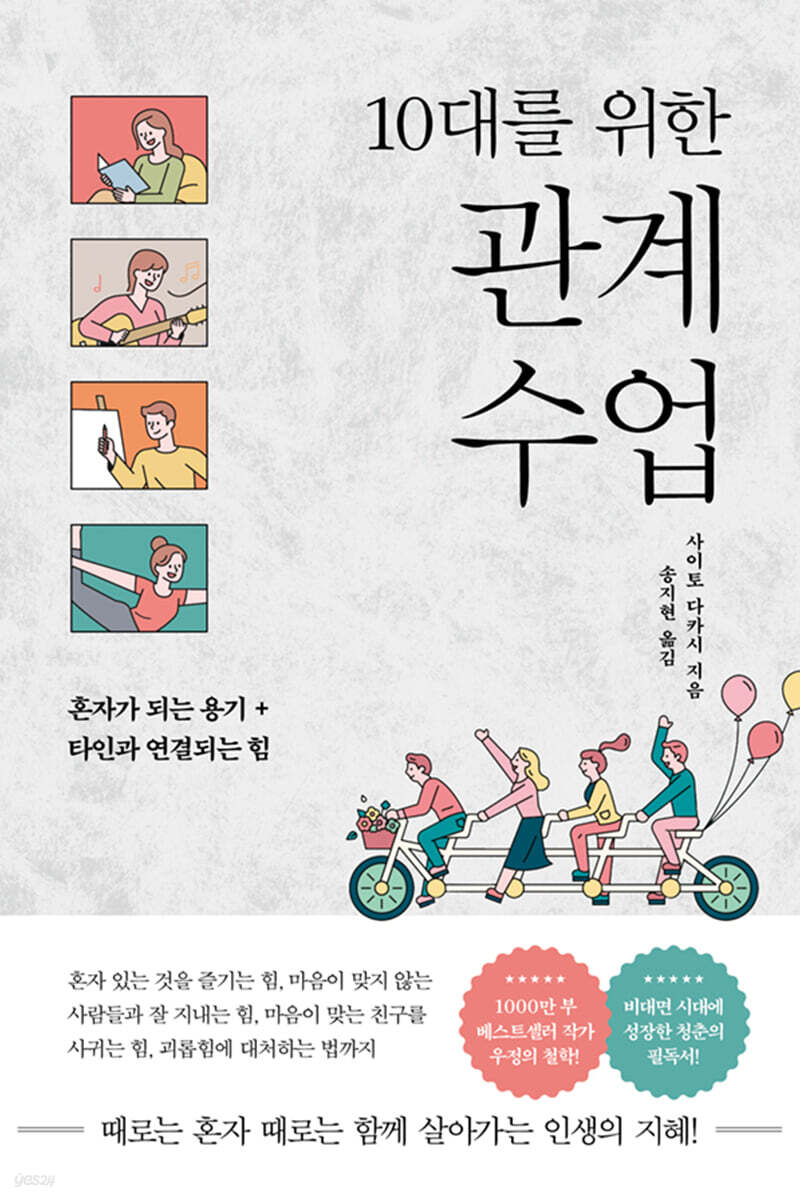
Relationship Classes for Teens
 |
Description
Book Introduction
The basic principles of human relationships that will guide your life
The wisdom of living life sometimes alone and sometimes together!
Adolescence is a major turning point when people begin to develop full-fledged social skills.
Learning a mature attitude and method for interpersonal relationships during adolescence can significantly reduce the trials and errors of life, and can help develop the inner strength to withstand peer pressure, preventing one from becoming a perpetrator or victim of school violence.
Takashi Saito, a professor at Meiji University's Faculty of Literature and one of the most influential educators, is the bestselling author of "Five Forces That Move World History" and "The Power of Time Alone."
The author said that he wrote this book in the hope that young people growing up would not make the same mistakes he did, looking back on his 20s when he was in pain and at odds with those around him.
This book names these three powers—the power to enjoy being alone, the power to make like-minded friends, and the power to get along with people you don't get along with—the "Triangle of Happiness," which serves as the foundation for forming and coordinating proactive relationships in any situation. It also presents specific suggestions on how to cultivate and balance these three powers.
The author's unique humanistic knowledge and knowledge of culture and arts shine through in various quotations and examples.
Reflecting the reality that non-face-to-face contact has become a major means of maintaining relationships, we have included 'Seven Ways to Reduce the Emotional Distance (in Non-face-to-face Conversations)' in the appendix.
Kim Seong-sik, the team leader of the Beautiful Foundation, who was in charge of the 'Eighteen Adults' campaign that raised social awareness about young people preparing for independence (children who have left protection); Jo Jeong-sil, the head of the Association of Families of Victims of School Violence, who runs the Haemareum Center, a healing facility for students who have been victims of school violence; and Baek Seung-ju, a teacher who has worked as a high school teacher for 30 years, read this book first and strongly recommended it.
The wisdom of living life sometimes alone and sometimes together!
Adolescence is a major turning point when people begin to develop full-fledged social skills.
Learning a mature attitude and method for interpersonal relationships during adolescence can significantly reduce the trials and errors of life, and can help develop the inner strength to withstand peer pressure, preventing one from becoming a perpetrator or victim of school violence.
Takashi Saito, a professor at Meiji University's Faculty of Literature and one of the most influential educators, is the bestselling author of "Five Forces That Move World History" and "The Power of Time Alone."
The author said that he wrote this book in the hope that young people growing up would not make the same mistakes he did, looking back on his 20s when he was in pain and at odds with those around him.
This book names these three powers—the power to enjoy being alone, the power to make like-minded friends, and the power to get along with people you don't get along with—the "Triangle of Happiness," which serves as the foundation for forming and coordinating proactive relationships in any situation. It also presents specific suggestions on how to cultivate and balance these three powers.
The author's unique humanistic knowledge and knowledge of culture and arts shine through in various quotations and examples.
Reflecting the reality that non-face-to-face contact has become a major means of maintaining relationships, we have included 'Seven Ways to Reduce the Emotional Distance (in Non-face-to-face Conversations)' in the appendix.
Kim Seong-sik, the team leader of the Beautiful Foundation, who was in charge of the 'Eighteen Adults' campaign that raised social awareness about young people preparing for independence (children who have left protection); Jo Jeong-sil, the head of the Association of Families of Victims of School Violence, who runs the Haemareum Center, a healing facility for students who have been victims of school violence; and Baek Seung-ju, a teacher who has worked as a high school teacher for 30 years, read this book first and strongly recommended it.
- You can preview some of the book's contents.
Preview
index
Introduction
Chapter 1 What is a friend?
Why do we need friends? / Why is it difficult to get along with friends? / Everyone is awkward at forming relationships / Distinguish between my tasks and others' tasks / You don't have to get along with everyone / Is it good to have many friends? / A friend is someone who is fun and energizing to be with / The power to get along with people you don't get along with / How to become someone you want to meet again and talk to more? / Friendship is something that moves / If you want to gain confidence, develop a 'heart of liking' / Three relationship skills that will support you throughout your life
Chapter 2 How to Make Like-minded Friends
Let's cherish the world that expands from 'liking' / 'Love triangle' between things you like / Let's visualize what you like with a 'favoritism map' / If you pay attention to what you like, there is no one who is difficult to deal with / Not a group that hangs out together, but a group that likes together / A gathering of people who like the same thing, a club / Colleagues rather than friends / Having colleagues makes you feel secure / Let's look outside of school / How do you meet friends who you like? / A simple, non-sticky meeting
Chapter 3: The Courage to Be Alone
Why we fear being alone / Let's become active loners / From loner to loner, let's find 'friends of the heart' and 'teachers of the heart' / Spirits can be connected even with old people we've never met / Things we realize when we're alone / Do we have the courage to be alone? / The true meaning of cooperation / Go alone like a rhinoceros horn
Chapter 4: Why Friends Leave
Words that can be sharp like a knife, “I’m just saying this because we’re friends…” / If you have a habit of saying no, you’re likely to be hated / It’s hard to get along with people who get angry / People who keep refusing won’t call you anymore / Can you apologize without being stubborn / Can you let go when you hear rude words / Conflicts that arise from differences in mannerisms and habits / Let’s practice consciously adjusting to others
Chapter 5: There are some relationships where you have to say no.
It's okay not to have friends like that / Anyone can bully someone else / What you can do to break the chain of bullying / How to find a way out / Bring in an objective third party / Let's switch and focus on something else
Chapter 6 Friends are the best
Don't send letters written at night / The 'Happiness Triangle' to avoid worrying about friends / If you're better off alone, do you need friends? / Do I make people laugh when they make me laugh? / Imagination to think from the other person's perspective / Regret can also be the strength to push you to the next step / What is the best friend?
Appendix / Seven Ways to Reduce the Distance Between Your Hearts
Words that come out
Chapter 1 What is a friend?
Why do we need friends? / Why is it difficult to get along with friends? / Everyone is awkward at forming relationships / Distinguish between my tasks and others' tasks / You don't have to get along with everyone / Is it good to have many friends? / A friend is someone who is fun and energizing to be with / The power to get along with people you don't get along with / How to become someone you want to meet again and talk to more? / Friendship is something that moves / If you want to gain confidence, develop a 'heart of liking' / Three relationship skills that will support you throughout your life
Chapter 2 How to Make Like-minded Friends
Let's cherish the world that expands from 'liking' / 'Love triangle' between things you like / Let's visualize what you like with a 'favoritism map' / If you pay attention to what you like, there is no one who is difficult to deal with / Not a group that hangs out together, but a group that likes together / A gathering of people who like the same thing, a club / Colleagues rather than friends / Having colleagues makes you feel secure / Let's look outside of school / How do you meet friends who you like? / A simple, non-sticky meeting
Chapter 3: The Courage to Be Alone
Why we fear being alone / Let's become active loners / From loner to loner, let's find 'friends of the heart' and 'teachers of the heart' / Spirits can be connected even with old people we've never met / Things we realize when we're alone / Do we have the courage to be alone? / The true meaning of cooperation / Go alone like a rhinoceros horn
Chapter 4: Why Friends Leave
Words that can be sharp like a knife, “I’m just saying this because we’re friends…” / If you have a habit of saying no, you’re likely to be hated / It’s hard to get along with people who get angry / People who keep refusing won’t call you anymore / Can you apologize without being stubborn / Can you let go when you hear rude words / Conflicts that arise from differences in mannerisms and habits / Let’s practice consciously adjusting to others
Chapter 5: There are some relationships where you have to say no.
It's okay not to have friends like that / Anyone can bully someone else / What you can do to break the chain of bullying / How to find a way out / Bring in an objective third party / Let's switch and focus on something else
Chapter 6 Friends are the best
Don't send letters written at night / The 'Happiness Triangle' to avoid worrying about friends / If you're better off alone, do you need friends? / Do I make people laugh when they make me laugh? / Imagination to think from the other person's perspective / Regret can also be the strength to push you to the next step / What is the best friend?
Appendix / Seven Ways to Reduce the Distance Between Your Hearts
Words that come out
Detailed image
.jpg)
Into the book
Teenagers have entered the adult world, but they are still 'novices' when it comes to forming relationships.
Even after becoming an adult, if you act immaturely like a child, people will avoid you, thinking, "What have you done to be so immature at this age?"
Before becoming adults, the times when we clash with each other due to our immaturity are the perfect opportunities for us to change.
---From "Chapter 1: Everyone is Clumsy at Building Relationships"
'Most conflicts in human relationships arise when we intrude on others' tasks, or when others intrude on our own tasks.' Adler tells us to distinguish between 'others' tasks' and 'our own tasks.'
This is the secret to resolving most conflicts that arise between people.
---From "Chapter 1: Distinguishing between My Tasks and Other People's Tasks"
Being friends only with people in a certain group and not interacting much with others is like staying in a stuffy room.
A group of people who are connected by their similar interests and goals don't feel anxious even if they don't always hang out together.
However, groups that do not share the same tastes or goals feel united by always being together.
If someone doesn't take action, they are criticized or excluded.
Because it makes it easier to feel a sense of solidarity.
Friendships like that are suffocating.
I think it's okay if you just have friends who hang out together.
---From "Chapter 2: Not a group of people hanging out together, but a group of people who like to hang out together"
I didn't have a steady job until I was in my thirties.
It was so lonely and desolate to feel like I didn't belong anywhere in society.
Then, at the suggestion of the owner of my regular restaurant, I joined a local baseball team.
Although I didn't know much about their personal information, such as their occupations or addresses, I made friends with whom I could play baseball and laugh.
What is most necessary in social life is the power to create and cooperate with colleagues, and the power to make reality better based on that.
Many times, colleagues become friends who stay with us for a long time.
I hope that teenagers, who are developing the strength to survive in the world, will have the experience of making friends through various groups and clubs.
---From "Chapter 2: It's Reassuring to Have a Companion"
Being in sync means that the feelings and rhythms flowing between people are in sync.
To acquire this sense, you must first experience the distance between people by meeting various people.
If you want like-minded friends and like-minded colleagues, you should not associate with people narrowly and deeply, but rather associate with people broadly and shallowly, and develop the ability to recognize people who are compatible with you.
---From "Chapter 2: How to Meet a Like-minded Friend"
There is a manga called "Yugami-kun Has No Friends" with a high school student as the main character.
Yugami is a self-made man of strong convictions, an active loner.
“I have no intention of wasting my brainpower on past relationships,” he says bluntly.
Her classmates think that Yugami is a strange person who is hard to get along with.
But he is not isolated.
Because he has a world he likes.
---From "Chapter 3: Becoming an Active Loner"
It is said that music was what supported Aimyong's heart during his high school years.
I was so absorbed in music that I missed school days and was at risk of repeating a year.
After much deliberation, Aimy decided to transfer to another school.
I completely lost touch with my old school friends, and I didn't feel like making friends at my new school, so I spent most of my time alone.
He said that as he had more time to himself, his desire to pursue music became clearer.
It is said that by being alone and experiencing solitude, he came to clearly know what he truly cherished and what he wanted to do.
---From "Chapter 3: Things You Realize When You're Alone"
Just because you're good friends doesn't mean it's okay to reveal your true thoughts and feelings.
Looking back on my experiences, to be honest, there have been very few good times.
It just destroys human relationships.
We too need to become ‘diplomats’ in our daily lives.
---From “Chapter 4: Words That Could Be Sharp Swords, “I’m just saying this because we’re friends…””
“Teacher, your face is big.”
“Your legs are really short.”
When the prospective teachers I teach go out for student teaching, some of them say things like this to gauge the student teachers' reactions.
In times like these, it's best to take it as a joke.
“Your face is really big, right? Actors have to stand out on stage, so it’s good to have a big face.
“I also made my face bigger for you all so that you can see me clearly when I stand at the podium.”
“I don’t fall over easily because my legs are short.
So, I'm good at wrestling, who wants to give it a try?"
It is about taking the poison that the other person spews out and transforming it into laughter.
Honing your 'joke-taking' skills will help you in a variety of situations.
---From "Chapter 4: Can You Let It Go When You Hear Rude Words?"
The German writer Goethe is said to have said this.
“To get along well with people who don’t suit our personality, we must exercise self-restraint, and through this, various aspects within us are stimulated, developed, and perfected.
So, you will finally be able to deal with anyone you bump into.”
Being able to get along well with people you don't get along with will not only help you get along well with close friends, but it will also make you more adept at dealing with interpersonal relationships in general.
A skill necessary for social life is the ability to get along well with colleagues, customers, and business partners who have different perspectives and ways of thinking.
---From Chapter 4, “Let’s practice consciously adjusting to others”
Just run away.
'Escape' is an action to find a way and means to survive.
If you are constantly exposed to verbal abuse and violence, you will lose the ability to even think.
If you keep getting treated badly and experiencing unpleasant things, you will feel like you are being defiled.
If you feel that you can no longer attend school, you can transfer or drop out.
As long as you're alive, you can start over at any time.
Bullying isn't a problem you can solve alone, so you need to gather allies and form a team.
Your strongest allies are your parents.
If you get understanding from your parents, you can feel safe at home.
If you have a situation where you cannot confide in your parents or if talking to a teacher doesn't help, you can ask for help from an adult relative you often talk to, a child protection agency, or a youth counseling center.
We need to send out SOS signs in various forms.
If I look hard enough, there is definitely a safety net in this world that will protect me.
---From "Chapter 5: How to Find a Way to Escape"
When you are in your own closed world without mixing with people, your way of looking at things becomes more and more fixed.
If you want to grow, you need to surround yourself with "living people" who will inspire you, like teachers or seniors who will advise you, or colleagues who will train with you.
My sphere of activity expands as it is swayed by external stimuli.
I hope you actively accept the stimulation given by others and welcome the experiences that shake you up because of it.
Even after becoming an adult, if you act immaturely like a child, people will avoid you, thinking, "What have you done to be so immature at this age?"
Before becoming adults, the times when we clash with each other due to our immaturity are the perfect opportunities for us to change.
---From "Chapter 1: Everyone is Clumsy at Building Relationships"
'Most conflicts in human relationships arise when we intrude on others' tasks, or when others intrude on our own tasks.' Adler tells us to distinguish between 'others' tasks' and 'our own tasks.'
This is the secret to resolving most conflicts that arise between people.
---From "Chapter 1: Distinguishing between My Tasks and Other People's Tasks"
Being friends only with people in a certain group and not interacting much with others is like staying in a stuffy room.
A group of people who are connected by their similar interests and goals don't feel anxious even if they don't always hang out together.
However, groups that do not share the same tastes or goals feel united by always being together.
If someone doesn't take action, they are criticized or excluded.
Because it makes it easier to feel a sense of solidarity.
Friendships like that are suffocating.
I think it's okay if you just have friends who hang out together.
---From "Chapter 2: Not a group of people hanging out together, but a group of people who like to hang out together"
I didn't have a steady job until I was in my thirties.
It was so lonely and desolate to feel like I didn't belong anywhere in society.
Then, at the suggestion of the owner of my regular restaurant, I joined a local baseball team.
Although I didn't know much about their personal information, such as their occupations or addresses, I made friends with whom I could play baseball and laugh.
What is most necessary in social life is the power to create and cooperate with colleagues, and the power to make reality better based on that.
Many times, colleagues become friends who stay with us for a long time.
I hope that teenagers, who are developing the strength to survive in the world, will have the experience of making friends through various groups and clubs.
---From "Chapter 2: It's Reassuring to Have a Companion"
Being in sync means that the feelings and rhythms flowing between people are in sync.
To acquire this sense, you must first experience the distance between people by meeting various people.
If you want like-minded friends and like-minded colleagues, you should not associate with people narrowly and deeply, but rather associate with people broadly and shallowly, and develop the ability to recognize people who are compatible with you.
---From "Chapter 2: How to Meet a Like-minded Friend"
There is a manga called "Yugami-kun Has No Friends" with a high school student as the main character.
Yugami is a self-made man of strong convictions, an active loner.
“I have no intention of wasting my brainpower on past relationships,” he says bluntly.
Her classmates think that Yugami is a strange person who is hard to get along with.
But he is not isolated.
Because he has a world he likes.
---From "Chapter 3: Becoming an Active Loner"
It is said that music was what supported Aimyong's heart during his high school years.
I was so absorbed in music that I missed school days and was at risk of repeating a year.
After much deliberation, Aimy decided to transfer to another school.
I completely lost touch with my old school friends, and I didn't feel like making friends at my new school, so I spent most of my time alone.
He said that as he had more time to himself, his desire to pursue music became clearer.
It is said that by being alone and experiencing solitude, he came to clearly know what he truly cherished and what he wanted to do.
---From "Chapter 3: Things You Realize When You're Alone"
Just because you're good friends doesn't mean it's okay to reveal your true thoughts and feelings.
Looking back on my experiences, to be honest, there have been very few good times.
It just destroys human relationships.
We too need to become ‘diplomats’ in our daily lives.
---From “Chapter 4: Words That Could Be Sharp Swords, “I’m just saying this because we’re friends…””
“Teacher, your face is big.”
“Your legs are really short.”
When the prospective teachers I teach go out for student teaching, some of them say things like this to gauge the student teachers' reactions.
In times like these, it's best to take it as a joke.
“Your face is really big, right? Actors have to stand out on stage, so it’s good to have a big face.
“I also made my face bigger for you all so that you can see me clearly when I stand at the podium.”
“I don’t fall over easily because my legs are short.
So, I'm good at wrestling, who wants to give it a try?"
It is about taking the poison that the other person spews out and transforming it into laughter.
Honing your 'joke-taking' skills will help you in a variety of situations.
---From "Chapter 4: Can You Let It Go When You Hear Rude Words?"
The German writer Goethe is said to have said this.
“To get along well with people who don’t suit our personality, we must exercise self-restraint, and through this, various aspects within us are stimulated, developed, and perfected.
So, you will finally be able to deal with anyone you bump into.”
Being able to get along well with people you don't get along with will not only help you get along well with close friends, but it will also make you more adept at dealing with interpersonal relationships in general.
A skill necessary for social life is the ability to get along well with colleagues, customers, and business partners who have different perspectives and ways of thinking.
---From Chapter 4, “Let’s practice consciously adjusting to others”
Just run away.
'Escape' is an action to find a way and means to survive.
If you are constantly exposed to verbal abuse and violence, you will lose the ability to even think.
If you keep getting treated badly and experiencing unpleasant things, you will feel like you are being defiled.
If you feel that you can no longer attend school, you can transfer or drop out.
As long as you're alive, you can start over at any time.
Bullying isn't a problem you can solve alone, so you need to gather allies and form a team.
Your strongest allies are your parents.
If you get understanding from your parents, you can feel safe at home.
If you have a situation where you cannot confide in your parents or if talking to a teacher doesn't help, you can ask for help from an adult relative you often talk to, a child protection agency, or a youth counseling center.
We need to send out SOS signs in various forms.
If I look hard enough, there is definitely a safety net in this world that will protect me.
---From "Chapter 5: How to Find a Way to Escape"
When you are in your own closed world without mixing with people, your way of looking at things becomes more and more fixed.
If you want to grow, you need to surround yourself with "living people" who will inspire you, like teachers or seniors who will advise you, or colleagues who will train with you.
My sphere of activity expands as it is swayed by external stimuli.
I hope you actively accept the stimulation given by others and welcome the experiences that shake you up because of it.
---From "Chapter 6: If I'm Better Alone, Do I Need Friends?"
Publisher's Review
The basic principles of human relationships that will keep you centered throughout your life!
The wisdom of living life sometimes alone and sometimes together!
A must-read for youth growing up in a non-face-to-face society, a time when they are developing full-fledged social skills.
- The Philosophy of Friendship by Takashi Saito, a bestselling author and educator with 10 million copies sold
Adolescence is a crucial turning point when friendships become increasingly important beyond the family circle and when full-fledged social skills begin to develop.
Learning a mature attitude and method for interpersonal relationships during adolescence can significantly reduce the trials and errors of life, and can help develop the inner strength to withstand peer pressure, preventing one from becoming a perpetrator or victim of school violence.
Takashi Saito, a professor at Meiji University's Faculty of Literature and one of the most influential educators, is a bestselling author whose books have sold over 10 million copies, including "Five Forces That Move World History," "The Power of Alone Time," and "The Reason I Study."
This book began with the author's painful regret that he would have enjoyed a much more satisfying youth if he had learned the basics of human relationships during his adolescence, as he looked back on his twenties, spent in pain and conflict with those around him.
After failing the college entrance exam and retaking the exam in Tokyo, he lived alone in an unfamiliar city, carrying the frustration and anxiety that came with his failure. He became tense and even after entering college, he clashed with people by rationalizing that saying whatever came to mind was being sincere.
The author, who has been teaching prospective teachers at a university and has paid special attention to the education of children and adolescents, wrote this book in the hope that growing youth will not make the same mistakes he did.
Many adults who constantly communicate with the youth of this country and support their independence read this book first and gave heartfelt recommendations.
Kim Seong-sik, the team leader of the Beautiful Foundation, who is in charge of the “Eighteen Adults” campaign, which has raised social awareness about children who have left child protection facilities and are now called “youth preparing for independence,” and recently published “Hello, Eighteen Adults,” said, “I underlined many parts while reading this book.
The author speaks warmly about how to love yourself, make friends, and meet the world.
“The truth of life is contained in this book,” he confessed.
“This is a friendly guide that helps youth build and coordinate relationships proactively in various situations,” said Jo Jeong-sil, the president of the Association of Families of Victims of School Violence and the head of the Haemaeum Center, a healing facility for victims of school violence.
He expressed his appreciation, saying, “It also contains realistic advice such as ‘When to say no’ and ‘How to deal with bullying,’” and Seung-ju Baek, a teacher who has worked with teenagers as a high school teacher for 30 years, said, “I would like to start by making a ‘favoritism map’ to connect with others through ‘things I like’ during physical education time.
“I want to make sure that teachers can play a role in lowering the barriers to entry for students to become friends with someone,” he said.
Children and adolescents growing up during the COVID-19 pandemic have been severely restricted from interacting with others for a significant period of time during a crucial period for developing social skills.
The sudden arrival of a contactless society has presented new challenges not only to college students and young adults, but also to adults who have been in society for a long time.
This book reflects the reality that non-face-to-face contact has become a major means of human relationships, and includes in the appendix 'Seven Ways to Reduce the Emotional Distance (in Non-face-to-face Conversations)', which the author has learned through numerous interviews and broadcast activities.
The Triangle of Happiness: The Three Forces That Form the Foundation of Self-Reliant Human Relationships
The author advises that any problem becomes simpler if you take a step back and look at it.
What you experience with your friends now may seem like a huge problem that affects your entire life, but it is only a part of the various human relationships that surround you.
This book simply defines a friend as someone who makes you laugh and feel good when you're with them.
It is diagnosed that many people cling to unhappy relationships for fear of being left alone, although they should hang out with people who are enjoyable to be with and avoid those who are not.
So the author emphasizes both ‘the courage to be alone’ and ‘the power to connect with others.’
People who can enjoy being alone can have healthy relationships with others.
On the other hand, if you avoid relationships because you feel more comfortable being alone, your perspective will narrow and you will have difficulties in social life.
Being alone is a great opportunity to face yourself.
When your attention turns inward, you begin to think deeply about questions like, "What do I want to do?" and "What do I want to become?"
You can focus completely on your own problems and interests without being swept away by your surroundings.
“The power to be okay even when alone will support your ‘knowledge (judgement), benevolence (virtue), and courage (action)’ (p. 118).”
This book emphasizes that the most important task of adolescence is to make close friends and learn interpersonal skills to coexist peacefully with non-friends, and that while there are times when you don't have friends, the "power to get along with people you don't get along with" is essential.
Because to survive in this world, the ability to get along with colleagues, customers, and business partners who have different perspectives and ways of thinking is more important than the ability to make close friends.
In that sense, there are many times when a colleague pursuing the same goal is more important than a friend.
The author emphasizes the sense of solidarity and accomplishment that comes from joining forces with colleagues to make reality better.
Students can make friends through sports or club activities, and often these friends become lifelong friends.
The power to enjoy being alone, the power to make like-minded friends, and the power to get along with people you don't get along with - these three powers provide the foundation for forming and coordinating subjective relationships in any situation.
The author named this the 'Triangle of Happiness'.
With these three strengths, you can easily escape from harmful relationships and avoid being swayed by group psychology and participating in bullying.
Chapter 5 details how to escape bullying.
If you are the target of bullying, I advise you to first run away and survive.
If you continue to be insulted and ignored, you may feel defiled, your self-esteem may plummet, and your will to live may be broken.
It's okay to transfer or quit school, but I recommend focusing on maintaining a healthy body and mind. I also recommend informing your parents and other adults around you who can provide support, and gathering as many allies as possible to help you cope.
Let's fill our inner world with 'love' and expand our relationships.
The author recommends 'immersing yourself in something you love' as the best way to develop the ability to enjoy being alone.
When you get really into something, you become so curious that you want to see, hear, and know more about it that you run out of time.
So even when I'm alone, I don't feel lonely, I feel like there's nothing wrong.
If you like something and create your own inner world through it, you won't be overly dependent on your friends.
My own world, firmly established within me, serves as a support system that allows me to maintain balance without feeling anxious or swayed when relating to others.
Meanwhile, you can make friends and expand your relationships through 'things you like'.
Even between strangers, conversations become lively when you share common interests.
The most enjoyable and happiest moments are when we are with others.
As you meet more people through 'things you like' and increase the number of people you can have casual conversations with, you will also have more opportunities to meet friends who are just right for you.
This book recommends 'drawing a preference map' by writing down everything you like.
Write freely about things you 'like very much' to the point of saying 'I love you biasedly'.
Write down your preferences and hobbies as they come to mind, including music, characters, stars, sports, and food.
If it's a book or animation, write not only the title, but also the author and the name of your favorite character.
Famous quotes and lines are also good.
Even if you don't write it down, you can easily reduce the distance between people by talking about the things you like based on the 'favorite map' organized in your head.
Even if you don't have common interests, listening to each other's interests can make you feel better and closer.
The author says that in university classes or corporate training sessions, he divides students into pairs and gives each pair a map of their preferences while having 'time to talk about things they like.'
They say that the class is conducted in groups several times, and by the time it ends, the classroom is filled with a friendly atmosphere.
'Friends of the Heart' and 'Teachers of the Heart' from Culture, Arts, and Classics
Takashi Saito's humanistic knowledge and knowledge of popular culture shine especially brightly in this book discussing friendship.
When we immerse ourselves in classics and cultural arts, we can gain 'friends of the heart' and 'teachers of the heart.'
As we continue to meet friends who resonate with us across time and space, and teachers we emulate, our inner selves become richer, and we feel connected to them anytime, anywhere, and our hearts feel secure even when we're alone.
The author considered Snufkin, the 'master of playing alone' from the 'Moomin' series, to be his 'heart's friend' during his childhood (p. 77).
It also introduces a manga called “Yugami-kun Has No Friends,” which depicts a high school student who lives well despite having no friends (page 75), and shows that singer-songwriter Aimyong, who became alone during his school days, came to understand himself better and fell deeply into the world of music (page 82).
Being alone is good, but having a friend who shares your similarities with you is even better.
The author discusses friendship by quoting Adler, Buddha, Goethe, Descartes, and others.
Among them, it is said that he was deeply influenced by the philosopher Nietzsche's book, Thus Spoke Zarathustra.
'Because you must become an arrow pointing toward the superman to your friend, a longing that yearns for the superman (p. 130).'
The author stands before his friends with a spirit of improvement and enterprising spirit, like an arrow flying toward a clear goal.
They say that is the greatest courtesy one can show to a friend.
Nietzsche is said to have talked about the 'friendship of stars', in which people, like stars shining in the night sky, are active in their own fields and support each other (p. 147).
As an example, let us introduce the friendship between novelist Natsume Soseki and poet Masaoka Shiki.
It is said that until Shiki died from tuberculosis, the two of them tried to make each other laugh no matter how difficult it was, and encouraged and inspired each other's literary inspiration (p. 138).
The author thinks this is the best friend, the best friendship.
The wisdom of living life sometimes alone and sometimes together!
A must-read for youth growing up in a non-face-to-face society, a time when they are developing full-fledged social skills.
- The Philosophy of Friendship by Takashi Saito, a bestselling author and educator with 10 million copies sold
Adolescence is a crucial turning point when friendships become increasingly important beyond the family circle and when full-fledged social skills begin to develop.
Learning a mature attitude and method for interpersonal relationships during adolescence can significantly reduce the trials and errors of life, and can help develop the inner strength to withstand peer pressure, preventing one from becoming a perpetrator or victim of school violence.
Takashi Saito, a professor at Meiji University's Faculty of Literature and one of the most influential educators, is a bestselling author whose books have sold over 10 million copies, including "Five Forces That Move World History," "The Power of Alone Time," and "The Reason I Study."
This book began with the author's painful regret that he would have enjoyed a much more satisfying youth if he had learned the basics of human relationships during his adolescence, as he looked back on his twenties, spent in pain and conflict with those around him.
After failing the college entrance exam and retaking the exam in Tokyo, he lived alone in an unfamiliar city, carrying the frustration and anxiety that came with his failure. He became tense and even after entering college, he clashed with people by rationalizing that saying whatever came to mind was being sincere.
The author, who has been teaching prospective teachers at a university and has paid special attention to the education of children and adolescents, wrote this book in the hope that growing youth will not make the same mistakes he did.
Many adults who constantly communicate with the youth of this country and support their independence read this book first and gave heartfelt recommendations.
Kim Seong-sik, the team leader of the Beautiful Foundation, who is in charge of the “Eighteen Adults” campaign, which has raised social awareness about children who have left child protection facilities and are now called “youth preparing for independence,” and recently published “Hello, Eighteen Adults,” said, “I underlined many parts while reading this book.
The author speaks warmly about how to love yourself, make friends, and meet the world.
“The truth of life is contained in this book,” he confessed.
“This is a friendly guide that helps youth build and coordinate relationships proactively in various situations,” said Jo Jeong-sil, the president of the Association of Families of Victims of School Violence and the head of the Haemaeum Center, a healing facility for victims of school violence.
He expressed his appreciation, saying, “It also contains realistic advice such as ‘When to say no’ and ‘How to deal with bullying,’” and Seung-ju Baek, a teacher who has worked with teenagers as a high school teacher for 30 years, said, “I would like to start by making a ‘favoritism map’ to connect with others through ‘things I like’ during physical education time.
“I want to make sure that teachers can play a role in lowering the barriers to entry for students to become friends with someone,” he said.
Children and adolescents growing up during the COVID-19 pandemic have been severely restricted from interacting with others for a significant period of time during a crucial period for developing social skills.
The sudden arrival of a contactless society has presented new challenges not only to college students and young adults, but also to adults who have been in society for a long time.
This book reflects the reality that non-face-to-face contact has become a major means of human relationships, and includes in the appendix 'Seven Ways to Reduce the Emotional Distance (in Non-face-to-face Conversations)', which the author has learned through numerous interviews and broadcast activities.
The Triangle of Happiness: The Three Forces That Form the Foundation of Self-Reliant Human Relationships
The author advises that any problem becomes simpler if you take a step back and look at it.
What you experience with your friends now may seem like a huge problem that affects your entire life, but it is only a part of the various human relationships that surround you.
This book simply defines a friend as someone who makes you laugh and feel good when you're with them.
It is diagnosed that many people cling to unhappy relationships for fear of being left alone, although they should hang out with people who are enjoyable to be with and avoid those who are not.
So the author emphasizes both ‘the courage to be alone’ and ‘the power to connect with others.’
People who can enjoy being alone can have healthy relationships with others.
On the other hand, if you avoid relationships because you feel more comfortable being alone, your perspective will narrow and you will have difficulties in social life.
Being alone is a great opportunity to face yourself.
When your attention turns inward, you begin to think deeply about questions like, "What do I want to do?" and "What do I want to become?"
You can focus completely on your own problems and interests without being swept away by your surroundings.
“The power to be okay even when alone will support your ‘knowledge (judgement), benevolence (virtue), and courage (action)’ (p. 118).”
This book emphasizes that the most important task of adolescence is to make close friends and learn interpersonal skills to coexist peacefully with non-friends, and that while there are times when you don't have friends, the "power to get along with people you don't get along with" is essential.
Because to survive in this world, the ability to get along with colleagues, customers, and business partners who have different perspectives and ways of thinking is more important than the ability to make close friends.
In that sense, there are many times when a colleague pursuing the same goal is more important than a friend.
The author emphasizes the sense of solidarity and accomplishment that comes from joining forces with colleagues to make reality better.
Students can make friends through sports or club activities, and often these friends become lifelong friends.
The power to enjoy being alone, the power to make like-minded friends, and the power to get along with people you don't get along with - these three powers provide the foundation for forming and coordinating subjective relationships in any situation.
The author named this the 'Triangle of Happiness'.
With these three strengths, you can easily escape from harmful relationships and avoid being swayed by group psychology and participating in bullying.
Chapter 5 details how to escape bullying.
If you are the target of bullying, I advise you to first run away and survive.
If you continue to be insulted and ignored, you may feel defiled, your self-esteem may plummet, and your will to live may be broken.
It's okay to transfer or quit school, but I recommend focusing on maintaining a healthy body and mind. I also recommend informing your parents and other adults around you who can provide support, and gathering as many allies as possible to help you cope.
Let's fill our inner world with 'love' and expand our relationships.
The author recommends 'immersing yourself in something you love' as the best way to develop the ability to enjoy being alone.
When you get really into something, you become so curious that you want to see, hear, and know more about it that you run out of time.
So even when I'm alone, I don't feel lonely, I feel like there's nothing wrong.
If you like something and create your own inner world through it, you won't be overly dependent on your friends.
My own world, firmly established within me, serves as a support system that allows me to maintain balance without feeling anxious or swayed when relating to others.
Meanwhile, you can make friends and expand your relationships through 'things you like'.
Even between strangers, conversations become lively when you share common interests.
The most enjoyable and happiest moments are when we are with others.
As you meet more people through 'things you like' and increase the number of people you can have casual conversations with, you will also have more opportunities to meet friends who are just right for you.
This book recommends 'drawing a preference map' by writing down everything you like.
Write freely about things you 'like very much' to the point of saying 'I love you biasedly'.
Write down your preferences and hobbies as they come to mind, including music, characters, stars, sports, and food.
If it's a book or animation, write not only the title, but also the author and the name of your favorite character.
Famous quotes and lines are also good.
Even if you don't write it down, you can easily reduce the distance between people by talking about the things you like based on the 'favorite map' organized in your head.
Even if you don't have common interests, listening to each other's interests can make you feel better and closer.
The author says that in university classes or corporate training sessions, he divides students into pairs and gives each pair a map of their preferences while having 'time to talk about things they like.'
They say that the class is conducted in groups several times, and by the time it ends, the classroom is filled with a friendly atmosphere.
'Friends of the Heart' and 'Teachers of the Heart' from Culture, Arts, and Classics
Takashi Saito's humanistic knowledge and knowledge of popular culture shine especially brightly in this book discussing friendship.
When we immerse ourselves in classics and cultural arts, we can gain 'friends of the heart' and 'teachers of the heart.'
As we continue to meet friends who resonate with us across time and space, and teachers we emulate, our inner selves become richer, and we feel connected to them anytime, anywhere, and our hearts feel secure even when we're alone.
The author considered Snufkin, the 'master of playing alone' from the 'Moomin' series, to be his 'heart's friend' during his childhood (p. 77).
It also introduces a manga called “Yugami-kun Has No Friends,” which depicts a high school student who lives well despite having no friends (page 75), and shows that singer-songwriter Aimyong, who became alone during his school days, came to understand himself better and fell deeply into the world of music (page 82).
Being alone is good, but having a friend who shares your similarities with you is even better.
The author discusses friendship by quoting Adler, Buddha, Goethe, Descartes, and others.
Among them, it is said that he was deeply influenced by the philosopher Nietzsche's book, Thus Spoke Zarathustra.
'Because you must become an arrow pointing toward the superman to your friend, a longing that yearns for the superman (p. 130).'
The author stands before his friends with a spirit of improvement and enterprising spirit, like an arrow flying toward a clear goal.
They say that is the greatest courtesy one can show to a friend.
Nietzsche is said to have talked about the 'friendship of stars', in which people, like stars shining in the night sky, are active in their own fields and support each other (p. 147).
As an example, let us introduce the friendship between novelist Natsume Soseki and poet Masaoka Shiki.
It is said that until Shiki died from tuberculosis, the two of them tried to make each other laugh no matter how difficult it was, and encouraged and inspired each other's literary inspiration (p. 138).
The author thinks this is the best friend, the best friendship.
GOODS SPECIFICS
- Date of issue: May 2, 2023
- Page count, weight, size: 172 pages | 284g | 140*210*13mm
- ISBN13: 9791198127945
- ISBN10: 1198127945
You may also like
카테고리
korean


korean

![GQ KOREA Mark (Monthly): December [2025]](http://librairie.coreenne.fr/cdn/shop/files/8ef265dbbfbf186523ed75ba7319009d.jpg?v=1765340328&width=3840)


