

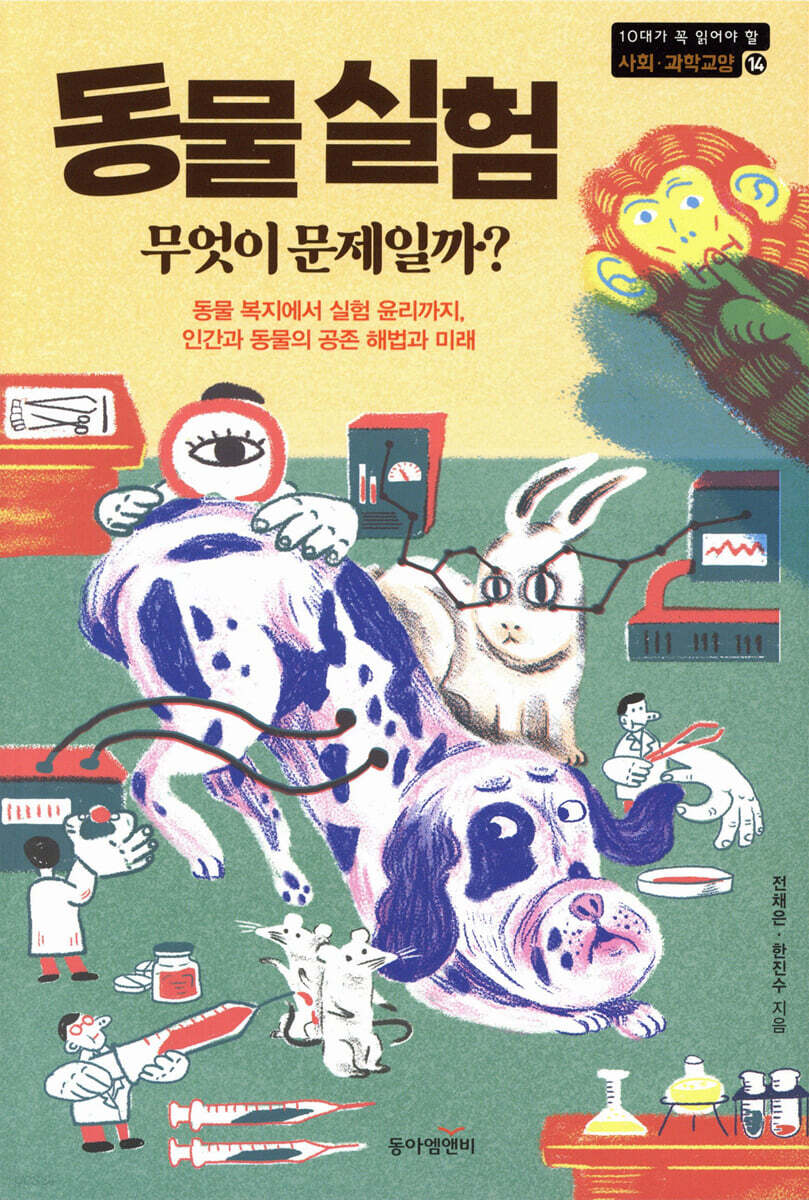
Animal Testing: What's the Problem?
 |
Description
Book Introduction
For the proper coexistence of humans and animals
The first scholar to conduct animal experiments was Aristotle.
He is said to have laid the foundations of anatomy and plant and animal taxonomy, collecting, dissecting, and classifying rare animals.
Later, in the late 17th century, some intellectuals criticized the cruelty of animal experiments and opposed meaningless sacrifice.
The 19th century was a time of advancement in life sciences, and these advancements in physiology and life sciences also sparked a movement against vivisection.
How does animal testing evolve in the 21st century? In medical research, scientists cling to even a 1% chance of saving a human life.
How should we view the animal testing currently being conducted? We live in an era of 15 million companion animals.
30% of our country's population lives with pets.
Pet food, clothing, snacks, play equipment, strollers, etc. are becoming another consumption pattern.
If you go out for a walk, you will often see groups of people walking with their animals.
It is true that in this era where the number of pets is rapidly increasing, interest in animal welfare is also increasing.
This book goes beyond simply discussing the pros and cons of animal testing, and provides a detailed introduction to the history and types of animal testing, how laboratory animals are managed, and the legal standards for this.
Through this, we will be able to confirm various claims that are consistent with historical evidence and the conditions of the times.
The first scholar to conduct animal experiments was Aristotle.
He is said to have laid the foundations of anatomy and plant and animal taxonomy, collecting, dissecting, and classifying rare animals.
Later, in the late 17th century, some intellectuals criticized the cruelty of animal experiments and opposed meaningless sacrifice.
The 19th century was a time of advancement in life sciences, and these advancements in physiology and life sciences also sparked a movement against vivisection.
How does animal testing evolve in the 21st century? In medical research, scientists cling to even a 1% chance of saving a human life.
How should we view the animal testing currently being conducted? We live in an era of 15 million companion animals.
30% of our country's population lives with pets.
Pet food, clothing, snacks, play equipment, strollers, etc. are becoming another consumption pattern.
If you go out for a walk, you will often see groups of people walking with their animals.
It is true that in this era where the number of pets is rapidly increasing, interest in animal welfare is also increasing.
This book goes beyond simply discussing the pros and cons of animal testing, and provides a detailed introduction to the history and types of animal testing, how laboratory animals are managed, and the legal standards for this.
Through this, we will be able to confirm various claims that are consistent with historical evidence and the conditions of the times.
index
Introduction · 4
Part 1: The History of Animal Experimentation
Chapter 1: What is Animal Testing? · 12
- Chapter 2: The History of Animal Experimentation · 22
* Chew your thoughts carefully and organize them · 41
Part 2: Laws and Controversies Related to Animal Testing
- Chapter 1 Animal Testing Laws · 44
- Chapter 2: The Debate on Educational Experiments · 56
* Chew your thoughts carefully and organize them · 71
Part 3 Types of Animal Experiments
- Chapter 1 Medical Experiments · 74
- Chapter 2 Toxicity Test · 80
* Chew your thoughts carefully and organize them · 95
Part 4: Pros and Cons of Animal Testing
Chapter 1: Philosophical Issues Surrounding Animal Testing · 98
* Chew your thoughts carefully and organize them · 123
Part 5: Laboratory Animal Welfare
Chapter 1: Violations of Laboratory Animal Welfare · 126
Chapter 2: Implementing the 3Rs in the Laboratory · 146
* Chew your thoughts carefully and organize them · 177
Conclusion · 178
Part 1: The History of Animal Experimentation
Chapter 1: What is Animal Testing? · 12
- Chapter 2: The History of Animal Experimentation · 22
* Chew your thoughts carefully and organize them · 41
Part 2: Laws and Controversies Related to Animal Testing
- Chapter 1 Animal Testing Laws · 44
- Chapter 2: The Debate on Educational Experiments · 56
* Chew your thoughts carefully and organize them · 71
Part 3 Types of Animal Experiments
- Chapter 1 Medical Experiments · 74
- Chapter 2 Toxicity Test · 80
* Chew your thoughts carefully and organize them · 95
Part 4: Pros and Cons of Animal Testing
Chapter 1: Philosophical Issues Surrounding Animal Testing · 98
* Chew your thoughts carefully and organize them · 123
Part 5: Laboratory Animal Welfare
Chapter 1: Violations of Laboratory Animal Welfare · 126
Chapter 2: Implementing the 3Rs in the Laboratory · 146
* Chew your thoughts carefully and organize them · 177
Conclusion · 178
Into the book
Animal testing can be defined as the process of giving special treatment to experimental animals to verify a hypothesis and then observing the results.
Animal testing is primarily used in medical and life science research, but it is also used in educational practice, toxicity testing to determine the toxicity of substances, and in various other fields such as pharmaceutical development.
--- p.12, from “Part 1: History of Animal Experimentation”
Despite the controversy, animal testing has become the only means of studying aspects that are difficult to directly apply to humans in all research, including research, screening, diagnosis, manufacturing, and education.
The need for this is further highlighted by the ability to observe how new drugs are metabolized in the human body, thereby providing information on their safety.
--- p.15, from “Part 1: History of Animal Experimentation”
The first scholar in history to conduct animal experiments was Aristotle.
He is said to have laid the foundations of anatomy and plant and animal taxonomy, collecting, dissecting, and classifying rare animals from all over the world.
Later, Galen, a Roman physician, dissected sheep, pigs, and monkeys to study blood circulation and anatomical structures.
He was a doctor who treated gladiators, but after Christianity was recognized in Rome, it was difficult to study the human body directly, so he studied animals instead.
--- p.22, from “Part 1: History of Animal Experimentation”
Since the 17th century, some intellectuals have criticized cruel animal experiments and opposed scientific research that sacrifices lives without meaning.
Intellectuals such as Robert Boyle, Richard Lower, and Alexander Pope criticized the animal cruelty aspects of animal testing.
The question was, “Just because humans are in a slightly better position than animals, does that give us the right to kill them?”
--- p.26, from “Part 1: History of Animal Experimentation”
Some people have suggested alternatives to animal testing.
Marshall Hall, a British physician and physiologist, argued that animal suffering should be considered in physiological experimental procedures.
He argued that there should be 'five principles' for animal testing, which were quite similar to modern ethical principles for animal testing.
According to Hall, animal testing can be justified only if the following conditions are met:
① The purpose must be clear, ② there is no other alternative, ③ there is no need to repeat the research, ④ animal suffering must be minimized, and ⑤ the research results must be publishable.
--- pp.28~29, from “Part 1: History of Animal Experimentation”
However, advances in physiology and life sciences sparked a movement against vivisection.
The Martin Law was enacted in England in 1822, the world's first law to protect animal welfare and animal rights. Its official name is the 'Act for the Prevention of Unfair Treatment of Domestic Animals'.
It was named after Richard Martin, who worked to enact laws to prevent animal cruelty at the time.
--- p.31, from “Part 1: History of Animal Experimentation”
Animal testing in the 21st century faces new challenges.
With the completion of the Genome Project in the early 21st century, the field of biological sciences has become a major industry worldwide.
Additionally, as genetically modified animals are created as new disease models, facilities and management standards for genetically modified animals are being strictly established.
--- p.36, from “Part 1: History of Animal Experimentation”
Article 3 of the Animal Protection Act stipulates that the following five principles must be observed as basic principles of animal protection.
1. To enable animals to live normally while maintaining their original habits and physical form; 2.
3. Ensure that animals do not suffer from thirst, hunger or malnutrition.
4. Ensure that animals can express normal behavior and do not experience discomfort.
5. Ensure that animals are free from pain, injury and disease.
This includes ensuring that animals do not experience fear or stress.
Chapter 3 of the Animal Protection Act is about animal testing and covers the principles and ethics of animal testing.
--- p.44, from “Part 1: History of Animal Experimentation”
Not all animals can be used in experiments.
According to Article 24 of the Animal Protection Act, lost or abandoned animals, guide dogs for the disabled, military dogs, etc. are animals that cannot be used for experiments.
Most animals in animal shelters are euthanized if they cannot find new homes.
--- p.47, from “Part 2: Laws and Controversies Related to Animal Testing”
In the UK, there is a law regarding animal testing called the Animal Research Procedures Act.
According to this law, animal testing is permitted only when the following obligations are met:
First, animal testing is only permitted when there is no other alternative and when the benefits to humans outweigh the suffering experienced by the animals.
Second, unnecessary suffering should not be inflicted.
Third, experiments that cause pain and permanent damage are controlled.
Fourth, breeding of species that administer poisons to animals, develop new drugs, or manipulate genes is restricted.
Fifth, to conduct animal experiments, licenses are required for the individual, the experimental project, and the building where the experiments are conducted.
Sixth, primates such as dogs and cats require special care.
Seventh, violation of this may result in imprisonment for up to two years or a fine.
--- pp.52~53, from “Part 2: Laws and Controversies Related to Animal Testing”
Animal testing is primarily criticized because it is not something humans and animals agree on as equals.
Animals have never said that they would be willing to sacrifice themselves for humans.
It can also be ethically problematic in that humans cause suffering to animals for the sake of their own health.
Where does the authority to sacrifice animals for humans come from?
--- p.99, from “Part 4 Pros and Cons of Animal Testing”
The arguments in favor of animal testing have the following logic:
First, humans and animals are biologically similar.
(Omitted) Second, the logic is that animal testing is absolutely necessary for human life and health.
(Omitted) Third, the position is that there is no other solution besides animal testing.
--- pp.104~107, from “Part 4: Pros and Cons of Animal Experimentation”
Animals used in laboratories are sometimes bred in the laboratory, but most are purchased from professional laboratory animal production facilities.
The reason why you should purchase from a specialized production facility is that animals used for laboratory purposes can be vulnerable to diseases, and if they are contaminated in the general environment, the results of the experiment can be erroneous.
--- pp.146~147, from “Part 5: Laboratory Animal Welfare”
Because euthanasia involves ending the life of an animal, it also places a great burden on the experimenter.
We must be responsible as we deal with life.
Euthanasia must be performed in a humane manner that causes the least amount of pain to the animal, and the person performing the euthanasia must also be meticulous.
Animal testing is primarily used in medical and life science research, but it is also used in educational practice, toxicity testing to determine the toxicity of substances, and in various other fields such as pharmaceutical development.
--- p.12, from “Part 1: History of Animal Experimentation”
Despite the controversy, animal testing has become the only means of studying aspects that are difficult to directly apply to humans in all research, including research, screening, diagnosis, manufacturing, and education.
The need for this is further highlighted by the ability to observe how new drugs are metabolized in the human body, thereby providing information on their safety.
--- p.15, from “Part 1: History of Animal Experimentation”
The first scholar in history to conduct animal experiments was Aristotle.
He is said to have laid the foundations of anatomy and plant and animal taxonomy, collecting, dissecting, and classifying rare animals from all over the world.
Later, Galen, a Roman physician, dissected sheep, pigs, and monkeys to study blood circulation and anatomical structures.
He was a doctor who treated gladiators, but after Christianity was recognized in Rome, it was difficult to study the human body directly, so he studied animals instead.
--- p.22, from “Part 1: History of Animal Experimentation”
Since the 17th century, some intellectuals have criticized cruel animal experiments and opposed scientific research that sacrifices lives without meaning.
Intellectuals such as Robert Boyle, Richard Lower, and Alexander Pope criticized the animal cruelty aspects of animal testing.
The question was, “Just because humans are in a slightly better position than animals, does that give us the right to kill them?”
--- p.26, from “Part 1: History of Animal Experimentation”
Some people have suggested alternatives to animal testing.
Marshall Hall, a British physician and physiologist, argued that animal suffering should be considered in physiological experimental procedures.
He argued that there should be 'five principles' for animal testing, which were quite similar to modern ethical principles for animal testing.
According to Hall, animal testing can be justified only if the following conditions are met:
① The purpose must be clear, ② there is no other alternative, ③ there is no need to repeat the research, ④ animal suffering must be minimized, and ⑤ the research results must be publishable.
--- pp.28~29, from “Part 1: History of Animal Experimentation”
However, advances in physiology and life sciences sparked a movement against vivisection.
The Martin Law was enacted in England in 1822, the world's first law to protect animal welfare and animal rights. Its official name is the 'Act for the Prevention of Unfair Treatment of Domestic Animals'.
It was named after Richard Martin, who worked to enact laws to prevent animal cruelty at the time.
--- p.31, from “Part 1: History of Animal Experimentation”
Animal testing in the 21st century faces new challenges.
With the completion of the Genome Project in the early 21st century, the field of biological sciences has become a major industry worldwide.
Additionally, as genetically modified animals are created as new disease models, facilities and management standards for genetically modified animals are being strictly established.
--- p.36, from “Part 1: History of Animal Experimentation”
Article 3 of the Animal Protection Act stipulates that the following five principles must be observed as basic principles of animal protection.
1. To enable animals to live normally while maintaining their original habits and physical form; 2.
3. Ensure that animals do not suffer from thirst, hunger or malnutrition.
4. Ensure that animals can express normal behavior and do not experience discomfort.
5. Ensure that animals are free from pain, injury and disease.
This includes ensuring that animals do not experience fear or stress.
Chapter 3 of the Animal Protection Act is about animal testing and covers the principles and ethics of animal testing.
--- p.44, from “Part 1: History of Animal Experimentation”
Not all animals can be used in experiments.
According to Article 24 of the Animal Protection Act, lost or abandoned animals, guide dogs for the disabled, military dogs, etc. are animals that cannot be used for experiments.
Most animals in animal shelters are euthanized if they cannot find new homes.
--- p.47, from “Part 2: Laws and Controversies Related to Animal Testing”
In the UK, there is a law regarding animal testing called the Animal Research Procedures Act.
According to this law, animal testing is permitted only when the following obligations are met:
First, animal testing is only permitted when there is no other alternative and when the benefits to humans outweigh the suffering experienced by the animals.
Second, unnecessary suffering should not be inflicted.
Third, experiments that cause pain and permanent damage are controlled.
Fourth, breeding of species that administer poisons to animals, develop new drugs, or manipulate genes is restricted.
Fifth, to conduct animal experiments, licenses are required for the individual, the experimental project, and the building where the experiments are conducted.
Sixth, primates such as dogs and cats require special care.
Seventh, violation of this may result in imprisonment for up to two years or a fine.
--- pp.52~53, from “Part 2: Laws and Controversies Related to Animal Testing”
Animal testing is primarily criticized because it is not something humans and animals agree on as equals.
Animals have never said that they would be willing to sacrifice themselves for humans.
It can also be ethically problematic in that humans cause suffering to animals for the sake of their own health.
Where does the authority to sacrifice animals for humans come from?
--- p.99, from “Part 4 Pros and Cons of Animal Testing”
The arguments in favor of animal testing have the following logic:
First, humans and animals are biologically similar.
(Omitted) Second, the logic is that animal testing is absolutely necessary for human life and health.
(Omitted) Third, the position is that there is no other solution besides animal testing.
--- pp.104~107, from “Part 4: Pros and Cons of Animal Experimentation”
Animals used in laboratories are sometimes bred in the laboratory, but most are purchased from professional laboratory animal production facilities.
The reason why you should purchase from a specialized production facility is that animals used for laboratory purposes can be vulnerable to diseases, and if they are contaminated in the general environment, the results of the experiment can be erroneous.
--- pp.146~147, from “Part 5: Laboratory Animal Welfare”
Because euthanasia involves ending the life of an animal, it also places a great burden on the experimenter.
We must be responsible as we deal with life.
Euthanasia must be performed in a humane manner that causes the least amount of pain to the animal, and the person performing the euthanasia must also be meticulous.
--- p.169, from “Part 5: Laboratory Animal Welfare”
Publisher's Review
From animal welfare to experimental ethics
Animal testing in the 21st century faces new challenges.
With the completion of the Genome Project, the field of biological sciences has become a major industry worldwide.
This could lead to an increase in animal testing and stricter standards for animal welfare.
The 3R principles, which were created as part of efforts to establish ethics in animal testing after World War II, continue to serve as important ethical principles.
Animal welfare means that animals are healthy, comfortable, well-nourished, and able to express their natural behavior in a safe environment, and do not experience adverse conditions such as pain, fear, or harassment.
It is based on the 'Five Freedoms of Animals', which are 1.
Freedom from hunger, malnutrition and thirst, 2.
Freedom from discomfort, 3.
Freedom from pain, injury and disease, 4.
Freedom from fear and pain, 5.
It is the freedom to express normal behavior.
Experimental ethics were advocated by Marshall Hall, a British physician and physiologist. 1.
The purpose is clear, 2.
When there is no other alternative, 3.
There is no need to repeat the study, 4.
Minimize animal suffering, 5.
The content is that research results must be able to be published.
Many researchers strive to adhere to the 3R principles of experimental ethics in their laboratories.
As human lives have been enriched by the help of animals, we should also be grateful to the animals that have helped us.
It will provide a fresh perspective on controversial topics for aspiring scientists and anyone interested in science.
Animal testing in the 21st century faces new challenges.
With the completion of the Genome Project, the field of biological sciences has become a major industry worldwide.
This could lead to an increase in animal testing and stricter standards for animal welfare.
The 3R principles, which were created as part of efforts to establish ethics in animal testing after World War II, continue to serve as important ethical principles.
Animal welfare means that animals are healthy, comfortable, well-nourished, and able to express their natural behavior in a safe environment, and do not experience adverse conditions such as pain, fear, or harassment.
It is based on the 'Five Freedoms of Animals', which are 1.
Freedom from hunger, malnutrition and thirst, 2.
Freedom from discomfort, 3.
Freedom from pain, injury and disease, 4.
Freedom from fear and pain, 5.
It is the freedom to express normal behavior.
Experimental ethics were advocated by Marshall Hall, a British physician and physiologist. 1.
The purpose is clear, 2.
When there is no other alternative, 3.
There is no need to repeat the study, 4.
Minimize animal suffering, 5.
The content is that research results must be able to be published.
Many researchers strive to adhere to the 3R principles of experimental ethics in their laboratories.
As human lives have been enriched by the help of animals, we should also be grateful to the animals that have helped us.
It will provide a fresh perspective on controversial topics for aspiring scientists and anyone interested in science.
GOODS SPECIFICS
- Publication date: October 20, 2022
- Page count, weight, size: 200 pages | 340g | 150*220*20mm
- ISBN13: 9791163635871
- ISBN10: 1163635871
You may also like
카테고리
korean


korean

![GQ KOREA Mark (Monthly): December [2025]](http://librairie.coreenne.fr/cdn/shop/files/8ef265dbbfbf186523ed75ba7319009d.jpg?v=1765340328&width=3840)


