

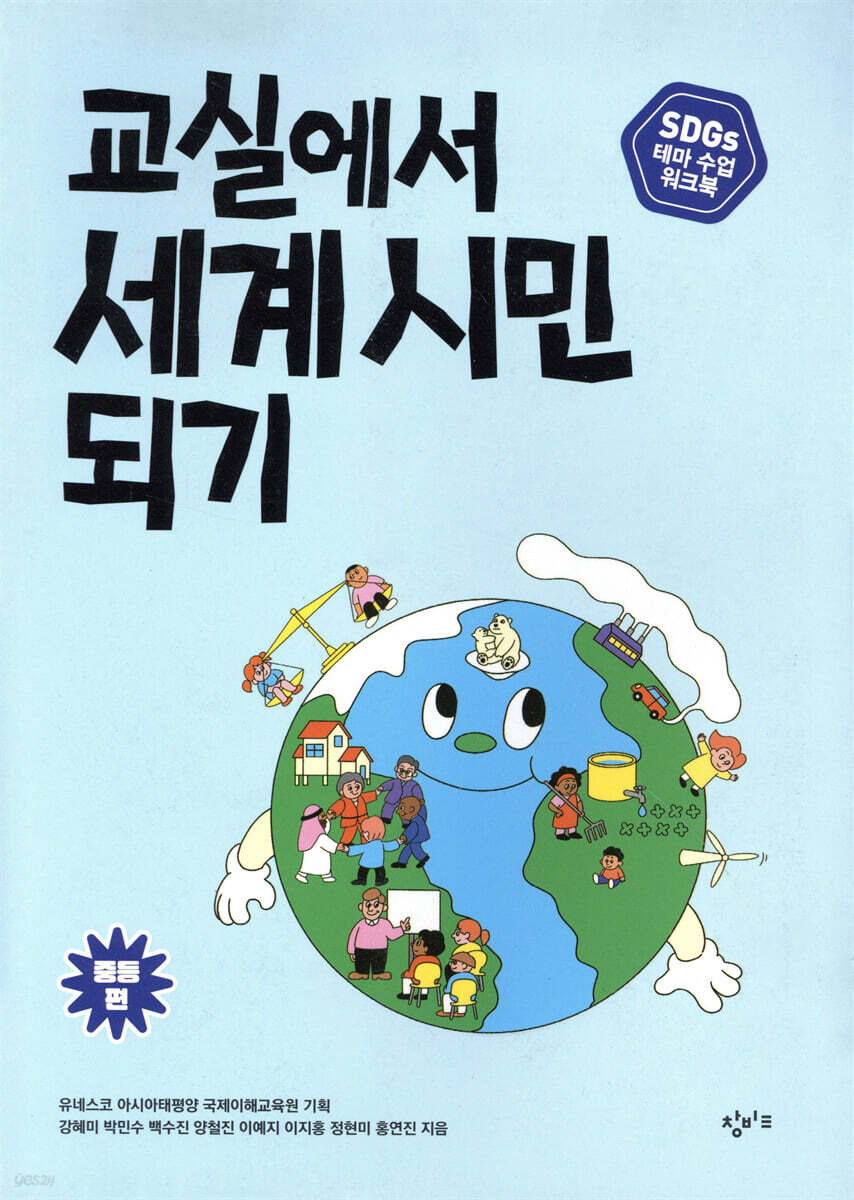
Becoming a Global Citizen in the Classroom: SDGs Theme Lesson Workbook (Middle School Edition)
 |
Description
Book Introduction
My first global citizenship class: Changing the future of the planet
A story we need today as we dream of a sustainable world.
The elementary and middle school edition (2 volumes) of "Becoming a Global Citizen in the Classroom," planned by the UNESCO Asia-Pacific Centre of Education for International Understanding and written by the global citizenship education research and development community "Neuru," has been published.
"Becoming a Global Citizen in the Classroom" is a global citizenship education workbook focused on the Sustainable Development Goals (SDGs), which the international community has pledged to achieve to improve the lives of people around the world and preserve the Earth's ecosystem.
There are 17 'Sustainable Development Goals' in total, including 'end poverty', 'health and well-being', 'reducing inequality', and 'responding to climate change'.
This book introduces the latest global issues related to the Sustainable Development Goals and provides step-by-step guidance on various activities.
In this process, various images such as cartoons, photos, and maps were used to allow students to vividly experience situations around the world.
This book is based on the experience of the authors, who have consistently thought about and practiced global citizenship education in schools, and allows students to approach the 'Sustainable Development Goals' as a story connected to their own lives, without feeling too difficult or distant.
This book will help many teachers and students learn and converse together in the classroom, growing into global citizens.
A story we need today as we dream of a sustainable world.
The elementary and middle school edition (2 volumes) of "Becoming a Global Citizen in the Classroom," planned by the UNESCO Asia-Pacific Centre of Education for International Understanding and written by the global citizenship education research and development community "Neuru," has been published.
"Becoming a Global Citizen in the Classroom" is a global citizenship education workbook focused on the Sustainable Development Goals (SDGs), which the international community has pledged to achieve to improve the lives of people around the world and preserve the Earth's ecosystem.
There are 17 'Sustainable Development Goals' in total, including 'end poverty', 'health and well-being', 'reducing inequality', and 'responding to climate change'.
This book introduces the latest global issues related to the Sustainable Development Goals and provides step-by-step guidance on various activities.
In this process, various images such as cartoons, photos, and maps were used to allow students to vividly experience situations around the world.
This book is based on the experience of the authors, who have consistently thought about and practiced global citizenship education in schools, and allows students to approach the 'Sustainable Development Goals' as a story connected to their own lives, without feeling too difficult or distant.
This book will help many teachers and students learn and converse together in the classroom, growing into global citizens.
- You can preview some of the book's contents.
Preview
index
Introduction 04
What are the SDGs? 08
SDG 1: End poverty 14
SDG 2: Ending Hunger 28
SDGs 3 Health and Well-being 40
SDGs 4 Quality Education 52
SDGs 5 Gender Equality 62
SDGs 6 Clean Water and Sanitation 76
SDG 7 Sustainable Clean Energy 90
SDG 8 Decent Work and Economic Growth 102
SDGs 9 Industry, Innovation, and Infrastructure 116
SDG 10: Reducing Inequality 128
SDG 11 Sustainable Cities and Communities 138
SDG 12 Sustainable Consumption and Production 148
SDG 13 Climate Change Response 160
SDG 14 Marine Ecosystem 172
SDGs 15 Terrestrial Ecosystem 182
SDGs 16 Peace, Justice, and Strong Institutions 194
SDGs 17 Global Partnership 206
Appendix 216
References and Sources 218
Activity sheet
What are the SDGs? 08
SDG 1: End poverty 14
SDG 2: Ending Hunger 28
SDGs 3 Health and Well-being 40
SDGs 4 Quality Education 52
SDGs 5 Gender Equality 62
SDGs 6 Clean Water and Sanitation 76
SDG 7 Sustainable Clean Energy 90
SDG 8 Decent Work and Economic Growth 102
SDGs 9 Industry, Innovation, and Infrastructure 116
SDG 10: Reducing Inequality 128
SDG 11 Sustainable Cities and Communities 138
SDG 12 Sustainable Consumption and Production 148
SDG 13 Climate Change Response 160
SDG 14 Marine Ecosystem 172
SDGs 15 Terrestrial Ecosystem 182
SDGs 16 Peace, Justice, and Strong Institutions 194
SDGs 17 Global Partnership 206
Appendix 216
References and Sources 218
Activity sheet
Into the book
According to scholars, current agricultural production is enough to feed 12 billion people, far more than the entire world population.
But even if there is enough food, if it is not distributed evenly, there will inevitably be hungry and poor people.
The fundamental cause of the poverty problem lies in the social structure, which does not distribute wealth equally but instead concentrates it in the hands of a few.
So how do we solve poverty? Should we just provide aid to impoverished countries? Aid is necessary, but it's not the complete answer.
Unless the root causes and structural problems of poverty are addressed, the effectiveness of temporary aid will inevitably be limited.
--- p.24
A water footprint is an indicator of water flow.
So where do we find the largest water footprints? Ironically, it's places like Africa and Central and South America, places where water is scarce.
Developed countries are producing and consuming products using water from other countries, as in the case of rose farms in Kenya.
78% of South Korea's water footprint occurs outside the country.
We are unknowingly using a lot of water from other countries.
Facts like these tell us that we too have a role and responsibility in addressing the global water shortage problem.
--- p.86
When habitats are destroyed and biodiversity collapses, large animals disappear and small animals survive.
However, small animals have weak immune systems and are vulnerable to viruses.
In other words, as the animal population decreases, infectious diseases are bound to become more severe.
Preserving biodiversity isn't just about saving poor animals.
This also has to do with protecting us as humans.
We must protect living things from extinction in order to protect ourselves.
But even if there is enough food, if it is not distributed evenly, there will inevitably be hungry and poor people.
The fundamental cause of the poverty problem lies in the social structure, which does not distribute wealth equally but instead concentrates it in the hands of a few.
So how do we solve poverty? Should we just provide aid to impoverished countries? Aid is necessary, but it's not the complete answer.
Unless the root causes and structural problems of poverty are addressed, the effectiveness of temporary aid will inevitably be limited.
--- p.24
A water footprint is an indicator of water flow.
So where do we find the largest water footprints? Ironically, it's places like Africa and Central and South America, places where water is scarce.
Developed countries are producing and consuming products using water from other countries, as in the case of rose farms in Kenya.
78% of South Korea's water footprint occurs outside the country.
We are unknowingly using a lot of water from other countries.
Facts like these tell us that we too have a role and responsibility in addressing the global water shortage problem.
--- p.86
When habitats are destroyed and biodiversity collapses, large animals disappear and small animals survive.
However, small animals have weak immune systems and are vulnerable to viruses.
In other words, as the animal population decreases, infectious diseases are bound to become more severe.
Preserving biodiversity isn't just about saving poor animals.
This also has to do with protecting us as humans.
We must protect living things from extinction in order to protect ourselves.
--- p.189
Publisher's Review
My first global citizenship class: Changing the future of the planet
The elementary and middle school edition (2 volumes) of "Becoming a Global Citizen in the Classroom," planned by the UNESCO Asia-Pacific Centre of Education for International Understanding and written by the global citizenship education research and development community "Neuru," has been published.
"Becoming a Global Citizen in the Classroom" is a global citizenship education workbook focused on the Sustainable Development Goals (SDGs), which the international community has pledged to achieve by 2030 to improve the lives of people around the world and preserve the Earth's ecosystem.
The 'Sustainable Development Goals' consist of 17 goals and 169 targets, including 'end poverty', 'health and well-being', 'reduced inequality', 'sustainable consumption and production', and 'response to climate change'.
This book introduces the latest global issues related to the Sustainable Development Goals and provides step-by-step guidance on various activities.
For secondary education, the 17 goals of the SDGs were organized into each unit, making it easy to select the necessary content for each subject class according to the characteristics of middle school.
In the introduction, we had students guess what the unit would cover and recall their usual thoughts about it.
This activity is divided into three stages to help students understand the world situation, delve deeper into the causes of problems, and take actions they can take in their daily lives to solve the problems.
Lastly, we introduced related UN World Days and summarized what we learned in class to help students remember them.
In this process, various images such as cartoons, photos, and maps were used to allow students to vividly experience situations related to the issue.
A separate activity sheet is provided at the back of the book for convenient use in class.
A story we need today as we dream of a sustainable world.
This book is based on the experience of the authors, who have consistently thought about and practiced global citizenship education in schools, and allows students to approach the 'Sustainable Development Goals' as a story connected to their own lives, without feeling too difficult or distant.
Playing the "Get the Vaccine" game made everyone think about how to get a safe vaccine and think about how many non-human creatures they encounter each day.
And we had them design the kiosk themselves to see how it could be designed to get more people to use it.
The classroom is a place where teachers and students build relationships, learn together, think together, and share the joy of communication.
It is a place where different ideas collide at the same time, sometimes causing conflicts big and small, and where we learn how to resolve such conflicts with our body and mind.
That's why the classroom is a wonderful place to learn and practice who a global citizen is, how to think and act as one, and help them grow into global citizens.
As the title of the book, “Becoming a Global Citizen in the Classroom,” suggests, this book will help many teachers and students learn and communicate together in the classroom and grow into global citizens.
As young people read, they will naturally ponder how to solve various problems in the world, such as gender discrimination, infectious diseases, the climate crisis, war, poverty, and cross-cultural exclusion.
The book contains a variety of questions and food for thought, making it ideal for teachers and students to think about and discuss together.
The elementary and middle school edition (2 volumes) of "Becoming a Global Citizen in the Classroom," planned by the UNESCO Asia-Pacific Centre of Education for International Understanding and written by the global citizenship education research and development community "Neuru," has been published.
"Becoming a Global Citizen in the Classroom" is a global citizenship education workbook focused on the Sustainable Development Goals (SDGs), which the international community has pledged to achieve by 2030 to improve the lives of people around the world and preserve the Earth's ecosystem.
The 'Sustainable Development Goals' consist of 17 goals and 169 targets, including 'end poverty', 'health and well-being', 'reduced inequality', 'sustainable consumption and production', and 'response to climate change'.
This book introduces the latest global issues related to the Sustainable Development Goals and provides step-by-step guidance on various activities.
For secondary education, the 17 goals of the SDGs were organized into each unit, making it easy to select the necessary content for each subject class according to the characteristics of middle school.
In the introduction, we had students guess what the unit would cover and recall their usual thoughts about it.
This activity is divided into three stages to help students understand the world situation, delve deeper into the causes of problems, and take actions they can take in their daily lives to solve the problems.
Lastly, we introduced related UN World Days and summarized what we learned in class to help students remember them.
In this process, various images such as cartoons, photos, and maps were used to allow students to vividly experience situations related to the issue.
A separate activity sheet is provided at the back of the book for convenient use in class.
A story we need today as we dream of a sustainable world.
This book is based on the experience of the authors, who have consistently thought about and practiced global citizenship education in schools, and allows students to approach the 'Sustainable Development Goals' as a story connected to their own lives, without feeling too difficult or distant.
Playing the "Get the Vaccine" game made everyone think about how to get a safe vaccine and think about how many non-human creatures they encounter each day.
And we had them design the kiosk themselves to see how it could be designed to get more people to use it.
The classroom is a place where teachers and students build relationships, learn together, think together, and share the joy of communication.
It is a place where different ideas collide at the same time, sometimes causing conflicts big and small, and where we learn how to resolve such conflicts with our body and mind.
That's why the classroom is a wonderful place to learn and practice who a global citizen is, how to think and act as one, and help them grow into global citizens.
As the title of the book, “Becoming a Global Citizen in the Classroom,” suggests, this book will help many teachers and students learn and communicate together in the classroom and grow into global citizens.
As young people read, they will naturally ponder how to solve various problems in the world, such as gender discrimination, infectious diseases, the climate crisis, war, poverty, and cross-cultural exclusion.
The book contains a variety of questions and food for thought, making it ideal for teachers and students to think about and discuss together.
GOODS SPECIFICS
- Publication date: March 30, 2022
- Page count, weight, size: 224 pages | 672g | 176*248*17mm
- ISBN13: 9791165701253
- ISBN10: 1165701251
You may also like
카테고리
korean


korean

![GQ KOREA Mark (Monthly): December [2025]](http://librairie.coreenne.fr/cdn/shop/files/8ef265dbbfbf186523ed75ba7319009d.jpg?v=1765340328&width=3840)


