

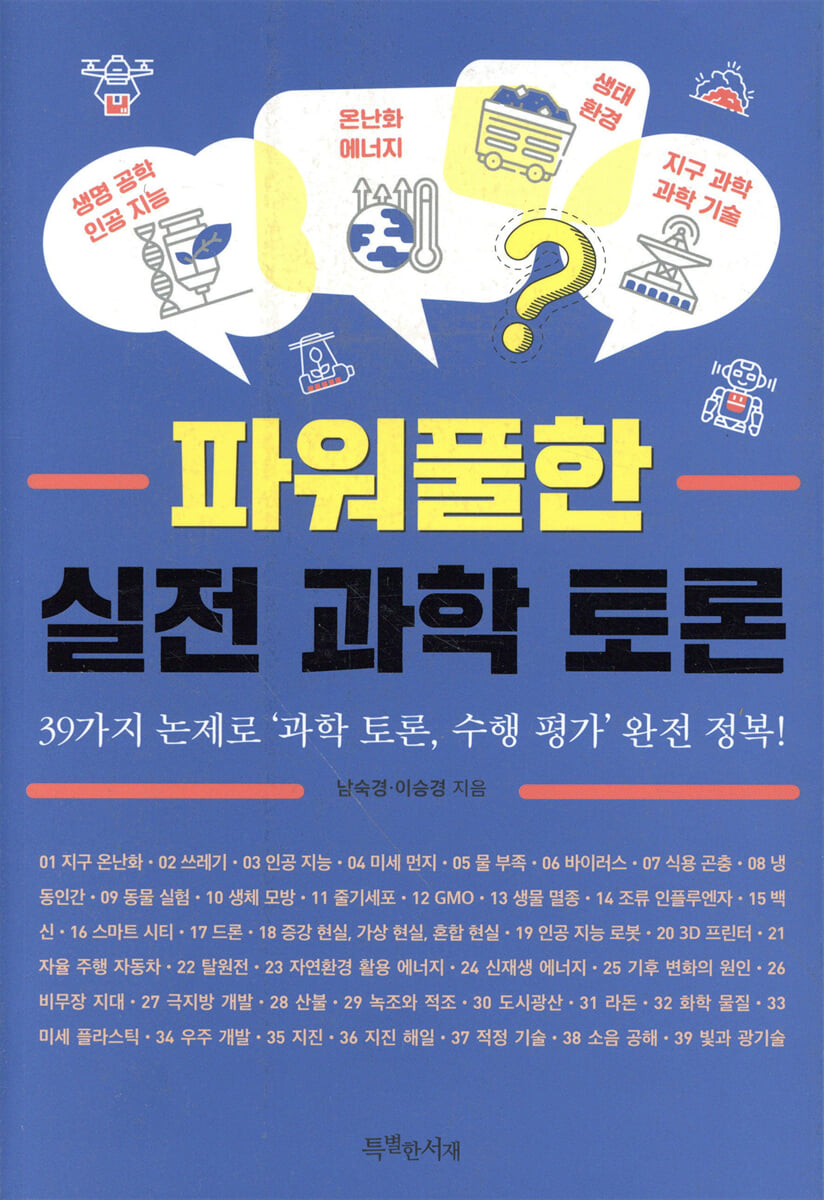
Powerful, hands-on science discussions
 |
Description
Book Introduction
How to prepare for a science debate competition and performance evaluation?
So that students can develop their own 'thinking muscles'
The most practical guide to scientific discussion that will help you!
The Science Debate Competition, held annually in April as part of Science Month, aims to develop students' comprehensive thinking skills.
Science performance assessments implemented in schools also require scientific thinking skills, inquiry skills, and problem-solving abilities.
However, scientific debate competitions and performance assessments require advanced thinking training, so preparing for them is not easy.
Two authors with long-standing experience in teaching debate have reunited to help students who struggle to prepare for science debate competitions or performance assessments.
The two authors, who have already received rave reviews for their book, "Powerful Textbook Science Discussion," have written this book to provide more specific and practical help.
We collected the topics presented by schools, city/provincial offices of education, and the Korea Foundation for the Advancement of Science and Creativity over the past four years (2017-2020), and systematically organized 39 carefully selected topics.
If students faithfully train their thinking skills by following the structure of this book, anyone can perfectly prepare for science debate competitions and performance assessments on their own.
The book also provides a training process for students to develop their own "thinking muscles" in science debate competitions and performance assessments.
When your thinking muscles grow strong, you will be able to analyze the cause of any problem given to you, beyond the 39 topics, and come up with ideas to solve it.
If you possess problem-solving skills and the confidence and enterprising attitude that come from them, you will grow into a key talent who will exert a positive influence not only at school but also in society in the future.
So that students can develop their own 'thinking muscles'
The most practical guide to scientific discussion that will help you!
The Science Debate Competition, held annually in April as part of Science Month, aims to develop students' comprehensive thinking skills.
Science performance assessments implemented in schools also require scientific thinking skills, inquiry skills, and problem-solving abilities.
However, scientific debate competitions and performance assessments require advanced thinking training, so preparing for them is not easy.
Two authors with long-standing experience in teaching debate have reunited to help students who struggle to prepare for science debate competitions or performance assessments.
The two authors, who have already received rave reviews for their book, "Powerful Textbook Science Discussion," have written this book to provide more specific and practical help.
We collected the topics presented by schools, city/provincial offices of education, and the Korea Foundation for the Advancement of Science and Creativity over the past four years (2017-2020), and systematically organized 39 carefully selected topics.
If students faithfully train their thinking skills by following the structure of this book, anyone can perfectly prepare for science debate competitions and performance assessments on their own.
The book also provides a training process for students to develop their own "thinking muscles" in science debate competitions and performance assessments.
When your thinking muscles grow strong, you will be able to analyze the cause of any problem given to you, beyond the 39 topics, and come up with ideas to solve it.
If you possess problem-solving skills and the confidence and enterprising attitude that come from them, you will grow into a key talent who will exert a positive influence not only at school but also in society in the future.
- You can preview some of the book's contents.
Preview
index
To begin with
PART 01 How to Write a Practical Science Discussion Outline
Practice writing a scientific discussion outline
[Topic 1] Global Warming
[Topic 2] Garbage
[Topic 3] Artificial Intelligence
[Topic 4] Fine dust
[Topic 5] Water Shortage
[Topic 6] Viruses
PART 02: Examining Past Exam Questions from Schools Nationwide Over the Past Four Years
CHAPTER 01 _ Biotechnology
[Topic 7] Edible Insects
[Topic 8] Cryonics
[Topic 9] Animal Testing
[Topic 10] Biomimicry
[Topic 11] Stem Cells
[Topic 12] GMO
[Topic 13] Extinction of Species
[Topic 14] Avian Influenza
[Topic 15] Vaccines
CHAPTER 02 _ Artificial Intelligence
[Topic 16] Smart City
[Topic 17] Drones
[Topic 18] Augmented Reality, Virtual Reality, and Mixed Reality
[Topic 19] Artificial Intelligence Robots
[Topic 20] 3D Printer
[Topic 21] Autonomous Vehicles
CHAPTER 03 _ Global Warming / Energy
[Topic 22] Nuclear phase-out
[Topic 23] Energy from the Natural Environment
[Topic 24] Renewable Energy
[Topic 25] Causes of Climate Change
CHAPTER 04 _ Ecology / Environment
[Topic 26] Demilitarized Zone
[Topic 27] Polar Region Development
[Topic 28] Forest Fire
[Topic 29] Green and Red Tide
[Topic 30] Urban Mining
[Topic 31] Radon
[Topic 32] Chemical Substances
[Topic 33] Microplastics
CHAPTER 05 _ Earth Science / Science and Technology
[Topic 34] Space Development
[Topic 35] Earthquake
[Topic 36] Earthquake and Tsunami
[Topic 37] Appropriate Technology
[Topic 38] Noise Pollution
[Topic 39] Light and Optical Technology
PART 03 How to prepare for a science debate competition?
What is a science debate competition?
What topics will be on the exam?
How should I write an outline?
How should I conduct the presentation and Q&A?
PART 01 How to Write a Practical Science Discussion Outline
Practice writing a scientific discussion outline
[Topic 1] Global Warming
[Topic 2] Garbage
[Topic 3] Artificial Intelligence
[Topic 4] Fine dust
[Topic 5] Water Shortage
[Topic 6] Viruses
PART 02: Examining Past Exam Questions from Schools Nationwide Over the Past Four Years
CHAPTER 01 _ Biotechnology
[Topic 7] Edible Insects
[Topic 8] Cryonics
[Topic 9] Animal Testing
[Topic 10] Biomimicry
[Topic 11] Stem Cells
[Topic 12] GMO
[Topic 13] Extinction of Species
[Topic 14] Avian Influenza
[Topic 15] Vaccines
CHAPTER 02 _ Artificial Intelligence
[Topic 16] Smart City
[Topic 17] Drones
[Topic 18] Augmented Reality, Virtual Reality, and Mixed Reality
[Topic 19] Artificial Intelligence Robots
[Topic 20] 3D Printer
[Topic 21] Autonomous Vehicles
CHAPTER 03 _ Global Warming / Energy
[Topic 22] Nuclear phase-out
[Topic 23] Energy from the Natural Environment
[Topic 24] Renewable Energy
[Topic 25] Causes of Climate Change
CHAPTER 04 _ Ecology / Environment
[Topic 26] Demilitarized Zone
[Topic 27] Polar Region Development
[Topic 28] Forest Fire
[Topic 29] Green and Red Tide
[Topic 30] Urban Mining
[Topic 31] Radon
[Topic 32] Chemical Substances
[Topic 33] Microplastics
CHAPTER 05 _ Earth Science / Science and Technology
[Topic 34] Space Development
[Topic 35] Earthquake
[Topic 36] Earthquake and Tsunami
[Topic 37] Appropriate Technology
[Topic 38] Noise Pollution
[Topic 39] Light and Optical Technology
PART 03 How to prepare for a science debate competition?
What is a science debate competition?
What topics will be on the exam?
How should I write an outline?
How should I conduct the presentation and Q&A?
Detailed image
Publisher's Review
“Global warming, artificial intelligence, viruses, etc.
39 key topics from the past four years
“Conquer science debate competitions and performance assessments!”
The Fourth Industrial Revolution and the impact of COVID-19 are accelerating social transformation.
To quickly adapt to a world that changes every day, you need "comprehensive thinking"—the ability to scientifically analyze problematic situations and find the most appropriate solutions.
So how can we develop comprehensive thinking skills, a core competency essential in this day and age?
The Science Debate Competition, held annually in April as part of Science Month, aims to develop students' comprehensive thinking skills.
Science performance assessments implemented in schools also require scientific thinking skills, inquiry skills, and problem-solving abilities.
However, scientific debate competitions and performance assessments require advanced thinking training, so preparing for them is not easy.
Two authors with long-standing experience in teaching debate have reunited to help students who struggle to prepare for science debate competitions or performance assessments.
The two authors, who have already received rave reviews for their book, "Powerful Textbook Science Discussion," have written this book to provide more specific and practical help.
We collected the topics presented by schools, city/provincial offices of education, and the Korea Foundation for the Advancement of Science and Creativity over the past four years (2017-2020), and systematically organized 39 carefully selected topics.
If students faithfully train their thinking skills by following the structure of this book, anyone can perfectly prepare for science debate competitions and performance assessments on their own.
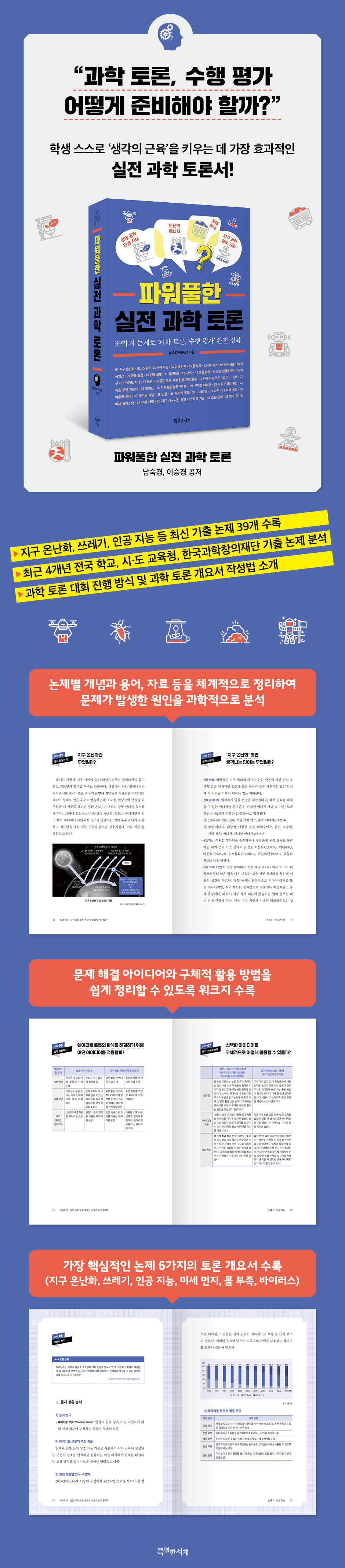
- Introduction to the scientific debate competition process and how to write a scientific debate outline.
- Analysis of past exam questions from schools, city/provincial offices of education, and the Korea Foundation for the Advancement of Science and Creativity over the past four years (2017-2020).
- Includes 39 latest past exam topics, including global warming, waste, artificial intelligence, fine dust, water shortage, and viruses.
If you train your problem analysis and problem solving skills with this book,
No scientific debates, no performance evaluations to be afraid of!
While teaching debate in the field, the two authors often saw students struggling with how to prepare for debate and performance assessments.
The most important thing when preparing for a science debate competition or performance assessment is to set the direction for 'what' and 'how' to prepare.
As mentioned earlier, the purpose of science debate competitions and performance assessments is to develop 'comprehensive thinking skills'.
The goal is to improve students' ability to analyze problem situations and find solutions on their own.
So, what kind of problem situations should be analyzed in a science debate competition? To answer this question, the two authors recently collected all the topics presented by schools, city and provincial offices of education, and the Korea Foundation for the Advancement of Science and Creativity across the country.
These topics are among the most important scientific and social issues currently being debated in our society.
Among these, we carefully selected 39 topics with the highest frequency of appearance.
Anyone who is familiar with just these 39 topics can confidently participate in scientific debate competitions and performance assessments.
How should we train with these topics? This book first systematically organizes the concepts, terminology, and data for each topic, helping you scientifically analyze the root causes of the problems.
Then, we've included an "Apply Your Ideas" worksheet to help you gather ideas that can address the root cause of the problem and easily organize how to put them into practice.
In particular, six of the most crucial topics, including global warming, waste, artificial intelligence, fine dust, water shortage, and viruses, are included with discussion outlines to help participants acquire a sense of real-life debate.
This book provides a training process for students to develop their own "thinking muscles" in science debate competitions and performance assessments.
As your thinking muscles grow stronger, you will be able to analyze the cause of any problem given to you, beyond the 39 topics, and come up with ideas to solve it.
If you possess problem-solving skills and the confidence and enterprising attitude that come from them, you will grow into a key talent who will exert a positive influence not only at school but also in society in the future.
Beginning - Nam Sook-kyung
I felt that watching students participate in the 'Science Debate Competition' up close helped them develop their thinking skills more than any other program.
Unfortunately, however, it is extremely difficult to scientifically analyze the problematic situations occurring around us and suggest various solutions to solve them.
Because of this, students participating in science debate competitions are having a hard time because they don't know what to prepare or how to prepare.
So, with a strong desire to provide practical help to students preparing for the competition, I categorized the topics presented by schools, city/provincial offices of education, and the Korea Foundation for the Advancement of Science and Creativity over the past four years (2017-2020) and created 39 topics.
This book includes a conceptual overview for writing a discussion outline for each topic, along with an "Apply Thinking" worksheet to help you organize your ideas for solutions based on the outline.
The 'Apply Thinking' worksheet was created after much thought while teaching students in the field and helping them find solutions to problems.
Using this worksheet will make the process of finding solutions to a wide range of topics easier and more logical.
By understanding the structure of the book and following it in order, students can prepare for the competition on their own.
Such meaningful experiences are a great opportunity to build confidence in science.
Furthermore, it can form the foundation of scientific thinking accompanied by a curiosity for science as well as persistence and perseverance.
And it would be a great help if you could apply the contents of the book to prepare for performance assessments at school.
I sincerely hope that through this book, students will develop their 'thinking muscles' and improve their comprehensive thinking skills.
39 key topics from the past four years
“Conquer science debate competitions and performance assessments!”
The Fourth Industrial Revolution and the impact of COVID-19 are accelerating social transformation.
To quickly adapt to a world that changes every day, you need "comprehensive thinking"—the ability to scientifically analyze problematic situations and find the most appropriate solutions.
So how can we develop comprehensive thinking skills, a core competency essential in this day and age?
The Science Debate Competition, held annually in April as part of Science Month, aims to develop students' comprehensive thinking skills.
Science performance assessments implemented in schools also require scientific thinking skills, inquiry skills, and problem-solving abilities.
However, scientific debate competitions and performance assessments require advanced thinking training, so preparing for them is not easy.
Two authors with long-standing experience in teaching debate have reunited to help students who struggle to prepare for science debate competitions or performance assessments.
The two authors, who have already received rave reviews for their book, "Powerful Textbook Science Discussion," have written this book to provide more specific and practical help.
We collected the topics presented by schools, city/provincial offices of education, and the Korea Foundation for the Advancement of Science and Creativity over the past four years (2017-2020), and systematically organized 39 carefully selected topics.
If students faithfully train their thinking skills by following the structure of this book, anyone can perfectly prepare for science debate competitions and performance assessments on their own.
- Introduction to the scientific debate competition process and how to write a scientific debate outline.
- Analysis of past exam questions from schools, city/provincial offices of education, and the Korea Foundation for the Advancement of Science and Creativity over the past four years (2017-2020).
- Includes 39 latest past exam topics, including global warming, waste, artificial intelligence, fine dust, water shortage, and viruses.
If you train your problem analysis and problem solving skills with this book,
No scientific debates, no performance evaluations to be afraid of!
While teaching debate in the field, the two authors often saw students struggling with how to prepare for debate and performance assessments.
The most important thing when preparing for a science debate competition or performance assessment is to set the direction for 'what' and 'how' to prepare.
As mentioned earlier, the purpose of science debate competitions and performance assessments is to develop 'comprehensive thinking skills'.
The goal is to improve students' ability to analyze problem situations and find solutions on their own.
So, what kind of problem situations should be analyzed in a science debate competition? To answer this question, the two authors recently collected all the topics presented by schools, city and provincial offices of education, and the Korea Foundation for the Advancement of Science and Creativity across the country.
These topics are among the most important scientific and social issues currently being debated in our society.
Among these, we carefully selected 39 topics with the highest frequency of appearance.
Anyone who is familiar with just these 39 topics can confidently participate in scientific debate competitions and performance assessments.
How should we train with these topics? This book first systematically organizes the concepts, terminology, and data for each topic, helping you scientifically analyze the root causes of the problems.
Then, we've included an "Apply Your Ideas" worksheet to help you gather ideas that can address the root cause of the problem and easily organize how to put them into practice.
In particular, six of the most crucial topics, including global warming, waste, artificial intelligence, fine dust, water shortage, and viruses, are included with discussion outlines to help participants acquire a sense of real-life debate.
This book provides a training process for students to develop their own "thinking muscles" in science debate competitions and performance assessments.
As your thinking muscles grow stronger, you will be able to analyze the cause of any problem given to you, beyond the 39 topics, and come up with ideas to solve it.
If you possess problem-solving skills and the confidence and enterprising attitude that come from them, you will grow into a key talent who will exert a positive influence not only at school but also in society in the future.
Beginning - Nam Sook-kyung
I felt that watching students participate in the 'Science Debate Competition' up close helped them develop their thinking skills more than any other program.
Unfortunately, however, it is extremely difficult to scientifically analyze the problematic situations occurring around us and suggest various solutions to solve them.
Because of this, students participating in science debate competitions are having a hard time because they don't know what to prepare or how to prepare.
So, with a strong desire to provide practical help to students preparing for the competition, I categorized the topics presented by schools, city/provincial offices of education, and the Korea Foundation for the Advancement of Science and Creativity over the past four years (2017-2020) and created 39 topics.
This book includes a conceptual overview for writing a discussion outline for each topic, along with an "Apply Thinking" worksheet to help you organize your ideas for solutions based on the outline.
The 'Apply Thinking' worksheet was created after much thought while teaching students in the field and helping them find solutions to problems.
Using this worksheet will make the process of finding solutions to a wide range of topics easier and more logical.
By understanding the structure of the book and following it in order, students can prepare for the competition on their own.
Such meaningful experiences are a great opportunity to build confidence in science.
Furthermore, it can form the foundation of scientific thinking accompanied by a curiosity for science as well as persistence and perseverance.
And it would be a great help if you could apply the contents of the book to prepare for performance assessments at school.
I sincerely hope that through this book, students will develop their 'thinking muscles' and improve their comprehensive thinking skills.
GOODS SPECIFICS
- Publication date: March 21, 2022
- Page count, weight, size: 496 pages | 780g | 153*220*31mm
- ISBN13: 9791167030467
- ISBN10: 116703046X
You may also like
카테고리
korean


korean

![GQ KOREA Mark (Monthly): December [2025]](http://librairie.coreenne.fr/cdn/shop/files/8ef265dbbfbf186523ed75ba7319009d.jpg?v=1765340328&width=3840)


