

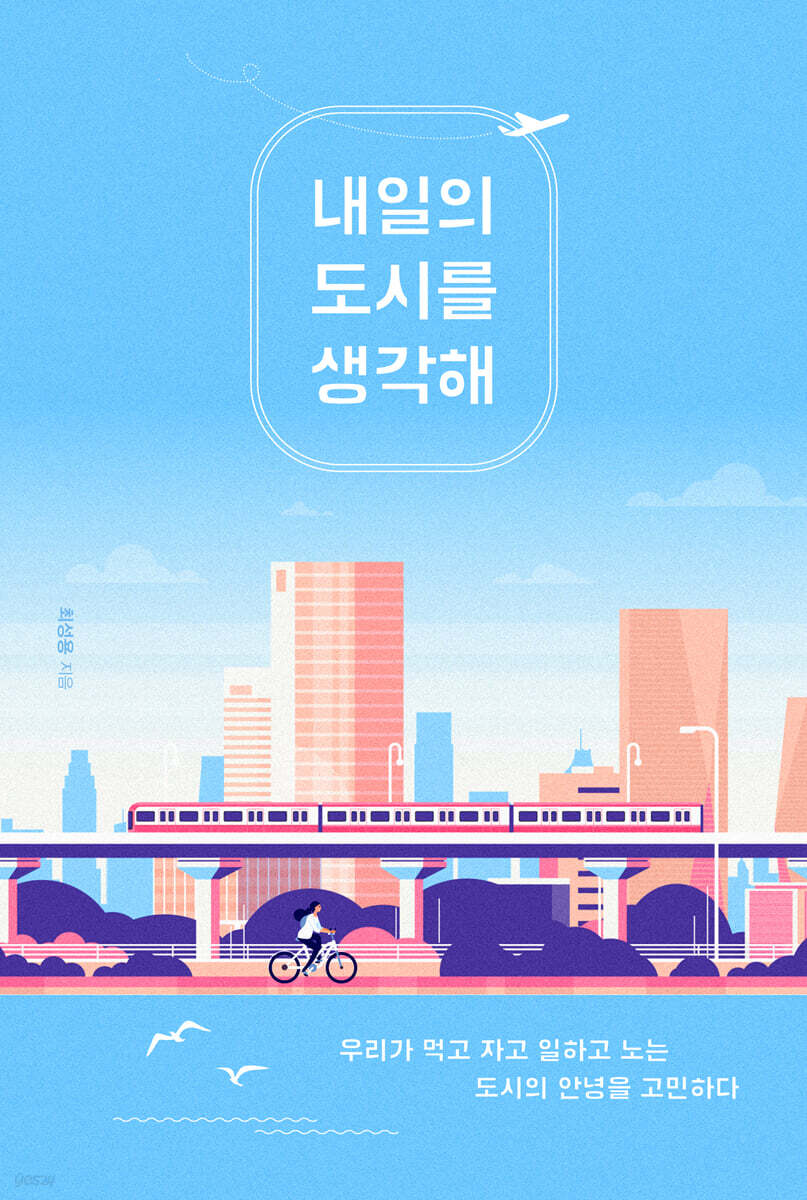
Thinking about the city of tomorrow
 |
Description
Book Introduction
How can we create better, more sustainable cities?
Let's draw the 'big picture' of a happy city!
Clogged roads, skyrocketing housing prices, high costs, overflowing trash, pungent air, polarized housing conditions, shrinking green space…
The reality of a city where so many people live together is bleak.
Can't we transform this bleak, stifling, and ruthless gray city into something humane, vibrant, and kind? How can we ensure that everyone in the city can live safely and happily?
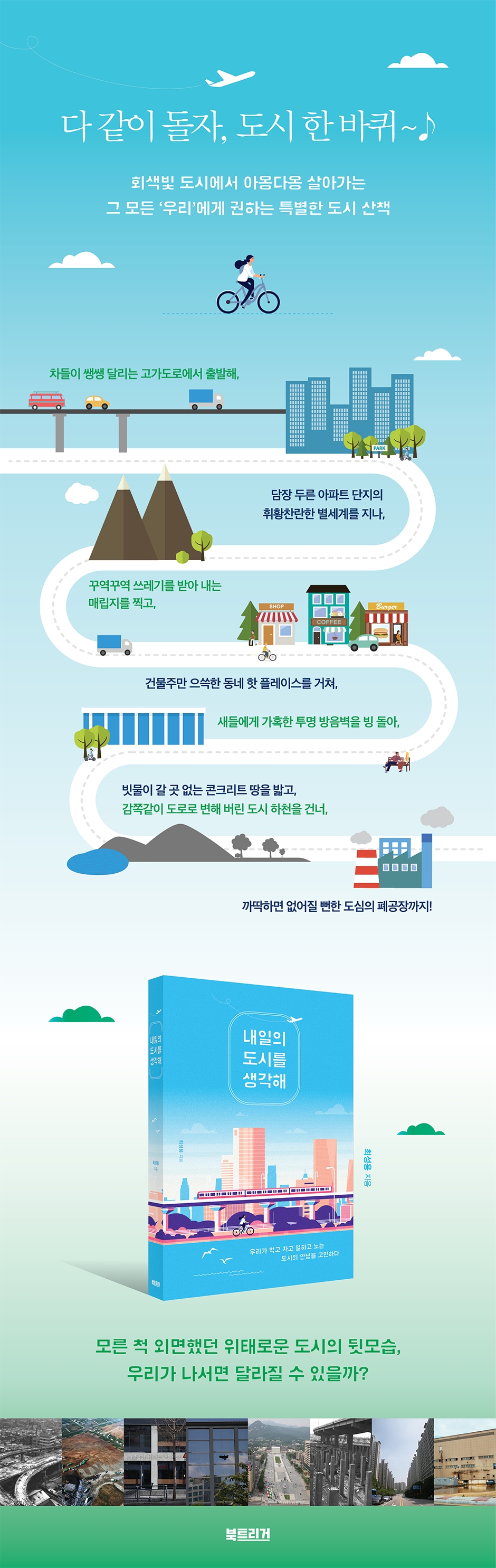
"Thinking of the City of Tomorrow" recommends a special city walk to those who will live in the "city of tomorrow."
The author dynamically interprets the changes surrounding the urban environment by directly visiting and observing structures and places that make up urban space, such as crosswalks, overpasses, apartment complexes, landfills, transmission towers, sound barriers, concrete land, urban rivers, greenbelts, reclaimed land, and abandoned factories.
I propose that we look at the other side of urban development, which sometimes takes a step forward and sometimes takes a step backward, and draw together the 'big picture' of a happy city.
The book's message is clear.
A city that is good to live in is in the hands of its citizens.
In an age where creative solutions to urban problems are desperately needed, this book is recommended for all citizens.
Let's draw the 'big picture' of a happy city!
Clogged roads, skyrocketing housing prices, high costs, overflowing trash, pungent air, polarized housing conditions, shrinking green space…
The reality of a city where so many people live together is bleak.
Can't we transform this bleak, stifling, and ruthless gray city into something humane, vibrant, and kind? How can we ensure that everyone in the city can live safely and happily?
"Thinking of the City of Tomorrow" recommends a special city walk to those who will live in the "city of tomorrow."
The author dynamically interprets the changes surrounding the urban environment by directly visiting and observing structures and places that make up urban space, such as crosswalks, overpasses, apartment complexes, landfills, transmission towers, sound barriers, concrete land, urban rivers, greenbelts, reclaimed land, and abandoned factories.
I propose that we look at the other side of urban development, which sometimes takes a step forward and sometimes takes a step backward, and draw together the 'big picture' of a happy city.
The book's message is clear.
A city that is good to live in is in the hands of its citizens.
In an age where creative solutions to urban problems are desperately needed, this book is recommended for all citizens.
- You can preview some of the book's contents.
Preview
index
First story
Is this comfortable city life okay?
#01 The question posed in the automobile age: Who owns the roads?
#02 Apartment Republic: What We Gained and What We Lost
#03 Trash, will it be over if it just disappears from my sight?
#04 The Inconvenient Truth About the Long Journey Before Electricity Arrived
#05 A City That Forgot the Night: Are 24 Hours Equal for Everyone?
Second story
Is our city's symbiosis index green or red?
#06 The Lives of Immigrants That Cities Must Remember
#07 Towards a city where disabilities are not disabilities
#08 How to Live with Pets in the City
#09 Sky Road, Water Road, Land Road, All Kill
#10 Stories of Plants and Animals That Became City Dwellers
Third story
How can urban development be sustainable?
#11 Is there a way to overcome the dilemma of a "rising neighborhood"?
#12 Concrete-covered ground, where does rainwater go?
#13 Urban Rivers: Cover or Open?
#14 Greenbelt: Why Does It Keep Shrinking?
#15 There are no tidal flats there anymore.
The fourth story
Can a small experiment change a city?
#16 Breathing life into abandoned city buildings
#17 Why did they tear down the wall?
#18 Want to try gardening in the city?
#19 Bicycle, Between Should and Necessity
Is this comfortable city life okay?
#01 The question posed in the automobile age: Who owns the roads?
#02 Apartment Republic: What We Gained and What We Lost
#03 Trash, will it be over if it just disappears from my sight?
#04 The Inconvenient Truth About the Long Journey Before Electricity Arrived
#05 A City That Forgot the Night: Are 24 Hours Equal for Everyone?
Second story
Is our city's symbiosis index green or red?
#06 The Lives of Immigrants That Cities Must Remember
#07 Towards a city where disabilities are not disabilities
#08 How to Live with Pets in the City
#09 Sky Road, Water Road, Land Road, All Kill
#10 Stories of Plants and Animals That Became City Dwellers
Third story
How can urban development be sustainable?
#11 Is there a way to overcome the dilemma of a "rising neighborhood"?
#12 Concrete-covered ground, where does rainwater go?
#13 Urban Rivers: Cover or Open?
#14 Greenbelt: Why Does It Keep Shrinking?
#15 There are no tidal flats there anymore.
The fourth story
Can a small experiment change a city?
#16 Breathing life into abandoned city buildings
#17 Why did they tear down the wall?
#18 Want to try gardening in the city?
#19 Bicycle, Between Should and Necessity
Detailed image
Into the book
Even if something as extreme as blocking access doesn't occur, the construction of a single apartment complex can have the effect of creating a large, walled-off space in the surrounding urban area.
…while the interior spaces used by the apartment complex residents feature beautiful gardens, the landscape of the village where the apartment complex is located is bleak and monotonous due to the sturdy walls and long exterior walls of the buildings.
No matter what happens around you, as long as the dedicated space inside is comfortable, that's all that matters.
Imagine walking along the wall of this apartment building.
Do you want to walk? Streets once lined with shops and filled with social interaction are now reduced to mere "roads" with the rise of apartment complexes.
--- pp.48~49, 「#02 Apartment Republic: What We Gained and What We Lost」
There are some facts that have been confirmed through this process.
The thing is, no one wants to deal with someone else's garbage in their own area.
Seoul, Gyeonggi Province, and Incheon City agreed to find ways to dispose of waste within their administrative districts during the period of use of the three landfills.
This does not simply mean designating the waste disposal area as ‘within the administrative district.’
The 'source-based treatment principle', which states that waste should be treated where it is generated, has emerged as a basic principle of waste treatment.
Now it's difficult to throw away the trash I create in someone else's neighborhood.
Waste disposal facilities will inevitably be pushed deeper into the cities we live in.
--- pp.63~64, "#03 Trash, will it be over if it disappears from my sight?"
The Convenience Solidarity, which has been working for the right to mobility for the disabled, changed its name to the 'Citizens' Solidarity for Barrier-Free Living Environment' (Barrier-Free Solidarity) in 2009.
There was a shift in thinking that rather than building a city based on the non-disabled and then later creating facilities for the disabled, it was much more important to create a city without barriers from the beginning.
The idea is to design cities from the beginning so that everyone can participate, without restrictions based on nationality, age, disability, or gender.
Then there would be no need to install separate convenience facilities.
This technique of creating a city centered on universality is called 'Universal Design'.
It is also called 'barrier free', meaning 'no barriers', meaning 'no obstacles', meaning 'no barriers', meaning 'no obstacles'.
--- pp.136~137, 「#07 Towards a City Where Disability Is Not a Disability」
Humans threaten the flora and fauna of the Earth in many ways, one of which is fragmenting the habitats where animals live.
First, let's consider roads. Roads, connecting people to people and cities to cities, have divided the natural world where animals naturally thrive.
Then, many wild animals crossing the road were hit by cars and lost their lives.
The word "roadkill" was coined.
What about dams and weirs installed at river mouths to prevent floods and utilize water?
The path of fish that migrate between the sea and river to spawn has been blocked.
And now, with the emergence of transparent soundproof walls and glass buildings, even the paths of birds are blocked.
--- p.165, 「#09 Sky Road, Water Road, Land Road, All Kill」
The increasing value of trees in cities is demonstrated by the outstanding trees that have emerged as landscape trees.
In an apartment complex in Seoul that began occupancy in 2009, a thousand-year-old tree was brought in.
…The construction company that planted the tree expected that the 1,000-year-old zelkova tree would positively impact the apartment complex’s image and sales, and as expected, the tree immediately attracted people’s attention.
However, although the 1,000-year-old zelkova tree survived the relocation to Goryeong, Gyeongbuk, which has a similar climate, it could not survive the relocation to the cold north.
After eight years in Seoul, news spread that the zelkova tree was dying.
… Will planting a thousand-year-old tree in a complex really increase the value of a house? It's deeply disheartening to see a tree that once enjoyed the love of its villagers in its hometown, relocated to the heart of the city and forced to the brink of death.
--- pp.184~186, 「#10 Stories of Plants and Animals that Became City Dwellers」
In 2019, Daejangdeulnyeok was included in the 3rd new town development plan and was renamed 'Daejang District'.
Amidst the policy need to increase housing supply, the vast expanse of Daejang Fields was selected as an ideal site for development.
This shows that the government's perception of Daejangdeulnyeok was limited to "a development zone that must be developed someday," rather than "a development-restricted area that must be well preserved."
Usually, when lifting development restriction zones, the target areas are development restriction zones of grades 4 and 5, which have already been significantly damaged and have low conservation value (development restriction zones are divided into grades 1 to 5, with grade 1 having the highest environmental value and grade 5 having the lowest).
Daejang District is a development-restricted area with 99.9% of its area being 84.5% of which is land with high conservation value of Grade 2 or higher.
If we include grade 3, the figure rises to 92.2%.
It is said that an 'eco-friendly new city' will be built in Daejang District, which is scheduled to be completed in 2029.
The number of people enjoying eco-friendliness will increase.
So where should the cranes go?
--- pp. 263-264, "#14 Greenbelt: Why Does It Keep Shrinking?"
In Gajwa-dong, Seo-gu, Incheon, there is a complex cultural space called 'Cosmo 40'.
This place, which combines a cafe, performance hall, and exhibition hall, boasts a unique history as it was created by renovating an old chemical factory.
The building's location originally housed a titanium dioxide refining plant called Cosmo Chemical.
… The factory, which had been in operation for over 40 years since 1968, will cease operations at the end of 2016 as it moves to Ulsan.
And then we go into the demolition process.
The shutdown and demolition of the polluting factory was welcome news to local residents.
However, a local company, recognizing the historical value of the site, purchased one wing of the factory, opening a new chapter in the history of the area known as 'Cosmo 40'.
Among the 45 buildings, the 40th building, the only one that was not demolished, was the target for remodeling.
That's why this place is called Cosmo 40.
A wonderful space was created by preserving the existing old factory building as much as possible while adding new facilities and connecting them.
…while the interior spaces used by the apartment complex residents feature beautiful gardens, the landscape of the village where the apartment complex is located is bleak and monotonous due to the sturdy walls and long exterior walls of the buildings.
No matter what happens around you, as long as the dedicated space inside is comfortable, that's all that matters.
Imagine walking along the wall of this apartment building.
Do you want to walk? Streets once lined with shops and filled with social interaction are now reduced to mere "roads" with the rise of apartment complexes.
--- pp.48~49, 「#02 Apartment Republic: What We Gained and What We Lost」
There are some facts that have been confirmed through this process.
The thing is, no one wants to deal with someone else's garbage in their own area.
Seoul, Gyeonggi Province, and Incheon City agreed to find ways to dispose of waste within their administrative districts during the period of use of the three landfills.
This does not simply mean designating the waste disposal area as ‘within the administrative district.’
The 'source-based treatment principle', which states that waste should be treated where it is generated, has emerged as a basic principle of waste treatment.
Now it's difficult to throw away the trash I create in someone else's neighborhood.
Waste disposal facilities will inevitably be pushed deeper into the cities we live in.
--- pp.63~64, "#03 Trash, will it be over if it disappears from my sight?"
The Convenience Solidarity, which has been working for the right to mobility for the disabled, changed its name to the 'Citizens' Solidarity for Barrier-Free Living Environment' (Barrier-Free Solidarity) in 2009.
There was a shift in thinking that rather than building a city based on the non-disabled and then later creating facilities for the disabled, it was much more important to create a city without barriers from the beginning.
The idea is to design cities from the beginning so that everyone can participate, without restrictions based on nationality, age, disability, or gender.
Then there would be no need to install separate convenience facilities.
This technique of creating a city centered on universality is called 'Universal Design'.
It is also called 'barrier free', meaning 'no barriers', meaning 'no obstacles', meaning 'no barriers', meaning 'no obstacles'.
--- pp.136~137, 「#07 Towards a City Where Disability Is Not a Disability」
Humans threaten the flora and fauna of the Earth in many ways, one of which is fragmenting the habitats where animals live.
First, let's consider roads. Roads, connecting people to people and cities to cities, have divided the natural world where animals naturally thrive.
Then, many wild animals crossing the road were hit by cars and lost their lives.
The word "roadkill" was coined.
What about dams and weirs installed at river mouths to prevent floods and utilize water?
The path of fish that migrate between the sea and river to spawn has been blocked.
And now, with the emergence of transparent soundproof walls and glass buildings, even the paths of birds are blocked.
--- p.165, 「#09 Sky Road, Water Road, Land Road, All Kill」
The increasing value of trees in cities is demonstrated by the outstanding trees that have emerged as landscape trees.
In an apartment complex in Seoul that began occupancy in 2009, a thousand-year-old tree was brought in.
…The construction company that planted the tree expected that the 1,000-year-old zelkova tree would positively impact the apartment complex’s image and sales, and as expected, the tree immediately attracted people’s attention.
However, although the 1,000-year-old zelkova tree survived the relocation to Goryeong, Gyeongbuk, which has a similar climate, it could not survive the relocation to the cold north.
After eight years in Seoul, news spread that the zelkova tree was dying.
… Will planting a thousand-year-old tree in a complex really increase the value of a house? It's deeply disheartening to see a tree that once enjoyed the love of its villagers in its hometown, relocated to the heart of the city and forced to the brink of death.
--- pp.184~186, 「#10 Stories of Plants and Animals that Became City Dwellers」
In 2019, Daejangdeulnyeok was included in the 3rd new town development plan and was renamed 'Daejang District'.
Amidst the policy need to increase housing supply, the vast expanse of Daejang Fields was selected as an ideal site for development.
This shows that the government's perception of Daejangdeulnyeok was limited to "a development zone that must be developed someday," rather than "a development-restricted area that must be well preserved."
Usually, when lifting development restriction zones, the target areas are development restriction zones of grades 4 and 5, which have already been significantly damaged and have low conservation value (development restriction zones are divided into grades 1 to 5, with grade 1 having the highest environmental value and grade 5 having the lowest).
Daejang District is a development-restricted area with 99.9% of its area being 84.5% of which is land with high conservation value of Grade 2 or higher.
If we include grade 3, the figure rises to 92.2%.
It is said that an 'eco-friendly new city' will be built in Daejang District, which is scheduled to be completed in 2029.
The number of people enjoying eco-friendliness will increase.
So where should the cranes go?
--- pp. 263-264, "#14 Greenbelt: Why Does It Keep Shrinking?"
In Gajwa-dong, Seo-gu, Incheon, there is a complex cultural space called 'Cosmo 40'.
This place, which combines a cafe, performance hall, and exhibition hall, boasts a unique history as it was created by renovating an old chemical factory.
The building's location originally housed a titanium dioxide refining plant called Cosmo Chemical.
… The factory, which had been in operation for over 40 years since 1968, will cease operations at the end of 2016 as it moves to Ulsan.
And then we go into the demolition process.
The shutdown and demolition of the polluting factory was welcome news to local residents.
However, a local company, recognizing the historical value of the site, purchased one wing of the factory, opening a new chapter in the history of the area known as 'Cosmo 40'.
Among the 45 buildings, the 40th building, the only one that was not demolished, was the target for remodeling.
That's why this place is called Cosmo 40.
A wonderful space was created by preserving the existing old factory building as much as possible while adding new facilities and connecting them.
--- pp.290~291, 「#16 Breathing Life into Abandoned Urban Architecture」
Publisher's Review
Can we be happy in the city?
Living in a gray city
A special city walk recommended to all of us
Breaking it down, building it up, changing it…
The city is still under construction today!
“A city in turmoil, is it going in the right direction?”
South Korea, where 90% of the population lives in cities.
In our country, where 'nine out of ten' people are city dwellers, cities are where most people were born and raised.
Our lives, living in cities, are, quite naturally, greatly influenced by the appearance of the city.
Is our city truly a place everyone can love? Cities are always under construction.
We are so busy breaking, building, and changing things that we don't have time to reflect on the traces and memories of the past, and it is not easy to judge whether the direction of change is right.
The elevated highways that decorated the industrial era are being torn down in an instant, and old single-family homes are being demolished without anyone noticing, and large apartment complexes are being built.
Bicycle paths that were once a fad are disappearing one by one as if they had never been there, and green parks are being built in the place where fences have disappeared.
Is our city really on the right track?
Thanks to the rapid urbanization of the past 50 years, the living spaces where city dwellers eat, sleep, work, and play have improved in a seemingly astonishing way.
But if we look closely, the lives of all city dwellers have not become qualitatively richer.
This is because cities that have only experienced quantitative expansion inevitably exacerbate inequality, regional imbalances, waste of resources, and social conflict.
This book examines how cities have changed in terms of transportation, housing, environment, ecology, welfare, labor, and culture, and presents the complex relationships of interest entangled in Korea's urban problems in the most three-dimensional way possible.
Good questions make good cities!
Four Questions for the Future of Cities
“Is this comfortable city life okay?” (Chapter 1), “Is our city’s symbiosis index green or red?” (Chapter 2), “How can urban development be sustainable?” (Chapter 3), “Can small experiments change the city?” (Chapter 4) The four major questions raised in this book are topics that citizens must consider in order to create a city that is good to live in.
Each chapter broadly examines the issues facing our cities.
It closely examines discussions surrounding citizens' mobility and transportation systems, including pedestrian rights, mobility rights for the disabled, and alternative transportation, while also revealing how environmental and ecological values have been reflected in policies on issues such as waste disposal, energy production, and urban river management.
Urban issues that have sharp differences of opinion depending on class or vested interests, such as the 24-hour society, multicultural society, and gentrification, were also thoroughly covered.
This book, which examines the other side of urbanization that we often overlook, meticulously explores the issues that must be addressed to make our dilapidated urban environment more humane.
Bus stops, overpasses, apartment complexes, alleyways…
Actively exploring the back side of the city
Shall we draw the 'city of tomorrow'?
Author Choi Seong-yong enjoys wandering around the city and exploring.
His research locations are not limited to small cities, medium cities, or large cities.
When I come across an area or facility that interests me, I tend to thoroughly explore it, and I find joy in obsessively following a place from the beginning and uncovering the city's history.
Just looking at the author's track record, including his 10 years of experience in urban social movements at Urban Solidarity and his current role as an editorial member of the quarterly journal "Walkable City," one can see how deeply interested he is in various aspects of the city.
This book contains the author's vivid reflections on actively observing the urban environment and his keen interest in publicizing urban issues.
It is supported by robust research, including extensive academic papers, policy reports from major institutions and administrative authorities, and statistics. It also includes the results of the author's active research conducted throughout the city.
For example, rather than simply asserting that “roads are important,” we directly prove that the proportion of roads in external public spaces is absolutely high by investigating the spatial composition of three villages in Seoul (Bukchon, Seochon, and Haengchon).
It is also fun to look at the photos the author took diligently while traveling to every corner of the city, including bus stops, overpasses, apartment complexes, fences, bike paths, parking lots, and alleyways.
The author reflects on the fact that the current urban landscape was not created by chance, and poses a serious and weighty question to readers about what constitutes a desirable urban environment.
A city is a place where citizens live.
It goes without saying that each citizen has the right to design their own urban space and change it as they wish.
A city where wheelchairs and strollers can move around easily, a city where birds don't die from collisions with glass facades, a city with clean, ecological streams flowing through it, a city where building owners and tenants coexist, a quiet city with well-preserved modern architecture...
Ideas for happier, healthier, and more beautiful cities are as diverse as the number of people who live there.
This book will provide concrete and realistic advice to those who vaguely dream of a city that is good to live in.
Living in a gray city
A special city walk recommended to all of us
Breaking it down, building it up, changing it…
The city is still under construction today!
“A city in turmoil, is it going in the right direction?”
South Korea, where 90% of the population lives in cities.
In our country, where 'nine out of ten' people are city dwellers, cities are where most people were born and raised.
Our lives, living in cities, are, quite naturally, greatly influenced by the appearance of the city.
Is our city truly a place everyone can love? Cities are always under construction.
We are so busy breaking, building, and changing things that we don't have time to reflect on the traces and memories of the past, and it is not easy to judge whether the direction of change is right.
The elevated highways that decorated the industrial era are being torn down in an instant, and old single-family homes are being demolished without anyone noticing, and large apartment complexes are being built.
Bicycle paths that were once a fad are disappearing one by one as if they had never been there, and green parks are being built in the place where fences have disappeared.
Is our city really on the right track?
Thanks to the rapid urbanization of the past 50 years, the living spaces where city dwellers eat, sleep, work, and play have improved in a seemingly astonishing way.
But if we look closely, the lives of all city dwellers have not become qualitatively richer.
This is because cities that have only experienced quantitative expansion inevitably exacerbate inequality, regional imbalances, waste of resources, and social conflict.
This book examines how cities have changed in terms of transportation, housing, environment, ecology, welfare, labor, and culture, and presents the complex relationships of interest entangled in Korea's urban problems in the most three-dimensional way possible.
Good questions make good cities!
Four Questions for the Future of Cities
“Is this comfortable city life okay?” (Chapter 1), “Is our city’s symbiosis index green or red?” (Chapter 2), “How can urban development be sustainable?” (Chapter 3), “Can small experiments change the city?” (Chapter 4) The four major questions raised in this book are topics that citizens must consider in order to create a city that is good to live in.
Each chapter broadly examines the issues facing our cities.
It closely examines discussions surrounding citizens' mobility and transportation systems, including pedestrian rights, mobility rights for the disabled, and alternative transportation, while also revealing how environmental and ecological values have been reflected in policies on issues such as waste disposal, energy production, and urban river management.
Urban issues that have sharp differences of opinion depending on class or vested interests, such as the 24-hour society, multicultural society, and gentrification, were also thoroughly covered.
This book, which examines the other side of urbanization that we often overlook, meticulously explores the issues that must be addressed to make our dilapidated urban environment more humane.
Bus stops, overpasses, apartment complexes, alleyways…
Actively exploring the back side of the city
Shall we draw the 'city of tomorrow'?
Author Choi Seong-yong enjoys wandering around the city and exploring.
His research locations are not limited to small cities, medium cities, or large cities.
When I come across an area or facility that interests me, I tend to thoroughly explore it, and I find joy in obsessively following a place from the beginning and uncovering the city's history.
Just looking at the author's track record, including his 10 years of experience in urban social movements at Urban Solidarity and his current role as an editorial member of the quarterly journal "Walkable City," one can see how deeply interested he is in various aspects of the city.
This book contains the author's vivid reflections on actively observing the urban environment and his keen interest in publicizing urban issues.
It is supported by robust research, including extensive academic papers, policy reports from major institutions and administrative authorities, and statistics. It also includes the results of the author's active research conducted throughout the city.
For example, rather than simply asserting that “roads are important,” we directly prove that the proportion of roads in external public spaces is absolutely high by investigating the spatial composition of three villages in Seoul (Bukchon, Seochon, and Haengchon).
It is also fun to look at the photos the author took diligently while traveling to every corner of the city, including bus stops, overpasses, apartment complexes, fences, bike paths, parking lots, and alleyways.
The author reflects on the fact that the current urban landscape was not created by chance, and poses a serious and weighty question to readers about what constitutes a desirable urban environment.
A city is a place where citizens live.
It goes without saying that each citizen has the right to design their own urban space and change it as they wish.
A city where wheelchairs and strollers can move around easily, a city where birds don't die from collisions with glass facades, a city with clean, ecological streams flowing through it, a city where building owners and tenants coexist, a quiet city with well-preserved modern architecture...
Ideas for happier, healthier, and more beautiful cities are as diverse as the number of people who live there.
This book will provide concrete and realistic advice to those who vaguely dream of a city that is good to live in.
GOODS SPECIFICS
- Publication date: July 20, 2021
- Page count, weight, size: 364 pages | 542g | 138*205*21mm
- ISBN13: 9791189799533
- ISBN10: 1189799537
You may also like
카테고리
korean


korean

![GQ KOREA Mark (Monthly): December [2025]](http://librairie.coreenne.fr/cdn/shop/files/8ef265dbbfbf186523ed75ba7319009d.jpg?v=1765340328&width=3840)


