

The Ultimate Guide to Perfect Score in Middle School Math: Concepts Matter
 |
Description
Book Introduction
In the era of liberal arts and science integration, the top grade in high school mathematics is ultimately determined by middle school mathematics!
This book is a revised edition of 『Complete Middle School Math with 7 Concepts』 and 『7 Conceptual Math for Middle School Students』.
Elementary mathematics focuses on numerical operations, middle school mathematics focuses on formulas, and high school mathematics is a variety of extensions of the formulas learned in middle school.
If you look at it broadly, the final goal of elementary and middle school mathematics is the first year of high school, as the formulas learned in elementary and middle school are expanded in the first year of high school.
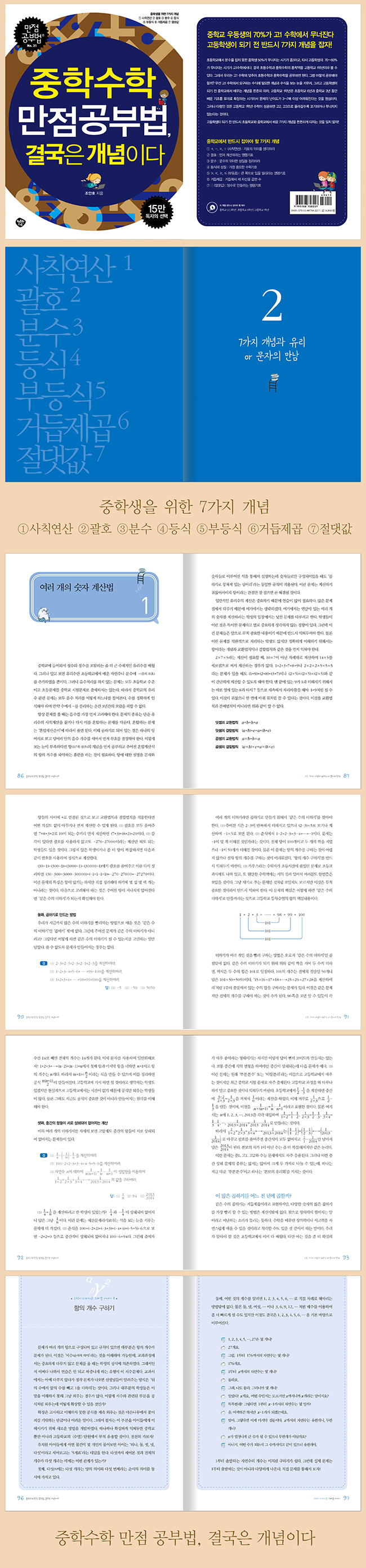
The seven concepts of middle school mathematics covered here are as follows:
① Arithmetic symbols, ② Parentheses, ③ Properties of fractions, ④ Properties of equality, ⑤ Properties of inequality, ⑥ Absolute value, ⑦ Exponentiation
These seven concepts will help you understand how problems are created and predict how problems will be created in the future.
And there are parts that are not covered in middle school but suddenly appear in high school, leaving students confused. All concepts, including these, and how they expand are explained in an easy and fun way.
Advanced mathematics, which integrates liberal arts and science, has become a necessity rather than an option.
If you build a solid foundation in elementary school mathematics and expand your concepts in middle school mathematics, you will definitely be able to master high school mathematics.
This book is a revised edition of 『Complete Middle School Math with 7 Concepts』 and 『7 Conceptual Math for Middle School Students』.
Elementary mathematics focuses on numerical operations, middle school mathematics focuses on formulas, and high school mathematics is a variety of extensions of the formulas learned in middle school.
If you look at it broadly, the final goal of elementary and middle school mathematics is the first year of high school, as the formulas learned in elementary and middle school are expanded in the first year of high school.
The seven concepts of middle school mathematics covered here are as follows:
① Arithmetic symbols, ② Parentheses, ③ Properties of fractions, ④ Properties of equality, ⑤ Properties of inequality, ⑥ Absolute value, ⑦ Exponentiation
These seven concepts will help you understand how problems are created and predict how problems will be created in the future.
And there are parts that are not covered in middle school but suddenly appear in high school, leaving students confused. All concepts, including these, and how they expand are explained in an easy and fun way.
Advanced mathematics, which integrates liberal arts and science, has become a necessity rather than an option.
If you build a solid foundation in elementary school mathematics and expand your concepts in middle school mathematics, you will definitely be able to master high school mathematics.
- You can preview some of the book's contents.
Preview
index
Prologue: Middle School Math: 7 Concepts to Conclude
Part 1.
How to Score Perfect Score in Middle School Math: Analyze 7 Concepts
0.
Explaining seven concepts, from the four basic operations to absolute values.
1.
Think about the meaning of the four arithmetic operation symbols (+, ?, ×, ÷)
2.
Parentheses are a command to calculate first.
3.
Summarize the great properties of fractions.
4.
The property of equations is the most important mathematical symbol.
5.
Inequality signs (>, <, ≥, ≤) are command symbols to open the mouth to the larger side.
6.
A power is a number that is multiplied by itself repeatedly.
7.
The absolute value (| |) is a command symbol to make it positive.
Part 2.
The meeting of 7 concepts and rational numbers or letters
0.
Calculation of rational numbers or (or) letters
1.
Multiple number calculation method
2.
The meeting of unknown and unknown
3.
Let's distinguish between the four basic arithmetic operations of unknown variables and those that can be calculated.
4.
The meeting of numbers and letters (unknown numbers)
5.
An eye for polynomials (terms, number of terms, degree, etc.)
6.
Types of equations in middle school mathematics
7.
50% of middle school math is about college entrance exams.
8.
Arithmetic operations on numbers or linear equations
9.
The meeting of equations and equal signs
10.
Solve ax=b at the end of every linear equation
11.
An identity that always holds true
12.
Ratios and proportions that should have been properly learned in elementary school
13.
The meeting of the ratio and the equal sign that requires understanding, not formulas
14.
Proportional distribution
15.
The meeting of two equations
16.
Perfect use of equations
17.
The meeting of exponentiation and arithmetic
Part 3.
The meeting of equations and inequalities and math problem solver 0
0.
7 concepts + properties of 0
1.
'0' that was not originally non-existent but was and then ceased to exist
2.
An encounter where the sum is 0
3.
An encounter where the product becomes 0
4.
Inequalities where the sum or product is not 0
5.
Four basic operations of inequalities
6.
Application of inequalities
Part 4.
Concepts for achieving full marks: real numbers and quadratic equations
0.
Quadratic equations used up to the third year of high school
1.
Diet machine, square root
2.
Characteristics of mistakes not found in textbooks
3.
The relationship between irrational numbers and absolute values (| |)
4.
The four basic arithmetic operations that require speed practice
5.
Multiplication formulas to learn quickly before factoring
6.
Factorization to convert two or more terms into monomials
7.
Various factorization problems to learn as a problem type
8.
Preservation of common divisors that are preserved when two numbers are subtracted
9.
Solving quadratic equations by factoring
10.
Quadratic equation with degree 2
11.
Solving quadratic equations in perfect square form
12.
Roots and Coefficients and Their Relationship
|Epilogue| It Should Be Easy for Me, Not Math Problems
[Special Story on Making Math Easy]
1.
Why should we calculate multiplication before addition?
2.
(Concept) + (Part) = (Summary)
3.
Distinction between fractions and rational numbers
4.
Types of equations
5.
powers of 10
6.
Eyes that see |x|, the more you see, the more beautiful it becomes
7.
There is rhythm to solving math problems.
8.
Find the number of protests
9.
Expressing using letters
10.
Why on earth do we learn identities?
11.
Why is 20 1?
12.
Let's divide by zero!
13.
What is the difference between rational and irrational numbers?
14.
What if the exponent contains a negative sign or a fraction?
15.
How is the total number of matches in a tournament calculated?
16.
Are factor and divisor the same thing?
17.
Solve using the properties of equations and equality
18.
Eyes that see food
Part 1.
How to Score Perfect Score in Middle School Math: Analyze 7 Concepts
0.
Explaining seven concepts, from the four basic operations to absolute values.
1.
Think about the meaning of the four arithmetic operation symbols (+, ?, ×, ÷)
2.
Parentheses are a command to calculate first.
3.
Summarize the great properties of fractions.
4.
The property of equations is the most important mathematical symbol.
5.
Inequality signs (>, <, ≥, ≤) are command symbols to open the mouth to the larger side.
6.
A power is a number that is multiplied by itself repeatedly.
7.
The absolute value (| |) is a command symbol to make it positive.
Part 2.
The meeting of 7 concepts and rational numbers or letters
0.
Calculation of rational numbers or (or) letters
1.
Multiple number calculation method
2.
The meeting of unknown and unknown
3.
Let's distinguish between the four basic arithmetic operations of unknown variables and those that can be calculated.
4.
The meeting of numbers and letters (unknown numbers)
5.
An eye for polynomials (terms, number of terms, degree, etc.)
6.
Types of equations in middle school mathematics
7.
50% of middle school math is about college entrance exams.
8.
Arithmetic operations on numbers or linear equations
9.
The meeting of equations and equal signs
10.
Solve ax=b at the end of every linear equation
11.
An identity that always holds true
12.
Ratios and proportions that should have been properly learned in elementary school
13.
The meeting of the ratio and the equal sign that requires understanding, not formulas
14.
Proportional distribution
15.
The meeting of two equations
16.
Perfect use of equations
17.
The meeting of exponentiation and arithmetic
Part 3.
The meeting of equations and inequalities and math problem solver 0
0.
7 concepts + properties of 0
1.
'0' that was not originally non-existent but was and then ceased to exist
2.
An encounter where the sum is 0
3.
An encounter where the product becomes 0
4.
Inequalities where the sum or product is not 0
5.
Four basic operations of inequalities
6.
Application of inequalities
Part 4.
Concepts for achieving full marks: real numbers and quadratic equations
0.
Quadratic equations used up to the third year of high school
1.
Diet machine, square root
2.
Characteristics of mistakes not found in textbooks
3.
The relationship between irrational numbers and absolute values (| |)
4.
The four basic arithmetic operations that require speed practice
5.
Multiplication formulas to learn quickly before factoring
6.
Factorization to convert two or more terms into monomials
7.
Various factorization problems to learn as a problem type
8.
Preservation of common divisors that are preserved when two numbers are subtracted
9.
Solving quadratic equations by factoring
10.
Quadratic equation with degree 2
11.
Solving quadratic equations in perfect square form
12.
Roots and Coefficients and Their Relationship
|Epilogue| It Should Be Easy for Me, Not Math Problems
[Special Story on Making Math Easy]
1.
Why should we calculate multiplication before addition?
2.
(Concept) + (Part) = (Summary)
3.
Distinction between fractions and rational numbers
4.
Types of equations
5.
powers of 10
6.
Eyes that see |x|, the more you see, the more beautiful it becomes
7.
There is rhythm to solving math problems.
8.
Find the number of protests
9.
Expressing using letters
10.
Why on earth do we learn identities?
11.
Why is 20 1?
12.
Let's divide by zero!
13.
What is the difference between rational and irrational numbers?
14.
What if the exponent contains a negative sign or a fraction?
15.
How is the total number of matches in a tournament calculated?
16.
Are factor and divisor the same thing?
17.
Solve using the properties of equations and equality
18.
Eyes that see food
Detailed image
Into the book
If your math grades are at the bottom, you probably think you have to do whatever it takes to improve your grades.
I agree to some extent, but it is increasingly difficult to maintain that kind of study method in the long run, and it is impossible to do anything about it in the face of mathematics.
--- p.22
I created the equation (concept) + (part) = (summary).
When studying mathematics, you must first study the concepts.
Of course, just learning the concepts doesn't mean you'll be good at math right away.
Even after learning the concepts, you still need to solve problems that fall into each section.
--- p.39
The textbook defines an equation as 'an equation that is either true or false depending on the value of x.'
However, to understand this definition, you often have to spend a long time solving equations and learning functions to finally understand its meaning.
So when I teach students, I first have them memorize equations as 'equations with unknown variables'.
--- p.54
A sense of numbers isn't something that's built overnight.
Middle school is not a time to learn numerical operations, but rather a time to focus on handling and understanding formulas, so no workbook provides enough problems.
Therefore, you should memorize the powers of simple numbers such as 2, 3, 5, etc. to some extent, even if it means writing them down separately at the top of your desk.
--- p.66
Now that we've learned about inequalities, it's time to learn the four basic operations on inequalities.
Although the four basic operations of inequalities are not covered in the curriculum, they are sometimes included in problems, which confuses students.
So, some teachers at schools or academies teach this, but students often memorize it as if it were a formula and get stuck trying to solve it.
This is because there are many formulas used in the calculation of inequalities, and some are mixed or unlearned.
I agree to some extent, but it is increasingly difficult to maintain that kind of study method in the long run, and it is impossible to do anything about it in the face of mathematics.
--- p.22
I created the equation (concept) + (part) = (summary).
When studying mathematics, you must first study the concepts.
Of course, just learning the concepts doesn't mean you'll be good at math right away.
Even after learning the concepts, you still need to solve problems that fall into each section.
--- p.39
The textbook defines an equation as 'an equation that is either true or false depending on the value of x.'
However, to understand this definition, you often have to spend a long time solving equations and learning functions to finally understand its meaning.
So when I teach students, I first have them memorize equations as 'equations with unknown variables'.
--- p.54
A sense of numbers isn't something that's built overnight.
Middle school is not a time to learn numerical operations, but rather a time to focus on handling and understanding formulas, so no workbook provides enough problems.
Therefore, you should memorize the powers of simple numbers such as 2, 3, 5, etc. to some extent, even if it means writing them down separately at the top of your desk.
--- p.66
Now that we've learned about inequalities, it's time to learn the four basic operations on inequalities.
Although the four basic operations of inequalities are not covered in the curriculum, they are sometimes included in problems, which confuses students.
So, some teachers at schools or academies teach this, but students often memorize it as if it were a formula and get stuck trying to solve it.
This is because there are many formulas used in the calculation of inequalities, and some are mixed or unlearned.
--- p.240
Publisher's Review
[Author's Note]
“Many students self-diagnose that they have weak mathematical skills.
The likelihood of poor math grades due to poor application skills is not that great, at least until high school.
Because high school mathematics is not a course that elicits mathematical thinking, it does not place value on things like applied skills or creativity in mathematics.”
A story about middle school math concepts for advanced math!
This book is about middle school math concepts written by Jo An-ho, a math study method expert.
If 50% of middle school students who failed to grasp their place in elementary school collapse during their third year of middle school, then 70-80% of students who advance to high school collapse during their first year of high school.
Not only average students, but more than 70% of middle school honor students also fall apart in their first year of high school, so you should not be complacent just because your school grades are stable.
To truly develop skills, students need to develop an eye for the concepts and formulas required for math in the first year of high school, when they begin to crumble.
Let's meet Mr. Jo An-ho, who calls himself a math interpreter, and talk about middle school math concepts that will lead you to a perfect score.
“Many students self-diagnose that they have weak mathematical skills.
The likelihood of poor math grades due to poor application skills is not that great, at least until high school.
Because high school mathematics is not a course that elicits mathematical thinking, it does not place value on things like applied skills or creativity in mathematics.”
A story about middle school math concepts for advanced math!
This book is about middle school math concepts written by Jo An-ho, a math study method expert.
If 50% of middle school students who failed to grasp their place in elementary school collapse during their third year of middle school, then 70-80% of students who advance to high school collapse during their first year of high school.
Not only average students, but more than 70% of middle school honor students also fall apart in their first year of high school, so you should not be complacent just because your school grades are stable.
To truly develop skills, students need to develop an eye for the concepts and formulas required for math in the first year of high school, when they begin to crumble.
Let's meet Mr. Jo An-ho, who calls himself a math interpreter, and talk about middle school math concepts that will lead you to a perfect score.
GOODS SPECIFICS
- Date of issue: August 8, 2020
- Page count, weight, size: 328 pages | 576g | 170*225*20mm
- ISBN13: 9791188758227
- ISBN10: 1188758225
- KC Certification: Certification Type: Conformity Confirmation
You may also like
카테고리
korean


korean

![GQ KOREA Mark (Monthly): December [2025]](http://librairie.coreenne.fr/cdn/shop/files/8ef265dbbfbf186523ed75ba7319009d.jpg?v=1765340328&width=3840)


