

A fun botanical story that will keep you reading all night
 |
Description
Book Introduction
Bestselling Youth Science Books Chosen by Parents and Teachers
The "Botany" edition of the "Fun Night" series has been released.
Textbooks alone are not enough.
The 'Fun Night' series is a representative series in which experts explain various fields to middle and high school students in an easy-to-understand manner. It has been consistently publishing 18 books for 6 years, receiving love from teachers and parents.
During this time, we covered topics such as physics, life sciences, mathematics, chemistry, evolution, astronomy, and anatomy.
It was selected as an excellent science book by the Ministry of Science, ICT and Future Planning (Korea Foundation for the Advancement of Science and Creativity) in 2013 and as a recommended book for youth by the Korea Publication Industry Promotion Agency in 2016. Each volume published is continuously selected as a recommended book for youth by the Office of Education Library.
(Hanuri Open Education Recommended Books, School Library Journal Recommended Books, etc.)
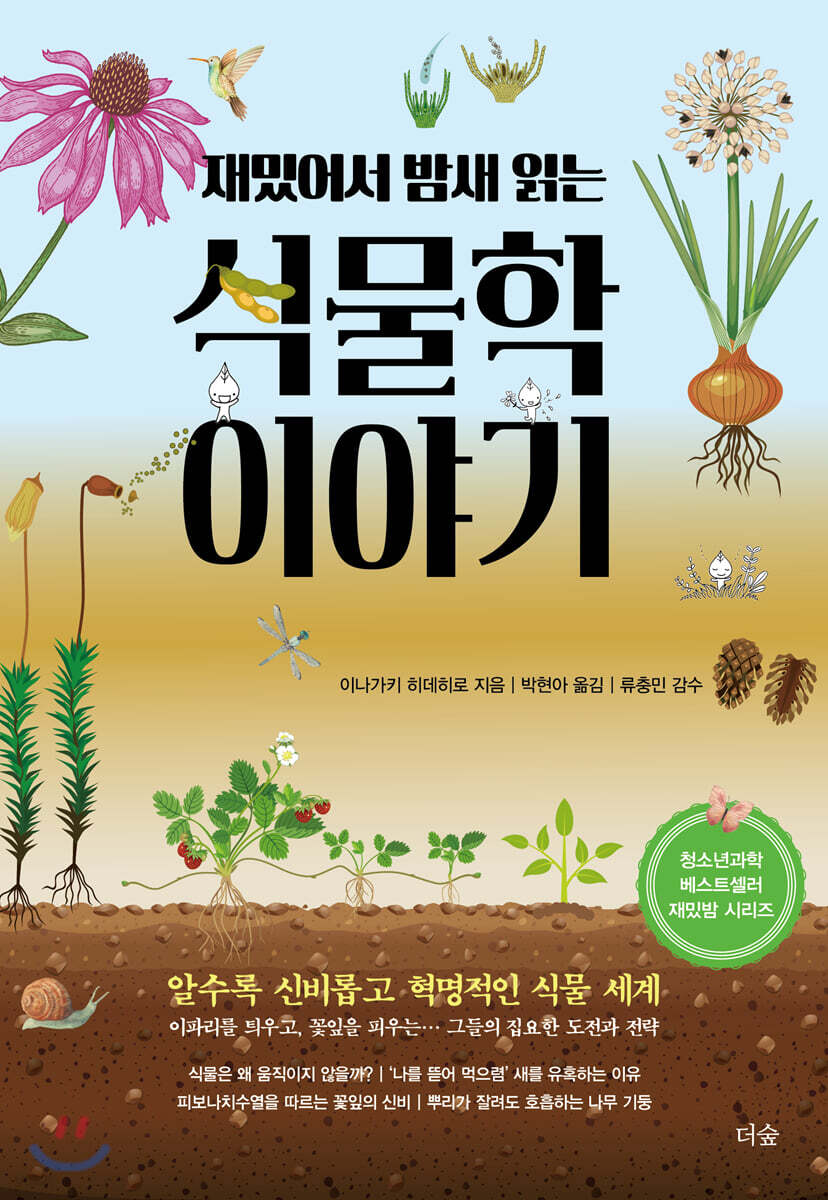
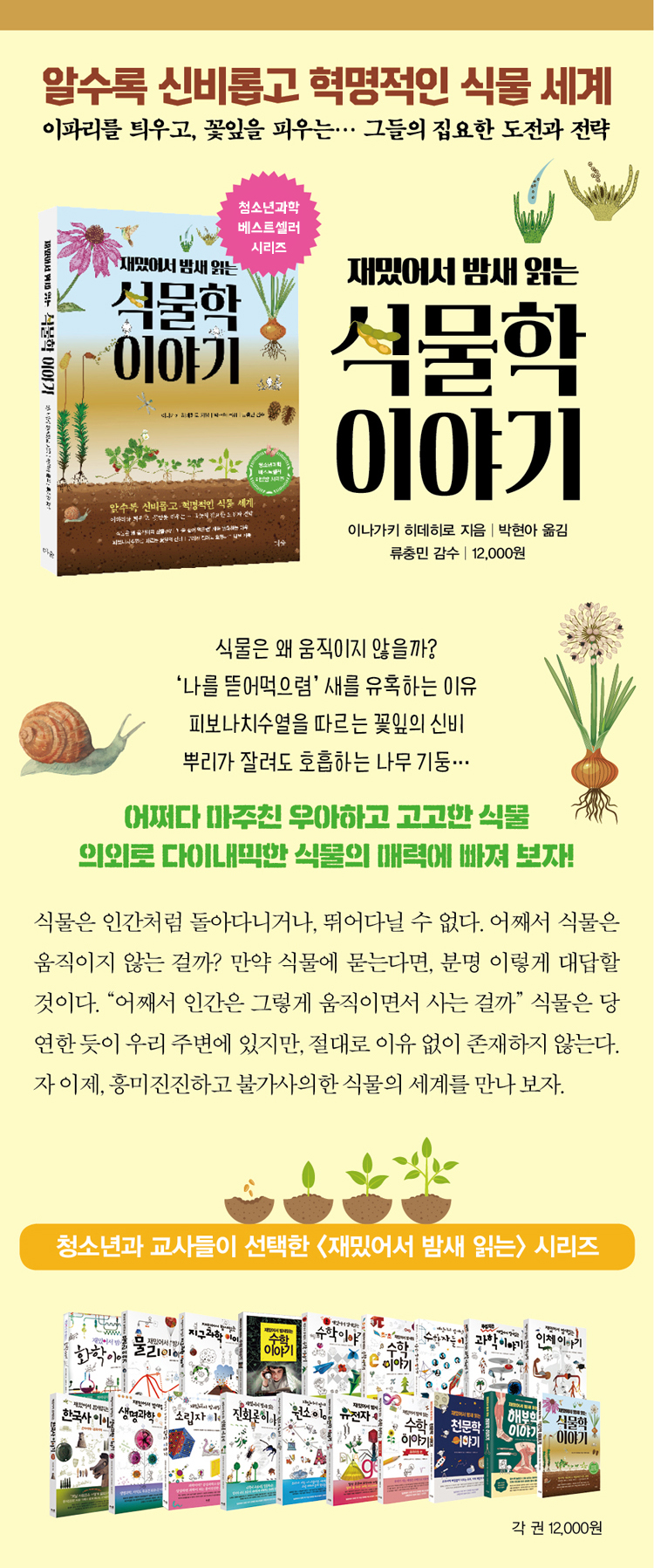
The recently published 『Botanical Stories That Are So Fun You'll Read Them All Night』 introduces the mysterious world of plants at a level suitable for young people.
Botany is a branch of biology.
Although now overshadowed by genetics and molecular biology, it was once at the forefront of modern and early contemporary biology.
As sustainable environmental issues have recently come to the forefront, educational policies are also focusing on ecological education, which involves growing and observing plants, and plants are also re-emerging as a cultural trend.
Curiosity about plants that we used to pass by without noticing is growing.
The author, Hidehiro Inagaki, is a botanist known for writing fascinating plant education books.
He majored in weed ecology and has written over 30 books, including “Fighting Plants,” “10 Plants That Changed World History,” and “The Birth of Edo, the Plant City,” which received favorable reviews from domestic readers.
The author has refined the plant story for teenagers.
He emphasizes that botany may seem dry and boring, but it is a fascinating field full of mysteries (p. 6).
As the book says, plants are active organisms that persistently strategize and challenge their environment.
It attracts birds to spread its seeds (p. 138) and causes flowers to bloom.
They create poison (page 69) to avoid being eaten carelessly, and when conditions are right for survival, they sprout at the right time (page 80). They are persistent and active.
The "Botany" edition of the "Fun Night" series has been released.
Textbooks alone are not enough.
The 'Fun Night' series is a representative series in which experts explain various fields to middle and high school students in an easy-to-understand manner. It has been consistently publishing 18 books for 6 years, receiving love from teachers and parents.
During this time, we covered topics such as physics, life sciences, mathematics, chemistry, evolution, astronomy, and anatomy.
It was selected as an excellent science book by the Ministry of Science, ICT and Future Planning (Korea Foundation for the Advancement of Science and Creativity) in 2013 and as a recommended book for youth by the Korea Publication Industry Promotion Agency in 2016. Each volume published is continuously selected as a recommended book for youth by the Office of Education Library.
(Hanuri Open Education Recommended Books, School Library Journal Recommended Books, etc.)
The recently published 『Botanical Stories That Are So Fun You'll Read Them All Night』 introduces the mysterious world of plants at a level suitable for young people.
Botany is a branch of biology.
Although now overshadowed by genetics and molecular biology, it was once at the forefront of modern and early contemporary biology.
As sustainable environmental issues have recently come to the forefront, educational policies are also focusing on ecological education, which involves growing and observing plants, and plants are also re-emerging as a cultural trend.
Curiosity about plants that we used to pass by without noticing is growing.
The author, Hidehiro Inagaki, is a botanist known for writing fascinating plant education books.
He majored in weed ecology and has written over 30 books, including “Fighting Plants,” “10 Plants That Changed World History,” and “The Birth of Edo, the Plant City,” which received favorable reviews from domestic readers.
The author has refined the plant story for teenagers.
He emphasizes that botany may seem dry and boring, but it is a fascinating field full of mysteries (p. 6).
As the book says, plants are active organisms that persistently strategize and challenge their environment.
It attracts birds to spread its seeds (p. 138) and causes flowers to bloom.
They create poison (page 69) to avoid being eaten carelessly, and when conditions are right for survival, they sprout at the right time (page 80). They are persistent and active.
- You can preview some of the book's contents.
Preview
index
Part I: The Amazing Story of Plants
How big can a tree grow?
The Da Vinci Code of Plants
How to get the answers you want at a flower shop
For whom do flowers bloom?
Why do butterflies linger on rapeseed leaves?
Flower's First Love Story
The Decline of Triceratops and the Evolution of Plants
Where is the apple stem?
The more you know, the more different the Western dandelion is.
Design inspired by violets
Why do maple leaves change color?
The poison of a fascinating plant
Why are pine trees always green?
Part II: Botany: A Fun Way to Read All Night
I don't sprout
Is bamboo a tree or a grass?
Differences between carrots and radishes
Which came first, the tree or the grass?
'Mudari' is a compliment?
Why Plants Don't Move
Why are plants green?
Do plants have blood types?
The story behind cherry blossoms blooming and falling simultaneously
The secret of seeds we don't know
Mendel's laws of inheritance
The Secret of the Brilliant Colors of Corn
Part III: A Quick Look at Plant Stories
Neon signs like ripe fruit
The grass family that led human civilization
Botany in the Kitchen
If a radish grows, will it become a radish?
The fact that bananas have no seeds
Dogweed is a high-performance plant
The ivy we loved
male and female trees
The wooden pillar is alive
Plant fiber that supports life
Planet of Plants, Earth
Conclusion
How big can a tree grow?
The Da Vinci Code of Plants
How to get the answers you want at a flower shop
For whom do flowers bloom?
Why do butterflies linger on rapeseed leaves?
Flower's First Love Story
The Decline of Triceratops and the Evolution of Plants
Where is the apple stem?
The more you know, the more different the Western dandelion is.
Design inspired by violets
Why do maple leaves change color?
The poison of a fascinating plant
Why are pine trees always green?
Part II: Botany: A Fun Way to Read All Night
I don't sprout
Is bamboo a tree or a grass?
Differences between carrots and radishes
Which came first, the tree or the grass?
'Mudari' is a compliment?
Why Plants Don't Move
Why are plants green?
Do plants have blood types?
The story behind cherry blossoms blooming and falling simultaneously
The secret of seeds we don't know
Mendel's laws of inheritance
The Secret of the Brilliant Colors of Corn
Part III: A Quick Look at Plant Stories
Neon signs like ripe fruit
The grass family that led human civilization
Botany in the Kitchen
If a radish grows, will it become a radish?
The fact that bananas have no seeds
Dogweed is a high-performance plant
The ivy we loved
male and female trees
The wooden pillar is alive
Plant fiber that supports life
Planet of Plants, Earth
Conclusion
Detailed image
Into the book
Plants cannot move or jump around like humans.
If you ask a plant why it doesn't move, it will surely answer like this.
“Why do humans live by moving like that?” Animals cannot survive without moving.
You cannot survive without finding food and eating it.
Plants don't need that.
So there is no need to move.
(Omitted) The life of plants is very unique.
How come plants don't have to move around and eat to find food like animals?
--- "Why Plants Don't Move" from 'The Somehow Unique Life of Plants'
There is no significant difference in the basic lifestyles of plants and animals.
3.8 billion years ago, when life arose on Earth, there was no difference between animals and plants.
Plants and animals evolved from a common ancestor.
--- "Why Plants Don't Move" from 'The Somehow Unique Life of Plants'
In other words, the angle between consecutive primitive cells, 137.5 degrees, becomes the golden angle.
This is the most balanced angle that leads to the Fibonacci sequence.
The reason why we can see this sequence of regularities in the leaves of plants is to maintain balance so that all leaves do not overlap and receive light evenly, allowing the stem to grow strong.
Of course, not all plant leaves are arranged in the golden ratio.
Many plants also follow a temperature closer to 137.5 degrees, which is 2/5 (144 degrees) or 3/8 (135 degrees).
It's fascinating how plants follow the golden ratio or complex sequences.
--- From "The Da Vinci Code of Plants" 'The Very Elaborate Arrangement of Leaves'
Life arose on Earth 3.8 billion years ago.
One day, a creature with a terrifying evolution appeared.
It was 'phytoplankton', the ancestor of plants.
Phytoplankton with chloroplasts photosynthesize and create energy from carbon dioxide and water.
--- From "Planet Earth of Plants" '3.8 Billion Years of History of the Earth'
Plants are a wonder to humans.
Some people feel offended when they see a beautiful butterfly, and some people are scared when they see a cute puppy.
But it is rare to find someone who dislikes flowers.
People feel beauty when they see flowers.
Plants bloom pretty flowers to attract insects and transport pollen.
Plants do not bloom for humans.
It's no wonder that insects that feed on nectar and pollen love flowers.
--- From the "Conclusion"
Some people might think, 'Studying botany won't help you in life.'
There are not many cases where botany is directly helpful in actual business or social life.
However, since ancient times, people have used plants for various purposes in their lives.
The vegetables and fruits we eat are all plants.
Wood used for pillars and boards is also a plant.
It is a plant that makes hemp and cotton into clothes.
If you ask a plant why it doesn't move, it will surely answer like this.
“Why do humans live by moving like that?” Animals cannot survive without moving.
You cannot survive without finding food and eating it.
Plants don't need that.
So there is no need to move.
(Omitted) The life of plants is very unique.
How come plants don't have to move around and eat to find food like animals?
--- "Why Plants Don't Move" from 'The Somehow Unique Life of Plants'
There is no significant difference in the basic lifestyles of plants and animals.
3.8 billion years ago, when life arose on Earth, there was no difference between animals and plants.
Plants and animals evolved from a common ancestor.
--- "Why Plants Don't Move" from 'The Somehow Unique Life of Plants'
In other words, the angle between consecutive primitive cells, 137.5 degrees, becomes the golden angle.
This is the most balanced angle that leads to the Fibonacci sequence.
The reason why we can see this sequence of regularities in the leaves of plants is to maintain balance so that all leaves do not overlap and receive light evenly, allowing the stem to grow strong.
Of course, not all plant leaves are arranged in the golden ratio.
Many plants also follow a temperature closer to 137.5 degrees, which is 2/5 (144 degrees) or 3/8 (135 degrees).
It's fascinating how plants follow the golden ratio or complex sequences.
--- From "The Da Vinci Code of Plants" 'The Very Elaborate Arrangement of Leaves'
Life arose on Earth 3.8 billion years ago.
One day, a creature with a terrifying evolution appeared.
It was 'phytoplankton', the ancestor of plants.
Phytoplankton with chloroplasts photosynthesize and create energy from carbon dioxide and water.
--- From "Planet Earth of Plants" '3.8 Billion Years of History of the Earth'
Plants are a wonder to humans.
Some people feel offended when they see a beautiful butterfly, and some people are scared when they see a cute puppy.
But it is rare to find someone who dislikes flowers.
People feel beauty when they see flowers.
Plants bloom pretty flowers to attract insects and transport pollen.
Plants do not bloom for humans.
It's no wonder that insects that feed on nectar and pollen love flowers.
--- From the "Conclusion"
Some people might think, 'Studying botany won't help you in life.'
There are not many cases where botany is directly helpful in actual business or social life.
However, since ancient times, people have used plants for various purposes in their lives.
The vegetables and fruits we eat are all plants.
Wood used for pillars and boards is also a plant.
It is a plant that makes hemp and cotton into clothes.
--- From the "Conclusion"
Publisher's Review
'The gentle plant' is a human illusion
The surprisingly dynamic and tenacious life of plants
The interesting fact that the number of petals on a plant follows the Fibonacci sequence makes mathematics accessible even to those who find arithmetic difficult.
The arrangement of each leaf of a plant, called leaf order, also follows the Fibonacci sequence, with each leaf growing at a slightly different angle so that it can receive sunlight equally.
Such sequences are frequently found in nature.
Strangely enough, mathematics is hidden within the very nature of living things (page 18).
Are tomatoes vegetables or fruits? In the United States, a court case was held over this question.
The terms 'vegetable' and 'fruit' are not botanical distinctions, but rather a classification system created for human convenience.
The definitions of vegetables and fruits vary from country to country (p. 84).
Even in the plant world, there is no clear distinction between 'tree' and 'grass'.
It's just a way that humans came up with to make it easier to distinguish.
Originally, there was no clear distinction in nature.
Besides, 『Botany Stories That Are Fun and Will Keep You Reading All Night』 is full of questions and answers that stimulate your curiosity.
How big can a tree be? Why are plants green? Why do cherry blossoms bloom and fall all at once? Which side of a tangerine is up and which side is down? Why do maple leaves turn red? What is the caffeine poison that fascinates humans? Why are pine trees always green? Why do plants remain motionless? What is the crucial difference between carrots and radishes? Why don't animals have chlorophyll? How do you cut an onion without crying? What are the characteristics of plant cells in plant fibers, such as tissue paper and paper, that have long been with humans?
Moreover, the human instinct to drool at the sight of a red neon sign for a restaurant explains the ancient instinct of mankind to devour red ripe fruits.
It depicts the struggles of gymnosperms and angiosperms to survive by repeatedly adopting new strategies and challenges to leave seeds.
It is the history of evolution that humans and plants have walked together.
When viewed through the eyes of a plant
A new look at the other side of the world
This book contains all the questions we had about plants that we never really wondered about because they were so natural to us.
Why should we learn about plants? Plants have not only provided human food, but also provided clothing and building materials, and have been closely associated with human life.
It is a living entity that has survived alongside humans throughout the 3.8 billion years of Earth's history.
We usually use plants as static and helpless rhetoric.
Vegetative state, vegetative government, vegetative ○○, etc.
To the human eye, plants, which are immobile beings, appear quiet and static.
But plants are by no means helpless.
Even if humans spread cement on top of the soil for their convenience, the struggles of plants to spread their leaves and roots between the asphalt are not much different from human life.
At the end of the book, the author says:
In the past, all kinds of things were made from plants, including food, clothing, housing, tools, fertilizers, medicines, and fuel.
In modern times, when we make so many things from chemicals and petroleum products, it may seem like the days of relying on plants are a distant memory.
Chemical and petroleum products become waste once they are used up.
However, everything made from plants returns to the earth after use.
(Page 197)
Grasses have been with us since the beginning of human civilization.
It has become a useful crop in settlements as a cultivated plant.
The 'plants' that humans domesticated as food went through a process called 'cultivation'.
Plants try to leave behind many offspring with diversity, but the rich diversity of plants is not very beneficial for human cultivation (p. 100).
Once you sow the seeds, you need plants that grow in a consistent manner so that you can harvest them all at once.
However, plants that grow in a haphazard and unruly manner are not only unsuitable for cultivation, but are also a dynamic and unique plant life in themselves.
When we look at the world through the eyes of plants, we see a new side of the world that was previously invisible due to human-centered judgment.
The author, who is spreading the charm of 'botany' to the world, has rolled up his sleeves for young people and vividly tells the story of the lives of plants.
The surprisingly dynamic and tenacious life of plants
The interesting fact that the number of petals on a plant follows the Fibonacci sequence makes mathematics accessible even to those who find arithmetic difficult.
The arrangement of each leaf of a plant, called leaf order, also follows the Fibonacci sequence, with each leaf growing at a slightly different angle so that it can receive sunlight equally.
Such sequences are frequently found in nature.
Strangely enough, mathematics is hidden within the very nature of living things (page 18).
Are tomatoes vegetables or fruits? In the United States, a court case was held over this question.
The terms 'vegetable' and 'fruit' are not botanical distinctions, but rather a classification system created for human convenience.
The definitions of vegetables and fruits vary from country to country (p. 84).
Even in the plant world, there is no clear distinction between 'tree' and 'grass'.
It's just a way that humans came up with to make it easier to distinguish.
Originally, there was no clear distinction in nature.
Besides, 『Botany Stories That Are Fun and Will Keep You Reading All Night』 is full of questions and answers that stimulate your curiosity.
How big can a tree be? Why are plants green? Why do cherry blossoms bloom and fall all at once? Which side of a tangerine is up and which side is down? Why do maple leaves turn red? What is the caffeine poison that fascinates humans? Why are pine trees always green? Why do plants remain motionless? What is the crucial difference between carrots and radishes? Why don't animals have chlorophyll? How do you cut an onion without crying? What are the characteristics of plant cells in plant fibers, such as tissue paper and paper, that have long been with humans?
Moreover, the human instinct to drool at the sight of a red neon sign for a restaurant explains the ancient instinct of mankind to devour red ripe fruits.
It depicts the struggles of gymnosperms and angiosperms to survive by repeatedly adopting new strategies and challenges to leave seeds.
It is the history of evolution that humans and plants have walked together.
When viewed through the eyes of a plant
A new look at the other side of the world
This book contains all the questions we had about plants that we never really wondered about because they were so natural to us.
Why should we learn about plants? Plants have not only provided human food, but also provided clothing and building materials, and have been closely associated with human life.
It is a living entity that has survived alongside humans throughout the 3.8 billion years of Earth's history.
We usually use plants as static and helpless rhetoric.
Vegetative state, vegetative government, vegetative ○○, etc.
To the human eye, plants, which are immobile beings, appear quiet and static.
But plants are by no means helpless.
Even if humans spread cement on top of the soil for their convenience, the struggles of plants to spread their leaves and roots between the asphalt are not much different from human life.
At the end of the book, the author says:
In the past, all kinds of things were made from plants, including food, clothing, housing, tools, fertilizers, medicines, and fuel.
In modern times, when we make so many things from chemicals and petroleum products, it may seem like the days of relying on plants are a distant memory.
Chemical and petroleum products become waste once they are used up.
However, everything made from plants returns to the earth after use.
(Page 197)
Grasses have been with us since the beginning of human civilization.
It has become a useful crop in settlements as a cultivated plant.
The 'plants' that humans domesticated as food went through a process called 'cultivation'.
Plants try to leave behind many offspring with diversity, but the rich diversity of plants is not very beneficial for human cultivation (p. 100).
Once you sow the seeds, you need plants that grow in a consistent manner so that you can harvest them all at once.
However, plants that grow in a haphazard and unruly manner are not only unsuitable for cultivation, but are also a dynamic and unique plant life in themselves.
When we look at the world through the eyes of plants, we see a new side of the world that was previously invisible due to human-centered judgment.
The author, who is spreading the charm of 'botany' to the world, has rolled up his sleeves for young people and vividly tells the story of the lives of plants.
GOODS SPECIFICS
- Date of issue: August 30, 2019
- Page count, weight, size: 202 pages | 330g | 146*210*20mm
- ISBN13: 9791186900932
- ISBN10: 1186900938
You may also like
카테고리
korean


korean

![GQ KOREA Mark (Monthly): December [2025]](http://librairie.coreenne.fr/cdn/shop/files/8ef265dbbfbf186523ed75ba7319009d.jpg?v=1765340328&width=3840)


