

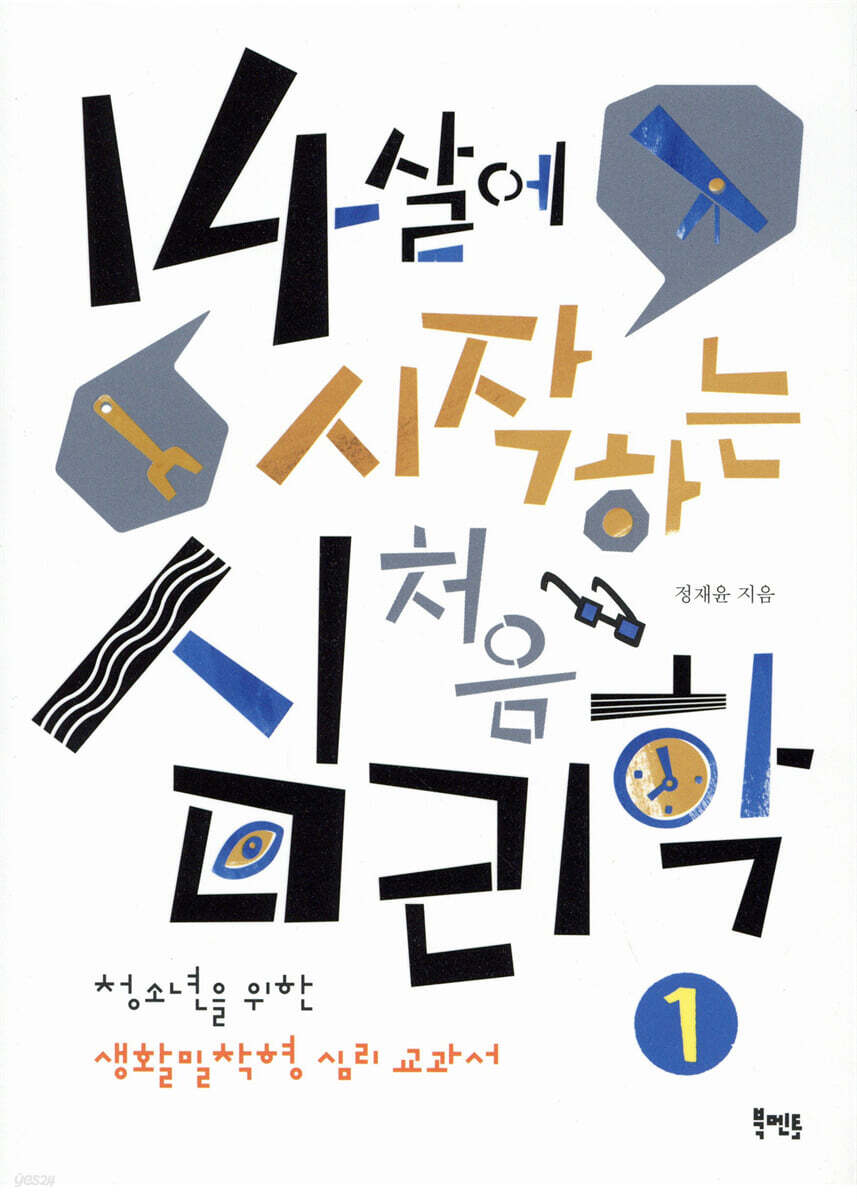
First psychology starting at age 14
 |
Description
Book Introduction
At the age of fourteen, your body, mind, and spirit grow along with yours.
Adolescence is a stormy time, filled with people you don't understand, and sometimes even you can't understand yourself! Beyond strange behaviors, a psychology textbook for children who are just beginning to wonder about the invisible "heart" has been published: "First Psychology at Age 14."
Adolescence is a time when children still receive help from adults in everything, but they begin to increasingly have to make their own judgments and decisions.
『Psychology for Beginners at Age 14』, which explains 'psychology' in the form of counseling and explanation to help you become wise in situations where you need to make a choice, is an introductory book to psychology written so that not only teenagers but also anyone who is curious about the 'psychology' of themselves and others can easily understand psychology.
Author Jae-yoon Jeong, who graduated from the Department of Korean Language Education at Seoul National University and studied general linguistics at the University of Cologne in Germany, has been editing, translating, and writing books for young adults. Through this book, he uses witty storytelling to unravel the big and small misunderstandings and concerns we encounter in our daily lives, and then explains related psychological experiments in a friendly and detailed manner.
Adolescence is a stormy time, filled with people you don't understand, and sometimes even you can't understand yourself! Beyond strange behaviors, a psychology textbook for children who are just beginning to wonder about the invisible "heart" has been published: "First Psychology at Age 14."
Adolescence is a time when children still receive help from adults in everything, but they begin to increasingly have to make their own judgments and decisions.
『Psychology for Beginners at Age 14』, which explains 'psychology' in the form of counseling and explanation to help you become wise in situations where you need to make a choice, is an introductory book to psychology written so that not only teenagers but also anyone who is curious about the 'psychology' of themselves and others can easily understand psychology.
Author Jae-yoon Jeong, who graduated from the Department of Korean Language Education at Seoul National University and studied general linguistics at the University of Cologne in Germany, has been editing, translating, and writing books for young adults. Through this book, he uses witty storytelling to unravel the big and small misunderstandings and concerns we encounter in our daily lives, and then explains related psychological experiments in a friendly and detailed manner.
- You can preview some of the book's contents.
Preview
index
Preface - A Different Way to Understand Myself and Others
Chapter 1: We Live in Illusion: We Can't See Even with Our Eyes Wide Open: The Illusion of Attention
Are confident people more capable? : The illusion of confidence
Remembering Only What You Want to Remember?: The Memory Illusion
Calling it expensive first: The anchoring effect
Chapter 2: No matter how hard we try, we still fall into error.
It was inevitable: cognitive dissonance
Always later than expected: the planning fallacy
Does Having Lots of Books at Home Make You Study Better?: A Misconception
This time, definitely: the gambler's fallacy
Chapter 3: Circumstances Move Me
No one is helping me! : The bystander effect
Ordinary People Can Be Infinitely Evil: Obedience to Authority
Bullying to avoid being bullied? : The phenomenon of conformity
Is that guy originally like that?: Fundamental attribution error
Chapter 4: Bad Habits, Bad Thinking
See, I was right: confirmation bias
I knew it: hindsight bias
It's Not My Fault!: Selfish Bias
Is there anything to consider? : Heuristic
Chapter 5: Our Strange Psychology
That's my story: The Forer Effect
What You Wish For Comes True: The Pygmalion Effect
How much effort did I put in: The endowment effect
Hey, don't do it next time, what! : Delayed Gratification and Procrastination
Epilogue
References
Chapter 1: We Live in Illusion: We Can't See Even with Our Eyes Wide Open: The Illusion of Attention
Are confident people more capable? : The illusion of confidence
Remembering Only What You Want to Remember?: The Memory Illusion
Calling it expensive first: The anchoring effect
Chapter 2: No matter how hard we try, we still fall into error.
It was inevitable: cognitive dissonance
Always later than expected: the planning fallacy
Does Having Lots of Books at Home Make You Study Better?: A Misconception
This time, definitely: the gambler's fallacy
Chapter 3: Circumstances Move Me
No one is helping me! : The bystander effect
Ordinary People Can Be Infinitely Evil: Obedience to Authority
Bullying to avoid being bullied? : The phenomenon of conformity
Is that guy originally like that?: Fundamental attribution error
Chapter 4: Bad Habits, Bad Thinking
See, I was right: confirmation bias
I knew it: hindsight bias
It's Not My Fault!: Selfish Bias
Is there anything to consider? : Heuristic
Chapter 5: Our Strange Psychology
That's my story: The Forer Effect
What You Wish For Comes True: The Pygmalion Effect
How much effort did I put in: The endowment effect
Hey, don't do it next time, what! : Delayed Gratification and Procrastination
Epilogue
References
Into the book
"I think that rather than hastily giving advice and finding solutions, it is better to first acknowledge and accept their hearts and thoughts.
I've always believed that psychology is a discipline that focuses on understanding people, but I'm starting to think that in order to truly understand someone, you have to first have affection for them.
"Ultimately, psychology is the study of how to love people."
I've always believed that psychology is a discipline that focuses on understanding people, but I'm starting to think that in order to truly understand someone, you have to first have affection for them.
"Ultimately, psychology is the study of how to love people."
--- From the text
Publisher's Review
“Are you crazy?”
“I really don’t understand!”
I get angry at my friend who is always late for appointments.
My older sister who only talks about dieting is weird.
When I hate myself for only looking at my smartphone the day before the exam,
Knowing psychology brings your heart closer!
It is divided into five chapters, each of which deals with the hidden psychological processes behind the mistakes and errors we habitually commit and the wrong thoughts in uncontrollable situations: “Chapter 1: We Live in Illusion,” “Chapter 2: We Fall into Errors No Matter How Hard We Try,” “Chapter 3: Circumstances Move Me,” “Chapter 4: Wrong Habits, Wrong Thinking,” and “Chapter 5: Our Strange Psychology.”
"Beginner Psychology at 14" reminds us that humans are neither very rational nor very strong beings, and that we must always check our minds to avoid falling into delusion and error. This book will broaden and deepen our understanding of human existence by helping us understand the words and actions of others that we could never understand, and by objectively looking into our own minds that even we could not explain.
Psychology is the study of why people think this way and why they act that way.
Psychology is the study of trying to understand the psychology of people who behave strangely.
After all, psychology is the study of human behavior.
I hope this book will help you understand yourself and others better, and become a more rational thinker and action-oriented person.
--- 『Main Text』
A different way to understand myself and others
A Psychology Textbook for Teenagers
The psychological counseling center run by Shintong and Bangtong serves as a great community center for the village.
From teenagers who laugh and cry a lot, to the neighborhood jajangmyeon delivery man, to the wife with a luxury handbag.
Every day, people who are angry, frustrated, and curious about something come to seek out supernatural powers and divination.
'Why did he just leave without saying hello when he clearly saw me?'
'When I fell on the street, so many people were watching me, so why didn't anyone help me?'
'Why do the plans I make never come true?'
Everyone has experienced this in their daily lives, so it is familiar, but when faced with embarrassing situations, people who are at a loss each time are given a glass of special cocktail (of course, a non-alcoholic drink for teenagers) and listen to the 'inner thoughts' they reveal.
Instead of hasty advice and vague solutions, through various psychological studies and specific examples provided by Shintong and Bangtong, 'the cold-hearted friend who just passed me by' is still a kind friend who just fell into 'attentional blindness', 'the bad people who didn't help me when I fell' are people who became indifferent and lacked courage due to the 'bystander effect', and 'I who failed to stick to the plan' is an extremely human(?) being who falls prey to 'Hofstadter's Law' that cannot be avoided unless done so.
Psychological terms you've likely heard at least once are combined with everyday examples, and the author's loving and detailed interpretation of these concepts helps not only those who have visited a counseling center, but also readers who have had similar experiences, to realize the psychological mechanisms of their own minds that they were unaware of.
Furthermore, it humorously offers clues to problem solving and relationship restoration (they are 'old men' in terms of magic and divination), and it is filled with a clarity that is by no means light and a lot of warm affection for the other person.
At the end of each episode, the psychological terms that are the subject of the episode are concisely summarized, and examples from movies, books, and people are provided to enable a more vivid understanding, thereby guiding young people who are more familiar with psychology in the form of 'psychological tests' to kill time into the fascinating world of psychology as an 'academic subject'.
When we learn the scientific truth behind the very 'psychology' that makes us unable and unwilling to understand others or ourselves, we can love ourselves more generously and gain the strength of heart to truly empathize with others.
Psychology, which sits between the 'humanities' that study human values and the 'natural sciences' based on objective experiments and statistics, makes 'communication through empathy', a uniquely human ability, more rational and appropriate.
“I really don’t understand!”
I get angry at my friend who is always late for appointments.
My older sister who only talks about dieting is weird.
When I hate myself for only looking at my smartphone the day before the exam,
Knowing psychology brings your heart closer!
It is divided into five chapters, each of which deals with the hidden psychological processes behind the mistakes and errors we habitually commit and the wrong thoughts in uncontrollable situations: “Chapter 1: We Live in Illusion,” “Chapter 2: We Fall into Errors No Matter How Hard We Try,” “Chapter 3: Circumstances Move Me,” “Chapter 4: Wrong Habits, Wrong Thinking,” and “Chapter 5: Our Strange Psychology.”
"Beginner Psychology at 14" reminds us that humans are neither very rational nor very strong beings, and that we must always check our minds to avoid falling into delusion and error. This book will broaden and deepen our understanding of human existence by helping us understand the words and actions of others that we could never understand, and by objectively looking into our own minds that even we could not explain.
Psychology is the study of why people think this way and why they act that way.
Psychology is the study of trying to understand the psychology of people who behave strangely.
After all, psychology is the study of human behavior.
I hope this book will help you understand yourself and others better, and become a more rational thinker and action-oriented person.
--- 『Main Text』
A different way to understand myself and others
A Psychology Textbook for Teenagers
The psychological counseling center run by Shintong and Bangtong serves as a great community center for the village.
From teenagers who laugh and cry a lot, to the neighborhood jajangmyeon delivery man, to the wife with a luxury handbag.
Every day, people who are angry, frustrated, and curious about something come to seek out supernatural powers and divination.
'Why did he just leave without saying hello when he clearly saw me?'
'When I fell on the street, so many people were watching me, so why didn't anyone help me?'
'Why do the plans I make never come true?'
Everyone has experienced this in their daily lives, so it is familiar, but when faced with embarrassing situations, people who are at a loss each time are given a glass of special cocktail (of course, a non-alcoholic drink for teenagers) and listen to the 'inner thoughts' they reveal.
Instead of hasty advice and vague solutions, through various psychological studies and specific examples provided by Shintong and Bangtong, 'the cold-hearted friend who just passed me by' is still a kind friend who just fell into 'attentional blindness', 'the bad people who didn't help me when I fell' are people who became indifferent and lacked courage due to the 'bystander effect', and 'I who failed to stick to the plan' is an extremely human(?) being who falls prey to 'Hofstadter's Law' that cannot be avoided unless done so.
Psychological terms you've likely heard at least once are combined with everyday examples, and the author's loving and detailed interpretation of these concepts helps not only those who have visited a counseling center, but also readers who have had similar experiences, to realize the psychological mechanisms of their own minds that they were unaware of.
Furthermore, it humorously offers clues to problem solving and relationship restoration (they are 'old men' in terms of magic and divination), and it is filled with a clarity that is by no means light and a lot of warm affection for the other person.
At the end of each episode, the psychological terms that are the subject of the episode are concisely summarized, and examples from movies, books, and people are provided to enable a more vivid understanding, thereby guiding young people who are more familiar with psychology in the form of 'psychological tests' to kill time into the fascinating world of psychology as an 'academic subject'.
When we learn the scientific truth behind the very 'psychology' that makes us unable and unwilling to understand others or ourselves, we can love ourselves more generously and gain the strength of heart to truly empathize with others.
Psychology, which sits between the 'humanities' that study human values and the 'natural sciences' based on objective experiments and statistics, makes 'communication through empathy', a uniquely human ability, more rational and appropriate.
GOODS SPECIFICS
- Date of publication: October 7, 2016
- Page count, weight, size: 260 pages | 441g | 150*210*14mm
- ISBN13: 9788963191911
- ISBN10: 8963191915
You may also like
카테고리
korean


korean

![GQ KOREA Mark (Monthly): December [2025]](http://librairie.coreenne.fr/cdn/shop/files/8ef265dbbfbf186523ed75ba7319009d.jpg?v=1765340328&width=3840)


