

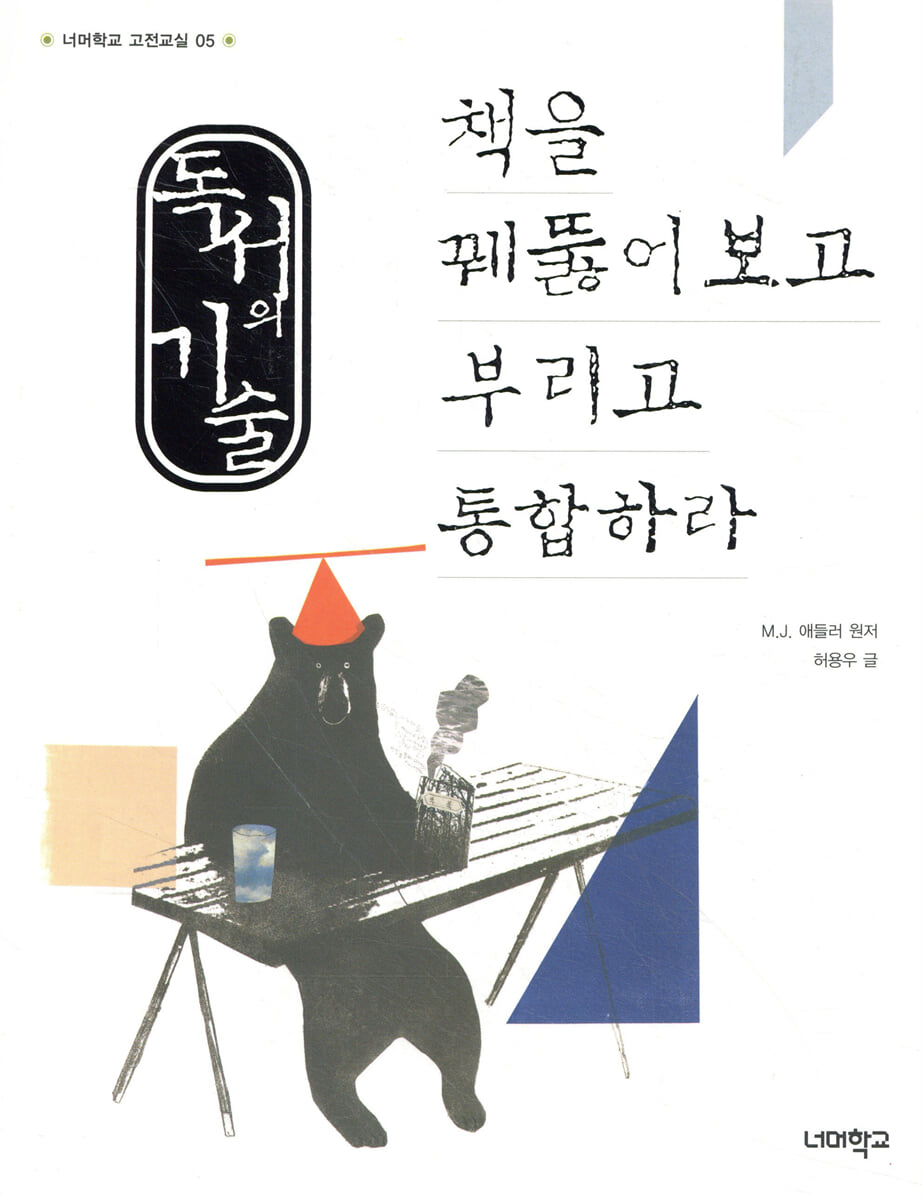
The Art of Reading: Seeing Through, Using, and Integrating Books
 |
Description
Book Introduction
A New Topical Reading Method Rewritten for Teenagers
Modern masterpiece Mortimer J.
This book is a new interpretation of Adler's 『How to Read a Book』 (hereafter referred to as 『How to Read a Book』) for teenagers.
Author Heo Yong-woo presents Adler's "The Art of Reading," which is unfamiliar and difficult because it deals only with Western classics, through familiar books and examples, specific and easy commentary, and cheerful and vivid writing.
He compares the skill of reading to soccer, encouraging readers to try playing high-level national team soccer rather than early-stage soccer, and encourages readers by saying that it is impossible to understand the content that the author has researched for a long time in one go.
For our teenagers who are pressed for time and leisure due to the burden of schoolwork, we have increased practicality by introducing practical books, literature, math, science, history, and how to read textbooks.
It will be of great help to elementary school students and middle and high school students who want to learn advanced reading skills early on, as well as college students and the general public who feel burdened by summarizing and writing.
If you consistently follow this book and practice, you will soon find yourself growing to the point where you can converse with the greatest thinkers of humanity through it. You will also enjoy the joy of creating a book that grows with you and becomes your life companion.
Modern masterpiece Mortimer J.
This book is a new interpretation of Adler's 『How to Read a Book』 (hereafter referred to as 『How to Read a Book』) for teenagers.
Author Heo Yong-woo presents Adler's "The Art of Reading," which is unfamiliar and difficult because it deals only with Western classics, through familiar books and examples, specific and easy commentary, and cheerful and vivid writing.
He compares the skill of reading to soccer, encouraging readers to try playing high-level national team soccer rather than early-stage soccer, and encourages readers by saying that it is impossible to understand the content that the author has researched for a long time in one go.
For our teenagers who are pressed for time and leisure due to the burden of schoolwork, we have increased practicality by introducing practical books, literature, math, science, history, and how to read textbooks.
It will be of great help to elementary school students and middle and high school students who want to learn advanced reading skills early on, as well as college students and the general public who feel burdened by summarizing and writing.
If you consistently follow this book and practice, you will soon find yourself growing to the point where you can converse with the greatest thinkers of humanity through it. You will also enjoy the joy of creating a book that grows with you and becomes your life companion.
- You can preview some of the book's contents.
Preview
index
Introduction
Chapter 1: Learn from books and grow from books
Learn to read and learn through reading | There are levels to reading | Beginner-level reading | Effective reading, careful reading
Tip Notes: How to Leave Your Mark
Chapter 2: Reading with Penetration and Criticism
Categorizing Books | Examining Books | Coming to a Consensus with the Author | What is the Author Saying? | What is Critical Reading?
Tools to help you read and analyze tips
Chapter 3: Reading Differently Depending on the Book, Reading by Type
How to Read Practical Books | How to Read Literature | How to Read History | How to Read Science and Math | How to Read Philosophy | How to Read Social Science Books
Tips to help you understand the book
Chapter 4: Good Readers Become Great Writers: Integrative Reading
What is Integrative Reading? Tips for Taking Reading to the Next Level
The story that comes out
Must-Read Books for Advanced Reading | Books I Referenced While Writing This Book
Chapter 1: Learn from books and grow from books
Learn to read and learn through reading | There are levels to reading | Beginner-level reading | Effective reading, careful reading
Tip Notes: How to Leave Your Mark
Chapter 2: Reading with Penetration and Criticism
Categorizing Books | Examining Books | Coming to a Consensus with the Author | What is the Author Saying? | What is Critical Reading?
Tools to help you read and analyze tips
Chapter 3: Reading Differently Depending on the Book, Reading by Type
How to Read Practical Books | How to Read Literature | How to Read History | How to Read Science and Math | How to Read Philosophy | How to Read Social Science Books
Tips to help you understand the book
Chapter 4: Good Readers Become Great Writers: Integrative Reading
What is Integrative Reading? Tips for Taking Reading to the Next Level
The story that comes out
Must-Read Books for Advanced Reading | Books I Referenced While Writing This Book
Into the book
Books that impart knowledge are especially important to read carefully.
Trying to understand books that deal with knowledge from the beginning is the same as not reading them at all.
Even among the books commonly recommended as science textbooks, there are many that are so difficult that you can't get past a few pages once you delve into the concepts and principles.
It is not easy to read and properly understand 『Fermat's Last Theorem』 or 『E=mc2』.
Social science books like Alvin Toffler's The Future of Wealth and Adam Smith's The Wealth of Nations are no joke either.
The goal of reading with complete understanding is set in 'analyzing reading', which involves reading in more detail. Here, the goal is to read from beginning to end, focusing on parts that can be understood, and harvest the important core points.
--- p.58
When memorizing poetry, you must associate yourself with the poem and imagine it.
If you feel the pain of someone who is lonely and far from their loved ones, imagine yourself in that situation.
If you have already had that experience, it will be easier to relate to.
But just because you don't have experience doesn't mean you don't have feelings.
Just like you can feel love without necessarily experiencing it.
--- p.54
In 『The Autobiography of Gandhi』, the process by which an ordinary person gradually developed himself is revealed with great sincerity.
However, no matter how honestly one writes, one's personal memories cannot be completely free of distortion.
If you really want to be historically accurate, you should read biographies along with autobiographies.
A biography is written by a biographer and is strictly based on objective data.
It is more subjective than a historical record, but more objective than an autobiography.
In the case of Gandhi, there are also several biographies published.
--- p.174
Perelman is a mathematician who tends to work alone.
On the other hand, Paul Erdos enjoys working together.
In "We're All a Little Crazy" (Winnings), Paul Erdos demonstrates how mathematics can be studied with a large number of people.
It is said that he collaborated with as many as 485 mathematicians and wrote 1,475 joint papers.
He, who devoted himself to research for 19 hours a day, said, “I will have plenty of time to rest when I go to the grave.”
--- p.196
The second difficulty encountered when reading social science books lies in the definition of concepts.
This is because the terms used in social science may be ones we already know, but they are often defined with new meanings.
It is also not uncommon to coin new terms.
For example, Alvin Toffler talks about 'wealth' in a somewhat different way in 'The Future of Wealth'.
Contrary to our common belief that 'wealth' is money, Alvin Toffler says that health, love, a happy family, and respect for one another are also part of wealth.
Wealth is defined as anything that satisfies human desires and relieves needs.
--- p.213
The important thing in the second stage of reading in an integrated manner is to incorporate the ‘author’s concept’ into ‘my concept.’
Authors define and use their own terms.
In mathematics, all authors use the same concepts, but in the humanities and social sciences, each author often develops his or her own concepts.
For example, what comes to mind when you hear the word "nomadism"? Don't you picture nomads herding sheep and cattle across lush pastures? However, in the humanities, the term "nomadism" also refers to a way of thinking or acting that is free from the constraints of specific ideologies or politics.
Of course, there are people who use the word nomadism in a different sense.
How to use these concepts is a very important question in the second stage.
Trying to understand books that deal with knowledge from the beginning is the same as not reading them at all.
Even among the books commonly recommended as science textbooks, there are many that are so difficult that you can't get past a few pages once you delve into the concepts and principles.
It is not easy to read and properly understand 『Fermat's Last Theorem』 or 『E=mc2』.
Social science books like Alvin Toffler's The Future of Wealth and Adam Smith's The Wealth of Nations are no joke either.
The goal of reading with complete understanding is set in 'analyzing reading', which involves reading in more detail. Here, the goal is to read from beginning to end, focusing on parts that can be understood, and harvest the important core points.
--- p.58
When memorizing poetry, you must associate yourself with the poem and imagine it.
If you feel the pain of someone who is lonely and far from their loved ones, imagine yourself in that situation.
If you have already had that experience, it will be easier to relate to.
But just because you don't have experience doesn't mean you don't have feelings.
Just like you can feel love without necessarily experiencing it.
--- p.54
In 『The Autobiography of Gandhi』, the process by which an ordinary person gradually developed himself is revealed with great sincerity.
However, no matter how honestly one writes, one's personal memories cannot be completely free of distortion.
If you really want to be historically accurate, you should read biographies along with autobiographies.
A biography is written by a biographer and is strictly based on objective data.
It is more subjective than a historical record, but more objective than an autobiography.
In the case of Gandhi, there are also several biographies published.
--- p.174
Perelman is a mathematician who tends to work alone.
On the other hand, Paul Erdos enjoys working together.
In "We're All a Little Crazy" (Winnings), Paul Erdos demonstrates how mathematics can be studied with a large number of people.
It is said that he collaborated with as many as 485 mathematicians and wrote 1,475 joint papers.
He, who devoted himself to research for 19 hours a day, said, “I will have plenty of time to rest when I go to the grave.”
--- p.196
The second difficulty encountered when reading social science books lies in the definition of concepts.
This is because the terms used in social science may be ones we already know, but they are often defined with new meanings.
It is also not uncommon to coin new terms.
For example, Alvin Toffler talks about 'wealth' in a somewhat different way in 'The Future of Wealth'.
Contrary to our common belief that 'wealth' is money, Alvin Toffler says that health, love, a happy family, and respect for one another are also part of wealth.
Wealth is defined as anything that satisfies human desires and relieves needs.
--- p.213
The important thing in the second stage of reading in an integrated manner is to incorporate the ‘author’s concept’ into ‘my concept.’
Authors define and use their own terms.
In mathematics, all authors use the same concepts, but in the humanities and social sciences, each author often develops his or her own concepts.
For example, what comes to mind when you hear the word "nomadism"? Don't you picture nomads herding sheep and cattle across lush pastures? However, in the humanities, the term "nomadism" also refers to a way of thinking or acting that is free from the constraints of specific ideologies or politics.
Of course, there are people who use the word nomadism in a different sense.
How to use these concepts is a very important question in the second stage.
--- pp.230-231
Publisher's Review
Rewriting Adler's Syntopical Reading Method, a Modern Masterpiece, for Our Teenagers
Learn the skills of reading and selecting books, and how to criticize the author's arguments.
The ultimate step to integrate and use books to your heart's content according to topic!
Why did Professor Yong-woo Heo, who has taught philosophy and essay writing for many years, bring up Adler's "The Art of Reading," published in 1940? "Many children can't read properly.
I pretend to read well.
Reading a lot of books doesn't improve my reading comprehension, and it doesn't help me study.
I read books with my children using the step-by-step reading method in Adler's The Art of Reading.
“I was able to solidify my principles over the years of teaching.”
First, let's systematically acquire reading skills step by step; after passing the basic stage of reading for fun, we will learn "scrutiny reading," which involves reading a book at a glance, and "analytical reading," which involves reading while questioning the book and the author.
By analyzing and applying reading and practicing reading methods appropriate to the subject matter of the book, you can reach the highest level of reading.
Second, let's break down reading skills into specific instructions; let's provide friendly, concrete methods that children can understand and follow.
Unlike most books on reading methods for teenagers, this book does not simply introduce a lot of good books, but allows readers to practice reading by thinking while reading and writing down their thoughts directly in the book.
Third, let's experience the highest level of reading, becoming one's own author; we will explain in detail and teach you the secrets of logical writing, which involves organizing and integrating multiple books on a single topic, in 13 steps.
Learn the skills to read and select books beyond the basic level.
What does it mean to read well? Reading books for fun and enjoyment doesn't require any special skills.
But to truly choose and read good books, books that have inspired countless people for decades, not just reading the words with your eyes, but understanding and being aware of the hidden meaning behind the words, questioning and criticizing the author, and growing yourself, you must learn the 'art of reading.'
Adler went beyond 'experiential reading theory' to present the highest level of reading technique with 'syntopical reading method', which greatly raised the intellectual level of American college students and has become a classic in reading method to this day.
Before mastering the reading technique of 『The Art of Reading: See Through, Use, and Integrate Books』, let's first check our own reading level.
The most basic level begins in the lower grades of elementary school and is usually completed by the 5th or 6th grade.
The goal is to understand accurately at the word and sentence level, such as “learning basic words like school, friend, and mother when first learning a foreign language” or “learning negative numbers, rational numbers, or irrational numbers in math,” so that one can read between the lines and eventually read difficult books on one’s own.
The intermediate level is usually mastered in middle and high school.
As we are in a time when we need to read a lot of books in a limited amount of time, we need the skill to read books efficiently in a limited amount of time. As such, the author introduces 'reading in detail' as an efficient reading skill.
Step 1 of skimming involves “scanning” the book to determine whether it is worth reading carefully.
After learning how to read the title page, preface, table of contents, index, bibliography, and front and back covers, you can then quickly read the main text here and there to “get a feel for the entire book.”
If you decide that this book is worth reading, move on to the second stage of reading.
Practice reading the entire book from beginning to end in one to two hours, grasping the main points.
“It is a reading method that is not about reading roughly, but about getting as much as possible at once.”
Advanced reading that understands, questions, and critiques the author's argument
The advanced stage is the stage of reading perfectly and thoroughly, and it is the stage of 'analyzing and reading', where you learn to classify books by genre, summarize the entire book, and read critically while thinking about the author's concerns.
It's something that high school students should easily be able to achieve, but it's not easy for us teenagers who are so busy and short on time.
However, as this book teaches, let's learn the technique of summarizing the entire book in a few simple sentences, and the technique of summarizing it in detail by chapter, subheading, and paragraph, and practice writing it ourselves.
Let's patiently answer questions like, "Did the author clearly explain the problem he was trying to solve? Were there any issues left unexplained?" "Did I accurately identify the key concepts the author used? Can I reconstruct the argument to support his central claim?"
Before you know it, you and the author will find yourself asking each other key questions about the book.
After learning to read and analyze up to this point, you will learn how to read critically.
After reading "Simcheongjeon," you might ask, "Was it really the right decision for Simcheong to fall into the Indangsu River to open her father's eyesight?" And after reading Descartes' "Principia Philosophica," you might criticize him by saying, "Perhaps Descartes, who did not recognize the rotation of the Earth, did not know much about mathematics or science?"
Also, in response to the question in 『History of Ahn Eung-chil』, “Why did Ahn Jung-geun claim that the Donghak Party mistreated the people and eventually changed into the Iljinhoe and sold out the country?”, you can guess the reason by reading Kim Gu’s 『Baekbeom Ilji』, and by comparing the two books, you can also compare the two people’s opinions on Donghak.
It is about gradually advancing to the highest level of reading.
Classify books and learn different reading methods according to the subject.
One of the important features of this book is ‘reading by branch.’
It is not right to read all books in the same way, and it is also a great loss to choose a book that does not fit your purpose.
The author emphasizes that “you shouldn’t hold onto a math textbook while trying to solve various types of problems,” and that “you shouldn’t read poetry at the same pace as a novel.”
First, the author categorizes the book you are reading into practical, literary, historical, mathematical, philosophical, scientific, and social science genres, and then introduces how to read books in each genre and things to keep in mind.
This will be a place where you can experience the true joy of reading by actually reading and critiquing good books in each field.
It is important to clearly define the purpose of reading a practical book. The purpose is usually stated in the introduction, so read it carefully.
Also, since many of the writings contain moral arguments, I advise you to carefully examine the author's background.
The book on literature is divided into novels, poetry, plays, epics, and myths, and explains how to read them, but it strongly emphasizes that you must first read them 'immersively' before analyzing them.
He suggests making your own poetry notebook, saying that drawing a genealogy of the main character will help you write a long novel, and that you can only truly appreciate the joy of poetry by memorizing it and recalling it.
When first encountering a history book, it is said that a good book is one that has a good mix of textbook-like explanations and stories that “gives you the overall framework while allowing you to feel the vividness of history.”
Since history involves the narrator's personal perspective, it is important to understand the "author's perspective," and it is important to read and compare multiple books on the same history.
For example, when reading Kim Bu-sik's Samguk Sagi, you should read it while taking into account the reason why "he places the Silla Chronicles first while revealing that Goryeo succeeded Goguryeo."
The goal of reading a scientific book is to understand “the overall theory” and “why the theory is important and what impact it has.”
Especially when reading difficult scientific books, you should not try to understand everything, but rather read “focusing on things that are easy to understand.”
When it comes to math books, it is important to “learn one proposition, formula, or principle at a time, with the mindset of learning a new language.” In particular, it is said that it is important to read the entire book thoroughly, by skimming through it.
In addition, it introduces a fun way to read seemingly difficult math books such as Fermat's Theorem and E=mc2, by asking interesting mathematical questions and practicing experiments on them.
Philosophy books, like mathematics, should be read as if learning a new language, slowly savoring and summarizing.
I recommend reading the original text, and I have also prepared a chapter where you can read Descartes' Discourse on the Method while applying the "analytical reading" method and summarize the content and write it yourself.
Books in the social sciences, which are so broad in scope that they encompass all disciplines that study society, should be read with particular caution regarding the reader's preconceptions.
The point is not to make the mistake of dismissing Marx's 『Das Kapital』 as a book about the "communist revolution" without even reading it properly.
Because social science offers a variety of perspectives on the same topic, it's important to be careful not to read just one book and make a conclusion.
Comparing and reading various books on a single topic is a good way to learn, and in this respect, reading social science books is related to integrated reading.
The Best Reading, Integrative Reading - Active Readers Become Great Writers!
Should we be content with simply understanding a book and accepting its contents? This book argues otherwise.
“We don’t read books to memorize the content verbatim.
“Books are just tools, what we want to know is the truth and the truth,” he says.
And I introduce 'integrated reading', which is a method of using books as a tool to express my thoughts.
This is our interpretation of Adler's 'syntopical' reading method.
Integrative reading means “exploring a specific topic,” and the process is divided into five steps and 13 guidelines.
Integrated Reading Steps 1 and 2: Select and read materials that fit the topic you want to explore, but “read proactively according to the topic you have chosen.” At this time, select appropriate materials through “scrutiny reading” and learn how to read while taking notes using Jeong Yak-yong’s “Cho-seo” method.
You will also learn how to paraphrase the concepts used by the author in your own vocabulary.
Step 3 of Integrative Reading: Make a list of questions to ask the authors of the material and find your own answers.
We start with broad questions like “What is justice?” and move on to more specific questions like “Is equal opportunity and individual self-realization possible through distributive justice?”
The more detailed the question, the more difficult it is to get a direct answer from the author, but in such cases, we try to infer the answer.
From this point on, you should make good use of the 'analytical reading' technique.
Step 4 of Integrative Reading: Find answers from the authors, summarize them, and organize arguments for and against them.
For example, to the question, “Is sustainable development possible?” you would get the answer “It is quite possible” from Alvin Toffler, and “It is not possible” from Jeremy Rifkin.
Step 5 of Integrative Reading: Systematically organize the authors' answers to fit the topic of inquiry.
Consider whether there are any new issues that need to be explored.
For example, instead of asking, “Is sustainable development possible?” we can create new questions such as, “Is development truly beneficial to humanity?” and “Is development limited to material things?”
After explaining the five steps of integrated reading, the guidelines and process for logical writing are briefly summarized.
Although this book does not cover essay writing in depth, it emphasizes that integrated reading is ultimately “the reading method that forms the foundation for writing good essays or papers.”
We must not remain passive readers who worship books, but must become active readers who use and integrate multiple books to develop our own thoughts.
Moreover, it is dangerous to jump to conclusions based on just one book.
You should be able to compare several books on any topic, come to your own conclusions, and even develop new awareness of the issues.
To achieve this, we say that we learn integrated reading.
The author emphasizes that if integrated reading is done well, “any paper can be written with ease, just like an undergraduate or graduate student.”
Practice reading techniques and enjoy various information about books.
This book introduces about 30 classic or comparable books in various genres, and helps readers practice reading techniques such as “reading with observation” and “reading with analysis” that they have learned previously.
It will be a great opportunity to encounter books that you may have previously been hesitant to read because they seemed too difficult, and to read and learn about new books with the author's clear commentary.
Eastern classics such as Yi I's 『Gyeokmongyogyeol』, Confucius's 『Analects of Confucius』, Ryu Seong-ryong's 『Jingbirok』, and Sima Qian's 『Records of the Grand Historian』, Western classics such as Descartes' 『Discourse on Method』 and Victor Hugo's 『Les Misérables』, somewhat unfamiliar math books such as 『The Hundred Years' Challenge: The Poincaré Conjecture』 and 『Fermat's Theorem』, science books such as 『The Elegant Universe』 and 『Jeong Jae-seung's Science Concert』, literature books such as Park Wan-seo's 『Who Ate Up All the Singa』 and Baek Seok's poem "Sura", social science books such as Marx's 『Capital』 and Alvin Toffler's 『The Third Wave』, and many other good books from various genres that you should definitely read at least once are cited, drawing attention.
It also gave me access to books that were mentioned in textbooks but were somewhat difficult to read on my own.
You will learn the difference between 『Samguk Sagi』 and 『Samguk Yusa』, which have similar names but completely different contents, and it also provides useful information for readers who have heard of the titles but are not familiar with the contents, such as 『Bukhakui』 and 『Baekbeom Ilji』.
Although I haven't heard much about it, there are surprisingly good books introduced.
Examples include 『Masako's Questions』, which deals with the history of the Japanese colonial period, 『Our Living Myths』, which tells the story of our proud mythology, and 『Learning the Law of Waves through Mathematics』.
If you use the information contained here as a guide when tackling the original text, you will gain even more inspiration and information.
At the end of the book, there is an appendix with a list of about 100 recommended books and reference books.
Additionally, the text includes the cover of the first edition, which is not easily accessible to our teenagers, and information about it, providing a variety of rich content to see.
As you admire the covers or inside covers of over 40 books, including classic Eastern and Western works as well as modern masterpieces, and read the photo information, you will have time to think about the stories and twists and turns that went into the creation of each book.
Beyond School Classics Classroom Series
The classics classroom at Neomeo School began with the goal of providing teenagers living in the 21st century with a fresh perspective, a diverse list of classics, and a free format to enjoy and experience the classics.
Experts who have studied and loved the classics for a long time plan to carefully edit and publish the classic stories in a fun, easy-to-read, and enjoyable way, with text structure that matches the story, easy-to-read sentences, and illustrations and photographs that broaden the mind.
Samguk Yusa, The Secret of the Broken Sky Road and the Egg Man, by Il-yeon and Hyun-beom Jo (*Bookttase 2011 Summer Vacation Official Recommendation)
The Origin of Species: A Declaration of Freedom for All Living Things, by Charles Darwin, written by Park Seong-gwan
A word from the classics 1.
You must be you Beyond Breastfeeding R
Words from the classics 2.
Study for me beyond breastfeeding R
The Art of Reading: Seeing Through, Using, and Integrating Books MJ
Adler's original work, written by Heo Yong-woo
* This series will continue.
Learn the skills of reading and selecting books, and how to criticize the author's arguments.
The ultimate step to integrate and use books to your heart's content according to topic!
Why did Professor Yong-woo Heo, who has taught philosophy and essay writing for many years, bring up Adler's "The Art of Reading," published in 1940? "Many children can't read properly.
I pretend to read well.
Reading a lot of books doesn't improve my reading comprehension, and it doesn't help me study.
I read books with my children using the step-by-step reading method in Adler's The Art of Reading.
“I was able to solidify my principles over the years of teaching.”
First, let's systematically acquire reading skills step by step; after passing the basic stage of reading for fun, we will learn "scrutiny reading," which involves reading a book at a glance, and "analytical reading," which involves reading while questioning the book and the author.
By analyzing and applying reading and practicing reading methods appropriate to the subject matter of the book, you can reach the highest level of reading.
Second, let's break down reading skills into specific instructions; let's provide friendly, concrete methods that children can understand and follow.
Unlike most books on reading methods for teenagers, this book does not simply introduce a lot of good books, but allows readers to practice reading by thinking while reading and writing down their thoughts directly in the book.
Third, let's experience the highest level of reading, becoming one's own author; we will explain in detail and teach you the secrets of logical writing, which involves organizing and integrating multiple books on a single topic, in 13 steps.
Learn the skills to read and select books beyond the basic level.
What does it mean to read well? Reading books for fun and enjoyment doesn't require any special skills.
But to truly choose and read good books, books that have inspired countless people for decades, not just reading the words with your eyes, but understanding and being aware of the hidden meaning behind the words, questioning and criticizing the author, and growing yourself, you must learn the 'art of reading.'
Adler went beyond 'experiential reading theory' to present the highest level of reading technique with 'syntopical reading method', which greatly raised the intellectual level of American college students and has become a classic in reading method to this day.
Before mastering the reading technique of 『The Art of Reading: See Through, Use, and Integrate Books』, let's first check our own reading level.
The most basic level begins in the lower grades of elementary school and is usually completed by the 5th or 6th grade.
The goal is to understand accurately at the word and sentence level, such as “learning basic words like school, friend, and mother when first learning a foreign language” or “learning negative numbers, rational numbers, or irrational numbers in math,” so that one can read between the lines and eventually read difficult books on one’s own.
The intermediate level is usually mastered in middle and high school.
As we are in a time when we need to read a lot of books in a limited amount of time, we need the skill to read books efficiently in a limited amount of time. As such, the author introduces 'reading in detail' as an efficient reading skill.
Step 1 of skimming involves “scanning” the book to determine whether it is worth reading carefully.
After learning how to read the title page, preface, table of contents, index, bibliography, and front and back covers, you can then quickly read the main text here and there to “get a feel for the entire book.”
If you decide that this book is worth reading, move on to the second stage of reading.
Practice reading the entire book from beginning to end in one to two hours, grasping the main points.
“It is a reading method that is not about reading roughly, but about getting as much as possible at once.”
Advanced reading that understands, questions, and critiques the author's argument
The advanced stage is the stage of reading perfectly and thoroughly, and it is the stage of 'analyzing and reading', where you learn to classify books by genre, summarize the entire book, and read critically while thinking about the author's concerns.
It's something that high school students should easily be able to achieve, but it's not easy for us teenagers who are so busy and short on time.
However, as this book teaches, let's learn the technique of summarizing the entire book in a few simple sentences, and the technique of summarizing it in detail by chapter, subheading, and paragraph, and practice writing it ourselves.
Let's patiently answer questions like, "Did the author clearly explain the problem he was trying to solve? Were there any issues left unexplained?" "Did I accurately identify the key concepts the author used? Can I reconstruct the argument to support his central claim?"
Before you know it, you and the author will find yourself asking each other key questions about the book.
After learning to read and analyze up to this point, you will learn how to read critically.
After reading "Simcheongjeon," you might ask, "Was it really the right decision for Simcheong to fall into the Indangsu River to open her father's eyesight?" And after reading Descartes' "Principia Philosophica," you might criticize him by saying, "Perhaps Descartes, who did not recognize the rotation of the Earth, did not know much about mathematics or science?"
Also, in response to the question in 『History of Ahn Eung-chil』, “Why did Ahn Jung-geun claim that the Donghak Party mistreated the people and eventually changed into the Iljinhoe and sold out the country?”, you can guess the reason by reading Kim Gu’s 『Baekbeom Ilji』, and by comparing the two books, you can also compare the two people’s opinions on Donghak.
It is about gradually advancing to the highest level of reading.
Classify books and learn different reading methods according to the subject.
One of the important features of this book is ‘reading by branch.’
It is not right to read all books in the same way, and it is also a great loss to choose a book that does not fit your purpose.
The author emphasizes that “you shouldn’t hold onto a math textbook while trying to solve various types of problems,” and that “you shouldn’t read poetry at the same pace as a novel.”
First, the author categorizes the book you are reading into practical, literary, historical, mathematical, philosophical, scientific, and social science genres, and then introduces how to read books in each genre and things to keep in mind.
This will be a place where you can experience the true joy of reading by actually reading and critiquing good books in each field.
It is important to clearly define the purpose of reading a practical book. The purpose is usually stated in the introduction, so read it carefully.
Also, since many of the writings contain moral arguments, I advise you to carefully examine the author's background.
The book on literature is divided into novels, poetry, plays, epics, and myths, and explains how to read them, but it strongly emphasizes that you must first read them 'immersively' before analyzing them.
He suggests making your own poetry notebook, saying that drawing a genealogy of the main character will help you write a long novel, and that you can only truly appreciate the joy of poetry by memorizing it and recalling it.
When first encountering a history book, it is said that a good book is one that has a good mix of textbook-like explanations and stories that “gives you the overall framework while allowing you to feel the vividness of history.”
Since history involves the narrator's personal perspective, it is important to understand the "author's perspective," and it is important to read and compare multiple books on the same history.
For example, when reading Kim Bu-sik's Samguk Sagi, you should read it while taking into account the reason why "he places the Silla Chronicles first while revealing that Goryeo succeeded Goguryeo."
The goal of reading a scientific book is to understand “the overall theory” and “why the theory is important and what impact it has.”
Especially when reading difficult scientific books, you should not try to understand everything, but rather read “focusing on things that are easy to understand.”
When it comes to math books, it is important to “learn one proposition, formula, or principle at a time, with the mindset of learning a new language.” In particular, it is said that it is important to read the entire book thoroughly, by skimming through it.
In addition, it introduces a fun way to read seemingly difficult math books such as Fermat's Theorem and E=mc2, by asking interesting mathematical questions and practicing experiments on them.
Philosophy books, like mathematics, should be read as if learning a new language, slowly savoring and summarizing.
I recommend reading the original text, and I have also prepared a chapter where you can read Descartes' Discourse on the Method while applying the "analytical reading" method and summarize the content and write it yourself.
Books in the social sciences, which are so broad in scope that they encompass all disciplines that study society, should be read with particular caution regarding the reader's preconceptions.
The point is not to make the mistake of dismissing Marx's 『Das Kapital』 as a book about the "communist revolution" without even reading it properly.
Because social science offers a variety of perspectives on the same topic, it's important to be careful not to read just one book and make a conclusion.
Comparing and reading various books on a single topic is a good way to learn, and in this respect, reading social science books is related to integrated reading.
The Best Reading, Integrative Reading - Active Readers Become Great Writers!
Should we be content with simply understanding a book and accepting its contents? This book argues otherwise.
“We don’t read books to memorize the content verbatim.
“Books are just tools, what we want to know is the truth and the truth,” he says.
And I introduce 'integrated reading', which is a method of using books as a tool to express my thoughts.
This is our interpretation of Adler's 'syntopical' reading method.
Integrative reading means “exploring a specific topic,” and the process is divided into five steps and 13 guidelines.
Integrated Reading Steps 1 and 2: Select and read materials that fit the topic you want to explore, but “read proactively according to the topic you have chosen.” At this time, select appropriate materials through “scrutiny reading” and learn how to read while taking notes using Jeong Yak-yong’s “Cho-seo” method.
You will also learn how to paraphrase the concepts used by the author in your own vocabulary.
Step 3 of Integrative Reading: Make a list of questions to ask the authors of the material and find your own answers.
We start with broad questions like “What is justice?” and move on to more specific questions like “Is equal opportunity and individual self-realization possible through distributive justice?”
The more detailed the question, the more difficult it is to get a direct answer from the author, but in such cases, we try to infer the answer.
From this point on, you should make good use of the 'analytical reading' technique.
Step 4 of Integrative Reading: Find answers from the authors, summarize them, and organize arguments for and against them.
For example, to the question, “Is sustainable development possible?” you would get the answer “It is quite possible” from Alvin Toffler, and “It is not possible” from Jeremy Rifkin.
Step 5 of Integrative Reading: Systematically organize the authors' answers to fit the topic of inquiry.
Consider whether there are any new issues that need to be explored.
For example, instead of asking, “Is sustainable development possible?” we can create new questions such as, “Is development truly beneficial to humanity?” and “Is development limited to material things?”
After explaining the five steps of integrated reading, the guidelines and process for logical writing are briefly summarized.
Although this book does not cover essay writing in depth, it emphasizes that integrated reading is ultimately “the reading method that forms the foundation for writing good essays or papers.”
We must not remain passive readers who worship books, but must become active readers who use and integrate multiple books to develop our own thoughts.
Moreover, it is dangerous to jump to conclusions based on just one book.
You should be able to compare several books on any topic, come to your own conclusions, and even develop new awareness of the issues.
To achieve this, we say that we learn integrated reading.
The author emphasizes that if integrated reading is done well, “any paper can be written with ease, just like an undergraduate or graduate student.”
Practice reading techniques and enjoy various information about books.
This book introduces about 30 classic or comparable books in various genres, and helps readers practice reading techniques such as “reading with observation” and “reading with analysis” that they have learned previously.
It will be a great opportunity to encounter books that you may have previously been hesitant to read because they seemed too difficult, and to read and learn about new books with the author's clear commentary.
Eastern classics such as Yi I's 『Gyeokmongyogyeol』, Confucius's 『Analects of Confucius』, Ryu Seong-ryong's 『Jingbirok』, and Sima Qian's 『Records of the Grand Historian』, Western classics such as Descartes' 『Discourse on Method』 and Victor Hugo's 『Les Misérables』, somewhat unfamiliar math books such as 『The Hundred Years' Challenge: The Poincaré Conjecture』 and 『Fermat's Theorem』, science books such as 『The Elegant Universe』 and 『Jeong Jae-seung's Science Concert』, literature books such as Park Wan-seo's 『Who Ate Up All the Singa』 and Baek Seok's poem "Sura", social science books such as Marx's 『Capital』 and Alvin Toffler's 『The Third Wave』, and many other good books from various genres that you should definitely read at least once are cited, drawing attention.
It also gave me access to books that were mentioned in textbooks but were somewhat difficult to read on my own.
You will learn the difference between 『Samguk Sagi』 and 『Samguk Yusa』, which have similar names but completely different contents, and it also provides useful information for readers who have heard of the titles but are not familiar with the contents, such as 『Bukhakui』 and 『Baekbeom Ilji』.
Although I haven't heard much about it, there are surprisingly good books introduced.
Examples include 『Masako's Questions』, which deals with the history of the Japanese colonial period, 『Our Living Myths』, which tells the story of our proud mythology, and 『Learning the Law of Waves through Mathematics』.
If you use the information contained here as a guide when tackling the original text, you will gain even more inspiration and information.
At the end of the book, there is an appendix with a list of about 100 recommended books and reference books.
Additionally, the text includes the cover of the first edition, which is not easily accessible to our teenagers, and information about it, providing a variety of rich content to see.
As you admire the covers or inside covers of over 40 books, including classic Eastern and Western works as well as modern masterpieces, and read the photo information, you will have time to think about the stories and twists and turns that went into the creation of each book.
Beyond School Classics Classroom Series
The classics classroom at Neomeo School began with the goal of providing teenagers living in the 21st century with a fresh perspective, a diverse list of classics, and a free format to enjoy and experience the classics.
Experts who have studied and loved the classics for a long time plan to carefully edit and publish the classic stories in a fun, easy-to-read, and enjoyable way, with text structure that matches the story, easy-to-read sentences, and illustrations and photographs that broaden the mind.
Samguk Yusa, The Secret of the Broken Sky Road and the Egg Man, by Il-yeon and Hyun-beom Jo (*Bookttase 2011 Summer Vacation Official Recommendation)
The Origin of Species: A Declaration of Freedom for All Living Things, by Charles Darwin, written by Park Seong-gwan
A word from the classics 1.
You must be you Beyond Breastfeeding R
Words from the classics 2.
Study for me beyond breastfeeding R
The Art of Reading: Seeing Through, Using, and Integrating Books MJ
Adler's original work, written by Heo Yong-woo
* This series will continue.
GOODS SPECIFICS
- Date of issue: September 30, 2013
- Page count, weight, size: 256 pages | 442g | 175*220*20mm
- ISBN13: 9788994407203
- ISBN10: 8994407200
You may also like
카테고리
korean


korean

![GQ KOREA Mark (Monthly): December [2025]](http://librairie.coreenne.fr/cdn/shop/files/8ef265dbbfbf186523ed75ba7319009d.jpg?v=1765340328&width=3840)


