

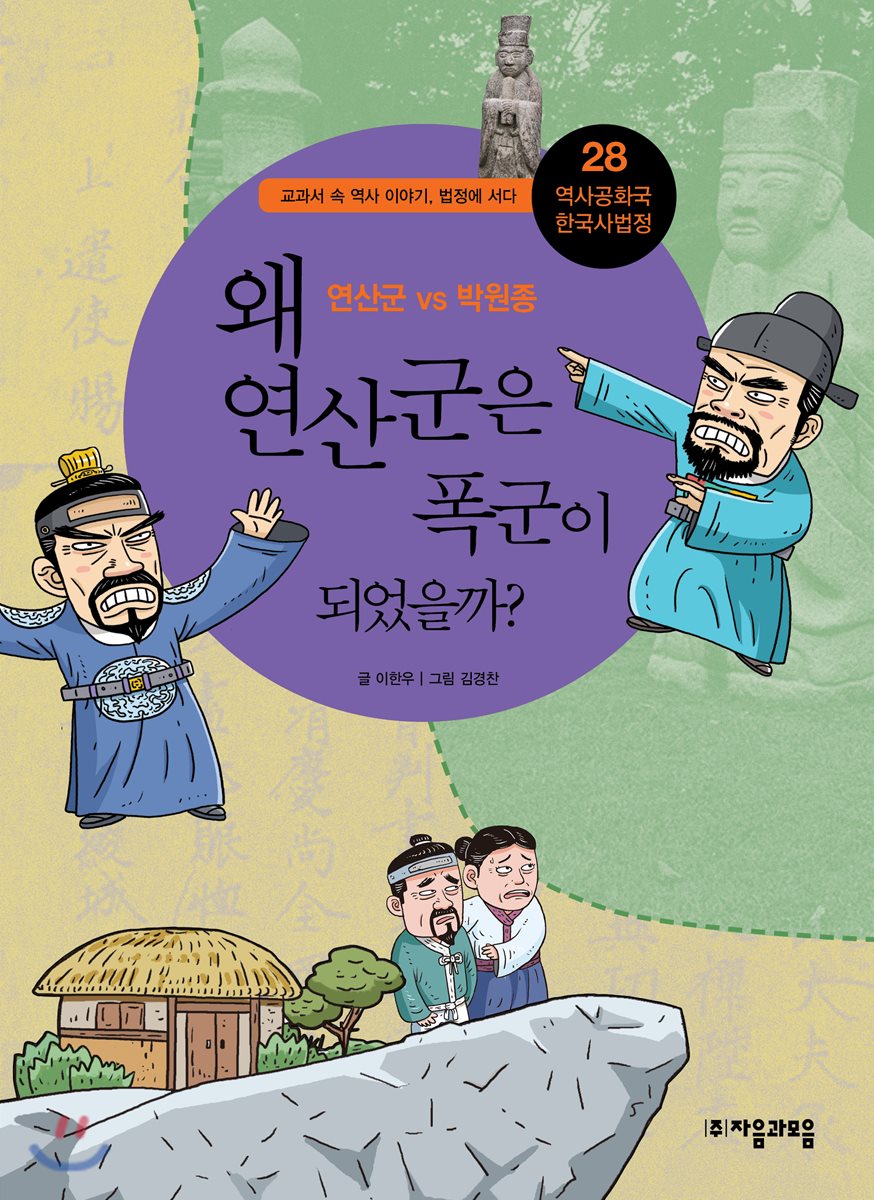
Why did Yeonsangun become a tyrant?
 |
Description
Book Introduction
A republic of history where rivals from history gather together and hold trials.
It is often said that history is 'written by the victors'.
So, most history textbooks and books are interpreted based only on the 'winners' in history.
That is why even if new historical evidence that could overturn history books appears, it is not easily reflected in history books.
Featuring a diverse cast of witnesses, including the plaintiff and the defendant, "Republic of History: Korean History Court, World History Court" vividly presents historical stories from textbooks from a balanced perspective.
This allows readers to free themselves from prejudice and independently judge the stories in history.
The events and content introduced in 『History Republic, Korean History Court, World History Court』 were selected from current elementary, middle, and high school textbooks.
The authors are also current professors and teachers who have specialized in Korean and world history and teach students in the field, and they critically review the core contents of the curriculum.
Meanwhile, unlike existing history books or textbooks where the story unfolds through explanations, this series adds dramatic fun with a 'courtroom-style' structure where the plaintiff and defendant engage in a lawsuit.
Through this, readers can observe history in a three-dimensional way by following the fierce battles between historical figures, and develop a subjective worldview that will allow them to live wisely in the world.
It is often said that history is 'written by the victors'.
So, most history textbooks and books are interpreted based only on the 'winners' in history.
That is why even if new historical evidence that could overturn history books appears, it is not easily reflected in history books.
Featuring a diverse cast of witnesses, including the plaintiff and the defendant, "Republic of History: Korean History Court, World History Court" vividly presents historical stories from textbooks from a balanced perspective.
This allows readers to free themselves from prejudice and independently judge the stories in history.
The events and content introduced in 『History Republic, Korean History Court, World History Court』 were selected from current elementary, middle, and high school textbooks.
The authors are also current professors and teachers who have specialized in Korean and world history and teach students in the field, and they critically review the core contents of the curriculum.
Meanwhile, unlike existing history books or textbooks where the story unfolds through explanations, this series adds dramatic fun with a 'courtroom-style' structure where the plaintiff and defendant engage in a lawsuit.
Through this, readers can observe history in a three-dimensional way by following the fierce battles between historical figures, and develop a subjective worldview that will allow them to live wisely in the world.
- You can preview some of the book's contents.
Preview
index
At the beginning of the book
In the textbook
Characters
prolog
The first day of the trial - Was Yeonsangun unqualified to be king?
1.
Was Yeonsangun cruel in nature?
Open the knowledge warehouse - Who are the Sarim faction?
2.
Was Yeonsangun suspicious?
3.
Did Yeonsangun make politics harsh?
Break Interview
Second day of trial - Why did King Yeonsangun cause the Muosa Incident?
1.
How did the Muosahwa Incident occur?
2.
How did King Yeonsangun utilize the Muosahwa?
Break Interview
Third day of trial - Was Yeonsangun a villain or was he crazy?
1.
How did the Gapjasahwa happen?
2.
Was the uprising justified?
Break Interview
Inside the textbook vs. Outside the textbook
Final statement
Verdict
Epilogue
Epilogue
In the textbook
Characters
prolog
The first day of the trial - Was Yeonsangun unqualified to be king?
1.
Was Yeonsangun cruel in nature?
Open the knowledge warehouse - Who are the Sarim faction?
2.
Was Yeonsangun suspicious?
3.
Did Yeonsangun make politics harsh?
Break Interview
Second day of trial - Why did King Yeonsangun cause the Muosa Incident?
1.
How did the Muosahwa Incident occur?
2.
How did King Yeonsangun utilize the Muosahwa?
Break Interview
Third day of trial - Was Yeonsangun a villain or was he crazy?
1.
How did the Gapjasahwa happen?
2.
Was the uprising justified?
Break Interview
Inside the textbook vs. Outside the textbook
Final statement
Verdict
Epilogue
Epilogue
Publisher's Review
Yeonsangun, was he a monarch who dreamed of a strong monarchy or a tyrant?
There are four kings in Joseon who ascended to the throne through rebellion or rebellion.
Taejong Yi Bang-won, who started the Prince's Rebellion and became king, Sejo, who drove out his nephew Danjong, Jungjong, who became king through the Jungjong Restoration, and Injo, the main character of the Injo Restoration.
Among them, King Yeonsangun, who was driven out by the Jungjong Rebellion, is called a tyrant with many words and stories.
In particular, in the movie 'The King and the Clown', which recently attracted 10 million viewers, King Yeonsangun was portrayed as not only a tyrant but also a mad king, or a mad king.
However, the author of this article focuses on the question, 'Why did Yeonsangun have no choice but to become a tyrant?' while reinterpreting the evaluation of Yeonsangun depicted in the Annals of the Joseon Dynasty.
There is also an opinion that Yeonsangun was a person who was destined to become king from birth, and after becoming king, he pursued a strong royal authority, and as a result, he eliminated the Hungu and Sarim factions that wielded power at the time.
In the Korean History Court of the Republic of Korea, “Why did King Yeonsangun become a tyrant?”, King Yeonsangun filed a lawsuit against Park Won-jong, the leader of the forces that staged the rebellion, for “treason against the state and defamation of his reputation.”
Here, Yeonsangun argues that the period when he carried out his politics harshly was the end of his reign, and that the Muosahwa and Gapjasahwa were also means to check the divine power that threatened the royal authority.
Let's meet again at the Korean Historical Court to learn the hidden story of King Yeonsangun, who has been branded a tyrant throughout history.
[Advantages and Features of This Book]
― The story of Yeonsangun, known as a tyrant throughout the 500 years of Joseon history, unfolds from a new perspective as questions are raised about why he had to become a tyrant.
― The character traits and actions of King Yeonsangun during the final years of his reign are introduced, allowing for a multifaceted understanding of him.
― By thoroughly linking the textbooks to how the Yeonsangun's actions are explained, we can critically interpret the content inside and outside the textbooks.
Taejong Yi Bang-won, who started the Prince's Rebellion and became king, Sejo, who drove out his nephew Danjong, Jungjong, who became king through the Jungjong Restoration, and Injo, the main character of the Injo Restoration.
Among them, King Yeonsangun, who was driven out by the Jungjong Rebellion, is called a tyrant with many words and stories.
In particular, in the movie 'The King and the Clown', which recently attracted 10 million viewers, King Yeonsangun was portrayed as not only a tyrant but also a mad king, or a mad king.
However, the author of this article focuses on the question, 'Why did Yeonsangun have no choice but to become a tyrant?' while reinterpreting the evaluation of Yeonsangun depicted in the Annals of the Joseon Dynasty.
There is also an opinion that Yeonsangun was a person who was destined to become king from birth, and after becoming king, he pursued a strong royal authority, and as a result, he eliminated the Hungu and Sarim factions that wielded power at the time.
In the Korean History Court of the Republic of Korea, “Why did King Yeonsangun become a tyrant?”, King Yeonsangun filed a lawsuit against Park Won-jong, the leader of the forces that staged the rebellion, for “treason against the state and defamation of his reputation.”
Here, Yeonsangun argues that the period when he carried out his politics harshly was the end of his reign, and that the Muosahwa and Gapjasahwa were also means to check the divine power that threatened the royal authority.
Let's meet again at the Korean Historical Court to learn the hidden story of King Yeonsangun, who has been branded a tyrant throughout history.
[Advantages and Features of This Book]
― The story of Yeonsangun, known as a tyrant throughout the 500 years of Joseon history, unfolds from a new perspective as questions are raised about why he had to become a tyrant.
― The character traits and actions of King Yeonsangun during the final years of his reign are introduced, allowing for a multifaceted understanding of him.
― By thoroughly linking the textbooks to how the Yeonsangun's actions are explained, we can critically interpret the content inside and outside the textbooks.
GOODS SPECIFICS
- Date of issue: April 10, 2011
- Page count, weight, size: 132 pages | 278g | 160*225*20mm
- ISBN13: 9788954423281
- ISBN10: 8954423280
You may also like
카테고리
korean


korean

![GQ KOREA Mark (Monthly): December [2025]](http://librairie.coreenne.fr/cdn/shop/files/8ef265dbbfbf186523ed75ba7319009d.jpg?v=1765340328&width=3840)


