

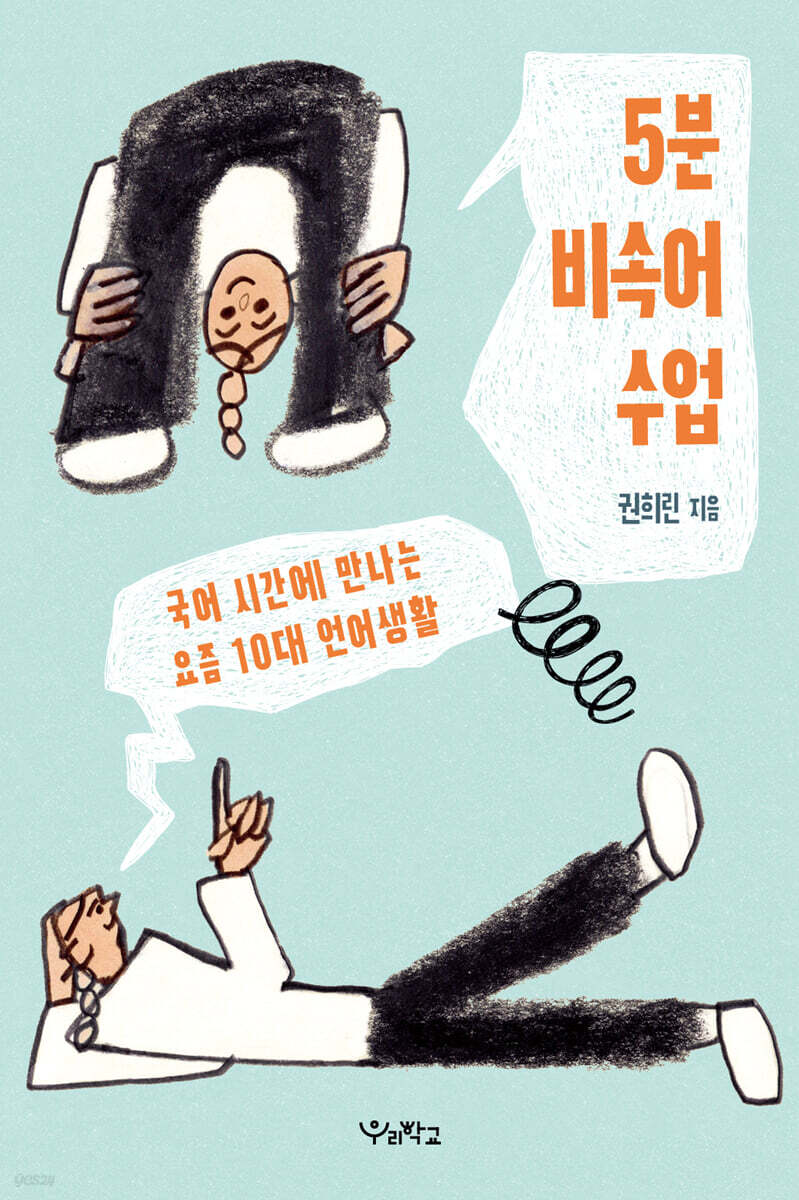
5-minute slang lesson
 |
Description
Book Introduction
From vulgar words to neologisms, from etymologies to alternative words
A look into the language life of teenagers these days
Special Korean language classes
What kind of language do teenagers use most often these days? Teacher Kwon Hee-rin, who has spent 17 years exploring the language habits of teenagers in schools and dedicated five minutes of her Korean language classes to a fascinating "slang lesson," has now published "5-Minute Slang Lessons," based on her experience.
In this book, the author examines the language life of teenagers from various angles, focusing on the swear words, new words, and trendy words that teenagers frequently use.
From vulgar expressions that have survived the changing times like "Ddaeng-daeng-i" and "Kkondae" to newly emerging buzzwords like "Chugumi", "Jung-geok-ma", and "Guk-rule", and even various curse words, there is a wide variety of vulgar expressions that are still on the lips of young people today.
Instead of simply condemning these vulgar words, the author examined their etymology, found similar words and antonyms, and even suggested alternative words, examining them three-dimensionally with the students.
He shares his experience of how simply explaining the etymology of vulgar language significantly reduced the amount of swearing students used, and delves into the hearts of young people contained within vulgar language.
A look into the language life of teenagers these days
Special Korean language classes
What kind of language do teenagers use most often these days? Teacher Kwon Hee-rin, who has spent 17 years exploring the language habits of teenagers in schools and dedicated five minutes of her Korean language classes to a fascinating "slang lesson," has now published "5-Minute Slang Lessons," based on her experience.
In this book, the author examines the language life of teenagers from various angles, focusing on the swear words, new words, and trendy words that teenagers frequently use.
From vulgar expressions that have survived the changing times like "Ddaeng-daeng-i" and "Kkondae" to newly emerging buzzwords like "Chugumi", "Jung-geok-ma", and "Guk-rule", and even various curse words, there is a wide variety of vulgar expressions that are still on the lips of young people today.
Instead of simply condemning these vulgar words, the author examined their etymology, found similar words and antonyms, and even suggested alternative words, examining them three-dimensionally with the students.
He shares his experience of how simply explaining the etymology of vulgar language significantly reduced the amount of swearing students used, and delves into the hearts of young people contained within vulgar language.
- You can preview some of the book's contents.
Preview
index
Introduction
Chapter 1.
Where are the words to express us?
newborn
Heavy-duty horse
National rules
Aljaltakkalsen
Not pretending
sick taste
Donjul
Chugoumi
The end
I hate being a jerk
Chapter 2.
It's sweet when you spit it out, but bitter when you hear it
pup
Eat shit
Loner
Shit
Fuck
Torai
-insect
spectator
chew
Chapter 3.
Words that remain the same even as times change
It's awesome
Open
Ddaengdaengi
shit
old fart
Liar
Passionate
Chapter 4.
There is no other way, that's all I can say
It sucks
It's like a beggar
Answer
It's tough
Oh my god
There's not much to do
Can't take it out or put it in
be sold out
Tta-chi-da
Chapter 1.
Where are the words to express us?
newborn
Heavy-duty horse
National rules
Aljaltakkalsen
Not pretending
sick taste
Donjul
Chugoumi
The end
I hate being a jerk
Chapter 2.
It's sweet when you spit it out, but bitter when you hear it
pup
Eat shit
Loner
Shit
Fuck
Torai
-insect
spectator
chew
Chapter 3.
Words that remain the same even as times change
It's awesome
Open
Ddaengdaengi
shit
old fart
Liar
Passionate
Chapter 4.
There is no other way, that's all I can say
It sucks
It's like a beggar
Answer
It's tough
Oh my god
There's not much to do
Can't take it out or put it in
be sold out
Tta-chi-da
Detailed image

Into the book
I can still vividly remember the students' expressions when the foul language came out of my mouth.
It was a face that simultaneously showed confusion, thinking, 'How can a teacher swear?' and the question, 'But why can't I use it?'
That question was the starting point of the five-minute slang lesson.
We chose one slang word each hour and talked about how we use it, what we know it means, and even looked closely at its actual etymology and context.
There were many days when I blushed, and when I saw students getting more excited and shouting out swear words along, I wondered, 'Is this really educational?'
But a surprising change came after that.
--- From the main text, “Introductory Remarks”
When we think of a new life, we often think of a life where we achieve great goals, but the essence of a new life is not grandeur.
It is closer to a positive self-development mindset that seeks to grow little by little every day, or an attitude toward life that faithfully follows a simple routine.
For example, small practices such as waking up in the morning and drinking a glass of warm water, or writing down good sentences for 10 minutes a day can be the starting point of a new life.
--- p.15, from the text “Gotsaeng”
“Teacher, what are we doing today...” Before I could finish my sentence, I quietly pointed towards the bookshelf with my finger.
The children who saw that looked through the list, started organizing the books, cleaning the floor, and organizing the return box.
It was as if the entire library was in 'Know-It-All Mode'.
'Aljaltakkalsen' is not just a sensible abbreviation, but a saying that conveys the heart before words.
That day, I came to believe in the power of communication in five letters.
--- p.34-35, from the text “Aljaltakkalsen”
Perhaps, ‘Kkuan-kku’ is a ‘competition to hide the traces of effort’ created by our society.
The atmosphere where you have to show off your sweat and effort but don't show it, and it seems like you were born with it naturally, and the social view that it looks cooler to say "I just tried it and it worked" than to say "I worked hard" - that may be the essence of this word.
--- p.44, from the text “Kkuankku”
“Teacher, why is there only ‘bastard’ among swear words and no ‘cow’ or ‘horse’?” The other students looked puzzled for a moment at this question posed by one student in class.
I spoke slowly.
“Since primitive times, humans have strictly prohibited incest.
“Most domestic animals have mating rules like humans, but dogs are said to be an exception.” In other words, the insult called 'bastard' is the result of verbally expressing human caution and disgust towards beings who deviate from moral standards.
--- p.85, from the text “Asshole”
One time, during class, we read a poem that parodied Kim Chun-su's poem "Flower" using profanity.
“When I called your name loudly, you came to me and turned into a flower.” At first, the children laughed.
It's a natural reaction to burst out laughing when a familiar poem is mixed with vulgar language.
But as I read a few more lines, a strange discomfort crossed the children's faces.
I experienced firsthand the mood and emotion contained in a single word, and how that word changed the mood of the text.
--- p.107-108, from the text “Fuck”
We often say negative things about someone who makes their presence known, like, “He’s a pedophile.”
But behind those words, it seems like there is a hidden desire to be noticed, something that everyone has.
Wanting to be noticed and acknowledged is a completely natural and healthy emotion.
Rather than unconditionally condemning someone's desire for attention, why not take a moment to listen to the small, sincere voice within that voice that says, "I'm here."
--- p.127, from the text “Guanjong”
The substitute word for 'shitty' that the students came up with was 'like a flower'.
These words have similar pronunciations and the same number of syllables, but of course they have a completely different nuance as they are said with the same meaning as 'something I don't like', but how noble is the meaning that appears on the surface.
I think it's a word that's pleasant to hear and much softer and more pleasant to say.
It was a face that simultaneously showed confusion, thinking, 'How can a teacher swear?' and the question, 'But why can't I use it?'
That question was the starting point of the five-minute slang lesson.
We chose one slang word each hour and talked about how we use it, what we know it means, and even looked closely at its actual etymology and context.
There were many days when I blushed, and when I saw students getting more excited and shouting out swear words along, I wondered, 'Is this really educational?'
But a surprising change came after that.
--- From the main text, “Introductory Remarks”
When we think of a new life, we often think of a life where we achieve great goals, but the essence of a new life is not grandeur.
It is closer to a positive self-development mindset that seeks to grow little by little every day, or an attitude toward life that faithfully follows a simple routine.
For example, small practices such as waking up in the morning and drinking a glass of warm water, or writing down good sentences for 10 minutes a day can be the starting point of a new life.
--- p.15, from the text “Gotsaeng”
“Teacher, what are we doing today...” Before I could finish my sentence, I quietly pointed towards the bookshelf with my finger.
The children who saw that looked through the list, started organizing the books, cleaning the floor, and organizing the return box.
It was as if the entire library was in 'Know-It-All Mode'.
'Aljaltakkalsen' is not just a sensible abbreviation, but a saying that conveys the heart before words.
That day, I came to believe in the power of communication in five letters.
--- p.34-35, from the text “Aljaltakkalsen”
Perhaps, ‘Kkuan-kku’ is a ‘competition to hide the traces of effort’ created by our society.
The atmosphere where you have to show off your sweat and effort but don't show it, and it seems like you were born with it naturally, and the social view that it looks cooler to say "I just tried it and it worked" than to say "I worked hard" - that may be the essence of this word.
--- p.44, from the text “Kkuankku”
“Teacher, why is there only ‘bastard’ among swear words and no ‘cow’ or ‘horse’?” The other students looked puzzled for a moment at this question posed by one student in class.
I spoke slowly.
“Since primitive times, humans have strictly prohibited incest.
“Most domestic animals have mating rules like humans, but dogs are said to be an exception.” In other words, the insult called 'bastard' is the result of verbally expressing human caution and disgust towards beings who deviate from moral standards.
--- p.85, from the text “Asshole”
One time, during class, we read a poem that parodied Kim Chun-su's poem "Flower" using profanity.
“When I called your name loudly, you came to me and turned into a flower.” At first, the children laughed.
It's a natural reaction to burst out laughing when a familiar poem is mixed with vulgar language.
But as I read a few more lines, a strange discomfort crossed the children's faces.
I experienced firsthand the mood and emotion contained in a single word, and how that word changed the mood of the text.
--- p.107-108, from the text “Fuck”
We often say negative things about someone who makes their presence known, like, “He’s a pedophile.”
But behind those words, it seems like there is a hidden desire to be noticed, something that everyone has.
Wanting to be noticed and acknowledged is a completely natural and healthy emotion.
Rather than unconditionally condemning someone's desire for attention, why not take a moment to listen to the small, sincere voice within that voice that says, "I'm here."
--- p.127, from the text “Guanjong”
The substitute word for 'shitty' that the students came up with was 'like a flower'.
These words have similar pronunciations and the same number of syllables, but of course they have a completely different nuance as they are said with the same meaning as 'something I don't like', but how noble is the meaning that appears on the surface.
I think it's a word that's pleasant to hear and much softer and more pleasant to say.
--- p.192, from the text "It sucks"
Publisher's Review
What kind of vulgar language do teenagers use these days, and why?
Words collected by 'word collector' Kwon Hee-rin at school
Youth profanity lifestyle
“Teacher, the kid sitting behind me is really noisy.” One day during class, a student raised his hand, laughed, and swore.
Seeing students swearing nonchalantly even in the presence of a teacher, Kwon Hee-rin, a teacher with 17 years of experience, realized the 'raw language life' of teenagers.
The author, who began to wonder 'why children use profanity' and 'why they should not use profanity', took on the attitude of a 'word collector' and collected various profanity words floating around schools and classrooms for a long time.
I analyzed the etymology of each word, looked for similar words and antonyms, and observed and recorded how students used them in what context and to express what feelings.
And, sharing the results of those observations and records with the students, I set aside 5 minutes during Korean language class to select one word a day and conduct a 'slang lesson'.
We looked into the etymology and context of vulgar words and also looked for alternative words for vulgar words that could hurt others' feelings.
The children's eyes shone brighter than in any other class.
"5 Minute Slang Lesson" is a collection of stories and lessons learned from those fun classes.
“I feel like a flower today.”
A special lesson learned from the Korean language class on profanity
Author Kwon Hee-rin's 'Exploring the Language Life of Teenagers Today' is not something that has been going on for just a year or two.
Since my first time in the classroom, I have been deeply interested in children's language and their unique culture for over 17 years, and have consistently observed them.
The results of that research were published in the books “B-Turn Language” and “B-Turn Language, Tackling the World.”
The book "5-Minute Slang Lessons," which connects the two books, contains everything from long-standing slang to new words that are popular among young people these days, allowing us to feel the changing times.
The book also contains valuable lessons learned from slang lessons in the classroom.
One student confessed, "I know it's a bad word, but it sticks to my mouth and I can't get it out," and reflected on his own language habits. He also read a poem parodying Kim Chun-su's poem "Flower" using profanity, and felt the discomfort of profanity and realized that it was an insulting expression.
Students even created their own substitutes for swear words.
The expression 'like a flower' is a fun idea that a student suggested when asking a friend to find a substitute for a vulgar word that would make them feel bad.
The students came up with their own expressions that could express their thoughts and feelings without offending anyone and instead brighten the mood.
Once students learn the exact origins and meanings of profanity, and remember the hateful and discriminatory meanings they contain, they will become more cautious about using profanity.
"5-Minute Slang Lesson" shares various stories surrounding familiar slang, helping readers reflect on their own language habits and discover healthier alternatives.
Words collected by 'word collector' Kwon Hee-rin at school
Youth profanity lifestyle
“Teacher, the kid sitting behind me is really noisy.” One day during class, a student raised his hand, laughed, and swore.
Seeing students swearing nonchalantly even in the presence of a teacher, Kwon Hee-rin, a teacher with 17 years of experience, realized the 'raw language life' of teenagers.
The author, who began to wonder 'why children use profanity' and 'why they should not use profanity', took on the attitude of a 'word collector' and collected various profanity words floating around schools and classrooms for a long time.
I analyzed the etymology of each word, looked for similar words and antonyms, and observed and recorded how students used them in what context and to express what feelings.
And, sharing the results of those observations and records with the students, I set aside 5 minutes during Korean language class to select one word a day and conduct a 'slang lesson'.
We looked into the etymology and context of vulgar words and also looked for alternative words for vulgar words that could hurt others' feelings.
The children's eyes shone brighter than in any other class.
"5 Minute Slang Lesson" is a collection of stories and lessons learned from those fun classes.
“I feel like a flower today.”
A special lesson learned from the Korean language class on profanity
Author Kwon Hee-rin's 'Exploring the Language Life of Teenagers Today' is not something that has been going on for just a year or two.
Since my first time in the classroom, I have been deeply interested in children's language and their unique culture for over 17 years, and have consistently observed them.
The results of that research were published in the books “B-Turn Language” and “B-Turn Language, Tackling the World.”
The book "5-Minute Slang Lessons," which connects the two books, contains everything from long-standing slang to new words that are popular among young people these days, allowing us to feel the changing times.
The book also contains valuable lessons learned from slang lessons in the classroom.
One student confessed, "I know it's a bad word, but it sticks to my mouth and I can't get it out," and reflected on his own language habits. He also read a poem parodying Kim Chun-su's poem "Flower" using profanity, and felt the discomfort of profanity and realized that it was an insulting expression.
Students even created their own substitutes for swear words.
The expression 'like a flower' is a fun idea that a student suggested when asking a friend to find a substitute for a vulgar word that would make them feel bad.
The students came up with their own expressions that could express their thoughts and feelings without offending anyone and instead brighten the mood.
Once students learn the exact origins and meanings of profanity, and remember the hateful and discriminatory meanings they contain, they will become more cautious about using profanity.
"5-Minute Slang Lesson" shares various stories surrounding familiar slang, helping readers reflect on their own language habits and discover healthier alternatives.
GOODS SPECIFICS
- Date of issue: November 30, 2025
- Page count, weight, size: 248 pages | 378g | 140*210*16mm
- ISBN13: 9791167553461
- ISBN10: 1167553462
You may also like
카테고리
korean


korean

![GQ KOREA Mark (Monthly): December [2025]](http://librairie.coreenne.fr/cdn/shop/files/8ef265dbbfbf186523ed75ba7319009d.jpg?v=1765340328&width=3840)


