

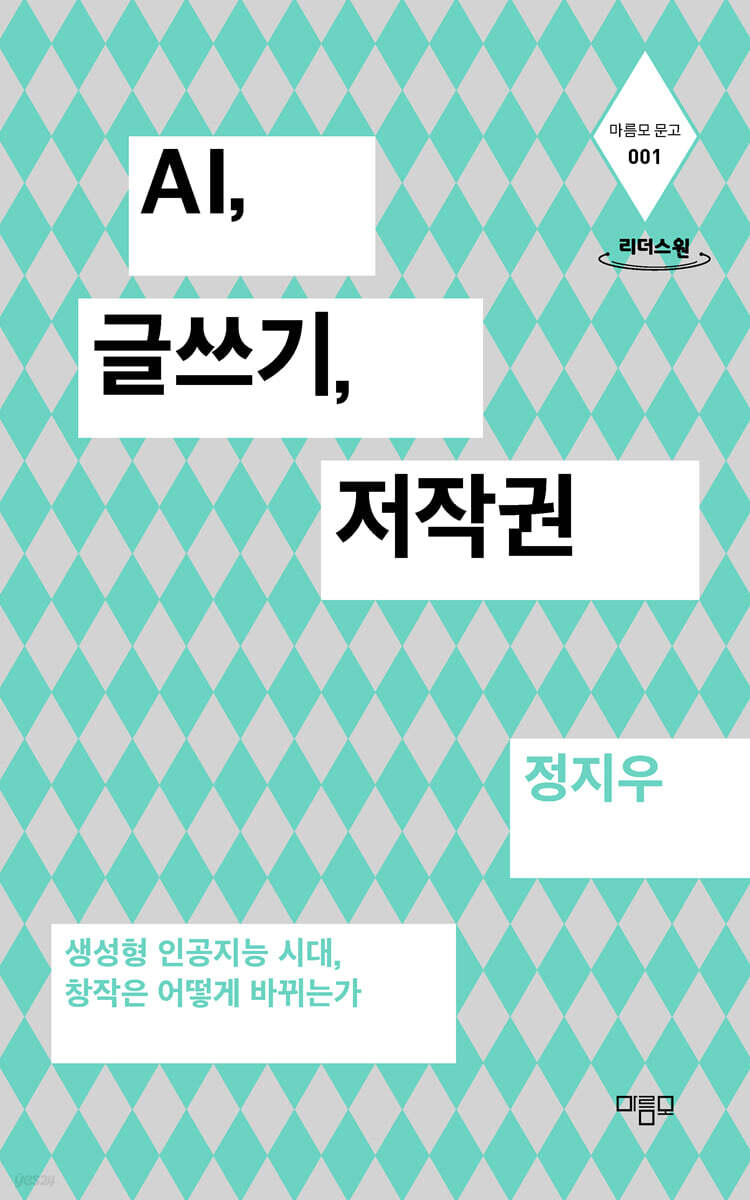
AI, Writing, and Copyright (Large Print Book)
 |
Description
Book Introduction
To ride the wave of AI
How to Leverage AI and Go Beyond AI
Under the slogan “Parallel lines eventually meet,” we present for the first time the humanities and liberal arts series “Rhombus Library,” which ponders the issues of the times.
The first volume is "AI, Writing, and Copyright," which questions the future of creation and content in the era of generative artificial intelligence.
Jiwoo Jeong, a writer, copyright attorney, and cultural critic who has written daily for over 20 years, examines from a philosophical, practical, and legal perspective how the emergence of generative AI will transform our lives and creation.
Beginning with insight into the unique role of humans in an age where even writing is being replaced by machines, we explore how to utilize AI to practically benefit creators, and what kind of "human writing" is still valid in the AI era.
Furthermore, we examine the various copyright issues that have recently erupted surrounding generative AI through specific examples, and address the issues of the scope of creation, rights, and responsibilities.
It offers profound insights and practical guidance not only for content producers and copyright holders, but also for anyone preparing for a future with AI.
Introduction to large print books
Leaders One's large-print books are books with 'font size' and 'line spacing' enlarged by '120% to 150%' compared to regular paperbacks to provide a comfortable reading environment for all those who have difficulty reading due to small print.
We want to bring back the joy of reading to those who have poor eyesight or find small print frustrating.
How to Leverage AI and Go Beyond AI
Under the slogan “Parallel lines eventually meet,” we present for the first time the humanities and liberal arts series “Rhombus Library,” which ponders the issues of the times.
The first volume is "AI, Writing, and Copyright," which questions the future of creation and content in the era of generative artificial intelligence.
Jiwoo Jeong, a writer, copyright attorney, and cultural critic who has written daily for over 20 years, examines from a philosophical, practical, and legal perspective how the emergence of generative AI will transform our lives and creation.
Beginning with insight into the unique role of humans in an age where even writing is being replaced by machines, we explore how to utilize AI to practically benefit creators, and what kind of "human writing" is still valid in the AI era.
Furthermore, we examine the various copyright issues that have recently erupted surrounding generative AI through specific examples, and address the issues of the scope of creation, rights, and responsibilities.
It offers profound insights and practical guidance not only for content producers and copyright holders, but also for anyone preparing for a future with AI.
Introduction to large print books
Leaders One's large-print books are books with 'font size' and 'line spacing' enlarged by '120% to 150%' compared to regular paperbacks to provide a comfortable reading environment for all those who have difficulty reading due to small print.
We want to bring back the joy of reading to those who have poor eyesight or find small print frustrating.
index
prolog
1. AI: The Age of Transformation
What is the difference between humans and AI?
Reason? Creativity? Emotion?
From function to value
The way of being irreplaceable
The place of human 'experience'
How AI Algorithms Are Taking Over Our Lives
Designed desire
Conclusion: Stay awake
2.
Writing: Leveraging AI and Beyond AI
AI as a tool
Leveraging AI 1
Leveraging AI 2
Beyond AI 1
Beyond AI 2
Conclusion: Raising Questions
3.
Copyright: A Sharp Issue Surrounding Generative AI
The most significant challenge in the history of copyright law
Controversy Surrounding ChatGPT and Ghibli
The problem of AI learning from data
Rediscovery of Editing and Edited Works
Preparing for AI Risks
Conclusion: Recognizing it as my problem
Epilogue
1. AI: The Age of Transformation
What is the difference between humans and AI?
Reason? Creativity? Emotion?
From function to value
The way of being irreplaceable
The place of human 'experience'
How AI Algorithms Are Taking Over Our Lives
Designed desire
Conclusion: Stay awake
2.
Writing: Leveraging AI and Beyond AI
AI as a tool
Leveraging AI 1
Leveraging AI 2
Beyond AI 1
Beyond AI 2
Conclusion: Raising Questions
3.
Copyright: A Sharp Issue Surrounding Generative AI
The most significant challenge in the history of copyright law
Controversy Surrounding ChatGPT and Ghibli
The problem of AI learning from data
Rediscovery of Editing and Edited Works
Preparing for AI Risks
Conclusion: Recognizing it as my problem
Epilogue
Into the book
We are living in a time together.
This is not an area where AI can do it.
We want to fill our lives by sharing human feelings with others.
I hope that I will be your memory and you will be my memory, and that we will walk together, comforting, supporting, and cheering each other on.
I hope we can be each other's companions in our lonely lives and create irreplaceable moments for each other.
As long as that kind of mind is divided, AI cannot replace that time.
--- p.36 "The Place of Human 'Experience'"
We need to think about it every single day, without fail.
Am I truly living the life I want?
Is this feed on this screen I'm touching really valuable to me?
Are these biased opinions that I've accumulated by clicking 'like' really the only correct ones?
Am I watching this video right now for my true life?
Rather, isn't all this taking away from me the things that are more precious?
--- p.48~49 "Designed Desire"
Even before the development of AI, we already lived in an era where various machines could cook countless dishes incredibly efficiently, but people still seek out chefs with a sense of taste and discernment born from their extensive experience, and pay exorbitant prices to eat dishes they have created with their fingertips.
That is the instinctive, fundamental, and inevitable tendency of humans to pursue human vision.
Furthermore, it is a direction toward human interaction and solidarity and trust between humans that will exist until the last day of humanity.
What we believe in is the lives of others.
It is a human life, and the insight that that life has melted and extracted.
--- p.77~78 "Beyond AI 1"
Those who utilize AI well and those who do not are divided based on their ability to raise questions based on their own perspective.
Even when creating a piece of writing, you can create a much better piece by questioning its details and modifying its writing style, such as its writing style and word choice.
For example, you could ask AI to write an article about South Korea's 'population extinction'.
A person without discernment has difficulty knowing whether the writing is good, bad, or lacking.
However, someone with sound knowledge and discernment can elaborate and refine the writing by pointing out and supplementing any shortcomings, such as, "The real estate issue is missing," "The economic aspect is disappointing," or "But are those figures accurate? They're different from what I know. Could you provide a source?"
--- p.89~90 "Conclusion: Raising Questions"
Of course, as I have argued throughout this book, I believe that the ability to write one's own work will never become invaluable; rather, it may become an increasingly rare and important skill.
But at the same time, I think we have clearly entered an era where we can create works with just 'editing skills', and we cannot simply reject this.
In a way, we can say that we are entering an era where the 'creative ability' of each and every stitch and the 'editing ability' of looking at such elements from a macro perspective and combining and arranging them coexist in a golden ratio.
No, the era has already arrived where writers are also editors.
This is not an area where AI can do it.
We want to fill our lives by sharing human feelings with others.
I hope that I will be your memory and you will be my memory, and that we will walk together, comforting, supporting, and cheering each other on.
I hope we can be each other's companions in our lonely lives and create irreplaceable moments for each other.
As long as that kind of mind is divided, AI cannot replace that time.
--- p.36 "The Place of Human 'Experience'"
We need to think about it every single day, without fail.
Am I truly living the life I want?
Is this feed on this screen I'm touching really valuable to me?
Are these biased opinions that I've accumulated by clicking 'like' really the only correct ones?
Am I watching this video right now for my true life?
Rather, isn't all this taking away from me the things that are more precious?
--- p.48~49 "Designed Desire"
Even before the development of AI, we already lived in an era where various machines could cook countless dishes incredibly efficiently, but people still seek out chefs with a sense of taste and discernment born from their extensive experience, and pay exorbitant prices to eat dishes they have created with their fingertips.
That is the instinctive, fundamental, and inevitable tendency of humans to pursue human vision.
Furthermore, it is a direction toward human interaction and solidarity and trust between humans that will exist until the last day of humanity.
What we believe in is the lives of others.
It is a human life, and the insight that that life has melted and extracted.
--- p.77~78 "Beyond AI 1"
Those who utilize AI well and those who do not are divided based on their ability to raise questions based on their own perspective.
Even when creating a piece of writing, you can create a much better piece by questioning its details and modifying its writing style, such as its writing style and word choice.
For example, you could ask AI to write an article about South Korea's 'population extinction'.
A person without discernment has difficulty knowing whether the writing is good, bad, or lacking.
However, someone with sound knowledge and discernment can elaborate and refine the writing by pointing out and supplementing any shortcomings, such as, "The real estate issue is missing," "The economic aspect is disappointing," or "But are those figures accurate? They're different from what I know. Could you provide a source?"
--- p.89~90 "Conclusion: Raising Questions"
Of course, as I have argued throughout this book, I believe that the ability to write one's own work will never become invaluable; rather, it may become an increasingly rare and important skill.
But at the same time, I think we have clearly entered an era where we can create works with just 'editing skills', and we cannot simply reject this.
In a way, we can say that we are entering an era where the 'creative ability' of each and every stitch and the 'editing ability' of looking at such elements from a macro perspective and combining and arranging them coexist in a golden ratio.
No, the era has already arrived where writers are also editors.
--- p.117 "Rediscovery of Editing and Edited Works"
Publisher's Review
1. AI: The Age of Transformation
Questioning the irreplaceable nature of human existence
“Even if AI replaces all human work,
There are some things that cannot be replaced.
That's life." _Page 25
Just a few years ago, few people would have believed that a time would come when AI would write poetry, draw pictures, or sing songs with a human voice.
But now, there is a growing sense of crisis and fear that creative fields may be replaced by AI, and that very detailed physical labor may become something that only humans can do.
If generative AI learns, thinks, and creates like humans, then what exactly is the difference between humans and AI?
The author argues that humans must be redefined from the perspective of "life," beyond the Enlightenment belief that humans, unlike animals, are rational beings, and the Romantic view of humanity as special beings with creativity and emotion.
This is only possible when we shift our perspective on humans from function to value.
If you show ChatGPT what you wrote and ask it to tell you what to fix, it will tell you better than most humans.
In that case, it can be said that the functional value of writing instructors has decreased.
But what if he were to engage in meaningful conversations with students throughout their classes, maintain relationships, and even become a colleague who writes books and shares life with them? This isn't something AI can do.
I am not valuable because I am useful to the world.
Humans still have a unique place in the dimension of 'life experience'.
The author argues that in the age of AI, the more we detach ourselves from the essence of life, the more difficult it will be to feel our own dignity and worth.
AI algorithms, designed to steal our "time" and "attention," meticulously understand our tastes and present only the things we're most likely to enjoy. Without AI algorithms' guidance, we'd no longer know what our desires are, what to watch, what to eat, or what to buy. The more we become accustomed to AI, the less capable we'll become of independent thought.
However, the design of AI fundamentally serves the interests of the big tech platforms that utilize AI.
The author says that we must constantly reflect and be 'awake' to protect our 'real interests', not theirs.
I must establish my own values and take responsibility for my own life. AI cannot live my life for me.
2.
Writing: Leveraging AI and Beyond AI
Is AI the End of Creativity or a New Beginning?
“What writers need to worry about is not AI’s writing skills.
Rather, it is a matter of proving writing through life.” _Page 86
In an age where AI writes, is the role of the writer over? Why and how should we write? Based on reflections on human nature, the author delves into the essence of writing, a skill that will never be replaced even in the age of AI.
First, based on an understanding of the principles of generative AI, the author presents practical methods for actually utilizing AI in writing.
How to create writing that only you can create by entering 'specific constraints', how to increase productivity by outsourcing brainstorming, data research, editing, and reviewing, etc.
However, even here, the author emphasizes that one must first firmly establish one's own thoughts before utilizing AI as a tool.
If someone who has never properly read or written a text relies solely on AI, the chances of developing their own authentic perspective are reduced.
The ability to discern truly good writing and decipher its context and meaning—in other words, discernment and literacy—is becoming increasingly valuable skills amidst the overflow of automatically generated content.
In particular, the author cites 'writing my story' as a human writing domain that AI can never invade.
It is highly likely that writing press releases, newspaper articles, and even screenplays and novels will increasingly be replaced by AI.
However, one person's memories, emotions, and experiences can only be revealed by that person.
The process of AI refining simple speech into sentences and the process of writing, which involves exploring the unconscious through direct writing, are fundamentally different.
What readers truly crave is not refined, plausible sentences, but a living story of one person.
The author predicts that the alignment between "writing" and "life" will become increasingly important. In an era overflowing with AI-written texts, if we cannot identify the author and what kind of life they lead, trust in their writing will diminish.
The author says:
“Now, the writer will repay their trust by giving himself completely to the readers, and will prove his writing by living a life that is true to himself, created with his own unique perspective.
And as long as he succeeds in that, there is no crisis for the writer.”
3.
Copyright: A Sharp Issue Surrounding Generative AI
A New Paradigm for Creators' Rights in the AI Era
“About the AI field, which is currently experiencing the fastest development in the world.
The law cannot always withhold its answer and respond slowly.” _Page 102
AI also poses significant challenges to the legal realm.
This book examines new and fierce legal debates, ranging from whether AI-generated works can be copyrighted, to the stylistic copyright issues surrounding Ghibli, to the various legal risks posed by AI, and proposes how the copyright system should evolve in the future.
The most striking proposal is the explicit introduction of an “AI learning opt-out.”
For example, if you insert the phrase "This work is a work that refuses AI learning" into a text or image posted on the web, it is technically possible to create a device that allows AI to recognize this and exclude it from learning.
Furthermore, he emphasized that prior permission from the creator or organization must be obtained for the use of prompts such as 'Ghibli style' and 'Han River style', and that this will create a virtuous cycle in which AI companies that have consulted with copyright holders can provide differentiated services while also protecting the rights of copyright holders.
Another insight is the rise of the concept of "edited works." The AI era can be called the era of "editing."
For example, there is an explosive increase in cases where AI is used to write scripts and compose songs, then generate and combine images to create movies or music videos.
These individual elements are all created by AI and therefore not copyrighted, but if a human combines these elements with their own unique perspective to create an original work, it is considered an edited work.
The author diagnoses that through this trend, we are now moving from an era where 'everyone is a creator' to an era where 'everyone is an editor and the copyright holder of edited works.'
This represents a new era where creators, editors, and copyright holders are united, and it is expected to become a key variable in the copyright environment surrounding the future use and reprocessing of AI content.
How does generative AI work, and what are its limitations and potential?
How do humans coexist or conflict with AI in the realm of writing and creativity?
How does the current copyright system regulate this new reality, and what should we prepare for in the future?
Drawing on his experience as a writer, his expertise as a copyright attorney, and his critical awareness as a cultural critic, the author examines the various problems raised by the AI era and proposes concrete and feasible alternatives that can foster social consensus.
Furthermore, he emphasizes that these issues must be addressed by AI engineers, artists, copyright holders, fans and consumers of the works, and even legal professionals, all working together to create new standards for our society.
Questioning the irreplaceable nature of human existence
“Even if AI replaces all human work,
There are some things that cannot be replaced.
That's life." _Page 25
Just a few years ago, few people would have believed that a time would come when AI would write poetry, draw pictures, or sing songs with a human voice.
But now, there is a growing sense of crisis and fear that creative fields may be replaced by AI, and that very detailed physical labor may become something that only humans can do.
If generative AI learns, thinks, and creates like humans, then what exactly is the difference between humans and AI?
The author argues that humans must be redefined from the perspective of "life," beyond the Enlightenment belief that humans, unlike animals, are rational beings, and the Romantic view of humanity as special beings with creativity and emotion.
This is only possible when we shift our perspective on humans from function to value.
If you show ChatGPT what you wrote and ask it to tell you what to fix, it will tell you better than most humans.
In that case, it can be said that the functional value of writing instructors has decreased.
But what if he were to engage in meaningful conversations with students throughout their classes, maintain relationships, and even become a colleague who writes books and shares life with them? This isn't something AI can do.
I am not valuable because I am useful to the world.
Humans still have a unique place in the dimension of 'life experience'.
The author argues that in the age of AI, the more we detach ourselves from the essence of life, the more difficult it will be to feel our own dignity and worth.
AI algorithms, designed to steal our "time" and "attention," meticulously understand our tastes and present only the things we're most likely to enjoy. Without AI algorithms' guidance, we'd no longer know what our desires are, what to watch, what to eat, or what to buy. The more we become accustomed to AI, the less capable we'll become of independent thought.
However, the design of AI fundamentally serves the interests of the big tech platforms that utilize AI.
The author says that we must constantly reflect and be 'awake' to protect our 'real interests', not theirs.
I must establish my own values and take responsibility for my own life. AI cannot live my life for me.
2.
Writing: Leveraging AI and Beyond AI
Is AI the End of Creativity or a New Beginning?
“What writers need to worry about is not AI’s writing skills.
Rather, it is a matter of proving writing through life.” _Page 86
In an age where AI writes, is the role of the writer over? Why and how should we write? Based on reflections on human nature, the author delves into the essence of writing, a skill that will never be replaced even in the age of AI.
First, based on an understanding of the principles of generative AI, the author presents practical methods for actually utilizing AI in writing.
How to create writing that only you can create by entering 'specific constraints', how to increase productivity by outsourcing brainstorming, data research, editing, and reviewing, etc.
However, even here, the author emphasizes that one must first firmly establish one's own thoughts before utilizing AI as a tool.
If someone who has never properly read or written a text relies solely on AI, the chances of developing their own authentic perspective are reduced.
The ability to discern truly good writing and decipher its context and meaning—in other words, discernment and literacy—is becoming increasingly valuable skills amidst the overflow of automatically generated content.
In particular, the author cites 'writing my story' as a human writing domain that AI can never invade.
It is highly likely that writing press releases, newspaper articles, and even screenplays and novels will increasingly be replaced by AI.
However, one person's memories, emotions, and experiences can only be revealed by that person.
The process of AI refining simple speech into sentences and the process of writing, which involves exploring the unconscious through direct writing, are fundamentally different.
What readers truly crave is not refined, plausible sentences, but a living story of one person.
The author predicts that the alignment between "writing" and "life" will become increasingly important. In an era overflowing with AI-written texts, if we cannot identify the author and what kind of life they lead, trust in their writing will diminish.
The author says:
“Now, the writer will repay their trust by giving himself completely to the readers, and will prove his writing by living a life that is true to himself, created with his own unique perspective.
And as long as he succeeds in that, there is no crisis for the writer.”
3.
Copyright: A Sharp Issue Surrounding Generative AI
A New Paradigm for Creators' Rights in the AI Era
“About the AI field, which is currently experiencing the fastest development in the world.
The law cannot always withhold its answer and respond slowly.” _Page 102
AI also poses significant challenges to the legal realm.
This book examines new and fierce legal debates, ranging from whether AI-generated works can be copyrighted, to the stylistic copyright issues surrounding Ghibli, to the various legal risks posed by AI, and proposes how the copyright system should evolve in the future.
The most striking proposal is the explicit introduction of an “AI learning opt-out.”
For example, if you insert the phrase "This work is a work that refuses AI learning" into a text or image posted on the web, it is technically possible to create a device that allows AI to recognize this and exclude it from learning.
Furthermore, he emphasized that prior permission from the creator or organization must be obtained for the use of prompts such as 'Ghibli style' and 'Han River style', and that this will create a virtuous cycle in which AI companies that have consulted with copyright holders can provide differentiated services while also protecting the rights of copyright holders.
Another insight is the rise of the concept of "edited works." The AI era can be called the era of "editing."
For example, there is an explosive increase in cases where AI is used to write scripts and compose songs, then generate and combine images to create movies or music videos.
These individual elements are all created by AI and therefore not copyrighted, but if a human combines these elements with their own unique perspective to create an original work, it is considered an edited work.
The author diagnoses that through this trend, we are now moving from an era where 'everyone is a creator' to an era where 'everyone is an editor and the copyright holder of edited works.'
This represents a new era where creators, editors, and copyright holders are united, and it is expected to become a key variable in the copyright environment surrounding the future use and reprocessing of AI content.
How does generative AI work, and what are its limitations and potential?
How do humans coexist or conflict with AI in the realm of writing and creativity?
How does the current copyright system regulate this new reality, and what should we prepare for in the future?
Drawing on his experience as a writer, his expertise as a copyright attorney, and his critical awareness as a cultural critic, the author examines the various problems raised by the AI era and proposes concrete and feasible alternatives that can foster social consensus.
Furthermore, he emphasizes that these issues must be addressed by AI engineers, artists, copyright holders, fans and consumers of the works, and even legal professionals, all working together to create new standards for our society.
GOODS SPECIFICS
- Date of issue: September 29, 2025
- Page count, weight, size: 132 pages | 182*291*12mm
- ISBN13: 9791194285182
- ISBN10: 119428518X
You may also like
카테고리
korean


korean

![GQ KOREA Mark (Monthly): December [2025]](http://librairie.coreenne.fr/cdn/shop/files/8ef265dbbfbf186523ed75ba7319009d.jpg?v=1765340328&width=3840)


