

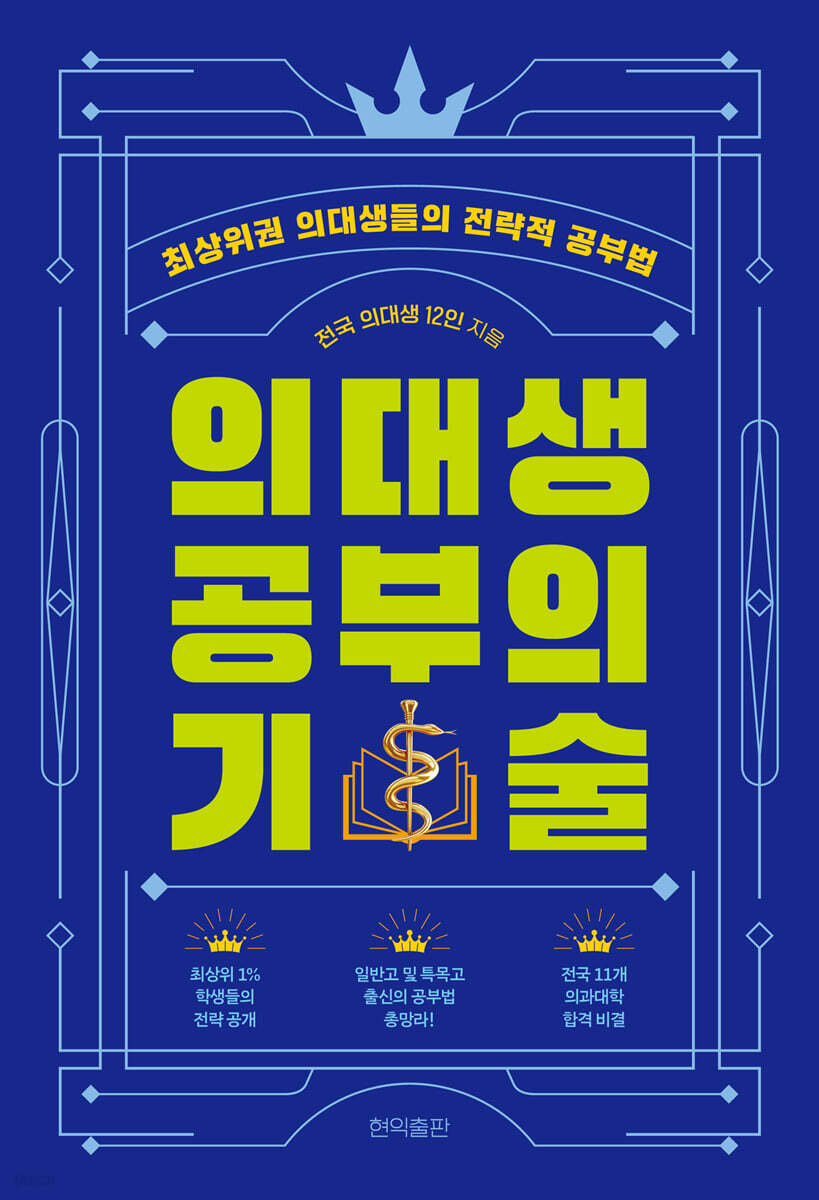
Medical Student Study Skills
 |
Description
Book Introduction
Study skills that medical students must know!
From the secrets of improving grades to mental management, it contains both failures and successes.
The study bible, born from 100 hours of study strategy analysis and interviews!
"Study Skills for Medical Students" is based on approximately 100 hours of interviews and in-depth research with 12 medical students, and contains study strategies and habits that have proven effective in actual exam situations.
It doesn't simply show you how to 'do it well', but it also shows you the process of finding and perfecting your own study method, repeated mistakes and how to overcome them, and even a routine that is strong in practice.
We provide advice and case studies tailored to various situations, including repeat test takers, students seeking short-term results, and students whose study plans frequently fall through.
From the notes and error notes of those who passed medical school, to memorization strategies, concept organization methods, and even strategies for both early and regular admissions, all the content in this book is based on direct experience and multi-faceted verification.
Whatever your target university or major, you'll learn the key elements needed to set direction and develop a strategy.
There's no perfect answer to studying, but there's definitely something to be learned from successful patterns and routines.
This book doesn't teach you 'how to study well', but 'how to persevere without getting tired'.
The experiences of those who have run toward the most intense goals will serve as a compass to design the study journey of test takers.
From the secrets of improving grades to mental management, it contains both failures and successes.
The study bible, born from 100 hours of study strategy analysis and interviews!
"Study Skills for Medical Students" is based on approximately 100 hours of interviews and in-depth research with 12 medical students, and contains study strategies and habits that have proven effective in actual exam situations.
It doesn't simply show you how to 'do it well', but it also shows you the process of finding and perfecting your own study method, repeated mistakes and how to overcome them, and even a routine that is strong in practice.
We provide advice and case studies tailored to various situations, including repeat test takers, students seeking short-term results, and students whose study plans frequently fall through.
From the notes and error notes of those who passed medical school, to memorization strategies, concept organization methods, and even strategies for both early and regular admissions, all the content in this book is based on direct experience and multi-faceted verification.
Whatever your target university or major, you'll learn the key elements needed to set direction and develop a strategy.
There's no perfect answer to studying, but there's definitely something to be learned from successful patterns and routines.
This book doesn't teach you 'how to study well', but 'how to persevere without getting tired'.
The experiences of those who have run toward the most intense goals will serve as a compass to design the study journey of test takers.
index
Entering
1.
Do-Hyeon Lim, Catholic University College of Medicine
Korean│Competing with Literacy
Math│How to Understand Concepts Deeply
English│A New Approach to Vocabulary Memorization
Science Exploration│Striving for Balance between Grades and the College Scholastic Ability Test
2.
Kang Ra-el, Korea University College of Medicine
Korean│Strategies for capturing the flow of the text
Mathematics│How to Trace Your Thought Process
English│Strategy for Absolute Evaluation
Science Exploration│Memorize through Problems and Complete through Understanding
3.
Daeyeon Kim, Kyungpook National University College of Medicine
Korean│Strategies for Overcoming Difficult Non-Fiction
Mathematics│Look beyond the problem to the principle
English│Fingerprint interpretation is solved through flow.
Science Exploration│How to reinforce concepts with past exam questions
4.
Park Hyeon-woo, Dankook University College of Medicine
Korean│The power to awaken your sense of language
Mathematics│The Art of Reducing Mistakes
English│Breathing through with intuition and solving with flow
Science Exploration│Practical Sense Completed with Concepts and Previous Questions
Medical School Tour 1.
Catholic University
Medical School Tour 2.
Korea University
5.
Bae Yeon-jae, Dongguk University College of Medicine
Korean│The power of background knowledge built through internal assessments
Math│The sense of your fingertips comes alive when you solve problems every day.
English│The fight to maintain sense
Science Exploration│The Essence of Study Created by Selection and Repetition
6.
Junhyung Yuk, Seoul National University College of Medicine
Korean│The power to handle text
Math│The Path to Grade 1: Past Exam Questions and Repetition
English│Necessary Strategies for Absolute Evaluation
Science Exploration│Complete through memorization, incorrect answers, and repetition
7.
Shin Ji-seung, Soonchunhyang University College of Medicine
Korean│Power achieved through reading and past exam questions
Mathematics│The Path to Error-Free Solutions
English│The power of English comes from words.
Science Exploration│A subject that produces results in a short period of time
8.
Kang Dong-seok, Eulji University College of Medicine
Korean: Reading comprehension comes from thought training.
Mathematics│A Study Journey from Essentials to Practice
English│The CSAT is about strategy, and school grades are about memorization.
Science Exploration│Subject-specific study methods and practical preparation
Medical School Tour 3.
Seoul National University
Medical School Tour 4.
Soonchunhyang University
9.
Jang Yoon-seo, Ewha Womans University College of Medicine
Korean│The Power to Overcome Time and Boredom
Mathematics│A Breakthrough Created by Records and Habits
English│Continuous Reading
Scientific Exploration│Exploration Strategies Built on Weaknesses
10.
Ha Bo-kyung, Ewha Womans University College of Medicine
Korean│The Answer to Korean Language: School Grades and the College Scholastic Ability Test (CSAT): Finding It in Different Paths
Math│Completing the Basics is More Important Than Killer Skills
English│A sense of accomplishment achieved through consistency and strategy
Science Exploration│Find the Subject and Study Method That's Right for You
11.
Lee Dan-bi, Hanyang University College of Medicine
Korean│Studying through reading and time management
Math | Confidence in Math Built Through Constant Repetition
English│English begins with the perseverance to read to the end.
Science Exploration│From Prophecy Summary to Concept Checking, the Core of Inquiry Learning
12.
Lee Dong-Hyeon, Chungbuk National University College of Medicine
Korean│A Harmony of Reading Skills and Practical Sense
Math│From Explanation to Killer Training
English│In the era of absolute evaluation, interpretation skills were the answer.
Scientific Exploration│A process of learning concepts and reinforcing them through repetition.
Medical School Tour 5.
Ewha Womans University
Medical School Tour 6.
Hanyang University
Keeping Up with Medical Student Study Methods: Subject-by-Subject Strategies
How to study Korean
How to study math
How to study English
Science Exploration Study Method
1.
Do-Hyeon Lim, Catholic University College of Medicine
Korean│Competing with Literacy
Math│How to Understand Concepts Deeply
English│A New Approach to Vocabulary Memorization
Science Exploration│Striving for Balance between Grades and the College Scholastic Ability Test
2.
Kang Ra-el, Korea University College of Medicine
Korean│Strategies for capturing the flow of the text
Mathematics│How to Trace Your Thought Process
English│Strategy for Absolute Evaluation
Science Exploration│Memorize through Problems and Complete through Understanding
3.
Daeyeon Kim, Kyungpook National University College of Medicine
Korean│Strategies for Overcoming Difficult Non-Fiction
Mathematics│Look beyond the problem to the principle
English│Fingerprint interpretation is solved through flow.
Science Exploration│How to reinforce concepts with past exam questions
4.
Park Hyeon-woo, Dankook University College of Medicine
Korean│The power to awaken your sense of language
Mathematics│The Art of Reducing Mistakes
English│Breathing through with intuition and solving with flow
Science Exploration│Practical Sense Completed with Concepts and Previous Questions
Medical School Tour 1.
Catholic University
Medical School Tour 2.
Korea University
5.
Bae Yeon-jae, Dongguk University College of Medicine
Korean│The power of background knowledge built through internal assessments
Math│The sense of your fingertips comes alive when you solve problems every day.
English│The fight to maintain sense
Science Exploration│The Essence of Study Created by Selection and Repetition
6.
Junhyung Yuk, Seoul National University College of Medicine
Korean│The power to handle text
Math│The Path to Grade 1: Past Exam Questions and Repetition
English│Necessary Strategies for Absolute Evaluation
Science Exploration│Complete through memorization, incorrect answers, and repetition
7.
Shin Ji-seung, Soonchunhyang University College of Medicine
Korean│Power achieved through reading and past exam questions
Mathematics│The Path to Error-Free Solutions
English│The power of English comes from words.
Science Exploration│A subject that produces results in a short period of time
8.
Kang Dong-seok, Eulji University College of Medicine
Korean: Reading comprehension comes from thought training.
Mathematics│A Study Journey from Essentials to Practice
English│The CSAT is about strategy, and school grades are about memorization.
Science Exploration│Subject-specific study methods and practical preparation
Medical School Tour 3.
Seoul National University
Medical School Tour 4.
Soonchunhyang University
9.
Jang Yoon-seo, Ewha Womans University College of Medicine
Korean│The Power to Overcome Time and Boredom
Mathematics│A Breakthrough Created by Records and Habits
English│Continuous Reading
Scientific Exploration│Exploration Strategies Built on Weaknesses
10.
Ha Bo-kyung, Ewha Womans University College of Medicine
Korean│The Answer to Korean Language: School Grades and the College Scholastic Ability Test (CSAT): Finding It in Different Paths
Math│Completing the Basics is More Important Than Killer Skills
English│A sense of accomplishment achieved through consistency and strategy
Science Exploration│Find the Subject and Study Method That's Right for You
11.
Lee Dan-bi, Hanyang University College of Medicine
Korean│Studying through reading and time management
Math | Confidence in Math Built Through Constant Repetition
English│English begins with the perseverance to read to the end.
Science Exploration│From Prophecy Summary to Concept Checking, the Core of Inquiry Learning
12.
Lee Dong-Hyeon, Chungbuk National University College of Medicine
Korean│A Harmony of Reading Skills and Practical Sense
Math│From Explanation to Killer Training
English│In the era of absolute evaluation, interpretation skills were the answer.
Scientific Exploration│A process of learning concepts and reinforcing them through repetition.
Medical School Tour 5.
Ewha Womans University
Medical School Tour 6.
Hanyang University
Keeping Up with Medical Student Study Methods: Subject-by-Subject Strategies
How to study Korean
How to study math
How to study English
Science Exploration Study Method
Detailed image

Into the book
I didn't make a separate notebook of wrong answers. Organizing problems by scraping them felt like decorating a diary, which didn't suit my personality. Instead, I found it more effective to immediately go back and solve the problems I got wrong.
I once tried copying the concepts section of 'The Essentials of Mathematics', but I felt like I was just filling up my study time, and my grades actually dropped.
Eventually I realized that that wasn't the way to do it for me.
p.28~29
Among the students who like games, there are some who can memorize things like 'LoL Champion Traits' just by looking at them once.
It is possible because it is your own interest.
I tried to apply that kind of concentration to Korean texts.
I consistently practiced reading to improve my concentration, and I believed that this would make a difference in my skills.
p.64
I once tutored a student whose English score was in the 4th or 5th grade two months before the CSAT.
At that time, because time was limited, I taught in a way that 'reads the text as if it were Korean' rather than memorizing all the words.
I read only the first and last sentences of the text, boldly omitted difficult expressions in the middle, and extracted only key words to infer the overall flow.
--- p.187
Review was mandatory every time.
I felt that difficult problems could often be solved not because of completely unknown concepts, but rather by combining concepts that I already knew.
When I got stuck on a killer problem, instead of moving on, I tried to clearly identify which concept I was lacking.
I once tried copying the concepts section of 'The Essentials of Mathematics', but I felt like I was just filling up my study time, and my grades actually dropped.
Eventually I realized that that wasn't the way to do it for me.
p.28~29
Among the students who like games, there are some who can memorize things like 'LoL Champion Traits' just by looking at them once.
It is possible because it is your own interest.
I tried to apply that kind of concentration to Korean texts.
I consistently practiced reading to improve my concentration, and I believed that this would make a difference in my skills.
p.64
I once tutored a student whose English score was in the 4th or 5th grade two months before the CSAT.
At that time, because time was limited, I taught in a way that 'reads the text as if it were Korean' rather than memorizing all the words.
I read only the first and last sentences of the text, boldly omitted difficult expressions in the middle, and extracted only key words to infer the overall flow.
--- p.187
Review was mandatory every time.
I felt that difficult problems could often be solved not because of completely unknown concepts, but rather by combining concepts that I already knew.
When I got stuck on a killer problem, instead of moving on, I tried to clearly identify which concept I was lacking.
--- p.257
Publisher's Review
The records of successful applicants teach us not how to study well, but how to not get tired!
Find your own study strategy through learning from failure and overcoming it.
Over 100 hours of interviews and in-depth research with 12 medical students!
All the proven study methods for passing the exam are included in one book!
Completed through over 100 hours of interviews and in-depth research, "Study Skills for Medical Students" is not simply a book listing "how to study well."
It vividly portrays how each person developed their own study method, the failures and trials they experienced along the way, and how they overcame them.
A diverse range of study journeys are gathered in one book, including those who passed the college entrance exam, students who achieved their goals after repeating the exam for the second or third time, and students who took both the early and regular admissions.
Their experiences are full of ‘practical language.’
In particular, the atmosphere and characteristics of each medical school, as directly conveyed by medical students, are of great help to applicants in specifically imagining and preparing for their target universities.
Study techniques to get into medical school, recommended by medical students themselves.
Practical study methods organized by subject!
This book, which contains the handwritten notes, error notes, and memorization strategies that actual medical students used during their exams, goes beyond simple examples and specifically explains which methods were used in which situations and what changes resulted from them.
For example, test takers can immediately apply the study habits that shorten the time spent in the exam room, the method of checking when their scores stagnate, and the method of not getting tired even after a long period of studying.
In particular, for students who have difficulty allocating their time while taking both regular and special admissions, examples of strategic time allocation, when to switch between subjects, and secrets to maximizing short-term concentration are presented.
Beyond simply knowing a 'good method,' you develop the power to modify and develop it to suit your own circumstances.
Study habits of medical students who survived fierce competition to the end.
The secrets of study strategies that led to passing the exam are revealed!
This book does not provide the 'perfect answer' to studying.
Instead, he emphasizes that the core of studying is the process of knowing various methods and choosing the one that suits you.
A medical student said that before starting to study Korean, he listened to almost all the online lectures available on the market, and then chose an instructor who suited him and listened to the lectures until the end.
The same goes for study methods.
The optimal method must be found through trial and error, and for this purpose, it is important to know various strategies and cases.
The study journey of 12 people included failures and frustrations, but the process created highly refined routines and habits.
This book presents a "passing pattern" extracted from their experiences, helping readers more precisely complete their own study plan.
A roadmap of passing strategies that all test takers can follow.
Revealing specific study methods that reduce failure and increase the probability of success!
"Study Techniques for Medical Students" is open not only to students aiming for medical school, but also to all students seeking strategic and sustainable study methods, regardless of their target university or major.
It contains realistic solutions and advice tailored to each individual's situation, from repeaters, repeaters, students switching from liberal arts to science, and even students who are frustrated when their study plans fall through every time.
The key message of this book is 'how to persevere to the end without getting tired.'
The experiences of those who have pursued a fierce goal allow us to view studying not as a simple repetition of effort, but as a process of strategic design.
Even if your grades don't improve right away, it gives you the confidence that if you keep moving in the right direction, results will follow.
[This book's primary target audience]
1.
A student who has just started studying seriously
2.
Students who invest a lot of time but see slow improvement in their grades
3.
Desperate test takers who need to achieve results in a short period of time
4.
Repeaters and repeaters, those who have regained their composure and are starting to study again.
5.
Students who are transitioning from liberal arts to science and are afraid of the subject
6.
Parents of elementary and middle school children who need study habits
Find your own study strategy through learning from failure and overcoming it.
Over 100 hours of interviews and in-depth research with 12 medical students!
All the proven study methods for passing the exam are included in one book!
Completed through over 100 hours of interviews and in-depth research, "Study Skills for Medical Students" is not simply a book listing "how to study well."
It vividly portrays how each person developed their own study method, the failures and trials they experienced along the way, and how they overcame them.
A diverse range of study journeys are gathered in one book, including those who passed the college entrance exam, students who achieved their goals after repeating the exam for the second or third time, and students who took both the early and regular admissions.
Their experiences are full of ‘practical language.’
In particular, the atmosphere and characteristics of each medical school, as directly conveyed by medical students, are of great help to applicants in specifically imagining and preparing for their target universities.
Study techniques to get into medical school, recommended by medical students themselves.
Practical study methods organized by subject!
This book, which contains the handwritten notes, error notes, and memorization strategies that actual medical students used during their exams, goes beyond simple examples and specifically explains which methods were used in which situations and what changes resulted from them.
For example, test takers can immediately apply the study habits that shorten the time spent in the exam room, the method of checking when their scores stagnate, and the method of not getting tired even after a long period of studying.
In particular, for students who have difficulty allocating their time while taking both regular and special admissions, examples of strategic time allocation, when to switch between subjects, and secrets to maximizing short-term concentration are presented.
Beyond simply knowing a 'good method,' you develop the power to modify and develop it to suit your own circumstances.
Study habits of medical students who survived fierce competition to the end.
The secrets of study strategies that led to passing the exam are revealed!
This book does not provide the 'perfect answer' to studying.
Instead, he emphasizes that the core of studying is the process of knowing various methods and choosing the one that suits you.
A medical student said that before starting to study Korean, he listened to almost all the online lectures available on the market, and then chose an instructor who suited him and listened to the lectures until the end.
The same goes for study methods.
The optimal method must be found through trial and error, and for this purpose, it is important to know various strategies and cases.
The study journey of 12 people included failures and frustrations, but the process created highly refined routines and habits.
This book presents a "passing pattern" extracted from their experiences, helping readers more precisely complete their own study plan.
A roadmap of passing strategies that all test takers can follow.
Revealing specific study methods that reduce failure and increase the probability of success!
"Study Techniques for Medical Students" is open not only to students aiming for medical school, but also to all students seeking strategic and sustainable study methods, regardless of their target university or major.
It contains realistic solutions and advice tailored to each individual's situation, from repeaters, repeaters, students switching from liberal arts to science, and even students who are frustrated when their study plans fall through every time.
The key message of this book is 'how to persevere to the end without getting tired.'
The experiences of those who have pursued a fierce goal allow us to view studying not as a simple repetition of effort, but as a process of strategic design.
Even if your grades don't improve right away, it gives you the confidence that if you keep moving in the right direction, results will follow.
[This book's primary target audience]
1.
A student who has just started studying seriously
2.
Students who invest a lot of time but see slow improvement in their grades
3.
Desperate test takers who need to achieve results in a short period of time
4.
Repeaters and repeaters, those who have regained their composure and are starting to study again.
5.
Students who are transitioning from liberal arts to science and are afraid of the subject
6.
Parents of elementary and middle school children who need study habits
GOODS SPECIFICS
- Date of issue: October 15, 2025
- Page count, weight, size: 288 pages | 140*205*20mm
- ISBN13: 9791194793335
- ISBN10: 1194793339
You may also like
카테고리
korean


korean

![GQ KOREA Mark (Monthly): December [2025]](http://librairie.coreenne.fr/cdn/shop/files/8ef265dbbfbf186523ed75ba7319009d.jpg?v=1765340328&width=3840)


