

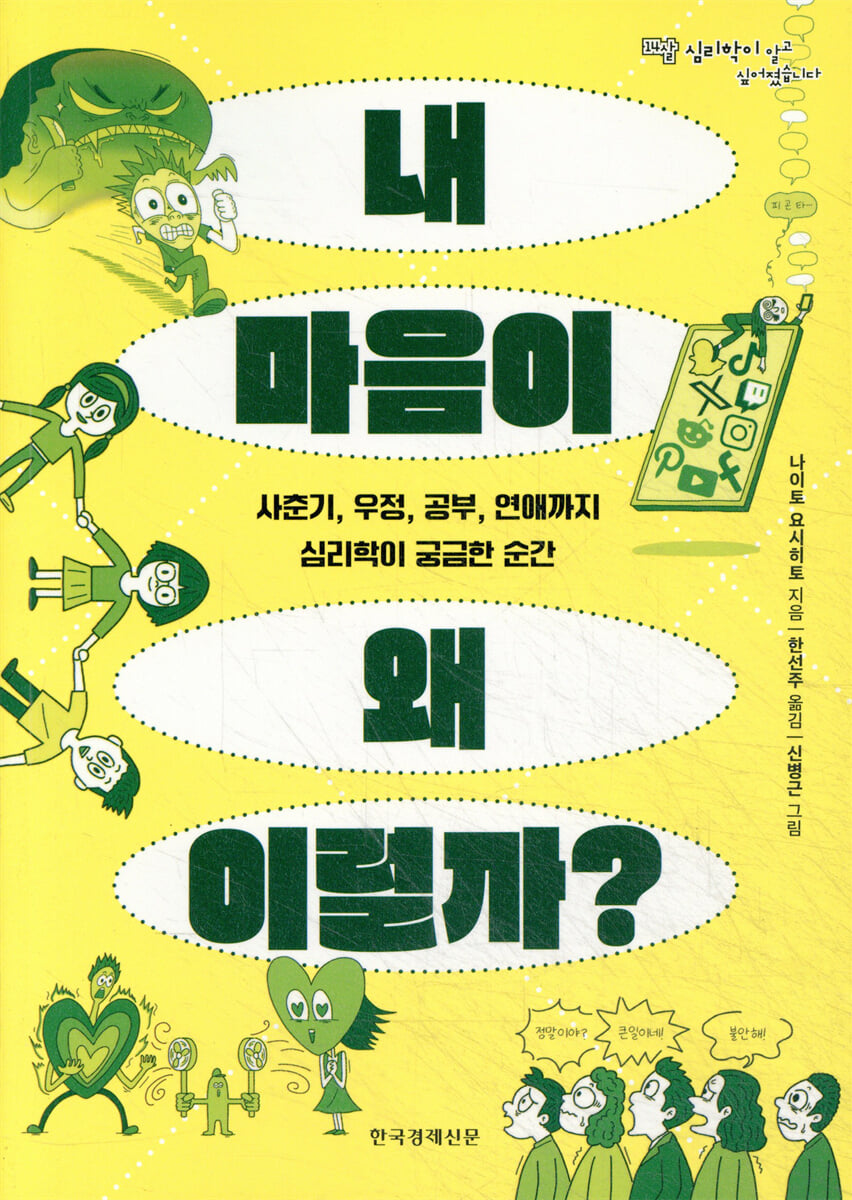
Why is my heart like this?
 |
Description
Book Introduction
To the youth who are beginning to wonder about the 'heart'
The world of psychology revealed by Professor Yoshihito Naito, a leading expert in practical psychology.
"A fun and easy-to-read dictionary of psychology with 67 topics."
Psychologist Yoshihito Naito, who captured the hearts of many adults with “Just Change Your Tone of Speaking,” has now published a psychology book for teenagers.
If you vaguely thought, “Isn’t psychology the study of reading other people’s minds?” this book will completely change your mind.
It is an interesting and friendly explanation of what psychology is and how it is deeply connected to our daily lives.
It is structured so that anyone from elementary school students to adults can easily read and understand it, making it a good introductory book to psychology.
Psychology, like biology or astronomy, is a discipline that aims to understand the world, but it is special in that its subject is 'ourselves'.
Anyone going through puberty has probably asked themselves these questions at least once - "Are looks everything when it comes to dating?", "Is it a disadvantage to have a quiet personality?", "Will I really be happy if I do what I love?", "What should I do if I'm a victim of cyberbullying?", "Can I tell if someone is successful through Instagram?" - This book provides clear and practical answers to these questions from a psychological perspective.
As you read, you will find yourself exclaiming, “I didn’t know psychology could be such a fun and useful subject?”
The book is divided into six themes: 'Family and Friends', 'Love and Sex', 'Study and Sports', 'Money and Career', 'Society and the Future', and 'Lies and Truth'.
For each topic, we provide easy and fun explanations of topics that teenagers might be curious about, based on the latest psychological research from around the world.
It introduces various psychological theories such as the six degrees of separation theory, the contagion effect, and the halo effect, so you can use it as a dictionary by selecting only the topics of interest.
Above all, what makes this book special is that it goes beyond simply imparting knowledge. It deeply empathizes with the real-world concerns of teenagers and offers solutions. Focusing on real-life issues faced by teenagers, such as social media, appearance concerns, school violence, and cyberbullying, it demonstrates how psychology can be a life-changing tool.
"Why Is My Heart Like This?" is an introductory psychology book that helps teenagers better understand themselves and develop perspectives on others just by reading it.
This book will serve as the first step toward helping young people grow into healthy members of society.
This is a must-read for teenagers, as well as their parents and teachers who want to understand their hearts.
The world of psychology revealed by Professor Yoshihito Naito, a leading expert in practical psychology.
"A fun and easy-to-read dictionary of psychology with 67 topics."
Psychologist Yoshihito Naito, who captured the hearts of many adults with “Just Change Your Tone of Speaking,” has now published a psychology book for teenagers.
If you vaguely thought, “Isn’t psychology the study of reading other people’s minds?” this book will completely change your mind.
It is an interesting and friendly explanation of what psychology is and how it is deeply connected to our daily lives.
It is structured so that anyone from elementary school students to adults can easily read and understand it, making it a good introductory book to psychology.
Psychology, like biology or astronomy, is a discipline that aims to understand the world, but it is special in that its subject is 'ourselves'.
Anyone going through puberty has probably asked themselves these questions at least once - "Are looks everything when it comes to dating?", "Is it a disadvantage to have a quiet personality?", "Will I really be happy if I do what I love?", "What should I do if I'm a victim of cyberbullying?", "Can I tell if someone is successful through Instagram?" - This book provides clear and practical answers to these questions from a psychological perspective.
As you read, you will find yourself exclaiming, “I didn’t know psychology could be such a fun and useful subject?”
The book is divided into six themes: 'Family and Friends', 'Love and Sex', 'Study and Sports', 'Money and Career', 'Society and the Future', and 'Lies and Truth'.
For each topic, we provide easy and fun explanations of topics that teenagers might be curious about, based on the latest psychological research from around the world.
It introduces various psychological theories such as the six degrees of separation theory, the contagion effect, and the halo effect, so you can use it as a dictionary by selecting only the topics of interest.
Above all, what makes this book special is that it goes beyond simply imparting knowledge. It deeply empathizes with the real-world concerns of teenagers and offers solutions. Focusing on real-life issues faced by teenagers, such as social media, appearance concerns, school violence, and cyberbullying, it demonstrates how psychology can be a life-changing tool.
"Why Is My Heart Like This?" is an introductory psychology book that helps teenagers better understand themselves and develop perspectives on others just by reading it.
This book will serve as the first step toward helping young people grow into healthy members of society.
This is a must-read for teenagers, as well as their parents and teachers who want to understand their hearts.
- You can preview some of the book's contents.
Preview
index
To begin with
Chapter 1: Learning Psychology through 'Family and Friendship Relationships'
1.
A child who sucks on a pacifier a lot can't read the mood?
2.
There are two things people hate more than death.
3.
What a small world! It only takes six people to know each other.
4.
Friends who pretend not to see bullying fuel the bullying.
5.
One in four victims of cyberbullying?
6.
Why isn't my child's poop dirty?
7. Check SNS only three times a day!
8.
Is it abnormal to be conscious of other people's gaze?
9.
People don't care about me
10.
Is being popular annoying?
11.
If you follow a role model, you become a role model yourself.
12.
The Power of Small Routines That Make Your Family Happy
Chapter 2: Learning Psychology through 'Love and Sex'
13.
Differences between men and women in their perception of appearance
14.
If you feel a complex, check the related data.
15.
Do 'masculinity' and 'femininity' really exist?
16.
Why are we obsessed with being thin?
17.
Are you attracted to people who resemble your parents?
18.
Does white skin really make a good impression?
19.
Are women with long hair more popular than women with short hair?
20.
Don't rush into relationships, take your time and take your time!
21.
Looks aren't everything
22.
36 Questions to Get Closer to Someone You're Attracted To
23.
Introverts and extroverts: Are there really differences in brains and genes?
24.
In the long run, a quiet personality is advantageous.
25.
The reason you like someone changes into the reason you hate them.
Chapter 3: Learning Psychology through 'Study and Sports'
26.
Does your birth month matter in sports and academics?
27.
A variety of approaches leads to greater achievement than just one.
28.
Self-hypnosis to unleash your inner potential
29.
Even when speaking from authority, let's take it with a grain of salt sometimes.
30.
Having a rival gives you strength
31.
Too many star players is a problem
32.
People who worry a lot are smart.
33.
Solve the test questions before studying.
34.
Will 'brain training' make you smarter?
35.
If you believe firmly, your grades will improve.
36.
If you ask a question, be willing to answer.
37.
Organizing by category makes it easier to remember
38.
If you create your own problems and answers, you will remember them for a long time.
Chapter 4: Learning Psychology through 'Money and Career'
39. A person's success can be seen by looking at their social media.
40.
Money isn't everything, but the richer you are, the longer you live.
41.
Once a standard of living has risen, it is difficult to lower it.
42.
The psychological state of a high-stakes lottery winner
43.
The era where academic qualifications are no longer necessary is coming.
44.
People who have achieved their dreams are prone to depression.
45.
The era of women with superior social skills is coming.
46.
Some jobs don't require social skills.
47.
What do people who are good at numbers do?
48.
The diverse world of psychology, with its diverse incomes.
Chapter 5: Learning Psychology through 'Society and the Future'
49.
A simple way to predict the future
50.
Predicting the economy with elementary school textbooks?
51.
Don't be swayed by the powerful influence of the media.
52.
Is it bad to tolerate injustice?
53.
Why Tropical Regions Have Diverse Languages and Religions
54.
The Real Reason Autism and ADHD Are Rising
55.
Something more dangerous and harder to quit than drugs
56.
Even marriage and divorce require a cooling-off period.
Chapter 6: Learning Psychology through 'Lies and Truths'
57.
Our 'memories' lie
58.
Little lies to package yourself
59.
Why do rumors and urban legends continue to spread?
60.
Even questionable products are effective.
61.
Does puberty really make you emotionally unstable?
62.
Why only guilty verdicts are handed down in criminal trials
63.
Does the verdict change depending on the judge's mood?
64.
It's important to reflect when you make a mistake.
65.
Can staying away from doctors make you live longer?
66.
Our unconscious mind rejects murder.
67.
Inequality is OK, unfairness is NG
In conclusion
References
Chapter 1: Learning Psychology through 'Family and Friendship Relationships'
1.
A child who sucks on a pacifier a lot can't read the mood?
2.
There are two things people hate more than death.
3.
What a small world! It only takes six people to know each other.
4.
Friends who pretend not to see bullying fuel the bullying.
5.
One in four victims of cyberbullying?
6.
Why isn't my child's poop dirty?
7. Check SNS only three times a day!
8.
Is it abnormal to be conscious of other people's gaze?
9.
People don't care about me
10.
Is being popular annoying?
11.
If you follow a role model, you become a role model yourself.
12.
The Power of Small Routines That Make Your Family Happy
Chapter 2: Learning Psychology through 'Love and Sex'
13.
Differences between men and women in their perception of appearance
14.
If you feel a complex, check the related data.
15.
Do 'masculinity' and 'femininity' really exist?
16.
Why are we obsessed with being thin?
17.
Are you attracted to people who resemble your parents?
18.
Does white skin really make a good impression?
19.
Are women with long hair more popular than women with short hair?
20.
Don't rush into relationships, take your time and take your time!
21.
Looks aren't everything
22.
36 Questions to Get Closer to Someone You're Attracted To
23.
Introverts and extroverts: Are there really differences in brains and genes?
24.
In the long run, a quiet personality is advantageous.
25.
The reason you like someone changes into the reason you hate them.
Chapter 3: Learning Psychology through 'Study and Sports'
26.
Does your birth month matter in sports and academics?
27.
A variety of approaches leads to greater achievement than just one.
28.
Self-hypnosis to unleash your inner potential
29.
Even when speaking from authority, let's take it with a grain of salt sometimes.
30.
Having a rival gives you strength
31.
Too many star players is a problem
32.
People who worry a lot are smart.
33.
Solve the test questions before studying.
34.
Will 'brain training' make you smarter?
35.
If you believe firmly, your grades will improve.
36.
If you ask a question, be willing to answer.
37.
Organizing by category makes it easier to remember
38.
If you create your own problems and answers, you will remember them for a long time.
Chapter 4: Learning Psychology through 'Money and Career'
39. A person's success can be seen by looking at their social media.
40.
Money isn't everything, but the richer you are, the longer you live.
41.
Once a standard of living has risen, it is difficult to lower it.
42.
The psychological state of a high-stakes lottery winner
43.
The era where academic qualifications are no longer necessary is coming.
44.
People who have achieved their dreams are prone to depression.
45.
The era of women with superior social skills is coming.
46.
Some jobs don't require social skills.
47.
What do people who are good at numbers do?
48.
The diverse world of psychology, with its diverse incomes.
Chapter 5: Learning Psychology through 'Society and the Future'
49.
A simple way to predict the future
50.
Predicting the economy with elementary school textbooks?
51.
Don't be swayed by the powerful influence of the media.
52.
Is it bad to tolerate injustice?
53.
Why Tropical Regions Have Diverse Languages and Religions
54.
The Real Reason Autism and ADHD Are Rising
55.
Something more dangerous and harder to quit than drugs
56.
Even marriage and divorce require a cooling-off period.
Chapter 6: Learning Psychology through 'Lies and Truths'
57.
Our 'memories' lie
58.
Little lies to package yourself
59.
Why do rumors and urban legends continue to spread?
60.
Even questionable products are effective.
61.
Does puberty really make you emotionally unstable?
62.
Why only guilty verdicts are handed down in criminal trials
63.
Does the verdict change depending on the judge's mood?
64.
It's important to reflect when you make a mistake.
65.
Can staying away from doctors make you live longer?
66.
Our unconscious mind rejects murder.
67.
Inequality is OK, unfairness is NG
In conclusion
References
Detailed image

Into the book
Unfortunately, bullying is common in schools, workplaces, and other communities where people gather.
If you see someone around you being bullied, don't hesitate, step forward and help.
Psychological research shows that when you hesitate and hesitate, thinking, "Should I start a conversation? What should I do?", most people end up choosing to just "stay still."
When helping, you should just reflexively jump in and say to the perpetrator, “Hey, don’t do that!”
Or, it would be good to listen to the victim and say, “If you’re having a hard time, I’ll give you some advice.”
--- p.
28~29
Why do women want to be so thin? Perhaps the media has a big influence.
All models and celebrities are slim.
There are some chubby celebrities, but most of them are comedians.
If you come into contact with this kind of mass media every day, you will subconsciously start to think, 'I should become slim like model ○○.'
As I explained about 'mean and standard deviation' earlier, if you look at the data, there are many women who are not fat.
So don't try too hard to follow what you see in the media.
Celebrities and models are only 'exceptional' situations, and in reality, there is no need to lose that much weight as long as there are no health problems.
--- p.67
Sometimes, better results are achieved when players train and compete freely rather than under the supervision of a coach.
This may not be the case for all teams, but it is clear that it is easier to perform well when you approach the game with a relaxed and calm attitude.
Basically, you should follow what the coach and manager say, but if you really can't agree with something, just let it go.
Leaders are also human, so they sometimes make mistakes or misjudge things.
If the player does not understand and enjoy the game, good performance will not be achieved.
--- p.107
Since you won't know what's important without looking at past exam questions, you'll have no choice but to memorize every subject from the beginning.
Then, the amount of material you have to memorize increases significantly and learning efficiency decreases.
For efficient and smooth learning, please remember to start with solving past exam questions.
--- p.116
When studying, it is a good idea to divide the content into several chunks and memorize them.
For example, if there are 100 pieces of knowledge, similar or related ones are grouped together and made into five or ten categories.
This will also help you remember it.
--- p.128
Stuart McCann of Cape Breton University in Canada has published a surprising study showing that you can predict a person's success by looking at their X (formerly Twitter) account.
McCann analyzed the tweets of more than 140,000 people and also looked into the social status and financial income of those accounts.
As a result, we found that the more positive the tweets, the higher the position and income of the person in the company.
Rich and successful people don't complain or gossip about others.
--- p.136~137
Why do scary ghost stories make people want to share them? According to Heath, it's because they "have high survival value."
For example, if you hear something like, “It’s dangerous there, so you shouldn’t go near it,” you can be careful in advance and reduce the risk of your life being in danger.
We shouldn't incite unnecessary anxiety or fear, but psychologically, everyone wants to live in peace and safety, so rumors that are life-threatening tend to spread easily and be believed easily.
If you see someone around you being bullied, don't hesitate, step forward and help.
Psychological research shows that when you hesitate and hesitate, thinking, "Should I start a conversation? What should I do?", most people end up choosing to just "stay still."
When helping, you should just reflexively jump in and say to the perpetrator, “Hey, don’t do that!”
Or, it would be good to listen to the victim and say, “If you’re having a hard time, I’ll give you some advice.”
--- p.
28~29
Why do women want to be so thin? Perhaps the media has a big influence.
All models and celebrities are slim.
There are some chubby celebrities, but most of them are comedians.
If you come into contact with this kind of mass media every day, you will subconsciously start to think, 'I should become slim like model ○○.'
As I explained about 'mean and standard deviation' earlier, if you look at the data, there are many women who are not fat.
So don't try too hard to follow what you see in the media.
Celebrities and models are only 'exceptional' situations, and in reality, there is no need to lose that much weight as long as there are no health problems.
--- p.67
Sometimes, better results are achieved when players train and compete freely rather than under the supervision of a coach.
This may not be the case for all teams, but it is clear that it is easier to perform well when you approach the game with a relaxed and calm attitude.
Basically, you should follow what the coach and manager say, but if you really can't agree with something, just let it go.
Leaders are also human, so they sometimes make mistakes or misjudge things.
If the player does not understand and enjoy the game, good performance will not be achieved.
--- p.107
Since you won't know what's important without looking at past exam questions, you'll have no choice but to memorize every subject from the beginning.
Then, the amount of material you have to memorize increases significantly and learning efficiency decreases.
For efficient and smooth learning, please remember to start with solving past exam questions.
--- p.116
When studying, it is a good idea to divide the content into several chunks and memorize them.
For example, if there are 100 pieces of knowledge, similar or related ones are grouped together and made into five or ten categories.
This will also help you remember it.
--- p.128
Stuart McCann of Cape Breton University in Canada has published a surprising study showing that you can predict a person's success by looking at their X (formerly Twitter) account.
McCann analyzed the tweets of more than 140,000 people and also looked into the social status and financial income of those accounts.
As a result, we found that the more positive the tweets, the higher the position and income of the person in the company.
Rich and successful people don't complain or gossip about others.
--- p.136~137
Why do scary ghost stories make people want to share them? According to Heath, it's because they "have high survival value."
For example, if you hear something like, “It’s dangerous there, so you shouldn’t go near it,” you can be careful in advance and reduce the risk of your life being in danger.
We shouldn't incite unnecessary anxiety or fear, but psychologically, everyone wants to live in peace and safety, so rumors that are life-threatening tend to spread easily and be believed easily.
--- p.199
Publisher's Review
Psychology is now an elective subject taught in high schools.
This means that the importance of psychology and interest in it are growing.
The fact that the MBTI personality type test, which was created based on the psychological theory of Carl Gustav Jung, has become so popular in Korea also shows that the need to understand oneself through psychology is growing stronger.
For adolescents who wonder why their fickle minds change several times a day, Professor Yoshihito Naito, a leading expert in practical psychology, introduces psychology in an easy and fun way.
For readers who wonder if psychology is simply a discipline about reading other people's minds, this book explains, through a variety of research cases, what psychology is, what research fields it encompasses, and how it can benefit their lives.
For teenagers who lose confidence in themselves in front of the mirror, whose hearts race when it's time to give a presentation, who spend a lot of time on social media, and who are easily swayed by prejudice and rumors, this book will show them how psychology can be a useful tool in their lives.
Psychology, which can be difficult to understand, is explained in an easy and fun way through research from around the world and real-life examples, making it accessible to anyone.
An introductory psychology book focused on everyday life, organized into six themes covering the entire spectrum of adolescent life.
The book is divided into six chapters that cover the entire spectrum of a teenager's life, including family and friendships, love and sex, study and sports, money and career, society and the future, and lies and truth.
This book selects realistic concerns that teenagers face every day outside of textbooks, such as 'Why do we care about what other people think?', 'How often do we check social media?', 'How to deal with cyberbullying?', and 'How to overcome appearance complex?', and provides psychological solutions.
Even if you just skim the table of contents, you will sympathize and say, “That’s my story.”
It is practical as it provides not only psychological knowledge but also practical life tips that can be applied immediately in real life.
An interesting composition that allows you to experience the pleasure of reading itself.
The 67 subheadings, categorized into six themes, begin with life-related questions such as “Why are we obsessed with being thin?” and “How many times a day should we ideally check social media?”, strongly stimulating the curiosity of adolescent readers.
Each subheading covers a separate topic, so readers can use it like a dictionary by looking at the table of contents and reading only the parts they want.
Additionally, each subheading is composed of short passages, so even teenagers who find long texts burdensome can read it easily.
By eliminating complex formulas and technical terms, and introducing psychology based on interesting, cutting-edge research results and theories, it is highly reliable and easy to read.
Through this book, even teenagers who struggle with reading will be able to experience the joy of reading it all.
Furthermore, beyond personal reading, post-reading discussion activities utilizing the topics introduced in the book are also possible.
This means that the importance of psychology and interest in it are growing.
The fact that the MBTI personality type test, which was created based on the psychological theory of Carl Gustav Jung, has become so popular in Korea also shows that the need to understand oneself through psychology is growing stronger.
For adolescents who wonder why their fickle minds change several times a day, Professor Yoshihito Naito, a leading expert in practical psychology, introduces psychology in an easy and fun way.
For readers who wonder if psychology is simply a discipline about reading other people's minds, this book explains, through a variety of research cases, what psychology is, what research fields it encompasses, and how it can benefit their lives.
For teenagers who lose confidence in themselves in front of the mirror, whose hearts race when it's time to give a presentation, who spend a lot of time on social media, and who are easily swayed by prejudice and rumors, this book will show them how psychology can be a useful tool in their lives.
Psychology, which can be difficult to understand, is explained in an easy and fun way through research from around the world and real-life examples, making it accessible to anyone.
An introductory psychology book focused on everyday life, organized into six themes covering the entire spectrum of adolescent life.
The book is divided into six chapters that cover the entire spectrum of a teenager's life, including family and friendships, love and sex, study and sports, money and career, society and the future, and lies and truth.
This book selects realistic concerns that teenagers face every day outside of textbooks, such as 'Why do we care about what other people think?', 'How often do we check social media?', 'How to deal with cyberbullying?', and 'How to overcome appearance complex?', and provides psychological solutions.
Even if you just skim the table of contents, you will sympathize and say, “That’s my story.”
It is practical as it provides not only psychological knowledge but also practical life tips that can be applied immediately in real life.
An interesting composition that allows you to experience the pleasure of reading itself.
The 67 subheadings, categorized into six themes, begin with life-related questions such as “Why are we obsessed with being thin?” and “How many times a day should we ideally check social media?”, strongly stimulating the curiosity of adolescent readers.
Each subheading covers a separate topic, so readers can use it like a dictionary by looking at the table of contents and reading only the parts they want.
Additionally, each subheading is composed of short passages, so even teenagers who find long texts burdensome can read it easily.
By eliminating complex formulas and technical terms, and introducing psychology based on interesting, cutting-edge research results and theories, it is highly reliable and easy to read.
Through this book, even teenagers who struggle with reading will be able to experience the joy of reading it all.
Furthermore, beyond personal reading, post-reading discussion activities utilizing the topics introduced in the book are also possible.
GOODS SPECIFICS
- Date of issue: August 27, 2025
- Page count, weight, size: 232 pages | 150*210*20mm
- ISBN13: 9788947501842
- ISBN10: 8947501840
You may also like
카테고리
korean


korean

![GQ KOREA Mark (Monthly): December [2025]](http://librairie.coreenne.fr/cdn/shop/files/8ef265dbbfbf186523ed75ba7319009d.jpg?v=1765340328&width=3840)


