

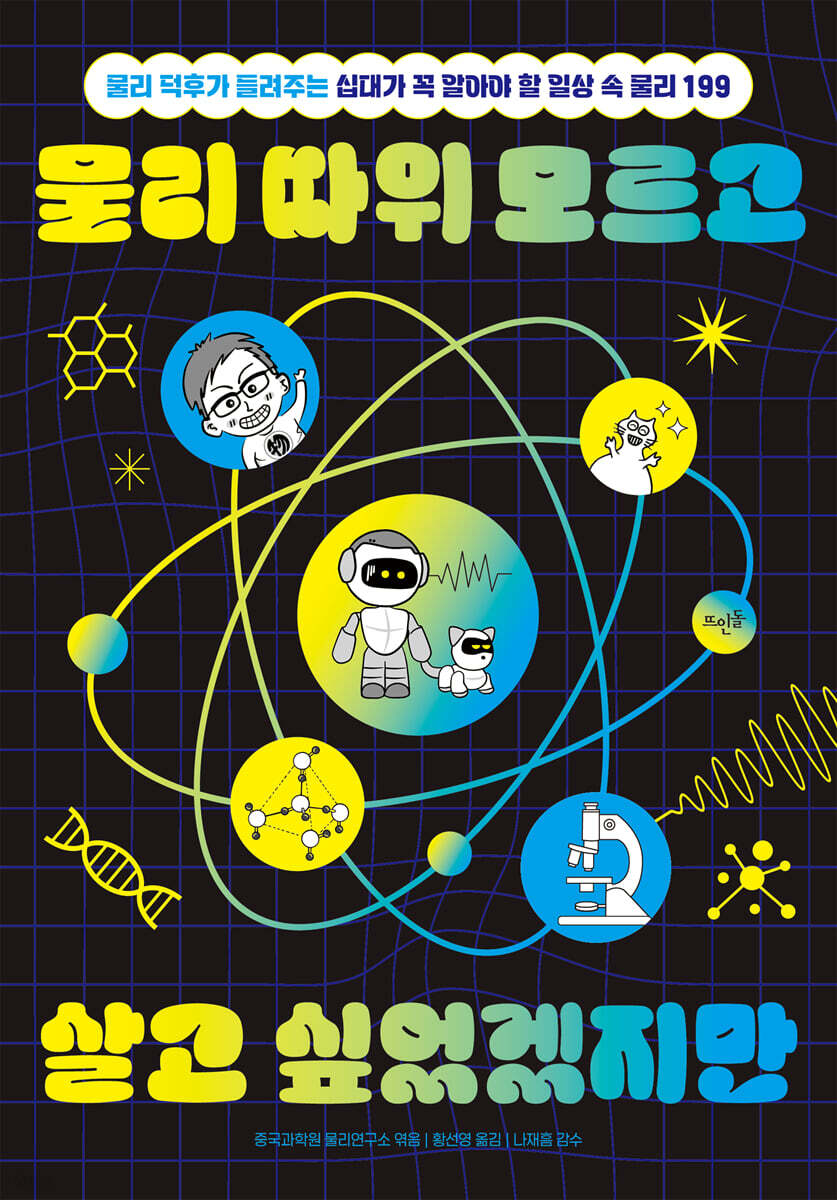
I wish I could live without knowing anything about physics.
 |
Description
Book Introduction
Physically solving everyday curiosities from the perspective of teenagers
A fun and intriguing science adventure!
“You may have wanted to live without knowing anything about physics, but you are already living in physics!”
Everyday life is full of physics.
The gravity you feel when you drop your phone, the magical phenomenon of earphone cords getting tangled, and the weight of time you feel when you ignore your alarm clock.
"I Wish I'd Lived Without Knowing About Physics" is a delightful science guide that allows us to look at everyday phenomena through the lens of physics.
This book, a science adventure in which a physics nerd who is lost in a parallel universe explores various spaces to find answers to physics, was planned at a level suitable for teenagers based on the Q&A content of the official WeChat account operated for many years by the Institute of Physics of the Chinese Academy of Sciences, a leading physics research institute in China.
The answers that provide refreshing answers to everyday questions contain core physics content that is important in the curriculum.
No complicated formulas! Friendly explanations directly from scientists and intuitive illustrations make it easy and fun to understand! "I Wish I'd Lived Without Physics" is a book that will teach you that studying physics is a smarter and more interesting way to view the world.
The moment you close this book, your daily life will begin to look physical again.
A fun and intriguing science adventure!
“You may have wanted to live without knowing anything about physics, but you are already living in physics!”
Everyday life is full of physics.
The gravity you feel when you drop your phone, the magical phenomenon of earphone cords getting tangled, and the weight of time you feel when you ignore your alarm clock.
"I Wish I'd Lived Without Knowing About Physics" is a delightful science guide that allows us to look at everyday phenomena through the lens of physics.
This book, a science adventure in which a physics nerd who is lost in a parallel universe explores various spaces to find answers to physics, was planned at a level suitable for teenagers based on the Q&A content of the official WeChat account operated for many years by the Institute of Physics of the Chinese Academy of Sciences, a leading physics research institute in China.
The answers that provide refreshing answers to everyday questions contain core physics content that is important in the curriculum.
No complicated formulas! Friendly explanations directly from scientists and intuitive illustrations make it easy and fun to understand! "I Wish I'd Lived Without Physics" is a book that will teach you that studying physics is a smarter and more interesting way to view the world.
The moment you close this book, your daily life will begin to look physical again.
- You can preview some of the book's contents.
Preview
index
Shall we begin the story?
Physics I Met at Home
Physics encountered in food
Physics I Met at School
Physics encountered in electronics
Physics met in light
Physics encountered in the weather
Physics encountered in space
Physics I Met at the Lab
BONUS! Q&A on Physics in Transportation
Physics I Met at Home
Physics encountered in food
Physics I Met at School
Physics encountered in electronics
Physics met in light
Physics encountered in the weather
Physics encountered in space
Physics I Met at the Lab
BONUS! Q&A on Physics in Transportation
Detailed image

Into the book
Q.
Why do blankets become fluffier and heavier after being hung out in the sun?
Sometimes I feel like a sun-dried blanket has become as thick and fluffy as a new blanket.
This is because warm air fills the spaces between the cotton fibers.
In addition, after being exposed to sunlight, the amount of air inside the blanket increases, which loosens the cotton fibers, improving elasticity and heat retention. In addition, ultraviolet rays remove moisture and germs inside the blanket, which helps prevent infectious diseases such as colds.
--- p.33
Q.
Why does the spout of a glass make a noise when you rub it with wet hands?
Sound is a phenomenon in which the vibrations of an object are transmitted through a medium (a substance that transmits waves) such as air or other solids or liquids so that they can be detected by the auditory organs of humans or animals.
When you rub the spout of a glass with wet hands, the sound you hear is because the vibrations generated by the object are transmitted through the medium and we detect them.
--- p.39
Q.
Why do my nails bounce around when I cut them?
Human fingernails have some degree of curve.
The blades of the nail clippers are curved inward to make it easier to shape your nails.
When viewed from the front, the surface where the upper and lower blades meet is flat.
So, when a curved nail is pressed against the nail clipper blade, it flattens out for a moment, and then bounces back to its original curved shape as it is cut.
At this time, the cut nail hits the connecting shaft of the nail clipper or other parts and flies in all directions.
--- p.45
Q.
Why can't people pass through walls?
In quantum mechanics, there is something called the 'quantum tunneling effect'.
Even if a particle encounters an energy barrier greater than its kinetic energy, it does not bounce off unconditionally as classical physics says, but rather has a certain probability of passing through.
But this is only possible with a single particle.
Humans are made up of countless particles, and these particles interact in a very complex way.
The logic that can be explained by a single particle cannot be directly applied to humans.
--- p.48
Q.
Why does oil splatter when you put it in a pot with water remaining in it and boil it?
It is common for oil to splatter when frying food.
When the oil in the pan is hot and you put in moist vegetables, the oil will splatter.
Because the boiling point of oil is higher than that of water, the temperature of the already heated oil is much higher than that of water.
So when water comes into contact with hot oil, it rapidly vaporizes, rapidly expanding in volume and expelling the oil.
--- p.61
Q.
Will strong winds affect my Wi-Fi signal?
Strong winds do not directly affect Wi-Fi signals.
Wi-Fi signals are a type of radio wave (a type of electromagnetic wave primarily used for communication), and wind is created when the air density in a certain area increases.
The effect of air on the speed of radio waves is very small.
It's at a level that can be ignored.
--- p.116
At that time, the exhibition guide heard the conversation between the physics group and Shunyangi and spoke to them.
“Our optical technology complex is currently holding an event where we are giving away prizes to those who answer the quiz correctly.
The prize is a round-trip high-speed train ticket to the Meteorological Science Museum! A new Meteorological Science Museum recently opened about 100 kilometers away.
“You seem like smart people. Can you answer a few questions?”
The physics group glanced over the problems posted on the wall.
It was all a matter of light.
There were a few questions that were quite difficult, but they were all at a level that the physics group could answer.
“Let me try to solve it.”
The physics group said confidently.
"Shall we show off our skills? Okay, let's start with the white LED problem…."
Why do blankets become fluffier and heavier after being hung out in the sun?
Sometimes I feel like a sun-dried blanket has become as thick and fluffy as a new blanket.
This is because warm air fills the spaces between the cotton fibers.
In addition, after being exposed to sunlight, the amount of air inside the blanket increases, which loosens the cotton fibers, improving elasticity and heat retention. In addition, ultraviolet rays remove moisture and germs inside the blanket, which helps prevent infectious diseases such as colds.
--- p.33
Q.
Why does the spout of a glass make a noise when you rub it with wet hands?
Sound is a phenomenon in which the vibrations of an object are transmitted through a medium (a substance that transmits waves) such as air or other solids or liquids so that they can be detected by the auditory organs of humans or animals.
When you rub the spout of a glass with wet hands, the sound you hear is because the vibrations generated by the object are transmitted through the medium and we detect them.
--- p.39
Q.
Why do my nails bounce around when I cut them?
Human fingernails have some degree of curve.
The blades of the nail clippers are curved inward to make it easier to shape your nails.
When viewed from the front, the surface where the upper and lower blades meet is flat.
So, when a curved nail is pressed against the nail clipper blade, it flattens out for a moment, and then bounces back to its original curved shape as it is cut.
At this time, the cut nail hits the connecting shaft of the nail clipper or other parts and flies in all directions.
--- p.45
Q.
Why can't people pass through walls?
In quantum mechanics, there is something called the 'quantum tunneling effect'.
Even if a particle encounters an energy barrier greater than its kinetic energy, it does not bounce off unconditionally as classical physics says, but rather has a certain probability of passing through.
But this is only possible with a single particle.
Humans are made up of countless particles, and these particles interact in a very complex way.
The logic that can be explained by a single particle cannot be directly applied to humans.
--- p.48
Q.
Why does oil splatter when you put it in a pot with water remaining in it and boil it?
It is common for oil to splatter when frying food.
When the oil in the pan is hot and you put in moist vegetables, the oil will splatter.
Because the boiling point of oil is higher than that of water, the temperature of the already heated oil is much higher than that of water.
So when water comes into contact with hot oil, it rapidly vaporizes, rapidly expanding in volume and expelling the oil.
--- p.61
Q.
Will strong winds affect my Wi-Fi signal?
Strong winds do not directly affect Wi-Fi signals.
Wi-Fi signals are a type of radio wave (a type of electromagnetic wave primarily used for communication), and wind is created when the air density in a certain area increases.
The effect of air on the speed of radio waves is very small.
It's at a level that can be ignored.
--- p.116
At that time, the exhibition guide heard the conversation between the physics group and Shunyangi and spoke to them.
“Our optical technology complex is currently holding an event where we are giving away prizes to those who answer the quiz correctly.
The prize is a round-trip high-speed train ticket to the Meteorological Science Museum! A new Meteorological Science Museum recently opened about 100 kilometers away.
“You seem like smart people. Can you answer a few questions?”
The physics group glanced over the problems posted on the wall.
It was all a matter of light.
There were a few questions that were quite difficult, but they were all at a level that the physics group could answer.
“Let me try to solve it.”
The physics group said confidently.
"Shall we show off our skills? Okay, let's start with the white LED problem…."
--- p.141
Publisher's Review
Solve the daily curiosities you face with physics!
The question that suddenly popped into my head while I was browsing at the mall, clipping my nails, or riding an airplane.
“Wait a minute… why is this happening?”
Why do our legs sway when an elevator stops? Why do fingernails bounce in different directions every time? Why aren't airplane windows square? These are everyday mysteries we've often overlooked. "I Wish I'd Lived Without Knowing About Physics" is a book that uses physics to answer these questions, which have likely occurred to everyone at least once.
This book, which carefully selects 199 of the most popular questions from the Q&A content of the WeChat account operated for many years by the Institute of Physics of the Chinese Academy of Sciences, a leading physics research institute in China, and organizes them at a level suitable for teenagers, will not frighten them with the word "physics" but rather arouse their curiosity.
“How to see the world more intelligently,” taught by physics nerds themselves.
As you read, you might find yourself thinking about inertia while riding an elevator or fluid dynamics while showering.
A physics adventure that unfolds like a game!
8 stages, bonus Q&A, and tight curriculum integration!
While chasing Schrödinger's cat, graduate student "Physics Gun" is suddenly sucked into a parallel universe physics map! The only way to return to reality? Answer the questions posed by the inhabitants of each space using physics and progress through each stage.
The book is written in a game format for teenage readers.
This is a configuration where you can only advance to the next stage after passing the quest.
At each stage, outrageous questions are asked.
These questions are linked to core physics concepts in the curriculum.
The stages that the physics army must pass are as follows:
Stage 1.
Home - A World of Power and Movement
How much do I have to wring out a towel to get all the water out? Why does soap lather so well when I use a foam net?
→ Explore the ‘physics of the nearest world’ such as rotational force, friction, and surface tension.
Stage 2.
Delicious Food - Taste Created by Thermal Energy
Why does water become noisy and then quiet when it boils? Why does a cold popsicle stick to your tongue?
→ Boiling point, heat conduction… There is physics behind taste.
Stage 3.
School - A Labyrinth of Waves and Sounds
Do vibrating objects necessarily make sound? Can sound put out fire?
→ Waves, medium, sound waves… Dissecting the nature of sound through physics.
Stage 4.
Digital Complex - The Convenience of Electricity
How is fast charging possible? How does the anti-theft chip work?
→ We delve into electronic products, which are a collection of physics: current, voltage, magnetic fields…
Stage 5.
Optical Technology Complex - Physics of Light
Why are rainbows semicircles? How do 3D glasses provide three-dimensional images?
→ Refraction, scattering, quantum entanglement… Follow the world that light draws.
Stage 6.
Korea Meteorological Administration - Physical Phenomena in Nature
Why does water evaporate even at room temperature? How can artificial rain be created?
→ Pressure, condensation, radiation… Sensory experiences are transferred to physics.
Stage 7.
Planetarium - Physics of the Universe
How do we receive alien signals? Can we create stars?
→ Electromagnetic waves, interstellar matter, cosmic radiation… the introductory stage of astrophysics!
Stage 8.
Physics Research Institute - The Birth of a Physics Geek
How do our ears distinguish between high and low sounds? Are electrons material?
→ Fourier transforms, fermions, elementary particles… Enter the deep world of physics!
**Bonus Q&A - Physics in Transportation
Bicycles, subways, cars, airplanes… Every movement has its own physics!
Easy and friendly explanations + intuitive illustrations
There is no complicated formula.
Easy to understand with short one-page explanations and intuitive illustrations.
You don't have to read them in order.
Let's start by selecting the questions you are curious about and reading them.
A book that both physics beginners and physics nerds can enjoy training in scientific thinking.
The moment you close this book, your daily life will begin to look physical again.
The question that suddenly popped into my head while I was browsing at the mall, clipping my nails, or riding an airplane.
“Wait a minute… why is this happening?”
Why do our legs sway when an elevator stops? Why do fingernails bounce in different directions every time? Why aren't airplane windows square? These are everyday mysteries we've often overlooked. "I Wish I'd Lived Without Knowing About Physics" is a book that uses physics to answer these questions, which have likely occurred to everyone at least once.
This book, which carefully selects 199 of the most popular questions from the Q&A content of the WeChat account operated for many years by the Institute of Physics of the Chinese Academy of Sciences, a leading physics research institute in China, and organizes them at a level suitable for teenagers, will not frighten them with the word "physics" but rather arouse their curiosity.
“How to see the world more intelligently,” taught by physics nerds themselves.
As you read, you might find yourself thinking about inertia while riding an elevator or fluid dynamics while showering.
A physics adventure that unfolds like a game!
8 stages, bonus Q&A, and tight curriculum integration!
While chasing Schrödinger's cat, graduate student "Physics Gun" is suddenly sucked into a parallel universe physics map! The only way to return to reality? Answer the questions posed by the inhabitants of each space using physics and progress through each stage.
The book is written in a game format for teenage readers.
This is a configuration where you can only advance to the next stage after passing the quest.
At each stage, outrageous questions are asked.
These questions are linked to core physics concepts in the curriculum.
The stages that the physics army must pass are as follows:
Stage 1.
Home - A World of Power and Movement
How much do I have to wring out a towel to get all the water out? Why does soap lather so well when I use a foam net?
→ Explore the ‘physics of the nearest world’ such as rotational force, friction, and surface tension.
Stage 2.
Delicious Food - Taste Created by Thermal Energy
Why does water become noisy and then quiet when it boils? Why does a cold popsicle stick to your tongue?
→ Boiling point, heat conduction… There is physics behind taste.
Stage 3.
School - A Labyrinth of Waves and Sounds
Do vibrating objects necessarily make sound? Can sound put out fire?
→ Waves, medium, sound waves… Dissecting the nature of sound through physics.
Stage 4.
Digital Complex - The Convenience of Electricity
How is fast charging possible? How does the anti-theft chip work?
→ We delve into electronic products, which are a collection of physics: current, voltage, magnetic fields…
Stage 5.
Optical Technology Complex - Physics of Light
Why are rainbows semicircles? How do 3D glasses provide three-dimensional images?
→ Refraction, scattering, quantum entanglement… Follow the world that light draws.
Stage 6.
Korea Meteorological Administration - Physical Phenomena in Nature
Why does water evaporate even at room temperature? How can artificial rain be created?
→ Pressure, condensation, radiation… Sensory experiences are transferred to physics.
Stage 7.
Planetarium - Physics of the Universe
How do we receive alien signals? Can we create stars?
→ Electromagnetic waves, interstellar matter, cosmic radiation… the introductory stage of astrophysics!
Stage 8.
Physics Research Institute - The Birth of a Physics Geek
How do our ears distinguish between high and low sounds? Are electrons material?
→ Fourier transforms, fermions, elementary particles… Enter the deep world of physics!
**Bonus Q&A - Physics in Transportation
Bicycles, subways, cars, airplanes… Every movement has its own physics!
Easy and friendly explanations + intuitive illustrations
There is no complicated formula.
Easy to understand with short one-page explanations and intuitive illustrations.
You don't have to read them in order.
Let's start by selecting the questions you are curious about and reading them.
A book that both physics beginners and physics nerds can enjoy training in scientific thinking.
The moment you close this book, your daily life will begin to look physical again.
GOODS SPECIFICS
- Date of issue: August 18, 2025
- Page count, weight, size: 279 pages | 488g | 150*215*18mm
- ISBN13: 9788958070733
You may also like
카테고리
korean


korean

![GQ KOREA Mark (Monthly): December [2025]](http://librairie.coreenne.fr/cdn/shop/files/8ef265dbbfbf186523ed75ba7319009d.jpg?v=1765340328&width=3840)


