

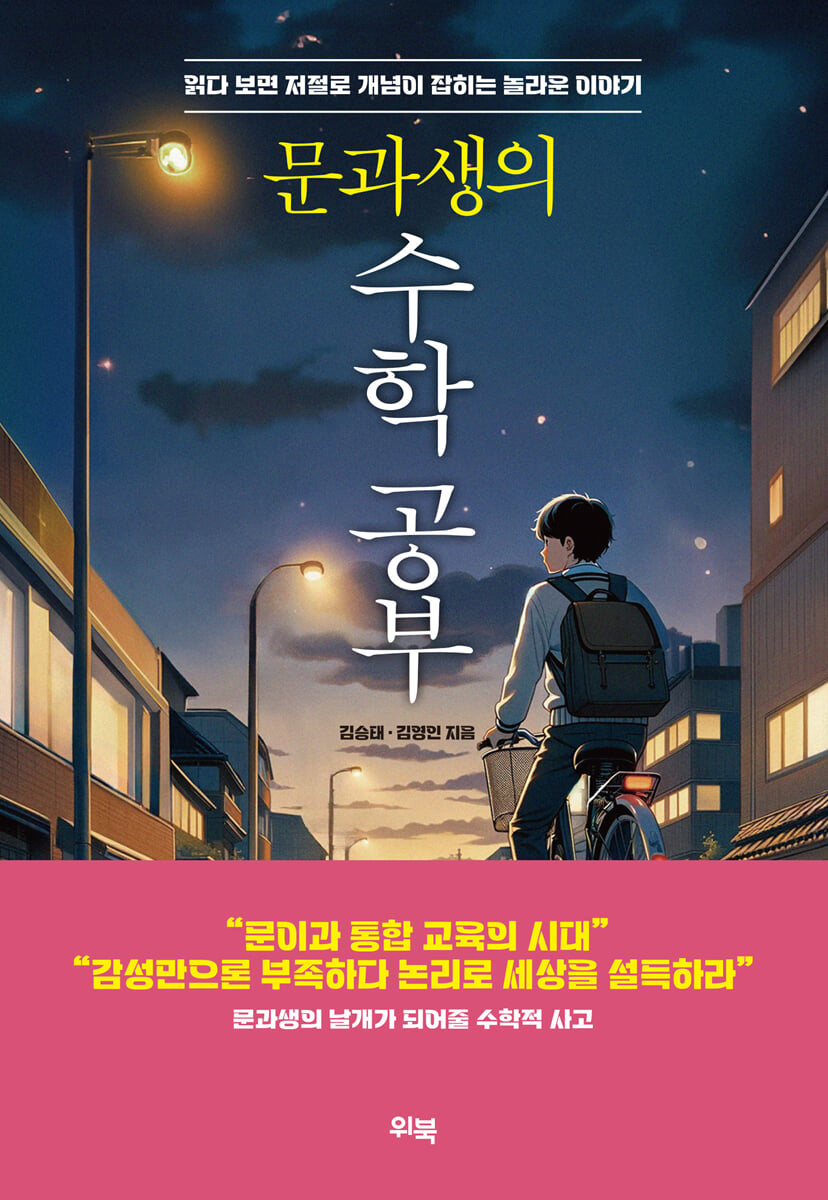
Mathematics study for liberal arts students
 |
Description
Book Introduction
Even liberal arts students can become friends with math.
A new math textbook that connects math concepts through storytelling.
A textbook that explains mathematical concepts in an easy-to-understand way using everyday topics such as Slam Dunk, viruses, and perms.
Instead of formulas and problem solving, it naturally conveys core concepts such as quadratic functions, logarithms, and probability through interesting examples from everyday life.
This is a storytelling-based textbook designed to help liberal arts students become familiar with mathematics, and anyone in middle school or higher can read it without difficulty.
It is also suitable for use in integrated reading or project classes in educational settings.
This is a new introductory book that awakens the thinking skills and curiosity of those who have given up on mathematics.
A new math textbook that connects math concepts through storytelling.
A textbook that explains mathematical concepts in an easy-to-understand way using everyday topics such as Slam Dunk, viruses, and perms.
Instead of formulas and problem solving, it naturally conveys core concepts such as quadratic functions, logarithms, and probability through interesting examples from everyday life.
This is a storytelling-based textbook designed to help liberal arts students become familiar with mathematics, and anyone in middle school or higher can read it without difficulty.
It is also suitable for use in integrated reading or project classes in educational settings.
This is a new introductory book that awakens the thinking skills and curiosity of those who have given up on mathematics.
- You can preview some of the book's contents.
Preview
index
preface
01 Functions that capture movement in action
- Mathematical techniques not revealed in Slam Dunk
- Linear functions and keys
- Differentiation can do things like this
- Differentiation is active in every aspect of our lives
- Quadratic curves at work everywhere
Eskimos bring math to igloos
- I'll launch the ball as high as I can, so gather around, everyone.
- A curve faster than a straight line, a curve that can save or kill life.
- A high jumper who enjoys quadratic functions
- You don't necessarily need quadratic functions to enjoy windsurfing.
02 Functions are always integrated into our lives.
- Now even the height of a light bulb involves mathematics.
- How fast do you need to escape this stuffy Earth?
- Differentiation can hire and fire employees.
- What is the devil's curve that mathematicians talk about?
- I want to see the famous statue from the best location.
- Trigonometric functions that can be used to study the movement of tsunamis
- Figuring out when dinosaurs lived is also math.
- Mathematics that directs modern cinema
- Catching cheating with logarithms in math
- I never thought a hairdresser would be a math whiz.
03 Mathematical letters, formulas, and daily life
- Mathematician Descartes sues Steve Jobs from the afterlife.
- Surviving an Arctic Expedition
- Mathematics finds traces of the criminal.
- Even baseball curveballs have math in them.
- There is a line even in the league
- Drunk Man's Math
- What is the speed of the spaceship?
- Unmanned surveillance cameras also recognize math and enforce it.
- Supercomputers love matrices.
- Calculate the course that is advantageous for turning a curve in a track and field race.
04 Geometry Penetration
- Circles aren't just used in math textbooks.
- Does the coronavirus do math?
- Mathematics increases the value of diamonds.
- I'm scared to even eat one egg.
Because there is math there too
- Don't tell secrets in the whispering gallery room.
- Will the amount of cement used in both pillars be the same?
- Even laying tiles on the floor takes a lot of math.
- The playground of computer graphics, spatial coordinates
- The role of vectors in weather forecasting
- I knew about the soap film.
The most economical road construction
05 Why are numbers and operations there?
- Why is one bottle of soju equal to seven glasses?
- Diagnose cancer by scanning a drop of blood with a barcode.
- What would have happened if there were no Indian Arabic numerals?
- Is the devil's number 666 Bill Gates?
- Robots and factorization
- Mathematics in Geunjeongjeon Hall of Gyeongbokgung Palace
- Unlike apartments, Hanoks utilize mathematics to some extent.
06 Do not manipulate.
Probability and Statistics
- Why are the odds of winning the lottery 1 in 13983816?
Mathematics ultimately plays a role in uncovering the human genome.
- The probability of two enemies meeting on the street
- The reason why my line is long
- Statistics Lie: Vitamins Threaten People
- The math behind winning money from gambling
- The Monty Hall problem that appears in every book
- Math has changed.
Quite smoothly
- To deceive like this.
Average prank
- Math is wrong from the start
Concluding remarks by the editor
01 Functions that capture movement in action
- Mathematical techniques not revealed in Slam Dunk
- Linear functions and keys
- Differentiation can do things like this
- Differentiation is active in every aspect of our lives
- Quadratic curves at work everywhere
Eskimos bring math to igloos
- I'll launch the ball as high as I can, so gather around, everyone.
- A curve faster than a straight line, a curve that can save or kill life.
- A high jumper who enjoys quadratic functions
- You don't necessarily need quadratic functions to enjoy windsurfing.
02 Functions are always integrated into our lives.
- Now even the height of a light bulb involves mathematics.
- How fast do you need to escape this stuffy Earth?
- Differentiation can hire and fire employees.
- What is the devil's curve that mathematicians talk about?
- I want to see the famous statue from the best location.
- Trigonometric functions that can be used to study the movement of tsunamis
- Figuring out when dinosaurs lived is also math.
- Mathematics that directs modern cinema
- Catching cheating with logarithms in math
- I never thought a hairdresser would be a math whiz.
03 Mathematical letters, formulas, and daily life
- Mathematician Descartes sues Steve Jobs from the afterlife.
- Surviving an Arctic Expedition
- Mathematics finds traces of the criminal.
- Even baseball curveballs have math in them.
- There is a line even in the league
- Drunk Man's Math
- What is the speed of the spaceship?
- Unmanned surveillance cameras also recognize math and enforce it.
- Supercomputers love matrices.
- Calculate the course that is advantageous for turning a curve in a track and field race.
04 Geometry Penetration
- Circles aren't just used in math textbooks.
- Does the coronavirus do math?
- Mathematics increases the value of diamonds.
- I'm scared to even eat one egg.
Because there is math there too
- Don't tell secrets in the whispering gallery room.
- Will the amount of cement used in both pillars be the same?
- Even laying tiles on the floor takes a lot of math.
- The playground of computer graphics, spatial coordinates
- The role of vectors in weather forecasting
- I knew about the soap film.
The most economical road construction
05 Why are numbers and operations there?
- Why is one bottle of soju equal to seven glasses?
- Diagnose cancer by scanning a drop of blood with a barcode.
- What would have happened if there were no Indian Arabic numerals?
- Is the devil's number 666 Bill Gates?
- Robots and factorization
- Mathematics in Geunjeongjeon Hall of Gyeongbokgung Palace
- Unlike apartments, Hanoks utilize mathematics to some extent.
06 Do not manipulate.
Probability and Statistics
- Why are the odds of winning the lottery 1 in 13983816?
Mathematics ultimately plays a role in uncovering the human genome.
- The probability of two enemies meeting on the street
- The reason why my line is long
- Statistics Lie: Vitamins Threaten People
- The math behind winning money from gambling
- The Monty Hall problem that appears in every book
- Math has changed.
Quite smoothly
- To deceive like this.
Average prank
- Math is wrong from the start
Concluding remarks by the editor
Detailed image

Into the book
Have you ever wondered why players put spin on the ball when they shoot? It's fine if it goes in right away, but if you use the backboard, the spin on the ball is much more likely to score.
---P.14
Hairdressers simply use a circular tool called a rod to wind the hair around themselves to create waves like sine and cosine graphs.
Why bother knowing whether it's a sine graph or a cosine graph?
---P.92
Smartphones enable communication through numbers.
Coordinate awareness is also realized through numbers.
What we want to know is not that complex mathematics, but that Steve Jobs stole Descartes' technique.
This is the coordinate technology created by Descartes.
Touchscreen.
---P.99
Let's take an example.
If you were to build a road connecting four points located at the corners of a square, how would you connect them to create the shortest road while minimizing cost?
---P.174
Mathematics sometimes miraculously guards our wealth and secrets in the shadows.
They work in the shade while supporting the sun.
It sounds like something I've heard somewhere, but mathematics actually does such things silently.
---P.185
There were some groups of people who couldn't swim, so they decided to cross a river whose average depth was 1 m.
The height of all of them was over 160 cm.
So everyone crossed the river with confidence, believing in their own height, and ended up dying.
Why did they lose their lives? It was because they believed in the trap of averages.
---P.14
Hairdressers simply use a circular tool called a rod to wind the hair around themselves to create waves like sine and cosine graphs.
Why bother knowing whether it's a sine graph or a cosine graph?
---P.92
Smartphones enable communication through numbers.
Coordinate awareness is also realized through numbers.
What we want to know is not that complex mathematics, but that Steve Jobs stole Descartes' technique.
This is the coordinate technology created by Descartes.
Touchscreen.
---P.99
Let's take an example.
If you were to build a road connecting four points located at the corners of a square, how would you connect them to create the shortest road while minimizing cost?
---P.174
Mathematics sometimes miraculously guards our wealth and secrets in the shadows.
They work in the shade while supporting the sun.
It sounds like something I've heard somewhere, but mathematics actually does such things silently.
---P.185
There were some groups of people who couldn't swim, so they decided to cross a river whose average depth was 1 m.
The height of all of them was over 160 cm.
So everyone crossed the river with confidence, believing in their own height, and ended up dying.
Why did they lose their lives? It was because they believed in the trap of averages.
---P.234
Publisher's Review
Even liberal arts students can become friends with math.
A new math textbook that connects math concepts through storytelling.
Slam Dunk, Perm Hair, Criminal Investigation, Virus Structure, etc. Math is no longer a rigid formula in textbooks, but rather an interesting story that comes to life in everyday life.
This is a unique approach that focuses on understanding "why we learn" by explaining mathematical concepts in a story format, helping even liberal arts students who have given up on mathematics to read and understand the concepts without burden.
"Mathematics for Liberal Arts Students" introduces how mathematics is hidden and operates in various fields we encounter in our daily lives, such as sports, art, beauty, film, disease, and statistics, through familiar examples.
As you follow the story, mathematical concepts will begin to form in your head, from the parabolic shot in Slam Dunk, to the trigonometry in perm hair designs, to the binary system used in fingerprint analysis, to the icosahedral structure of the COVID-19 virus, to the mathematically designed criminal investigation techniques.
Author Seungtae Kim is a lecturer with experience writing various mathematics textbooks and is skilled at structurally explaining mathematical concepts.
Co-author Kim Young-in also teaches students in Daechi-dong, developing lectures and content based on the philosophy of "easy and friendly math."
The two authors stated their intention in writing, saying, "Even liberal arts students can become quite familiar with mathematics," and "I wanted to help students overcome their fear of mathematics and build a foundation."
A math textbook that connects the classroom and reality
Focus on stories rather than formulas, and on intuition rather than problem solving.
"Mathematics for Liberal Arts Students" explains various concepts covered in the middle and high school curriculum, such as quadratic functions, trigonometric functions, logarithms, differentiation, probability and statistics, and vectors, by connecting them to real-life stories.
The structure of reducing formulas and calculations and instead showing 'why this concept is important' and 'how it is used in the world' is especially beneficial for students who struggle with math.
For example, quadratic functions originate from the parabolic trajectory of a basketball shot, and trigonometric functions are found in the hands of a hairdresser creating waves in a salon.
Logs are used to date dinosaur fossils, and vectors are used to predict wind direction in weather forecasts.
Readers are encouraged to embrace mathematical concepts in a 'new language' and experience intuitive and logical thinking, moving away from 'formula-based memorization' mathematics.
Beyond simple explanations, the book also contains interesting questions that stimulate the imagination.
Questions like "Why do I always fail at the lottery?", "Does math determine the price of diamonds?", "What math do unmanned speed cameras use?", and "Are the statistics in vitamin advertisements true?" naturally convey the fact that mathematics affects every aspect of life, and help bridge the gap between mathematics and the real world.
A "real math textbook" that expands your thinking skills without the burden of studying.
Practical content useful for students, parents, and teachers
『Mathematics Study for Liberal Arts Students』 is especially useful for the following readership groups:
These include high school students in the humanities who have given up on or are afraid of math, parents who want to help their children with math, teachers who plan storytelling-based integrated reading, and general readers looking for interesting and practical general education books.
Based on curriculum concepts but aimed at expanding mathematical thinking rather than for testing purposes, this book is also suitable for use in integrated classes or after-school math reading programs.
The book is designed to be readable by anyone in middle school or higher, and to help develop an intuition for mathematical concepts without excessive formulas or calculations.
In particular, it is advertised as a book that allows you to become familiar with mathematics without feeling like you are studying, and it is also a good second introduction to mathematics that helps you not give up on mathematics.
"Mathematics for Liberal Arts Students" will be a practical and engaging guide for readers seeking to develop their thinking skills through mathematics.
Through this book, mathematics is no longer a cold formula, but a new way to view the world.
A new math textbook that connects math concepts through storytelling.
Slam Dunk, Perm Hair, Criminal Investigation, Virus Structure, etc. Math is no longer a rigid formula in textbooks, but rather an interesting story that comes to life in everyday life.
This is a unique approach that focuses on understanding "why we learn" by explaining mathematical concepts in a story format, helping even liberal arts students who have given up on mathematics to read and understand the concepts without burden.
"Mathematics for Liberal Arts Students" introduces how mathematics is hidden and operates in various fields we encounter in our daily lives, such as sports, art, beauty, film, disease, and statistics, through familiar examples.
As you follow the story, mathematical concepts will begin to form in your head, from the parabolic shot in Slam Dunk, to the trigonometry in perm hair designs, to the binary system used in fingerprint analysis, to the icosahedral structure of the COVID-19 virus, to the mathematically designed criminal investigation techniques.
Author Seungtae Kim is a lecturer with experience writing various mathematics textbooks and is skilled at structurally explaining mathematical concepts.
Co-author Kim Young-in also teaches students in Daechi-dong, developing lectures and content based on the philosophy of "easy and friendly math."
The two authors stated their intention in writing, saying, "Even liberal arts students can become quite familiar with mathematics," and "I wanted to help students overcome their fear of mathematics and build a foundation."
A math textbook that connects the classroom and reality
Focus on stories rather than formulas, and on intuition rather than problem solving.
"Mathematics for Liberal Arts Students" explains various concepts covered in the middle and high school curriculum, such as quadratic functions, trigonometric functions, logarithms, differentiation, probability and statistics, and vectors, by connecting them to real-life stories.
The structure of reducing formulas and calculations and instead showing 'why this concept is important' and 'how it is used in the world' is especially beneficial for students who struggle with math.
For example, quadratic functions originate from the parabolic trajectory of a basketball shot, and trigonometric functions are found in the hands of a hairdresser creating waves in a salon.
Logs are used to date dinosaur fossils, and vectors are used to predict wind direction in weather forecasts.
Readers are encouraged to embrace mathematical concepts in a 'new language' and experience intuitive and logical thinking, moving away from 'formula-based memorization' mathematics.
Beyond simple explanations, the book also contains interesting questions that stimulate the imagination.
Questions like "Why do I always fail at the lottery?", "Does math determine the price of diamonds?", "What math do unmanned speed cameras use?", and "Are the statistics in vitamin advertisements true?" naturally convey the fact that mathematics affects every aspect of life, and help bridge the gap between mathematics and the real world.
A "real math textbook" that expands your thinking skills without the burden of studying.
Practical content useful for students, parents, and teachers
『Mathematics Study for Liberal Arts Students』 is especially useful for the following readership groups:
These include high school students in the humanities who have given up on or are afraid of math, parents who want to help their children with math, teachers who plan storytelling-based integrated reading, and general readers looking for interesting and practical general education books.
Based on curriculum concepts but aimed at expanding mathematical thinking rather than for testing purposes, this book is also suitable for use in integrated classes or after-school math reading programs.
The book is designed to be readable by anyone in middle school or higher, and to help develop an intuition for mathematical concepts without excessive formulas or calculations.
In particular, it is advertised as a book that allows you to become familiar with mathematics without feeling like you are studying, and it is also a good second introduction to mathematics that helps you not give up on mathematics.
"Mathematics for Liberal Arts Students" will be a practical and engaging guide for readers seeking to develop their thinking skills through mathematics.
Through this book, mathematics is no longer a cold formula, but a new way to view the world.
GOODS SPECIFICS
- Date of issue: August 18, 2025
- Page count, weight, size: 244 pages | 145*210*20mm
- ISBN13: 9791191618297
- ISBN10: 1191618293
You may also like
카테고리
korean


korean

![GQ KOREA Mark (Monthly): December [2025]](http://librairie.coreenne.fr/cdn/shop/files/8ef265dbbfbf186523ed75ba7319009d.jpg?v=1765340328&width=3840)


