

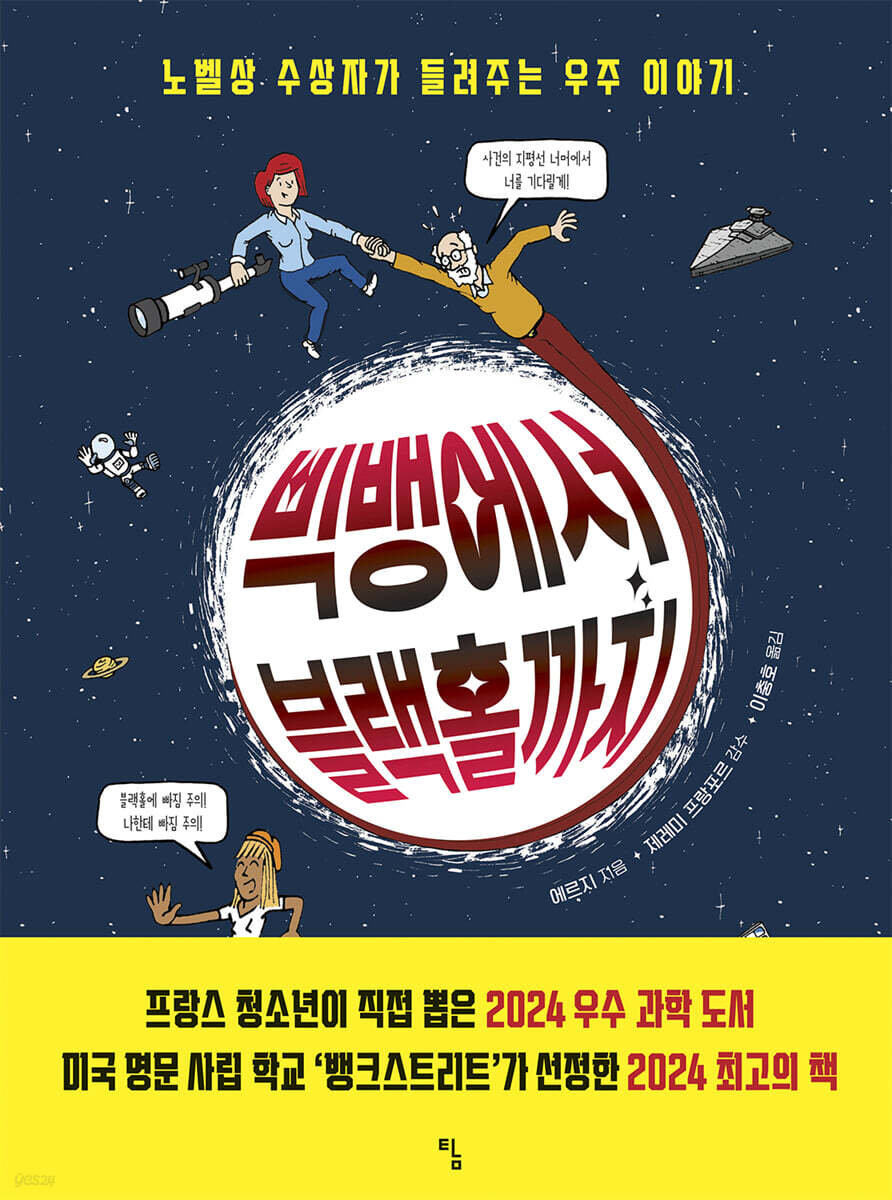
From the Big Bang to Black Holes
 |
Description
Book Introduction
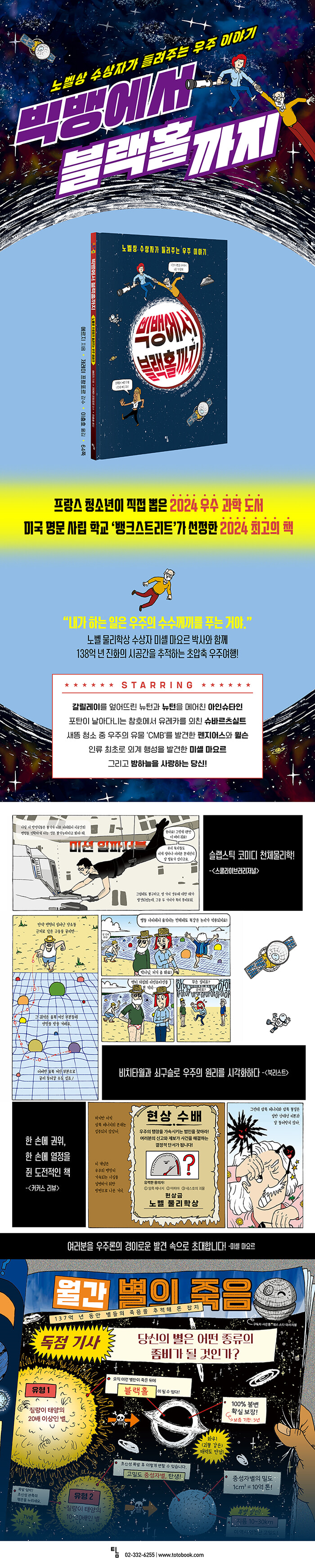
“What I do is solve the mysteries of the universe.”
With Nobel Prize winner in Physics Dr. Michel Mayor
A hyper-compressed space journey tracing 13.8 billion years of evolutionary time and space!
At the moment of the Big Bang, was there an explosion? What were the early cosmic relics, and how were they discovered? Why is the "event horizon" called that? A slapstick astrophysics show unfolds, where you'll swim through primordial soup, plunge into black holes, and traverse 13.8 billion years of evolutionary time and space.
Discover the brilliant achievements of cosmology, which has unraveled the mysteries of the universe from the Big Bang to black holes, through entertaining and intellectual educational comics.
As the [Kirkus Review] review states, “It is a challenging book that holds authority in one hand and passion in the other.”
One of the best science books of 2024, chosen by French youth, and one of the best books of 2024 by Bank Street in the United States.
With Nobel Prize winner in Physics Dr. Michel Mayor
A hyper-compressed space journey tracing 13.8 billion years of evolutionary time and space!
At the moment of the Big Bang, was there an explosion? What were the early cosmic relics, and how were they discovered? Why is the "event horizon" called that? A slapstick astrophysics show unfolds, where you'll swim through primordial soup, plunge into black holes, and traverse 13.8 billion years of evolutionary time and space.
Discover the brilliant achievements of cosmology, which has unraveled the mysteries of the universe from the Big Bang to black holes, through entertaining and intellectual educational comics.
As the [Kirkus Review] review states, “It is a challenging book that holds authority in one hand and passion in the other.”
One of the best science books of 2024, chosen by French youth, and one of the best books of 2024 by Bank Street in the United States.
- You can preview some of the book's contents.
Preview
index
Chapter 1: Gravity: From Galileo to Einstein, p. 9
Chapter 2: Cosmology: The Big Bang and the Cosmic MB, p. 24
Chapter 3_ Black Holes_ Page 44
Glossary_ Page 62
Chapter 2: Cosmology: The Big Bang and the Cosmic MB, p. 24
Chapter 3_ Black Holes_ Page 44
Glossary_ Page 62
Detailed image
Into the book
“You’ve probably heard of the Big Bang, right? When people think of the Big Bang, they usually think of a huge explosion.
But in reality, that's not the case.
Our scientists think of the Big Bang as simply the moment when the universe first appeared.
It's hard to imagine that event, but that's how we now understand the universe to have come into being.
“From a state of nothingness, the first universe was created, a state similar to a soup of boiling particles.”
--- p.6
“Newton didn’t have the potential to be a great scientist from the beginning.
Born prematurely, it was almost a miracle that I survived.
They say he had a bit of an eccentric personality during his school days.
Newton had a strong tendency to beat others, and because of that, he worked very hard.
Newton's mother wanted her son to quit his studies and become a farmer.
Fortunately, some people who knew of Newton's talent persuaded his mother to send him to college.
Thanks to this, humanity has gained great benefits.
--- p.15
"Observations show that the universe is largely uniform.
That is, the material is evenly distributed throughout.
If we believe what we see with our eyes, these results might surprise you.
The night sky is filled with tiny dots of light scattered throughout, with vast expanses of space between them.
If we were to shrink the entire solar system to the size of a ping-pong ball... the nearest other solar system would be 250 meters away! That doesn't look uniform at all.
So, to see a uniform universe, we need to reduce it by an order of magnitude.
So much so that you can see 100 million galaxies at a glance.
At this stage, the universe begins to look truly uniform.
--- p.28
“Okay, but how can we measure the distances to galaxies that are incredibly far away from Earth?”
“One popular method is to look for a special type of star called a Cepheid variable star.
This variable star's brightness changes regularly.
If you want to understand the principle, think about a light source with its own brightness.
Like street lights, for example.
By looking at the streetlights, we can estimate how far away something is from us.
Because I know roughly the original brightness of the streetlight.
This principle applies equally to stars.
“If we know the apparent brightness and the intrinsic brightness, we can calculate the distance.”
--- p.41
“The Schwarzschild radius is not only a concept that defines a black hole, but also the ‘event horizon’ that corresponds to the boundary of a black hole.
Once you cross this boundary, it is impossible to escape the black hole.
If you are even just 1cm outside the boundary line, theoretically escape is still possible.
But if you go just 1cm inside the border, and there's no evidence yet that you can do that, it's game over.
“You may cross this invisible line without even realizing it, and you may not feel anything special, but that person’s fate is already sealed.”
--- p.47
“Dark energy accounts for about 70% of all matter and energy in the universe.
They suspect that dark energy is the reason why the expansion of the universe is accelerating, even though theoretically it should be slowing down or even contracting.
However, the existence of dark energy has not yet been proven.
This concept came about as a means to explain the fact that the expansion of the universe is accelerating.”
--- p.59
“Finally, there is a question about the origin of the universe.
How the universe came into being remains a great mystery.
Unfortunately, we cannot create the conditions for the Big Bang in a laboratory.
So it is difficult for this research to make much progress.
So, you may have to wait a very long time to rewind this film.
…to finally learn Jack's secret.”
But in reality, that's not the case.
Our scientists think of the Big Bang as simply the moment when the universe first appeared.
It's hard to imagine that event, but that's how we now understand the universe to have come into being.
“From a state of nothingness, the first universe was created, a state similar to a soup of boiling particles.”
--- p.6
“Newton didn’t have the potential to be a great scientist from the beginning.
Born prematurely, it was almost a miracle that I survived.
They say he had a bit of an eccentric personality during his school days.
Newton had a strong tendency to beat others, and because of that, he worked very hard.
Newton's mother wanted her son to quit his studies and become a farmer.
Fortunately, some people who knew of Newton's talent persuaded his mother to send him to college.
Thanks to this, humanity has gained great benefits.
--- p.15
"Observations show that the universe is largely uniform.
That is, the material is evenly distributed throughout.
If we believe what we see with our eyes, these results might surprise you.
The night sky is filled with tiny dots of light scattered throughout, with vast expanses of space between them.
If we were to shrink the entire solar system to the size of a ping-pong ball... the nearest other solar system would be 250 meters away! That doesn't look uniform at all.
So, to see a uniform universe, we need to reduce it by an order of magnitude.
So much so that you can see 100 million galaxies at a glance.
At this stage, the universe begins to look truly uniform.
--- p.28
“Okay, but how can we measure the distances to galaxies that are incredibly far away from Earth?”
“One popular method is to look for a special type of star called a Cepheid variable star.
This variable star's brightness changes regularly.
If you want to understand the principle, think about a light source with its own brightness.
Like street lights, for example.
By looking at the streetlights, we can estimate how far away something is from us.
Because I know roughly the original brightness of the streetlight.
This principle applies equally to stars.
“If we know the apparent brightness and the intrinsic brightness, we can calculate the distance.”
--- p.41
“The Schwarzschild radius is not only a concept that defines a black hole, but also the ‘event horizon’ that corresponds to the boundary of a black hole.
Once you cross this boundary, it is impossible to escape the black hole.
If you are even just 1cm outside the boundary line, theoretically escape is still possible.
But if you go just 1cm inside the border, and there's no evidence yet that you can do that, it's game over.
“You may cross this invisible line without even realizing it, and you may not feel anything special, but that person’s fate is already sealed.”
--- p.47
“Dark energy accounts for about 70% of all matter and energy in the universe.
They suspect that dark energy is the reason why the expansion of the universe is accelerating, even though theoretically it should be slowing down or even contracting.
However, the existence of dark energy has not yet been proven.
This concept came about as a means to explain the fact that the expansion of the universe is accelerating.”
--- p.59
“Finally, there is a question about the origin of the universe.
How the universe came into being remains a great mystery.
Unfortunately, we cannot create the conditions for the Big Bang in a laboratory.
So it is difficult for this research to make much progress.
So, you may have to wait a very long time to rewind this film.
…to finally learn Jack's secret.”
--- p.61
Publisher's Review
My first cosmology class
The book begins with a letter from Nobel Prize winner in Physics, Dr. Michel Mayor.
“Dear readers,
Thanks to this book, I was able to achieve the dream of every physicist.
“It’s like looking right into a black hole.”
The doctor was the first person in human history to discover an exoplanet and was awarded the Nobel Prize.
There is also a famous interview where he gave a sharp rebuke to the question of whether humanity will be able to realize its dream of becoming a multi-planetary species: “Exoplanets are too far away, so let’s preserve our own planet that is still habitable (rather than dreaming of such a far-fetched dream)!”
The doctor says that since time immemorial, people from all civilizations on Earth have been preoccupied with the common riddle, “When and how did the world come into being?” and that solving that question is the task of “cosmology.”
This book will take us on a journey to discover the wonders of cosmology.
The days that cosmologists fight are, in fact, nothing more than a lonely battle over difficult and complex equations and numbers.
However, this book aims to explain the universe in an interesting way for the general public and young people by eliminating equations full of meaningless numbers and symbols as much as possible and using visual metaphors such as 'beach towels and iron beads'.
Chapter 1 explains gravity, the fundamental physical law that underpins cosmology, using easy-to-understand metaphors and examples from movies.
Chapter 2 concisely conveys the fundamentals of cosmology, including how the universe was born and has evolved, what substances exist in the universe and how much of them there are, and how the CMB, the oldest light in the universe, came into being.
Chapter 3 delves into the true nature of black holes, often called "cosmic superstars," and also touches on dark matter and dark energy, the universe's many unknowns.
So, let's embark on a hyper-compressed space journey through 13.8 billion years of spacetime with Nobel laureate Michel Mayor, red-haired physicist Celeste, and quirky teenager Valentin.
Want to know more about space? Then start with gravity!
The first place they arrived was in front of the Leaning Tower of Pisa, Italy, in the early 16th century.
Because the first thing we need to do to lay the foundation for cosmology is to understand gravity.
At that time and there, Galileo studied the phenomenon of objects falling and the movement of celestial bodies, which led Isaac Newton in England to discover the law of universal gravitation and the three laws of motion that support it (the law of inertia, the law of acceleration, and the law of action and reaction) several decades later.
About 200 years after Newton's great discovery, Einstein laid the foundation for the general theory of relativity by discovering that space and time can be changed by other things.
Of course, it is also worth noting that in the 200 years between Newton and Einstein, there were discoveries such as James Clerk Maxwell's theory of electromagnetism and Poincaré and Minkowski's discoveries in mathematics.
How is the universe born and dies?
After completing their journey into gravity, the three begin to explore the deep seas of space in earnest.
How did the universe come into being? How did it change over time? Why does it continue to expand? Why are galaxies distributed as they are today? What will happen in the future? Will the universe itself eventually "die?" Einstein's general theory of relativity provides a universal framework for studying all these questions.
The book also brings back some very interesting facts.
When we say 'Big Bang', we usually think of a 'big explosion', but in reality, no explosion occurred.
The universe was not created by a bomb-like substance exploding in an instant. Rather, before the Big Bang, there was simply a state of complete 'nothingness' where there was nothing.
No one can fully explain why the universe just appeared 'out of nowhere'.
However, it has been revealed in relatively detail how the fundamental particles such as electrons, photons, and quarks came together to form matter in the boiling soup-like universe about a second after the universe was created for an unknown reason, and how the first light, the CMB, was created 380,000 years later.
The universe's greatest star, the black hole, and 70% of the universe's dark energy
There are concepts familiar even to those with little knowledge of cosmology.
It's a 'black hole'.
Black holes have inspired countless epic works beyond science.
We often use the expression, ‘sucking everything in like a black hole’ in everyday life.
Strictly speaking, a black hole is a 'solution' (value) discovered by the German physicist and astronomer Karl Schwarzschild while solving Einstein's equations.
Furthermore, it tells us what a black hole actually looks like, what it looks like, and what the 'event horizon' means in relation to it.
[Curriculum Linkage]
Middle School Science 1
Ⅱ.
Various powers
V.
Change of state of matter
VI.
Light and waves
VII.
Science and My Future
Middle School Science 2
Ⅰ.
Composition of matter
Middle School Science 3
I.
Rules of chemical reactions and energy changes
III.
Exercise and Energy
VI.
Energy Transition and Conservation
VII.
Stars and Space
Advanced Integrated Science
Ⅰ.
Regularity and combination of matter
Ⅱ.
Natural constituents
Ⅲ.
dynamical systems
Physics I
I.
Mechanics and Energy
II.
Matter and electromagnetic fields
III.
Waves and Information Communication
Physics II
II.
Matter and electromagnetic fields
Earth Science I
V.
Stars and exoplanetary systems
VI.
External galaxies and the expansion of the universe
Earth Science II
VI.
Planetary motion
VII.
The structure of our galaxy and the universe
The book begins with a letter from Nobel Prize winner in Physics, Dr. Michel Mayor.
“Dear readers,
Thanks to this book, I was able to achieve the dream of every physicist.
“It’s like looking right into a black hole.”
The doctor was the first person in human history to discover an exoplanet and was awarded the Nobel Prize.
There is also a famous interview where he gave a sharp rebuke to the question of whether humanity will be able to realize its dream of becoming a multi-planetary species: “Exoplanets are too far away, so let’s preserve our own planet that is still habitable (rather than dreaming of such a far-fetched dream)!”
The doctor says that since time immemorial, people from all civilizations on Earth have been preoccupied with the common riddle, “When and how did the world come into being?” and that solving that question is the task of “cosmology.”
This book will take us on a journey to discover the wonders of cosmology.
The days that cosmologists fight are, in fact, nothing more than a lonely battle over difficult and complex equations and numbers.
However, this book aims to explain the universe in an interesting way for the general public and young people by eliminating equations full of meaningless numbers and symbols as much as possible and using visual metaphors such as 'beach towels and iron beads'.
Chapter 1 explains gravity, the fundamental physical law that underpins cosmology, using easy-to-understand metaphors and examples from movies.
Chapter 2 concisely conveys the fundamentals of cosmology, including how the universe was born and has evolved, what substances exist in the universe and how much of them there are, and how the CMB, the oldest light in the universe, came into being.
Chapter 3 delves into the true nature of black holes, often called "cosmic superstars," and also touches on dark matter and dark energy, the universe's many unknowns.
So, let's embark on a hyper-compressed space journey through 13.8 billion years of spacetime with Nobel laureate Michel Mayor, red-haired physicist Celeste, and quirky teenager Valentin.
Want to know more about space? Then start with gravity!
The first place they arrived was in front of the Leaning Tower of Pisa, Italy, in the early 16th century.
Because the first thing we need to do to lay the foundation for cosmology is to understand gravity.
At that time and there, Galileo studied the phenomenon of objects falling and the movement of celestial bodies, which led Isaac Newton in England to discover the law of universal gravitation and the three laws of motion that support it (the law of inertia, the law of acceleration, and the law of action and reaction) several decades later.
About 200 years after Newton's great discovery, Einstein laid the foundation for the general theory of relativity by discovering that space and time can be changed by other things.
Of course, it is also worth noting that in the 200 years between Newton and Einstein, there were discoveries such as James Clerk Maxwell's theory of electromagnetism and Poincaré and Minkowski's discoveries in mathematics.
How is the universe born and dies?
After completing their journey into gravity, the three begin to explore the deep seas of space in earnest.
How did the universe come into being? How did it change over time? Why does it continue to expand? Why are galaxies distributed as they are today? What will happen in the future? Will the universe itself eventually "die?" Einstein's general theory of relativity provides a universal framework for studying all these questions.
The book also brings back some very interesting facts.
When we say 'Big Bang', we usually think of a 'big explosion', but in reality, no explosion occurred.
The universe was not created by a bomb-like substance exploding in an instant. Rather, before the Big Bang, there was simply a state of complete 'nothingness' where there was nothing.
No one can fully explain why the universe just appeared 'out of nowhere'.
However, it has been revealed in relatively detail how the fundamental particles such as electrons, photons, and quarks came together to form matter in the boiling soup-like universe about a second after the universe was created for an unknown reason, and how the first light, the CMB, was created 380,000 years later.
The universe's greatest star, the black hole, and 70% of the universe's dark energy
There are concepts familiar even to those with little knowledge of cosmology.
It's a 'black hole'.
Black holes have inspired countless epic works beyond science.
We often use the expression, ‘sucking everything in like a black hole’ in everyday life.
Strictly speaking, a black hole is a 'solution' (value) discovered by the German physicist and astronomer Karl Schwarzschild while solving Einstein's equations.
Furthermore, it tells us what a black hole actually looks like, what it looks like, and what the 'event horizon' means in relation to it.
[Curriculum Linkage]
Middle School Science 1
Ⅱ.
Various powers
V.
Change of state of matter
VI.
Light and waves
VII.
Science and My Future
Middle School Science 2
Ⅰ.
Composition of matter
Middle School Science 3
I.
Rules of chemical reactions and energy changes
III.
Exercise and Energy
VI.
Energy Transition and Conservation
VII.
Stars and Space
Advanced Integrated Science
Ⅰ.
Regularity and combination of matter
Ⅱ.
Natural constituents
Ⅲ.
dynamical systems
Physics I
I.
Mechanics and Energy
II.
Matter and electromagnetic fields
III.
Waves and Information Communication
Physics II
II.
Matter and electromagnetic fields
Earth Science I
V.
Stars and exoplanetary systems
VI.
External galaxies and the expansion of the universe
Earth Science II
VI.
Planetary motion
VII.
The structure of our galaxy and the universe
GOODS SPECIFICS
- Date of issue: January 20, 2025
- Format: Hardcover book binding method guide
- Page count, weight, size: 64 pages | 606g | 232*313*10mm
- ISBN13: 9788964965269
You may also like
카테고리
korean


korean

![GQ KOREA Mark (Monthly): December [2025]](http://librairie.coreenne.fr/cdn/shop/files/8ef265dbbfbf186523ed75ba7319009d.jpg?v=1765340328&width=3840)


