

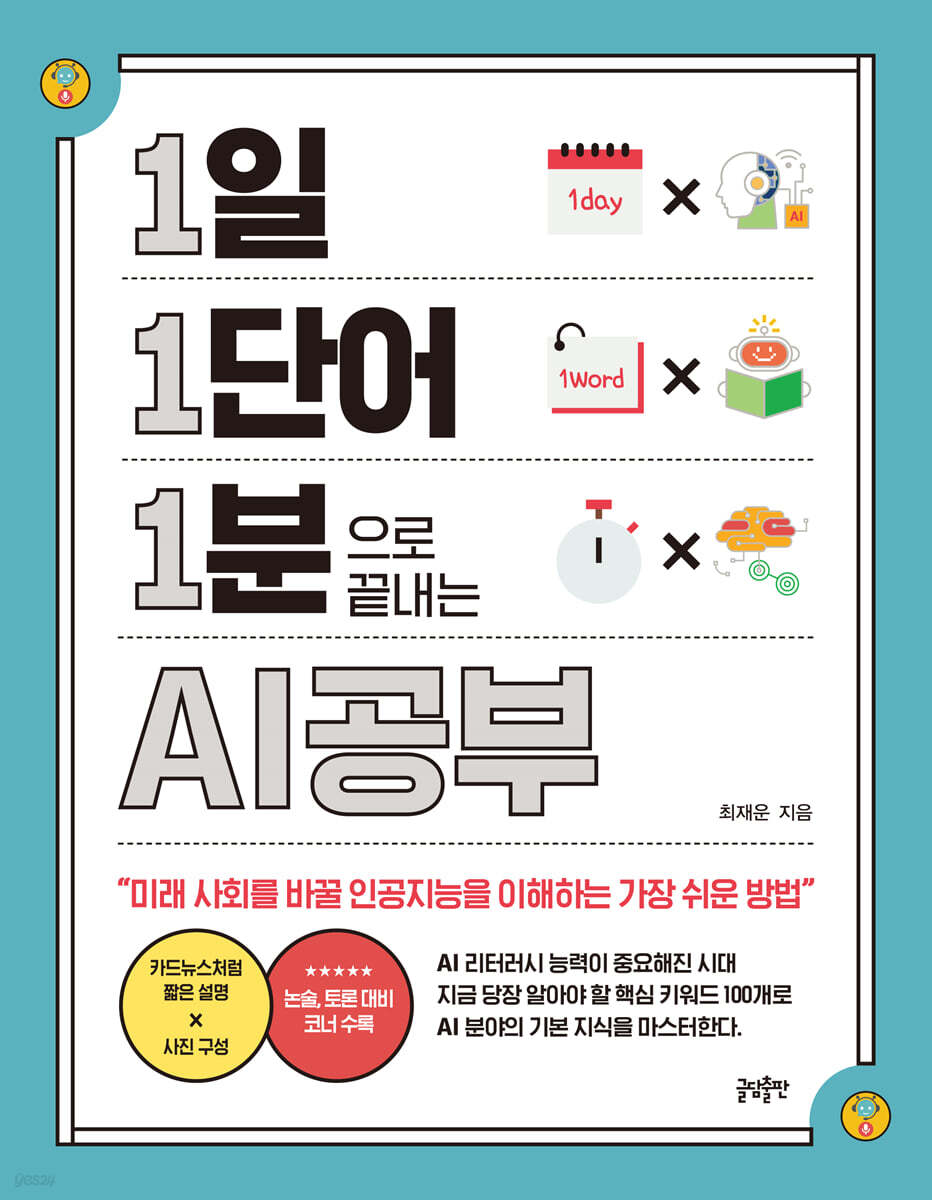
AI Study: One Word a Day, One Minute
 |
Description
Book Introduction
The core technologies and principles of artificial intelligence, and the future that artificial intelligence will create,
The ultimate textbook for fostering AI literacy, a necessity for future generations.
The eighth book in the Geuldam Publishing Youth Culture Book [111 Series].
"AI Study in One Minute, One Word a Day" selects 100 essential words for understanding AI and introduces them in 10 chapters: basic concepts, history, machine learning, deep learning, application fields, technology and tools, key figures and organizations, AI ethics, AI in popular culture, and the future of AI.
To ensure that each concept is thoroughly understood, the core content is presented with various examples, and various materials such as figures, photos, and tables are provided to enhance the reader's understanding.
The most up-to-date information is reflected to keep up with the rapidly changing trends.
AI literacy, or the ability to understand AI, includes not only knowledge of AI technology but also how it impacts society as a whole and how it can be used meaningfully and usefully.
The ability to manage AI so that it can be used as a useful tool in human life is AI literacy.
This book shows the positive changes and dynamic future that AI advancements will bring, while also providing food for thought on the ethics of AI that we must not overlook.
What will happen if we lose sight of the "human-centered AI" vision and focus solely on technological development? This book, which introduces AI in a balanced way through 100 key keywords, will serve as an excellent guide for readers to develop AI literacy through reading and discussion.
The ultimate textbook for fostering AI literacy, a necessity for future generations.
The eighth book in the Geuldam Publishing Youth Culture Book [111 Series].
"AI Study in One Minute, One Word a Day" selects 100 essential words for understanding AI and introduces them in 10 chapters: basic concepts, history, machine learning, deep learning, application fields, technology and tools, key figures and organizations, AI ethics, AI in popular culture, and the future of AI.
To ensure that each concept is thoroughly understood, the core content is presented with various examples, and various materials such as figures, photos, and tables are provided to enhance the reader's understanding.
The most up-to-date information is reflected to keep up with the rapidly changing trends.
AI literacy, or the ability to understand AI, includes not only knowledge of AI technology but also how it impacts society as a whole and how it can be used meaningfully and usefully.
The ability to manage AI so that it can be used as a useful tool in human life is AI literacy.
This book shows the positive changes and dynamic future that AI advancements will bring, while also providing food for thought on the ethics of AI that we must not overlook.
What will happen if we lose sight of the "human-centered AI" vision and focus solely on technological development? This book, which introduces AI in a balanced way through 100 key keywords, will serve as an excellent guide for readers to develop AI literacy through reading and discussion.
- You can preview some of the book's contents.
Preview
index
Chapter 1 Basic Concepts
001 Artificial Intelligence: What is Artificial Intelligence?
002 Strong AI and Weak AI: Where is AI at today?
003 Artificial Intelligence, Machine Learning, and Deep Learning: What are the differences between artificial intelligence, machine learning, and deep learning?
004 Machine Learning: Can Machines Learn on Their Own?
005 Deep Learning: The more layers a neural network is stacked on top of each other, the smarter it becomes?
Reading the World with AI Ⅰ Why Are People So Interested in Artificial Intelligence? Human-Like Creations
Chapter 2: The History of Artificial Intelligence
006 Alan Turing: Father of Computers and Artificial Intelligence
007 Turing Test: Can machines think like humans?
008 Dartmouth Workshop: When did the term "artificial intelligence" first come into being?
009 Marvin Minsky: Can we make computers think like humans?
010 Frank Rosenblatt: Can the workings of neural networks be implemented on computers?
011 The First Winter of AI: Why Has AI Research, Once Prospering, Halted?
012 Expert Systems: Computers that give expert advice?
013 The Second Winter of Artificial Intelligence: What Brought a Revolutionary Shift in AI Scholars' Thinking?
014 Geoffrey Hinton: The Godfather of Artificial Intelligence Who Solved Mysterious Problems
015 Deep Blue: What was the first AI to defeat a world chess champion?
016 AlphaGo: Why did AlphaGo win against the world champion Go player?
017 ChatGPT: Is the AI era divided into before and after ChatGPT?
Reading the World with AI I: How Should We Determine the Standards for Machine Understanding? _Chinese Room Argument
Chapter 3 Machine Learning
018 Machine Learning Procedure: Can Computers Learn on Their Own with Just Data?
019 Supervised Learning: A learning method that provides both the problem and the answer.
020 Unsupervised Learning: A learning method that finds patterns in data without correct answers.
021 Reinforcement Learning: A Learning Method Using Repeated Trial and Error
022 Decision Tree: A Machine Learning Algorithm Resembling a Tree Structure
023 Random Forest: An Algorithm for Improving the Low Accuracy of a Single Model
024 Naive Bayes: A probability-based classification algorithm
025 Support Vector Machine: An algorithm that finds boundaries that classify data.
026 Regression Analysis: Machine Learning Algorithms for Predicting the Future
027 Clustering: An algorithm for grouping similar data.
Reading the World with AI I: What's the Most Important Factor influencing AI Performance? The Importance of Data
Reading the World with AI II: Do AI Make Mistakes?_Overfitting
Chapter 4 Deep Learning
028 Perceptron: Do computers also have neurons that send and receive signals?
029 Deep Neural Networks: What Ushered in the Era of Deep Learning?
030 Backpropagation: What was the last step to correcting errors in deep neural networks?
031 CNN: A deep learning algorithm that mimics the human visual system.
032 RNN: A deep learning algorithm specialized for time series data analysis.
033 Autoencoder: A deep learning algorithm capable of flexible compression and restoration.
034 GAN: Can AI Play Cop and Thief?
035 Word Embeddings: How Do Computers Understand Words?
036 Transformer: The Revolutionary Deep Learning Algorithm That Gave Birth to ChatGPT
Reading the World with AI I: Is AI suffering from Habsburg genetic disease? - Synthetic data
Chapter 5: Applications of Artificial Intelligence
037 Recommendation System: How does YouTube recommend videos users will like?
038 AI Speaker: A speaker that can do everything from playing music to controlling your smart home?
039 Voice Assistant: Can you do anything you want with just a voice command?
040 Chatbot: Is there a person you can talk to 24 hours a day without getting tired?
041 AI Agent: Will Iron Man's all-purpose assistant Jarvis appear in reality?
042 Image Recognition: How can images on your phone be automatically classified?
043 Image Recognition: A Technology for Security or Control?
044 Autonomous Driving: Is the Era Coming When Drivers Don't Drive?
045 Generative AI: Can AI Create Creative Works of Art?
046 Medical AI: How will artificial intelligence be used in the medical field?
047 Game AI: Artificial intelligence increases the fun and immersion of games?
048 Financial AI: Can AI be good at stock investing?
049 Cybersecurity: What Will Be the Outcome of the Battle Between AI and Shield?
050 Robot: Is the appearance of humanoid robots that resemble humans just around the corner?
Reading the World with AI I: How Will AI Transform the Future of Sports?_Sports AI
Reading the World with AI II: An AI-Written Essay Wins a Literary Award?_Artistic Creation and AI
Chapter 6 Artificial Intelligence Technologies and Tools
051 Python: What is the most useful programming language today?
052 Open Source: Software source code available to everyone?
053 Artificial Intelligence Library: Are there libraries in the world of artificial intelligence?
054 GPU: Why has semiconductors emerged as a key industry?
055 Large Language Models: How Can We Converse with AI?
056 Super-Large AI: Is the Era of Universal Artificial Intelligence, Learning All Forms of Data, Coming?
057 Cloud: How can I recover deleted files from my smartphone?
Reading the World with AI I: Generative AI Has Shifted the Paradigm of Coding Languages?_Coding Language
Chapter 7 Key People and Organizations
058 The Four Heavenly Kings of Artificial Intelligence: Who are the four biggest stars in the AI field?
059 Sam Altman: The most influential CEO of OpenAI today
060 Elon Musk: The most innovative entrepreneur of our time, who has stirred controversy.
061 OpenAI: A Leading Company in the Artificial Intelligence Industry
062 Microsoft: Why was MS able to reclaim the world's number one spot?
063 DeepMind: A company that overcomes the limitations of artificial intelligence and challenges humanity's challenges.
064 Google: What happens when the emperor who dominated the search market meets artificial intelligence?
065 Apple: Can the synonym for innovative companies, now equipped with the wings of artificial intelligence?
066 Meta: An IT giant seeking to maximize user experience through artificial intelligence.
067 NVIDIA: The undisputed leader in AI hardware
068 Amazon: Why did Amazon enter the cloud business?
069 Samsung Electronics: What is the era of on-device AI envisioned by Samsung?
070 Naver: Is there an AI model specialized for Korean?
Reading the World with AI I: OpenAI's Founder Fired? _The Sam Altman Firing Incident
Reading the World with AI II: Can AI Win a Nobel Prize? - DeepMind's AlphaFold
Chapter 8: Artificial Intelligence Ethics
071 AI Bias: What Are the Fatal Downsides of Artificial Intelligence?
072 Hallucination: Generative AI is a master of plausible lies?
073 Privacy: Can we protect our privacy from artificial intelligence?
074 Copyright: Is AI a data thief?
075 Black Box: If we don't know the decision-making process of artificial intelligence, who is responsible?
076 The Trolley Dilemma: How Can Artificial Intelligence Solve Ethical Dilemmas?
077 Killer Robots: Is it OK to give artificial intelligence the power to take life?
078 The Three Laws of Robotics: Are there any laws that robots must follow?
079 Asilomar AI Principles: Are there ethical principles that AI must adhere to?
080 Environmental Issues: Does AI Affect Climate Change?
Reading the World with AI I: Are Big Tech Companies Exploiting Labor? - Data Annotator
Chapter 9: Artificial Intelligence in Popular Culture
081 Child, Robot: What should be the most important thing in the development of robotics technology?
082 2001: A Space Odyssey: What if AI goes haywire?
083 Terminator: Can autonomous artificial intelligence and humans coexist?
084 Ghost in the Shell: What defines human identity?
085 2020 Wonder Kid of the Universe: What did people in the 1990s see as the future of 2020?
086 The Matrix: Which would you choose: the safety of virtual reality or the cruel reality?
087 Iron Man: Can artificial intelligence become humanity's greatest assistant?
088 Her: Can humans fall in love with artificial intelligence?
089 Mission Impossible 7: What if AI surpasses the realm of gods?
090 Detroit: Become Human: What does the human world look like through the eyes of artificial intelligence?
Reading the World with AI I: Why We Feel Disgusted When Robots Look Like Real People_The Uncanny Valley
Chapter 10: The Future of Artificial Intelligence
091 Singularity: What if technological advancements surpass human intellectual capabilities?
092 AI Luddite Movement: Will AI Take Human Jobs?
093 Basic Income: Why has basic income emerged as an alternative in the age of artificial intelligence?
094 Fake News: AI Can Change Election Results?
095 Artificial General Intelligence: What if artificial intelligence attains human-level intelligence?
096 Superintelligence: What if an artificial intelligence that surpasses human intelligence emerges?
097 AI Doomerism: Will Artificial Intelligence Ultimately Destroy Humanity?
098 AI Surveillance and Control: What if the fictional "Big Brother" becomes reality?
099 AI Gap: Is AI Widening the Inequality Gap?
100 AI Literacy: Why Does Everyone Need AI Literacy?
Reading the World with AI Ⅰ: Is There a Caribbean Island Nation Making Money with Its National Domain? _Domain .ai
Reading the World with AI II: What Possible Destruction AI Experts Predict? - The Future of AI
001 Artificial Intelligence: What is Artificial Intelligence?
002 Strong AI and Weak AI: Where is AI at today?
003 Artificial Intelligence, Machine Learning, and Deep Learning: What are the differences between artificial intelligence, machine learning, and deep learning?
004 Machine Learning: Can Machines Learn on Their Own?
005 Deep Learning: The more layers a neural network is stacked on top of each other, the smarter it becomes?
Reading the World with AI Ⅰ Why Are People So Interested in Artificial Intelligence? Human-Like Creations
Chapter 2: The History of Artificial Intelligence
006 Alan Turing: Father of Computers and Artificial Intelligence
007 Turing Test: Can machines think like humans?
008 Dartmouth Workshop: When did the term "artificial intelligence" first come into being?
009 Marvin Minsky: Can we make computers think like humans?
010 Frank Rosenblatt: Can the workings of neural networks be implemented on computers?
011 The First Winter of AI: Why Has AI Research, Once Prospering, Halted?
012 Expert Systems: Computers that give expert advice?
013 The Second Winter of Artificial Intelligence: What Brought a Revolutionary Shift in AI Scholars' Thinking?
014 Geoffrey Hinton: The Godfather of Artificial Intelligence Who Solved Mysterious Problems
015 Deep Blue: What was the first AI to defeat a world chess champion?
016 AlphaGo: Why did AlphaGo win against the world champion Go player?
017 ChatGPT: Is the AI era divided into before and after ChatGPT?
Reading the World with AI I: How Should We Determine the Standards for Machine Understanding? _Chinese Room Argument
Chapter 3 Machine Learning
018 Machine Learning Procedure: Can Computers Learn on Their Own with Just Data?
019 Supervised Learning: A learning method that provides both the problem and the answer.
020 Unsupervised Learning: A learning method that finds patterns in data without correct answers.
021 Reinforcement Learning: A Learning Method Using Repeated Trial and Error
022 Decision Tree: A Machine Learning Algorithm Resembling a Tree Structure
023 Random Forest: An Algorithm for Improving the Low Accuracy of a Single Model
024 Naive Bayes: A probability-based classification algorithm
025 Support Vector Machine: An algorithm that finds boundaries that classify data.
026 Regression Analysis: Machine Learning Algorithms for Predicting the Future
027 Clustering: An algorithm for grouping similar data.
Reading the World with AI I: What's the Most Important Factor influencing AI Performance? The Importance of Data
Reading the World with AI II: Do AI Make Mistakes?_Overfitting
Chapter 4 Deep Learning
028 Perceptron: Do computers also have neurons that send and receive signals?
029 Deep Neural Networks: What Ushered in the Era of Deep Learning?
030 Backpropagation: What was the last step to correcting errors in deep neural networks?
031 CNN: A deep learning algorithm that mimics the human visual system.
032 RNN: A deep learning algorithm specialized for time series data analysis.
033 Autoencoder: A deep learning algorithm capable of flexible compression and restoration.
034 GAN: Can AI Play Cop and Thief?
035 Word Embeddings: How Do Computers Understand Words?
036 Transformer: The Revolutionary Deep Learning Algorithm That Gave Birth to ChatGPT
Reading the World with AI I: Is AI suffering from Habsburg genetic disease? - Synthetic data
Chapter 5: Applications of Artificial Intelligence
037 Recommendation System: How does YouTube recommend videos users will like?
038 AI Speaker: A speaker that can do everything from playing music to controlling your smart home?
039 Voice Assistant: Can you do anything you want with just a voice command?
040 Chatbot: Is there a person you can talk to 24 hours a day without getting tired?
041 AI Agent: Will Iron Man's all-purpose assistant Jarvis appear in reality?
042 Image Recognition: How can images on your phone be automatically classified?
043 Image Recognition: A Technology for Security or Control?
044 Autonomous Driving: Is the Era Coming When Drivers Don't Drive?
045 Generative AI: Can AI Create Creative Works of Art?
046 Medical AI: How will artificial intelligence be used in the medical field?
047 Game AI: Artificial intelligence increases the fun and immersion of games?
048 Financial AI: Can AI be good at stock investing?
049 Cybersecurity: What Will Be the Outcome of the Battle Between AI and Shield?
050 Robot: Is the appearance of humanoid robots that resemble humans just around the corner?
Reading the World with AI I: How Will AI Transform the Future of Sports?_Sports AI
Reading the World with AI II: An AI-Written Essay Wins a Literary Award?_Artistic Creation and AI
Chapter 6 Artificial Intelligence Technologies and Tools
051 Python: What is the most useful programming language today?
052 Open Source: Software source code available to everyone?
053 Artificial Intelligence Library: Are there libraries in the world of artificial intelligence?
054 GPU: Why has semiconductors emerged as a key industry?
055 Large Language Models: How Can We Converse with AI?
056 Super-Large AI: Is the Era of Universal Artificial Intelligence, Learning All Forms of Data, Coming?
057 Cloud: How can I recover deleted files from my smartphone?
Reading the World with AI I: Generative AI Has Shifted the Paradigm of Coding Languages?_Coding Language
Chapter 7 Key People and Organizations
058 The Four Heavenly Kings of Artificial Intelligence: Who are the four biggest stars in the AI field?
059 Sam Altman: The most influential CEO of OpenAI today
060 Elon Musk: The most innovative entrepreneur of our time, who has stirred controversy.
061 OpenAI: A Leading Company in the Artificial Intelligence Industry
062 Microsoft: Why was MS able to reclaim the world's number one spot?
063 DeepMind: A company that overcomes the limitations of artificial intelligence and challenges humanity's challenges.
064 Google: What happens when the emperor who dominated the search market meets artificial intelligence?
065 Apple: Can the synonym for innovative companies, now equipped with the wings of artificial intelligence?
066 Meta: An IT giant seeking to maximize user experience through artificial intelligence.
067 NVIDIA: The undisputed leader in AI hardware
068 Amazon: Why did Amazon enter the cloud business?
069 Samsung Electronics: What is the era of on-device AI envisioned by Samsung?
070 Naver: Is there an AI model specialized for Korean?
Reading the World with AI I: OpenAI's Founder Fired? _The Sam Altman Firing Incident
Reading the World with AI II: Can AI Win a Nobel Prize? - DeepMind's AlphaFold
Chapter 8: Artificial Intelligence Ethics
071 AI Bias: What Are the Fatal Downsides of Artificial Intelligence?
072 Hallucination: Generative AI is a master of plausible lies?
073 Privacy: Can we protect our privacy from artificial intelligence?
074 Copyright: Is AI a data thief?
075 Black Box: If we don't know the decision-making process of artificial intelligence, who is responsible?
076 The Trolley Dilemma: How Can Artificial Intelligence Solve Ethical Dilemmas?
077 Killer Robots: Is it OK to give artificial intelligence the power to take life?
078 The Three Laws of Robotics: Are there any laws that robots must follow?
079 Asilomar AI Principles: Are there ethical principles that AI must adhere to?
080 Environmental Issues: Does AI Affect Climate Change?
Reading the World with AI I: Are Big Tech Companies Exploiting Labor? - Data Annotator
Chapter 9: Artificial Intelligence in Popular Culture
081 Child, Robot: What should be the most important thing in the development of robotics technology?
082 2001: A Space Odyssey: What if AI goes haywire?
083 Terminator: Can autonomous artificial intelligence and humans coexist?
084 Ghost in the Shell: What defines human identity?
085 2020 Wonder Kid of the Universe: What did people in the 1990s see as the future of 2020?
086 The Matrix: Which would you choose: the safety of virtual reality or the cruel reality?
087 Iron Man: Can artificial intelligence become humanity's greatest assistant?
088 Her: Can humans fall in love with artificial intelligence?
089 Mission Impossible 7: What if AI surpasses the realm of gods?
090 Detroit: Become Human: What does the human world look like through the eyes of artificial intelligence?
Reading the World with AI I: Why We Feel Disgusted When Robots Look Like Real People_The Uncanny Valley
Chapter 10: The Future of Artificial Intelligence
091 Singularity: What if technological advancements surpass human intellectual capabilities?
092 AI Luddite Movement: Will AI Take Human Jobs?
093 Basic Income: Why has basic income emerged as an alternative in the age of artificial intelligence?
094 Fake News: AI Can Change Election Results?
095 Artificial General Intelligence: What if artificial intelligence attains human-level intelligence?
096 Superintelligence: What if an artificial intelligence that surpasses human intelligence emerges?
097 AI Doomerism: Will Artificial Intelligence Ultimately Destroy Humanity?
098 AI Surveillance and Control: What if the fictional "Big Brother" becomes reality?
099 AI Gap: Is AI Widening the Inequality Gap?
100 AI Literacy: Why Does Everyone Need AI Literacy?
Reading the World with AI Ⅰ: Is There a Caribbean Island Nation Making Money with Its National Domain? _Domain .ai
Reading the World with AI II: What Possible Destruction AI Experts Predict? - The Future of AI
Detailed image

Publisher's Review
“Everyone needs to know about artificial intelligence now, but how should I study it?”
ChatGPT, autonomous driving, deepfakes, chatbots, AI speakers, generative AI…
Everything you need to know about artificial intelligence, which has become deeply ingrained in our daily lives but is still unfamiliar to us!
Even when AlphaGo, developed by Google DeepMind, won the match against 9-dan Go player Lee Sedol in 2016, people thought that artificial intelligence only excelled in certain fields.
The emergence of omnipotent artificial intelligence in movies was thought to be a thing of the distant future.
However, when OpenAI introduced ChatGPT on November 30, 2022, the world suddenly entered the era of artificial intelligence.
Unlike previous models, ChatGPT gave me the feeling of talking to a real person, and it was surprising how easily it answered any question.
ChatGPT quickly gained 100 million users since its launch, ushering in the era of artificial intelligence as the fastest-growing software in history.
Big tech companies like Microsoft, Google, and Meta have all embarked on research and development and investment in artificial intelligence.
Now, two years later in 2024, artificial intelligence can be easily found in smartphones, home appliances like refrigerators and vacuum cleaners, cars, and airplanes.
In addition, the use of artificial intelligence is gradually increasing in sports, finance, and medicine, and even in creative fields such as literature, art, and music, attempts are being made to utilize artificial intelligence.
It is difficult to find a field that is not related to artificial intelligence.
Artificial intelligence is developing so rapidly that we hear new news every day.
Artificial intelligence has now become a major concern not only for related industries but also for everyone.
"AI Study in One Minute, One Word a Day" is a book that selects 100 essential AI-related words and explains them one by one from the basics in an easy-to-understand manner. It is the best introductory book for readers who are just beginning to take an interest in artificial intelligence.
Especially for young people, studying artificial intelligence is essential because it is like understanding the system itself of the future society in which they will live.
If you want to learn about artificial intelligence but don't know where to start, I recommend you open this book.
It will lead you to the amazing world of artificial intelligence.
Master the fundamentals of AI with 100 key keywords!
AI experts select only the topics essential for understanding AI.
An essential introductory course on AI, designed to be easily accessible to young people.
This book consists of a total of 10 chapters.
It is divided into basic concepts, history, machine learning, deep learning, application areas, technology and tools, key figures and organizations, AI ethics, AI in popular culture, and the future of AI, allowing you to learn the basics step by step.
To ensure that each concept is thoroughly understood, the book provides a variety of examples to help readers understand each word, and provides a variety of materials, including pictures, photos, and tables, to enhance readers' understanding.
We aimed to include the most up-to-date information to reflect the rapidly changing situation, and the most important concerns at this point in time were introduced in more detail in a separate appendix, "Reading the World with AI."
The basic concepts and technical details introduced in the previous chapters may seem somewhat difficult, but they are essential for understanding artificial intelligence, so we have tried to explain them as simply as possible.
In the field of artificial intelligence applications, we looked at the various artificial intelligence technologies currently being used in our lives, and looked at how far they will develop in the future and the various issues that must be considered in the process.
The chapter on key figures and organizations related to AI features names we frequently see and hear in the news today.
It is an interesting read as it examines the characteristics of each person and organization, as well as the relationships between them, and even the direction of development of artificial intelligence they pursue.
Each of the 100 keywords tells its own story, but they're all connected. By the end of this book, you'll be able to visualize the big picture of the new world of artificial intelligence.
You will look upon another dimension of the world that was vague and frightening with eyes of curiosity and anticipation.
“In the near future, entire social systems will operate on the basis of artificial intelligence.”
The smartest way to prepare for the future: studying AI literacy.
AI literacy, or the ability to understand AI, does not simply mean knowledge of artificial intelligence technology.
It includes areas that consider everything from how the technology will impact society as a whole, how it can be used meaningfully and usefully, to what problems may arise as the technology develops.
The ability to manage AI so that it can be used as a useful tool in human life is AI literacy.
Advances in AI technology will undoubtedly bring dramatic changes to our lives.
It will bring convenience in all aspects, increase productivity through faster and more accurate work processing, and free people from simple labor.
On the other hand, there are also loud voices expressing concern about the rapid development of AI.
As discussed in Chapter 8 of this book, the ethical issues of AI are also becoming increasingly important topics of discussion in society, including privacy violations, AI bias, a fatal flaw of AI, hallucination, a generative AI that tells plausible lies, and killer robots.
A representative example is the recent emergence of deepfake sexually exploitative videos as a serious social problem.
Deep learning technology has made it possible to create fake videos with incredible ease, leading to widespread widespread serious crime.
Additionally, fake news can influence election results and cause stock market fluctuations.
The era of artificial intelligence, once seen only in movies and books, is now becoming a reality.
What will happen if we lose sight of the goal of "human-centered AI" and focus solely on technological development? "AI Study: One Word a Day, One Minute" illustrates the positive changes and dynamic future that AI advancements will bring, while also providing food for thought on the ethics of AI that we must not overlook.
This book, which introduces artificial intelligence in a balanced way through 100 key keywords, will serve as the ultimate guide for developing AI literacy through reading and discussion.
ChatGPT, autonomous driving, deepfakes, chatbots, AI speakers, generative AI…
Everything you need to know about artificial intelligence, which has become deeply ingrained in our daily lives but is still unfamiliar to us!
Even when AlphaGo, developed by Google DeepMind, won the match against 9-dan Go player Lee Sedol in 2016, people thought that artificial intelligence only excelled in certain fields.
The emergence of omnipotent artificial intelligence in movies was thought to be a thing of the distant future.
However, when OpenAI introduced ChatGPT on November 30, 2022, the world suddenly entered the era of artificial intelligence.
Unlike previous models, ChatGPT gave me the feeling of talking to a real person, and it was surprising how easily it answered any question.
ChatGPT quickly gained 100 million users since its launch, ushering in the era of artificial intelligence as the fastest-growing software in history.
Big tech companies like Microsoft, Google, and Meta have all embarked on research and development and investment in artificial intelligence.
Now, two years later in 2024, artificial intelligence can be easily found in smartphones, home appliances like refrigerators and vacuum cleaners, cars, and airplanes.
In addition, the use of artificial intelligence is gradually increasing in sports, finance, and medicine, and even in creative fields such as literature, art, and music, attempts are being made to utilize artificial intelligence.
It is difficult to find a field that is not related to artificial intelligence.
Artificial intelligence is developing so rapidly that we hear new news every day.
Artificial intelligence has now become a major concern not only for related industries but also for everyone.
"AI Study in One Minute, One Word a Day" is a book that selects 100 essential AI-related words and explains them one by one from the basics in an easy-to-understand manner. It is the best introductory book for readers who are just beginning to take an interest in artificial intelligence.
Especially for young people, studying artificial intelligence is essential because it is like understanding the system itself of the future society in which they will live.
If you want to learn about artificial intelligence but don't know where to start, I recommend you open this book.
It will lead you to the amazing world of artificial intelligence.
Master the fundamentals of AI with 100 key keywords!
AI experts select only the topics essential for understanding AI.
An essential introductory course on AI, designed to be easily accessible to young people.
This book consists of a total of 10 chapters.
It is divided into basic concepts, history, machine learning, deep learning, application areas, technology and tools, key figures and organizations, AI ethics, AI in popular culture, and the future of AI, allowing you to learn the basics step by step.
To ensure that each concept is thoroughly understood, the book provides a variety of examples to help readers understand each word, and provides a variety of materials, including pictures, photos, and tables, to enhance readers' understanding.
We aimed to include the most up-to-date information to reflect the rapidly changing situation, and the most important concerns at this point in time were introduced in more detail in a separate appendix, "Reading the World with AI."
The basic concepts and technical details introduced in the previous chapters may seem somewhat difficult, but they are essential for understanding artificial intelligence, so we have tried to explain them as simply as possible.
In the field of artificial intelligence applications, we looked at the various artificial intelligence technologies currently being used in our lives, and looked at how far they will develop in the future and the various issues that must be considered in the process.
The chapter on key figures and organizations related to AI features names we frequently see and hear in the news today.
It is an interesting read as it examines the characteristics of each person and organization, as well as the relationships between them, and even the direction of development of artificial intelligence they pursue.
Each of the 100 keywords tells its own story, but they're all connected. By the end of this book, you'll be able to visualize the big picture of the new world of artificial intelligence.
You will look upon another dimension of the world that was vague and frightening with eyes of curiosity and anticipation.
“In the near future, entire social systems will operate on the basis of artificial intelligence.”
The smartest way to prepare for the future: studying AI literacy.
AI literacy, or the ability to understand AI, does not simply mean knowledge of artificial intelligence technology.
It includes areas that consider everything from how the technology will impact society as a whole, how it can be used meaningfully and usefully, to what problems may arise as the technology develops.
The ability to manage AI so that it can be used as a useful tool in human life is AI literacy.
Advances in AI technology will undoubtedly bring dramatic changes to our lives.
It will bring convenience in all aspects, increase productivity through faster and more accurate work processing, and free people from simple labor.
On the other hand, there are also loud voices expressing concern about the rapid development of AI.
As discussed in Chapter 8 of this book, the ethical issues of AI are also becoming increasingly important topics of discussion in society, including privacy violations, AI bias, a fatal flaw of AI, hallucination, a generative AI that tells plausible lies, and killer robots.
A representative example is the recent emergence of deepfake sexually exploitative videos as a serious social problem.
Deep learning technology has made it possible to create fake videos with incredible ease, leading to widespread widespread serious crime.
Additionally, fake news can influence election results and cause stock market fluctuations.
The era of artificial intelligence, once seen only in movies and books, is now becoming a reality.
What will happen if we lose sight of the goal of "human-centered AI" and focus solely on technological development? "AI Study: One Word a Day, One Minute" illustrates the positive changes and dynamic future that AI advancements will bring, while also providing food for thought on the ethics of AI that we must not overlook.
This book, which introduces artificial intelligence in a balanced way through 100 key keywords, will serve as the ultimate guide for developing AI literacy through reading and discussion.
GOODS SPECIFICS
- Date of issue: October 7, 2024
- Page count, weight, size: 261 pages | 554g | 170*225*16mm
- ISBN13: 9791191309713
- ISBN10: 1191309711
You may also like
카테고리
korean


korean

![GQ KOREA Mark (Monthly): December [2025]](http://librairie.coreenne.fr/cdn/shop/files/8ef265dbbfbf186523ed75ba7319009d.jpg?v=1765340328&width=3840)


