

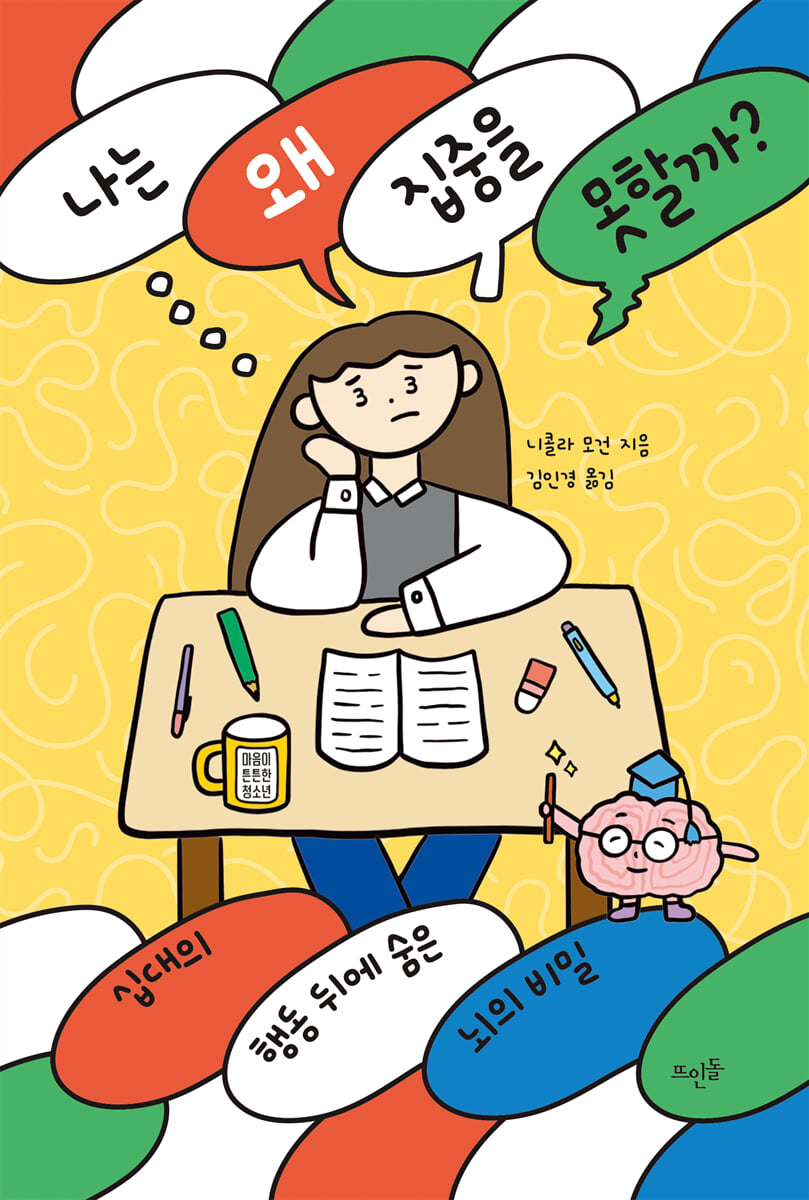
Why can't I concentrate?
 |
Description
Book Introduction
The One and Only Brain User Manual for Teenagers
“If you understand the adolescent brain, your lost concentration will return!”
I can't concentrate for even a moment, I sleep in every day, I yell at my mom, I do reckless things like riding three people on one scooter, I feel anxious if I don't have my phone with me even for a moment...
Why on earth do teenagers do this?
It's not because teenagers are lazy, lack the will, or suffer from chuunibyou.
Behind all these actions lies the 'brain'.
The adolescent brain undergoes tremendous remodeling as various regions connect and separate to 'become adults.'
When remodeling, it is naturally noisy, messy, and unstable.
Understanding the brain's properties and mechanisms can help us understand the reasons behind adolescent behavioral patterns and identify appropriate solutions for this age group.
Based on brain science, this book clearly analyzes teenagers' behaviors, which even they are unaware of, and suggests the right solutions.
It's based on brain science, but it's not difficult at all and is full of wit.
By reading real-life examples and cartoons that capture the ups and downs of teenagers, tests that assess concentration and empathy, and easy and fun explanations, teenagers will be able to learn about their own brains and find ways to become the adults they want to be.
“If you understand the adolescent brain, your lost concentration will return!”
I can't concentrate for even a moment, I sleep in every day, I yell at my mom, I do reckless things like riding three people on one scooter, I feel anxious if I don't have my phone with me even for a moment...
Why on earth do teenagers do this?
It's not because teenagers are lazy, lack the will, or suffer from chuunibyou.
Behind all these actions lies the 'brain'.
The adolescent brain undergoes tremendous remodeling as various regions connect and separate to 'become adults.'
When remodeling, it is naturally noisy, messy, and unstable.
Understanding the brain's properties and mechanisms can help us understand the reasons behind adolescent behavioral patterns and identify appropriate solutions for this age group.
Based on brain science, this book clearly analyzes teenagers' behaviors, which even they are unaware of, and suggests the right solutions.
It's based on brain science, but it's not difficult at all and is full of wit.
By reading real-life examples and cartoons that capture the ups and downs of teenagers, tests that assess concentration and empathy, and easy and fun explanations, teenagers will be able to learn about their own brains and find ways to become the adults they want to be.
- You can preview some of the book's contents.
Preview
index
prolog
6 Things You Need to Know About Your Brain
Chapter 1
Why can't I concentrate?
- Brain, smartphone, and friends
“Please help me find my lost concentration.”
Chapter 2
Why can't I communicate with my mom?
- Emotions that swirl around and around
“Don’t tell me what to do! Oh, but could you give me some pocket money?”
Chapter 3
Why can't I sleep at night?
- Between insomnia and oversleeping
“I think night school is the right choice for me.
“I feel refreshed at night.”
Chapter 4
Why would I want to do something reckless?
- It's all because of dopamine.
“Why did you do that? I just wanted to.”
Chapter 5
Why do I act differently from him?
- Boy's Brain vs.
girl's brain
“Size doesn’t matter.
What you do with it is what matters.”
Chapter 6
Why am I depressed?
- About depression, addiction, and self-harm
“I don’t know why I should live.”
Chapter 7
Can I get better?
- Believe in the power of your brain.
“I want to tell my adolescent brain that it did a good job.”
Brain vocabulary list
Epilogue
6 Things You Need to Know About Your Brain
Chapter 1
Why can't I concentrate?
- Brain, smartphone, and friends
“Please help me find my lost concentration.”
Chapter 2
Why can't I communicate with my mom?
- Emotions that swirl around and around
“Don’t tell me what to do! Oh, but could you give me some pocket money?”
Chapter 3
Why can't I sleep at night?
- Between insomnia and oversleeping
“I think night school is the right choice for me.
“I feel refreshed at night.”
Chapter 4
Why would I want to do something reckless?
- It's all because of dopamine.
“Why did you do that? I just wanted to.”
Chapter 5
Why do I act differently from him?
- Boy's Brain vs.
girl's brain
“Size doesn’t matter.
What you do with it is what matters.”
Chapter 6
Why am I depressed?
- About depression, addiction, and self-harm
“I don’t know why I should live.”
Chapter 7
Can I get better?
- Believe in the power of your brain.
“I want to tell my adolescent brain that it did a good job.”
Brain vocabulary list
Epilogue
Detailed image
.jpg)
Into the book
I'm going to tell you about your brain from now on.
Why do teenagers want to sleep until lunchtime? And yet, why are they so wide awake in the wee hours of the morning? Why do they want to swear at their teachers and smoke unhealthy cigarettes? And why do they have trouble concentrating and act distracted? If you're experiencing any of the behaviors mentioned above, along with emotional reactions to others, risky behavior, and general irritability, tell me this:
“It’s not my fault.
“It’s your brain’s fault!”
--- p.8
The human brain is like a computer system in that each area is 'connected'.
That is, it is programmed to function in a certain way.
This type of connection was used by our hunter-gatherer ancestors thousands of years ago.
Our brains have a hard time detaching from electronic screens and social media because of three characteristics in particular.
Shall we take a look at them one by one?
The brain is social - early humans would have survived much more safely and easily if they lived in groups.
They shared information, hunted together, built hideouts, raised children, and cared for each other when sick.
Even now, we help each other, cooperate, share friendship, have fun, strengthen our bonds, and benefit together.
In other words, our brains want to be socially connected.
The brain is curious - early humans had to be curious.
I wondered how to make a good extension, how to build a safe and warm shelter, whether there was a good place to live across the river, whether there was more food beyond the mountains.
It is this curiosity that allows us to learn skills and accumulate knowledge even today.
The brain is easily distracted - our ancestors had to constantly be alert for the movements of predators or enemies.
In other words, it was an important function of the brain to be able to shift attention elsewhere.
Even today, it is thanks to him that we can easily recognize problems and threats around us.
Electronic devices are designed to keep us constantly social, curious, and distracted.
That's why we stare at the screen day and night!
We often feel compelled to check our electronic devices.
The reward system in our brain kicks in and creates this hard-to-break habit.
The reason we love our electronic devices and don't want to put them down is because every time we use them, our brain's reward system is activated, fueling addictive behavior.
- Pages 34-35
During adolescence, the brain undergoes extensive physical changes.
As we prepare for adult life, different areas are undergoing simultaneous remodeling to function in complex ways.
It's natural for young people to face difficult and diverse challenges during these times of great upheaval.
As you know from experience, teenagers live with various stresses.
These various pressures make teenagers more emotional and sometimes unmanageable.
Researchers have discovered some very interesting facts that support this theory.
Scientists have found that teenage brains (especially early teens) are generally less able to judge other people's emotions from their facial expressions than late teens and adults.
Professor Sarah-Jane Blakemore recently conducted a study examining the empathy of teenagers, and found differences compared to adults.
The same was true in a study conducted in the United States.
Researchers showed teenagers and adults images of women expressing extreme fear and asked the participants to describe how the women in the pictures felt.
In this experiment, all adults gave the correct answer, while many of the adolescent participants gave incorrect answers.
Of course, there are many cases where adults also have difficulty reading facial expressions properly.
Adults aren't perfect either, and some are just not good at it.
But it certainly seems to have its downsides for teenagers.
And surprisingly, when researchers scanned the brains of the study participants, they found that most teenagers used different brain regions than adults when looking at pictures of facial expressions.
--- pp.67-68
How can we help our brains take risks without hesitation?
♥ Make your own choice.
I'm talking about a real, proper choice, not one that your friends or your emotional part of the brain pushes you to make.
Dopamine can also be satisfied through sports, roller coasters, skateboarding, and trampolines.
♥ Take on challenges that carry the risk of failure, but have the potential to yield truly positive results if successful.
Wouldn't it be great to audition for a play, lead a team, give a presentation, or do something that requires a certain level of competition? Your brain will perceive such challenges as a risk, similar to physical activity, and release dopamine and adrenaline.
♥ If you really have to do that, you'll have no choice but to cause trouble.
But even in such cases, it should not be done in a way that harms your future, health, or other people.
If you do that, you might end up regretting it for the rest of your life.
Why do teenagers want to sleep until lunchtime? And yet, why are they so wide awake in the wee hours of the morning? Why do they want to swear at their teachers and smoke unhealthy cigarettes? And why do they have trouble concentrating and act distracted? If you're experiencing any of the behaviors mentioned above, along with emotional reactions to others, risky behavior, and general irritability, tell me this:
“It’s not my fault.
“It’s your brain’s fault!”
--- p.8
The human brain is like a computer system in that each area is 'connected'.
That is, it is programmed to function in a certain way.
This type of connection was used by our hunter-gatherer ancestors thousands of years ago.
Our brains have a hard time detaching from electronic screens and social media because of three characteristics in particular.
Shall we take a look at them one by one?
The brain is social - early humans would have survived much more safely and easily if they lived in groups.
They shared information, hunted together, built hideouts, raised children, and cared for each other when sick.
Even now, we help each other, cooperate, share friendship, have fun, strengthen our bonds, and benefit together.
In other words, our brains want to be socially connected.
The brain is curious - early humans had to be curious.
I wondered how to make a good extension, how to build a safe and warm shelter, whether there was a good place to live across the river, whether there was more food beyond the mountains.
It is this curiosity that allows us to learn skills and accumulate knowledge even today.
The brain is easily distracted - our ancestors had to constantly be alert for the movements of predators or enemies.
In other words, it was an important function of the brain to be able to shift attention elsewhere.
Even today, it is thanks to him that we can easily recognize problems and threats around us.
Electronic devices are designed to keep us constantly social, curious, and distracted.
That's why we stare at the screen day and night!
We often feel compelled to check our electronic devices.
The reward system in our brain kicks in and creates this hard-to-break habit.
The reason we love our electronic devices and don't want to put them down is because every time we use them, our brain's reward system is activated, fueling addictive behavior.
- Pages 34-35
During adolescence, the brain undergoes extensive physical changes.
As we prepare for adult life, different areas are undergoing simultaneous remodeling to function in complex ways.
It's natural for young people to face difficult and diverse challenges during these times of great upheaval.
As you know from experience, teenagers live with various stresses.
These various pressures make teenagers more emotional and sometimes unmanageable.
Researchers have discovered some very interesting facts that support this theory.
Scientists have found that teenage brains (especially early teens) are generally less able to judge other people's emotions from their facial expressions than late teens and adults.
Professor Sarah-Jane Blakemore recently conducted a study examining the empathy of teenagers, and found differences compared to adults.
The same was true in a study conducted in the United States.
Researchers showed teenagers and adults images of women expressing extreme fear and asked the participants to describe how the women in the pictures felt.
In this experiment, all adults gave the correct answer, while many of the adolescent participants gave incorrect answers.
Of course, there are many cases where adults also have difficulty reading facial expressions properly.
Adults aren't perfect either, and some are just not good at it.
But it certainly seems to have its downsides for teenagers.
And surprisingly, when researchers scanned the brains of the study participants, they found that most teenagers used different brain regions than adults when looking at pictures of facial expressions.
--- pp.67-68
How can we help our brains take risks without hesitation?
♥ Make your own choice.
I'm talking about a real, proper choice, not one that your friends or your emotional part of the brain pushes you to make.
Dopamine can also be satisfied through sports, roller coasters, skateboarding, and trampolines.
♥ Take on challenges that carry the risk of failure, but have the potential to yield truly positive results if successful.
Wouldn't it be great to audition for a play, lead a team, give a presentation, or do something that requires a certain level of competition? Your brain will perceive such challenges as a risk, similar to physical activity, and release dopamine and adrenaline.
♥ If you really have to do that, you'll have no choice but to cause trouble.
But even in such cases, it should not be done in a way that harms your future, health, or other people.
If you do that, you might end up regretting it for the rest of your life.
--- pp.146-147
Publisher's Review
I will regain my lost concentration.
The One and Only Brain User Manual for Teenagers
It's an era of dopamine addiction and loss of focus.
Many people can't read long texts or sit through a single drama, so they look for 10-minute summaries.
You may be good at multitasking, but your ability to complete one task is declining.
This happens especially more frequently among teenagers.
Why are adolescents more vulnerable to these problems? Nicola Morgan, who has long conducted in-depth research on adolescent cognitive abilities and the brain, discovered that the brain is behind adolescent behavior. She published a brain science book, "Why Can't I Focus?", which provides insight into the characteristics and mechanisms of the adolescent brain.
This book argues that teenagers are not intentionally lazy, distracted, and anger-deficient troublemakers.
The adolescent brain undergoes its most radical and fundamental changes after the age of two.
Many people overlook this part, which is why misunderstandings about puberty continue to recur.
The adolescent brain undergoes tremendous remodeling, with many areas connecting and separating to become 'adults.'
When remodeling, it is naturally noisy, messy, and unstable.
Adolescents experience tremendous growing pains as changes occur in the brain that remove unnecessary parts and thicken nerve branches.
“Synapses that rapidly increase just before and around the beginning of puberty are reduced in size or eliminated as puberty progresses.
In other words, pruning is the process of removing unnecessary connections from the brain.
Scientists say this pruning process is much more important than the branch growth process.
When pruning real trees, you reduce the number of branches and allow the remaining ones to grow thicker and stronger, right? It's the same principle.
By the time you're 16 or 17, you'll have the same level of synapses as an adult.” _Pages 66-67
Nicola Morgan's rigorous, multifaceted research provides a clear and three-dimensional view of the adolescent brain.
It's based on brain science, but it's not difficult or complicated at all.
The author kindly and wittily explains how the adolescent brain works, using vivid examples that seem to be taken straight from the daily lives of teenagers, evoking empathy.
The core of this book is a clear solution for how adolescents can control their brains that are under construction during puberty.
The author offers practical, real-world solutions to help young people recognize changes in their brains, cope with challenging situations, develop good habits, and respect themselves and others.
It also serves as a good guide for adults who have difficulty understanding teenagers.
This book provides a great resource for sharing knowledge about the adolescent brain and engaging in natural conversations and discussions with teenagers, rather than just observing or pressuring them.
A UK Amazon Bestseller! Teacher's Pick!
An interesting composition that will capture the hearts of young people
From cute cartoons that will make you empathize with others to various psychological tests.
This book is divided into seven chapters and focuses on the difficulties that teenagers face in their daily lives, and specifically addresses issues related to the adolescent brain, such as concentration, addiction, sleep, depression, relationships, and dopamine.
Why can't I concentrate? | Why can't I communicate with my mom? | Why can't I sleep at night?
Why do I want to do something reckless? | Why do I act differently from him? | Why am I depressed?
Can I get better?
Rather than just boringly listing brain science theories, it sufficiently reflects the reality of teenagers and explains how the brain works in an easy and fun way, so there's no time to get bored.
Sol opened his laptop with his left hand while scanning the messages with his right.
Sol sent messages across KakaoTalk, Instagram, and Facebook.
I checked the message my aunt sent, but I didn't reply.
(Isn't that okay for messages from adults?) Anyway, a few minutes passed like that.
Sol glanced at the laptop.
Oh, right.
I was trying to open the essay assignment file.
On the screen was a Twitch window open, the one Sol had left open before closing his laptop.
'Okay, let's just take a quick look to see who's playing the game,' Sol thought as he set the alarm.
I was just planning on watching it for about 15 minutes and then doing my homework.
Sol started scanning the screen, going back and forth between the chat window and Twitch.
Sol is a teenager.
Unlike my parents, I'm not very good at multitasking.
Oh, I should check Instagram too.
Then, Sol looked at his watch and realized that nearly an hour had passed.
I was overcome with a tremendous sense of guilt.
What should I do, I haven't even started my homework yet! _Pages 28-29
Seven hilarious cartoons depicting the daily lives of teenagers will resonate with you and allow you, the readers, to read them as your own stories.
Additionally, the interesting tests inserted at the end of each chapter (concentration test, smartphone addiction test, sleep test, empathy test, etc.) are great tools to help teenagers take an objective look at themselves.
Through this book, teenagers will be able to learn about their own brains and find ways to become the adults they want to be.
Recommendation
Nicola Morgan has a rare talent for making science fun.
She introduces brain science to the general reader in an educational and entertaining way.
Professor Simon Baron Cohen
It's rare for an author to successfully write a book for teenagers while also making it a must-read for parents and teachers.
_The Scotsman
I just want to tell you how much I enjoyed reading this book.
This is a truly excellent and much-needed book.
Professor John Stein
The One and Only Brain User Manual for Teenagers
It's an era of dopamine addiction and loss of focus.
Many people can't read long texts or sit through a single drama, so they look for 10-minute summaries.
You may be good at multitasking, but your ability to complete one task is declining.
This happens especially more frequently among teenagers.
Why are adolescents more vulnerable to these problems? Nicola Morgan, who has long conducted in-depth research on adolescent cognitive abilities and the brain, discovered that the brain is behind adolescent behavior. She published a brain science book, "Why Can't I Focus?", which provides insight into the characteristics and mechanisms of the adolescent brain.
This book argues that teenagers are not intentionally lazy, distracted, and anger-deficient troublemakers.
The adolescent brain undergoes its most radical and fundamental changes after the age of two.
Many people overlook this part, which is why misunderstandings about puberty continue to recur.
The adolescent brain undergoes tremendous remodeling, with many areas connecting and separating to become 'adults.'
When remodeling, it is naturally noisy, messy, and unstable.
Adolescents experience tremendous growing pains as changes occur in the brain that remove unnecessary parts and thicken nerve branches.
“Synapses that rapidly increase just before and around the beginning of puberty are reduced in size or eliminated as puberty progresses.
In other words, pruning is the process of removing unnecessary connections from the brain.
Scientists say this pruning process is much more important than the branch growth process.
When pruning real trees, you reduce the number of branches and allow the remaining ones to grow thicker and stronger, right? It's the same principle.
By the time you're 16 or 17, you'll have the same level of synapses as an adult.” _Pages 66-67
Nicola Morgan's rigorous, multifaceted research provides a clear and three-dimensional view of the adolescent brain.
It's based on brain science, but it's not difficult or complicated at all.
The author kindly and wittily explains how the adolescent brain works, using vivid examples that seem to be taken straight from the daily lives of teenagers, evoking empathy.
The core of this book is a clear solution for how adolescents can control their brains that are under construction during puberty.
The author offers practical, real-world solutions to help young people recognize changes in their brains, cope with challenging situations, develop good habits, and respect themselves and others.
It also serves as a good guide for adults who have difficulty understanding teenagers.
This book provides a great resource for sharing knowledge about the adolescent brain and engaging in natural conversations and discussions with teenagers, rather than just observing or pressuring them.
A UK Amazon Bestseller! Teacher's Pick!
An interesting composition that will capture the hearts of young people
From cute cartoons that will make you empathize with others to various psychological tests.
This book is divided into seven chapters and focuses on the difficulties that teenagers face in their daily lives, and specifically addresses issues related to the adolescent brain, such as concentration, addiction, sleep, depression, relationships, and dopamine.
Why can't I concentrate? | Why can't I communicate with my mom? | Why can't I sleep at night?
Why do I want to do something reckless? | Why do I act differently from him? | Why am I depressed?
Can I get better?
Rather than just boringly listing brain science theories, it sufficiently reflects the reality of teenagers and explains how the brain works in an easy and fun way, so there's no time to get bored.
Sol opened his laptop with his left hand while scanning the messages with his right.
Sol sent messages across KakaoTalk, Instagram, and Facebook.
I checked the message my aunt sent, but I didn't reply.
(Isn't that okay for messages from adults?) Anyway, a few minutes passed like that.
Sol glanced at the laptop.
Oh, right.
I was trying to open the essay assignment file.
On the screen was a Twitch window open, the one Sol had left open before closing his laptop.
'Okay, let's just take a quick look to see who's playing the game,' Sol thought as he set the alarm.
I was just planning on watching it for about 15 minutes and then doing my homework.
Sol started scanning the screen, going back and forth between the chat window and Twitch.
Sol is a teenager.
Unlike my parents, I'm not very good at multitasking.
Oh, I should check Instagram too.
Then, Sol looked at his watch and realized that nearly an hour had passed.
I was overcome with a tremendous sense of guilt.
What should I do, I haven't even started my homework yet! _Pages 28-29
Seven hilarious cartoons depicting the daily lives of teenagers will resonate with you and allow you, the readers, to read them as your own stories.
Additionally, the interesting tests inserted at the end of each chapter (concentration test, smartphone addiction test, sleep test, empathy test, etc.) are great tools to help teenagers take an objective look at themselves.
Through this book, teenagers will be able to learn about their own brains and find ways to become the adults they want to be.
Recommendation
Nicola Morgan has a rare talent for making science fun.
She introduces brain science to the general reader in an educational and entertaining way.
Professor Simon Baron Cohen
It's rare for an author to successfully write a book for teenagers while also making it a must-read for parents and teachers.
_The Scotsman
I just want to tell you how much I enjoyed reading this book.
This is a truly excellent and much-needed book.
Professor John Stein
GOODS SPECIFICS
- Date of issue: July 31, 2024
- Page count, weight, size: 264 pages | 392g | 135*200*17mm
- ISBN13: 9788958070153
You may also like
카테고리
korean


korean

![GQ KOREA Mark (Monthly): December [2025]](http://librairie.coreenne.fr/cdn/shop/files/8ef265dbbfbf186523ed75ba7319009d.jpg?v=1765340328&width=3840)


