

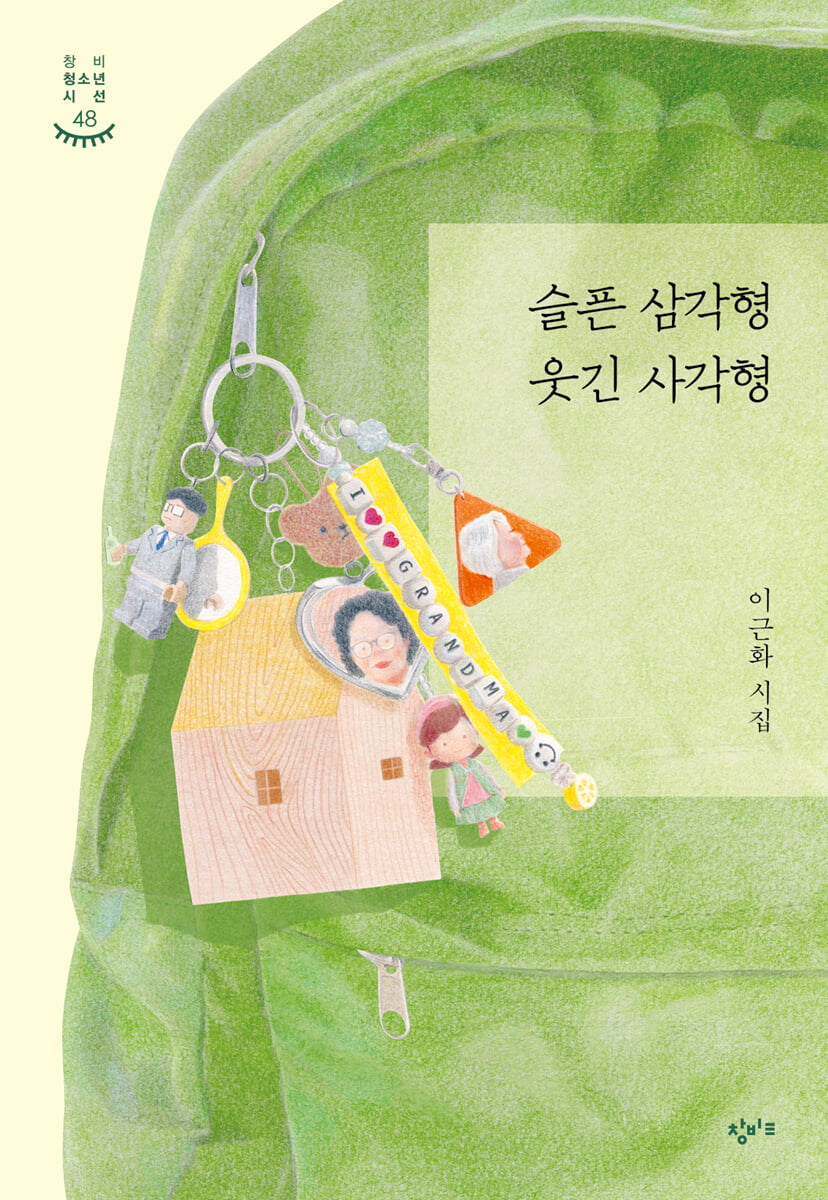
sad triangle funny square
 |
Description
Book Introduction
“Reading the records of love contained in this collection of poems,
“I thought back to my surroundings, my family, and the love I felt with them.” - Choi Ji-eun (poet)
A collection of poetry for young people that illuminates the world of "family," the world that makes us cry, laugh, and live.
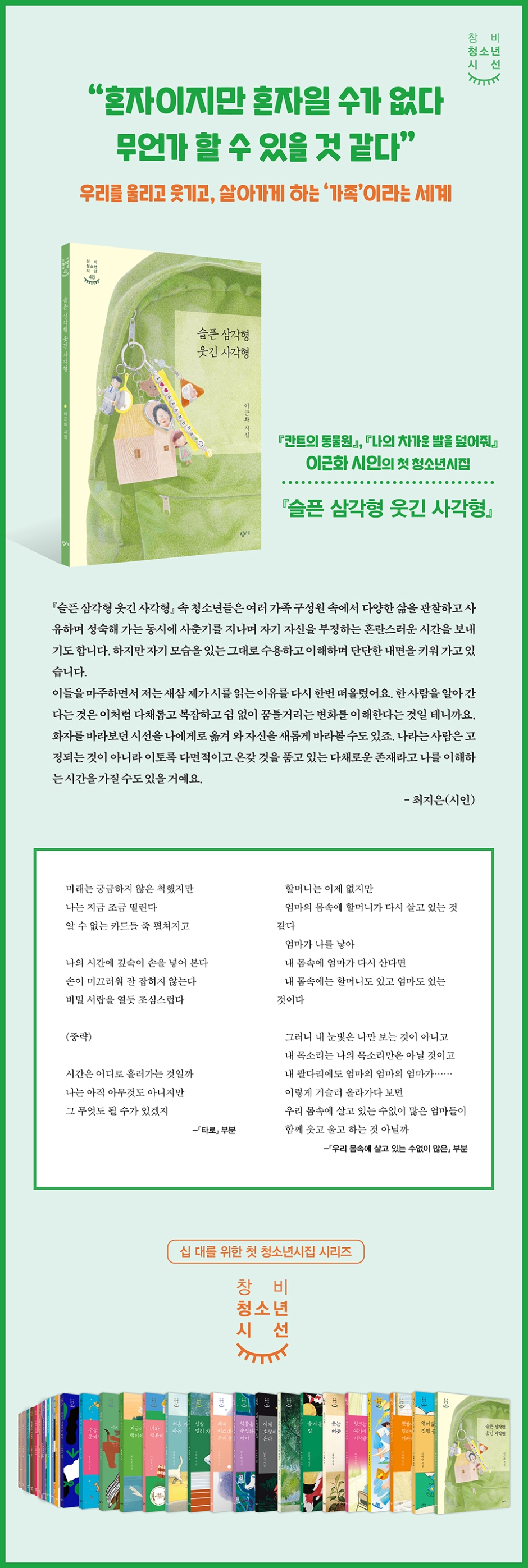
This book is the forty-eighth poetry collection of the Changbi Youth Poetry Series. It is a youth poetry collection that encourages the infinite potential of youth through a youth speaker who observes and understands members of an extended family and expands his or her own world.
This is also the first poetry collection for young adults by poet Lee Geun-hwa, who began his career in 2004 as a recommended new writer by 『Modern Literature』 and has since drawn detailed scenes of everyday life with his own unique style that stands out for its emotional language and delicate descriptions.
This collection of poems captures the complex and subtle psychology and arduous lives of today's youth in soft and affectionate poetry.
The story of a rare extended family with three generations living together makes us reflect on the meaning and role of family, and the love and hate shared within it.
Adolescents who withdraw from their families because they feel withdrawn and anxious are prone to isolation and confusion.
But rather, the closer you get to your family, the more you become filled with your own identity and expand your world.
This collection of poems is a record of love and solidarity that encourages young people to cultivate their inner selves with warm voices, while inviting adults to listen to their inner selves.
As readers read 『Sad Triangle, Funny Square』, they will be able to dismantle and reassemble themselves in the world of ‘family’ that evokes complex emotions, and be reborn as a new ‘me’ who “feels like I can do something.”
“I thought back to my surroundings, my family, and the love I felt with them.” - Choi Ji-eun (poet)
A collection of poetry for young people that illuminates the world of "family," the world that makes us cry, laugh, and live.
This book is the forty-eighth poetry collection of the Changbi Youth Poetry Series. It is a youth poetry collection that encourages the infinite potential of youth through a youth speaker who observes and understands members of an extended family and expands his or her own world.
This is also the first poetry collection for young adults by poet Lee Geun-hwa, who began his career in 2004 as a recommended new writer by 『Modern Literature』 and has since drawn detailed scenes of everyday life with his own unique style that stands out for its emotional language and delicate descriptions.
This collection of poems captures the complex and subtle psychology and arduous lives of today's youth in soft and affectionate poetry.
The story of a rare extended family with three generations living together makes us reflect on the meaning and role of family, and the love and hate shared within it.
Adolescents who withdraw from their families because they feel withdrawn and anxious are prone to isolation and confusion.
But rather, the closer you get to your family, the more you become filled with your own identity and expand your world.
This collection of poems is a record of love and solidarity that encourages young people to cultivate their inner selves with warm voices, while inviting adults to listen to their inner selves.
As readers read 『Sad Triangle, Funny Square』, they will be able to dismantle and reassemble themselves in the world of ‘family’ that evokes complex emotions, and be reborn as a new ‘me’ who “feels like I can do something.”
- You can preview some of the book's contents.
Preview
index
Part 1: I Can't Write Down My Dreams
My dream can't be written down
Is it still like that now?
The ability to turn lights on and off
Mom, this vacation
That shining thing under the workbook
After getting sick
General Menggun under the shade of a hand's length
Neighbors in the neighborhood
This world right now
weekend outing
Part 2: Waiting by the Riverside at Midnight
Apricot Tree Conference
Waiting by the riverside in the middle of the night
Meal time
Tarot
There's a reason for my slowness.
crookedly
Deep in my heart
Late on the morning of the exam
Cloudy weather
Beans, eggplant, mushrooms, and anchovies
Part 3: Humans and Ghosts Together
See you at Maebongsan Mountain
Mom who eats one bread a day
Hedgehog Grandma
Seongbukyoung
We owe you our hearts
curled eyelashes
Grandma Clam
Winter's Speed
Grandma's sleep talk
Life and Ginseng
A long night, humans and ghosts together
The anaconda swallowed my mother.
Part 4: The Countless Living Inside Our Bodies
sad triangle funny square
Where is your hometown?
Grandma's Spring
Cookies or soap?
I wish I had a sister
Three generations of taste
The Joy of Rooms
cutting water with a knife
Love is different from each other
Bacon in the morning, bacon in the evening
There are countless living things inside our bodies.
Preface | Ji-eun Choi
Poet's words
My dream can't be written down
Is it still like that now?
The ability to turn lights on and off
Mom, this vacation
That shining thing under the workbook
After getting sick
General Menggun under the shade of a hand's length
Neighbors in the neighborhood
This world right now
weekend outing
Part 2: Waiting by the Riverside at Midnight
Apricot Tree Conference
Waiting by the riverside in the middle of the night
Meal time
Tarot
There's a reason for my slowness.
crookedly
Deep in my heart
Late on the morning of the exam
Cloudy weather
Beans, eggplant, mushrooms, and anchovies
Part 3: Humans and Ghosts Together
See you at Maebongsan Mountain
Mom who eats one bread a day
Hedgehog Grandma
Seongbukyoung
We owe you our hearts
curled eyelashes
Grandma Clam
Winter's Speed
Grandma's sleep talk
Life and Ginseng
A long night, humans and ghosts together
The anaconda swallowed my mother.
Part 4: The Countless Living Inside Our Bodies
sad triangle funny square
Where is your hometown?
Grandma's Spring
Cookies or soap?
I wish I had a sister
Three generations of taste
The Joy of Rooms
cutting water with a knife
Love is different from each other
Bacon in the morning, bacon in the evening
There are countless living things inside our bodies.
Preface | Ji-eun Choi
Poet's words
Detailed image
Publisher's Review
Youth, a being with infinite potential deep within the midst of discouragement and anxiety
Teenagers going through puberty are unable to shake off their feelings of anxiety and fear, while simultaneously denying and affirming themselves.
When “embarrassing moments that weren’t me” and “strange moments when I made mistakes knowingly” (“Deep Inside My Heart”) suddenly come to mind, “everything becomes difficult, it suddenly gets dark, and my feet keep sinking” (“Lunch Time”),
“The things I love often disappear” (“Grandma Hedgehog”), and even when I talk about my dreams, I feel like I “would run away” (“I Can’t Write Down My Dreams”), so I can’t write them down, which is just confusing.
“When I was fifteen, I had no interests,” “I didn’t know what I was good at,” “It was okay not to be perfect,” “I was a happy and cute kid back then,” but “now I’m just a sleepy and heavy teenager” (“Is it still like that now?”), and thinking about the future is daunting.
Sometimes, in the midst of the question, “Where am I going?”, I feel “ridiculous, like a chess piece” (“General Menggun Under a Span’s Shade”).
When I was five years old, I loved digging.
(I have no favorite things when I'm fifteen)
I was better at digging than doing arithmetic.
(I don't know what I'm good at right now)
Ants, centipedes, and beetles were affectionate friends.
(Who has a friend who likes me now?)
(…)
I was a happy and cute kid back then
(Should I say I'm a sleepy and heavy teenager now?)
Gone are the days when it was okay to be imperfect.
(If you think about it in the distant future, will it still be like that now?)
―The "Is it still like that now?" part
However, youth are beings who are “nothing yet/but can become anything” (Tarot).
Young people do not give in to reality and take time to reflect on themselves with the mindset of “I love myself” (“There is a reason for my slowness”).
Sometimes, he reveals his presence within the family by saying, “What would you do without me/If it weren’t for me, there would be nothing to laugh about” (“Cookies or Soap”), and sometimes he asks, “Isn’t it okay if I don’t become a great person?” (“Life and Ginseng”), and eventually he reaches the realization that life is “living my own way/my own way” (“Crookedly”).
“As slow as a turtle, a sloth, a koala, I am slow in speaking/slow in walking/and slow in acting,” but I proudly shout “Long live my slowness!” and “I go at my own pace” (“There’s a Reason for My Slowness”).
That's how you create your own world.
I told you to knock and come in after 3 seconds.
It's too fast for a human, Mom
That's strange, why are you rushing around so quickly?
Give it to me, look at it here, what are you hiding?
What's that shining thing under the workbook?
If you want to do it, do it confidently. Why are you hiding it?
What on earth are you looking at on your phone?
You're really suspicious
What's weird is Mom, what are you digging for?
I'm just surprised
That thing under the workbook, it looks really shiny?
What's wrong with the workbook? Put it away and do it confidently.
Whatever you see, look at it with confidence, or don't look at it at all.
Is it that easy, Mom?
Even if it's not easy, do what you have to do and say what you have to say.
If that works out, you'll be a teenager, right?
I want to meet my mom when I was little
It's a good thing I don't have a time machine.
Since we can't meet, please knock and come in after 3 seconds.
As a human being, I need 3 seconds too.
―Full text of "That Which Shines Beneath the Problem Book"
A world of self expanded through the prism of family
However, teenagers are not confined to their own inner world.
“Life is something we don’t know everything about” (“Weekend Outing”), but we call “life” “ginseng” and try to live “ginseng that explodes with coolness” (“Life and Ginseng”), looking around us.
Observing that “the love of aunts is God” and that mother “has many things to pray to Buddha,” he also understands the earnestness of “faith requires effort” (“Love is Different”).
In “Between Mom, Wife, and Daughter-in-Law,” he worries about “how Mom’s life is going” (“The Anaconda Ate Mom”), wishes for “Mom, who is tired and depressed every day” (“Mom Who Eats One Bread a Day”) to always be happy, and shows his maturity by “deciding to continue loving my busy dad/as a busy dad” (“Sad Triangle, Funny Square”).
I had a dream where an anaconda swallowed my mother.
I remember waking up crying as a child.
Hoping the anaconda would spit out its mother
In my dream, I was holding a stick and stabbing the air.
The anaconda didn't move at all.
I was worried that my mom would leave
Between my grandmother, my father, and me, my mother talks a lot.
There are many worries between mother, wife, and daughter-in-law.
How is Mom's life going?
Even if bugs come at you, you remain calm
Even if swallowed by an anaconda, it won't move
I think about my mother's life
A mother outside of a dream is better than a mother in a dream
I hope you are happy
―The part about "The Anaconda Swallowed Mom"
In the poetry collection, ‘grandmother’ appears particularly frequently, giving off the scent of a grandmother who is “warm and fragrant” (“Curled Eyelashes”).
To me, who feels a certain role and responsibility within the family, ‘grandmother’ is like a place of rest.
Furthermore, through the sad and honest life of the 'grandmother', the poet awakens the consciousness of existence as a woman before becoming an adolescent girl, the poetic speaker, 'I'.
I, who watch over my sleeping grandmother and “record my grandmother’s dreams” (“Grandmother’s Sleep Talk”) that are “round like kidney beans/yellow like corn kernels/fluffy like snow,” feel special, proud, and lovable, and when I imagine the “mothers” boiling “hot, crimson red bean porridge/trying to call my dead grandmother” (“Long Night, Humans and Ghosts Together”), my heart aches.
Furthermore, by “measuring the solidarity and connection of women” (Ji-eun Choi, preface) that goes back and forth between the past and present and “grandmother-mother-me,” we arrive at the discovery that “there is both grandmother and mother inside me,” and we gain courage that “I am alone, but I cannot be alone,” and “I feel like I can do something” (from “Countless People Living Inside Us”).
My grandmother is no longer there
It's like my grandmother is living inside my mother's body again.
My mother gave birth to me
If my mother lived again in my body
There is both a grandmother and a mother inside me.
So my eyes are not only looking at me
My voice will not be just my voice
My mother's mother's mother is also in my arms and legs...
If you go back like this
There are countless mothers living inside our bodies.
Isn't it about laughing and crying together?
Even if you're lonely, you're not lonely
I'm alone, but I can't be alone
I feel like I can do something
―「Countless” experts living inside our bodies
The speaker imagines the past and present of a family he does not know, and goes a step further from understanding them as human beings.
Seeing the tragedy of “buildings collapsing/roofs blowing off/children dying” all over the world, he agonizes over “what it means to live with hope in a “hopeless” world where people discriminate against and even kill each other simply because they are “different races/different religions/different ethnicities,” “different genders/different classes/different classes” (“This World Now”).
After experiencing the pandemic, where he felt “uncomfortable even when a friend coughs,” he made a promise to himself to “become a small human being” (“After Getting Sick”), thinking that “when living things get along well/the Earth won’t be sick/and humans won’t be sick.”
Finally, the gaze shifted beyond me and my family to society.
The building is collapsing
The roof is blown away
Children are dying
Corpses littering the streets
bleeding people
Cannot be rescued
People who go somewhere by boat
Refugees will be rejected and will wander again.
People who drift and starve to death
Different races
Different religions
Because we are of different nationalities
-Can you kill me?
-there is
(…)
People who answer
scary people
Among those who have no hope
What does it mean to live with hope?
―The part about “This World Now”
Support and comfort passed on to the next generation through mutual exchange
『Sad Triangle, Funny Square』 is different from other poetry collections for young adults.
The fact that it deals with the narrative of an extended family in the era of the nuclear family is special, and the poems that require a sense of the delicate language itself serve as a stepping stone for young people to cross from 'youth poetry' to 'poetry'.
In “The Poet’s Note,” the poet says that he “still cherishes the alleyways, the traditional markets, and the images of his mother and grandmothers” that he saw as a child, and that the “circle” created by the grandmothers and children around him surrounds him.
This collection of poems is a collection of countless 'circles' that the poet gives to his readers.
The circle speaks softly.
“If you don’t even think, you can’t do anything,” so let’s let our imagination run wild, even if it’s “a little bit strange and crooked,” and hope that “a life led by faith” will become our future.
“It’s okay, it’ll get better” (from “Grandma Clam”) A single whisper will always be a warm comfort and warm encouragement to the youth, and will always be by their side.
I am a headache for my mother
Grandma's eternal puppy
As daddy's cutie
I am me
In my laughter
Our family is rolling along
It was a sad triangle, then a funny square
―The "Sad Triangle, Funny Square" section
Poet's words
It is difficult to write poetry and to live in love, but I write poetry to love.
Writing poetry can help you love a little more.
You can love longer.
Because if I don't use it, many things that would otherwise pass by stay with me for a while.
(…)
Let's tell our family, neighbors, and friends, "It's okay," often.
That word creates a 'next'.
Let's hold hands and walk together, because we can endure it a little better together.
I think, what can't a little comfort and affection do?
Not everything will go as planned, but if you don't even think about it, you won't be able to do anything.
It's okay if your thoughts are a little weird and crooked.
Imagination creates another me, and I can become anything.
A life led by faith, I hope that will be my future and yours.
Teenagers going through puberty are unable to shake off their feelings of anxiety and fear, while simultaneously denying and affirming themselves.
When “embarrassing moments that weren’t me” and “strange moments when I made mistakes knowingly” (“Deep Inside My Heart”) suddenly come to mind, “everything becomes difficult, it suddenly gets dark, and my feet keep sinking” (“Lunch Time”),
“The things I love often disappear” (“Grandma Hedgehog”), and even when I talk about my dreams, I feel like I “would run away” (“I Can’t Write Down My Dreams”), so I can’t write them down, which is just confusing.
“When I was fifteen, I had no interests,” “I didn’t know what I was good at,” “It was okay not to be perfect,” “I was a happy and cute kid back then,” but “now I’m just a sleepy and heavy teenager” (“Is it still like that now?”), and thinking about the future is daunting.
Sometimes, in the midst of the question, “Where am I going?”, I feel “ridiculous, like a chess piece” (“General Menggun Under a Span’s Shade”).
When I was five years old, I loved digging.
(I have no favorite things when I'm fifteen)
I was better at digging than doing arithmetic.
(I don't know what I'm good at right now)
Ants, centipedes, and beetles were affectionate friends.
(Who has a friend who likes me now?)
(…)
I was a happy and cute kid back then
(Should I say I'm a sleepy and heavy teenager now?)
Gone are the days when it was okay to be imperfect.
(If you think about it in the distant future, will it still be like that now?)
―The "Is it still like that now?" part
However, youth are beings who are “nothing yet/but can become anything” (Tarot).
Young people do not give in to reality and take time to reflect on themselves with the mindset of “I love myself” (“There is a reason for my slowness”).
Sometimes, he reveals his presence within the family by saying, “What would you do without me/If it weren’t for me, there would be nothing to laugh about” (“Cookies or Soap”), and sometimes he asks, “Isn’t it okay if I don’t become a great person?” (“Life and Ginseng”), and eventually he reaches the realization that life is “living my own way/my own way” (“Crookedly”).
“As slow as a turtle, a sloth, a koala, I am slow in speaking/slow in walking/and slow in acting,” but I proudly shout “Long live my slowness!” and “I go at my own pace” (“There’s a Reason for My Slowness”).
That's how you create your own world.
I told you to knock and come in after 3 seconds.
It's too fast for a human, Mom
That's strange, why are you rushing around so quickly?
Give it to me, look at it here, what are you hiding?
What's that shining thing under the workbook?
If you want to do it, do it confidently. Why are you hiding it?
What on earth are you looking at on your phone?
You're really suspicious
What's weird is Mom, what are you digging for?
I'm just surprised
That thing under the workbook, it looks really shiny?
What's wrong with the workbook? Put it away and do it confidently.
Whatever you see, look at it with confidence, or don't look at it at all.
Is it that easy, Mom?
Even if it's not easy, do what you have to do and say what you have to say.
If that works out, you'll be a teenager, right?
I want to meet my mom when I was little
It's a good thing I don't have a time machine.
Since we can't meet, please knock and come in after 3 seconds.
As a human being, I need 3 seconds too.
―Full text of "That Which Shines Beneath the Problem Book"
A world of self expanded through the prism of family
However, teenagers are not confined to their own inner world.
“Life is something we don’t know everything about” (“Weekend Outing”), but we call “life” “ginseng” and try to live “ginseng that explodes with coolness” (“Life and Ginseng”), looking around us.
Observing that “the love of aunts is God” and that mother “has many things to pray to Buddha,” he also understands the earnestness of “faith requires effort” (“Love is Different”).
In “Between Mom, Wife, and Daughter-in-Law,” he worries about “how Mom’s life is going” (“The Anaconda Ate Mom”), wishes for “Mom, who is tired and depressed every day” (“Mom Who Eats One Bread a Day”) to always be happy, and shows his maturity by “deciding to continue loving my busy dad/as a busy dad” (“Sad Triangle, Funny Square”).
I had a dream where an anaconda swallowed my mother.
I remember waking up crying as a child.
Hoping the anaconda would spit out its mother
In my dream, I was holding a stick and stabbing the air.
The anaconda didn't move at all.
I was worried that my mom would leave
Between my grandmother, my father, and me, my mother talks a lot.
There are many worries between mother, wife, and daughter-in-law.
How is Mom's life going?
Even if bugs come at you, you remain calm
Even if swallowed by an anaconda, it won't move
I think about my mother's life
A mother outside of a dream is better than a mother in a dream
I hope you are happy
―The part about "The Anaconda Swallowed Mom"
In the poetry collection, ‘grandmother’ appears particularly frequently, giving off the scent of a grandmother who is “warm and fragrant” (“Curled Eyelashes”).
To me, who feels a certain role and responsibility within the family, ‘grandmother’ is like a place of rest.
Furthermore, through the sad and honest life of the 'grandmother', the poet awakens the consciousness of existence as a woman before becoming an adolescent girl, the poetic speaker, 'I'.
I, who watch over my sleeping grandmother and “record my grandmother’s dreams” (“Grandmother’s Sleep Talk”) that are “round like kidney beans/yellow like corn kernels/fluffy like snow,” feel special, proud, and lovable, and when I imagine the “mothers” boiling “hot, crimson red bean porridge/trying to call my dead grandmother” (“Long Night, Humans and Ghosts Together”), my heart aches.
Furthermore, by “measuring the solidarity and connection of women” (Ji-eun Choi, preface) that goes back and forth between the past and present and “grandmother-mother-me,” we arrive at the discovery that “there is both grandmother and mother inside me,” and we gain courage that “I am alone, but I cannot be alone,” and “I feel like I can do something” (from “Countless People Living Inside Us”).
My grandmother is no longer there
It's like my grandmother is living inside my mother's body again.
My mother gave birth to me
If my mother lived again in my body
There is both a grandmother and a mother inside me.
So my eyes are not only looking at me
My voice will not be just my voice
My mother's mother's mother is also in my arms and legs...
If you go back like this
There are countless mothers living inside our bodies.
Isn't it about laughing and crying together?
Even if you're lonely, you're not lonely
I'm alone, but I can't be alone
I feel like I can do something
―「Countless” experts living inside our bodies
The speaker imagines the past and present of a family he does not know, and goes a step further from understanding them as human beings.
Seeing the tragedy of “buildings collapsing/roofs blowing off/children dying” all over the world, he agonizes over “what it means to live with hope in a “hopeless” world where people discriminate against and even kill each other simply because they are “different races/different religions/different ethnicities,” “different genders/different classes/different classes” (“This World Now”).
After experiencing the pandemic, where he felt “uncomfortable even when a friend coughs,” he made a promise to himself to “become a small human being” (“After Getting Sick”), thinking that “when living things get along well/the Earth won’t be sick/and humans won’t be sick.”
Finally, the gaze shifted beyond me and my family to society.
The building is collapsing
The roof is blown away
Children are dying
Corpses littering the streets
bleeding people
Cannot be rescued
People who go somewhere by boat
Refugees will be rejected and will wander again.
People who drift and starve to death
Different races
Different religions
Because we are of different nationalities
-Can you kill me?
-there is
(…)
People who answer
scary people
Among those who have no hope
What does it mean to live with hope?
―The part about “This World Now”
Support and comfort passed on to the next generation through mutual exchange
『Sad Triangle, Funny Square』 is different from other poetry collections for young adults.
The fact that it deals with the narrative of an extended family in the era of the nuclear family is special, and the poems that require a sense of the delicate language itself serve as a stepping stone for young people to cross from 'youth poetry' to 'poetry'.
In “The Poet’s Note,” the poet says that he “still cherishes the alleyways, the traditional markets, and the images of his mother and grandmothers” that he saw as a child, and that the “circle” created by the grandmothers and children around him surrounds him.
This collection of poems is a collection of countless 'circles' that the poet gives to his readers.
The circle speaks softly.
“If you don’t even think, you can’t do anything,” so let’s let our imagination run wild, even if it’s “a little bit strange and crooked,” and hope that “a life led by faith” will become our future.
“It’s okay, it’ll get better” (from “Grandma Clam”) A single whisper will always be a warm comfort and warm encouragement to the youth, and will always be by their side.
I am a headache for my mother
Grandma's eternal puppy
As daddy's cutie
I am me
In my laughter
Our family is rolling along
It was a sad triangle, then a funny square
―The "Sad Triangle, Funny Square" section
Poet's words
It is difficult to write poetry and to live in love, but I write poetry to love.
Writing poetry can help you love a little more.
You can love longer.
Because if I don't use it, many things that would otherwise pass by stay with me for a while.
(…)
Let's tell our family, neighbors, and friends, "It's okay," often.
That word creates a 'next'.
Let's hold hands and walk together, because we can endure it a little better together.
I think, what can't a little comfort and affection do?
Not everything will go as planned, but if you don't even think about it, you won't be able to do anything.
It's okay if your thoughts are a little weird and crooked.
Imagination creates another me, and I can become anything.
A life led by faith, I hope that will be my future and yours.
GOODS SPECIFICS
- Date of issue: August 5, 2024
- Page count, weight, size: 120 pages | 208g | 145*210*8mm
- ISBN13: 9791165702694
- ISBN10: 116570269X
You may also like
카테고리
korean


korean

![GQ KOREA Mark (Monthly): December [2025]](http://librairie.coreenne.fr/cdn/shop/files/8ef265dbbfbf186523ed75ba7319009d.jpg?v=1765340328&width=3840)


