

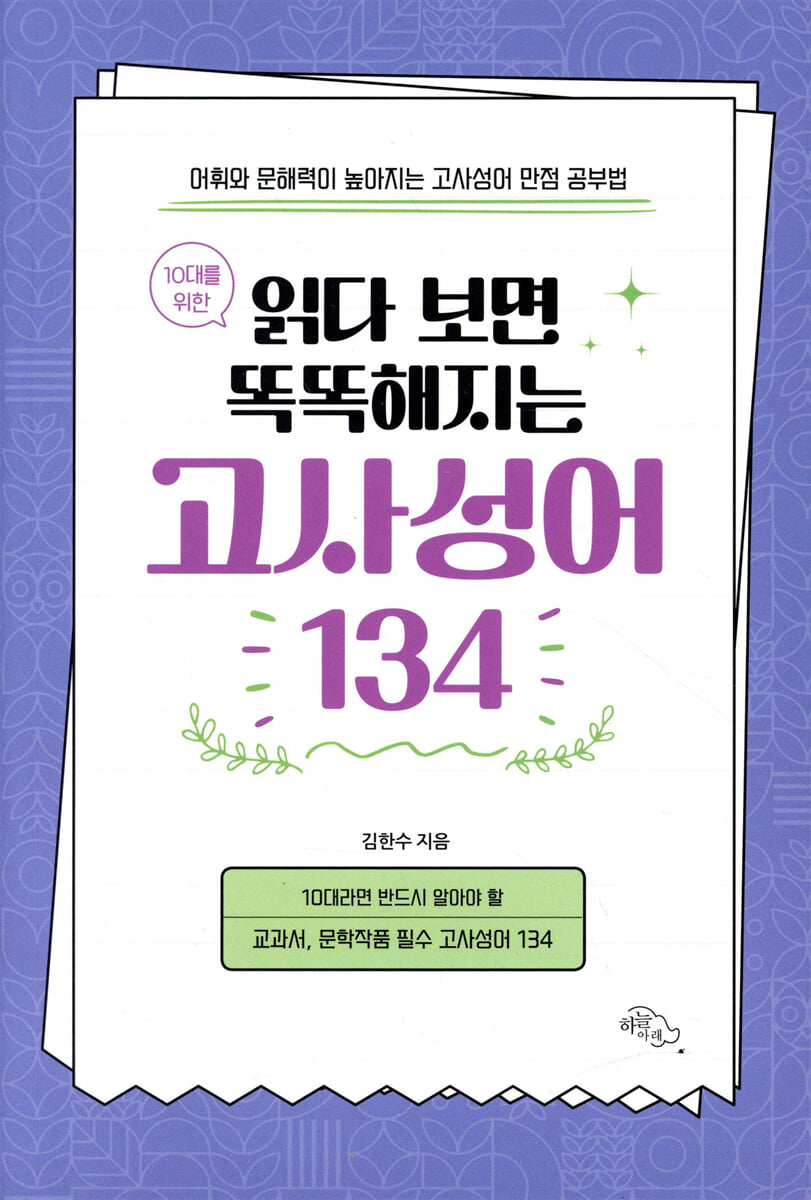
134 Idioms for Teens That Will Make You Smarter
 |
Description
Book Introduction
"A Perfect Score Study Method for Idioms that Improves Vocabulary and Literacy"
The difference between an idiom and a four-character idiom is that an idiom has a history and is a Chinese character idiom that has become naturally established in our lives over a long period of time.
If it consists of four characters, it becomes an idiom.
This book selects idioms and four-character idioms that appear in elementary, middle, and high school textbooks and literary works, allowing students preparing for the CSAT, essays, and interviews, as well as test takers, to study selectively.
We have selected idioms that frequently appear on exams and have clearly stated the background of the idiom and the order of the apparent meaning of each Chinese character, along with their inner meaning, so that you can easily interpret them on your own.
In addition, the formation process of Chinese characters has been organized so that knowing the formation process of Chinese characters can help improve vocabulary and literacy.
I sincerely hope that all elementary, middle, and high school students who read this book will not only expand their knowledge of Chinese characters through the idioms that make them smarter, but also gain wisdom for life, and use a high-level and rich vocabulary in their daily lives, thereby improving their quality of life.
The difference between an idiom and a four-character idiom is that an idiom has a history and is a Chinese character idiom that has become naturally established in our lives over a long period of time.
If it consists of four characters, it becomes an idiom.
This book selects idioms and four-character idioms that appear in elementary, middle, and high school textbooks and literary works, allowing students preparing for the CSAT, essays, and interviews, as well as test takers, to study selectively.
We have selected idioms that frequently appear on exams and have clearly stated the background of the idiom and the order of the apparent meaning of each Chinese character, along with their inner meaning, so that you can easily interpret them on your own.
In addition, the formation process of Chinese characters has been organized so that knowing the formation process of Chinese characters can help improve vocabulary and literacy.
I sincerely hope that all elementary, middle, and high school students who read this book will not only expand their knowledge of Chinese characters through the idioms that make them smarter, but also gain wisdom for life, and use a high-level and rich vocabulary in their daily lives, thereby improving their quality of life.
- You can preview some of the book's contents.
Preview
index
preface
Beautiful people have thin lives.
刻舟求劍 - Carving a lost sword on a boat
Liver and gallbladder mutually reflect each other
Gaegwacheonseon 改過遷善 - to correct one's mistakes and move to goodness
Covering the coffin and setting things straight
乾坤一擲 - Throw the sky [乾] and the earth [坤] once [一]
Geokmulchiji 格物致知 - to go to things [格] and reach knowledge [知]
Dog fight - a fight between a dog and a rabbit
Repaying kindness by weaving together grass
Gyeonggukjisaek 傾國之色 - a beautiful color that causes a country to decline
鷄口牛後 - the head [口] of a chicken and the tail [後] of a cow
Chicken eggs have bones - Chicken eggs also have bones.
Keimyunggudo 鷄鳴狗盜 - Cry like a chicken [鷄] and steal like a dog [狗].
Gobokgyeokyang 鼓腹擊壤 - to beat the stomach like a drum and strike the ground
Gosung Nakil (孤城落日) - The sun sets in an isolated castle
Flattering the world with false learning
Too much is as bad as not enough - Too much [過] is as bad [不] as not enough [不]
The friendship between Guan Zhong and Bao Shuya
Gwalmoksangdae 刮目相對 - rubbing one's eyes [目] and looking [刮] at the other person [相]
Skillful words and beautiful complexion
The heart of glue and lacquer
Gumilbokgum (口蜜腹劍) - There is honey in the mouth and a sword in the stomach.
A crane among a flock of chickens
Encourage good and punish evil - Encourage good and punish evil
Returning again [捲土重來] - Returning again [重], scattering the dust of the earth [土]
A friendship like gold and orchids
Geumseuljirak 琴瑟之樂 - The joy of the geomungo [琴] and the pipa [瑟][之]
Adding flowers on top of brocade - adding flowers on top of brocade
Resurrection - A dead person rises and comes back to life.
Giinjijiu 杞人之憂 - The worries of the people of the country Gi[杞]
The situation of riding a tiger [虎]
It's difficult to tell who is the older brother and who is the younger brother.
A dream under a southern tree branch
Namgyulbukji 南橘北枳 - If you move a tangerine tree [橘] in the south [南] to the north [北], it becomes a tangerine tree [枳].
An awl in a pocket
Internal and external troubles - troubles that occur inside and outside
Nomajiji 老馬之智 - The wisdom of an old horse
Discussing merits and giving rewards - discussing merits and giving rewards
The danger of stacking eggs - the danger of stacking eggs
Dagimangyang 多岐亡羊 - There are many forks in the road [岐], so lose [亡] sheep [羊]
The more the better - the more [多] the better [益]
Short-term warning against cutting off the machine - a warning against cutting off the machine used for weaving
A great vessel is made late - A great vessel is made late
Docheongdoseol (道聽塗說) - Words heard on the street [道] [塗]
The suffering of being drowned in mud and burned in charcoal fire
Sympathy for one another - feeling pity for one another when suffering from the same illness
Grinding an axe to make a needle - Grinding an axe to make a needle
East wind in the horse's ears
Maeksujitan 麥秀之嘆 - Lamenting [嘆] that barley [麥] has grown luxuriantly [秀]
Mao Sui's self-recommendation - Mao Sui recommends himself.
The Peach Blossom Spring of Wuling - The Peach Blossom Spring of Wuling
Even if your neck is cut off, you can still be friends.
A market in front of the gate - A market in front of the gate
Misengjisin 尾生之信 - Miseng[尾][生]'s[之] faith[信]
Ban-gu-je-gi 反求諸己 - turning back [reflecting] and finding all [all] causes in oneself [seeking]
Uprooting the root [本] and blocking the source [源]
Bangyakmuin 傍若無人 - It is as if there are no people around [若]
Back to the water - a formation with one's back to the water
Baeknyeonhacheong 百年河淸 - Once every hundred years, the Yellow River becomes clear.
Baek-a-jeol-hyeon 伯牙?絃 - Baek-a-ga [伯] [牙] cuts the strings of the zither [絃] [?]
Baekjungjigan 伯仲之間 - a relationship [間] where [仲] cannot determine [伯] superiority [伯] or inferiority [之]
Buhwanoedong 附和雷同 - Together [attached] to the sound of thunder [雷]
Burning books and burying scholars in pits
Meat lament - lamenting the meat on the thighs
Song of the Four-Sided Chu - A song of the Four-Sided Chu
Sachin-ihyo 事親以孝 - To serve one's parents with filial piety [孝] [以]
Sacrificing one's body to achieve benevolence
Samgochoryeo (三顧草廬) - Visiting a thatched hut three times
Three people make a tiger
Samcheonjigyo (三遷之敎) - Teaching through moving three times
Sangjeonbyeokhae (桑田碧海) - The mulberry field [田] becomes the blue [碧] sea [海]
Saeongjima 塞翁之馬 - The horse of an old man from the frontier
Suguchosim (首丘初心) - Put your head on the hill [丘] and return to your original mind [初] [心]
Washing your teeth with a stone and using the flowing water as a pillow
The friendship between water and fish
Three people make a tiger
Samcheonjigyo (三遷之敎) - Teaching through moving three times
Sangjeonbyeokhae (桑田碧海) - The mulberry field [田] becomes the blue [碧] sea [海]
Saeongjima 塞翁之馬 - The horse of an old man from the frontier
Suguchosim (首丘初心) - Put your head on the hill [丘] and return to your original mind [初] [心]
Washing your teeth with a stone and using the flowing water as a pillow
Su-eo-ji-gyo 水魚之交 - the relationship between water and fish
Sujudaeto 守株待兎 - staying on a stump [stock] and waiting for a rabbit [rabbit]
If your lips are gone, your teeth will be cold.
Anbinnakdo 安貧樂道 - Taking comfort in poverty [貧], following the way [道], and enjoying [樂] it
Angcheondaeso 仰天大笑 - Looking up at the sky [天] and laughing out loud [大]
Yangduguyuk 羊頭狗肉 - sheep's head [頭] and dog's meat [肉]
A gentleman on top of a beam
Good medicine is bitter in the mouth
Fisherman's profit - the profit of a fisherman
Climbing a tree [木] to seek fish [魚]
In the middle of a fog five li thick
Wu and Yue are in the same boat - a scene where people from Wu and Yue are in the same boat
A rabble of crows [烏] - a group of crows [烏] gathered together [合] [之]
Rooftop house - a roof built on top of a roof [屋]
Learn from the old to know the new.
Wasin Sangdam 臥薪嘗膽 - lying down on firewood [薪] and tasting [嘗] gall [膽]
Yosanyosu 樂山樂水 - liking mountains [山] and liking water [水]
Yongdusami 龍頭蛇尾 - Dragon's head [頭] and snake's tail [尾]
Yongho Sangbak (龍虎相搏) - A dragon and a tiger fight each other
Wei Pian San Jie 韋編三? - The leather [韋] string [編] breaks three times [三] [?]
The Foolish Old Man Moves a Mountain - The Foolish Old Man Moves a Mountain
If you prepare in advance, you will have no worries.
Yin virtue and yang retribution - Virtue done without knowing [Yin] is rewarded [Yang] by being revealed [Yang].
Weeping and cutting down Ma Su - Weeping and cutting down Ma Su
Telepathy - to communicate with one's heart and mind
Killing two birds with one stone - moving once [一] and getting two [兩]
Ilmangtajin 一網打盡 - Strike the net once [一] and catch them all [盡]
Self-abandonment - self-harm and abandonment
Jeonjeonbancheok 輾轉反側 - lying down [輾] tossing and turning [轉] [反] here and there [側]
Turning disaster into fortune - turning disaster into fortune
Procedure Takma 切磋琢磨 - cutting [切], sharpening [磋], trimming [琢], and polishing [磨]
Gradually entering a beautiful realm - gradually entering a beautiful realm
A wife who lived off of rice bran and rice lees
Jollyeongmogae (朝令暮改) - An order given in the morning is changed in the evening.
Josammosa 朝三暮四 - Three in the morning [朝], four in the evening [暮]
Bamboo horse friend - an old friend who used to ride a bamboo horse
It is difficult to block the mouths of many people.
Jigijiu 知己之友 - a friend who knows oneself
Pointing at a deer [鹿] and calling it a horse [馬]
A single grain of millet thrown into the vast sea
The sky is high and the horse is fat.
A once-in-a-millennium opportunity
The will of the blue cloud - the will of the blue cloud
A thunderbolt in the clear [blue] sky [天]
Blue comes from indigo
Chugi-geupin 推己及人 - to infer [推] oneself [己] and influence [及] people [人]
Tasanjiseok 他山之石 - a stone from another mountain
Tachogyeongsa 打草驚蛇 - To startle a snake by striking the grass.
Tosagupeng ? When a rabbit dies, a dog is boiled and eaten.
Breaking Bamboo - A momentum like splitting bamboo
The sigh of a tree blowing in the wind
A dream in Handan [邯] [鄲]
Hamheung envoy - send an envoy to Hamheung
The achievement of firefly [螢] and snow [雪] light
The fox borrows the might of the tiger.
Hoyeonjigi 浩然之氣 - The energy that fills the vast [浩] heaven and earth [然]
Hwarongjeomjeong ?龍點睛 - draw a dragon [龍] and mark [?] the pupils [睛]
Husengga-oe 後生可畏 - It is worth fearing [畏] one's juniors [後] [生]
Thick-skinned and shameless - having a thick face and no shame
Beautiful people have thin lives.
刻舟求劍 - Carving a lost sword on a boat
Liver and gallbladder mutually reflect each other
Gaegwacheonseon 改過遷善 - to correct one's mistakes and move to goodness
Covering the coffin and setting things straight
乾坤一擲 - Throw the sky [乾] and the earth [坤] once [一]
Geokmulchiji 格物致知 - to go to things [格] and reach knowledge [知]
Dog fight - a fight between a dog and a rabbit
Repaying kindness by weaving together grass
Gyeonggukjisaek 傾國之色 - a beautiful color that causes a country to decline
鷄口牛後 - the head [口] of a chicken and the tail [後] of a cow
Chicken eggs have bones - Chicken eggs also have bones.
Keimyunggudo 鷄鳴狗盜 - Cry like a chicken [鷄] and steal like a dog [狗].
Gobokgyeokyang 鼓腹擊壤 - to beat the stomach like a drum and strike the ground
Gosung Nakil (孤城落日) - The sun sets in an isolated castle
Flattering the world with false learning
Too much is as bad as not enough - Too much [過] is as bad [不] as not enough [不]
The friendship between Guan Zhong and Bao Shuya
Gwalmoksangdae 刮目相對 - rubbing one's eyes [目] and looking [刮] at the other person [相]
Skillful words and beautiful complexion
The heart of glue and lacquer
Gumilbokgum (口蜜腹劍) - There is honey in the mouth and a sword in the stomach.
A crane among a flock of chickens
Encourage good and punish evil - Encourage good and punish evil
Returning again [捲土重來] - Returning again [重], scattering the dust of the earth [土]
A friendship like gold and orchids
Geumseuljirak 琴瑟之樂 - The joy of the geomungo [琴] and the pipa [瑟][之]
Adding flowers on top of brocade - adding flowers on top of brocade
Resurrection - A dead person rises and comes back to life.
Giinjijiu 杞人之憂 - The worries of the people of the country Gi[杞]
The situation of riding a tiger [虎]
It's difficult to tell who is the older brother and who is the younger brother.
A dream under a southern tree branch
Namgyulbukji 南橘北枳 - If you move a tangerine tree [橘] in the south [南] to the north [北], it becomes a tangerine tree [枳].
An awl in a pocket
Internal and external troubles - troubles that occur inside and outside
Nomajiji 老馬之智 - The wisdom of an old horse
Discussing merits and giving rewards - discussing merits and giving rewards
The danger of stacking eggs - the danger of stacking eggs
Dagimangyang 多岐亡羊 - There are many forks in the road [岐], so lose [亡] sheep [羊]
The more the better - the more [多] the better [益]
Short-term warning against cutting off the machine - a warning against cutting off the machine used for weaving
A great vessel is made late - A great vessel is made late
Docheongdoseol (道聽塗說) - Words heard on the street [道] [塗]
The suffering of being drowned in mud and burned in charcoal fire
Sympathy for one another - feeling pity for one another when suffering from the same illness
Grinding an axe to make a needle - Grinding an axe to make a needle
East wind in the horse's ears
Maeksujitan 麥秀之嘆 - Lamenting [嘆] that barley [麥] has grown luxuriantly [秀]
Mao Sui's self-recommendation - Mao Sui recommends himself.
The Peach Blossom Spring of Wuling - The Peach Blossom Spring of Wuling
Even if your neck is cut off, you can still be friends.
A market in front of the gate - A market in front of the gate
Misengjisin 尾生之信 - Miseng[尾][生]'s[之] faith[信]
Ban-gu-je-gi 反求諸己 - turning back [reflecting] and finding all [all] causes in oneself [seeking]
Uprooting the root [本] and blocking the source [源]
Bangyakmuin 傍若無人 - It is as if there are no people around [若]
Back to the water - a formation with one's back to the water
Baeknyeonhacheong 百年河淸 - Once every hundred years, the Yellow River becomes clear.
Baek-a-jeol-hyeon 伯牙?絃 - Baek-a-ga [伯] [牙] cuts the strings of the zither [絃] [?]
Baekjungjigan 伯仲之間 - a relationship [間] where [仲] cannot determine [伯] superiority [伯] or inferiority [之]
Buhwanoedong 附和雷同 - Together [attached] to the sound of thunder [雷]
Burning books and burying scholars in pits
Meat lament - lamenting the meat on the thighs
Song of the Four-Sided Chu - A song of the Four-Sided Chu
Sachin-ihyo 事親以孝 - To serve one's parents with filial piety [孝] [以]
Sacrificing one's body to achieve benevolence
Samgochoryeo (三顧草廬) - Visiting a thatched hut three times
Three people make a tiger
Samcheonjigyo (三遷之敎) - Teaching through moving three times
Sangjeonbyeokhae (桑田碧海) - The mulberry field [田] becomes the blue [碧] sea [海]
Saeongjima 塞翁之馬 - The horse of an old man from the frontier
Suguchosim (首丘初心) - Put your head on the hill [丘] and return to your original mind [初] [心]
Washing your teeth with a stone and using the flowing water as a pillow
The friendship between water and fish
Three people make a tiger
Samcheonjigyo (三遷之敎) - Teaching through moving three times
Sangjeonbyeokhae (桑田碧海) - The mulberry field [田] becomes the blue [碧] sea [海]
Saeongjima 塞翁之馬 - The horse of an old man from the frontier
Suguchosim (首丘初心) - Put your head on the hill [丘] and return to your original mind [初] [心]
Washing your teeth with a stone and using the flowing water as a pillow
Su-eo-ji-gyo 水魚之交 - the relationship between water and fish
Sujudaeto 守株待兎 - staying on a stump [stock] and waiting for a rabbit [rabbit]
If your lips are gone, your teeth will be cold.
Anbinnakdo 安貧樂道 - Taking comfort in poverty [貧], following the way [道], and enjoying [樂] it
Angcheondaeso 仰天大笑 - Looking up at the sky [天] and laughing out loud [大]
Yangduguyuk 羊頭狗肉 - sheep's head [頭] and dog's meat [肉]
A gentleman on top of a beam
Good medicine is bitter in the mouth
Fisherman's profit - the profit of a fisherman
Climbing a tree [木] to seek fish [魚]
In the middle of a fog five li thick
Wu and Yue are in the same boat - a scene where people from Wu and Yue are in the same boat
A rabble of crows [烏] - a group of crows [烏] gathered together [合] [之]
Rooftop house - a roof built on top of a roof [屋]
Learn from the old to know the new.
Wasin Sangdam 臥薪嘗膽 - lying down on firewood [薪] and tasting [嘗] gall [膽]
Yosanyosu 樂山樂水 - liking mountains [山] and liking water [水]
Yongdusami 龍頭蛇尾 - Dragon's head [頭] and snake's tail [尾]
Yongho Sangbak (龍虎相搏) - A dragon and a tiger fight each other
Wei Pian San Jie 韋編三? - The leather [韋] string [編] breaks three times [三] [?]
The Foolish Old Man Moves a Mountain - The Foolish Old Man Moves a Mountain
If you prepare in advance, you will have no worries.
Yin virtue and yang retribution - Virtue done without knowing [Yin] is rewarded [Yang] by being revealed [Yang].
Weeping and cutting down Ma Su - Weeping and cutting down Ma Su
Telepathy - to communicate with one's heart and mind
Killing two birds with one stone - moving once [一] and getting two [兩]
Ilmangtajin 一網打盡 - Strike the net once [一] and catch them all [盡]
Self-abandonment - self-harm and abandonment
Jeonjeonbancheok 輾轉反側 - lying down [輾] tossing and turning [轉] [反] here and there [側]
Turning disaster into fortune - turning disaster into fortune
Procedure Takma 切磋琢磨 - cutting [切], sharpening [磋], trimming [琢], and polishing [磨]
Gradually entering a beautiful realm - gradually entering a beautiful realm
A wife who lived off of rice bran and rice lees
Jollyeongmogae (朝令暮改) - An order given in the morning is changed in the evening.
Josammosa 朝三暮四 - Three in the morning [朝], four in the evening [暮]
Bamboo horse friend - an old friend who used to ride a bamboo horse
It is difficult to block the mouths of many people.
Jigijiu 知己之友 - a friend who knows oneself
Pointing at a deer [鹿] and calling it a horse [馬]
A single grain of millet thrown into the vast sea
The sky is high and the horse is fat.
A once-in-a-millennium opportunity
The will of the blue cloud - the will of the blue cloud
A thunderbolt in the clear [blue] sky [天]
Blue comes from indigo
Chugi-geupin 推己及人 - to infer [推] oneself [己] and influence [及] people [人]
Tasanjiseok 他山之石 - a stone from another mountain
Tachogyeongsa 打草驚蛇 - To startle a snake by striking the grass.
Tosagupeng ? When a rabbit dies, a dog is boiled and eaten.
Breaking Bamboo - A momentum like splitting bamboo
The sigh of a tree blowing in the wind
A dream in Handan [邯] [鄲]
Hamheung envoy - send an envoy to Hamheung
The achievement of firefly [螢] and snow [雪] light
The fox borrows the might of the tiger.
Hoyeonjigi 浩然之氣 - The energy that fills the vast [浩] heaven and earth [然]
Hwarongjeomjeong ?龍點睛 - draw a dragon [龍] and mark [?] the pupils [睛]
Husengga-oe 後生可畏 - It is worth fearing [畏] one's juniors [後] [生]
Thick-skinned and shameless - having a thick face and no shame
Publisher's Review
“This is how ‘134 Idioms That Will Make You Smarter as You Read’ was created.”
● 134 idioms frequently appearing in college entrance exams and school tests were selected and included from textbooks and literary works.
● When reading idioms and four-character idioms, the order of their apparent meanings is explained along with the inner meanings so that you can easily interpret and understand them on your own.
● The historical background and origin of idioms and four-character idioms have been organized so that students can learn them together, and comprehension has been increased by explaining in which situations they are meaningfully expressed at present.
● The process of forming Chinese characters in idioms has been organized to help you understand them, making it easier to interpret their meanings. It has also been organized to help improve vocabulary and literacy.
● By helping students understand and apply the hidden meaning of Chinese character idioms, we have taken care to provide examples of how classical and four-character idioms are used in real life.
● 134 idioms frequently appearing in college entrance exams and school tests were selected and included from textbooks and literary works.
● When reading idioms and four-character idioms, the order of their apparent meanings is explained along with the inner meanings so that you can easily interpret and understand them on your own.
● The historical background and origin of idioms and four-character idioms have been organized so that students can learn them together, and comprehension has been increased by explaining in which situations they are meaningfully expressed at present.
● The process of forming Chinese characters in idioms has been organized to help you understand them, making it easier to interpret their meanings. It has also been organized to help improve vocabulary and literacy.
● By helping students understand and apply the hidden meaning of Chinese character idioms, we have taken care to provide examples of how classical and four-character idioms are used in real life.
GOODS SPECIFICS
- Date of issue: July 31, 2024
- Page count, weight, size: 280 pages | 150*220*20mm
- ISBN13: 9791159971006
- ISBN10: 1159971005
You may also like
카테고리
korean


korean

![GQ KOREA Mark (Monthly): December [2025]](http://librairie.coreenne.fr/cdn/shop/files/8ef265dbbfbf186523ed75ba7319009d.jpg?v=1765340328&width=3840)


