

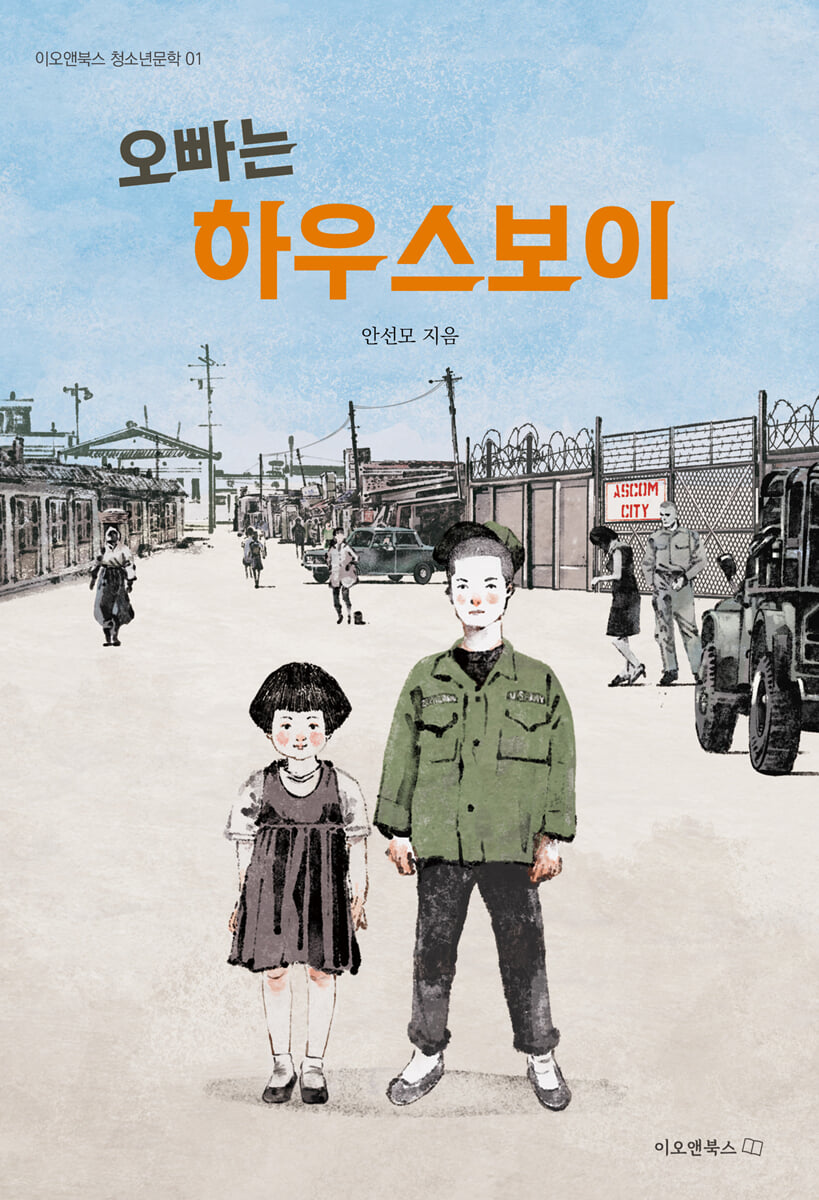
My brother is a houseboy
 |
Description
Book Introduction
Io & Books Youth Literature 01
Ascom, our land but a land we have never set foot on!
During the Japanese colonial period, it was the site of a Japanese military arsenal, and after liberation, it became the site of a US military base, Ascom.
A gentle and touching story of people living a poor but independent life in Ascom and its surrounding villages in the 1960s.
The protagonist, Seon-gi, lives in a village near Ascom, a US military base.
The curious Seon-gi lives in a village of houses from 1 to 10, and gets along with his neighbors like family.
Houses 1 through 10, which have to use communal water and toilets, each live each day with their own story.
From the uncle in house number 1 who works at the US military base, to the princess in house number 5, to the pig in house number 8 who sells honey porridge, to the hermit in house number 9 whose father is a gambler, each and every house in Juljip Village has its own memories and stories.
Seon-gi's younger brother, Woong-gi, wants to quit his studies and become a houseboy to earn money as soon as possible.
What does Seon-gi see in his family and neighbors? Will Woong-gi be able to become a houseboy and carve out the future he desires? Set in the Bupyeong Ascom US military base and the nearby villages of Juljip, Saechon, and Dadagumi, this is a story of ordinary yet extraordinary lives in the 1960s.
“There are many people who admire the American soldiers who came to our country as if they were a light, but where there is light, there is always a shadow.
So, we must remember that just because we cannot see something doesn't mean it doesn't have a shadow.”
Ascom was a place of light, a place of life, and at the same time a place of darkness where life collapsed.
Stories of people who lived alongside US military units in the 1960s, including honey porridge, handshake flour, the 8th US Army band, the 121st Evacuation Hospital, Yanggongju, houseboys, and the Vietnam War.
In "My Brother is a Houseboy," the story of our neighbors, who lived their lives poorly but fiercely, difficultly but preciously, is depicted in a gentle and touching way.
“I wanted to portray children who are poor and lacking but still pursue their dreams.
As the curious Seon-gi grew up, I also wanted to portray his older brother Woong-gi, who gave up studying and became a houseboy, but did not lose his self-esteem.
“I also wanted to let people know that the Republic of Korea exists today because there were families and neighbors who survived even in difficult circumstances where people were busy worrying about what to eat every day.” - From the author’s words
Ascom, our land but a land we have never set foot on!
During the Japanese colonial period, it was the site of a Japanese military arsenal, and after liberation, it became the site of a US military base, Ascom.
A gentle and touching story of people living a poor but independent life in Ascom and its surrounding villages in the 1960s.
The protagonist, Seon-gi, lives in a village near Ascom, a US military base.
The curious Seon-gi lives in a village of houses from 1 to 10, and gets along with his neighbors like family.
Houses 1 through 10, which have to use communal water and toilets, each live each day with their own story.
From the uncle in house number 1 who works at the US military base, to the princess in house number 5, to the pig in house number 8 who sells honey porridge, to the hermit in house number 9 whose father is a gambler, each and every house in Juljip Village has its own memories and stories.
Seon-gi's younger brother, Woong-gi, wants to quit his studies and become a houseboy to earn money as soon as possible.
What does Seon-gi see in his family and neighbors? Will Woong-gi be able to become a houseboy and carve out the future he desires? Set in the Bupyeong Ascom US military base and the nearby villages of Juljip, Saechon, and Dadagumi, this is a story of ordinary yet extraordinary lives in the 1960s.
“There are many people who admire the American soldiers who came to our country as if they were a light, but where there is light, there is always a shadow.
So, we must remember that just because we cannot see something doesn't mean it doesn't have a shadow.”
Ascom was a place of light, a place of life, and at the same time a place of darkness where life collapsed.
Stories of people who lived alongside US military units in the 1960s, including honey porridge, handshake flour, the 8th US Army band, the 121st Evacuation Hospital, Yanggongju, houseboys, and the Vietnam War.
In "My Brother is a Houseboy," the story of our neighbors, who lived their lives poorly but fiercely, difficultly but preciously, is depicted in a gentle and touching way.
“I wanted to portray children who are poor and lacking but still pursue their dreams.
As the curious Seon-gi grew up, I also wanted to portray his older brother Woong-gi, who gave up studying and became a houseboy, but did not lose his self-esteem.
“I also wanted to let people know that the Republic of Korea exists today because there were families and neighbors who survived even in difficult circumstances where people were busy worrying about what to eat every day.” - From the author’s words
- You can preview some of the book's contents.
Preview
index
Bamsol Mountain
communal water tap
Love Room Guest and Mother
Tadagumi Village
Crane commotion
Father's empty seat
The first time I met the princess
Coal and flour
Little brother's plot
American Armed Forces Day
That cruel summer
malnutrition
Houseboy
Saetbyeol Theater
Light and Shadow
new friend
The sold-out hermit sister
scholarship student
flower bier
Story notebook
communal water tap
Love Room Guest and Mother
Tadagumi Village
Crane commotion
Father's empty seat
The first time I met the princess
Coal and flour
Little brother's plot
American Armed Forces Day
That cruel summer
malnutrition
Houseboy
Saetbyeol Theater
Light and Shadow
new friend
The sold-out hermit sister
scholarship student
flower bier
Story notebook
Detailed image
.jpg)
Into the book
There is a huge US military base there, so vast that the end is not visible.
People call that place Askum.
Ascom is a US military base built to supply war supplies and food to US troops near the Military Demarcation Line.
There are several supply warehouses inside.
It is said that during the Japanese colonial period, there was a Japanese arsenal on that site.
--- P.12
If I meet an American soldier, I will not be surprised and will confidently say 'hello'.
And if you give me chocolate or gum without me asking, I will politely accept it with both hands and say 'thank you'.
--- P.31
Ah, the line is a stop.
A stop for a short while.
So people leave and new people come.
This is a place where we can't stay together for long.
For some reason, one side of my chest started to feel a pang.
--- P.35
A Korean man and an American man shake hands on a flour sack.
Perhaps this is how Korea and the United States advertise their good relationship.
--- P.65
“Unggi, there are many kids your age in the US military base.”
“Are you talking about Houseboy? What does Houseboy do?”
--- P.67
"Why should our young people sacrifice their lives in another country's war? How can sending them into battle be considered a duty?"
--- P.76
My uncle says we need to get along well with the US, but why does my father hate getting a job at the US military base?
--- P.114
There are many people who admire the American soldiers who came to our country as if they were a light, but where there is light, there is always a shadow.
So, he added, we must remember that just because we cannot see something doesn't mean it doesn't have a shadow.
When did my little brother become so mature?
--- P.132
I looked far away towards Ascom.
Gray buildings and tall walls that seem far away.
And the villages of Saechon and Dadagumi, which are crowded together.
There must be many stories piled up there too.
People call that place Askum.
Ascom is a US military base built to supply war supplies and food to US troops near the Military Demarcation Line.
There are several supply warehouses inside.
It is said that during the Japanese colonial period, there was a Japanese arsenal on that site.
--- P.12
If I meet an American soldier, I will not be surprised and will confidently say 'hello'.
And if you give me chocolate or gum without me asking, I will politely accept it with both hands and say 'thank you'.
--- P.31
Ah, the line is a stop.
A stop for a short while.
So people leave and new people come.
This is a place where we can't stay together for long.
For some reason, one side of my chest started to feel a pang.
--- P.35
A Korean man and an American man shake hands on a flour sack.
Perhaps this is how Korea and the United States advertise their good relationship.
--- P.65
“Unggi, there are many kids your age in the US military base.”
“Are you talking about Houseboy? What does Houseboy do?”
--- P.67
"Why should our young people sacrifice their lives in another country's war? How can sending them into battle be considered a duty?"
--- P.76
My uncle says we need to get along well with the US, but why does my father hate getting a job at the US military base?
--- P.114
There are many people who admire the American soldiers who came to our country as if they were a light, but where there is light, there is always a shadow.
So, he added, we must remember that just because we cannot see something doesn't mean it doesn't have a shadow.
When did my little brother become so mature?
--- P.132
I looked far away towards Ascom.
Gray buildings and tall walls that seem far away.
And the villages of Saechon and Dadagumi, which are crowded together.
There must be many stories piled up there too.
--- P.164
Publisher's Review
A space with a long and painful history
'A vast plain of one million pyeong that is our land, but has not been our land for a long time.'
The author of this book, Seonmo Ahn, wrote the story of the protagonist living in the largest arsenal and Mitsubishi row houses in Joseon during the Japanese colonial period in his previous work, Goodbye Mitsubishi.
And in this book, “My Brother is a Houseboy,” the site of the arsenal holds the painful history of being turned into the US military base Ascom after liberation.
The author, who lived in a Mitsubishi row house during his childhood, tells the story based on the story of his father, who had experience as a houseboy.
It also calmly depicts the story of our land, which was liberated but still not our master, and our neighbors who had to survive despite it all.
During the Japanese colonial period, the site of the Japanese military's Incheon Army Arsenal in Bupyeong was renamed Ascom after liberation, when the US military began stationing there.
It is our land, but we are still not the owners of the land.
After the Korean War, the United States continued to station troops and provide supplies and technology to the devastated country. Many people began to gather around the US military bases, which were rich in supplies.
The story of this book unfolds against this backdrop.
From the porridge made from leftover food from American soldiers, to the so-called "handshake flour" which is a symbol of American wheat aid, to the 8th Army Band which was a dream stage for popular musicians, to the Yanggongju who had to deal with American soldiers, it shows the life of the 1960s in detail.
There is no life that is not precious.
I pay tribute to the fierce struggles of each person.
“Unggi, there are many kids your age in the US military base.”
“Are you talking about Houseboy? What does Houseboy do?”
The historical setting of "My Brother is a Houseboy" is from 1962 to 1969, after the May 16 military coup.
This period was a time of political upheaval and economic chaos, with many unable to escape poverty.
The world is chaotic, but the lives of ordinary people are calm.
It seems like the life of a seeker who silently carries out the daily routine given to him in order to survive, and sometimes for his family.
The village of Juljip from No. 1 to No. 10 is passed by as many people as there are people in it.
The main character, Seon-gi, is very curious and always curious about his neighbors' stories; his mother takes care of the household chores and earns money in place of his sick father; and his older brother, Myeong-gi, studies so hard that he is nicknamed the desk ghost.
Woong-gi, the little brother who is as deep inside as he is big, wants to become a houseboy for his family.
Younger sister Jeonggi is bigger and stronger than her older sister Seongi.
Their daily life is difficult, but it is also very affectionate.
The first house owner who works at the US military base cafeteria.
The scene of the old man shaking out a sack of flour is vivid before my eyes.
Pig House, who makes and sells honey porridge and moonshine made from leftover food from the US military base; Princess Yebun, who has to endure the cold gaze of the world; Eunja, who lives a difficult life under her gambler father; and Jaehak, who dreams of performing on the US 8th Army stage. Sometimes life is difficult, but they live fiercely each day.
Is there anything small or light in the weight of life among these people?
But the author describes their lives in a calm manner.
Their lives are not expressed as right or wrong, good or bad.
Perhaps it is a tribute to the fact that their lives are all precious and that each of them lives a fierce life?
The fun of looking back on the turbulent times of the 1960s
In "My Brother is a Houseboy," there is the fun of looking back on history.
The film “A Guest in the Love Room and Mother,” “A Cemetery Under the Moon,” and the radio drama “Island Village Teacher,” which were all hugely popular when they were released in the 1960s, are placed here and there to provide the fun of finding historical devices.
It also shows the special characteristics of the times called houseboy.
Houseboy is a male child who helps with personal chores for American soldiers stationed in Korea after the Korean War. This occupation gradually disappeared as Korea became more stable and formal hiring procedures were established.
That is why the houseboy we experience through this book is unfamiliar and special to us today.
The confidence of Seon-gi is reflected in the youth of today.
In Seon-gi's confident appearance, who is curious about everything and has no prejudices about the world, we see the image of today's youth.
The image of a teenager living in the present is reflected in the main character Seon-gi, who is angry at the trend of valuing sons, and who feels that his older sister, who is a adopted daughter but is extremely kind, and her husband, James, who is an American soldier, are all the same people without any prejudice.
'Why is my father ashamed of being a houseboy?'
Perhaps it's because he supported the American soldiers who came to this land and ruled like masters. As a proud father, I think it's entirely understandable.
Now, looking at my father, who is well over ninety years old, a boy comes to mind.
A boy who was poor but not mean and knew how to carve out his own future.'
From the author's note
Io & Books Youth Literature Series
South Korea has achieved remarkable development as an IT powerhouse and a cultural powerhouse with K-pop and the Korean Wave.
The Io & Books Youth Literature Series is a youth history and culture series designed to open up a better future by looking back on the lives of youth in each era that led to today's lives.
Today's youth, despite having become more materially affluent, live with more worries, conflicts, and wounds.
These youth are shown the lives of youth from each era, from the 1960s to the 1970s, 1980s, 1990s, and 2000s, showing that today's dazzling development and abundance, as well as the current status of the Republic of Korea, were possible because they endured the pain of their times.
'A vast plain of one million pyeong that is our land, but has not been our land for a long time.'
The author of this book, Seonmo Ahn, wrote the story of the protagonist living in the largest arsenal and Mitsubishi row houses in Joseon during the Japanese colonial period in his previous work, Goodbye Mitsubishi.
And in this book, “My Brother is a Houseboy,” the site of the arsenal holds the painful history of being turned into the US military base Ascom after liberation.
The author, who lived in a Mitsubishi row house during his childhood, tells the story based on the story of his father, who had experience as a houseboy.
It also calmly depicts the story of our land, which was liberated but still not our master, and our neighbors who had to survive despite it all.
During the Japanese colonial period, the site of the Japanese military's Incheon Army Arsenal in Bupyeong was renamed Ascom after liberation, when the US military began stationing there.
It is our land, but we are still not the owners of the land.
After the Korean War, the United States continued to station troops and provide supplies and technology to the devastated country. Many people began to gather around the US military bases, which were rich in supplies.
The story of this book unfolds against this backdrop.
From the porridge made from leftover food from American soldiers, to the so-called "handshake flour" which is a symbol of American wheat aid, to the 8th Army Band which was a dream stage for popular musicians, to the Yanggongju who had to deal with American soldiers, it shows the life of the 1960s in detail.
There is no life that is not precious.
I pay tribute to the fierce struggles of each person.
“Unggi, there are many kids your age in the US military base.”
“Are you talking about Houseboy? What does Houseboy do?”
The historical setting of "My Brother is a Houseboy" is from 1962 to 1969, after the May 16 military coup.
This period was a time of political upheaval and economic chaos, with many unable to escape poverty.
The world is chaotic, but the lives of ordinary people are calm.
It seems like the life of a seeker who silently carries out the daily routine given to him in order to survive, and sometimes for his family.
The village of Juljip from No. 1 to No. 10 is passed by as many people as there are people in it.
The main character, Seon-gi, is very curious and always curious about his neighbors' stories; his mother takes care of the household chores and earns money in place of his sick father; and his older brother, Myeong-gi, studies so hard that he is nicknamed the desk ghost.
Woong-gi, the little brother who is as deep inside as he is big, wants to become a houseboy for his family.
Younger sister Jeonggi is bigger and stronger than her older sister Seongi.
Their daily life is difficult, but it is also very affectionate.
The first house owner who works at the US military base cafeteria.
The scene of the old man shaking out a sack of flour is vivid before my eyes.
Pig House, who makes and sells honey porridge and moonshine made from leftover food from the US military base; Princess Yebun, who has to endure the cold gaze of the world; Eunja, who lives a difficult life under her gambler father; and Jaehak, who dreams of performing on the US 8th Army stage. Sometimes life is difficult, but they live fiercely each day.
Is there anything small or light in the weight of life among these people?
But the author describes their lives in a calm manner.
Their lives are not expressed as right or wrong, good or bad.
Perhaps it is a tribute to the fact that their lives are all precious and that each of them lives a fierce life?
The fun of looking back on the turbulent times of the 1960s
In "My Brother is a Houseboy," there is the fun of looking back on history.
The film “A Guest in the Love Room and Mother,” “A Cemetery Under the Moon,” and the radio drama “Island Village Teacher,” which were all hugely popular when they were released in the 1960s, are placed here and there to provide the fun of finding historical devices.
It also shows the special characteristics of the times called houseboy.
Houseboy is a male child who helps with personal chores for American soldiers stationed in Korea after the Korean War. This occupation gradually disappeared as Korea became more stable and formal hiring procedures were established.
That is why the houseboy we experience through this book is unfamiliar and special to us today.
The confidence of Seon-gi is reflected in the youth of today.
In Seon-gi's confident appearance, who is curious about everything and has no prejudices about the world, we see the image of today's youth.
The image of a teenager living in the present is reflected in the main character Seon-gi, who is angry at the trend of valuing sons, and who feels that his older sister, who is a adopted daughter but is extremely kind, and her husband, James, who is an American soldier, are all the same people without any prejudice.
'Why is my father ashamed of being a houseboy?'
Perhaps it's because he supported the American soldiers who came to this land and ruled like masters. As a proud father, I think it's entirely understandable.
Now, looking at my father, who is well over ninety years old, a boy comes to mind.
A boy who was poor but not mean and knew how to carve out his own future.'
From the author's note
Io & Books Youth Literature Series
South Korea has achieved remarkable development as an IT powerhouse and a cultural powerhouse with K-pop and the Korean Wave.
The Io & Books Youth Literature Series is a youth history and culture series designed to open up a better future by looking back on the lives of youth in each era that led to today's lives.
Today's youth, despite having become more materially affluent, live with more worries, conflicts, and wounds.
These youth are shown the lives of youth from each era, from the 1960s to the 1970s, 1980s, 1990s, and 2000s, showing that today's dazzling development and abundance, as well as the current status of the Republic of Korea, were possible because they endured the pain of their times.
GOODS SPECIFICS
- Date of issue: May 8, 2024
- Page count, weight, size: 166 pages | 260g | 140*205*10mm
- ISBN13: 9791198220387
- ISBN10: 1198220384
- KC Certification: Certification Type: Conformity Confirmation
You may also like
카테고리
korean


korean

![GQ KOREA Mark (Monthly): December [2025]](http://librairie.coreenne.fr/cdn/shop/files/8ef265dbbfbf186523ed75ba7319009d.jpg?v=1765340328&width=3840)


