

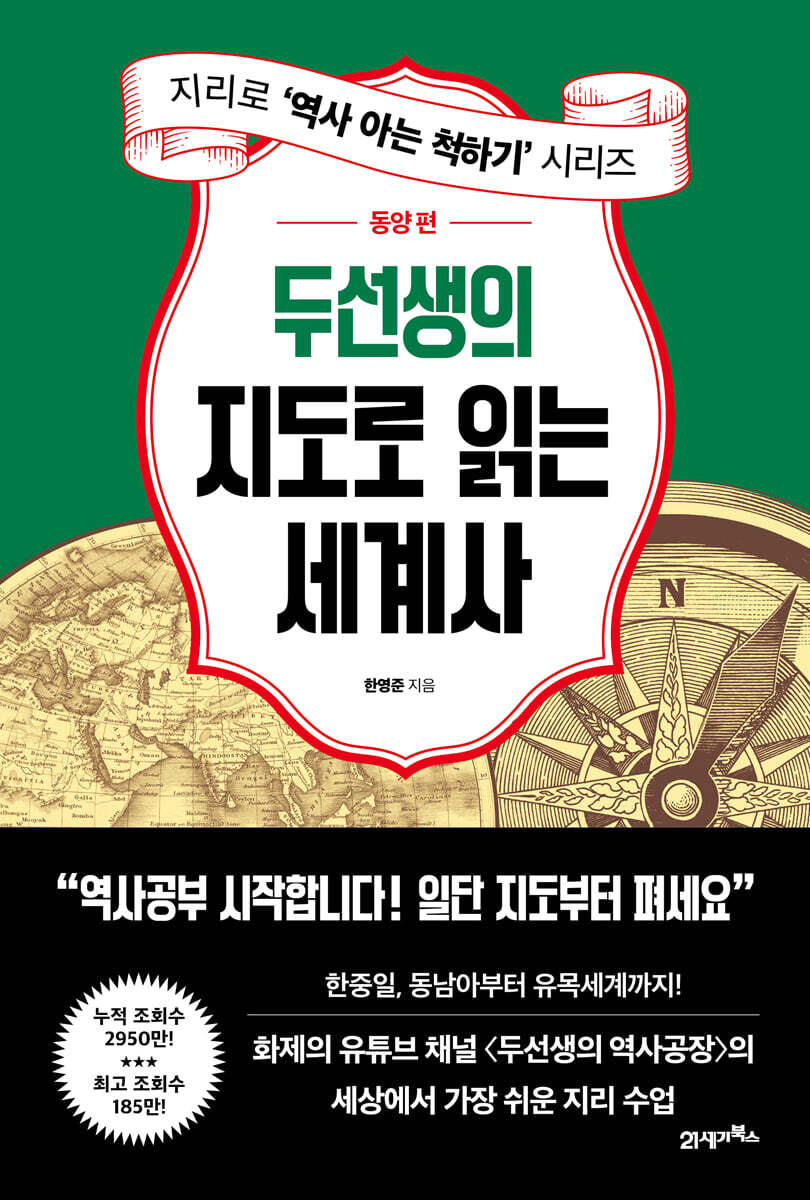
World History Under the Guidance of Two Teachers: East Asia
 |
Description
Book Introduction
"Let's start studying history! First, spread out the map."
★ Cumulative views: 29.35 million, peak views: 1.84 million
★ The world's easiest geography lesson from the popular YouTube channel "Two Teachers' History Factory"
“This is why China and Japan are different from our country!”
From China to the nomadic world, Asia's geopolitical situation at a glance!
With 29.35 million cumulative views and a peak of 1.84 million, the book "World History Under the Guidance of Mr. Doo," which encompasses the knowledge gathered from the popular YouTube channel "Mr. Doo's History Factory," has returned with an East Asian edition, following its Western edition.
Following the Western section, which delved into the history intertwined with geography from the United States and Europe to the Middle East and Africa, the Eastern section provides knowledge encompassing the entire world, looking at China, Central Eurasia, and Southeast Asia.
How did China come to occupy such a vast territory and boast such a large population? How did Koreans, who began their civilization in Manchuria, settle on the Korean Peninsula? Why did Buddhism, a world religion, disappear from India, where it originated? Why do most Southeast Asian countries that achieved independence similar to ours after World War II remain developing nations?
Maps and geography are not simply about the appearance of the land.
It is a window to the past and a blueprint for reading the future.
To properly study 'real' history, we must first understand geography, which contains the stories of mountain ranges and seas.
This book contains the author's characteristically humorous explanations that even those unfamiliar with history can understand at a glance, along with a wealth of visual aids in the form of 45 illustrated color maps.
This book will correct your perception that history is long and boring and maps are complicated and difficult to read.
★ Cumulative views: 29.35 million, peak views: 1.84 million
★ The world's easiest geography lesson from the popular YouTube channel "Two Teachers' History Factory"
“This is why China and Japan are different from our country!”
From China to the nomadic world, Asia's geopolitical situation at a glance!
With 29.35 million cumulative views and a peak of 1.84 million, the book "World History Under the Guidance of Mr. Doo," which encompasses the knowledge gathered from the popular YouTube channel "Mr. Doo's History Factory," has returned with an East Asian edition, following its Western edition.
Following the Western section, which delved into the history intertwined with geography from the United States and Europe to the Middle East and Africa, the Eastern section provides knowledge encompassing the entire world, looking at China, Central Eurasia, and Southeast Asia.
How did China come to occupy such a vast territory and boast such a large population? How did Koreans, who began their civilization in Manchuria, settle on the Korean Peninsula? Why did Buddhism, a world religion, disappear from India, where it originated? Why do most Southeast Asian countries that achieved independence similar to ours after World War II remain developing nations?
Maps and geography are not simply about the appearance of the land.
It is a window to the past and a blueprint for reading the future.
To properly study 'real' history, we must first understand geography, which contains the stories of mountain ranges and seas.
This book contains the author's characteristically humorous explanations that even those unfamiliar with history can understand at a glance, along with a wealth of visual aids in the form of 45 illustrated color maps.
This book will correct your perception that history is long and boring and maps are complicated and difficult to read.
- You can preview some of the book's contents.
Preview
index
Opening the Book: A Space for Reading Geography and History
CHAPTER 1: An Empire Made by Geography, an Empire Confined by Geography: China
[China's Natural Geography] Knowing the Rivers Understanding China
- How far does 'real China' extend?
Why China's Jiangnan development has been delayed
- How the Han people expanded their territory
[Chinese History] Chinese history is a roller coaster ride.
- The formation process of the Han people
- The rise and fall of empires
- Chinese history through capital cities
[China's Geopolitics] From Mongolia to Taiwan: Relations with China
- The descendants of the nomadic empire, the current location of Mongolia
- Where did the name Manchuria come from?
Why China is Obsessed with Tibet
- Taiwan's identity
Chinese Chapter Summary
CHAPTER 2: Korea and Japan, Neighbors Yet Close
[Physical Geography of Korea and Japan] Geographical Characteristics of the Korean Peninsula and Archipelago
- Why Koreans prefer metal chopsticks
- The geographical reason why there are 8 million gods in Japan
[History of Korea and Japan] Similar yet Different Histories of Korea and Japan
- Why did Korea give up Manchuria?
- A twist on familiar Korean history
- How different is Japanese history from Korean history?
- Geopolitics of Korea and Japan through History
[Human Geography of Korea and Japan] Stories of Korea and Japan Told Through the Land
- Korean history through place names
- Rivals in Japanese history, Kansai and Kanto
Summary of Korea and Japan Chapters
CHAPTER 3: Teachers of the East and West: South Asia and Central Eurasia
[Physical Geography of South Asia and Central Eurasia] The Influence of the Himalayas
South Asia, smaller than Europe, is home to 1.8 billion people.
- Map of the nomads who shaped world history
[History of South Asia and Central Eurasia] The Footsteps of Nomads and Religion
- A History of Nomads Through Genealogy and Bloodline
- South Asian History through Religion
[Human Geography of South Asia and Central Eurasia] Why Conflicts Persist
- How did India and Pakistan end up developing nuclear weapons?
- Afghanistan, the tragedy continues
- What are the differences between the five Central Asian countries?
- The changed geopolitics of Xinjiang Uyghur
Chapter Summary of South Asia and Central Eurasia
CHAPTER 4 Between India and China, Southeast Asia
[The Physical Geography and History of Southeast Asia] Maps and History: A Coexistence of Diverse Identities
Southeast Asia does not share a shared identity.
- How is Southeast Asian history different from Korea's?
[Human Geography of Southeast Asia] The Gradation of Indo-Chinese Civilization
- The cruel history of Cambodia, the land of Angkor Wat
- Where did the Thai Dynasty begin?
- Vietnam, the land of confidence
- Where does polarization in the Philippines come from?
- Indonesia, the world's largest Islamic country
- The story of Singapore's divorce from Malaysia
Southeast Asia Chapter Summary
Concluding the Book: A Story of People, Geography
CHAPTER 1: An Empire Made by Geography, an Empire Confined by Geography: China
[China's Natural Geography] Knowing the Rivers Understanding China
- How far does 'real China' extend?
Why China's Jiangnan development has been delayed
- How the Han people expanded their territory
[Chinese History] Chinese history is a roller coaster ride.
- The formation process of the Han people
- The rise and fall of empires
- Chinese history through capital cities
[China's Geopolitics] From Mongolia to Taiwan: Relations with China
- The descendants of the nomadic empire, the current location of Mongolia
- Where did the name Manchuria come from?
Why China is Obsessed with Tibet
- Taiwan's identity
Chinese Chapter Summary
CHAPTER 2: Korea and Japan, Neighbors Yet Close
[Physical Geography of Korea and Japan] Geographical Characteristics of the Korean Peninsula and Archipelago
- Why Koreans prefer metal chopsticks
- The geographical reason why there are 8 million gods in Japan
[History of Korea and Japan] Similar yet Different Histories of Korea and Japan
- Why did Korea give up Manchuria?
- A twist on familiar Korean history
- How different is Japanese history from Korean history?
- Geopolitics of Korea and Japan through History
[Human Geography of Korea and Japan] Stories of Korea and Japan Told Through the Land
- Korean history through place names
- Rivals in Japanese history, Kansai and Kanto
Summary of Korea and Japan Chapters
CHAPTER 3: Teachers of the East and West: South Asia and Central Eurasia
[Physical Geography of South Asia and Central Eurasia] The Influence of the Himalayas
South Asia, smaller than Europe, is home to 1.8 billion people.
- Map of the nomads who shaped world history
[History of South Asia and Central Eurasia] The Footsteps of Nomads and Religion
- A History of Nomads Through Genealogy and Bloodline
- South Asian History through Religion
[Human Geography of South Asia and Central Eurasia] Why Conflicts Persist
- How did India and Pakistan end up developing nuclear weapons?
- Afghanistan, the tragedy continues
- What are the differences between the five Central Asian countries?
- The changed geopolitics of Xinjiang Uyghur
Chapter Summary of South Asia and Central Eurasia
CHAPTER 4 Between India and China, Southeast Asia
[The Physical Geography and History of Southeast Asia] Maps and History: A Coexistence of Diverse Identities
Southeast Asia does not share a shared identity.
- How is Southeast Asian history different from Korea's?
[Human Geography of Southeast Asia] The Gradation of Indo-Chinese Civilization
- The cruel history of Cambodia, the land of Angkor Wat
- Where did the Thai Dynasty begin?
- Vietnam, the land of confidence
- Where does polarization in the Philippines come from?
- Indonesia, the world's largest Islamic country
- The story of Singapore's divorce from Malaysia
Southeast Asia Chapter Summary
Concluding the Book: A Story of People, Geography
Detailed image

Into the book
When explaining the geography of China, the first thing to know is ‘rivers.’
Because China has the most fertile plains in the world, and the Han people have enjoyed the richest history based on those plains, rivers have great historical and geographical significance.
If you know just the rivers of China, you can understand half of Chinese geography and maps.
The concept of 'nation' itself is a cultural concept rather than a blood concept.
It's a 'question of identity', how I define myself.
And Chinese history is also a process that shows how the Han Chinese identity expanded.
In fact, Chinese history is a history of ‘pongdang pongdang’.
The period of division, confusion, and unification keeps repeating itself.
After a period of chaos, a unified dynasty is established for 200 to 400 years, and when that country falls, chaos returns, and a unified dynasty is established again. This pattern continues.
--- From "China, an Empire Made by Geography, an Empire Confined by Geography"
In 663 AD, Baekje was destroyed when the Baekje revival forces were defeated in the Battle of Baekchon River at the mouth of the Geumgang River.
After the Battle of Baekchon River, the connection between the Korean Peninsula and the Japanese archipelago was severed, and as territorial consciousness bordering the Japanese archipelago grew stronger, the prototype of the national consciousness called Japan was born.
The name Euljiro comes from General Eulji Mundeok.
When the old-style army revolted in 1882 (Imo Incident), the Qing army suppressed it. As a result of this incident, Qing officials dispatched to Joseon began to reside in Euljiro, and Korea's first Chinatown was formed.
When changing place names to Korean names after liberation, the decision to name this road after General Eulji Mundeok was made because they wanted to suppress the Chinese's momentum, just like General Eulji Mundeok, who defeated the Sui army in the Battle of Salsu.
--- From "Close yet Distant Neighbors, Korea and Japan"
The most significant geographical feature that distinguishes South Asia from other regions is the Himalayas.
South Asia was originally a huge island that collided with the Eurasian continent about 50 million years ago, and the Himalayas, the 'roof of the world', were created as a result of that collision.
When the Soviet Union collapsed, the five Central Asian countries became independent, but the last secretaries appointed by the Soviet Union became the presidents of the five independent countries and have maintained their power hereditarily until recently.
The countries created by the Soviet Union are still politically and economically dependent on Russia.
Border disputes and ethnic conflicts still occur between the five countries.
A representative example is the Fergana Basin, where the borders of five countries are intertwined.
--- From "Teachers of the East and the West, South Asia and Central Eurasia"
Southeast Asia is a good place to lump together as one region.
But it is said that Southeast Asians do not actually share a common identity.
Historically, no single country had any significant influence over the entire Southeast Asia, and being located between the two great civilizations of India and China, it was heavily influenced by both regions.
Compared to the history of our country, which, while influenced by China, consistently pursued its own independence and, since the modern era, sought its own possibilities in the gap between continental and maritime powers, the history of Southeast Asia does not feel so unfamiliar.
Because China has the most fertile plains in the world, and the Han people have enjoyed the richest history based on those plains, rivers have great historical and geographical significance.
If you know just the rivers of China, you can understand half of Chinese geography and maps.
The concept of 'nation' itself is a cultural concept rather than a blood concept.
It's a 'question of identity', how I define myself.
And Chinese history is also a process that shows how the Han Chinese identity expanded.
In fact, Chinese history is a history of ‘pongdang pongdang’.
The period of division, confusion, and unification keeps repeating itself.
After a period of chaos, a unified dynasty is established for 200 to 400 years, and when that country falls, chaos returns, and a unified dynasty is established again. This pattern continues.
--- From "China, an Empire Made by Geography, an Empire Confined by Geography"
In 663 AD, Baekje was destroyed when the Baekje revival forces were defeated in the Battle of Baekchon River at the mouth of the Geumgang River.
After the Battle of Baekchon River, the connection between the Korean Peninsula and the Japanese archipelago was severed, and as territorial consciousness bordering the Japanese archipelago grew stronger, the prototype of the national consciousness called Japan was born.
The name Euljiro comes from General Eulji Mundeok.
When the old-style army revolted in 1882 (Imo Incident), the Qing army suppressed it. As a result of this incident, Qing officials dispatched to Joseon began to reside in Euljiro, and Korea's first Chinatown was formed.
When changing place names to Korean names after liberation, the decision to name this road after General Eulji Mundeok was made because they wanted to suppress the Chinese's momentum, just like General Eulji Mundeok, who defeated the Sui army in the Battle of Salsu.
--- From "Close yet Distant Neighbors, Korea and Japan"
The most significant geographical feature that distinguishes South Asia from other regions is the Himalayas.
South Asia was originally a huge island that collided with the Eurasian continent about 50 million years ago, and the Himalayas, the 'roof of the world', were created as a result of that collision.
When the Soviet Union collapsed, the five Central Asian countries became independent, but the last secretaries appointed by the Soviet Union became the presidents of the five independent countries and have maintained their power hereditarily until recently.
The countries created by the Soviet Union are still politically and economically dependent on Russia.
Border disputes and ethnic conflicts still occur between the five countries.
A representative example is the Fergana Basin, where the borders of five countries are intertwined.
--- From "Teachers of the East and the West, South Asia and Central Eurasia"
Southeast Asia is a good place to lump together as one region.
But it is said that Southeast Asians do not actually share a common identity.
Historically, no single country had any significant influence over the entire Southeast Asia, and being located between the two great civilizations of India and China, it was heavily influenced by both regions.
Compared to the history of our country, which, while influenced by China, consistently pursued its own independence and, since the modern era, sought its own possibilities in the gap between continental and maritime powers, the history of Southeast Asia does not feel so unfamiliar.
--- From "Between India and China, Southeast Asia"
Publisher's Review
From China to Central Eurasia and Southeast Asia
If you just know where the mountains and rivers are,
You can read the history that has been built up over thousands of years!
To know history, you must first know its geography.
Geography and history are inseparable.
Geography allows us to better understand people of the past.
The historical significance of geography, or the ‘historicity of geography,’ does not remain in the past but continues to the present.
For example, if you want to know the history of India, it is essential to know where the Indus and Ganges rivers flow and what the geographical features are like there.
To understand Korean history, we must understand the process and reasons why people came down from Manchuria and settled on the Korean Peninsula.
In the case of South Asia and Central Eurasia, the influence of the Himalayas should be noted.
Southeast Asia, which is familiar to us, achieved independence similar to our country, but most of it remains a developing country. The reason for this can also be found in its topography.
Even if there are similar environments and similar historical experiences, history can differ depending on the geographical characteristics of the region.
The landforms engraved on the map, such as the land that created civilization, the sea that laid the foundation for expansion and exchange, and the mountain ranges that divided borders, provide clues for easier communication with the past and a closer look at history.
This is why we need to open up maps to study 'real' history.
Main contents
ㆍChina
- How did China's territory expand?
- Why can't China give up Taiwan?
Korea and Japan
- Why did the Korean people give up Manchuria?
- What about the geopolitics of Korea and Japan?
ㆍSouth Asia and Central Eurasia
- 1.8 billion people crammed into a land smaller than Europe?
- Why is there constant conflict in South Asia?
Southeast Asia
- Why is it difficult for Southeast Asia to unite?
- What impact has colonial history had on the present of Southeast Asia?
Includes 45 color maps by topic and theme!
The power of maps that penetrate world history
In the East section, we first examine China, which has had the greatest influence on both the past and present, and then Korea and Japan, which have interacted the most with China yet have developed in different ways.
Next, India and South Asia, which have great influence in the East, were placed next to Korea, China, and Japan.
The most notable feature of this book is that it covers South Asia and Central Eurasia (the former nomadic region) in one chapter.
Lastly, by placing Southeast Asia, which shows various aspects between China and India, we helped people understand the long flow of world history naturally.
If you read it together with the Western edition that has already been published, world history, which seemed so distant, will feel a little closer.
Geographical environment does not determine everything about humans and society.
However, as the process of mankind adapting to and overcoming nature has become history, geography is the most accurate tool for reading history.
If you've ever thought studying history meant simply memorizing events one by one, open this book right now.
There will come a time when you will learn history when you read a map, and when you understand geography, you will understand current events.
If you just know where the mountains and rivers are,
You can read the history that has been built up over thousands of years!
To know history, you must first know its geography.
Geography and history are inseparable.
Geography allows us to better understand people of the past.
The historical significance of geography, or the ‘historicity of geography,’ does not remain in the past but continues to the present.
For example, if you want to know the history of India, it is essential to know where the Indus and Ganges rivers flow and what the geographical features are like there.
To understand Korean history, we must understand the process and reasons why people came down from Manchuria and settled on the Korean Peninsula.
In the case of South Asia and Central Eurasia, the influence of the Himalayas should be noted.
Southeast Asia, which is familiar to us, achieved independence similar to our country, but most of it remains a developing country. The reason for this can also be found in its topography.
Even if there are similar environments and similar historical experiences, history can differ depending on the geographical characteristics of the region.
The landforms engraved on the map, such as the land that created civilization, the sea that laid the foundation for expansion and exchange, and the mountain ranges that divided borders, provide clues for easier communication with the past and a closer look at history.
This is why we need to open up maps to study 'real' history.
Main contents
ㆍChina
- How did China's territory expand?
- Why can't China give up Taiwan?
Korea and Japan
- Why did the Korean people give up Manchuria?
- What about the geopolitics of Korea and Japan?
ㆍSouth Asia and Central Eurasia
- 1.8 billion people crammed into a land smaller than Europe?
- Why is there constant conflict in South Asia?
Southeast Asia
- Why is it difficult for Southeast Asia to unite?
- What impact has colonial history had on the present of Southeast Asia?
Includes 45 color maps by topic and theme!
The power of maps that penetrate world history
In the East section, we first examine China, which has had the greatest influence on both the past and present, and then Korea and Japan, which have interacted the most with China yet have developed in different ways.
Next, India and South Asia, which have great influence in the East, were placed next to Korea, China, and Japan.
The most notable feature of this book is that it covers South Asia and Central Eurasia (the former nomadic region) in one chapter.
Lastly, by placing Southeast Asia, which shows various aspects between China and India, we helped people understand the long flow of world history naturally.
If you read it together with the Western edition that has already been published, world history, which seemed so distant, will feel a little closer.
Geographical environment does not determine everything about humans and society.
However, as the process of mankind adapting to and overcoming nature has become history, geography is the most accurate tool for reading history.
If you've ever thought studying history meant simply memorizing events one by one, open this book right now.
There will come a time when you will learn history when you read a map, and when you understand geography, you will understand current events.
GOODS SPECIFICS
- Date of issue: June 18, 2025
- Page count, weight, size: 254 pages | 579g | 153*225*20mm
- ISBN13: 9791173572791
- ISBN10: 1173572791
You may also like
카테고리
korean


korean

![GQ KOREA Mark (Monthly): December [2025]](http://librairie.coreenne.fr/cdn/shop/files/8ef265dbbfbf186523ed75ba7319009d.jpg?v=1765340328&width=3840)


