

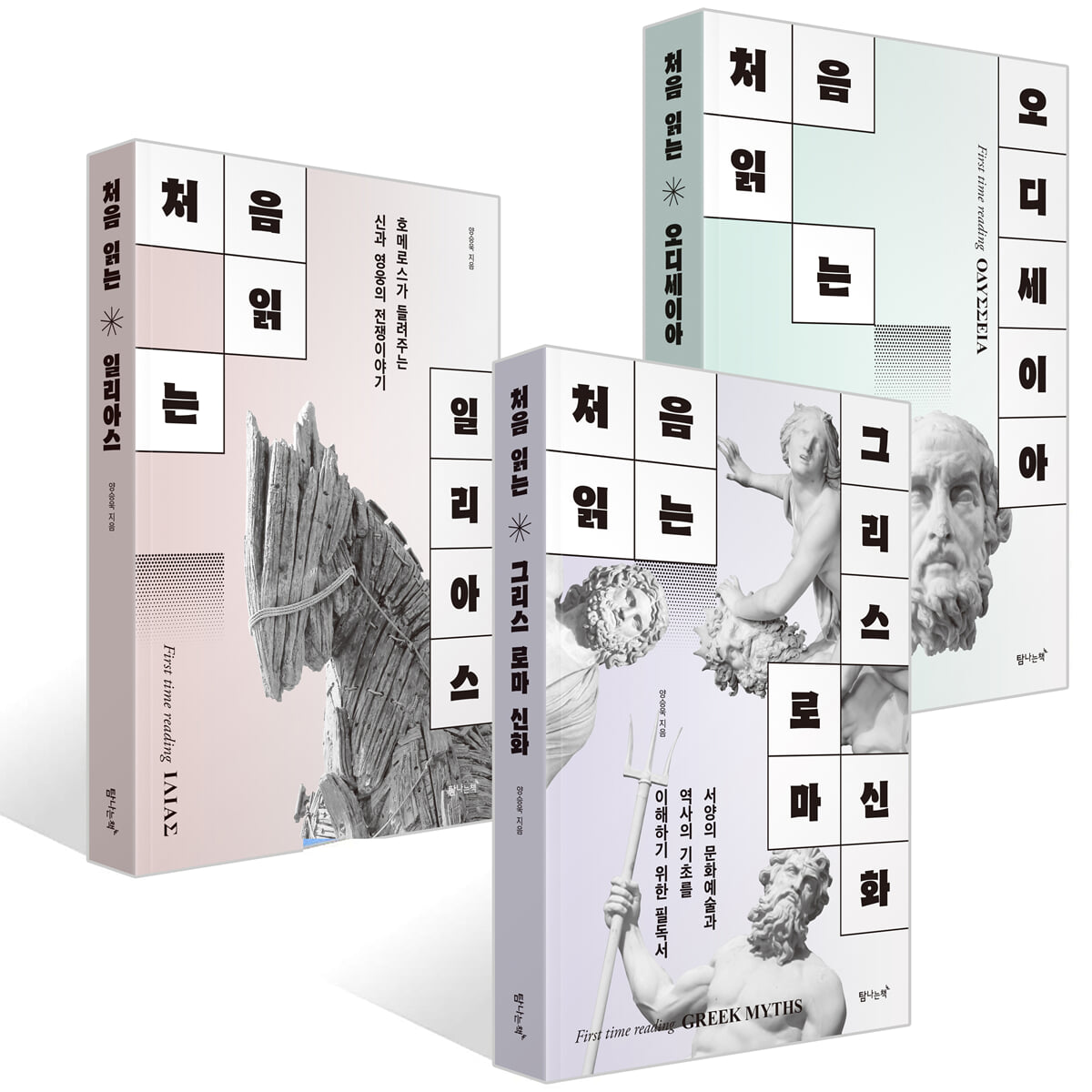
Reading Greek and Roman mythology for the first time + Iliad + Odyssey
 |
Description
Book Introduction
A must-read for Seoul National University students, a source of European culture, and the ultimate narrative that perfects wisdom and refinement.
Greek and Roman Mythology · Iliad · Odyssey
A civilization that began with myth, a mirror reflecting humanity
If you want to deeply understand Western civilization, the starting point is ancient Greece.
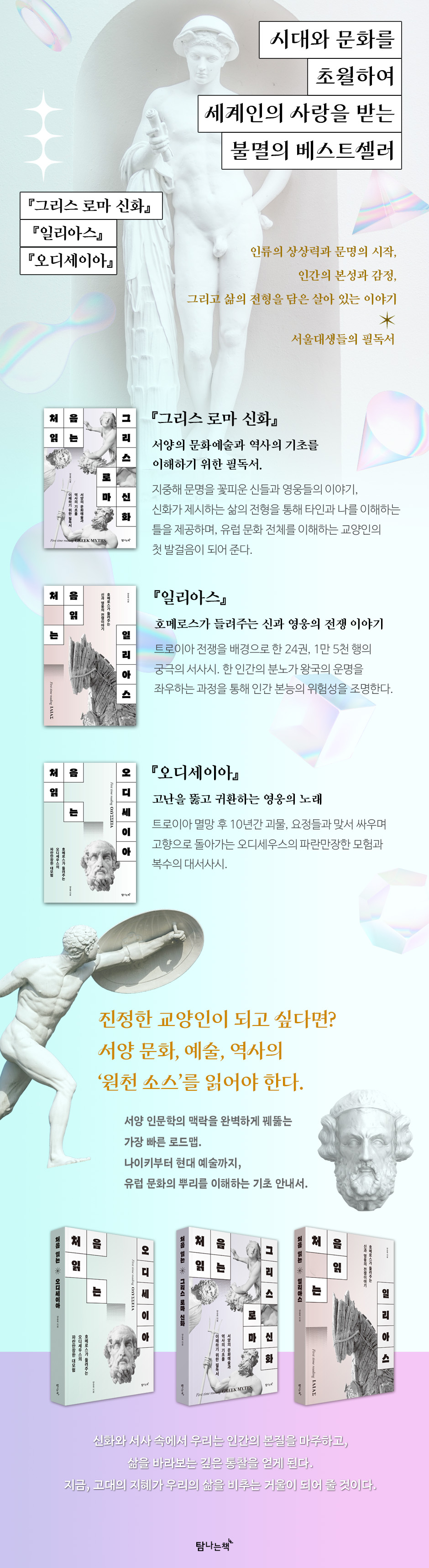
『Greek and Roman Mythology』, 『Iliad』, and 『Odyssey』 are the essence of humanities that show how European culture, art, history, and human imagination were formed.
These three classic masterpieces will provide the fastest and most reliable path to the heart of Western civilization.
Greek and Roman mythology is the first language through which mankind attempted to understand the world, and is a source of imagination.
Myths began in the imagination of mankind, and human civilization began with myths.
This book guides you through the origins of statues from Europe's great cities, brands like Nike and Hermes, and countless films and works of art, through the stories of gods and heroes like Zeus, Athena, and Hercules.
This is a friendly introduction that helps us understand European culture broadly and ourselves more specifically through the archetypes of life presented in mythology.
The Iliad is a classic poem that is recognized as the root of Western humanities and the ultimate epic.
This book tells the story of the last fifty days of the ten-year Trojan War.
In the midst of a great war between gods and humans, Achilles is consumed by rage and drives himself to ruin, but eventually understands the suffering of his enemies and regains his humanity.
This epic is not a simple war story, but a humanistic drama that makes us reflect on human instincts and emotions.
The Odyssey is an epic poem that depicts the ten years of adventures Odysseus goes through before returning to his hometown of Ithaca after the Trojan War.
Odysseus faces all kinds of monsters, nymphs, temptations, and threats due to the wrath of Poseidon, the god of the sea, and loses both his ship and his men, but through his wisdom and perseverance, he succeeds in returning home.
His journey still gives us the courage and wisdom to navigate reality today.
These three classics go beyond mere knowledge acquisition, offering insight into the deeper context of Western civilization and the essential emotions of human beings.
In myths and epics, we encounter the essence of humanity and gain deep insights into life.
Now, ancient wisdom will serve as a mirror that illuminates our lives.
Greek and Roman Mythology · Iliad · Odyssey
A civilization that began with myth, a mirror reflecting humanity
If you want to deeply understand Western civilization, the starting point is ancient Greece.
『Greek and Roman Mythology』, 『Iliad』, and 『Odyssey』 are the essence of humanities that show how European culture, art, history, and human imagination were formed.
These three classic masterpieces will provide the fastest and most reliable path to the heart of Western civilization.
Greek and Roman mythology is the first language through which mankind attempted to understand the world, and is a source of imagination.
Myths began in the imagination of mankind, and human civilization began with myths.
This book guides you through the origins of statues from Europe's great cities, brands like Nike and Hermes, and countless films and works of art, through the stories of gods and heroes like Zeus, Athena, and Hercules.
This is a friendly introduction that helps us understand European culture broadly and ourselves more specifically through the archetypes of life presented in mythology.
The Iliad is a classic poem that is recognized as the root of Western humanities and the ultimate epic.
This book tells the story of the last fifty days of the ten-year Trojan War.
In the midst of a great war between gods and humans, Achilles is consumed by rage and drives himself to ruin, but eventually understands the suffering of his enemies and regains his humanity.
This epic is not a simple war story, but a humanistic drama that makes us reflect on human instincts and emotions.
The Odyssey is an epic poem that depicts the ten years of adventures Odysseus goes through before returning to his hometown of Ithaca after the Trojan War.
Odysseus faces all kinds of monsters, nymphs, temptations, and threats due to the wrath of Poseidon, the god of the sea, and loses both his ship and his men, but through his wisdom and perseverance, he succeeds in returning home.
His journey still gives us the courage and wisdom to navigate reality today.
These three classics go beyond mere knowledge acquisition, offering insight into the deeper context of Western civilization and the essential emotions of human beings.
In myths and epics, we encounter the essence of humanity and gain deep insights into life.
Now, ancient wisdom will serve as a mirror that illuminates our lives.
index
Greco-Roman mythology
Introduction
Titans and Olympians
01 In the beginning there were gods
Chaos
Gaia, goddess of the earth
Uranus and Cronus
Titans
War of the Gods
Prometheus
Pandora's Box
The Five Ages of Mankind
02 The Gods of Olympus
Zeus, king of the gods
Hera, goddess of the home
Poseidon, god of the sea
Demeter, goddess of grain
Apollo, god of prophecy and the bow
Athena, goddess of wisdom and war
Ares, the god of war
Artemis, goddess of the hunt
Aphrodite, the goddess of beauty
Hephaestus, the god of blacksmiths
Hermes, the messenger god
Dionysus, god of wine
03 The World of Hades
Hades, king of the underworld
Orpheus visits the underworld
Sisyphus who deceived Hades
Tantalus, who tested the gods
04 Gods Outside Olympus
Helios, god of the sun
Chiron the Wise
wooden board
Leto, mother of Apollo and Artemis
Musai, goddesses of arts and learning
Circe, the goddess known as a witch
05 Age of Heroes
The Twelve Labors of Hercules
Perseus and Medusa
Daedalus and Icarus
The Adventures of Theseus
Jason and the Argonauts
Cadmus, the hero who turned into a snake
Bellerophon and Pegasus
Atalanta, the hunter maiden
06 Monsters
Argos, the monster with 100 eyes
Half-man, half-horse centaur
Siren singing the song of death
Cyclops, the one-eyed giant
Minotaur, the bull-headed monster
Scylla, who was turned into a monster by the goddess's jealousy
Monsters in mythology
07 Love and Tragedy
Oedipus complex
The Love of the Giant Orion
Eros and Psyche
Daphne, the nymph who became a laurel tree
Echo, the fairy who became an echo
Pygmalion, the man who loved statues
Adonis complex
Arachne, who competed with the gods in talent
08 Trojan War
The most beautiful woman in the world
Golden Apple
The Judgement of Paris
The beginning of the war
Helen, a prisoner of love
Achilles, the immortal hero
Ten Years' War
Trojan Horse
Electra complex
The Trojan hero who became the founder of Rome
Genealogy of the Gods
References
List of illustrations
Iliad
Introduction 4
Main Characters 10
The Golden Apple of Destiny is Thrown 17
Part 1: The Wrath of Achilles
Chapter 1: The Feud Between Two Heroes 44
Chapter 2: Agamemnon's Dream 57
Chapter 3: The Confrontation Between Paris and Menelaus 69
Chapter 4: Broken Promises 82
Chapter 5: Diomedes Challenges the Gods (92)
Chapter 6: Hector Farewells to His Wife 110
Part 2: The Burning Trojan War
Chapter 7: The Confrontation between Hector and Ajax 122
Chapter 8: Zeus on the Trojan Side 132
Chapter 9: Achilles' Refusal of Reconciliation 144
Chapter 10: Night Expedition 159
Chapter 11: Agamemnon's Activities 173
Chapter 12: Hector's Attack 187
Chapter 13: Poseidon's Help 195
Chapter 14: Hera's Temptation 212
Chapter 15: The Greek Crisis 225
Part 3: The Confrontation Between Achilles and Hector
Chapter 16: The Death of Patroclus 244
Chapter 17: The Battle for the Corpse 262
Chapter 18: The Wrath of Achilles 271
Chapter 19: The Reconciliation of Agamemnon and Achilles 284
Chapter 20: The Valor of Achilles 294
Chapter 21: The War of the Gods 303
Chapter 22: The Death of Hector 314
Chapter 23: The Memorial Games for Patroclus 323
Chapter 24: Hector's Funeral 333
Concluding remarks 344
List of Plates 348
Odyssey
Introduction -5
Main Characters -10
Prologue: The Trojan Horse -17
Part 1 The war is over, but
Chapter 1: The Council of the Gods -38
Chapter 2: Telemachus's Departure -57
Chapter 3: What Happened in Philos -74
Chapter 4: What Happened in Sparta -91
Chapter 5: Odysseus's Raft -122
Chapter 6: Princess Nausicaä -139
Part 2 Odysseus' adventure continues
Chapter 7 King Alcinous -152
Chapter 8: The Battle with the Phaeacians -164
Chapter 9: The Cyclops, the One-Eyed Giant -181
Chapter 10: The Witch Circe -200
Chapter 11: The Underworld -222
Chapter 12: The Monsters Scylla and Charybdis -242
Chapter 13: Arrival in Ithaca -264
Chapter 14: The Swineherd Eumaeus -280
Chapter 15: Telemachus's Return -295
Part 3: The Return of the Hero's Revenge
Chapter 16: Father and Son -308
Chapter 17: Telemachus's Return -323
Chapter 18: The Boxing Match with Iros -341
Chapter 19: Odysseus and Penelope's Dialogue -353
Chapter 20: The Suitors' Crisis -367
Chapter 21: Odysseus' Bow -378
Chapter 22: The Last of the Suitors -393
Chapter 23: Reunion with Penelope -410
Chapter 24: The Adventure's End -421
List of Plates -433
Introduction
Titans and Olympians
01 In the beginning there were gods
Chaos
Gaia, goddess of the earth
Uranus and Cronus
Titans
War of the Gods
Prometheus
Pandora's Box
The Five Ages of Mankind
02 The Gods of Olympus
Zeus, king of the gods
Hera, goddess of the home
Poseidon, god of the sea
Demeter, goddess of grain
Apollo, god of prophecy and the bow
Athena, goddess of wisdom and war
Ares, the god of war
Artemis, goddess of the hunt
Aphrodite, the goddess of beauty
Hephaestus, the god of blacksmiths
Hermes, the messenger god
Dionysus, god of wine
03 The World of Hades
Hades, king of the underworld
Orpheus visits the underworld
Sisyphus who deceived Hades
Tantalus, who tested the gods
04 Gods Outside Olympus
Helios, god of the sun
Chiron the Wise
wooden board
Leto, mother of Apollo and Artemis
Musai, goddesses of arts and learning
Circe, the goddess known as a witch
05 Age of Heroes
The Twelve Labors of Hercules
Perseus and Medusa
Daedalus and Icarus
The Adventures of Theseus
Jason and the Argonauts
Cadmus, the hero who turned into a snake
Bellerophon and Pegasus
Atalanta, the hunter maiden
06 Monsters
Argos, the monster with 100 eyes
Half-man, half-horse centaur
Siren singing the song of death
Cyclops, the one-eyed giant
Minotaur, the bull-headed monster
Scylla, who was turned into a monster by the goddess's jealousy
Monsters in mythology
07 Love and Tragedy
Oedipus complex
The Love of the Giant Orion
Eros and Psyche
Daphne, the nymph who became a laurel tree
Echo, the fairy who became an echo
Pygmalion, the man who loved statues
Adonis complex
Arachne, who competed with the gods in talent
08 Trojan War
The most beautiful woman in the world
Golden Apple
The Judgement of Paris
The beginning of the war
Helen, a prisoner of love
Achilles, the immortal hero
Ten Years' War
Trojan Horse
Electra complex
The Trojan hero who became the founder of Rome
Genealogy of the Gods
References
List of illustrations
Iliad
Introduction 4
Main Characters 10
The Golden Apple of Destiny is Thrown 17
Part 1: The Wrath of Achilles
Chapter 1: The Feud Between Two Heroes 44
Chapter 2: Agamemnon's Dream 57
Chapter 3: The Confrontation Between Paris and Menelaus 69
Chapter 4: Broken Promises 82
Chapter 5: Diomedes Challenges the Gods (92)
Chapter 6: Hector Farewells to His Wife 110
Part 2: The Burning Trojan War
Chapter 7: The Confrontation between Hector and Ajax 122
Chapter 8: Zeus on the Trojan Side 132
Chapter 9: Achilles' Refusal of Reconciliation 144
Chapter 10: Night Expedition 159
Chapter 11: Agamemnon's Activities 173
Chapter 12: Hector's Attack 187
Chapter 13: Poseidon's Help 195
Chapter 14: Hera's Temptation 212
Chapter 15: The Greek Crisis 225
Part 3: The Confrontation Between Achilles and Hector
Chapter 16: The Death of Patroclus 244
Chapter 17: The Battle for the Corpse 262
Chapter 18: The Wrath of Achilles 271
Chapter 19: The Reconciliation of Agamemnon and Achilles 284
Chapter 20: The Valor of Achilles 294
Chapter 21: The War of the Gods 303
Chapter 22: The Death of Hector 314
Chapter 23: The Memorial Games for Patroclus 323
Chapter 24: Hector's Funeral 333
Concluding remarks 344
List of Plates 348
Odyssey
Introduction -5
Main Characters -10
Prologue: The Trojan Horse -17
Part 1 The war is over, but
Chapter 1: The Council of the Gods -38
Chapter 2: Telemachus's Departure -57
Chapter 3: What Happened in Philos -74
Chapter 4: What Happened in Sparta -91
Chapter 5: Odysseus's Raft -122
Chapter 6: Princess Nausicaä -139
Part 2 Odysseus' adventure continues
Chapter 7 King Alcinous -152
Chapter 8: The Battle with the Phaeacians -164
Chapter 9: The Cyclops, the One-Eyed Giant -181
Chapter 10: The Witch Circe -200
Chapter 11: The Underworld -222
Chapter 12: The Monsters Scylla and Charybdis -242
Chapter 13: Arrival in Ithaca -264
Chapter 14: The Swineherd Eumaeus -280
Chapter 15: Telemachus's Return -295
Part 3: The Return of the Hero's Revenge
Chapter 16: Father and Son -308
Chapter 17: Telemachus's Return -323
Chapter 18: The Boxing Match with Iros -341
Chapter 19: Odysseus and Penelope's Dialogue -353
Chapter 20: The Suitors' Crisis -367
Chapter 21: Odysseus' Bow -378
Chapter 22: The Last of the Suitors -393
Chapter 23: Reunion with Penelope -410
Chapter 24: The Adventure's End -421
List of Plates -433
Detailed image
Publisher's Review
From Troy to Ithaca, explore the roots of Western civilization!
If you want to deeply understand Western culture, which is as complex as it is today, the surest way is to go back to its roots.
There are countless classics in the world, but few works encapsulate the essence of Western civilization as much as 『Greek and Roman Mythology』, 『Iliad』, and 『Odyssey』.
These three volumes are not mere classics; they are a humanistic blueprint encompassing 3,000 years of European art, history, and the human imagination.
"Greek and Roman Mythology" is a friendly guide to the world of mythology, which is humanity's first attempt to understand the world and can be said to be the common language of Western culture.
From the statues of Europe's great cities to brands like Nike and Hermès, to countless films and works of literature, myths still live and breathe in every aspect of our lives.
This book provides the basic knowledge necessary to understand European culture in general, and serves as a mirror that allows us to reflect on ourselves through the archetypes of life shown by the gods and heroes in mythology.
The Iliad is an epic poem by Homer about the Trojan War, and centers around the most intense human emotion, anger.
The hero Achilles' anger leads the war to ruin, but in the end, he understands the suffering of his enemy and lets go of his anger.
This scene resonates deeply with readers as a moment of humanistic self-awareness that transcends barbarism.
The Iliad is not simply a war story, but the ultimate psychological drama that makes us reflect on the instincts and emotions within human beings.
On the other hand, 『The Odyssey』 is a story after the war.
Odysseus's ten-year adventures on his way back to his hometown of Ithaca are an epic of wisdom and perseverance.
Despite the temptations and threats of monsters, fairies, and gods, he did not give up and did not bend his will to return home.
His journey is not merely a mythical adventure; it offers practical courage and leadership for those of us living in complex and challenging modern society.
These three classics go beyond mere knowledge acquisition, offering insight into the deeper context of Western civilization and the essential emotions of humankind.
These books are not just 'books to read', but books that 'change your perspective on life'.
Myths and
If you want to deeply understand Western culture, which is as complex as it is today, the surest way is to go back to its roots.
There are countless classics in the world, but few works encapsulate the essence of Western civilization as much as 『Greek and Roman Mythology』, 『Iliad』, and 『Odyssey』.
These three volumes are not mere classics; they are a humanistic blueprint encompassing 3,000 years of European art, history, and the human imagination.
"Greek and Roman Mythology" is a friendly guide to the world of mythology, which is humanity's first attempt to understand the world and can be said to be the common language of Western culture.
From the statues of Europe's great cities to brands like Nike and Hermès, to countless films and works of literature, myths still live and breathe in every aspect of our lives.
This book provides the basic knowledge necessary to understand European culture in general, and serves as a mirror that allows us to reflect on ourselves through the archetypes of life shown by the gods and heroes in mythology.
The Iliad is an epic poem by Homer about the Trojan War, and centers around the most intense human emotion, anger.
The hero Achilles' anger leads the war to ruin, but in the end, he understands the suffering of his enemy and lets go of his anger.
This scene resonates deeply with readers as a moment of humanistic self-awareness that transcends barbarism.
The Iliad is not simply a war story, but the ultimate psychological drama that makes us reflect on the instincts and emotions within human beings.
On the other hand, 『The Odyssey』 is a story after the war.
Odysseus's ten-year adventures on his way back to his hometown of Ithaca are an epic of wisdom and perseverance.
Despite the temptations and threats of monsters, fairies, and gods, he did not give up and did not bend his will to return home.
His journey is not merely a mythical adventure; it offers practical courage and leadership for those of us living in complex and challenging modern society.
These three classics go beyond mere knowledge acquisition, offering insight into the deeper context of Western civilization and the essential emotions of humankind.
These books are not just 'books to read', but books that 'change your perspective on life'.
Myths and
GOODS SPECIFICS
- Date of issue: November 10, 2025
- Page count, weight, size: 872 pages | 140*213*53mm
- ISBN13: 9791194381686
- ISBN10: 1194381685
You may also like
카테고리
korean


korean

![GQ KOREA Mark (Monthly): December [2025]](http://librairie.coreenne.fr/cdn/shop/files/8ef265dbbfbf186523ed75ba7319009d.jpg?v=1765340328&width=3840)


