

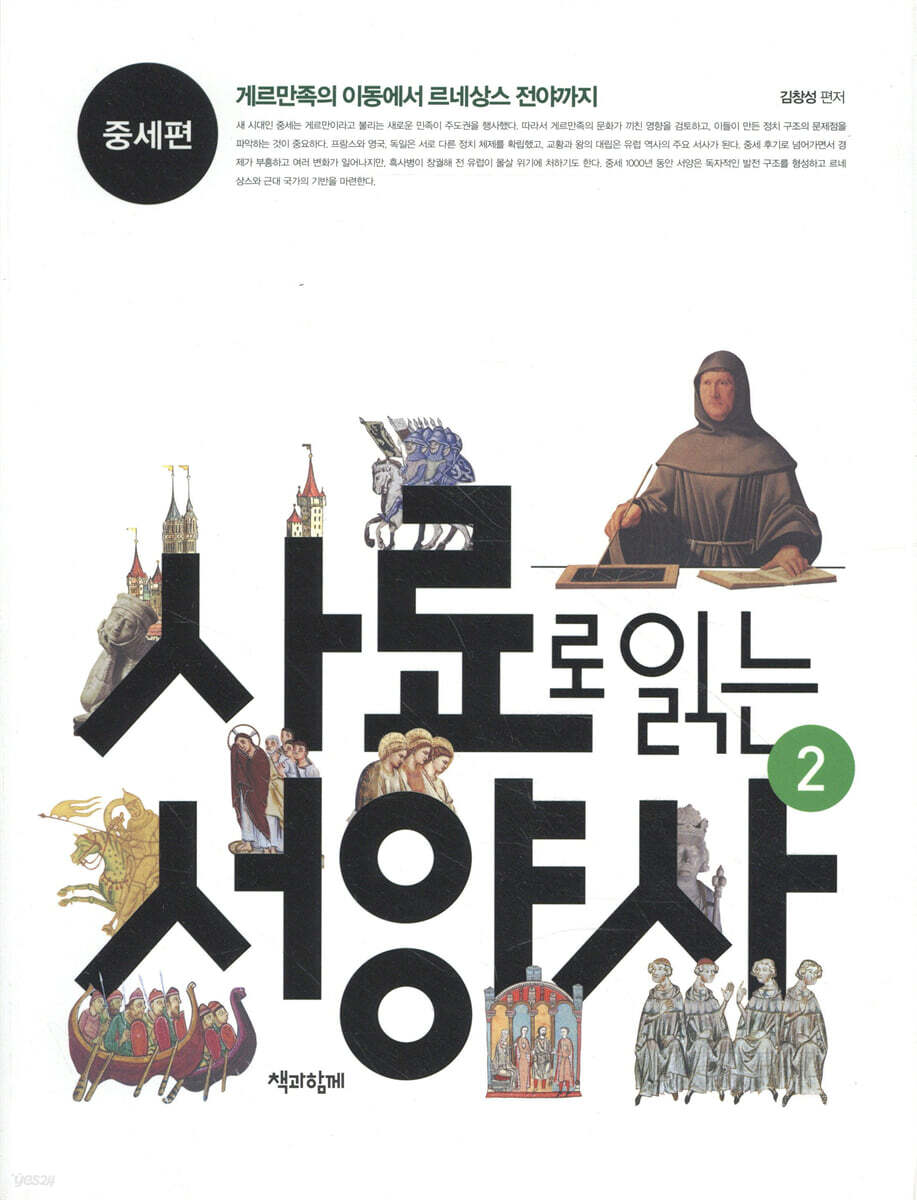
Western History Through Historical Materials 2: The Middle Ages
 |
Description
Book Introduction
From the migrations of the Germanic tribes to the dawn of the Renaissance, a comprehensive history of the Western Middle Ages in one volume.
The "Reading Western History through Historical Documents" series presents a wide range of historical materials, including not only commonly thought of literature but also sermons, wills, letters, inscriptions, and official documents.
For readers who wish to read Western history in depth and vividly, this book will serve as a guide, informing them of the resources available for studying Western history and how to approach them.
Furthermore, if used as teaching material for students, it will elevate the current Western history education to a new level.
It could be said that this series was created to arouse this kind of interest and curiosity.
Readers will realize that history is made up of historical materials, and will also learn how to handle these materials, allowing them to experience historical thinking.
In that respect, I am confident that the materials presented here will heighten the intellectual interest of the general public and serve as a source of historical insight and reflection.
The "Reading Western History through Historical Documents" series presents a wide range of historical materials, including not only commonly thought of literature but also sermons, wills, letters, inscriptions, and official documents.
For readers who wish to read Western history in depth and vividly, this book will serve as a guide, informing them of the resources available for studying Western history and how to approach them.
Furthermore, if used as teaching material for students, it will elevate the current Western history education to a new level.
It could be said that this series was created to arouse this kind of interest and curiosity.
Readers will realize that history is made up of historical materials, and will also learn how to handle these materials, allowing them to experience historical thinking.
In that respect, I am confident that the materials presented here will heighten the intellectual interest of the general public and serve as a source of historical insight and reflection.
- You can preview some of the book's contents.
Preview
index
Publishing the series
At the beginning of the book
Part 1: Society, Politics, and the Surroundings of the Early Middle Ages
1.
Germanic Society: Was It a Primitive Communist Society?
2.
The Migration of the Germanic Peoples: In Search of the Warm South
3.
Monarchy in the Early Middle Ages: The Franks Found a Kingdom
4.
The Development of Medieval Christianity: The Church's Search for Survival
5.
Byzantium: The Center of the World Economy
6.
Islam: One Faith for the World
Part 2: Feudalism and Agriculture
7.
The Basic Framework of Feudalism: Ideology or Reality?
8.
Family and Women: A Double Genealogy
9.
The Master-Servant System: From Servant to Nobleman
10.
Fiefs and the Land System: The Conflict Between Return and Hereditary Succession
11.
Agriculture: Agriculture is the foundation of feudalism.
12.
Interpretation and Perspective: Theory is a Tool
Part 3: The Development and Types of Feudal States
13.
France: A humble beginning
14.
England: Forming a ruling feudal state
15.
Germany: Backward or Special?
Part 4 Catholic Church
16.
Church Reform and the Investiture Struggle: The Struggle for Autonomy
17.
The Crusades: Mistakes Not to Be Repeated
18.
The Flowering of the Papacy: The Age of Innocent III
19.
The Decline of the Papacy: The Church as the Place of the Church
Part 5: The Maturity and Transition of Medieval Culture
20.
Thought and Education: The Birth of the University
21.
Architecture and Literature Aiming for Synthesis: The Ideal World of Medieval Man
22.
The Transformation of Rural Manors: The Foundations of Feudalism Shake
23.
Urban Development: Crisis as Opportunity
24.
Transition from the Middle Ages to the Modern Age: What Forces Drive History?
List of illustrations
Exploration problem
Search
At the beginning of the book
Part 1: Society, Politics, and the Surroundings of the Early Middle Ages
1.
Germanic Society: Was It a Primitive Communist Society?
2.
The Migration of the Germanic Peoples: In Search of the Warm South
3.
Monarchy in the Early Middle Ages: The Franks Found a Kingdom
4.
The Development of Medieval Christianity: The Church's Search for Survival
5.
Byzantium: The Center of the World Economy
6.
Islam: One Faith for the World
Part 2: Feudalism and Agriculture
7.
The Basic Framework of Feudalism: Ideology or Reality?
8.
Family and Women: A Double Genealogy
9.
The Master-Servant System: From Servant to Nobleman
10.
Fiefs and the Land System: The Conflict Between Return and Hereditary Succession
11.
Agriculture: Agriculture is the foundation of feudalism.
12.
Interpretation and Perspective: Theory is a Tool
Part 3: The Development and Types of Feudal States
13.
France: A humble beginning
14.
England: Forming a ruling feudal state
15.
Germany: Backward or Special?
Part 4 Catholic Church
16.
Church Reform and the Investiture Struggle: The Struggle for Autonomy
17.
The Crusades: Mistakes Not to Be Repeated
18.
The Flowering of the Papacy: The Age of Innocent III
19.
The Decline of the Papacy: The Church as the Place of the Church
Part 5: The Maturity and Transition of Medieval Culture
20.
Thought and Education: The Birth of the University
21.
Architecture and Literature Aiming for Synthesis: The Ideal World of Medieval Man
22.
The Transformation of Rural Manors: The Foundations of Feudalism Shake
23.
Urban Development: Crisis as Opportunity
24.
Transition from the Middle Ages to the Modern Age: What Forces Drive History?
List of illustrations
Exploration problem
Search
Into the book
Justinian I (527–565) succeeded his uncle Justin I as emperor.
Empress Theodora once worked as a dancer in a circus.
When Justinian was about to resign in fear of the riots, she dissuaded him and effectively suppressed the riots by mobilizing troops, allowing him to remain on the throne.
Therefore, if there had been no Theodora, there would have been no Emperor Justinian.
--- p.112
Source 01 Theodora's Persuasion _Procopius Caesarensis, History of Wars
The new concubine's opinion is as follows.
I'm not sure if it's safer to run away now than at any other time.
It's a bad time for that.
Once you are born as a human and see the light, it is inevitable that you will die.
But it is difficult to bear that the Emperor becomes a fugitive.
Please don't let me live any longer in a day when I will not be separated from the purple garment and when those who meet me will not call me Mama.
Your Majesty, if you wish to save yourself, it is not difficult.
Because we have a lot of money, we have the sea, and we have many ships.
But do you think that after His Majesty is safe, he will feel that it would be better to die?
As a concubine, I like the old saying, 'The throne is a good garment to wrap a corpse.'
---p.116
Works of Procopius Caesarensis: Procopius (500-565) was from Caesarea in present-day Israel. He served as a legal advisor to Justinian's general Belisarius and participated in several wars. He is considered the last great historian of antiquity, having left behind the works "History of Wars", "Secret History", and "The Architecture of Justinian".
In particular, he explained that the church was called ekklesia, meaning assembly, which was unfamiliar to classical Athens.
In particular, he viewed Justinian as a representative of God.
He also tried to write a history of the church, but failed.
---p.119
Muhammad, the founder of Islam, came from a prominent family in Mecca, but was extremely poor.
So, after managing the object of the older widow's love, he married her.
As a merchant, he was quite familiar with Judaism and Christianity, and it is said that he received the words of God Allah from the archangel Gabriel in a vision and wrote down the Quran. | Data 01 | Although he was illiterate to begin with, he wrote down the words under the archangel's instructions, creating the most beautiful piece of Arabic literature.
---p.122
Data 01 Muhammad Receiving Revelation in Medina _Quran, Surah 47
In the name of Allah, the Merciful, the Gracious.
Allah will nullify the deeds of those who disbelieve and turn others from His path.
As for those who have faith, do good deeds, and believe in what was revealed to Muhammad—for it is the truth from their Lord—Allah will forgive them their sins and ennoble their hearts.
This is because the disbelievers follow lies, while the believers follow the truth from their Lord.
(……) ---p.128
《Quran》: This name means 'the reading'.
The official name is 'Al-Quran al-Karim', which means 'The Noble Quran'.
The Quran was revealed to one person in one place over a period of 23 years in one language (Arabic).
Originally, the Quran was preserved through oral tradition and written records.
Muhammad's revelations continued in Mecca and Medina for 13 and 10 years respectively.
It was first compiled during the reign of the first caliph, Abu Bakr (reigned 632–634), after his death.
As variant manuscripts multiplied, Caliph Uthman ibn Affan had a precise manuscript made and the variants burned in 651.
It consists of 114 chapters and 6,200 verses.
Each chapter is called a "Sura." ---p.134
The movement to found convents was closely linked to the advancement of women's status.
From around 900 AD, it was common for sisters, widows, and daughters of kings and princes to become nuns without marrying.
In these cases, there were cases where a nun entered a convent with land and precious metals, lived there, and became the abbess, or founded a convent and gained social fame through good deeds.
The monastic movement can be seen as combining aristocratic tastes with religious training, with devotion, some learning, and discipline.
But the time has come to move beyond such passive evaluation.
In 2011, a German film titled “Vision” was produced that highlighted Sister Hildegard and was introduced in Korea under the title “The Great Revelation,” and research on her is also active.
He displayed his genius in many fields, not only creating and composing the first opera, but also showing outstanding talent in understanding the celestial bodies. |Data 06| The will is a testament to this woman's consciousness.
This allows us to examine medieval human relationships related to property.
---p.155
Material 06 A Medieval Nun Preaching _ Hildegard, "The Book of the Works of God"
The preface to the book 'On the Works of God' begins.
There were wonderful and true visions, which tormented me for five years, and in the sixth year after they had passed, a true vision of indescribable light presented to me, a very ignorant man, various customs.
It was a strange vision in its first year, and when I was sixty-five years old I had a vision so mysterious and powerful that I wish to tell you all about it.
… … For seven years I was almost exhausted writing about what such a great illusion was.
So in the year 1163 when the Lord was incarnated… …a voice was made from heaven.
(……) ---p.162
Material 07 The Will of a Medieval Woman _Joel T.
Rosenthal, ed., Understanding Medieval Primary Sources, 2012
Testator: Anastasu, widow of Nicolaus Carabello
Location: Crete, Venetian territory
Date: July 30, 1328
In the name of the everlasting God, Amen.
… … in Candia, Crete.
Since the time of life's end is unknown to all and nothing is more certain than the knowledge that we cannot escape death, we must all be careful to dispose of our earthly possessions.
Therefore, I, Anastasu, widow of Nicholas Garabello, a resident of Candia, being in good health and mind, and not wanting to die without making a will, I have called my secretary, Andrea de Bellamor, to write my will, in order to leave my estate in order.
I appoint as executors of my will Johannes Secreto, son of Lorenzo Secreto and my beloved nephew Rosa Secreto, and my beloved niece Anizza Fontarella, both of whom are inhabitants of Candia, to carry out my wishes after my death.
First, I leave fifty ephemeras for my soul, which I will give to those who are in prison for debt, five or six ephemeras to each prisoner.
(……)
I demand and command that the legacies mentioned above be distributed within nine days after my death.
I also demand that all my Massaria (household goods), that is, my blankets, linens, large pots, and everything else in my house, except gold and silver or money, be divided equally between my nephews, John the Secretor and Marcus the Secretor.
… … [I give my executors the power to act on my behalf after my death, and I stipulate that this will is final.]
… … I, Nicholas de Alexandrio, as a witness, have signed this [with the sign of the cross].
… … I, Johannes Alexander, as a witness, have signed this [also making the sign of the cross].
[Notary Public Signature] I, Andreas de Bellamor, have completed and notarized this [document].
---p.164
Hildegard's works: Hildegard (1098-1179) was of noble birth, educated at the Benedictine convent in Bodenberg, and became abbess.
Having had visions since childhood, she was allowed to reveal them and record them at the age of 43.
He left behind three books: Scibias (1141-1152), The Responsible Man (1163-1173), and The Book of the Works of God (1163-1173).
---p.167
Medieval Wills: These wills have been in use since the 13th century.
Church jurists and government authorities allowed legally independent people to make wills, which became common in the 14th and 15th centuries.
A will not only reveals the inner desires of an individual testator, but also reveals the relationship between the testator and his or her family and friends.
It is especially important to read it in the context of the times.
---p.167
Broadly speaking, the relationship between a lord and a vassal was a bilateral contractual relationship.
Entering into a bilateral contract confirms that the contracting parties are free persons and share the same status as warriors.
Therefore, it is necessary to recognize that the relationship between a lord and his vassal is not the Eastern monarch-subject relationship, but rather a contractual one. | Data 04 | ---p.171
Material 04 Letters of Fulbert of Chartres: The Duties of the Vassal and the Lord _ James Harvey Robinson, edited, Selected Sources of European History Vol.
1,
Those who swear loyalty to their lord must always remember six things.
That is, what is harmless, safe, honorable, beneficial, easy, and practical.
Non-harmful means that the vassal must not personally harm his lord.
The safe thing is that a vassal must not harm his lord by revealing his secrets or by betraying the defenses upon which his lord relies for safety.
Honor means that one should not harm one's lord in his lawsuit or in any other matter that concerns his lord's honor.
(……)
The lord must also act in all these matters in return for his loyal vassal's actions.
And if the lord does not do this, it is justly to be held that the lord is guilty of perjury, just as if the vassal were found to have shied away from his duty, or consented to shied away from it, he would be considered unfaithful and perjured.
---p.171
Letter of Fulbert of Chartres: A letter sent in 1020 by Bishop Fulbert of Chartres to Duke William of Aquitaine reveals the general rules of feudalism.
According to this letter, the relationship between lord and vassal was bilateral. ---p.179
The first full-scale crusade was the expedition to Palestine.
The Byzantine Empire lost major parts of Asia to the Seljuk Turks.
The Byzantine emperor, growing anxious, requested that relief troops be sent to Western Europe.
Although relations with Western Europe were not smooth, the Byzantine emperor regarded Islam as a common enemy and proposed that they fight together.
In 1095, the Pope of Rome preached the necessity of a crusade at a council held in Clermont. |Data 01| After this, many preachers traveled around and encouraged the crusade.
---p.318
Data 01 Urban II calls for a crusade at Clermont _François Guizot, 《Collected Documents on French History》 24:3-9
Dear brothers, Jim Urban, by God's permission, has received the Papal Triple Crown and the title of spiritual leader for the entire world, and has come to you, God's servants, to bring you God's warning in this time of great crisis.
… … Oh, sons of God, you who have been newly stirred by this divine correction still have a very urgent task ahead of you, for you have promised the Lord more earnestly than before to keep the peace and to uphold the rights of the Holy Church with loyalty.
… … We must urgently provide aid to our brothers in the East who need your help.
That's what they often asked for.
The [Seljuk] Turks, as some of you already know, attacked them.
… … Therefore, Jim asks you to pray the following with reverent sincerity:
… … That is, as heralds of Christ, you must frequently exhort people, urging all classes of people, knights and soldiers, rich and poor, to expedite the extermination of the vile race from your brother’s lands and to assist the [Orthodox] Christians accordingly.
… … If those who set out there lose their lives on the way, on land or sea or in battle with the pagans, their sins will be forgiven.
I grant this through the power God has given me.
― Chapter 17, page 323 (Reading Materials)
Urban's Sermon: A sermon by the Pope recorded by Fulcher of Chartres in 1095.
In this sermon, the Pope argues that the feudal states should overcome their conflicts and join forces to attack Islam.
---p.336
Despite the diverse origins of urban development, medieval cities shared some fundamental common characteristics.
It was a group that enjoyed autonomy and freedom.
The most representative way to enjoy autonomy and freedom in the city was to buy freedom.
There were ways to buy freedom by giving a large sum of money at once or by paying a certain amount of taxes, and there were also cases where lords developed cities to regularly raise tax revenue.
And there were cases where medieval townspeople joined forces to attack weaker lords and forcefully win their freedom.
Therefore, the freedom of the city was not something that was simply obtained, but was exchanged for life, and because it was bought with money, it could be seen as the most precious thing.
The city's charter is what confirms the city's status. |Data 02| - Chapter 23, page 450 (main text)
Data 02 Loris's Freedom Patent _John L.
Beatty Oliver A.
Johnson, The Heritage of Western Civilization
1.
Anyone who owns a house in the parish of Loris will be required to pay a tax of six deniers on their house alone.
And let him do so for every acre of farmland he may have in this parish, and let that amount be the immunity zone of his house if he acquires it.
2.
No resident of the parish of Loris shall pay any entrance fee or any tax on his provisions.
And he shall not pay taxes on the grain he obtains by his own labor or by the beasts he possesses.
And he will not pay taxes on the wine he produces from his vineyard.
3.
No one among the inhabitants shall go on foot or on horseback to join the army unless he can return home on the same day if he so desires.
5.
Anyone who has property in the parish of Loris shall not lose it if he commits any illegal act, unless it is done to himself or his guests.
9.
No one shall receive taxes, donations, or extortions from the people of Loris, whether we or others.
(……) ---p.461
Charter of Liberty of Loris: This charter was granted to Loris, a small town in north-central France, by Louis VII in 1155.
Historically, this document is important.
Because it has served as an exemplary role model for numerous city patent offices since then.
Empress Theodora once worked as a dancer in a circus.
When Justinian was about to resign in fear of the riots, she dissuaded him and effectively suppressed the riots by mobilizing troops, allowing him to remain on the throne.
Therefore, if there had been no Theodora, there would have been no Emperor Justinian.
--- p.112
Source 01 Theodora's Persuasion _Procopius Caesarensis, History of Wars
The new concubine's opinion is as follows.
I'm not sure if it's safer to run away now than at any other time.
It's a bad time for that.
Once you are born as a human and see the light, it is inevitable that you will die.
But it is difficult to bear that the Emperor becomes a fugitive.
Please don't let me live any longer in a day when I will not be separated from the purple garment and when those who meet me will not call me Mama.
Your Majesty, if you wish to save yourself, it is not difficult.
Because we have a lot of money, we have the sea, and we have many ships.
But do you think that after His Majesty is safe, he will feel that it would be better to die?
As a concubine, I like the old saying, 'The throne is a good garment to wrap a corpse.'
---p.116
Works of Procopius Caesarensis: Procopius (500-565) was from Caesarea in present-day Israel. He served as a legal advisor to Justinian's general Belisarius and participated in several wars. He is considered the last great historian of antiquity, having left behind the works "History of Wars", "Secret History", and "The Architecture of Justinian".
In particular, he explained that the church was called ekklesia, meaning assembly, which was unfamiliar to classical Athens.
In particular, he viewed Justinian as a representative of God.
He also tried to write a history of the church, but failed.
---p.119
Muhammad, the founder of Islam, came from a prominent family in Mecca, but was extremely poor.
So, after managing the object of the older widow's love, he married her.
As a merchant, he was quite familiar with Judaism and Christianity, and it is said that he received the words of God Allah from the archangel Gabriel in a vision and wrote down the Quran. | Data 01 | Although he was illiterate to begin with, he wrote down the words under the archangel's instructions, creating the most beautiful piece of Arabic literature.
---p.122
Data 01 Muhammad Receiving Revelation in Medina _Quran, Surah 47
In the name of Allah, the Merciful, the Gracious.
Allah will nullify the deeds of those who disbelieve and turn others from His path.
As for those who have faith, do good deeds, and believe in what was revealed to Muhammad—for it is the truth from their Lord—Allah will forgive them their sins and ennoble their hearts.
This is because the disbelievers follow lies, while the believers follow the truth from their Lord.
(……) ---p.128
《Quran》: This name means 'the reading'.
The official name is 'Al-Quran al-Karim', which means 'The Noble Quran'.
The Quran was revealed to one person in one place over a period of 23 years in one language (Arabic).
Originally, the Quran was preserved through oral tradition and written records.
Muhammad's revelations continued in Mecca and Medina for 13 and 10 years respectively.
It was first compiled during the reign of the first caliph, Abu Bakr (reigned 632–634), after his death.
As variant manuscripts multiplied, Caliph Uthman ibn Affan had a precise manuscript made and the variants burned in 651.
It consists of 114 chapters and 6,200 verses.
Each chapter is called a "Sura." ---p.134
The movement to found convents was closely linked to the advancement of women's status.
From around 900 AD, it was common for sisters, widows, and daughters of kings and princes to become nuns without marrying.
In these cases, there were cases where a nun entered a convent with land and precious metals, lived there, and became the abbess, or founded a convent and gained social fame through good deeds.
The monastic movement can be seen as combining aristocratic tastes with religious training, with devotion, some learning, and discipline.
But the time has come to move beyond such passive evaluation.
In 2011, a German film titled “Vision” was produced that highlighted Sister Hildegard and was introduced in Korea under the title “The Great Revelation,” and research on her is also active.
He displayed his genius in many fields, not only creating and composing the first opera, but also showing outstanding talent in understanding the celestial bodies. |Data 06| The will is a testament to this woman's consciousness.
This allows us to examine medieval human relationships related to property.
---p.155
Material 06 A Medieval Nun Preaching _ Hildegard, "The Book of the Works of God"
The preface to the book 'On the Works of God' begins.
There were wonderful and true visions, which tormented me for five years, and in the sixth year after they had passed, a true vision of indescribable light presented to me, a very ignorant man, various customs.
It was a strange vision in its first year, and when I was sixty-five years old I had a vision so mysterious and powerful that I wish to tell you all about it.
… … For seven years I was almost exhausted writing about what such a great illusion was.
So in the year 1163 when the Lord was incarnated… …a voice was made from heaven.
(……) ---p.162
Material 07 The Will of a Medieval Woman _Joel T.
Rosenthal, ed., Understanding Medieval Primary Sources, 2012
Testator: Anastasu, widow of Nicolaus Carabello
Location: Crete, Venetian territory
Date: July 30, 1328
In the name of the everlasting God, Amen.
… … in Candia, Crete.
Since the time of life's end is unknown to all and nothing is more certain than the knowledge that we cannot escape death, we must all be careful to dispose of our earthly possessions.
Therefore, I, Anastasu, widow of Nicholas Garabello, a resident of Candia, being in good health and mind, and not wanting to die without making a will, I have called my secretary, Andrea de Bellamor, to write my will, in order to leave my estate in order.
I appoint as executors of my will Johannes Secreto, son of Lorenzo Secreto and my beloved nephew Rosa Secreto, and my beloved niece Anizza Fontarella, both of whom are inhabitants of Candia, to carry out my wishes after my death.
First, I leave fifty ephemeras for my soul, which I will give to those who are in prison for debt, five or six ephemeras to each prisoner.
(……)
I demand and command that the legacies mentioned above be distributed within nine days after my death.
I also demand that all my Massaria (household goods), that is, my blankets, linens, large pots, and everything else in my house, except gold and silver or money, be divided equally between my nephews, John the Secretor and Marcus the Secretor.
… … [I give my executors the power to act on my behalf after my death, and I stipulate that this will is final.]
… … I, Nicholas de Alexandrio, as a witness, have signed this [with the sign of the cross].
… … I, Johannes Alexander, as a witness, have signed this [also making the sign of the cross].
[Notary Public Signature] I, Andreas de Bellamor, have completed and notarized this [document].
---p.164
Hildegard's works: Hildegard (1098-1179) was of noble birth, educated at the Benedictine convent in Bodenberg, and became abbess.
Having had visions since childhood, she was allowed to reveal them and record them at the age of 43.
He left behind three books: Scibias (1141-1152), The Responsible Man (1163-1173), and The Book of the Works of God (1163-1173).
---p.167
Medieval Wills: These wills have been in use since the 13th century.
Church jurists and government authorities allowed legally independent people to make wills, which became common in the 14th and 15th centuries.
A will not only reveals the inner desires of an individual testator, but also reveals the relationship between the testator and his or her family and friends.
It is especially important to read it in the context of the times.
---p.167
Broadly speaking, the relationship between a lord and a vassal was a bilateral contractual relationship.
Entering into a bilateral contract confirms that the contracting parties are free persons and share the same status as warriors.
Therefore, it is necessary to recognize that the relationship between a lord and his vassal is not the Eastern monarch-subject relationship, but rather a contractual one. | Data 04 | ---p.171
Material 04 Letters of Fulbert of Chartres: The Duties of the Vassal and the Lord _ James Harvey Robinson, edited, Selected Sources of European History Vol.
1,
Those who swear loyalty to their lord must always remember six things.
That is, what is harmless, safe, honorable, beneficial, easy, and practical.
Non-harmful means that the vassal must not personally harm his lord.
The safe thing is that a vassal must not harm his lord by revealing his secrets or by betraying the defenses upon which his lord relies for safety.
Honor means that one should not harm one's lord in his lawsuit or in any other matter that concerns his lord's honor.
(……)
The lord must also act in all these matters in return for his loyal vassal's actions.
And if the lord does not do this, it is justly to be held that the lord is guilty of perjury, just as if the vassal were found to have shied away from his duty, or consented to shied away from it, he would be considered unfaithful and perjured.
---p.171
Letter of Fulbert of Chartres: A letter sent in 1020 by Bishop Fulbert of Chartres to Duke William of Aquitaine reveals the general rules of feudalism.
According to this letter, the relationship between lord and vassal was bilateral. ---p.179
The first full-scale crusade was the expedition to Palestine.
The Byzantine Empire lost major parts of Asia to the Seljuk Turks.
The Byzantine emperor, growing anxious, requested that relief troops be sent to Western Europe.
Although relations with Western Europe were not smooth, the Byzantine emperor regarded Islam as a common enemy and proposed that they fight together.
In 1095, the Pope of Rome preached the necessity of a crusade at a council held in Clermont. |Data 01| After this, many preachers traveled around and encouraged the crusade.
---p.318
Data 01 Urban II calls for a crusade at Clermont _François Guizot, 《Collected Documents on French History》 24:3-9
Dear brothers, Jim Urban, by God's permission, has received the Papal Triple Crown and the title of spiritual leader for the entire world, and has come to you, God's servants, to bring you God's warning in this time of great crisis.
… … Oh, sons of God, you who have been newly stirred by this divine correction still have a very urgent task ahead of you, for you have promised the Lord more earnestly than before to keep the peace and to uphold the rights of the Holy Church with loyalty.
… … We must urgently provide aid to our brothers in the East who need your help.
That's what they often asked for.
The [Seljuk] Turks, as some of you already know, attacked them.
… … Therefore, Jim asks you to pray the following with reverent sincerity:
… … That is, as heralds of Christ, you must frequently exhort people, urging all classes of people, knights and soldiers, rich and poor, to expedite the extermination of the vile race from your brother’s lands and to assist the [Orthodox] Christians accordingly.
… … If those who set out there lose their lives on the way, on land or sea or in battle with the pagans, their sins will be forgiven.
I grant this through the power God has given me.
― Chapter 17, page 323 (Reading Materials)
Urban's Sermon: A sermon by the Pope recorded by Fulcher of Chartres in 1095.
In this sermon, the Pope argues that the feudal states should overcome their conflicts and join forces to attack Islam.
---p.336
Despite the diverse origins of urban development, medieval cities shared some fundamental common characteristics.
It was a group that enjoyed autonomy and freedom.
The most representative way to enjoy autonomy and freedom in the city was to buy freedom.
There were ways to buy freedom by giving a large sum of money at once or by paying a certain amount of taxes, and there were also cases where lords developed cities to regularly raise tax revenue.
And there were cases where medieval townspeople joined forces to attack weaker lords and forcefully win their freedom.
Therefore, the freedom of the city was not something that was simply obtained, but was exchanged for life, and because it was bought with money, it could be seen as the most precious thing.
The city's charter is what confirms the city's status. |Data 02| - Chapter 23, page 450 (main text)
Data 02 Loris's Freedom Patent _John L.
Beatty Oliver A.
Johnson, The Heritage of Western Civilization
1.
Anyone who owns a house in the parish of Loris will be required to pay a tax of six deniers on their house alone.
And let him do so for every acre of farmland he may have in this parish, and let that amount be the immunity zone of his house if he acquires it.
2.
No resident of the parish of Loris shall pay any entrance fee or any tax on his provisions.
And he shall not pay taxes on the grain he obtains by his own labor or by the beasts he possesses.
And he will not pay taxes on the wine he produces from his vineyard.
3.
No one among the inhabitants shall go on foot or on horseback to join the army unless he can return home on the same day if he so desires.
5.
Anyone who has property in the parish of Loris shall not lose it if he commits any illegal act, unless it is done to himself or his guests.
9.
No one shall receive taxes, donations, or extortions from the people of Loris, whether we or others.
(……) ---p.461
Charter of Liberty of Loris: This charter was granted to Loris, a small town in north-central France, by Louis VII in 1155.
Historically, this document is important.
Because it has served as an exemplary role model for numerous city patent offices since then.
---p.472
Publisher's Review
“Primary sources are to historians what molecules are to chemists.
“Just as chemists combine molecules to study the properties of matter, historians use historical records to study the past.”
Readers of the past were mainly satisfied with reading 'secondary things' that historians interpreted and wrote based on historical materials.
However, recently, there has been a growing number of readers who want to read history more vividly by directly accessing the historical materials used by historians and understanding their intentions.
Furthermore, it can be said that the basic qualifications of a historical researcher are to be able to understand and utilize the historical materials that serve as the basis for many translated or written works and the foundation for historical studies. In addition, if students are to achieve the educational goal of creativity and convergence, they must boldly and actively participate in classes through research and presentation of materials.
Although such in-depth research and self-directed classes require a lot of materials, the reality is not conducive to this.
Conversely, the free information that is irresponsibly distributed on the Internet kills the creativity of researchers and undermines the trust of educators.
The first collection of Western historical materials published in Korea
To improve this reality even a little, a collection of historical materials directly selected and written by specialized researchers is essential.
In the West, this work has been carried out in a variety of ways, resulting in the publication of many historical collections. In Korea, several historical collections have been published, but they are limited to the field of Korean history.
Western historical sources written in various languages have presented a practical challenge in that they are not easily accessible to anyone other than professional historical researchers due to language and content barriers.
However, we cannot simply translate and use Western historical sources.
It is absolutely necessary to reconstruct, appropriately interpret, and present the material with appropriate explanations to suit our environment and educational goals.
Following the thorough work of collecting and selecting materials and adding references and explanations, the second volume, “Medieval Times,” was published following the first volume, “Ancient Times,” and the “Modern Times” and “Contemporary Times” are also scheduled to be published in succession.
The "Western History Through Historical Materials" series, which covers Western history from ancient times to the 20th century, will be a valuable reference for readers seeking in-depth historical study.
A First Step to Vivid and Critical Historical Thinking
As recent discussions about what constitutes historical fact have shown, how we view historical materials can influence not only the content of history but also our historical consciousness.
Perhaps because our historical community has been so focused on the level of general knowledge that it must first know the facts, many translated or original books have been published, but they have not raised any questions about the historical sources that serve as their foundation, and have simply accepted them, riding on the wave of fame.
Therefore, the significance of this series lies in presenting the sources that form the basis of these writings and providing readers with the opportunity to make judgments based on those sources.
Moreover, studying history by reading and understanding historical materials stimulates, above all, the desire to explore.
Reading historical materials can lead to unexpected information, and seeing how history flows in unexpected directions can spark a different kind of curiosity than what you get from studying mathematics or science.
It could be said that this series was created to arouse this kind of interest and curiosity.
Readers will realize that history is made up of historical materials, and will also learn how to handle these materials, allowing them to experience historical thinking.
In that respect, I am confident that the materials presented here will heighten the intellectual interest of the general public and serve as a source of historical insight and reflection.
A general history of Western history centered on historical sources and their interpretation
You don't necessarily have to read this book from beginning to end.
Readers who wish to read a brief overview of Western history will be able to grasp the flow of Western history simply by reading the text of each chapter.
Readers who wish to conduct more in-depth research can refer to 'Reading Materials' and, if necessary, find more materials through the references and sources.
The "Reading Western History through Historical Materials" series, which presents a wide range of historical materials, including not only commonly thought of literature but also sermons, wills, letters, inscriptions, and official documents, will serve as a guide for readers who want to read Western history in depth and vividly, informing them of what materials are available for studying Western history and how to approach these materials. Furthermore, if used as teaching materials for students, it is expected to elevate the current education of Western history to a new level.
Main contents of "Western History through Historical Materials 2: The Middle Ages"
Part 1: Society, Politics, and the Surroundings of the Early Middle Ages
The Middle Ages were dominated by a new people called the Germans.
Although the Germanic peoples were a minority in population when they entered the Roman Empire, they gave birth to a new political system.
The obstacles they had to overcome were enormous, especially the agreement on the roles of religion and politics, which would determine the fate of Europe.
The Byzantine Empire was the direct successor to the Roman Empire, and Islam, adding Egyptian and Persian traditions to the legacy of ancient Greece, developed its own unique civilization and swept the Christian world in one fell swoop.
And Europe, which had been a backward society, grew by accepting the advanced civilizations of Byzantium and Islam.
Part 2: Feudalism and Agriculture
Those in power naturally dream of a centralized system like the Roman Empire, but this is a difficult task to achieve.
Before centralization, the principle that maintained order and supported society was feudalism.
What were the principles and specific operating methods of the feudal system that operated for a thousand years?
We examine the reality and development of the family system, the feudal system, the master-servant system, and the agricultural system that made feudalism possible and ultimately led to its dissolution.
Part 3: The Development and Types of Feudal States
France, a representative country of the Middle Ages, overcame feudal divisions and achieved absolute monarchy, while England, which had been a centralized country with power concentrated in the king from the beginning, developed into a feudal state under the influence of France.
However, unlike France, England took the path of victory for the nobility and the establishment of a parliamentary system.
Meanwhile, Germany, which was in a state of complete feudal fragmentation, tried to break free from the state of fragmentation, but failed to achieve that dream throughout the Middle Ages and moved toward a state of territorial sovereignty.
Part 4 Catholic Church
The Vatican was a real state that ruled central Italy during the Middle Ages, and the Holy See established itself as a modern state earlier than the feudal states.
However, the task of maintaining one's independence from the secular world with a weak power in a state without military force was not an easy one.
The conflicts and compromises that this situation produced soon became a major narrative in European history.
It also strives to maintain its orthodoxy and independence amidst various challenges and changes, such as the Crusades, the corruption and reform movements of the church, conflict with the royal authority, and the spread of heresy.
Culturally, the Catholic Church's efforts to spread the faith established universalism in Western European society.
In other words, a single faith, a single Bible, and a single script were established, which formed the basis of Western civilization.
Part 5: The Maturity and Transition of Medieval Culture
As the Middle Ages progressed into the later period, Europe experienced various changes, notable among which were the development of agriculture and cities, economic revival, the birth of universities, and the emergence of new artistic styles.
However, the spread of the Black Death brought all of Europe to the brink of destruction.
After the plague swept through Europe, it experienced a revival and entered a new turning point called the Renaissance and Modernism.
“Just as chemists combine molecules to study the properties of matter, historians use historical records to study the past.”
Readers of the past were mainly satisfied with reading 'secondary things' that historians interpreted and wrote based on historical materials.
However, recently, there has been a growing number of readers who want to read history more vividly by directly accessing the historical materials used by historians and understanding their intentions.
Furthermore, it can be said that the basic qualifications of a historical researcher are to be able to understand and utilize the historical materials that serve as the basis for many translated or written works and the foundation for historical studies. In addition, if students are to achieve the educational goal of creativity and convergence, they must boldly and actively participate in classes through research and presentation of materials.
Although such in-depth research and self-directed classes require a lot of materials, the reality is not conducive to this.
Conversely, the free information that is irresponsibly distributed on the Internet kills the creativity of researchers and undermines the trust of educators.
The first collection of Western historical materials published in Korea
To improve this reality even a little, a collection of historical materials directly selected and written by specialized researchers is essential.
In the West, this work has been carried out in a variety of ways, resulting in the publication of many historical collections. In Korea, several historical collections have been published, but they are limited to the field of Korean history.
Western historical sources written in various languages have presented a practical challenge in that they are not easily accessible to anyone other than professional historical researchers due to language and content barriers.
However, we cannot simply translate and use Western historical sources.
It is absolutely necessary to reconstruct, appropriately interpret, and present the material with appropriate explanations to suit our environment and educational goals.
Following the thorough work of collecting and selecting materials and adding references and explanations, the second volume, “Medieval Times,” was published following the first volume, “Ancient Times,” and the “Modern Times” and “Contemporary Times” are also scheduled to be published in succession.
The "Western History Through Historical Materials" series, which covers Western history from ancient times to the 20th century, will be a valuable reference for readers seeking in-depth historical study.
A First Step to Vivid and Critical Historical Thinking
As recent discussions about what constitutes historical fact have shown, how we view historical materials can influence not only the content of history but also our historical consciousness.
Perhaps because our historical community has been so focused on the level of general knowledge that it must first know the facts, many translated or original books have been published, but they have not raised any questions about the historical sources that serve as their foundation, and have simply accepted them, riding on the wave of fame.
Therefore, the significance of this series lies in presenting the sources that form the basis of these writings and providing readers with the opportunity to make judgments based on those sources.
Moreover, studying history by reading and understanding historical materials stimulates, above all, the desire to explore.
Reading historical materials can lead to unexpected information, and seeing how history flows in unexpected directions can spark a different kind of curiosity than what you get from studying mathematics or science.
It could be said that this series was created to arouse this kind of interest and curiosity.
Readers will realize that history is made up of historical materials, and will also learn how to handle these materials, allowing them to experience historical thinking.
In that respect, I am confident that the materials presented here will heighten the intellectual interest of the general public and serve as a source of historical insight and reflection.
A general history of Western history centered on historical sources and their interpretation
You don't necessarily have to read this book from beginning to end.
Readers who wish to read a brief overview of Western history will be able to grasp the flow of Western history simply by reading the text of each chapter.
Readers who wish to conduct more in-depth research can refer to 'Reading Materials' and, if necessary, find more materials through the references and sources.
The "Reading Western History through Historical Materials" series, which presents a wide range of historical materials, including not only commonly thought of literature but also sermons, wills, letters, inscriptions, and official documents, will serve as a guide for readers who want to read Western history in depth and vividly, informing them of what materials are available for studying Western history and how to approach these materials. Furthermore, if used as teaching materials for students, it is expected to elevate the current education of Western history to a new level.
Main contents of "Western History through Historical Materials 2: The Middle Ages"
Part 1: Society, Politics, and the Surroundings of the Early Middle Ages
The Middle Ages were dominated by a new people called the Germans.
Although the Germanic peoples were a minority in population when they entered the Roman Empire, they gave birth to a new political system.
The obstacles they had to overcome were enormous, especially the agreement on the roles of religion and politics, which would determine the fate of Europe.
The Byzantine Empire was the direct successor to the Roman Empire, and Islam, adding Egyptian and Persian traditions to the legacy of ancient Greece, developed its own unique civilization and swept the Christian world in one fell swoop.
And Europe, which had been a backward society, grew by accepting the advanced civilizations of Byzantium and Islam.
Part 2: Feudalism and Agriculture
Those in power naturally dream of a centralized system like the Roman Empire, but this is a difficult task to achieve.
Before centralization, the principle that maintained order and supported society was feudalism.
What were the principles and specific operating methods of the feudal system that operated for a thousand years?
We examine the reality and development of the family system, the feudal system, the master-servant system, and the agricultural system that made feudalism possible and ultimately led to its dissolution.
Part 3: The Development and Types of Feudal States
France, a representative country of the Middle Ages, overcame feudal divisions and achieved absolute monarchy, while England, which had been a centralized country with power concentrated in the king from the beginning, developed into a feudal state under the influence of France.
However, unlike France, England took the path of victory for the nobility and the establishment of a parliamentary system.
Meanwhile, Germany, which was in a state of complete feudal fragmentation, tried to break free from the state of fragmentation, but failed to achieve that dream throughout the Middle Ages and moved toward a state of territorial sovereignty.
Part 4 Catholic Church
The Vatican was a real state that ruled central Italy during the Middle Ages, and the Holy See established itself as a modern state earlier than the feudal states.
However, the task of maintaining one's independence from the secular world with a weak power in a state without military force was not an easy one.
The conflicts and compromises that this situation produced soon became a major narrative in European history.
It also strives to maintain its orthodoxy and independence amidst various challenges and changes, such as the Crusades, the corruption and reform movements of the church, conflict with the royal authority, and the spread of heresy.
Culturally, the Catholic Church's efforts to spread the faith established universalism in Western European society.
In other words, a single faith, a single Bible, and a single script were established, which formed the basis of Western civilization.
Part 5: The Maturity and Transition of Medieval Culture
As the Middle Ages progressed into the later period, Europe experienced various changes, notable among which were the development of agriculture and cities, economic revival, the birth of universities, and the emergence of new artistic styles.
However, the spread of the Black Death brought all of Europe to the brink of destruction.
After the plague swept through Europe, it experienced a revival and entered a new turning point called the Renaissance and Modernism.
GOODS SPECIFICS
- Date of issue: July 20, 2014
- Page count, weight, size: 507 pages | 1,036g | 188*254*24mm
- ISBN13: 9788997735440
- ISBN10: 8997735446
You may also like
카테고리
korean


korean

![GQ KOREA Mark (Monthly): December [2025]](http://librairie.coreenne.fr/cdn/shop/files/8ef265dbbfbf186523ed75ba7319009d.jpg?v=1765340328&width=3840)


