

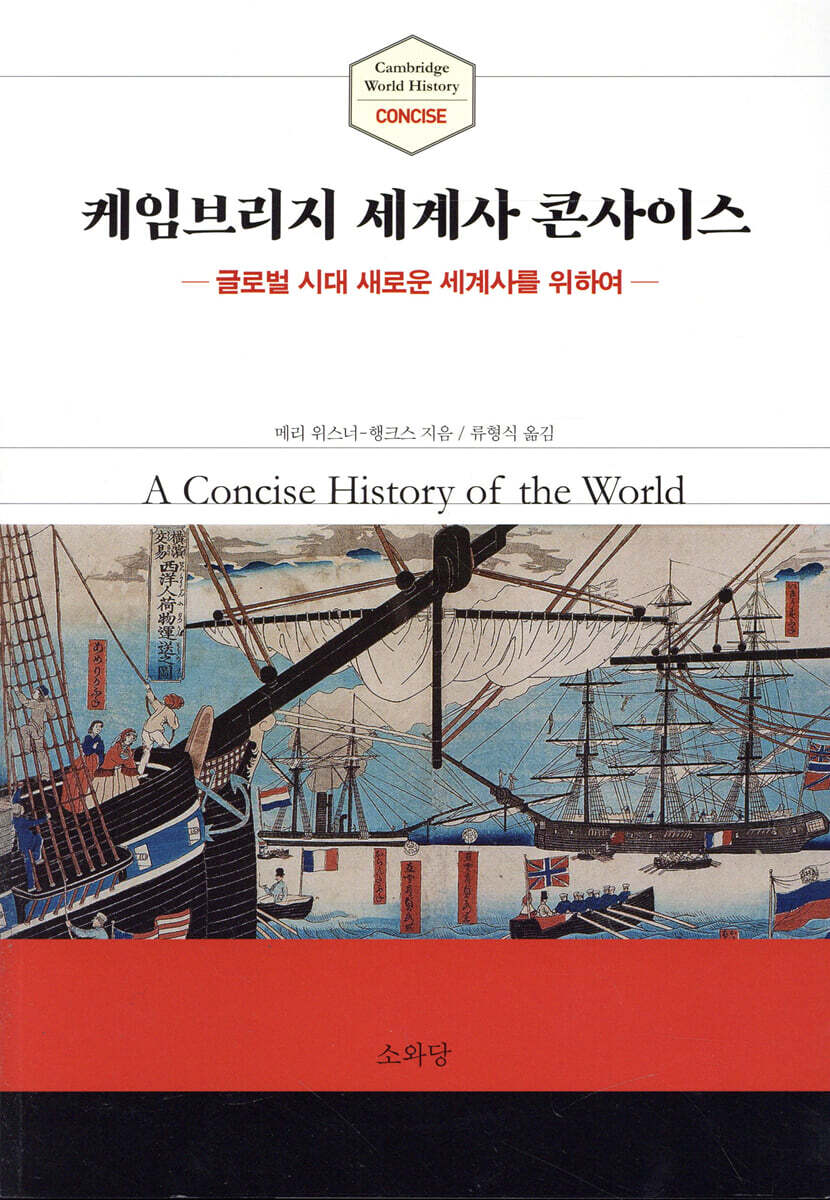
Cambridge Concise of World History
 |
Description
Book Introduction
For a new world history in the global era
For a new world history in the global era, world history in the global era must also change.
It has been over half a century since criticism of Western-centric world history began.
After the end of the Cold War between the United States and the Soviet Union, that voice grew louder.
Big History, Earth History, and other works from around the world have presented new alternatives to world history.
Finally, an opportunity has been created to comprehensively organize new attempts.
The University of Cambridge has planned a massive world history series, featuring the work of over 200 leading scholars from around the world. (A Korean edition will be published next year.)
This book is an overview of the series, written by the series' general editor.
That's why the word "concise" was added to the title.
The new direction of world history presented in Cambridge World History is relatively simple.
The idea is to look at world history from the perspective of women and culture, rather than politics or war.
The secrets of cooking and food, rather than the secrets of weapons or strategy, and the secrets of raising children, rather than the secrets of power struggles, should be brought to the forefront of world history.
That is the core of the new world history in the global era.
What kind of stories will unfold?
For a new world history in the global era, world history in the global era must also change.
It has been over half a century since criticism of Western-centric world history began.
After the end of the Cold War between the United States and the Soviet Union, that voice grew louder.
Big History, Earth History, and other works from around the world have presented new alternatives to world history.
Finally, an opportunity has been created to comprehensively organize new attempts.
The University of Cambridge has planned a massive world history series, featuring the work of over 200 leading scholars from around the world. (A Korean edition will be published next year.)
This book is an overview of the series, written by the series' general editor.
That's why the word "concise" was added to the title.
The new direction of world history presented in Cambridge World History is relatively simple.
The idea is to look at world history from the perspective of women and culture, rather than politics or war.
The secrets of cooking and food, rather than the secrets of weapons or strategy, and the secrets of raising children, rather than the secrets of power struggles, should be brought to the forefront of world history.
That is the core of the new world history in the global era.
What kind of stories will unfold?
Publisher's Review
A global era, a world history encompassing the entire planet
There is no world history major in the history department of any university in the world.
Even if you major in Chinese history, British history, medieval history, or modern history, world history is not recognized as a major.
This is because modern historiography itself is a historical research system for each country.
In today's world, where information is exchanged almost in real time around the world, it is becoming increasingly difficult to capture reality within the framework of modern historiography.
The new world history began by criticizing the limitations of existing historiography.
In recent decades, numerous frames have been discussed, including Big History, Earth History, Global History, and Transnational History.
Although the direction and scope of the content pursued by each are diverse, the common goal is to describe a world history that encompasses the entire Earth, a world history that fairly evaluates all regions and races, rather than being centered on Europe and white people.
World history centered on social culture, including family and food
The direction suggested by Cambridge World History is cultural history.
Cultural history covers so many fields.
Topics such as labor, family, women, gender, sexuality, children, material culture, the body, identity, ethnicity, consumption, etc. all belong to cultural history.
But what is clear is that history is not written with a focus on politics or heroes.
The genealogy of kings, empires, or kingdoms does not represent history.
Rather, topics much closer to real life, such as family life, changes in food over time, and the origins and development of gender discrimination, come to the forefront of history.
Is it possible to truly describe a syntactic history while encompassing such a vast spectrum? That's why the Cambridge World History, focusing on cultural history, is often seen as a challenge.
An introductory book introducing a vast series
Cambridge University Press in the UK has been publishing a series of extensive introductory books covering a single field.
『Cambridge History of China』, 『Cambridge Ancient History』, 『Cambridge Modern History』, etc. are part of such a series.
The Cambridge World History Series, which was designed to cover the entire field of world history, was also published in 2015 as part of the introductory book series.
This series brought together leading scholars from the fields of history, archaeology, art history, classics, economics, linguistics, sociology, biology, geography, and area studies, all with a world historical perspective.
A whopping 200 authors participated, including university professors from the United States, the United Kingdom, France, Australia, Israel, Portugal, New Zealand, Japan, Sweden, Switzerland, and Singapore.
The planning and editorial direction was taken by Mary Wiesner-Hanks, a professor at the University of Wisconsin, USA.
As the series' general editor, I wrote an introductory book that summarizes the purpose and main contents of the entire series, and that book is the recently published "Cambridge World History Concise."
For reference, the Korean version of the Cambridge World History Series is scheduled to be published sequentially starting in 2019.
There is no world history major in the history department of any university in the world.
Even if you major in Chinese history, British history, medieval history, or modern history, world history is not recognized as a major.
This is because modern historiography itself is a historical research system for each country.
In today's world, where information is exchanged almost in real time around the world, it is becoming increasingly difficult to capture reality within the framework of modern historiography.
The new world history began by criticizing the limitations of existing historiography.
In recent decades, numerous frames have been discussed, including Big History, Earth History, Global History, and Transnational History.
Although the direction and scope of the content pursued by each are diverse, the common goal is to describe a world history that encompasses the entire Earth, a world history that fairly evaluates all regions and races, rather than being centered on Europe and white people.
World history centered on social culture, including family and food
The direction suggested by Cambridge World History is cultural history.
Cultural history covers so many fields.
Topics such as labor, family, women, gender, sexuality, children, material culture, the body, identity, ethnicity, consumption, etc. all belong to cultural history.
But what is clear is that history is not written with a focus on politics or heroes.
The genealogy of kings, empires, or kingdoms does not represent history.
Rather, topics much closer to real life, such as family life, changes in food over time, and the origins and development of gender discrimination, come to the forefront of history.
Is it possible to truly describe a syntactic history while encompassing such a vast spectrum? That's why the Cambridge World History, focusing on cultural history, is often seen as a challenge.
An introductory book introducing a vast series
Cambridge University Press in the UK has been publishing a series of extensive introductory books covering a single field.
『Cambridge History of China』, 『Cambridge Ancient History』, 『Cambridge Modern History』, etc. are part of such a series.
The Cambridge World History Series, which was designed to cover the entire field of world history, was also published in 2015 as part of the introductory book series.
This series brought together leading scholars from the fields of history, archaeology, art history, classics, economics, linguistics, sociology, biology, geography, and area studies, all with a world historical perspective.
A whopping 200 authors participated, including university professors from the United States, the United Kingdom, France, Australia, Israel, Portugal, New Zealand, Japan, Sweden, Switzerland, and Singapore.
The planning and editorial direction was taken by Mary Wiesner-Hanks, a professor at the University of Wisconsin, USA.
As the series' general editor, I wrote an introductory book that summarizes the purpose and main contents of the entire series, and that book is the recently published "Cambridge World History Concise."
For reference, the Korean version of the Cambridge World History Series is scheduled to be published sequentially starting in 2019.
GOODS SPECIFICS
- Date of issue: March 5, 2018
- Page count, weight, size: 608 pages | 822g | 150*215*35mm
- ISBN13: 9788967220235
- ISBN10: 8967220235
You may also like
카테고리
korean


korean

![GQ KOREA Mark (Monthly): December [2025]](http://librairie.coreenne.fr/cdn/shop/files/8ef265dbbfbf186523ed75ba7319009d.jpg?v=1765340328&width=3840)


