

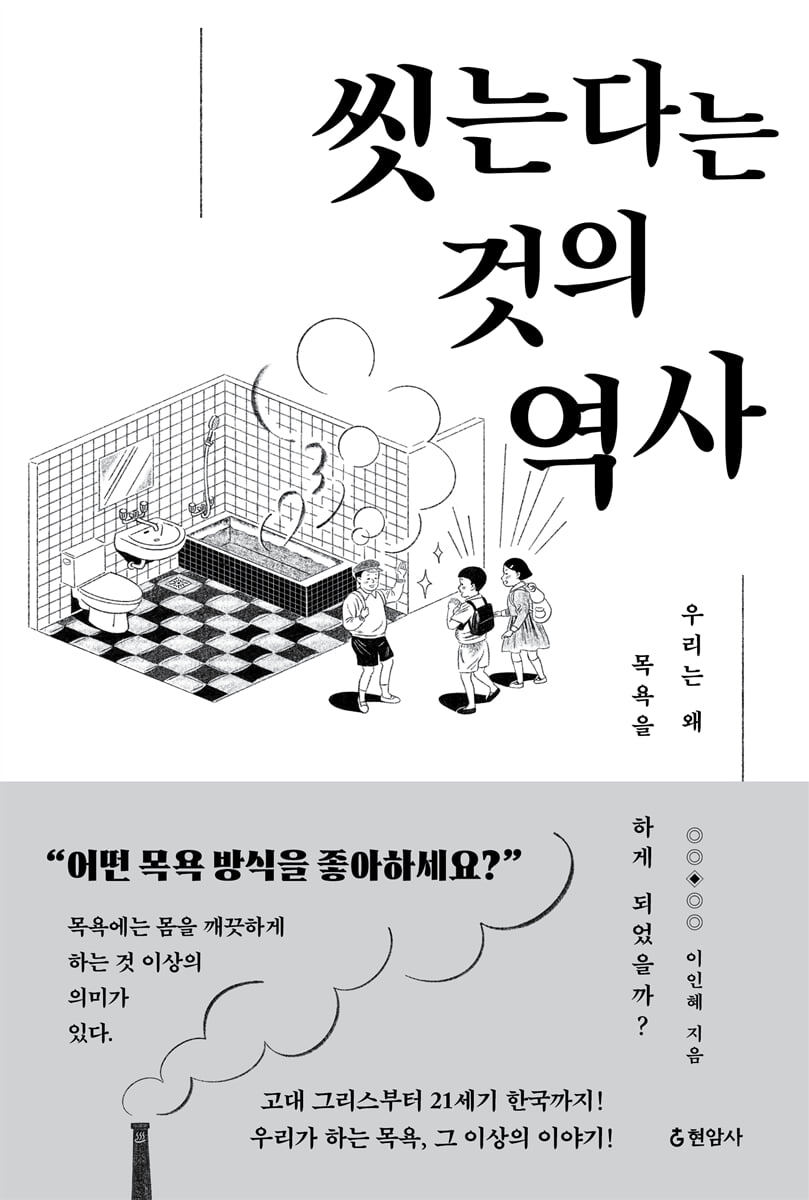
The history of washing
 |
Description
Book Introduction
“What kind of bathing style do you like?”
Bathing is more than just cleaning your body!
Let's think about a bathhouse scene.
Adults relax in the hot and cold pools in the middle, while children splash around in the cold pools on the other side.
I sit on a plastic chair in front of the faucet, scrub my face with an Italian towel, wash my hair under the shower water, and lather my body with soap.
Some people leave their backs to the bathhouse attendants, and in the locker room, local people gather in groups of three or five and chat.
It's a very familiar bathhouse scene.
However, the public bathhouses that are so familiar to us would feel very unfamiliar to people from other countries and times.
Bathing is both an instinctive habit of animals and a part of human culture.
The way humans bathe has continued to change over time and across cultures.
Whether to steam, soak in a bath, scrub, or change clothes instead of washing varies from culture to culture.
During the Joseon Dynasty, people did not often take full-body baths because it was considered rude to show one's naked body to others, but for ancient Romans, public baths were essential social activities that had to be visited every day.
While working as a curator at the National Folk Museum of Korea, author Lee In-hye traveled to bathhouses across the country to study bathhouse culture.
"The History of Washing" is a book that contains the author's experiences and research of bathing twice a day and visiting local bathhouses.
Sanitary practices, public welfare, penance, religious ceremonies, social activities, enlightenment movements… .
Bathing, which has become a daily routine today, has various meanings.
From the bathhouse ruins of the Indus Valley Civilization to today's neighborhood bathhouses in Korea, let's explore the fascinating historical stories surrounding bathing!
Bathing is more than just cleaning your body!
Let's think about a bathhouse scene.
Adults relax in the hot and cold pools in the middle, while children splash around in the cold pools on the other side.
I sit on a plastic chair in front of the faucet, scrub my face with an Italian towel, wash my hair under the shower water, and lather my body with soap.
Some people leave their backs to the bathhouse attendants, and in the locker room, local people gather in groups of three or five and chat.
It's a very familiar bathhouse scene.
However, the public bathhouses that are so familiar to us would feel very unfamiliar to people from other countries and times.
Bathing is both an instinctive habit of animals and a part of human culture.
The way humans bathe has continued to change over time and across cultures.
Whether to steam, soak in a bath, scrub, or change clothes instead of washing varies from culture to culture.
During the Joseon Dynasty, people did not often take full-body baths because it was considered rude to show one's naked body to others, but for ancient Romans, public baths were essential social activities that had to be visited every day.
While working as a curator at the National Folk Museum of Korea, author Lee In-hye traveled to bathhouses across the country to study bathhouse culture.
"The History of Washing" is a book that contains the author's experiences and research of bathing twice a day and visiting local bathhouses.
Sanitary practices, public welfare, penance, religious ceremonies, social activities, enlightenment movements… .
Bathing, which has become a daily routine today, has various meanings.
From the bathhouse ruins of the Indus Valley Civilization to today's neighborhood bathhouses in Korea, let's explore the fascinating historical stories surrounding bathing!
- You can preview some of the book's contents.
Preview
index
Introduction: When was your first bath?
Part 1.
The History of Bathing Around the World
1. Joining the Beginning of Civilization: Mohenjodaro and the Bathing Culture of Ancient Greece
2 Thermae, hot places: public baths in ancient Rome
3 The Unclean Is the Sacred: The Baths of Early Christianity
4 Can You Bathe Without a Bath?: Hamam, the Islamic Public Bathhouse
5 Baths That Came and Disappeared: Europe After the Crusades
6 Bathing, Restoring Honor: The Rise of Europe's New Class
7 Sherlock Holmes Couldn't Stop Bathing: The Industrial Revolution and Urbanization
8. Cleanliness as a New Identity: North American Bathing Culture
9. Steaming with the Soul: A Finnish Sauna
10 Soul-Purifying Festivals: India's Kumbh Mela
11 Similar but Different: Sento in Japan
Part 2.
Korean bathing culture
1. Atone for your sins with a bath: Bathing in the Three Kingdoms Period
Washing in the Stream: Bathing in Goryeo
3. It is not polite to show your naked body: Bathing in Joseon
4. A great reward will be given to those who seek the hot springs: The hot springs of Joseon
5 Nearest Clinic: Joseon's Hanjeung
6. Washing the body with medicine to pray for health: a folk custom
7. Not washing is like being uncivilized: Hygiene concepts of the late Joseon Dynasty
8. Take the train to a hot spring trip: Japanese colonial-era bathhouses and sightseeing
9. Spaces of Discrimination and Surveillance: Korean Bathhouses During the Japanese Colonial Period
Part 3.
Public Bathhouses and Modern Korean Society
1 What we need is a bathhouse, not a TV: the spread of public bathhouses
2. Do you have a bathtub in your house?: Changes in housing types and bathrooms
3. It just goes up and doesn't come down: The history of bathhouse usage fees
4 This Towel is a Stolen Towel: Public Bathhouse Etiquette
5. Becoming a Space for Entertainment and Luxury: Gangnam Development and Luxury Saunas
6 Places That Feel Like Home But Are Not: Koreans and the Jjimjilbang
7 Everyone Has a Time: The Scrub and the Italian Towel
8 Seoul is square, Gyeongsang-do is round: Environmental pollution and bathhouse chimneys
9 Bathhouses Remain Memories: Neighborhood Bathhouses and Loose Communities
Outgoing Article: Can Bathing Last?
main
Image copyright
Part 1.
The History of Bathing Around the World
1. Joining the Beginning of Civilization: Mohenjodaro and the Bathing Culture of Ancient Greece
2 Thermae, hot places: public baths in ancient Rome
3 The Unclean Is the Sacred: The Baths of Early Christianity
4 Can You Bathe Without a Bath?: Hamam, the Islamic Public Bathhouse
5 Baths That Came and Disappeared: Europe After the Crusades
6 Bathing, Restoring Honor: The Rise of Europe's New Class
7 Sherlock Holmes Couldn't Stop Bathing: The Industrial Revolution and Urbanization
8. Cleanliness as a New Identity: North American Bathing Culture
9. Steaming with the Soul: A Finnish Sauna
10 Soul-Purifying Festivals: India's Kumbh Mela
11 Similar but Different: Sento in Japan
Part 2.
Korean bathing culture
1. Atone for your sins with a bath: Bathing in the Three Kingdoms Period
Washing in the Stream: Bathing in Goryeo
3. It is not polite to show your naked body: Bathing in Joseon
4. A great reward will be given to those who seek the hot springs: The hot springs of Joseon
5 Nearest Clinic: Joseon's Hanjeung
6. Washing the body with medicine to pray for health: a folk custom
7. Not washing is like being uncivilized: Hygiene concepts of the late Joseon Dynasty
8. Take the train to a hot spring trip: Japanese colonial-era bathhouses and sightseeing
9. Spaces of Discrimination and Surveillance: Korean Bathhouses During the Japanese Colonial Period
Part 3.
Public Bathhouses and Modern Korean Society
1 What we need is a bathhouse, not a TV: the spread of public bathhouses
2. Do you have a bathtub in your house?: Changes in housing types and bathrooms
3. It just goes up and doesn't come down: The history of bathhouse usage fees
4 This Towel is a Stolen Towel: Public Bathhouse Etiquette
5. Becoming a Space for Entertainment and Luxury: Gangnam Development and Luxury Saunas
6 Places That Feel Like Home But Are Not: Koreans and the Jjimjilbang
7 Everyone Has a Time: The Scrub and the Italian Towel
8 Seoul is square, Gyeongsang-do is round: Environmental pollution and bathhouse chimneys
9 Bathhouses Remain Memories: Neighborhood Bathhouses and Loose Communities
Outgoing Article: Can Bathing Last?
main
Image copyright
Detailed image
.jpg)
Into the book
Let's go back to the original question that opened this article: "When was your first bath?"
The reason I was confident that the interviewer's and my answers would not differ significantly from 'I was bathed by medical staff at the hospital where I was born' was probably because I knew that he and I were born in different countries, but at similar times and in places with similar medical systems and infrastructure.
If he had been born and raised in a region or religious sphere quite different from the culture of my home country, South Korea, or if I had been born to a midwife during the Joseon Dynasty and bathed in boiled peach tree branches, I might have been able to give him the answer he wanted.
Conversely, I too might have been curious and waited for his answer.
---From "When was your first bath?"
So, what did public bathhouses look like to Christians? They weren't simply places to wash.
It was a place for leisure and pleasure, and sometimes even a place where mixed bathing and prostitution took place.
Therefore, to Christians, public bathhouses would have been considered dens of sin and dens of the devil.
The same goes for bathing.
Asceticism was not universal in early Christianity, but it gradually spread through the third and fourth centuries, with monks and saints practicing physical mortification by not washing.
The impurity gained by giving up the physical pleasures of bathing was a sign of holiness, and this asceticism was called alousia, meaning 'unwashed state'.
---From “Part 1, Part 3: The Unclean Is the Sacred”
This special steam is called 'Royal'.
In Finnish, 'höyülü' means steam or vapor, but 'röyülü' is used to refer to the steam produced in a sauna.
The word Löwülü also includes the meanings 'spirit, breath, soul'.
The core of the sauna, the lowilly, has different characteristics for each sauna.
To experience these different types of Löwülü, people visit several saunas and share their experiences and knowledge with others.
---From "Part 1, Chapter 9. Breathing in the Steam of the Soul"
Unlike modern times, where all family members share a single washbasin, in the Joseon Dynasty, each person had their own basin.
My mother-in-law, father-in-law, husband, myself, and even the servants each hung their own basins in their own rooms.
Therefore, in the case of wealthy noble families who even had servants, there were more than ten basins used in one household.
There were more basins than rice bowls.
So, even if people in the Joseon Dynasty preferred partial bathing, it is difficult to say that they were dirtier than when they enjoyed full body bathing.
---From "Part 2, Chapter 3. It is not polite to show your naked body"
This structure contrasts with the disappearance of the concept of a sanitary police in most European countries in the early 20th century, while Japan maintained the system in its colonial Korea to justify its rule.
It didn't matter to the Japanese whether Koreans actually kept their bodies clean or not.
Those who are ruled by those who rule have always been objects of management and supervision.
Public bathhouses were not only places to wash one's body, but also symbolic spaces where the bodies and cleanliness of Koreans were censored from a Japanese perspective.
---From "Part 2, Chapter 9: Spaces of Discrimination and Surveillance"
Italian towels sold out like hotcakes as soon as they were released.
It was so popular that even counterfeit products were produced.
In 1969, there was a counterfeiter who imitated Italian towels that were sold for 30 won each and sold 1,200 of them for 28 won each.
What’s more, he even threatened Kim Pil-gon, the patent owner, saying, “If you mess with me, I’ll kill you.”157 In 1974, another incident occurred.
A person who sold 54,000 counterfeit products at 33 won each to public bathhouses across the country was arrested for violating patent law.
In this way, Italian towels have become more than just bathing tools; they have become cultural icons.
---From "Part 3, Chapter 7. Everyone Has Their Time"
In cities where population mobility is high and human relationships are formed based on occupation and purpose, local communities tend to weaken.
However, in the older public bathhouses, private, local groups still formed, which over time solidified into communities.
People naturally gathered at the public bathhouse without having to set a time to meet.
It was like a village hall or pavilion in the countryside.
Members here fostered camaraderie by engaging in conversations about the community and their neighbors.
Public bathhouses served as a medium that united city dwellers.
The reason I was confident that the interviewer's and my answers would not differ significantly from 'I was bathed by medical staff at the hospital where I was born' was probably because I knew that he and I were born in different countries, but at similar times and in places with similar medical systems and infrastructure.
If he had been born and raised in a region or religious sphere quite different from the culture of my home country, South Korea, or if I had been born to a midwife during the Joseon Dynasty and bathed in boiled peach tree branches, I might have been able to give him the answer he wanted.
Conversely, I too might have been curious and waited for his answer.
---From "When was your first bath?"
So, what did public bathhouses look like to Christians? They weren't simply places to wash.
It was a place for leisure and pleasure, and sometimes even a place where mixed bathing and prostitution took place.
Therefore, to Christians, public bathhouses would have been considered dens of sin and dens of the devil.
The same goes for bathing.
Asceticism was not universal in early Christianity, but it gradually spread through the third and fourth centuries, with monks and saints practicing physical mortification by not washing.
The impurity gained by giving up the physical pleasures of bathing was a sign of holiness, and this asceticism was called alousia, meaning 'unwashed state'.
---From “Part 1, Part 3: The Unclean Is the Sacred”
This special steam is called 'Royal'.
In Finnish, 'höyülü' means steam or vapor, but 'röyülü' is used to refer to the steam produced in a sauna.
The word Löwülü also includes the meanings 'spirit, breath, soul'.
The core of the sauna, the lowilly, has different characteristics for each sauna.
To experience these different types of Löwülü, people visit several saunas and share their experiences and knowledge with others.
---From "Part 1, Chapter 9. Breathing in the Steam of the Soul"
Unlike modern times, where all family members share a single washbasin, in the Joseon Dynasty, each person had their own basin.
My mother-in-law, father-in-law, husband, myself, and even the servants each hung their own basins in their own rooms.
Therefore, in the case of wealthy noble families who even had servants, there were more than ten basins used in one household.
There were more basins than rice bowls.
So, even if people in the Joseon Dynasty preferred partial bathing, it is difficult to say that they were dirtier than when they enjoyed full body bathing.
---From "Part 2, Chapter 3. It is not polite to show your naked body"
This structure contrasts with the disappearance of the concept of a sanitary police in most European countries in the early 20th century, while Japan maintained the system in its colonial Korea to justify its rule.
It didn't matter to the Japanese whether Koreans actually kept their bodies clean or not.
Those who are ruled by those who rule have always been objects of management and supervision.
Public bathhouses were not only places to wash one's body, but also symbolic spaces where the bodies and cleanliness of Koreans were censored from a Japanese perspective.
---From "Part 2, Chapter 9: Spaces of Discrimination and Surveillance"
Italian towels sold out like hotcakes as soon as they were released.
It was so popular that even counterfeit products were produced.
In 1969, there was a counterfeiter who imitated Italian towels that were sold for 30 won each and sold 1,200 of them for 28 won each.
What’s more, he even threatened Kim Pil-gon, the patent owner, saying, “If you mess with me, I’ll kill you.”157 In 1974, another incident occurred.
A person who sold 54,000 counterfeit products at 33 won each to public bathhouses across the country was arrested for violating patent law.
In this way, Italian towels have become more than just bathing tools; they have become cultural icons.
---From "Part 3, Chapter 7. Everyone Has Their Time"
In cities where population mobility is high and human relationships are formed based on occupation and purpose, local communities tend to weaken.
However, in the older public bathhouses, private, local groups still formed, which over time solidified into communities.
People naturally gathered at the public bathhouse without having to set a time to meet.
It was like a village hall or pavilion in the countryside.
Members here fostered camaraderie by engaging in conversations about the community and their neighbors.
Public bathhouses served as a medium that united city dwellers.
---From "Part 3, Chapter 9. The Bathhouse Remains a Memories"
Publisher's Review
Bathing as a Culture, the Changing Bathing Landscape
When did humans begin bathing? The oldest evidence of bathing in human history is found in the ruins of Mohenjodaro, part of the Indus Valley Civilization.
The ancient city of Mohenjodaro, which was formed around 3000 BC, has aqueducts and wells throughout the city, and a large bathhouse is located in the center.
Bathing has been with human civilization for a long time, but it is not actually a behavior unique to the human species.
Fish, birds, and other mammals also bathe by rolling in sand or mud and rubbing themselves against rocks.
The desire to cleanse the body is an animal instinct.
However, what makes human bathing different from other animals is that the way we bathe changes with the times and regions and is passed down to future generations.
For humans, bathing is a custom and culture that goes beyond habit.
Bathing culture is influenced by a variety of factors.
Bathing is intertwined with numerous historical and cultural contexts, including ideas about cleanliness, religious doctrines, the spread of bathing facilities and the development of tools, and even the natural environment.
In ancient Greece and Rome, where the theory of the four humors was believed, bathing was a medical procedure to balance body fluids, but in medieval Europe, where it was believed that bad air entered the body through open pores, bathing was an unclean and fearful act.
A bathtub with hot water is essential in Korean bathhouses, but in Islamic cultures where stagnant water is considered unclean, bathing facilities do not have hot water.
The modern Korean style of bathing, in which one soaks in a bath and then rubs one's entire body with an Italian towel, was also born in various contexts.
Korean bathing culture has continued to change from the Three Kingdoms period to the present. The Goryeo custom of washing together in a stream regardless of gender or age became a shameful past in Joseon, which was dominated by Neo-Confucianism, and the imperialistic view of hygiene, which regarded uncleanness as uncivilization, became the basis for the Japanese oppression of colonial Joseon.
After liberation, public bathhouses were built throughout the region through the New Community Movement, and the spread of soap and the invention of the Italian towel made scrubbing popular.
With the emergence of jjimjilbangs, jjimjilbang culture spread to other countries, and with the spread of water facilities, even generations that had never been to a public bathhouse appeared.
In this way, the way we bathe and the meanings contained within it have always changed.
A wide range of bathing stories from the Indus Valley Civilization to modern Korea!
This book covers a wide range of historical stories surrounding bathing.
It consists of Part 1, which covers world history from ancient Greece to Japan, Part 2, which covers Korean history from the Three Kingdoms period to the Japanese colonial period, and Part 3, which covers Korean public bathhouses after liberation.
Ancient Greece, the Roman Empire, the Ottoman Empire, medieval Europe, Britain during the Industrial Revolution, Native Americans, the United States, Finland, India, and even Japan.
Covering a period from the Indus civilization to modern Korea, it clearly demonstrates that the everyday act of bathing is a core cultural aspect of human civilization.
The various plates and illustrations included in the book also provide something to see.
The bathing scenes from around the world seen in the book are quite unfamiliar to modern Koreans.
We included photos of historical sites and images of artifacts related to the content to enhance readers' understanding of the content, and for bathhouse scenes that cannot be captured in photos, such as the sauna rest area or bathhouse changing room, we used illustrations to convey the atmosphere of the site.
Bathing is a custom that reflects the social conditions and values of the time.
Bathing is a means of maintaining hygiene, an act of atonement to wash away sins, a religious ritual to purify the soul, a pleasure in daily life, a social act for fellowship, and an enlightening act to maintain class.
Reading this book might make you want to go to the bathhouse too.
When did humans begin bathing? The oldest evidence of bathing in human history is found in the ruins of Mohenjodaro, part of the Indus Valley Civilization.
The ancient city of Mohenjodaro, which was formed around 3000 BC, has aqueducts and wells throughout the city, and a large bathhouse is located in the center.
Bathing has been with human civilization for a long time, but it is not actually a behavior unique to the human species.
Fish, birds, and other mammals also bathe by rolling in sand or mud and rubbing themselves against rocks.
The desire to cleanse the body is an animal instinct.
However, what makes human bathing different from other animals is that the way we bathe changes with the times and regions and is passed down to future generations.
For humans, bathing is a custom and culture that goes beyond habit.
Bathing culture is influenced by a variety of factors.
Bathing is intertwined with numerous historical and cultural contexts, including ideas about cleanliness, religious doctrines, the spread of bathing facilities and the development of tools, and even the natural environment.
In ancient Greece and Rome, where the theory of the four humors was believed, bathing was a medical procedure to balance body fluids, but in medieval Europe, where it was believed that bad air entered the body through open pores, bathing was an unclean and fearful act.
A bathtub with hot water is essential in Korean bathhouses, but in Islamic cultures where stagnant water is considered unclean, bathing facilities do not have hot water.
The modern Korean style of bathing, in which one soaks in a bath and then rubs one's entire body with an Italian towel, was also born in various contexts.
Korean bathing culture has continued to change from the Three Kingdoms period to the present. The Goryeo custom of washing together in a stream regardless of gender or age became a shameful past in Joseon, which was dominated by Neo-Confucianism, and the imperialistic view of hygiene, which regarded uncleanness as uncivilization, became the basis for the Japanese oppression of colonial Joseon.
After liberation, public bathhouses were built throughout the region through the New Community Movement, and the spread of soap and the invention of the Italian towel made scrubbing popular.
With the emergence of jjimjilbangs, jjimjilbang culture spread to other countries, and with the spread of water facilities, even generations that had never been to a public bathhouse appeared.
In this way, the way we bathe and the meanings contained within it have always changed.
A wide range of bathing stories from the Indus Valley Civilization to modern Korea!
This book covers a wide range of historical stories surrounding bathing.
It consists of Part 1, which covers world history from ancient Greece to Japan, Part 2, which covers Korean history from the Three Kingdoms period to the Japanese colonial period, and Part 3, which covers Korean public bathhouses after liberation.
Ancient Greece, the Roman Empire, the Ottoman Empire, medieval Europe, Britain during the Industrial Revolution, Native Americans, the United States, Finland, India, and even Japan.
Covering a period from the Indus civilization to modern Korea, it clearly demonstrates that the everyday act of bathing is a core cultural aspect of human civilization.
The various plates and illustrations included in the book also provide something to see.
The bathing scenes from around the world seen in the book are quite unfamiliar to modern Koreans.
We included photos of historical sites and images of artifacts related to the content to enhance readers' understanding of the content, and for bathhouse scenes that cannot be captured in photos, such as the sauna rest area or bathhouse changing room, we used illustrations to convey the atmosphere of the site.
Bathing is a custom that reflects the social conditions and values of the time.
Bathing is a means of maintaining hygiene, an act of atonement to wash away sins, a religious ritual to purify the soul, a pleasure in daily life, a social act for fellowship, and an enlightening act to maintain class.
Reading this book might make you want to go to the bathhouse too.
GOODS SPECIFICS
- Date of issue: February 28, 2025
- Page count, weight, size: 392 pages | 644g | 145*215*25mm
- ISBN13: 9788932324128
You may also like
카테고리
korean


korean

![GQ KOREA Mark (Monthly): December [2025]](http://librairie.coreenne.fr/cdn/shop/files/8ef265dbbfbf186523ed75ba7319009d.jpg?v=1765340328&width=3840)


