

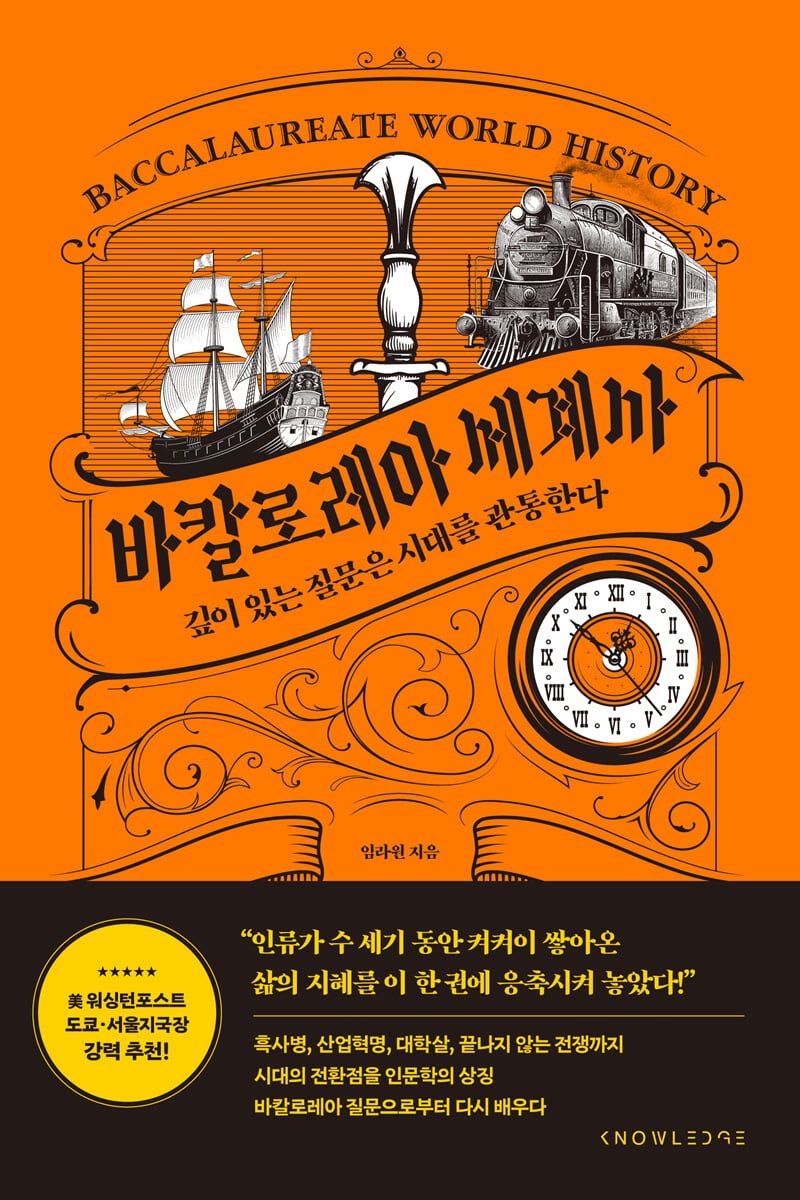
Baccalaureate World History
 |
Description
Book Introduction
“The wisdom of life that humanity has accumulated over centuries is condensed into this one book.”
- Strongly recommended by the Washington Post's Tokyo and Seoul bureau chiefs. From the Roman Empire to British colonial rule in America, to the Rwandan genocide… . Relearning about the turning point of our times from the question of the Baccalaureate, the symbol of the humanities. The International Baccalaureate (IB) is an internationally recognized educational curriculum that began in Geneva, Switzerland. This education is similar to the Baccalaureat, a French essay-based university entrance exam that assesses students' thinking skills. The goal is to help students solve problems on their own through the knowledge they have acquired. This book begins with a redefined question from history, one of the social studies areas in the IB Higher Education curriculum. By posing questions that encourage strategic thinking across time periods, such as what impact ancient Europe had on the lives of medieval Europeans, how the Black Death affected economic changes in European society, and how the Industrial Revolution influenced national development, readers can naturally understand the flow of the world. The author of "Baccalaureate World History" says world history is a record of large-scale battles of wits. This experience stems from his work on diplomatic strategy at the UN Security Council, the Pacific Forum, and the Center for Strategic Studies (CSIS) in the United States. In diplomatic strategy, 'eye contact' means survival and power. To develop a keen eye for detail, you must cultivate insight into each situation and cultivate strategic thinking by understanding the flow of world history. Through the questions of the Baccalaureate, the symbol of the humanities, we can structurally broaden our perspective and sharpen our perspective on the direction in which world history is flowing and how the international community has changed. |
- You can preview some of the book's contents.
Preview
index
Entering
How to read this book
Chapter 1.
Humans began to awaken to their instincts (BC–14th century)
Survival | The Birth of Feudalism - What Impact Did Ancient Europe Have on Medieval European Life?
The Black Death: What Impact Does Disease Have on Social and Economic Change?
Chapter 2.
Irresistible Allure, Money, and Technology (15th-18th centuries)
The Law of Karma | Pizarro and the Inca Empire - Was Territorial Expansion Driven by Economic Factors?
Prerequisites | Adam Smith and the Industrial Revolution - What Impact Does Technological Advancement Have on National Development?
Chapter 3.
How to Get What You Want Without Shedding Blood (15th-19th Century)
Insight | King Sejong and the Civil Service Examination - Can a Leader Gain Power Through Non-Military Means?
Defense | The Opium Wars and the Treaty of Nanking - Why Are Treaties Important?
Chapter 4.
A nation is its people (17th-20th centuries)
Self-Actualization | The American Revolution - What is the Role of Independence?
Identity | India and Pakistan - What is the Impact of the Separatist Movement?
Chapter 5.
Unexpected Democracies and Dictatorships (20th Century)
Opportunity | The Rwandan Genocide - Can a Crisis Advance Democracy?
Bystander | Hitler and the Evian Conference - How Organizations Maintain Power
Chapter 6.
Can Peace Last? (20th Century)
Overwhelm | Israel and Palestine - Why Some Wars Never End
Strategy | The Cold War and One China - Why Does Détente Matter?
And can the past become the future?
References
How to read this book
Chapter 1.
Humans began to awaken to their instincts (BC–14th century)
Survival | The Birth of Feudalism - What Impact Did Ancient Europe Have on Medieval European Life?
The Black Death: What Impact Does Disease Have on Social and Economic Change?
Chapter 2.
Irresistible Allure, Money, and Technology (15th-18th centuries)
The Law of Karma | Pizarro and the Inca Empire - Was Territorial Expansion Driven by Economic Factors?
Prerequisites | Adam Smith and the Industrial Revolution - What Impact Does Technological Advancement Have on National Development?
Chapter 3.
How to Get What You Want Without Shedding Blood (15th-19th Century)
Insight | King Sejong and the Civil Service Examination - Can a Leader Gain Power Through Non-Military Means?
Defense | The Opium Wars and the Treaty of Nanking - Why Are Treaties Important?
Chapter 4.
A nation is its people (17th-20th centuries)
Self-Actualization | The American Revolution - What is the Role of Independence?
Identity | India and Pakistan - What is the Impact of the Separatist Movement?
Chapter 5.
Unexpected Democracies and Dictatorships (20th Century)
Opportunity | The Rwandan Genocide - Can a Crisis Advance Democracy?
Bystander | Hitler and the Evian Conference - How Organizations Maintain Power
Chapter 6.
Can Peace Last? (20th Century)
Overwhelm | Israel and Palestine - Why Some Wars Never End
Strategy | The Cold War and One China - Why Does Détente Matter?
And can the past become the future?
References
Detailed image

Into the book
The key reason why we must read the flow of the world is survival.
Consider the ebb and flow of the tide. Those who understand the flow of water go out to the mudflats during low tide to dig for clams.
However, those who cannot read the flow of water will not even know that the tide is coming in and will find themselves knee-deep in water while digging for clams in the mudflats.
Just like water, so is the history of the world, and so is world history, the history of the world.
So how can we read the flow of the world? Surprisingly, it's all about "intuition."
The English expression for “take a hint” is “take a hint.”
To figure out hints, you need to develop the ability to find clues hidden in any situation or problem, even if it's indirect.
In this way, it is extremely important to cultivate a keen eye in order to understand not only world history but also the flow of the world itself.
According to the Standard Korean Dictionary, intuition is defined as “the ability to read someone else’s mind based on the situation at that time.”
Just as the ability to infer the situation at each time is the core of intuition, developing intuition requires insight appropriate to the situation.
---From "Entering"
Living with the flow means adopting a flexible attitude.
People say that people should be consistent from the beginning, but I think it's also important to know how to step back for a moment depending on the situation.
An attitude of humbly accepting one's position and preparing for change depending on the situation.
Isn't this the message that medieval Europeans wanted to convey to us?
---From "Survival | The Birth of Feudalism - What Influence Did Ancient Europe Have on the Life of Medieval Europeans?"
There is an easy way to figure out what kind of person you are dealing with.
It's about seeing what that person thinks, says, and does when things are at their worst.
Everyone shows their best side when they are in the best situation.
So, some people make the mistake of seeing only a fragmentary image of the other person and thinking that the other person is a good person.
But people show their true colors in times of crisis.
A crisis is like the edge of a cliff; if you twist your foot even a little, you fall to the ground.
---From "The Black Death - What Impact Does Disease Have on Social and Economic Change?"
The word 'need' has a much scarier connotation than we might think.
This is because necessity presupposes the condition of ‘must’ rather than ‘sufficient’.
For medieval Europeans of the time, the Black Death was a clear crisis.
However, to turn a crisis into an opportunity, you must first 'absolutely' survive.
However, in order to survive, the first priority becomes that you must survive no matter what, even if others die.
And in order to live, humans start by asking this question.
“What do I need now?” Everyone faces a moment of crisis in their lives.
Can you be the person who is indispensable in times of crisis?
---From "The Black Death - What Impact Does Disease Have on Social and Economic Change?"
People are everything, and what my people say is especially important.
The more you love someone, the more you want them to do well, so you say helpful things to them.
So, leaders can gain greater strength when they acknowledge their people and listen to their honest opinions.
This is because, based on the spirit of “a man knows himself and dies for himself,” there is nothing a person cannot do for someone who believes in him and acknowledges him.
That's why sometimes the power of people and the power of love are more frightening than guns and swords.
Because warmth melts cold.
---From "Anmok | King Sejong and the Civil Service Examination - Can a Leader Gain Power Through Non-Military Means?"
Germany began to show particularly anti-Semitic tendencies after its defeat in World War I.
Of course, anti-Jewish sentiments that have persisted since medieval Europe also played a role.
But the anti-Semitism that emerged in Germany in the early 20th century arose for reasons far beyond what we might imagine.
Germany was unified into 39 separate German states in the late 19th century by Otto Eduard Leopold von Bismarck, known as the Iron Chancellor.
There was something that Bismarck, who unified Germany, needed most.
It's capital.
There is a reason why Bismarck needed capital.
The superpower of the late 19th century was Britain, and to compete with Britain, Germany needed to develop not only its economy but also its military.
Consider the ebb and flow of the tide. Those who understand the flow of water go out to the mudflats during low tide to dig for clams.
However, those who cannot read the flow of water will not even know that the tide is coming in and will find themselves knee-deep in water while digging for clams in the mudflats.
Just like water, so is the history of the world, and so is world history, the history of the world.
So how can we read the flow of the world? Surprisingly, it's all about "intuition."
The English expression for “take a hint” is “take a hint.”
To figure out hints, you need to develop the ability to find clues hidden in any situation or problem, even if it's indirect.
In this way, it is extremely important to cultivate a keen eye in order to understand not only world history but also the flow of the world itself.
According to the Standard Korean Dictionary, intuition is defined as “the ability to read someone else’s mind based on the situation at that time.”
Just as the ability to infer the situation at each time is the core of intuition, developing intuition requires insight appropriate to the situation.
---From "Entering"
Living with the flow means adopting a flexible attitude.
People say that people should be consistent from the beginning, but I think it's also important to know how to step back for a moment depending on the situation.
An attitude of humbly accepting one's position and preparing for change depending on the situation.
Isn't this the message that medieval Europeans wanted to convey to us?
---From "Survival | The Birth of Feudalism - What Influence Did Ancient Europe Have on the Life of Medieval Europeans?"
There is an easy way to figure out what kind of person you are dealing with.
It's about seeing what that person thinks, says, and does when things are at their worst.
Everyone shows their best side when they are in the best situation.
So, some people make the mistake of seeing only a fragmentary image of the other person and thinking that the other person is a good person.
But people show their true colors in times of crisis.
A crisis is like the edge of a cliff; if you twist your foot even a little, you fall to the ground.
---From "The Black Death - What Impact Does Disease Have on Social and Economic Change?"
The word 'need' has a much scarier connotation than we might think.
This is because necessity presupposes the condition of ‘must’ rather than ‘sufficient’.
For medieval Europeans of the time, the Black Death was a clear crisis.
However, to turn a crisis into an opportunity, you must first 'absolutely' survive.
However, in order to survive, the first priority becomes that you must survive no matter what, even if others die.
And in order to live, humans start by asking this question.
“What do I need now?” Everyone faces a moment of crisis in their lives.
Can you be the person who is indispensable in times of crisis?
---From "The Black Death - What Impact Does Disease Have on Social and Economic Change?"
People are everything, and what my people say is especially important.
The more you love someone, the more you want them to do well, so you say helpful things to them.
So, leaders can gain greater strength when they acknowledge their people and listen to their honest opinions.
This is because, based on the spirit of “a man knows himself and dies for himself,” there is nothing a person cannot do for someone who believes in him and acknowledges him.
That's why sometimes the power of people and the power of love are more frightening than guns and swords.
Because warmth melts cold.
---From "Anmok | King Sejong and the Civil Service Examination - Can a Leader Gain Power Through Non-Military Means?"
Germany began to show particularly anti-Semitic tendencies after its defeat in World War I.
Of course, anti-Jewish sentiments that have persisted since medieval Europe also played a role.
But the anti-Semitism that emerged in Germany in the early 20th century arose for reasons far beyond what we might imagine.
Germany was unified into 39 separate German states in the late 19th century by Otto Eduard Leopold von Bismarck, known as the Iron Chancellor.
There was something that Bismarck, who unified Germany, needed most.
It's capital.
There is a reason why Bismarck needed capital.
The superpower of the late 19th century was Britain, and to compete with Britain, Germany needed to develop not only its economy but also its military.
---From "Bystander | Hitler and the Evian Conference - How Do Organizations Maintain Power?"
Publisher's Review
“In an era where people have lost the ability to think for themselves while only chasing set answers…
“Information and knowledge that seeks a single correct answer has become meaningless.”
Encounter world history from a new perspective through the questions of the Baccalaureate!
Until now, questions about meaning in life have been closer to 'test questions' presented with set answers.
The answer was already set, and life was also the starting point for going down the path where that question and answer were set.
But we are at a crossroads where we must truly think as human beings along the way.
Sam Altman of OpenAI, the developer of ChatGPT, said, “You need to develop original thinking to find solutions in situations where there are no solutions.”
In other words, to survive in the flood of fragmented information, you must think creatively and find creative answers without a set answer.
Baccalaureate is a discipline that shows that questions are important in our lives regardless of the answers, and that individual thinking is not complete.
The author also hopes that people will be able to interpret the flow of the world through their own perspectives, rather than viewing it based on set formulas and standardized answers, by tracing major events and situations in world history step by step, chronologically.
By considering the changes, wounds, hopes, and reflections clearly left by world history in each era, such as the background to the birth of the feudal system, the social and economic changes brought about by the Black Death in European society, the impact of the Industrial Revolution on national development, the meaning and role of independence as seen through the American Revolution, the development of democracy brought about by the crisis of the Rwandan genocide, and ways to achieve peace as seen through the endless war between Israel and Palestine, we can see where the world is heading with a broader perspective.
A journey of questions without set answers,
And at the end, you will encounter the most humanistic world history.
《Baccalaureate World History》 has re-established 12 core topics and questions that frequently appear in the history section, one of the social studies areas of the IB High School curriculum.
To help you easily understand the flow of world history, we have carefully selected the major events and themes that you must know from each era.
Through this, we can structurally understand the direction in which the world is flowing and leave behind implications that we can reflect on ourselves from a humanities perspective.
The author of this book not only suggests key keywords and hints, but also poses questions from beginning to end, providing a friendly guide for readers to come up with creative ideas and logical answers.
As readers follow the path of questions, like explorers with a map in hand, their perspective on the world will broaden and they will be able to come up with their own creative and logical answers to seemingly difficult questions in any field.
“Information and knowledge that seeks a single correct answer has become meaningless.”
Encounter world history from a new perspective through the questions of the Baccalaureate!
Until now, questions about meaning in life have been closer to 'test questions' presented with set answers.
The answer was already set, and life was also the starting point for going down the path where that question and answer were set.
But we are at a crossroads where we must truly think as human beings along the way.
Sam Altman of OpenAI, the developer of ChatGPT, said, “You need to develop original thinking to find solutions in situations where there are no solutions.”
In other words, to survive in the flood of fragmented information, you must think creatively and find creative answers without a set answer.
Baccalaureate is a discipline that shows that questions are important in our lives regardless of the answers, and that individual thinking is not complete.
The author also hopes that people will be able to interpret the flow of the world through their own perspectives, rather than viewing it based on set formulas and standardized answers, by tracing major events and situations in world history step by step, chronologically.
By considering the changes, wounds, hopes, and reflections clearly left by world history in each era, such as the background to the birth of the feudal system, the social and economic changes brought about by the Black Death in European society, the impact of the Industrial Revolution on national development, the meaning and role of independence as seen through the American Revolution, the development of democracy brought about by the crisis of the Rwandan genocide, and ways to achieve peace as seen through the endless war between Israel and Palestine, we can see where the world is heading with a broader perspective.
A journey of questions without set answers,
And at the end, you will encounter the most humanistic world history.
《Baccalaureate World History》 has re-established 12 core topics and questions that frequently appear in the history section, one of the social studies areas of the IB High School curriculum.
To help you easily understand the flow of world history, we have carefully selected the major events and themes that you must know from each era.
Through this, we can structurally understand the direction in which the world is flowing and leave behind implications that we can reflect on ourselves from a humanities perspective.
The author of this book not only suggests key keywords and hints, but also poses questions from beginning to end, providing a friendly guide for readers to come up with creative ideas and logical answers.
As readers follow the path of questions, like explorers with a map in hand, their perspective on the world will broaden and they will be able to come up with their own creative and logical answers to seemingly difficult questions in any field.
GOODS SPECIFICS
- Date of issue: July 29, 2024
- Page count, weight, size: 268 pages | 418g | 140*210*16mm
- ISBN13: 9791198496614
- ISBN10: 1198496614
You may also like
카테고리
korean


korean

![GQ KOREA Mark (Monthly): December [2025]](http://librairie.coreenne.fr/cdn/shop/files/8ef265dbbfbf186523ed75ba7319009d.jpg?v=1765340328&width=3840)


