

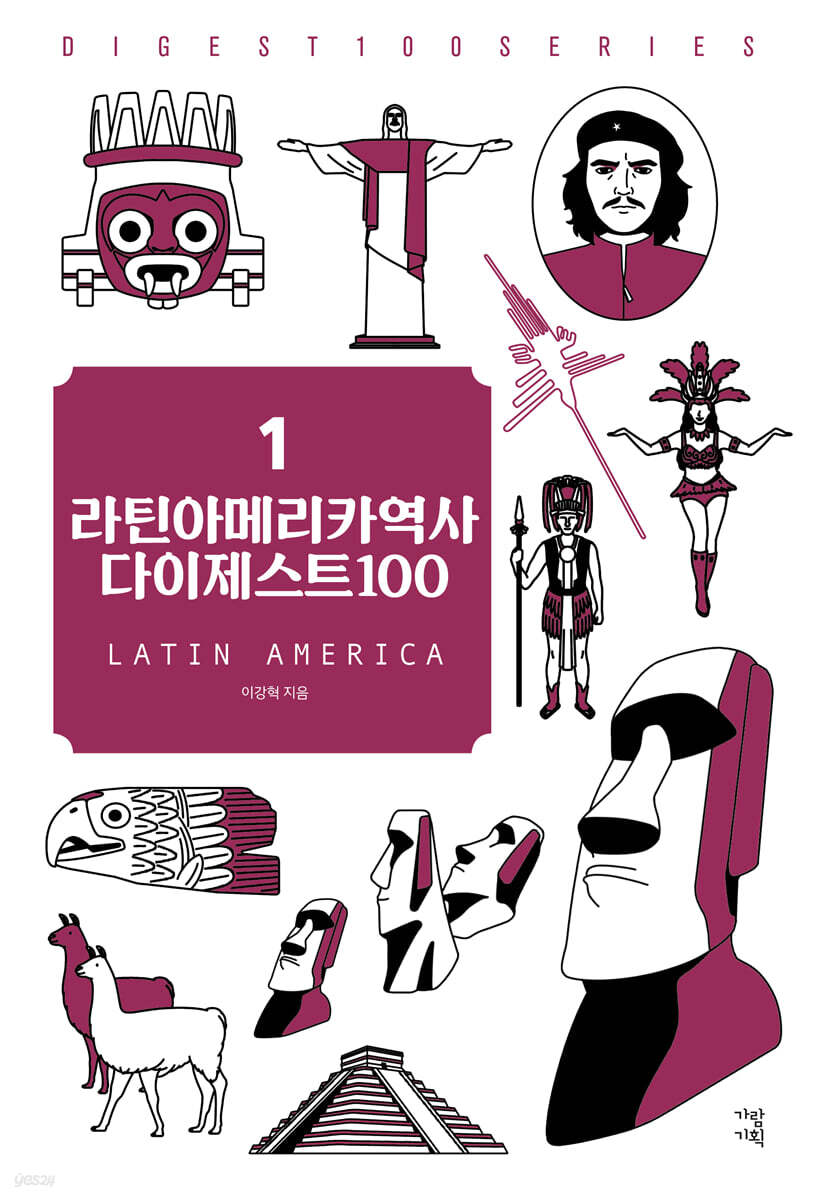
Latin American History Digest 100
 |
Description
Book Introduction
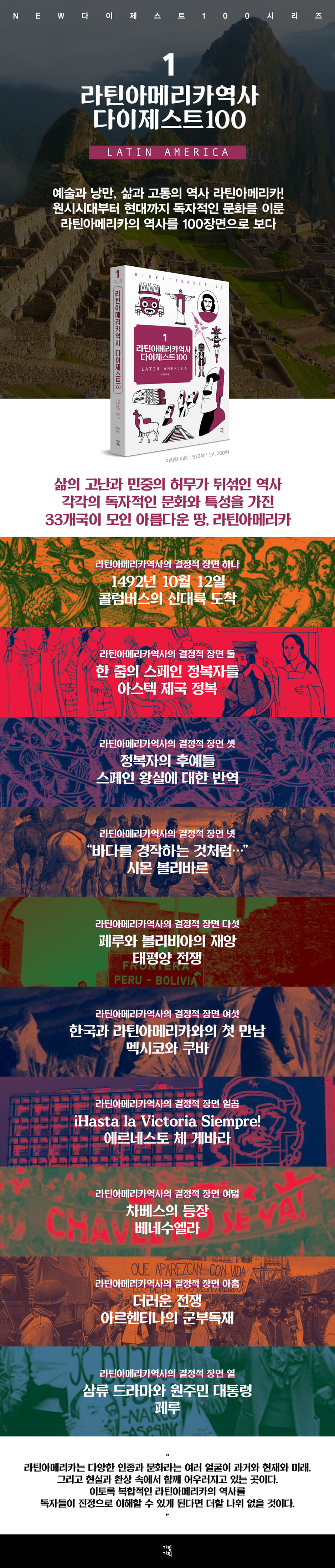
Latin America, a country with a history of art, romance, life, and suffering!
From the primitive age to the present, a continuous series of events has created an independent culture.
A glimpse into Latin American history in 100 scenes.
"Latin American History Digest 100" is the first book in Garam Planning's "NEW Digest 100" series, which selects 100 important historical scenes from each region and country.
This book covers the history of Latin America from its primitive past to the colonial period that began with Europe's Age of Exploration, and the modern era of the early 2000s, when it overcame its painful history and finally achieved modernization through reform.
The structure of 『Latin American History Digest 100』 is largely divided into three parts.
First, from the primitive era until Columbus arrived in the Americas in 1492; second, until the colonial period following the Age of Exploration in Europe; and third, after independence from Europe until mid-2008.
Each section selects major historical events that occurred during that period within the overall flow of Latin American history, and then describes them by considering the interconnectedness of each event.
Latin America is a place where the faces of diverse races and cultures coexist in the past, present, and future, reality and fantasy.
It would be wonderful if readers could truly understand the complex history of Latin America through the Latin American History Digest 100.
From the primitive age to the present, a continuous series of events has created an independent culture.
A glimpse into Latin American history in 100 scenes.
"Latin American History Digest 100" is the first book in Garam Planning's "NEW Digest 100" series, which selects 100 important historical scenes from each region and country.
This book covers the history of Latin America from its primitive past to the colonial period that began with Europe's Age of Exploration, and the modern era of the early 2000s, when it overcame its painful history and finally achieved modernization through reform.
The structure of 『Latin American History Digest 100』 is largely divided into three parts.
First, from the primitive era until Columbus arrived in the Americas in 1492; second, until the colonial period following the Age of Exploration in Europe; and third, after independence from Europe until mid-2008.
Each section selects major historical events that occurred during that period within the overall flow of Latin American history, and then describes them by considering the interconnectedness of each event.
Latin America is a place where the faces of diverse races and cultures coexist in the past, present, and future, reality and fantasy.
It would be wonderful if readers could truly understand the complex history of Latin America through the Latin American History Digest 100.
- You can preview some of the book's contents.
Preview
index
preface
Chapter 1.
Latin America: A Living Museum
1.
Land of Amerigo: America
2.
Along the Mongolian Route: People Living in Latin America
Chapter 2.
Ancient civilizations that flourished in Latin America
3.
Middle American and Stepped Civilizations: Ancient Civilizations
4.
Mesoamerica's First Civilization: The Olmec Civilization
5.
Where the Gods Dwell: Teotihuacán Civilization
6.
The People of Aztlán: Aztec Civilization 1
7.
Spectacular Society: Aztec Civilization 2
8.
Kaleidoscope of Cultures: Maya Civilization 1
9.
365.2422 days and 365.2420 days: Maya Civilization 2
10.
Bridges Between Andean and Mesoamerican Civilizations: Pre-Inca South American Civilizations 1
11.
The Mystery of the Nazca Lines: Pre-Inca Civilizations of South America Part 2
12.
The Navel of the World: Inca Civilization 1
13.
Chaski and Quipus: Inca Civilization 2
14.
A Great Country Across the Sea: The Adventures of Kon-Tiki
Chapter 3.
Encounter and Conquest
15.
Beyond the Sea: Europe's Expansion
16.
Where the Ocean Begins: Portugal's Expansion Policy
17.
Completion of the Reconquista: Spain's Expansion Policy
18.
October 12, 1492: Columbus arrives in the New World
19.
Pau Brasil: The Discovery and Conquest of Brazil
20.
Why Only Brazil Speaks Portuguese?: The Treaty of Tordesillas
21.
The Fall of the Mayan Civilization: The Fall of the Mayan Civilization
22.
A Handful of Spanish Conquistadors: The Conquest of the Aztec Empire
23.
Inca Civil War: Conquering the Inca Empire
24.
Sword and Cross: The Conquest of the Soul
25.
The Greatest Genocide in Human History: The Depopulation of Native Americans
26.
“Are these Indians not human?”: The cries of Father Casas and Father Vittoria
27.
Calm Seas, Pacific: The Explorers of the New World
Chapter 4.
colonial era
28.
Remote Control of Colonies: Viceroyalty
29.
Encomiendas, Mitas, and Haciendas: Economic Policies for the Colonies
30.
Portuguese Colonial Policy and Colonial Economy: Brazil
31.
Criollo and Peninsular: The Emergence of Multiracial Societies
32.
In Search of the Golden City of El Dorado: The Greed of the Conquistadors
33.
Increased International Trade and Rising Prices: Colonial Trade Policy
34.
Potatoes, Corn, and Sugar: Products of the New World
35.
Dutch and French Invasion: Foreign Occupation of Brazil
36.
Absolute obedience to God and the Pope: The Jesuits
37.
Descendants of the Conquistadors: Rebellion against the Spanish Crown
38.
Indigenism: Rebellion against the Portuguese Crown
39.
Tupac Amaru: Indigenous Rebellions Against Colonial Empires
Chapter 5.
Independence movement
40.
The Bourbon Reforms and the Criollo Rebellion: The Independence Movement
41.
“Like cultivating the sea…”: Simón Bolívar
42.
Protector of Peru: San Martin
43.
Dolores's Cry: Mexico's Independence
44.
“I am here”: Brazil’s independence
Chapter 6.
After independence (19th century)
45.
The Beginning of Conflict: Latin America after Independence
46.
Monarchy and 'Milk Coffee' Politics: Brazil
47.
Disaster in Peru and Bolivia: The War of the Pacific
Chapter 6-1.
The reign of the Caudillos
48.
Cracks in the Gap Between the Great Powers: Paraguay
49.
Bread or Club: Porfirio Diaz
50.
Little Venice: Venezuela
51.
“Governance is education”: Argentina
Chapter 6-2.
The Battle of Liberalism and Conservatism
52.
The Birth of the Central American Federation: Central America 1
53.
The Battleground of Conservatism and Liberalism: Central America 2
54.
Buffer country: Uruguay
55.
The Thousand Days' War: Colombia
56.
Equatorial country: Ecuador
57.
Bird droppings, guano: Peru
58.
Long country: Chile
Chapter 6-3.
American intervention
59.
Treaty of Guadalupe-Hidalgo: Territorial War Between the United States and Mexico
60.
Cuba's Kim Gu: Jose Marti
61.
Picnic Under the Moon: The Spanish-American War
Chapter 7.
Latin America in the 20th century
62.
Korea's First Encounter with Latin America: Mexico and Cuba
63.
Panama Canal: Panama
64.
Oil Country: Venezuela
65.
Bogotáso and La Violencia: Colombia
66.
Latin American Identity: The Boom Novel of the 1960s
Chapter 7-1.
Politics for the people
67.
Inter-American People's Revolutionary Alliance, APRA: Peru
68.
Samba and Soccer in Brazil: President Vargas
69.
Spokesmen of the Working Class: Perón and Evita
Chapter 7-2.
revolution
70.
Gringo: The Mexican Revolution
71.
Tata Cárdenas: The Completion of the Mexican Revolution
72.
The God Who Dies Every Six Years in Mexico: Presidentialism
73.
Another dependency: Cuba's independence
74.
Aboard the Granma: The Cuban Revolution
75.
¡Hasta la Victoria Siempre!: Ernesto Che Guevara
76.
“Everything is in the revolution…”: Fidel Castro
77.
Chaco War: Bolivia and Paraguay
78.
Viva Chile!: President Salvador Allende
79.
Poet of Love: Pablo Neruda
80.
New Song Movement: Nueva Canción
81.
Sandinista National Liberation Front: Nicaraguan Revolution
82.
Fujimori's Transformation, Cambio 90: Peru
83.
Football Wars: El Salvador and Honduras
84.
The Rise of Chavez: Venezuela
Chapter 7-3.
Settling the past
85.
Guatemala, Memories of Silence: The Guatemalan Civil War
86.
Dirty War: Argentina's Military Dictatorship
87.
Argentina's "Nunca Mas": Reconciling with the Past Part 1
88.
Chile's Augusto Pinochet: Reconciling with the Past 2
Chapter 7-4 Economic Integration
89.
The Lost Decade: Latin America's Economic Integration
90.
Zapata's Resurrection: The North American Free Trade Agreement (NAFTA)
Chapter 8: Latin America in the 21st Century
91.
A Fallen Dinosaur, a Change of Government After 71 Years: Mexico
92.
Third-Rate Dramas and Indigenous Presidents: Peru
93.
The Legend of President Lula: Brazil
94.
From the Minor Leagues to the Majors: Argentina
95.
Signing of a Free Trade Agreement with Korea: Chile
96.
Panic Without Hispanics: Hispanics in America
97.
Chavez Rewrote the History of Revolution: Venezuela
98.
Adios, Fidel!: Cuba
99.
The 'Axis of Good' Against the US: The Left's Surge in Latin America
100.
A United Latin America: The Launch of the Union of South American Nations (UNASUR)
References and Materials
Chapter 1.
Latin America: A Living Museum
1.
Land of Amerigo: America
2.
Along the Mongolian Route: People Living in Latin America
Chapter 2.
Ancient civilizations that flourished in Latin America
3.
Middle American and Stepped Civilizations: Ancient Civilizations
4.
Mesoamerica's First Civilization: The Olmec Civilization
5.
Where the Gods Dwell: Teotihuacán Civilization
6.
The People of Aztlán: Aztec Civilization 1
7.
Spectacular Society: Aztec Civilization 2
8.
Kaleidoscope of Cultures: Maya Civilization 1
9.
365.2422 days and 365.2420 days: Maya Civilization 2
10.
Bridges Between Andean and Mesoamerican Civilizations: Pre-Inca South American Civilizations 1
11.
The Mystery of the Nazca Lines: Pre-Inca Civilizations of South America Part 2
12.
The Navel of the World: Inca Civilization 1
13.
Chaski and Quipus: Inca Civilization 2
14.
A Great Country Across the Sea: The Adventures of Kon-Tiki
Chapter 3.
Encounter and Conquest
15.
Beyond the Sea: Europe's Expansion
16.
Where the Ocean Begins: Portugal's Expansion Policy
17.
Completion of the Reconquista: Spain's Expansion Policy
18.
October 12, 1492: Columbus arrives in the New World
19.
Pau Brasil: The Discovery and Conquest of Brazil
20.
Why Only Brazil Speaks Portuguese?: The Treaty of Tordesillas
21.
The Fall of the Mayan Civilization: The Fall of the Mayan Civilization
22.
A Handful of Spanish Conquistadors: The Conquest of the Aztec Empire
23.
Inca Civil War: Conquering the Inca Empire
24.
Sword and Cross: The Conquest of the Soul
25.
The Greatest Genocide in Human History: The Depopulation of Native Americans
26.
“Are these Indians not human?”: The cries of Father Casas and Father Vittoria
27.
Calm Seas, Pacific: The Explorers of the New World
Chapter 4.
colonial era
28.
Remote Control of Colonies: Viceroyalty
29.
Encomiendas, Mitas, and Haciendas: Economic Policies for the Colonies
30.
Portuguese Colonial Policy and Colonial Economy: Brazil
31.
Criollo and Peninsular: The Emergence of Multiracial Societies
32.
In Search of the Golden City of El Dorado: The Greed of the Conquistadors
33.
Increased International Trade and Rising Prices: Colonial Trade Policy
34.
Potatoes, Corn, and Sugar: Products of the New World
35.
Dutch and French Invasion: Foreign Occupation of Brazil
36.
Absolute obedience to God and the Pope: The Jesuits
37.
Descendants of the Conquistadors: Rebellion against the Spanish Crown
38.
Indigenism: Rebellion against the Portuguese Crown
39.
Tupac Amaru: Indigenous Rebellions Against Colonial Empires
Chapter 5.
Independence movement
40.
The Bourbon Reforms and the Criollo Rebellion: The Independence Movement
41.
“Like cultivating the sea…”: Simón Bolívar
42.
Protector of Peru: San Martin
43.
Dolores's Cry: Mexico's Independence
44.
“I am here”: Brazil’s independence
Chapter 6.
After independence (19th century)
45.
The Beginning of Conflict: Latin America after Independence
46.
Monarchy and 'Milk Coffee' Politics: Brazil
47.
Disaster in Peru and Bolivia: The War of the Pacific
Chapter 6-1.
The reign of the Caudillos
48.
Cracks in the Gap Between the Great Powers: Paraguay
49.
Bread or Club: Porfirio Diaz
50.
Little Venice: Venezuela
51.
“Governance is education”: Argentina
Chapter 6-2.
The Battle of Liberalism and Conservatism
52.
The Birth of the Central American Federation: Central America 1
53.
The Battleground of Conservatism and Liberalism: Central America 2
54.
Buffer country: Uruguay
55.
The Thousand Days' War: Colombia
56.
Equatorial country: Ecuador
57.
Bird droppings, guano: Peru
58.
Long country: Chile
Chapter 6-3.
American intervention
59.
Treaty of Guadalupe-Hidalgo: Territorial War Between the United States and Mexico
60.
Cuba's Kim Gu: Jose Marti
61.
Picnic Under the Moon: The Spanish-American War
Chapter 7.
Latin America in the 20th century
62.
Korea's First Encounter with Latin America: Mexico and Cuba
63.
Panama Canal: Panama
64.
Oil Country: Venezuela
65.
Bogotáso and La Violencia: Colombia
66.
Latin American Identity: The Boom Novel of the 1960s
Chapter 7-1.
Politics for the people
67.
Inter-American People's Revolutionary Alliance, APRA: Peru
68.
Samba and Soccer in Brazil: President Vargas
69.
Spokesmen of the Working Class: Perón and Evita
Chapter 7-2.
revolution
70.
Gringo: The Mexican Revolution
71.
Tata Cárdenas: The Completion of the Mexican Revolution
72.
The God Who Dies Every Six Years in Mexico: Presidentialism
73.
Another dependency: Cuba's independence
74.
Aboard the Granma: The Cuban Revolution
75.
¡Hasta la Victoria Siempre!: Ernesto Che Guevara
76.
“Everything is in the revolution…”: Fidel Castro
77.
Chaco War: Bolivia and Paraguay
78.
Viva Chile!: President Salvador Allende
79.
Poet of Love: Pablo Neruda
80.
New Song Movement: Nueva Canción
81.
Sandinista National Liberation Front: Nicaraguan Revolution
82.
Fujimori's Transformation, Cambio 90: Peru
83.
Football Wars: El Salvador and Honduras
84.
The Rise of Chavez: Venezuela
Chapter 7-3.
Settling the past
85.
Guatemala, Memories of Silence: The Guatemalan Civil War
86.
Dirty War: Argentina's Military Dictatorship
87.
Argentina's "Nunca Mas": Reconciling with the Past Part 1
88.
Chile's Augusto Pinochet: Reconciling with the Past 2
Chapter 7-4 Economic Integration
89.
The Lost Decade: Latin America's Economic Integration
90.
Zapata's Resurrection: The North American Free Trade Agreement (NAFTA)
Chapter 8: Latin America in the 21st Century
91.
A Fallen Dinosaur, a Change of Government After 71 Years: Mexico
92.
Third-Rate Dramas and Indigenous Presidents: Peru
93.
The Legend of President Lula: Brazil
94.
From the Minor Leagues to the Majors: Argentina
95.
Signing of a Free Trade Agreement with Korea: Chile
96.
Panic Without Hispanics: Hispanics in America
97.
Chavez Rewrote the History of Revolution: Venezuela
98.
Adios, Fidel!: Cuba
99.
The 'Axis of Good' Against the US: The Left's Surge in Latin America
100.
A United Latin America: The Launch of the Union of South American Nations (UNASUR)
References and Materials
Detailed image
Into the book
This great city of Tenochtitlan was built on a lake, and it is only two leagues from any direction to the city center from the land.
… … The city is as large as Seville or Cordoba, and its main streets are very wide and straight.
… … The city also has a large square that is about twice the size of Salamanca.
More than 60,000 people gather there every day to buy and sell all kinds of domestically produced goods.
… … There are about 40 very tall and beautiful towers, the highest of which has 50 steps to the top.
It is much taller than the tower of Seville Cathedral.
---「Chapter 2: Ancient Civilizations that Flourished in Latin America」7.
A Society of Spectacle: Aztec Civilization - From "A Report to the King by Spanish Conquistador Hernán Cortés"
On October 12, 1492, they finally landed on land.
Columbus named the island San Salvador (Savior, Redeemer) in connection with the savior.
He thought that the place he had arrived was India, so he called the natives of the Caribbean 'indio', meaning 'Indian people'.
But in reality, it was a small island called Guanaani in what is now the Bahamas.
---Chapter 3.
Encounter and Conquest 〉 18.
October 12, 1492: From "Columbus's Arrival in the New World"
Dom Pedro said, “I am ready for the well-being of all people and the overall happiness of the nation.
Tell the people I'm here to stay.
“Now I only ask you to be united and calm,” he replied.
January 9, 1822 is called 'Day of Stay', symbolizing the meaning of Dom Pedro's speech, 'Here I am', and this day became the starting point of Brazilian independence.
---Chapter 5.
Independence Movement 〉 44.
“I am here”: From “Brazil’s Independence”
In a radio address to the nation, President Allende declared that he would not step down until Chilean workers demanded his resignation, shouting "¡Viva Chile! (Viva Chile!), ¡Viva el Pueblo! (Viva el Pueblo!), ¡Viva los Trabajadores! (Viva los Trabajadores!)."
Soon after, the coup forces bombed the presidential palace, and President Allende sent his security forces out of the palace and met his end in an underground bunker with about 40 civilians.
---「Chapter 7-2.
Revolution 〉 78.
Viva Chile!: President Salvador Allende
In the 2000s, Attorney General Alberto Gonzalez, Commerce Secretary Carlos Gutierrez, Small Business Administration Administrator Hector Barreto, and former Los Angeles Mayor Antonio Villaraigosa were all Hispanic under the Bush administration.
As Hispanic influence in the United States grows, so does Americans' reliance on Hispanics, to the point where there's even a saying, "Without Hispanics, there's panic."
… … The city is as large as Seville or Cordoba, and its main streets are very wide and straight.
… … The city also has a large square that is about twice the size of Salamanca.
More than 60,000 people gather there every day to buy and sell all kinds of domestically produced goods.
… … There are about 40 very tall and beautiful towers, the highest of which has 50 steps to the top.
It is much taller than the tower of Seville Cathedral.
---「Chapter 2: Ancient Civilizations that Flourished in Latin America」7.
A Society of Spectacle: Aztec Civilization - From "A Report to the King by Spanish Conquistador Hernán Cortés"
On October 12, 1492, they finally landed on land.
Columbus named the island San Salvador (Savior, Redeemer) in connection with the savior.
He thought that the place he had arrived was India, so he called the natives of the Caribbean 'indio', meaning 'Indian people'.
But in reality, it was a small island called Guanaani in what is now the Bahamas.
---Chapter 3.
Encounter and Conquest 〉 18.
October 12, 1492: From "Columbus's Arrival in the New World"
Dom Pedro said, “I am ready for the well-being of all people and the overall happiness of the nation.
Tell the people I'm here to stay.
“Now I only ask you to be united and calm,” he replied.
January 9, 1822 is called 'Day of Stay', symbolizing the meaning of Dom Pedro's speech, 'Here I am', and this day became the starting point of Brazilian independence.
---Chapter 5.
Independence Movement 〉 44.
“I am here”: From “Brazil’s Independence”
In a radio address to the nation, President Allende declared that he would not step down until Chilean workers demanded his resignation, shouting "¡Viva Chile! (Viva Chile!), ¡Viva el Pueblo! (Viva el Pueblo!), ¡Viva los Trabajadores! (Viva los Trabajadores!)."
Soon after, the coup forces bombed the presidential palace, and President Allende sent his security forces out of the palace and met his end in an underground bunker with about 40 civilians.
---「Chapter 7-2.
Revolution 〉 78.
Viva Chile!: President Salvador Allende
In the 2000s, Attorney General Alberto Gonzalez, Commerce Secretary Carlos Gutierrez, Small Business Administration Administrator Hector Barreto, and former Los Angeles Mayor Antonio Villaraigosa were all Hispanic under the Bush administration.
As Hispanic influence in the United States grows, so does Americans' reliance on Hispanics, to the point where there's even a saying, "Without Hispanics, there's panic."
---「Chapter 8 Latin America in the 21st Century」96.
From "Panic Without Hispanics: Hispanics in America"
From "Panic Without Hispanics: Hispanics in America"
Publisher's Review
A beautiful land where 33 nations have overcome the passions and hardships of life.
Latin America, humanity's greatest masterpiece, created through painful history
History itself is like that, but Latin American history in particular is so vast that it is difficult to compile it into one volume.
Not only is there a number of 33 countries, but those 33 countries do not have one culture, one people, or one language.
Latin American history is not just the history of Latin America.
It is no exaggeration to say that the history of Latin America represents the history of all mankind.
Latin America is the greatest masterpiece in human history, born from overcoming painful hardships.
《Latin American History Digest 100》 is composed of 100 digests so that readers with an interest in history as well as those new to history can easily understand and digest Latin American history.
By summarizing 100 key scenes and providing detailed explanations, the book also does not miss the diachronic flow of Latin American history.
I hope that through this book, readers can explore the history of each country, culture, and language, and share their passion and pain.
A mixture of life's hardships and the people's emptiness
Why Latin America's Bitter Modern History Makes Us Feel Déjà Vu
Colombian author Gabriel García Márquez, who won the Nobel Prize in Literature in 1982 for One Hundred Years of Solitude (Cien Anos de Soledad), once said, “Latin America is a bitter reality where the hardships of life and the emptiness of the people are mixed together.”
This would mean that Latin America has had a history marked by suffering and pain since the European invasion in 1492.
As the saying goes, this vast land called Latin America was exploited as a European colony for a very long time, and in modern times, it was used as a battlefield for ideological wars.
The reason why this Latin American history feels familiar to us is probably because it contains many similar elements to our Korean history.
We too lived through the Japanese colonial period, dreamed of independence, shed much blood on the citizens due to corrupt power and military coups, and experienced much unrest due to ideological wars.
I believe that Koreans are the people who can understand better than anyone else the complex and multifaceted history of Latin America, a history interwoven with the suffering and futility of its people.
Just as we have overcome the painful history of the past and moved forward, Latin America is also gradually growing and moving forward into the future by concluding various trade agreements in modern times.
The Latin American History Digest 100 may be helpful in understanding the background history of Latin America more easily.
Latin America, humanity's greatest masterpiece, created through painful history
History itself is like that, but Latin American history in particular is so vast that it is difficult to compile it into one volume.
Not only is there a number of 33 countries, but those 33 countries do not have one culture, one people, or one language.
Latin American history is not just the history of Latin America.
It is no exaggeration to say that the history of Latin America represents the history of all mankind.
Latin America is the greatest masterpiece in human history, born from overcoming painful hardships.
《Latin American History Digest 100》 is composed of 100 digests so that readers with an interest in history as well as those new to history can easily understand and digest Latin American history.
By summarizing 100 key scenes and providing detailed explanations, the book also does not miss the diachronic flow of Latin American history.
I hope that through this book, readers can explore the history of each country, culture, and language, and share their passion and pain.
A mixture of life's hardships and the people's emptiness
Why Latin America's Bitter Modern History Makes Us Feel Déjà Vu
Colombian author Gabriel García Márquez, who won the Nobel Prize in Literature in 1982 for One Hundred Years of Solitude (Cien Anos de Soledad), once said, “Latin America is a bitter reality where the hardships of life and the emptiness of the people are mixed together.”
This would mean that Latin America has had a history marked by suffering and pain since the European invasion in 1492.
As the saying goes, this vast land called Latin America was exploited as a European colony for a very long time, and in modern times, it was used as a battlefield for ideological wars.
The reason why this Latin American history feels familiar to us is probably because it contains many similar elements to our Korean history.
We too lived through the Japanese colonial period, dreamed of independence, shed much blood on the citizens due to corrupt power and military coups, and experienced much unrest due to ideological wars.
I believe that Koreans are the people who can understand better than anyone else the complex and multifaceted history of Latin America, a history interwoven with the suffering and futility of its people.
Just as we have overcome the painful history of the past and moved forward, Latin America is also gradually growing and moving forward into the future by concluding various trade agreements in modern times.
The Latin American History Digest 100 may be helpful in understanding the background history of Latin America more easily.
GOODS SPECIFICS
- Publication date: November 24, 2023
- Page count, weight, size: 512 pages | 748g | 153*225*25mm
- ISBN13: 9788984355934
- ISBN10: 8984355933
You may also like
카테고리
korean


korean

![GQ KOREA Mark (Monthly): December [2025]](http://librairie.coreenne.fr/cdn/shop/files/8ef265dbbfbf186523ed75ba7319009d.jpg?v=1765340328&width=3840)


