

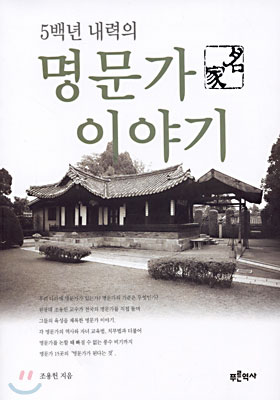
The story of a prestigious family with a 500-year history
 |
Description
Book Introduction
There is a proverb that says, "Even if you roll around in dog shit, this world is better than the next."
A proverb that clearly shows one's tenacious attachment to life.
The strong attachment our people have to life is largely due to the past 100 years of modern history, when they struggled to survive in the face of oppression and chaos.
But the author says:
What is a life of persistence?
Is this the life of an ordinary person who throws away all pride and dignity and unconditionally takes whatever food is placed in front of him?
Now is the time to talk about a life that exudes a profound fragrance and a character that knows how to keep one's integrity.
The author says he began writing this book because he wanted to "contribute to creating a new culture fit for the new millennium."
A new culture is a way of life that is dignified and humane.
And the author discovers that culture in the prestigious families of our country.
A truly prestigious family with philosophy and morality, not an immoral nouveau riche culture.
The author visited prestigious families across the country and recorded their stories, focusing on 'how their ancestors or family members lived.'
From the ancestral home of poet Jo Ji-hun to the richest family in Gyeongju, the old home of Chusa Kim Jeong-hui, and the Gangneung missionary camp.
In these days when we open our eyes to the word 'high society' and quickly become critical, this book makes us think again about what high society really is.
A proverb that clearly shows one's tenacious attachment to life.
The strong attachment our people have to life is largely due to the past 100 years of modern history, when they struggled to survive in the face of oppression and chaos.
But the author says:
What is a life of persistence?
Is this the life of an ordinary person who throws away all pride and dignity and unconditionally takes whatever food is placed in front of him?
Now is the time to talk about a life that exudes a profound fragrance and a character that knows how to keep one's integrity.
The author says he began writing this book because he wanted to "contribute to creating a new culture fit for the new millennium."
A new culture is a way of life that is dignified and humane.
And the author discovers that culture in the prestigious families of our country.
A truly prestigious family with philosophy and morality, not an immoral nouveau riche culture.
The author visited prestigious families across the country and recorded their stories, focusing on 'how their ancestors or family members lived.'
From the ancestral home of poet Jo Ji-hun to the richest family in Gyeongju, the old home of Chusa Kim Jeong-hui, and the Gangneung missionary camp.
In these days when we open our eyes to the word 'high society' and quickly become critical, this book makes us think again about what high society really is.
- You can preview some of the book's contents.
Preview
index
The ancestral home of poet Jo Ji-hun in Yeongyang, Gyeongsangbuk-do
I want to see a person with integrity!
The richest family in Gyeongju
What is the noblesse oblige of Joseon scholars?
Ki Se-hun's former residence in Gwangju, Jeollanam-do
Tradition is a strong foundation
Jeongonjongtaek in Geochang, Gyeongnam
Wait for the right time
The former residence of Haewi Yun Bo-seon in Anguk-dong
You must accumulate virtue to become a person.
Namwon Mongsimjae
I think of people who are worse off than me
Daegu Moon clan
Pass on wisdom, not money.
Yun Seon-do's former residence in Gosan, Haenam, Jeollanam-do
Live according to my will
Yesan Lee Clan Headquarters in Oeam Village, Asan, South Chungcheong Province
Aiming for spiritual nobility
Unrimsanbang, Yangcheon Heo Clan, Jindo, Jeollanam-do
If you're going to dig a well, dig only one.
Andong Uiseong Kim Clan Naeap Jongtaek
Don't live by bending your principles
The former residence of Chusa Kim Jeong-hui in Yesan, South Chungcheong Province
Hold the universe in your heart
The former residence of Song Yeong-gu, a prominent figure in Iksan, North Jeolla Province
People have different perspectives
Hakbong Jongtaek in Andong, Gyeongbuk
Pride is life itself.
Gangneung Mission Station
What does it mean to live like a human being?
I want to see a person with integrity!
The richest family in Gyeongju
What is the noblesse oblige of Joseon scholars?
Ki Se-hun's former residence in Gwangju, Jeollanam-do
Tradition is a strong foundation
Jeongonjongtaek in Geochang, Gyeongnam
Wait for the right time
The former residence of Haewi Yun Bo-seon in Anguk-dong
You must accumulate virtue to become a person.
Namwon Mongsimjae
I think of people who are worse off than me
Daegu Moon clan
Pass on wisdom, not money.
Yun Seon-do's former residence in Gosan, Haenam, Jeollanam-do
Live according to my will
Yesan Lee Clan Headquarters in Oeam Village, Asan, South Chungcheong Province
Aiming for spiritual nobility
Unrimsanbang, Yangcheon Heo Clan, Jindo, Jeollanam-do
If you're going to dig a well, dig only one.
Andong Uiseong Kim Clan Naeap Jongtaek
Don't live by bending your principles
The former residence of Chusa Kim Jeong-hui in Yesan, South Chungcheong Province
Hold the universe in your heart
The former residence of Song Yeong-gu, a prominent figure in Iksan, North Jeolla Province
People have different perspectives
Hakbong Jongtaek in Andong, Gyeongbuk
Pride is life itself.
Gangneung Mission Station
What does it mean to live like a human being?
Into the book
I met Mr. Jo Dong-gil, who currently manages this house.
After working as a civil servant in a foreign land, he retired and returned to his hometown to manage the ancestral home.
It is a meaningful way to spend the last years of one's life.
Since he is called Shin Mi-saeng, he is seventy years old this year.
Judging by his tightly closed mouth, slightly sharp eyes, and neat appearance, he is of the gold constitution type among the five elements.
People with a gold constitution usually have a samurai temperament that is precise in making and breaking connections, so they have the advantage of being clear about what they say and only talking about the main points.
The introduction is short and to the point, making it ideal for an interview.
When I was asked where I was from, I said, "I'm from Jeolla Province." He looked a bit surprised and started talking.
"In this Hoeun Jongtaek, there is a family motto that has been passed down for 370 years.
That's right, it's called Sambulcha."
- What does Sambulcha mean?
"There are three things that are not allowed.
That means you don't borrow.
First, do not borrow money from others, second, do not borrow people, and third, do not borrow words.
This Sambulcha has been preserved since the time of Grandfather Ho-eun until now."
After working as a civil servant in a foreign land, he retired and returned to his hometown to manage the ancestral home.
It is a meaningful way to spend the last years of one's life.
Since he is called Shin Mi-saeng, he is seventy years old this year.
Judging by his tightly closed mouth, slightly sharp eyes, and neat appearance, he is of the gold constitution type among the five elements.
People with a gold constitution usually have a samurai temperament that is precise in making and breaking connections, so they have the advantage of being clear about what they say and only talking about the main points.
The introduction is short and to the point, making it ideal for an interview.
When I was asked where I was from, I said, "I'm from Jeolla Province." He looked a bit surprised and started talking.
"In this Hoeun Jongtaek, there is a family motto that has been passed down for 370 years.
That's right, it's called Sambulcha."
- What does Sambulcha mean?
"There are three things that are not allowed.
That means you don't borrow.
First, do not borrow money from others, second, do not borrow people, and third, do not borrow words.
This Sambulcha has been preserved since the time of Grandfather Ho-eun until now."
--- pp.
20~21
20~21
Self-transcendence: living in a detached state,
Be gentle with others: Be gentle with others.
When there is no work to do, live in a clear and peaceful manner.
In times of emergency, be brave and act courageously.
When you get the idea, act calmly.
When you are depressed, act calmly.
Self-transcendence: living in a detached state,
Be gentle with others: Be gentle with others.
When there is no work to do, live in a clear and peaceful manner.
In times of emergency, be brave and act courageously.
When you get the idea, act calmly.
When you are depressed, act calmly.
Be gentle with others: Be gentle with others.
When there is no work to do, live in a clear and peaceful manner.
In times of emergency, be brave and act courageously.
When you get the idea, act calmly.
When you are depressed, act calmly.
Self-transcendence: living in a detached state,
Be gentle with others: Be gentle with others.
When there is no work to do, live in a clear and peaceful manner.
In times of emergency, be brave and act courageously.
When you get the idea, act calmly.
When you are depressed, act calmly.
--- p.128
An old house at 8 Anguk-dong.
It is said that this house was originally built by a nobleman with the surname Min around 130 years ago, during the late Joseon Dynasty.
He was a man of great character, nicknamed 'Min Bu-sa', and the rumor that he was building a huge mansion with over 99 rooms by mobilizing the famous tile builders of the capital reached the ears of the then king, Gojong.
King Gojong summoned Min Bu-sa and questioned him, "You say you are building a house as big as a palace. Do you have any intention of treason?"
At this time, the response from the Ministry of Civil Affairs is a masterpiece.
"This house is where Buddha lives."
The house where Buddha lives refers to a Buddhist temple, and if it is a temple, it can naturally be built large.
At the same time, since his nickname is Buddha, it also means that this is the house he will live in.
It is said that even King Gojong burst out laughing at this witty improvisation and just let it go.
After that, King Gojong heard that Park Yeong-hyo, who had been in exile in Japan and then returned to Korea, had no suitable place to live, so he ordered the Min Department to hand over a house to Park Yeong-hyo, and it is said that Park Yeong-hyo lived there for a while.
The house right next door, separated by a wall, is the house where Park Ji-won, the author of “Yeolha Diary” and “Heosaengjeon,” and Park Gyu-su, the grandson of Yeonam and a leader of the reformist faction, lived. One of only a few white pine trees in the country still stands there, guarding the site.
It has now been changed to the Constitutional Court.
Looking at the history of the Enlightenment Period, Park Yeong-hyo participated in the Gapsin Coup, but when it failed, he went into exile in Japan for the first time. After that, while serving as a minister in Kim Hong-jip's cabinet, he participated in a plot to dethrone Emperor Gojong, went into exile in Japan again, and returned to Korea in 1907 and was pardoned.
Considering the circumstances surrounding his two exiles to Japan and his return to Korea, it is likely that Park Yeong-hyo began living in this house around the late 1880s, when he returned from his first exile.
Since the plaque that Kim Ok-gyun wrote for Park Yeong-hyo remains in this house, it is unlikely that it was after his second exile.
Afterwards, it was briefly owned by a person with the surname Kim, and then in the 1910s, the Yoon family purchased the house. Since then, the Yoon family has lived here and it remains the main house to this day.
An old house at 8 Anguk-dong.
It is said that this house was originally built by a nobleman with the surname Min around 130 years ago, during the late Joseon Dynasty.
He was a man of great character, nicknamed 'Min Bu-sa', and the rumor that he was building a huge mansion with over 99 rooms by mobilizing the famous tile builders of the capital reached the ears of the then king, Gojong.
King Gojong summoned Min Bu-sa and questioned him, "You say you are building a house as big as a palace. Do you have any intention of treason?"
At this time, the response from the Ministry of Civil Affairs is a masterpiece.
"This house is where Buddha lives."
The house where Buddha lives refers to a Buddhist temple, and if it is a temple, it can naturally be built large.
At the same time, since his nickname is Buddha, it also means that this is the house he will live in.
It is said that even King Gojong burst out laughing at this witty improvisation and just let it go.
After that, King Gojong heard that Park Yeong-hyo, who had been in exile in Japan and then returned to Korea, had no suitable place to live, so he ordered the Min Department to hand over a house to Park Yeong-hyo, and it is said that Park Yeong-hyo lived there for a while.
The house right next door, separated by a wall, is the house where Park Ji-won, the author of “Yeolha Diary” and “Heosaengjeon,” and Park Gyu-su, the grandson of Yeonam and a leader of the reformist faction, lived. One of only a few white pine trees in the country still stands there, guarding the site.
It has now been changed to the Constitutional Court.
Looking at the history of the Enlightenment Period, Park Yeong-hyo participated in the Gapsin Coup, but when it failed, he went into exile in Japan for the first time. After that, while serving as a minister in Kim Hong-jip's cabinet, he participated in a plot to dethrone Emperor Gojong, went into exile in Japan again, and returned to Korea in 1907 and was pardoned.
Considering the circumstances surrounding his two exiles to Japan and his return to Korea, it is likely that Park Yeong-hyo began living in this house around the late 1880s, when he returned from his first exile.
Since the plaque that Kim Ok-gyun wrote for Park Yeong-hyo remains in this house, it is unlikely that it was after his second exile.
Afterwards, it was briefly owned by a person with the surname Kim, and then in the 1910s, the Yoon family purchased the house. Since then, the Yoon family has lived here and it remains the main house to this day.
It is said that this house was originally built by a nobleman with the surname Min around 130 years ago, during the late Joseon Dynasty.
He was a man of great character, nicknamed 'Min Bu-sa', and the rumor that he was building a huge mansion with over 99 rooms by mobilizing the famous tile builders of the capital reached the ears of the then king, Gojong.
King Gojong summoned Min Bu-sa and questioned him, "You say you are building a house as big as a palace. Do you have any intention of treason?"
At this time, the response from the Ministry of Civil Affairs is a masterpiece.
"This house is where Buddha lives."
The house where Buddha lives refers to a Buddhist temple, and if it is a temple, it can naturally be built large.
At the same time, since his nickname is Buddha, it also means that this is the house he will live in.
It is said that even King Gojong burst out laughing at this witty improvisation and just let it go.
After that, King Gojong heard that Park Yeong-hyo, who had been in exile in Japan and then returned to Korea, had no suitable place to live, so he ordered the Min Department to hand over a house to Park Yeong-hyo, and it is said that Park Yeong-hyo lived there for a while.
The house right next door, separated by a wall, is the house where Park Ji-won, the author of “Yeolha Diary” and “Heosaengjeon,” and Park Gyu-su, the grandson of Yeonam and a leader of the reformist faction, lived. One of only a few white pine trees in the country still stands there, guarding the site.
It has now been changed to the Constitutional Court.
Looking at the history of the Enlightenment Period, Park Yeong-hyo participated in the Gapsin Coup, but when it failed, he went into exile in Japan for the first time. After that, while serving as a minister in Kim Hong-jip's cabinet, he participated in a plot to dethrone Emperor Gojong, went into exile in Japan again, and returned to Korea in 1907 and was pardoned.
Considering the circumstances surrounding his two exiles to Japan and his return to Korea, it is likely that Park Yeong-hyo began living in this house around the late 1880s, when he returned from his first exile.
Since the plaque that Kim Ok-gyun wrote for Park Yeong-hyo remains in this house, it is unlikely that it was after his second exile.
Afterwards, it was briefly owned by a person with the surname Kim, and then in the 1910s, the Yoon family purchased the house. Since then, the Yoon family has lived here and it remains the main house to this day.
An old house at 8 Anguk-dong.
It is said that this house was originally built by a nobleman with the surname Min around 130 years ago, during the late Joseon Dynasty.
He was a man of great character, nicknamed 'Min Bu-sa', and the rumor that he was building a huge mansion with over 99 rooms by mobilizing the famous tile builders of the capital reached the ears of the then king, Gojong.
King Gojong summoned Min Bu-sa and questioned him, "You say you are building a house as big as a palace. Do you have any intention of treason?"
At this time, the response from the Ministry of Civil Affairs is a masterpiece.
"This house is where Buddha lives."
The house where Buddha lives refers to a Buddhist temple, and if it is a temple, it can naturally be built large.
At the same time, since his nickname is Buddha, it also means that this is the house he will live in.
It is said that even King Gojong burst out laughing at this witty improvisation and just let it go.
After that, King Gojong heard that Park Yeong-hyo, who had been in exile in Japan and then returned to Korea, had no suitable place to live, so he ordered the Min Department to hand over a house to Park Yeong-hyo, and it is said that Park Yeong-hyo lived there for a while.
The house right next door, separated by a wall, is the house where Park Ji-won, the author of “Yeolha Diary” and “Heosaengjeon,” and Park Gyu-su, the grandson of Yeonam and a leader of the reformist faction, lived. One of only a few white pine trees in the country still stands there, guarding the site.
It has now been changed to the Constitutional Court.
Looking at the history of the Enlightenment Period, Park Yeong-hyo participated in the Gapsin Coup, but when it failed, he went into exile in Japan for the first time. After that, while serving as a minister in Kim Hong-jip's cabinet, he participated in a plot to dethrone Emperor Gojong, went into exile in Japan again, and returned to Korea in 1907 and was pardoned.
Considering the circumstances surrounding his two exiles to Japan and his return to Korea, it is likely that Park Yeong-hyo began living in this house around the late 1880s, when he returned from his first exile.
Since the plaque that Kim Ok-gyun wrote for Park Yeong-hyo remains in this house, it is unlikely that it was after his second exile.
Afterwards, it was briefly owned by a person with the surname Kim, and then in the 1910s, the Yoon family purchased the house. Since then, the Yoon family has lived here and it remains the main house to this day.
--- pp.
121~122
121~122
There is a saying, “It is difficult for a wealthy person to survive beyond three generations.”
As I watch the conglomerates collapsing one after another these days, I think again about these words from the elders.
Witnessing the vain collapse and bankruptcy of Korean conglomerates that were thought to last for 100 years, I am realizing the truth of the matter: it is by no means easy for a wealthy family to survive for three generations.
It is quick to achieve, but it is also quick to fail.
Like the Baekdudaegan mountain range, which stretches for three thousand miles, is there no such thing as a long-lived wealthy man who has endured for more than three generations? I long to see that long-lived wealthy man.
The reason I visited the richest family was because I wanted to see the list of the rich, not the nouveau riche.
I want to learn the long-term experience of life by looking at the family tree that has been around for more than three generations.
It's not that there is no list in Korea.
There is a list in Korea too.
That house is the richest house in Gyeongju.
The Choi family was a well-known family throughout the eight provinces of Joseon, with nine generations of Jinsa (scholars) and 12 generations of Manseok (students with a high salary).
The house of the 9th Jinsa and the 12th Manseokgun.
There are many families that have made a fortune if you look for them, but this family is probably the only one in all of Joseon's eight provinces that has made a fortune for 12 generations.
This record is likely to be an unprecedented one that will be difficult to break in the future.
It's hard enough to have 3 generations, so how did you manage to have 12?
There must have been some experience and philosophy that enabled the family to continue for 12 generations. What exactly was it? With these questions in mind, I boarded the train to Gyeongju.
There is a saying, “It is difficult for a wealthy person to survive beyond three generations.”
As I watch the conglomerates collapsing one after another these days, I think again about these words from the elders.
Witnessing the vain collapse and bankruptcy of Korean conglomerates that were thought to last for 100 years, I am realizing the truth of the matter: it is by no means easy for a wealthy family to survive for three generations.
It is quick to achieve, but it is also quick to fail.
Like the Baekdudaegan mountain range, which stretches for three thousand miles, is there no such thing as a long-lived wealthy man who has endured for more than three generations? I long to see that long-lived wealthy man.
The reason I visited the richest family was because I wanted to see the list of the rich, not the nouveau riche.
I want to learn the long-term experience of life by looking at the family tree that has been around for more than three generations.
It's not that there is no list in Korea.
There is a list in Korea too.
That house is the richest house in Gyeongju.
The Choi family was a well-known family throughout the eight provinces of Joseon, with nine generations of Jinsa (scholars) and 12 generations of Manseok (students with a high salary).
The house of the 9th Jinsa and the 12th Manseokgun.
There are many families that have made a fortune if you look for them, but this family is probably the only one in all of Joseon's eight provinces that has made a fortune for 12 generations.
This record is likely to be an unprecedented one that will be difficult to break in the future.
It's hard enough to have 3 generations, so how did you manage to have 12?
There must have been some experience and philosophy that enabled the family to continue for 12 generations. What exactly was it? With these questions in mind, I boarded the train to Gyeongju.
As I watch the conglomerates collapsing one after another these days, I think again about these words from the elders.
Witnessing the vain collapse and bankruptcy of Korean conglomerates that were thought to last for 100 years, I am realizing the truth of the matter: it is by no means easy for a wealthy family to survive for three generations.
It is quick to achieve, but it is also quick to fail.
Like the Baekdudaegan mountain range, which stretches for three thousand miles, is there no such thing as a long-lived wealthy man who has endured for more than three generations? I long to see that long-lived wealthy man.
The reason I visited the richest family was because I wanted to see the list of the rich, not the nouveau riche.
I want to learn the long-term experience of life by looking at the family tree that has been around for more than three generations.
It's not that there is no list in Korea.
There is a list in Korea too.
That house is the richest house in Gyeongju.
The Choi family was a well-known family throughout the eight provinces of Joseon, with nine generations of Jinsa (scholars) and 12 generations of Manseok (students with a high salary).
The house of the 9th Jinsa and the 12th Manseokgun.
There are many families that have made a fortune if you look for them, but this family is probably the only one in all of Joseon's eight provinces that has made a fortune for 12 generations.
This record is likely to be an unprecedented one that will be difficult to break in the future.
It's hard enough to have 3 generations, so how did you manage to have 12?
There must have been some experience and philosophy that enabled the family to continue for 12 generations. What exactly was it? With these questions in mind, I boarded the train to Gyeongju.
There is a saying, “It is difficult for a wealthy person to survive beyond three generations.”
As I watch the conglomerates collapsing one after another these days, I think again about these words from the elders.
Witnessing the vain collapse and bankruptcy of Korean conglomerates that were thought to last for 100 years, I am realizing the truth of the matter: it is by no means easy for a wealthy family to survive for three generations.
It is quick to achieve, but it is also quick to fail.
Like the Baekdudaegan mountain range, which stretches for three thousand miles, is there no such thing as a long-lived wealthy man who has endured for more than three generations? I long to see that long-lived wealthy man.
The reason I visited the richest family was because I wanted to see the list of the rich, not the nouveau riche.
I want to learn the long-term experience of life by looking at the family tree that has been around for more than three generations.
It's not that there is no list in Korea.
There is a list in Korea too.
That house is the richest house in Gyeongju.
The Choi family was a well-known family throughout the eight provinces of Joseon, with nine generations of Jinsa (scholars) and 12 generations of Manseok (students with a high salary).
The house of the 9th Jinsa and the 12th Manseokgun.
There are many families that have made a fortune if you look for them, but this family is probably the only one in all of Joseon's eight provinces that has made a fortune for 12 generations.
This record is likely to be an unprecedented one that will be difficult to break in the future.
It's hard enough to have 3 generations, so how did you manage to have 12?
There must have been some experience and philosophy that enabled the family to continue for 12 generations. What exactly was it? With these questions in mind, I boarded the train to Gyeongju.
--- p.
42
42
Publisher's Review
1.
Why a prestigious family?
The book "500 Years of Stories of Prestigious Families" was published, which visited 15 prestigious families across the country and shed light on the history, spirit, past and present of each family.
Why, at this new millennium, is the story of a prestigious family being brought up again? Professor Cho Yong-heon, the author of this book, answers, "Because I want to contribute to creating a new culture befitting the new millennium."
Here, the new culture refers to a way of life that maintains pride and dignity.
It is time to talk about a humane and dignified life that we have neglected in the past while trying to survive and make a living.
The author expressed this as 'quality of life'.
Of course, quality of life is deeply connected to economic power, but it does not automatically arise simply from having economic power.
This is precisely the question the author was concerned with and sought to uncover in this book.
How can we live a life worthy of humanity, dignity, and quality? Who on this earth has lived, or is living, that way?
2.
To create a respected upper-class culture
This book, “The Story of a Prestigious Family with 500 Years of History,” was born from these concerns.
Here, we can see that the author's idea of a prestigious family refers to people who have a certain level of economic power and who have lived a life of dignity and humanity.
People who can truly be called upper class.
Now, an upper class society or upper class culture is being formed in Korean society as well.
In any country, there is bound to be an upper class society.
The more an upper class society with philosophy and morality exists, the more stable that society becomes, and the higher the quality of life for all its members.
The author now diagnoses that the era of the immoral nouveau riche has passed and that it is time for a proper upper class to emerge in Korean society.
So, I hope this book will be helpful in forming a respected upper-class culture.
So what constitutes true upper-class culture? How should one live to become a member of a prestigious family? What are the criteria for "selecting" a prestigious family? The author suggests several criteria, but the most important of these is "how the family's ancestors or members lived."
Having a lot of money or a high official position does not make you a prestigious family.
In a word, a noble family is a family that has lived a life in accordance with truth, goodness, and beauty for generations.
3.
The common thread between ancient Romans and Joseon scholars: Noblesse Oblige
The important concept the author brings up in this section is ‘Noblesse Oblige.’
Nanami Shiono, author of "The Story of the Romans," has revealed that the philosophy that sustained Rome for a thousand years was noblesse oblige.
However, Professor Cho Yong-heon says that this is also what our country's prestigious families have in common.
Noblesse oblige translates to 'responsibility of the privileged' or 'leadership by example of the privileged class.'
When war broke out, the Roman nobles took the lead, went to the front lines, shed blood, and returned their precious wealth to society for the public good.
There was a strong belief that the nobility had to take on social responsibility.
The nobles were responsible, while slaves and commoners had no or little responsibility.
Here came the leadership that led Rome.
This does not simply mean a moral obligation for those who have to give to those who do not.
Shiono's argument, and Professor Cho Yong-heon's argument, is that noblesse oblige is for the sake of the person who practices it, and is meant to improve the quality of their lives and find meaning in life.
4.
The principle of mutual existence, where you must live for me to live
This part, where he says that he improved the quality of his life through moral obligation, is important.
The principles of life pursued by the noble families of this land were not simply moral practices, but rather a way for them to find meaning and fulfillment in being born into this world.
This is in line with our traditional belief that 'a house that has done many good deeds will surely have many blessings.'
A family that cares about those less fortunate and struggling than themselves is bound to gain the trust of those around them, and as a result, there is a high possibility that they will unknowingly experience good fortune through the help of those around them.
Therefore, noblesse oblige can be said to be a value of coexistence where ‘I live, you live.’
It is because of this spirit that the family has survived to this day.
The author argues that while the Medici family of Italy, which supported the Renaissance, was great, the richest family in Gyeongju, who had been a wealthy family for nearly 300 years and 12 generations, was a family with an equally great philosophy and beliefs.
5.
A prestigious family must maintain an old house.
So what is the basis for understanding how the people in that family lived? The most substantial source is the old house.
The author said that, first of all, a house must still maintain its traditional architecture to be considered a prestigious family.
Maintaining these old houses to this day, despite the harsh winds of Westernization and industrialization, is impossible unless you are a prominent family with a strong economic foundation.
And it is only natural that the families that have maintained these old houses to this day are families that are deeply conscious of their historical significance.
The actions of people who are conscious of history and those who are not are bound to be different.
Of course, the history and social contribution of a family are not necessarily proportional, but the fact that a family has preserved an old house for 400 to 500 years is a remarkable feat in itself.
The family of Gobong Gi Dae-seung (1527-1572) in Gwangju, the ancestral home of Hakbong Kim Seong-il (1538-1593) in Andong, and the family of Gosan Yun Seon-do (1587-1671) in Haenam maintain these old houses.
6.
A prestigious family must produce talented people.
Among the families that maintain prestigious old houses, there are many that have produced many great figures from the past and present.
In particular, the founders who founded the family were famous figures of their time.
Many of their descendants are still active in various parts of society today.
The Yun Bo-seon family in Anguk-dong, Seoul is a representative example, and there are nearly 50 Yuns from this family listed in the Dictionary of Korean Names.
Meanwhile, Jindo's Unrimsanbang is a family that has produced painters for five generations since Sochi Heo Ryeon (1808-1893), and the Juksan Park clan of Namwon Mongsimjae has produced 40 Won Buddhism priests.
Since ancient times, only when a person of character emerges can an old house be maintained.
7.
The principles of wind and water that support prestigious families
The three things above are conditions that anyone can agree on.
The author adds the principles of wind and water here.
The author, who has visited prestigious traditional houses across the country, emphasizes that knowledge of feng shui is necessary to deeply understand Korea's prestigious traditional houses.
And he explains that the core of Feng Shui lies in the harmony between nature and man-made things.
Not only are the houses of prestigious families built without damaging the energy of the land, but if we look deeper, they are also built based on the Eastern idea of Samjae (三才), which believes that astronomy, geography, and human resources are organically connected.
Examples include the Seonyojang in Gangneung, which is considered the most beautiful old house in Korea, the ancestral home of the Yean Lee clan in Oeam Village, South Chungcheong Province, the Mangmodang in the royal palace of Iksan, North Jeolla Province, the Donggye House in Geochang, South Gyeongsang Province, and the old house of Chusa Kim Jeong-hui in Yesan.
Why a prestigious family?
The book "500 Years of Stories of Prestigious Families" was published, which visited 15 prestigious families across the country and shed light on the history, spirit, past and present of each family.
Why, at this new millennium, is the story of a prestigious family being brought up again? Professor Cho Yong-heon, the author of this book, answers, "Because I want to contribute to creating a new culture befitting the new millennium."
Here, the new culture refers to a way of life that maintains pride and dignity.
It is time to talk about a humane and dignified life that we have neglected in the past while trying to survive and make a living.
The author expressed this as 'quality of life'.
Of course, quality of life is deeply connected to economic power, but it does not automatically arise simply from having economic power.
This is precisely the question the author was concerned with and sought to uncover in this book.
How can we live a life worthy of humanity, dignity, and quality? Who on this earth has lived, or is living, that way?
2.
To create a respected upper-class culture
This book, “The Story of a Prestigious Family with 500 Years of History,” was born from these concerns.
Here, we can see that the author's idea of a prestigious family refers to people who have a certain level of economic power and who have lived a life of dignity and humanity.
People who can truly be called upper class.
Now, an upper class society or upper class culture is being formed in Korean society as well.
In any country, there is bound to be an upper class society.
The more an upper class society with philosophy and morality exists, the more stable that society becomes, and the higher the quality of life for all its members.
The author now diagnoses that the era of the immoral nouveau riche has passed and that it is time for a proper upper class to emerge in Korean society.
So, I hope this book will be helpful in forming a respected upper-class culture.
So what constitutes true upper-class culture? How should one live to become a member of a prestigious family? What are the criteria for "selecting" a prestigious family? The author suggests several criteria, but the most important of these is "how the family's ancestors or members lived."
Having a lot of money or a high official position does not make you a prestigious family.
In a word, a noble family is a family that has lived a life in accordance with truth, goodness, and beauty for generations.
3.
The common thread between ancient Romans and Joseon scholars: Noblesse Oblige
The important concept the author brings up in this section is ‘Noblesse Oblige.’
Nanami Shiono, author of "The Story of the Romans," has revealed that the philosophy that sustained Rome for a thousand years was noblesse oblige.
However, Professor Cho Yong-heon says that this is also what our country's prestigious families have in common.
Noblesse oblige translates to 'responsibility of the privileged' or 'leadership by example of the privileged class.'
When war broke out, the Roman nobles took the lead, went to the front lines, shed blood, and returned their precious wealth to society for the public good.
There was a strong belief that the nobility had to take on social responsibility.
The nobles were responsible, while slaves and commoners had no or little responsibility.
Here came the leadership that led Rome.
This does not simply mean a moral obligation for those who have to give to those who do not.
Shiono's argument, and Professor Cho Yong-heon's argument, is that noblesse oblige is for the sake of the person who practices it, and is meant to improve the quality of their lives and find meaning in life.
4.
The principle of mutual existence, where you must live for me to live
This part, where he says that he improved the quality of his life through moral obligation, is important.
The principles of life pursued by the noble families of this land were not simply moral practices, but rather a way for them to find meaning and fulfillment in being born into this world.
This is in line with our traditional belief that 'a house that has done many good deeds will surely have many blessings.'
A family that cares about those less fortunate and struggling than themselves is bound to gain the trust of those around them, and as a result, there is a high possibility that they will unknowingly experience good fortune through the help of those around them.
Therefore, noblesse oblige can be said to be a value of coexistence where ‘I live, you live.’
It is because of this spirit that the family has survived to this day.
The author argues that while the Medici family of Italy, which supported the Renaissance, was great, the richest family in Gyeongju, who had been a wealthy family for nearly 300 years and 12 generations, was a family with an equally great philosophy and beliefs.
5.
A prestigious family must maintain an old house.
So what is the basis for understanding how the people in that family lived? The most substantial source is the old house.
The author said that, first of all, a house must still maintain its traditional architecture to be considered a prestigious family.
Maintaining these old houses to this day, despite the harsh winds of Westernization and industrialization, is impossible unless you are a prominent family with a strong economic foundation.
And it is only natural that the families that have maintained these old houses to this day are families that are deeply conscious of their historical significance.
The actions of people who are conscious of history and those who are not are bound to be different.
Of course, the history and social contribution of a family are not necessarily proportional, but the fact that a family has preserved an old house for 400 to 500 years is a remarkable feat in itself.
The family of Gobong Gi Dae-seung (1527-1572) in Gwangju, the ancestral home of Hakbong Kim Seong-il (1538-1593) in Andong, and the family of Gosan Yun Seon-do (1587-1671) in Haenam maintain these old houses.
6.
A prestigious family must produce talented people.
Among the families that maintain prestigious old houses, there are many that have produced many great figures from the past and present.
In particular, the founders who founded the family were famous figures of their time.
Many of their descendants are still active in various parts of society today.
The Yun Bo-seon family in Anguk-dong, Seoul is a representative example, and there are nearly 50 Yuns from this family listed in the Dictionary of Korean Names.
Meanwhile, Jindo's Unrimsanbang is a family that has produced painters for five generations since Sochi Heo Ryeon (1808-1893), and the Juksan Park clan of Namwon Mongsimjae has produced 40 Won Buddhism priests.
Since ancient times, only when a person of character emerges can an old house be maintained.
7.
The principles of wind and water that support prestigious families
The three things above are conditions that anyone can agree on.
The author adds the principles of wind and water here.
The author, who has visited prestigious traditional houses across the country, emphasizes that knowledge of feng shui is necessary to deeply understand Korea's prestigious traditional houses.
And he explains that the core of Feng Shui lies in the harmony between nature and man-made things.
Not only are the houses of prestigious families built without damaging the energy of the land, but if we look deeper, they are also built based on the Eastern idea of Samjae (三才), which believes that astronomy, geography, and human resources are organically connected.
Examples include the Seonyojang in Gangneung, which is considered the most beautiful old house in Korea, the ancestral home of the Yean Lee clan in Oeam Village, South Chungcheong Province, the Mangmodang in the royal palace of Iksan, North Jeolla Province, the Donggye House in Geochang, South Gyeongsang Province, and the old house of Chusa Kim Jeong-hui in Yesan.
GOODS SPECIFICS
- Date of issue: January 31, 2002
- Page count, weight, size: 389 pages | 375g | 172*225*30mm
- ISBN13: 9788987787404
- ISBN10: 8987787400
You may also like
카테고리
korean


korean

![GQ KOREA Mark (Monthly): December [2025]](http://librairie.coreenne.fr/cdn/shop/files/8ef265dbbfbf186523ed75ba7319009d.jpg?v=1765340328&width=3840)


