

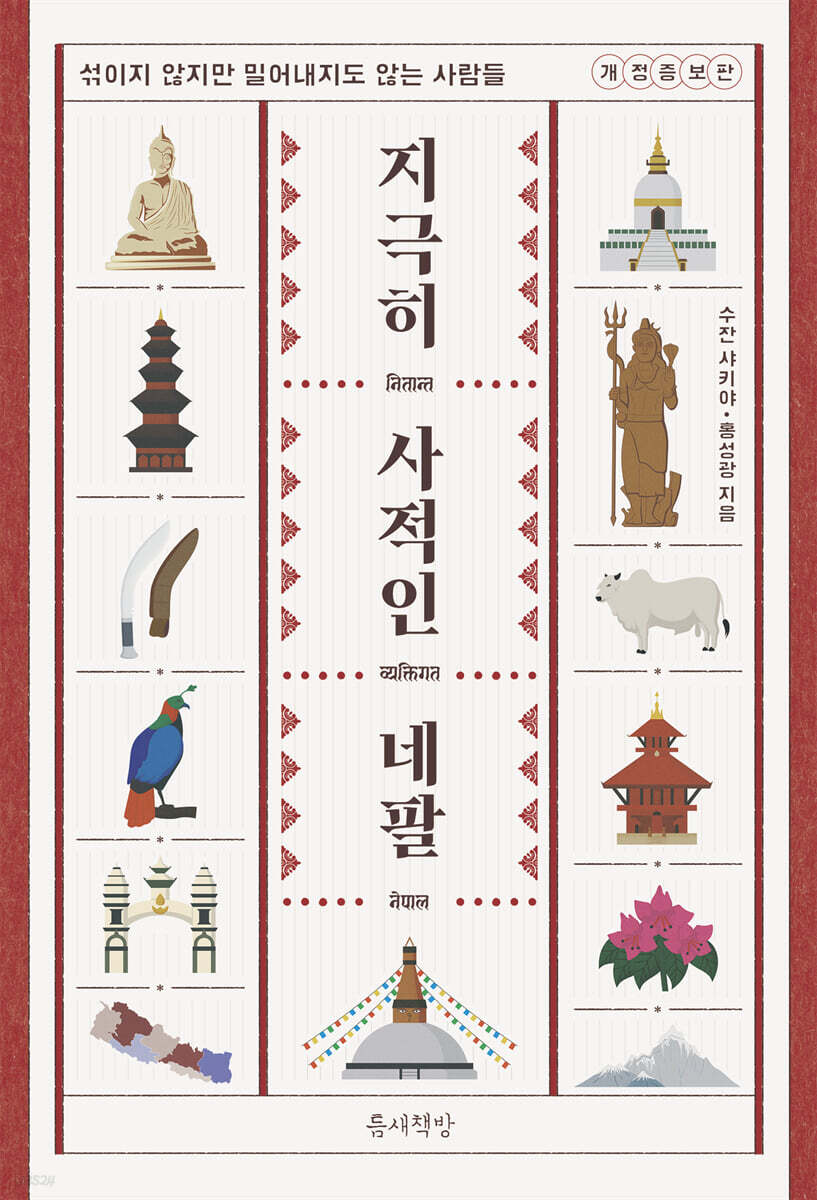
Nepal, a very private place
 |
Description
Book Introduction
ㆍA must-read for travelers to Nepal: 『Extremely Private Nepal』, revised and expanded edition
Bestsellers recommended by former President Moon Jae-in and poet Lee Byeong-ryul
The story has been enriched with the addition of an interview with a current Gurkha mercenary and a Korean bride's observations of Nepalese culture after marrying Susan.
The popular book in the "Guide for Earth Travelers" series from Niche Bookstore, "Extremely Private Nepal," has returned in a revised and expanded edition.
The first edition received a lot of attention and became a bestseller thanks to a recommendation from poet Lee Byeong-ryul and a mention on social media by former President Moon Jae-in.
This book, in which a Nepali person introduces his homeland to Korean readers, has received a great response by honestly capturing the inner workings of Nepal and the emotions of its people, which are difficult to understand unless you are a local.
The 'Guide for Travelers of the Earth' series has captivated readers interested in the differences between foreign and Korean cultures with books such as 'Extremely Private Italy' (Alberto Mondi), 'Extremely Private France' (Ohélionn Loubert), 'Extremely Private Nepal' (Susan Shakya), 'Extremely Private Russia' (Belyakov Ilya), and 'Extremely Private Japan' (Narikawa Aya).
The friendly and heartfelt stories of our homeland, like those told by a local to a friend, stimulate intellectual curiosity and make us reflect on who we are.
Another attraction of this series is that by following the culture and emotions of each country, we can gauge Korea's place in the world.
This revised and expanded edition includes two new stories that were not included in the first edition published in March 2022.
One is an in-depth interview with Sergeant Paras Gurung of the world-renowned Royal Gurkha Rifles.
It clearly answers questions about the Gurkhas, including the rigorous selection process, the pride of being a Gurkha, and the conditions required if the Korean military were to operate a Gurkha unit.
Another is 'Nepali Cultural Observation' by the author's wife, Song Hyeon-jeong, who is Korean.
It delicately depicts how 'Nepali-style respect and consideration' works, which sometimes even causes a sense of alienation while marrying a Nepali and living with a large Nepali family.
This vividly conveys that Nepal is a country built on a cultural foundation that respects and awes each other's differences.
The daily life of a Nepalese extended family, especially from the perspective of a Korean woman, transcends the pressures of married life and relationship conflicts that the term "extended family" conjures up, and reminds us of the true meaning of family and the precious values we have forgotten.
Bestsellers recommended by former President Moon Jae-in and poet Lee Byeong-ryul
The story has been enriched with the addition of an interview with a current Gurkha mercenary and a Korean bride's observations of Nepalese culture after marrying Susan.
The popular book in the "Guide for Earth Travelers" series from Niche Bookstore, "Extremely Private Nepal," has returned in a revised and expanded edition.
The first edition received a lot of attention and became a bestseller thanks to a recommendation from poet Lee Byeong-ryul and a mention on social media by former President Moon Jae-in.
This book, in which a Nepali person introduces his homeland to Korean readers, has received a great response by honestly capturing the inner workings of Nepal and the emotions of its people, which are difficult to understand unless you are a local.
The 'Guide for Travelers of the Earth' series has captivated readers interested in the differences between foreign and Korean cultures with books such as 'Extremely Private Italy' (Alberto Mondi), 'Extremely Private France' (Ohélionn Loubert), 'Extremely Private Nepal' (Susan Shakya), 'Extremely Private Russia' (Belyakov Ilya), and 'Extremely Private Japan' (Narikawa Aya).
The friendly and heartfelt stories of our homeland, like those told by a local to a friend, stimulate intellectual curiosity and make us reflect on who we are.
Another attraction of this series is that by following the culture and emotions of each country, we can gauge Korea's place in the world.
This revised and expanded edition includes two new stories that were not included in the first edition published in March 2022.
One is an in-depth interview with Sergeant Paras Gurung of the world-renowned Royal Gurkha Rifles.
It clearly answers questions about the Gurkhas, including the rigorous selection process, the pride of being a Gurkha, and the conditions required if the Korean military were to operate a Gurkha unit.
Another is 'Nepali Cultural Observation' by the author's wife, Song Hyeon-jeong, who is Korean.
It delicately depicts how 'Nepali-style respect and consideration' works, which sometimes even causes a sense of alienation while marrying a Nepali and living with a large Nepali family.
This vividly conveys that Nepal is a country built on a cultural foundation that respects and awes each other's differences.
The daily life of a Nepalese extended family, especially from the perspective of a Korean woman, transcends the pressures of married life and relationship conflicts that the term "extended family" conjures up, and reminds us of the true meaning of family and the precious values we have forgotten.
- You can preview some of the book's contents.
Preview
index
Recommendation
prolog
If you meet God, greet him like this: “Namaste.”
The tears of Romeo and Juliet are also found in Nepal.
What I do is my caste
We are the descendants of Krishna
The world's youngest republic
Why Nepalese Beer Is Hard to Find in Korea
Even cow dung is sacred
The Himalayas, a haven for the eyes
Those who protect the mountains and gods
The Himalayan climb that changed my life
Kumari, the living goddess
It's better to die than to be a coward.
A necklace of hundreds of flowers
Why Nepalese Love the Incheon Asian Games
People who don't mix but don't push each other away
My name is Susan Shakiya, born in 2044.
Welcome to the festival, God
Side Story | A Korean Wife's Observations of Nepali Culture
Epilogue
prolog
If you meet God, greet him like this: “Namaste.”
The tears of Romeo and Juliet are also found in Nepal.
What I do is my caste
We are the descendants of Krishna
The world's youngest republic
Why Nepalese Beer Is Hard to Find in Korea
Even cow dung is sacred
The Himalayas, a haven for the eyes
Those who protect the mountains and gods
The Himalayan climb that changed my life
Kumari, the living goddess
It's better to die than to be a coward.
A necklace of hundreds of flowers
Why Nepalese Love the Incheon Asian Games
People who don't mix but don't push each other away
My name is Susan Shakiya, born in 2044.
Welcome to the festival, God
Side Story | A Korean Wife's Observations of Nepali Culture
Epilogue
Detailed image
.jpg)
Into the book
This book is primarily intended to introduce the country of Nepal, but it also contains personal stories about my experiences growing up.
I may not dare to represent Nepal, but I am the only one who can represent Nepali Sujan Sakya.
If it were my story, not Nepal's, I could tell it proudly.
--- From "Prologue | Fate Led Me Here"
The palms together in the prayer pose is the easiest and most basic of all mudras.
It means that the moment your palms meet, likes and dislikes disappear and peace comes.
This is also why the name of the easiest yoga pose is Namaste.
It means that we should make sure that no one gets hurt.
It's about taking care of not only myself but also the people around me.
--- From "If you meet God, greet him like this, 'Namaste'"
I think there is at least an unspoken agreement among Nepalese people not to create conflict because of marriage.
It's not just marriage.
Do not interfere with or treat the culture of other peoples carelessly.
Likewise, other ethnic groups respect and care for our culture.
There is no ethnic conflict in Nepal.
There is no religious conflict.
Respect but don't interfere.
--- From "The Tears of 'Romeo and Juliet' Are Also in Nepal"
Shakyamuni is a transliteration of the Sanskrit word Shakyamuni.
Shakimuni means 'Sage of the Shakyas'.
The Shakya that appears here is the Shakya of our family.
And that's not all.
In Nepal, the living goddess Kumari is selected from the Shakya or Bajracharya clan.
In particular, the Royal Kumari of Kathmandu is selected only from the Shakya family.
My second younger sister was also nominated as a Kumari candidate when she was young.
It fell right away though.
--- From "What I Do Is My Caste"
Finally, let me make one more request: let us avoid saying that the birthplace of Buddha is India.
The birthplace of Buddha is present-day Lumbini, Nepal.
It is not reasonable to ask about his nationality, as he was born in a region close to India and at a time when the country of Nepal did not exist, but Nepalese people believe that Shakyamuni was Nepali.
In Nepal, saying that Buddha was Indian is similar to saying in Korea that Dokdo is Japanese territory.
Let's not say unnecessary things.
--- From "Why it's hard to drink Nepalese beer in Korea"
Because cows are so sacred, ridiculous things often happen.
If I have a neighbor who is on bad terms with me, I let my cows graze on the field where that neighbor farms.
You can't throw stones at a cow or chase it away.
You just have to hope that they will figure it out.
There's no use going to your neighbors and complaining.
Just pretend to be embarrassed and say, “What can I do if the cow goes into your field?”
If both houses raise cattle, endless retaliation will occur.
So, a house without a cow is in trouble.
This is because there is no means of defense in civil law.
--- From "Even Cow Dung Is Sacred"
Hindus in Nepal believe that gods live in the mountains.
Among them, the Himalayas are thought to be the place where the god Shiva lived and meditated.
It is the most sacred place.
The famous peaks over 8,000 meters are each named after a god.
Everest is called 'Sagarmatha' or 'Chomolangma'.
'Seogeore' means 'sky' and 'mata' means 'above the head'.
It means 'higher than the sky'.
'Chomollangma' means 'mother of the world' in Tibetan.
--- From "The Himalayas, a Sanctuary for the Eyes"
In Tibetan, Lungta means wind horse.
There is a belief that if you write a Buddhist scripture here, make a wish, and hang it up, the wind will convey your wish to the mountain.
All of this is a ritual to ask for blessings so that you can return safely from the mountain.
Even ordinary people can wear longta if they want.
It is also a good idea to walk along the Lungta with the Sherpas while making a wish during the ceremony.
--- From "The Himalayan Climb That Changed My Life"
Kumari was a destiny given to me.
It's not like I can say I want to do it.
In Nepal, there are many people who believe in the Kumari goddess.
I don't think there's any need to abolish the Kumari system if it can help these people.
And Kumari's history is also deep.
It is one of the cultures that shows Nepal's identity.
Nepal needs to protect this culture and history.
If there are any problems with the Kumari system, I think it can be improved and continued.
--- From "Interview | Murtina Shakya (Kathmandu Royal Kumari [2008-2017])"
High salaries alone will not attract Gurkha soldiers.
To attract Gurkhas, the following conditions must be met:
First, strong and trustworthy leadership.
Second, clear purpose and values.
Third, expertise.
And above all, an environment that fits the Gurkha spirit.
They must be given duties befitting their calling to serve, with discipline, honor, and pride.
Being a Gurkha is not just a job, it is a calling.
--- From "Interview | Sergeant Paras Gurung (Royal Gurkha Rifles, British Army)"
People who don't mix with each other, but don't repel each other either.
This is a Nepali person.
We take each other's differences for granted and respect them.
However, he does not compromise on things he must protect.
We also know that it would be good if different ethnicities could mix with each other.
However, the price of doing so is now unimaginably high.
So, Nepalese people will continue to maintain their castes and believe in God.
As Nepalis, our next task may be to create systems and methods to replace caste and create ways for our people to live in harmony with one another as they do now.
If you love Nepal, I hope you will support Nepal's slow-moving future.
--- From "People Who Don't Mix But Don't Push Away"
Tiz is nominally a festival where women pray for their husbands' longevity and health.
The original protagonist was actually supposed to be the husband.
But in reality, it's the exact opposite.
It is better for husbands to disappear from their wives' sight.
You shouldn't bother me.
Anything less eaten before fasting is the husband's responsibility.
Housework, cooking, and childcare are all men's responsibility.
Men jokingly complain, “What day is this for us? It’s for women.”
But there are no people with the nerve to say such things openly during a festival.
--- From "Welcome to the festival, God"
The "individual's place" in their extended family culture existed in a completely different way from our nuclear family culture, and it took me time to accept that difference.
Within the fence of an extended family, individuals live naturally intertwined with each other's lives rather than as independent beings.
In a structure where everything is shared and relationships are loosely connected, ‘my own time’ and ‘my own space’ often feel like luxuries.
But inside it was not oppression, but a deep sense of connection and natural consideration.
I was slowly coming to understand the difference.
I may not dare to represent Nepal, but I am the only one who can represent Nepali Sujan Sakya.
If it were my story, not Nepal's, I could tell it proudly.
--- From "Prologue | Fate Led Me Here"
The palms together in the prayer pose is the easiest and most basic of all mudras.
It means that the moment your palms meet, likes and dislikes disappear and peace comes.
This is also why the name of the easiest yoga pose is Namaste.
It means that we should make sure that no one gets hurt.
It's about taking care of not only myself but also the people around me.
--- From "If you meet God, greet him like this, 'Namaste'"
I think there is at least an unspoken agreement among Nepalese people not to create conflict because of marriage.
It's not just marriage.
Do not interfere with or treat the culture of other peoples carelessly.
Likewise, other ethnic groups respect and care for our culture.
There is no ethnic conflict in Nepal.
There is no religious conflict.
Respect but don't interfere.
--- From "The Tears of 'Romeo and Juliet' Are Also in Nepal"
Shakyamuni is a transliteration of the Sanskrit word Shakyamuni.
Shakimuni means 'Sage of the Shakyas'.
The Shakya that appears here is the Shakya of our family.
And that's not all.
In Nepal, the living goddess Kumari is selected from the Shakya or Bajracharya clan.
In particular, the Royal Kumari of Kathmandu is selected only from the Shakya family.
My second younger sister was also nominated as a Kumari candidate when she was young.
It fell right away though.
--- From "What I Do Is My Caste"
Finally, let me make one more request: let us avoid saying that the birthplace of Buddha is India.
The birthplace of Buddha is present-day Lumbini, Nepal.
It is not reasonable to ask about his nationality, as he was born in a region close to India and at a time when the country of Nepal did not exist, but Nepalese people believe that Shakyamuni was Nepali.
In Nepal, saying that Buddha was Indian is similar to saying in Korea that Dokdo is Japanese territory.
Let's not say unnecessary things.
--- From "Why it's hard to drink Nepalese beer in Korea"
Because cows are so sacred, ridiculous things often happen.
If I have a neighbor who is on bad terms with me, I let my cows graze on the field where that neighbor farms.
You can't throw stones at a cow or chase it away.
You just have to hope that they will figure it out.
There's no use going to your neighbors and complaining.
Just pretend to be embarrassed and say, “What can I do if the cow goes into your field?”
If both houses raise cattle, endless retaliation will occur.
So, a house without a cow is in trouble.
This is because there is no means of defense in civil law.
--- From "Even Cow Dung Is Sacred"
Hindus in Nepal believe that gods live in the mountains.
Among them, the Himalayas are thought to be the place where the god Shiva lived and meditated.
It is the most sacred place.
The famous peaks over 8,000 meters are each named after a god.
Everest is called 'Sagarmatha' or 'Chomolangma'.
'Seogeore' means 'sky' and 'mata' means 'above the head'.
It means 'higher than the sky'.
'Chomollangma' means 'mother of the world' in Tibetan.
--- From "The Himalayas, a Sanctuary for the Eyes"
In Tibetan, Lungta means wind horse.
There is a belief that if you write a Buddhist scripture here, make a wish, and hang it up, the wind will convey your wish to the mountain.
All of this is a ritual to ask for blessings so that you can return safely from the mountain.
Even ordinary people can wear longta if they want.
It is also a good idea to walk along the Lungta with the Sherpas while making a wish during the ceremony.
--- From "The Himalayan Climb That Changed My Life"
Kumari was a destiny given to me.
It's not like I can say I want to do it.
In Nepal, there are many people who believe in the Kumari goddess.
I don't think there's any need to abolish the Kumari system if it can help these people.
And Kumari's history is also deep.
It is one of the cultures that shows Nepal's identity.
Nepal needs to protect this culture and history.
If there are any problems with the Kumari system, I think it can be improved and continued.
--- From "Interview | Murtina Shakya (Kathmandu Royal Kumari [2008-2017])"
High salaries alone will not attract Gurkha soldiers.
To attract Gurkhas, the following conditions must be met:
First, strong and trustworthy leadership.
Second, clear purpose and values.
Third, expertise.
And above all, an environment that fits the Gurkha spirit.
They must be given duties befitting their calling to serve, with discipline, honor, and pride.
Being a Gurkha is not just a job, it is a calling.
--- From "Interview | Sergeant Paras Gurung (Royal Gurkha Rifles, British Army)"
People who don't mix with each other, but don't repel each other either.
This is a Nepali person.
We take each other's differences for granted and respect them.
However, he does not compromise on things he must protect.
We also know that it would be good if different ethnicities could mix with each other.
However, the price of doing so is now unimaginably high.
So, Nepalese people will continue to maintain their castes and believe in God.
As Nepalis, our next task may be to create systems and methods to replace caste and create ways for our people to live in harmony with one another as they do now.
If you love Nepal, I hope you will support Nepal's slow-moving future.
--- From "People Who Don't Mix But Don't Push Away"
Tiz is nominally a festival where women pray for their husbands' longevity and health.
The original protagonist was actually supposed to be the husband.
But in reality, it's the exact opposite.
It is better for husbands to disappear from their wives' sight.
You shouldn't bother me.
Anything less eaten before fasting is the husband's responsibility.
Housework, cooking, and childcare are all men's responsibility.
Men jokingly complain, “What day is this for us? It’s for women.”
But there are no people with the nerve to say such things openly during a festival.
--- From "Welcome to the festival, God"
The "individual's place" in their extended family culture existed in a completely different way from our nuclear family culture, and it took me time to accept that difference.
Within the fence of an extended family, individuals live naturally intertwined with each other's lives rather than as independent beings.
In a structure where everything is shared and relationships are loosely connected, ‘my own time’ and ‘my own space’ often feel like luxuries.
But inside it was not oppression, but a deep sense of connection and natural consideration.
I was slowly coming to understand the difference.
--- From "Extra Story | A Korean Wife's Observation of Nepalese Culture"
Publisher's Review
ㆍ“After you finish this book, you will miss Nepal.”
Nepalese people with kind eyes that tempt us
How people live without mixing but without pushing each other away
Susan Shakya said that foreigners first come to Nepal to see the mountains, and later come to Nepal to see the people.
It is said that you will fall in love with Nepal after falling in love with the ‘kind eyes’ of the Nepali people.
PD Tak Jae-hyung, who is also a travel writer, said, “I went to Nepal to report and was adopted by the Gurung people, so I have a family in Nepal.”
Most people who have visited Nepal frequently talk about Nepali people first when talking about the country.
It's no coincidence that people fall in love with Nepalese people.
It is because of the attitude towards all things in the world represented by ‘Namaste.’
Nepalese people believe that there is a god in everything in the world and respect it, so they treat foreigners who visit Nepal as gods.
For us, who have been entangled in all kinds of social relationships such as class, property, and norms, the Nepalese people are a refreshing shock.
Because they listen to and respect the god within us.
That is, to the Nepalese people, we are gods.
When we receive this kind of respect and consideration, we also become humble and respectful of others.
In the process, you will feel peace and tranquility.
The reason Nepalese people have kind eyes is because we also see them with kind eyes.
Nepal, as told by Susan Shakya, is a story about some of the most fascinating people in the world.
From Namaste to the wedding story of Susan's parents and siblings, the Himalayas and Sherpas, Kumari and Kumar, Nepal's unique calendar, flag, and national anthem, the fascinating and fascinating stories of Nepal continue endlessly.
These stories are a bridge that helps us understand that Nepal is not simply a distant country with an exotic and different culture, but rather what we have in common and what makes us different.
As we take these stepping stones one by one, we will be able to picture before us a charming Nepali person with kind eyes.
And when you close the book, you will miss them and find yourself looking for Nepal.
Nepalese people with kind eyes that tempt us
How people live without mixing but without pushing each other away
Susan Shakya said that foreigners first come to Nepal to see the mountains, and later come to Nepal to see the people.
It is said that you will fall in love with Nepal after falling in love with the ‘kind eyes’ of the Nepali people.
PD Tak Jae-hyung, who is also a travel writer, said, “I went to Nepal to report and was adopted by the Gurung people, so I have a family in Nepal.”
Most people who have visited Nepal frequently talk about Nepali people first when talking about the country.
It's no coincidence that people fall in love with Nepalese people.
It is because of the attitude towards all things in the world represented by ‘Namaste.’
Nepalese people believe that there is a god in everything in the world and respect it, so they treat foreigners who visit Nepal as gods.
For us, who have been entangled in all kinds of social relationships such as class, property, and norms, the Nepalese people are a refreshing shock.
Because they listen to and respect the god within us.
That is, to the Nepalese people, we are gods.
When we receive this kind of respect and consideration, we also become humble and respectful of others.
In the process, you will feel peace and tranquility.
The reason Nepalese people have kind eyes is because we also see them with kind eyes.
Nepal, as told by Susan Shakya, is a story about some of the most fascinating people in the world.
From Namaste to the wedding story of Susan's parents and siblings, the Himalayas and Sherpas, Kumari and Kumar, Nepal's unique calendar, flag, and national anthem, the fascinating and fascinating stories of Nepal continue endlessly.
These stories are a bridge that helps us understand that Nepal is not simply a distant country with an exotic and different culture, but rather what we have in common and what makes us different.
As we take these stepping stones one by one, we will be able to picture before us a charming Nepali person with kind eyes.
And when you close the book, you will miss them and find yourself looking for Nepal.
GOODS SPECIFICS
- Date of issue: August 27, 2025
- Page count, weight, size: 324 pages | 350g | 129*189*20mm
- ISBN13: 9791188949786
You may also like
카테고리
korean


korean

![GQ KOREA Mark (Monthly): December [2025]](http://librairie.coreenne.fr/cdn/shop/files/8ef265dbbfbf186523ed75ba7319009d.jpg?v=1765340328&width=3840)


