

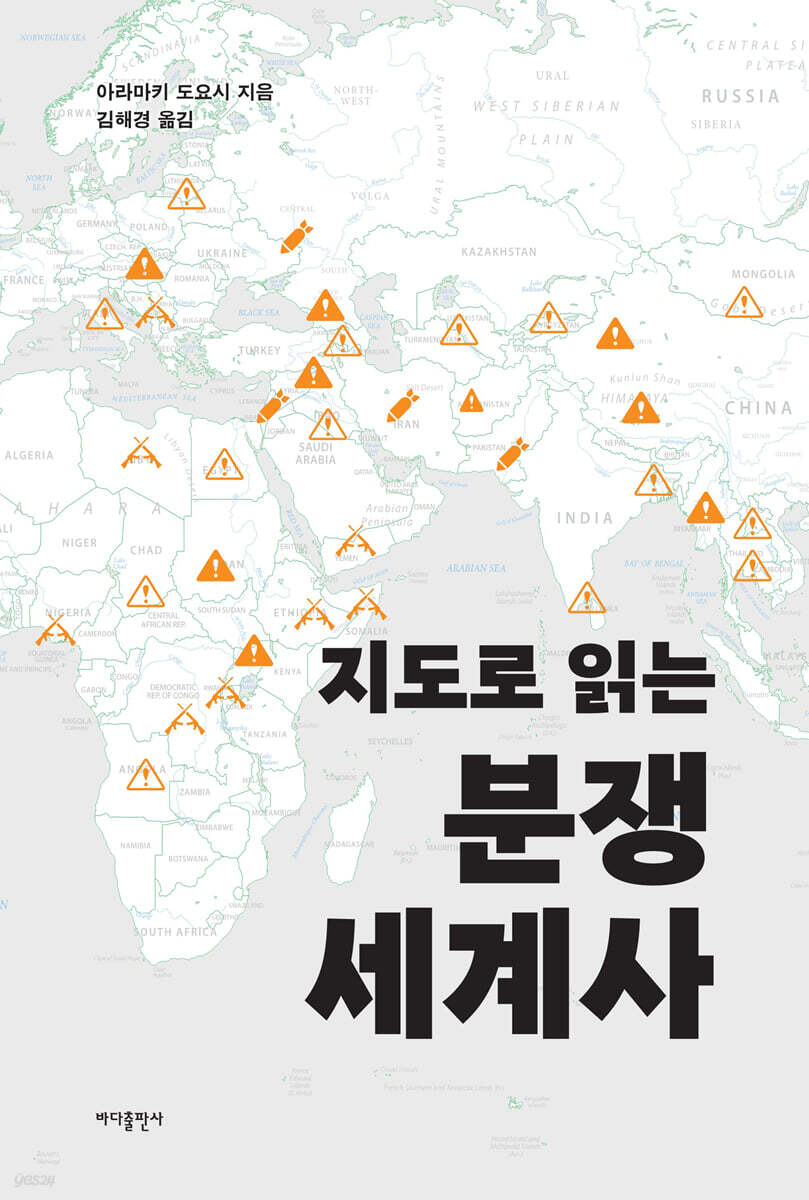
A World History of Conflicts Read Through Maps
 |
Description
Book Introduction
From World War to the era of world civil war
Reading the world through the history of conflict
The paradigm of conflict is changing.
From world war to world civil war.
Conflicts have continued throughout human history.
Conflict is the history of mankind.
Conflicts continue to occur today, no different from any other time period, but their causes and forms have changed.
The new paradigm is a civil war-like conflict.
Conflicts occur all over the world, often and for unpredictable reasons.
There may not be a war, but civil war-like conflicts have intensified.
Civil war has no defined front lines.
Life and conflict are intertwined.
The Gaza War and the Ukraine War clearly show this reality.
Some people watch missiles fall on their dinner table, while others watch missiles fall on their dinner table as if they were watching a soccer game.
It is a time of war like peacetime, and war like peacetime.
Why did the Gaza War break out? Why did Russia invade Ukraine? Why does the world continue to fight? To find answers to these questions, we must look to history.
To understand the world we live in today, we must understand the history of conflict.
This book tells the world's history of conflict, but it doesn't stop at simply imparting knowledge.
Going one step further beyond the conflict.
It provides insight into the flow of time and how the nationalism of the nation-state caused conflict.
It explains why new values such as anti-immigrants, LGBTQ, and anti-globalism are emerging as factors of conflict, in addition to existing conflict factors such as ethnicity, religion, language, and culture.
Above all, I emphasize repeatedly that it is important to look back on the history of conflict and develop our own perspective on the world we live in.
Another advantage is understanding history through maps.
The causes and consequences of conflicts that were difficult to understand through news and knowledge alone are explained easily using maps.
It unfolds the geographical characteristics and the ethnic, cultural, and historical roots contained within that space in a narrative format.
It shows in three dimensions how the borders drawn by imperialism and the land divided by the so-called justice brought about tragedy.
A detailed map guides you through the world's conflicts at a glance.
Reading the world through the history of conflict
The paradigm of conflict is changing.
From world war to world civil war.
Conflicts have continued throughout human history.
Conflict is the history of mankind.
Conflicts continue to occur today, no different from any other time period, but their causes and forms have changed.
The new paradigm is a civil war-like conflict.
Conflicts occur all over the world, often and for unpredictable reasons.
There may not be a war, but civil war-like conflicts have intensified.
Civil war has no defined front lines.
Life and conflict are intertwined.
The Gaza War and the Ukraine War clearly show this reality.
Some people watch missiles fall on their dinner table, while others watch missiles fall on their dinner table as if they were watching a soccer game.
It is a time of war like peacetime, and war like peacetime.
Why did the Gaza War break out? Why did Russia invade Ukraine? Why does the world continue to fight? To find answers to these questions, we must look to history.
To understand the world we live in today, we must understand the history of conflict.
This book tells the world's history of conflict, but it doesn't stop at simply imparting knowledge.
Going one step further beyond the conflict.
It provides insight into the flow of time and how the nationalism of the nation-state caused conflict.
It explains why new values such as anti-immigrants, LGBTQ, and anti-globalism are emerging as factors of conflict, in addition to existing conflict factors such as ethnicity, religion, language, and culture.
Above all, I emphasize repeatedly that it is important to look back on the history of conflict and develop our own perspective on the world we live in.
Another advantage is understanding history through maps.
The causes and consequences of conflicts that were difficult to understand through news and knowledge alone are explained easily using maps.
It unfolds the geographical characteristics and the ethnic, cultural, and historical roots contained within that space in a narrative format.
It shows in three dimensions how the borders drawn by imperialism and the land divided by the so-called justice brought about tragedy.
A detailed map guides you through the world's conflicts at a glance.
- You can preview some of the book's contents.
Preview
index
Introduction: What is 'Dispute'?
Chapter 1 From World War to World Civil War
Establishment of a sovereign state system
The Atlantic Revolution and the Rise of Nationalism
Dual Revolution and the Spread of the Nation-State
After 1848 and the Progress of Democracy
Imperialism and the Division of the World
World War I as a total war
World War II as a complex war
dismantling colonialism
The Changing Face of War
Politics surrounding the distribution of value
Chapter 2: The Light and Shadow of Colonial Independence
African conflicts
Congo War | Biafra War | Western Sahara Issue | Angolan Civil War | Ogaden War | Somali Civil War | Liberian Civil War | Ugandan Conflict | Rwandan Conflict | Burundian Civil War | First and Second Congo Wars | Darfur Conflict | Conflict Surrounding South Sudan | Central African Civil War | African-Style Democracy and Peacebuilding
Conflicts in Southeast Asia
Two Conflicts Facing Thailand | Laos' National Language Policy | The Mindanao Conflict in the Philippines | Myanmar's Democracy Struggle and Refugee Issues | Indonesia's Separatist Movement
Conflicts in South Asia
The partition of India and Pakistan | The Kashmir conflict | The Bangladesh War of Independence | The nuclear arms race | The rise of Hindu nationalism | The Sino-Indian border dispute | The Sri Lankan civil war
Chapter 3: The Aftermath of the Empire's Dissolution
Collapse of the Austro-Hungarian Empire
The Magyar Question | The Formation of Yugoslavia | The Dissolution of Yugoslavia | The Bosnian War | The Kosovo Conflict | The Dissolution of the Czechoslovak Federation
The collapse of the Soviet empire
Formation of the Soviet Union | Dissolution of the Soviet Union | Caucasus conflict | Nagorno-Karabakh conflict | Pro-Russian Armenia | Military conflict between Georgia and Russia |
Chechen conflict | Russia's invasion of Ukraine
The collapse of the Ottoman Empire
The Ottoman Empire and the Armenians | The Kurdish Question | The Divided Arab World | The Palestinian Question
The undisintegrated Chinese Empire
Human rights abuses in Inner Mongolia | Human rights abuses against Tibetans | Human rights issues in the Xinjiang Uyghur Autonomous Region | Taiwan issues
Chapter 4: The Conflict over Historical Perception in Europe
Issues Surrounding the Baltic States' Perception of History
Occupation or Liberation? | The Controversy Surrounding the Monument
Issues surrounding Austria's perception of history
Incomplete Denazification | Victim Nationalism | The Rise of the "Far-Right" Party
Issues Surrounding Italy's Perception of History
A historical 'deviation'
Issues surrounding France's perception of history
Why We're in the Victorious Position | The Resistance Myth and the Legitimacy of the Vichy Government
Issues surrounding Germany's perception of history
Have we reflected on the past? | The Historian Debate | The Goldhagen Debate
Chapter 5: Democracy vs. Authoritarianism
Three Waves of Democratization
Color Revolution
Democracy at a crossroads
Spreading authoritarianism
Populist Moment
What Gives Birth to Xenophobia
Historical revisionism, which intentionally rewrites history
Conspiracy theories linked to historical revisionism
Conclusion
Chapter 1 From World War to World Civil War
Establishment of a sovereign state system
The Atlantic Revolution and the Rise of Nationalism
Dual Revolution and the Spread of the Nation-State
After 1848 and the Progress of Democracy
Imperialism and the Division of the World
World War I as a total war
World War II as a complex war
dismantling colonialism
The Changing Face of War
Politics surrounding the distribution of value
Chapter 2: The Light and Shadow of Colonial Independence
African conflicts
Congo War | Biafra War | Western Sahara Issue | Angolan Civil War | Ogaden War | Somali Civil War | Liberian Civil War | Ugandan Conflict | Rwandan Conflict | Burundian Civil War | First and Second Congo Wars | Darfur Conflict | Conflict Surrounding South Sudan | Central African Civil War | African-Style Democracy and Peacebuilding
Conflicts in Southeast Asia
Two Conflicts Facing Thailand | Laos' National Language Policy | The Mindanao Conflict in the Philippines | Myanmar's Democracy Struggle and Refugee Issues | Indonesia's Separatist Movement
Conflicts in South Asia
The partition of India and Pakistan | The Kashmir conflict | The Bangladesh War of Independence | The nuclear arms race | The rise of Hindu nationalism | The Sino-Indian border dispute | The Sri Lankan civil war
Chapter 3: The Aftermath of the Empire's Dissolution
Collapse of the Austro-Hungarian Empire
The Magyar Question | The Formation of Yugoslavia | The Dissolution of Yugoslavia | The Bosnian War | The Kosovo Conflict | The Dissolution of the Czechoslovak Federation
The collapse of the Soviet empire
Formation of the Soviet Union | Dissolution of the Soviet Union | Caucasus conflict | Nagorno-Karabakh conflict | Pro-Russian Armenia | Military conflict between Georgia and Russia |
Chechen conflict | Russia's invasion of Ukraine
The collapse of the Ottoman Empire
The Ottoman Empire and the Armenians | The Kurdish Question | The Divided Arab World | The Palestinian Question
The undisintegrated Chinese Empire
Human rights abuses in Inner Mongolia | Human rights abuses against Tibetans | Human rights issues in the Xinjiang Uyghur Autonomous Region | Taiwan issues
Chapter 4: The Conflict over Historical Perception in Europe
Issues Surrounding the Baltic States' Perception of History
Occupation or Liberation? | The Controversy Surrounding the Monument
Issues surrounding Austria's perception of history
Incomplete Denazification | Victim Nationalism | The Rise of the "Far-Right" Party
Issues Surrounding Italy's Perception of History
A historical 'deviation'
Issues surrounding France's perception of history
Why We're in the Victorious Position | The Resistance Myth and the Legitimacy of the Vichy Government
Issues surrounding Germany's perception of history
Have we reflected on the past? | The Historian Debate | The Goldhagen Debate
Chapter 5: Democracy vs. Authoritarianism
Three Waves of Democratization
Color Revolution
Democracy at a crossroads
Spreading authoritarianism
Populist Moment
What Gives Birth to Xenophobia
Historical revisionism, which intentionally rewrites history
Conspiracy theories linked to historical revisionism
Conclusion
Detailed image

Publisher's Review
Nationalism of a nation-state that enforces homogenization
The 'dangerous greed' that led to the tragedy of civil war
With the end of World War II, the national power of colonial powers (imperialist countries) was greatly weakened.
At the same time, the principle of national self-determination emerged, and the independence of colonies followed.
The borders of the newly independent nations at this time were unnatural, as if drawn with a ruler.
Africa is a representative example.
This is because colonial powers drew borders according to their own interests.
Independent countries adopt the nation-state system that has been spreading since modern times.
The ideology of the nation-state is nationalism.
Nation-states and nationalism have the characteristic of trying to strengthen homogeneity.
Within the borders arbitrarily drawn by imperialism, different ethnic groups are mixed together, and their religions and languages are different.
Nationalism does not recognize these differences and pursues homogeneity.
Ignoring differences in ethnicity, language, religion, and culture, the majority's policies are forced on the minority to promote homogeneity.
If the minority opposes this, a civil war will break out.
This is a typical example of the civil war that took place in Africa.
The number of victims of African civil wars is estimated at at least 17 million.
It's no different in Asia.
Laos, which gained independence from France, advocated linguistic nationalism in order to completely escape the sphere of influence of neighboring Thailand.
The languages of the two countries are almost similar, but Laos created 'Proper Lao' as the number of Thai speakers increased.
As the Laotians admire Thailand's high economic standard, they are taking a confrontational stance out of fear that they might become part of Thailand.
Myanmar, home to over 100 ethnic groups, is made up of approximately 70% Burmese people, with the remainder being ethnic minorities.
The majority Myanmar people are pursuing a hard-line policy of homogenizing ethnic minorities through linguistic nationalism that emphasizes the Burmese language.
The representative victims are the Rohingya.
It can be said that nationalism brought about the brutal conflict of oppression of the Rohingya, a Muslim minority.
The Austrian Empire, Russian Empire, Ottoman Empire, and Qing Empire that existed in Eurasia also took the path of disintegration due to the spread of nationalism.
The process of trying to prevent its dissolution resulted in many conflicts that continue to this day.
The dangerous greed of nationalism, which calls for a 'single nation, single state,' has fueled conflicts everywhere.
A conflict paradigm that changes both in form and concept
The international community's deterrence is weakening.
World War I and World War II were wars between nations.
Each country waged an all-out war, and the damage was beyond imagination.
Above all, it was a war with a clear form and clear concept.
But wars after World War II have taken on a different appearance.
The form and concept of war have changed from the old days.
First, asymmetric warfare has increased.
Asymmetrical war is a war fought between regular and irregular forces, rather than between nations.
The Vietnam War (1960s and 1970s) was a war between the United States and a guerrilla force called the National Front for the Liberation of South Vietnam.
The Soviet invasion of Afghanistan, which began in 1979, also saw Soviet troops fight Afghan guerrilla forces.
The war in Afghanistan, which began during the Bush administration after the September 11, 2001 terrorist attacks, and the war with Iraq (global war on terrorism) in 2003 are also typical examples of asymmetric warfare between states and the Islamic terrorist organization Al Qaeda.
Another characteristic is the increase in disputes that are difficult to deal with under international law.
Nationalism is causing civil wars around the world, but it is difficult to sanction them under current international law.
Asymmetric warfare is also different from the types of war covered by international law.
Naturally, the international community's deterrence of war is also weakening.
Previously, the framework for conflict was divided into wartime and peacetime, and international and domestic.
However, the war on terror is not clearly defined as wartime or peacetime.
Additionally, since the subject of the civil war is not a state, international law of war does not apply.
Even if an unimaginable tragedy occurs, there is no basis for the international community to intervene.
A private military company called Wagner participated in the Ukrainian war.
The idea of a corporation participating in a war and operating under a separate command structure from the regular military is a concept that never existed before.
The military enterprise's operations are ruthless and unchecked.
The forms of conflict are becoming increasingly novel, and the international laws created to deter war are becoming less effective.
The perception and logic of "either you're with us or you're against us"
As a new driving force for conflict, division and conflict of values
In 2020, concerns were raised that the United States could fall into a civil war.
It was a statement made during the presidential election between Biden and Trump.
Although it did not escalate to an actual civil war, divisions between the two sides deepened, and on January 6, 2021, Trump supporters stormed the U.S. Capitol.
It was a clash of different values.
Historically, the biggest causes of conflict have been national interests, ethnicity, religion, and language.
Now a new element called value has emerged.
The fact that there are even concerns that a civil war could break out in the United States means that the conflict between different values is so strong.
This division and conflict is not limited to the United States.
It is also appearing in many other countries.
Another example is the heated global debate over same-sex marriage and LGBTQ (lesbian, gay, bisexual, transgender, queer).
Debate on this topic is spreading from the West to other parts of the world.
Every year, there is a dispute between those who want to hold a related event and those who absolutely must stop it.
Values invite conflict.
Anti-immigration sentiment is spreading in Europe.
As the influx of refugees rapidly increases, fake news and fear-mongering campaigns against them are spreading across countries.
While accepting immigration to solve labor shortages, they intentionally spread false complaints that immigrants are stealing jobs.
Anti-immigrant sentiment is fueling xenophobia and creating hatred and conflict across Europe, regardless of region.
This issue is about the 'distribution of value'.
The most central political and social debate in the past was that surrounding the ‘distribution of wealth.’
‘Distribution of wealth’ has room for discussion and adjustment of compromises, but ‘distribution of value’ is different.
The distribution of values, which is composed of thoughts and perceptions, is difficult to compromise or adjust.
There is only the perception that if you are not on our side, you are the enemy.
Divisions easily arise, strong conflicts arise, and eventually conflicts arise.
An era where we need our own perspective on conflict.
We need to develop the insight to distinguish between "correct history" and "true history."
Who is responsible for the 2023 Gaza conflict? Many people might offer opinions based on historical knowledge or emotional anger related to the conflict.
The author urges readers to develop their own perspective on the conflict, rather than relying on knowledge or emotions.
Knowledge of history is just knowledge.
Knowledge does not create perspective.
The author uses numerous maps to explain the world's history of conflict in an easy-to-understand and three-dimensional way, in order to provide a perspective that looks beyond the conflict.
Because each person's perspective will be an insight that looks beyond the conflict itself.
There is no such thing as objectively correct history.
Perhaps there is only a history of political correctness.
However, it is up to each individual to discern whether the move is truly correct, and one must have at least a minimal level of judgment to develop one's own perspective.
We live in an age of conflict.
Conflicts arise even between people of the same country.
The world is in constant conflict, with nations blaming each other for the past, both close to home and on the other side of the globe.
To understand these times, it is crucial to have conflict literacy.
All disputes are ongoing.
Even past conflicts that seem to have ended still have embers within them.
The present conflict is the embers of the past burning into new fire, and the present conflict foreshadows the future.
To understand the world's currents, the background and future of conflicts occurring everywhere, you must know history.
The world history of conflict is both a cultural knowledge and a lens through which we can read the world we live in today.
The 'dangerous greed' that led to the tragedy of civil war
With the end of World War II, the national power of colonial powers (imperialist countries) was greatly weakened.
At the same time, the principle of national self-determination emerged, and the independence of colonies followed.
The borders of the newly independent nations at this time were unnatural, as if drawn with a ruler.
Africa is a representative example.
This is because colonial powers drew borders according to their own interests.
Independent countries adopt the nation-state system that has been spreading since modern times.
The ideology of the nation-state is nationalism.
Nation-states and nationalism have the characteristic of trying to strengthen homogeneity.
Within the borders arbitrarily drawn by imperialism, different ethnic groups are mixed together, and their religions and languages are different.
Nationalism does not recognize these differences and pursues homogeneity.
Ignoring differences in ethnicity, language, religion, and culture, the majority's policies are forced on the minority to promote homogeneity.
If the minority opposes this, a civil war will break out.
This is a typical example of the civil war that took place in Africa.
The number of victims of African civil wars is estimated at at least 17 million.
It's no different in Asia.
Laos, which gained independence from France, advocated linguistic nationalism in order to completely escape the sphere of influence of neighboring Thailand.
The languages of the two countries are almost similar, but Laos created 'Proper Lao' as the number of Thai speakers increased.
As the Laotians admire Thailand's high economic standard, they are taking a confrontational stance out of fear that they might become part of Thailand.
Myanmar, home to over 100 ethnic groups, is made up of approximately 70% Burmese people, with the remainder being ethnic minorities.
The majority Myanmar people are pursuing a hard-line policy of homogenizing ethnic minorities through linguistic nationalism that emphasizes the Burmese language.
The representative victims are the Rohingya.
It can be said that nationalism brought about the brutal conflict of oppression of the Rohingya, a Muslim minority.
The Austrian Empire, Russian Empire, Ottoman Empire, and Qing Empire that existed in Eurasia also took the path of disintegration due to the spread of nationalism.
The process of trying to prevent its dissolution resulted in many conflicts that continue to this day.
The dangerous greed of nationalism, which calls for a 'single nation, single state,' has fueled conflicts everywhere.
A conflict paradigm that changes both in form and concept
The international community's deterrence is weakening.
World War I and World War II were wars between nations.
Each country waged an all-out war, and the damage was beyond imagination.
Above all, it was a war with a clear form and clear concept.
But wars after World War II have taken on a different appearance.
The form and concept of war have changed from the old days.
First, asymmetric warfare has increased.
Asymmetrical war is a war fought between regular and irregular forces, rather than between nations.
The Vietnam War (1960s and 1970s) was a war between the United States and a guerrilla force called the National Front for the Liberation of South Vietnam.
The Soviet invasion of Afghanistan, which began in 1979, also saw Soviet troops fight Afghan guerrilla forces.
The war in Afghanistan, which began during the Bush administration after the September 11, 2001 terrorist attacks, and the war with Iraq (global war on terrorism) in 2003 are also typical examples of asymmetric warfare between states and the Islamic terrorist organization Al Qaeda.
Another characteristic is the increase in disputes that are difficult to deal with under international law.
Nationalism is causing civil wars around the world, but it is difficult to sanction them under current international law.
Asymmetric warfare is also different from the types of war covered by international law.
Naturally, the international community's deterrence of war is also weakening.
Previously, the framework for conflict was divided into wartime and peacetime, and international and domestic.
However, the war on terror is not clearly defined as wartime or peacetime.
Additionally, since the subject of the civil war is not a state, international law of war does not apply.
Even if an unimaginable tragedy occurs, there is no basis for the international community to intervene.
A private military company called Wagner participated in the Ukrainian war.
The idea of a corporation participating in a war and operating under a separate command structure from the regular military is a concept that never existed before.
The military enterprise's operations are ruthless and unchecked.
The forms of conflict are becoming increasingly novel, and the international laws created to deter war are becoming less effective.
The perception and logic of "either you're with us or you're against us"
As a new driving force for conflict, division and conflict of values
In 2020, concerns were raised that the United States could fall into a civil war.
It was a statement made during the presidential election between Biden and Trump.
Although it did not escalate to an actual civil war, divisions between the two sides deepened, and on January 6, 2021, Trump supporters stormed the U.S. Capitol.
It was a clash of different values.
Historically, the biggest causes of conflict have been national interests, ethnicity, religion, and language.
Now a new element called value has emerged.
The fact that there are even concerns that a civil war could break out in the United States means that the conflict between different values is so strong.
This division and conflict is not limited to the United States.
It is also appearing in many other countries.
Another example is the heated global debate over same-sex marriage and LGBTQ (lesbian, gay, bisexual, transgender, queer).
Debate on this topic is spreading from the West to other parts of the world.
Every year, there is a dispute between those who want to hold a related event and those who absolutely must stop it.
Values invite conflict.
Anti-immigration sentiment is spreading in Europe.
As the influx of refugees rapidly increases, fake news and fear-mongering campaigns against them are spreading across countries.
While accepting immigration to solve labor shortages, they intentionally spread false complaints that immigrants are stealing jobs.
Anti-immigrant sentiment is fueling xenophobia and creating hatred and conflict across Europe, regardless of region.
This issue is about the 'distribution of value'.
The most central political and social debate in the past was that surrounding the ‘distribution of wealth.’
‘Distribution of wealth’ has room for discussion and adjustment of compromises, but ‘distribution of value’ is different.
The distribution of values, which is composed of thoughts and perceptions, is difficult to compromise or adjust.
There is only the perception that if you are not on our side, you are the enemy.
Divisions easily arise, strong conflicts arise, and eventually conflicts arise.
An era where we need our own perspective on conflict.
We need to develop the insight to distinguish between "correct history" and "true history."
Who is responsible for the 2023 Gaza conflict? Many people might offer opinions based on historical knowledge or emotional anger related to the conflict.
The author urges readers to develop their own perspective on the conflict, rather than relying on knowledge or emotions.
Knowledge of history is just knowledge.
Knowledge does not create perspective.
The author uses numerous maps to explain the world's history of conflict in an easy-to-understand and three-dimensional way, in order to provide a perspective that looks beyond the conflict.
Because each person's perspective will be an insight that looks beyond the conflict itself.
There is no such thing as objectively correct history.
Perhaps there is only a history of political correctness.
However, it is up to each individual to discern whether the move is truly correct, and one must have at least a minimal level of judgment to develop one's own perspective.
We live in an age of conflict.
Conflicts arise even between people of the same country.
The world is in constant conflict, with nations blaming each other for the past, both close to home and on the other side of the globe.
To understand these times, it is crucial to have conflict literacy.
All disputes are ongoing.
Even past conflicts that seem to have ended still have embers within them.
The present conflict is the embers of the past burning into new fire, and the present conflict foreshadows the future.
To understand the world's currents, the background and future of conflicts occurring everywhere, you must know history.
The world history of conflict is both a cultural knowledge and a lens through which we can read the world we live in today.
GOODS SPECIFICS
- Date of issue: July 31, 2025
- Page count, weight, size: 280 pages | 464g | 145*215*20mm
- ISBN13: 9791166893612
- ISBN10: 1166893618
You may also like
카테고리
korean


korean

![GQ KOREA Mark (Monthly): December [2025]](http://librairie.coreenne.fr/cdn/shop/files/8ef265dbbfbf186523ed75ba7319009d.jpg?v=1765340328&width=3840)


