

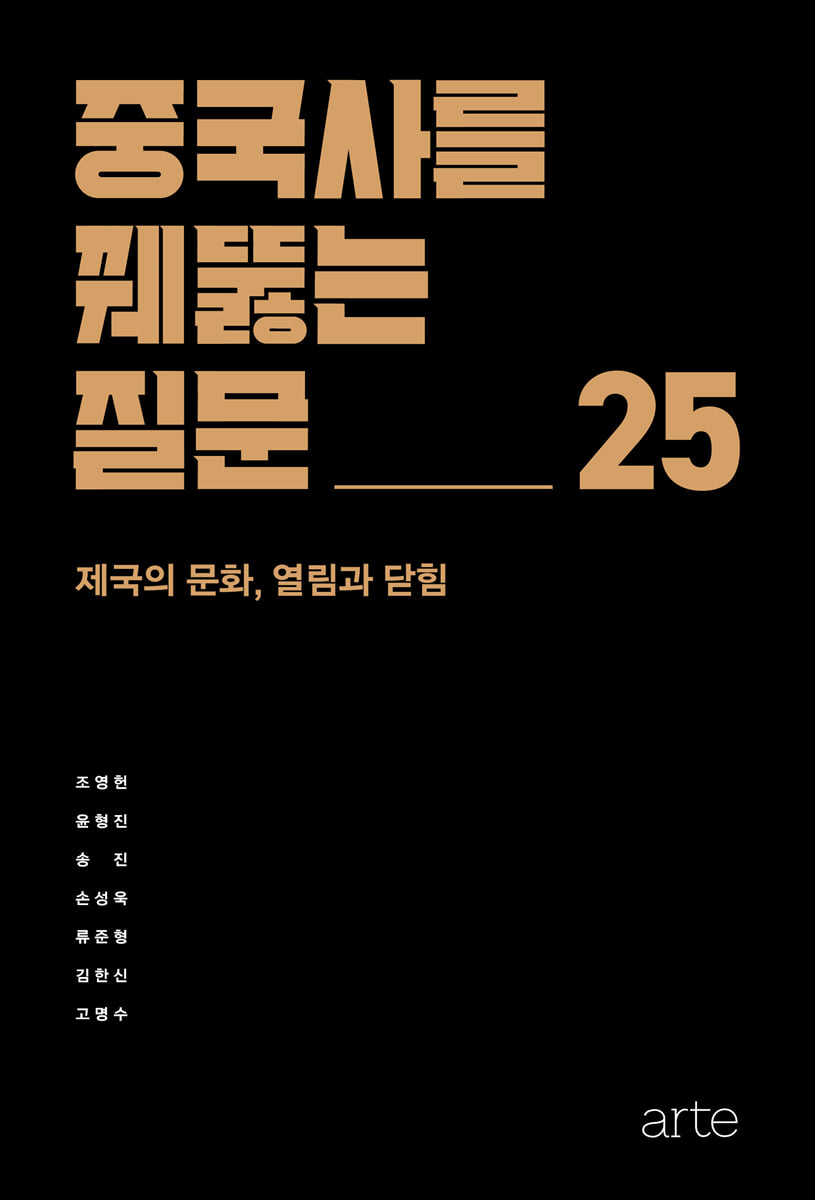
25 Questions That Penetrate Chinese History
 |
Description
Book Introduction
The "Piercing Questions" series
In the AI era, learning through questions and connections
We've entered an era where generative AI allows us to easily obtain answers with just a few clicks. The information provided by AI is becoming increasingly accurate and logical, based on human-researched data. AI utilization is rapidly expanding, with ChatGPT users surpassing 400 million worldwide (announced by OpenAI COO Brad Lightcap in February 2025).
In terms of the speed of information production, humans cannot keep up with AI. How should we study in this age of AI-induced information deluge? The "Penetrating Questions" series has designed a new form of humanities book to address this challenge, focusing on two areas:
First, let's study how to develop the 'power of questioning.'
The ability to gain insight into knowledge is developed through 'questions', not 'answers'.
"If you define the problem well, you've already found the answer." (Einstein) The ability to define a problem comes from well-designed questions. Prompt engineering, one of the core competencies of the AI era, is a testament to this.
Second, let us study to ‘connect’ the past and present, and the present and future, and to ‘respond on our own.’
“History is an unending dialogue between the past and the present.” (E.
H. Ka) The ability to view the present and future through the past is possible through complex and creative thinking. As we enter the AGI era and human dependence on AI accelerates, connecting thinking is the uniquely human way of learning.
The "Piercing Questions" series sheds new light on issues through key questions carefully selected by leading experts in the field, providing insights that accurately assess the present and predict the future.
In this spirit, we present 『25 Questions that Penetrate Chinese History』 as the first book in the series.
Penetrating Questions 001 『25 Questions Penetrating Chinese History』
A perspective that challenges conventional wisdom and gives a fresh perspective on history.
Does knowing a lot about history mean knowing history well? How should we study history? "Questions" play a crucial role in the age-old discipline of history.
Because it is an important starting point for historians to speak to the countless silent historical materials.
There is no material that provides answers without asking questions.
Even with the same material, new interpretations and meanings can be found depending on the question asked.
The seven authors, scholars of Chinese history, pondered for a long time over the proposition of 'a question that penetrates Chinese history.'
We have compiled the latest research findings on Chinese history over a period of over two years and carefully selected a total of 25 questions based on discussions on what kind of knowledge of Chinese history Koreans need.
Each chapter (25 chapters) and section (144 sections) of 『25 Questions Penetrating Chinese History』 is presented as a question that penetrates the core of each topic, allowing readers to examine the various aspects of the "question" through the perspective of a historian and embody that perspective.
The questions were carefully selected from the following three perspectives:
1) Questions essential to understanding China today, 2) Questions that overturn and correct existing perspectives, and 3) Questions that interpret key concepts that have not received much attention.
The topic was broadly summarized into the following three keywords.
1) Empire, 2) Trade, 3) Culture.
This book weaves together three perspectives and three themes to provide a broad overview of China's dynamic and diverse landscape from ancient to modern times, at the forefront of Chinese historical research.
In the AI era, learning through questions and connections
We've entered an era where generative AI allows us to easily obtain answers with just a few clicks. The information provided by AI is becoming increasingly accurate and logical, based on human-researched data. AI utilization is rapidly expanding, with ChatGPT users surpassing 400 million worldwide (announced by OpenAI COO Brad Lightcap in February 2025).
In terms of the speed of information production, humans cannot keep up with AI. How should we study in this age of AI-induced information deluge? The "Penetrating Questions" series has designed a new form of humanities book to address this challenge, focusing on two areas:
First, let's study how to develop the 'power of questioning.'
The ability to gain insight into knowledge is developed through 'questions', not 'answers'.
"If you define the problem well, you've already found the answer." (Einstein) The ability to define a problem comes from well-designed questions. Prompt engineering, one of the core competencies of the AI era, is a testament to this.
Second, let us study to ‘connect’ the past and present, and the present and future, and to ‘respond on our own.’
“History is an unending dialogue between the past and the present.” (E.
H. Ka) The ability to view the present and future through the past is possible through complex and creative thinking. As we enter the AGI era and human dependence on AI accelerates, connecting thinking is the uniquely human way of learning.
The "Piercing Questions" series sheds new light on issues through key questions carefully selected by leading experts in the field, providing insights that accurately assess the present and predict the future.
In this spirit, we present 『25 Questions that Penetrate Chinese History』 as the first book in the series.
Penetrating Questions 001 『25 Questions Penetrating Chinese History』
A perspective that challenges conventional wisdom and gives a fresh perspective on history.
Does knowing a lot about history mean knowing history well? How should we study history? "Questions" play a crucial role in the age-old discipline of history.
Because it is an important starting point for historians to speak to the countless silent historical materials.
There is no material that provides answers without asking questions.
Even with the same material, new interpretations and meanings can be found depending on the question asked.
The seven authors, scholars of Chinese history, pondered for a long time over the proposition of 'a question that penetrates Chinese history.'
We have compiled the latest research findings on Chinese history over a period of over two years and carefully selected a total of 25 questions based on discussions on what kind of knowledge of Chinese history Koreans need.
Each chapter (25 chapters) and section (144 sections) of 『25 Questions Penetrating Chinese History』 is presented as a question that penetrates the core of each topic, allowing readers to examine the various aspects of the "question" through the perspective of a historian and embody that perspective.
The questions were carefully selected from the following three perspectives:
1) Questions essential to understanding China today, 2) Questions that overturn and correct existing perspectives, and 3) Questions that interpret key concepts that have not received much attention.
The topic was broadly summarized into the following three keywords.
1) Empire, 2) Trade, 3) Culture.
This book weaves together three perspectives and three themes to provide a broad overview of China's dynamic and diverse landscape from ancient to modern times, at the forefront of Chinese historical research.
- You can preview some of the book's contents.
Preview
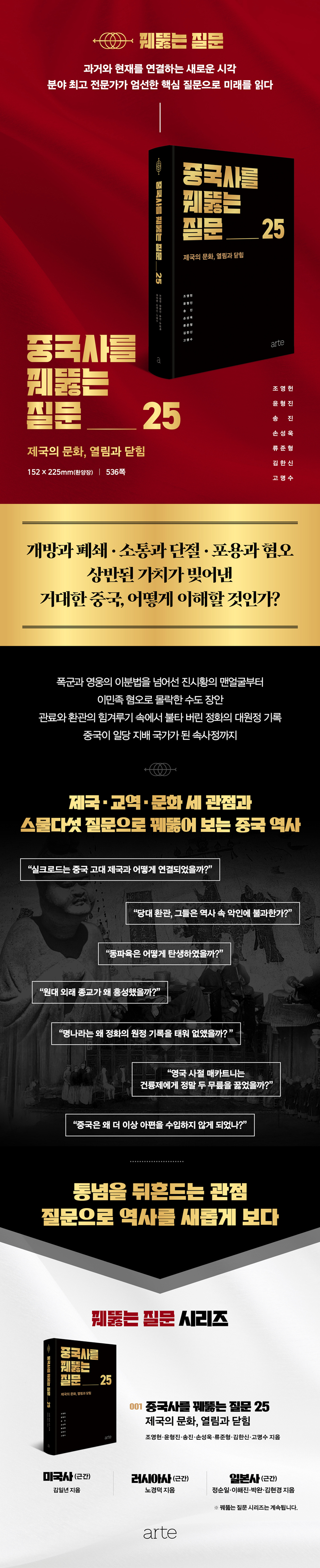
index
Preface: Studying History Through Questioning in the AI Age
1. Was Qin Shi Huang, the first emperor of China, a great tyrant or a hero who unified China?
How do we remember Qin Shi Huang? | What was the background that allowed the emergence of the 'outlier' Qin Shi Huang? | What did Qin Shi Huang do after unifying the world? | Why did Qin Shi Huang undertake large-scale civil engineering projects? | How was Qin Shi Huang able to rule such a vast territory in a unified manner? | Is Qin Shi Huang synonymous with 'tyranny'? | What does Qin Shi Huang mean to us today?
2 How was the Silk Road connected to the ancient Chinese empire?
What was the Silk Road? | When was the Silk Road "opened"? | Who traveled the Silk Road? | What were the necessary and sufficient conditions for crossing the Silk Road? | How did activities in the interior proceed after arriving in the Chinese dynasties? | What does the Silk Road mean to us today?
3 Why did people in the Jinhan Dynasty write contracts?
How did Chinese people live 2,000 years ago? | What did the "Kwonseo" (contracts) in ancient Chinese society look like? | Did individuals write contracts for every transaction of goods? | To what extent did state power monitor and manage private transactions? | Why did contracts even apply to the sale of clothing? | What is the true purpose of writing contracts? | What does the history of life in the Jin and Han Dynasties mean to us today?
4 How should we view Empress Wu Zetian, the only female emperor?
Why should we know about Wu Zetian? | How did Wu Zetian go from being the wife of Emperor Taizong to the wife of Emperor Gaozong? | How did the people of the time view Wu Zetian's return to the palace? | What process did Wu Zetian go through to become emperor? | Is it correct to understand Wu Zetian as a 'female' emperor? | Why did Wu Zetian, the emperor of the 'Zhou', choose the revival of the 'Tang'?
5 Eunuchs of the time, were they just villains in history?
What can we learn from the eunuchs of the Tang Dynasty? | What makes the eunuchs of the Tang Dynasty so special in Chinese history? | Were the eunuchs of the Tang Dynasty slaves or officials? | How did they rise to power? | What legacy did the activities of the eunuchs of the Tang Dynasty leave behind?
6 Why is the Tang Dynasty's ruling system considered typical of traditional Chinese dynasties?
What does the Party's model mean? | Why is the Party called a statutory state? | How does the central government system work? | How are local administrative districts organized? | Is the system alive or dead?
7 Why did Chang'an fail to maintain its 'long peace'?
What does the rise and fall of Chang'an tell us? | Why wasn't the Great Wall built during the Tang Dynasty? | What kind of city was Chang'an? | What did the Anshi Rebellion change? | Where is the center of the world moving?
8 How was Dongpa Pork born?
Why should we understand the Song Dynasty scholars? | How did news become a symbol of the scholars? | Why were Song Dynasty scholars so enthusiastic about spreading medical knowledge? | Why did the phrase "Unifying the customs of the world" become the slogan of Song Dynasty scholars? | What legacy did Song Dynasty scholars leave to Joseon Dynasty scholars?
9 Did civil administration make the Song Dynasty weak?
Why is civilian control of the military important? | Where do criticisms of Song dynasty civil rule originate? | Did civilian control of the military weaken the military? | Did the traditional Chinese imperial order persist during the Song dynasty? | Did the Liao military overwhelm the Song? | Why was the Jin cavalry weakened? | Was the Song truly a weak dynasty?
10 Why did the Song people go out to sea?
Why did maritime trade flourish in the Song Dynasty? | What did the Song people experience as they ventured into the "unknown world"? | What led Song Dynasty Chinese to engage in maritime trade? | How did maritime trade proceed during the Song Dynasty? | What legacy does the flourishing maritime trade of the Song Dynasty leave us?
11 Why did the people of the Song Dynasty avoid eating beef?
Where did the taboo against eating beef originate? | Why did even intellectuals participate in the legally prohibited slaughter of cattle? | How did folk tales of retribution contribute to the widespread spread of the beef taboo? | How was beef consumed despite legal prohibitions and folk taboos? | What does the spread of the Song Dynasty beef taboo tell us?
12 Why did Mongolia discriminate against Korean noblemen?
Why did successive Chinese dynasties favor the literati? | How did the Mongols perceive Korean literati? | Was the civil service examination conducted fairly? | Was the Four-Level Civil Service Examination System a system of racial discrimination?
13 Why did foreign religions flourish?
Were foreign religions introduced to China before the Yuan Dynasty? | How did the Mongols treat religion? | How did Tibetan Buddhism become the mainstream religion in Mongolia? | How did Islam spread to Mongolia? | Why did Christianity, once flourishing in Mongolia, disappear? | What is the identity of the Mongol Empire as seen through its religious policies?
14 Why did the nomadic Mongols promote maritime trade?
What was Pax Mongolica? | How did the Mongols perceive commerce and trade? | Did the Mongol conquest of Southeast Asia fail? | How did the Mongols promote maritime trade? | What was the scope of maritime trade? | What impact did the prosperity of maritime trade have on world history?
15 Why did the Ming Dynasty burn the records of Zheng He's expedition?
Why did the Ming Dynasty tolerate the destruction of Zheng He's records? | Why did the Yongle Emperor dispatch Zheng He? | Was Zheng He's expedition the pinnacle of maritime activity in Chinese history? | What is the relationship between the Grand Canal and the sea jin? | Again, why did the records related to Zheng He have to be burned?
Why did 16 people have to rebuild the Great Wall on such a large scale?
When was the Great Wall we see today in China built? | What was the early Ming strategy against the Mongols like? | So how was the Great Wall rebuilt? | What led to the massive construction of the Great Wall? | Did the Mongol threat ease with the "Rongjinghuai" in 1571? | Why did Meng Jiangnu weep in front of the Great Wall?
What was the success strategy of the Huizhou merchant who became the greatest merchant of the Ming and Qing Dynasties?
When did negative perceptions of merchants begin to change? | How did the Grand Canal become an "icon of hyperconnectivity"? | What vulnerabilities did Huizhou merchants discover? | What were Huizhou merchants' strategies for success leveraging the Grand Canal? | What did studying abroad mean to Huizhou merchants?
18 How did the Little Ice Age of the 17th century affect the transition between the Ming and Qing dynasties?
Why did the Ming Dynasty collapse so abruptly in 1644? | What is the 17th-century crisis theory? | How did the Little Ice Age influence the fall of the Ming Dynasty? | How should we interpret the rise of the Qing Dynasty during the Little Ice Age? | How should nations respond in the age of climate crisis?
19 How were elephants tamed and used in the world?
What were elephants like in Chinese history? | Where did the elephants that lived in the Central Plains go? | How did the Joseon envoys of the Ming Dynasty view Sun Sang? | What were the differences between Joseon and the Liao and Jin dynasties regarding Sun Sang? | Why were the Joseon envoys who saw elephants in the Ming Dynasty so full of praise? | Why did the Qing Joseon envoys' impressions of elephants change? | What happened to elephants in the late Qing Dynasty? | How do animals become symbols of diplomacy?
20 Did British envoy Macartney really kneel before the Qianlong Emperor?
Why did the Qianlong Emperor summon the Joseon envoy to Jehol? | Why did he open the sea route to the British envoy? | Was Macartney a tribute envoy or a plenipotentiary? | What did Britain want amidst the etiquette debate? | What did the Dutch envoy learn from Macartney? | What do Macartney's 'failure' and Teach's 'success' leave us with?
21 Were Joseon and Vietnam vassals of the Qing?
Does the term "vassal state" make us angry? | How did Joseon become a vassal state of the Qing? | Are vassal states created through war? | What does the prime minister want from a vassal state? | Did the prime minister truly fulfill his "self-serving" duties? | How did the prime minister deal with the dangers of an "independent" vassal state? | What, again, is a "vassal state"?
22 Was America really a 'beautiful country' to China?
Where did the US-China relationship come from? | Why did the US turn to China after independence? | How did the "Fire Nation" come to be called the "United States"? | How did Burlingame become the Qing "envoy"? | Why did the first Qing students go to the United States? | Why did the Qing introduce the United States to Joseon? | Can a country always be beautiful?
23 Why did China stop importing opium?
How did opium affect China? | How did the opium trade in China begin? | What role did opium merchants play in the Opium Wars? | How did the opium trade become legal? | What happened in China after the legalization of the opium trade? | How did the decline of the opium trade affect Western merchants? | What impact did opium have on the structure of Chinese trade?
24 Why did China become a one-party state?
What is the relationship between the People's Republic of China and the Chinese Communist Party? | What happened to the parliamentary system after the Xinhai Revolution? | What kind of government did the Chinese people dream of after the Xinhai Revolution? | What kind of state did the Kuomintang seek to create? | What kind of state did the Chinese Communist Party succeed in creating? | Can China's party-state system be maintained?
25 Who created the minorities?
Why should we care about China's ethnic minority issues? | Where did China's ethnic issues originate? | How did minority policies evolve during the Republic of China? | How were ethnicities "identified" in the People's Republic of China? | How are China's minority policies evolving?
Appendix: A Dialogue with the Writers: A History of China Through Time, Space, and Population
List of plates, maps, and tables
References
1. Was Qin Shi Huang, the first emperor of China, a great tyrant or a hero who unified China?
How do we remember Qin Shi Huang? | What was the background that allowed the emergence of the 'outlier' Qin Shi Huang? | What did Qin Shi Huang do after unifying the world? | Why did Qin Shi Huang undertake large-scale civil engineering projects? | How was Qin Shi Huang able to rule such a vast territory in a unified manner? | Is Qin Shi Huang synonymous with 'tyranny'? | What does Qin Shi Huang mean to us today?
2 How was the Silk Road connected to the ancient Chinese empire?
What was the Silk Road? | When was the Silk Road "opened"? | Who traveled the Silk Road? | What were the necessary and sufficient conditions for crossing the Silk Road? | How did activities in the interior proceed after arriving in the Chinese dynasties? | What does the Silk Road mean to us today?
3 Why did people in the Jinhan Dynasty write contracts?
How did Chinese people live 2,000 years ago? | What did the "Kwonseo" (contracts) in ancient Chinese society look like? | Did individuals write contracts for every transaction of goods? | To what extent did state power monitor and manage private transactions? | Why did contracts even apply to the sale of clothing? | What is the true purpose of writing contracts? | What does the history of life in the Jin and Han Dynasties mean to us today?
4 How should we view Empress Wu Zetian, the only female emperor?
Why should we know about Wu Zetian? | How did Wu Zetian go from being the wife of Emperor Taizong to the wife of Emperor Gaozong? | How did the people of the time view Wu Zetian's return to the palace? | What process did Wu Zetian go through to become emperor? | Is it correct to understand Wu Zetian as a 'female' emperor? | Why did Wu Zetian, the emperor of the 'Zhou', choose the revival of the 'Tang'?
5 Eunuchs of the time, were they just villains in history?
What can we learn from the eunuchs of the Tang Dynasty? | What makes the eunuchs of the Tang Dynasty so special in Chinese history? | Were the eunuchs of the Tang Dynasty slaves or officials? | How did they rise to power? | What legacy did the activities of the eunuchs of the Tang Dynasty leave behind?
6 Why is the Tang Dynasty's ruling system considered typical of traditional Chinese dynasties?
What does the Party's model mean? | Why is the Party called a statutory state? | How does the central government system work? | How are local administrative districts organized? | Is the system alive or dead?
7 Why did Chang'an fail to maintain its 'long peace'?
What does the rise and fall of Chang'an tell us? | Why wasn't the Great Wall built during the Tang Dynasty? | What kind of city was Chang'an? | What did the Anshi Rebellion change? | Where is the center of the world moving?
8 How was Dongpa Pork born?
Why should we understand the Song Dynasty scholars? | How did news become a symbol of the scholars? | Why were Song Dynasty scholars so enthusiastic about spreading medical knowledge? | Why did the phrase "Unifying the customs of the world" become the slogan of Song Dynasty scholars? | What legacy did Song Dynasty scholars leave to Joseon Dynasty scholars?
9 Did civil administration make the Song Dynasty weak?
Why is civilian control of the military important? | Where do criticisms of Song dynasty civil rule originate? | Did civilian control of the military weaken the military? | Did the traditional Chinese imperial order persist during the Song dynasty? | Did the Liao military overwhelm the Song? | Why was the Jin cavalry weakened? | Was the Song truly a weak dynasty?
10 Why did the Song people go out to sea?
Why did maritime trade flourish in the Song Dynasty? | What did the Song people experience as they ventured into the "unknown world"? | What led Song Dynasty Chinese to engage in maritime trade? | How did maritime trade proceed during the Song Dynasty? | What legacy does the flourishing maritime trade of the Song Dynasty leave us?
11 Why did the people of the Song Dynasty avoid eating beef?
Where did the taboo against eating beef originate? | Why did even intellectuals participate in the legally prohibited slaughter of cattle? | How did folk tales of retribution contribute to the widespread spread of the beef taboo? | How was beef consumed despite legal prohibitions and folk taboos? | What does the spread of the Song Dynasty beef taboo tell us?
12 Why did Mongolia discriminate against Korean noblemen?
Why did successive Chinese dynasties favor the literati? | How did the Mongols perceive Korean literati? | Was the civil service examination conducted fairly? | Was the Four-Level Civil Service Examination System a system of racial discrimination?
13 Why did foreign religions flourish?
Were foreign religions introduced to China before the Yuan Dynasty? | How did the Mongols treat religion? | How did Tibetan Buddhism become the mainstream religion in Mongolia? | How did Islam spread to Mongolia? | Why did Christianity, once flourishing in Mongolia, disappear? | What is the identity of the Mongol Empire as seen through its religious policies?
14 Why did the nomadic Mongols promote maritime trade?
What was Pax Mongolica? | How did the Mongols perceive commerce and trade? | Did the Mongol conquest of Southeast Asia fail? | How did the Mongols promote maritime trade? | What was the scope of maritime trade? | What impact did the prosperity of maritime trade have on world history?
15 Why did the Ming Dynasty burn the records of Zheng He's expedition?
Why did the Ming Dynasty tolerate the destruction of Zheng He's records? | Why did the Yongle Emperor dispatch Zheng He? | Was Zheng He's expedition the pinnacle of maritime activity in Chinese history? | What is the relationship between the Grand Canal and the sea jin? | Again, why did the records related to Zheng He have to be burned?
Why did 16 people have to rebuild the Great Wall on such a large scale?
When was the Great Wall we see today in China built? | What was the early Ming strategy against the Mongols like? | So how was the Great Wall rebuilt? | What led to the massive construction of the Great Wall? | Did the Mongol threat ease with the "Rongjinghuai" in 1571? | Why did Meng Jiangnu weep in front of the Great Wall?
What was the success strategy of the Huizhou merchant who became the greatest merchant of the Ming and Qing Dynasties?
When did negative perceptions of merchants begin to change? | How did the Grand Canal become an "icon of hyperconnectivity"? | What vulnerabilities did Huizhou merchants discover? | What were Huizhou merchants' strategies for success leveraging the Grand Canal? | What did studying abroad mean to Huizhou merchants?
18 How did the Little Ice Age of the 17th century affect the transition between the Ming and Qing dynasties?
Why did the Ming Dynasty collapse so abruptly in 1644? | What is the 17th-century crisis theory? | How did the Little Ice Age influence the fall of the Ming Dynasty? | How should we interpret the rise of the Qing Dynasty during the Little Ice Age? | How should nations respond in the age of climate crisis?
19 How were elephants tamed and used in the world?
What were elephants like in Chinese history? | Where did the elephants that lived in the Central Plains go? | How did the Joseon envoys of the Ming Dynasty view Sun Sang? | What were the differences between Joseon and the Liao and Jin dynasties regarding Sun Sang? | Why were the Joseon envoys who saw elephants in the Ming Dynasty so full of praise? | Why did the Qing Joseon envoys' impressions of elephants change? | What happened to elephants in the late Qing Dynasty? | How do animals become symbols of diplomacy?
20 Did British envoy Macartney really kneel before the Qianlong Emperor?
Why did the Qianlong Emperor summon the Joseon envoy to Jehol? | Why did he open the sea route to the British envoy? | Was Macartney a tribute envoy or a plenipotentiary? | What did Britain want amidst the etiquette debate? | What did the Dutch envoy learn from Macartney? | What do Macartney's 'failure' and Teach's 'success' leave us with?
21 Were Joseon and Vietnam vassals of the Qing?
Does the term "vassal state" make us angry? | How did Joseon become a vassal state of the Qing? | Are vassal states created through war? | What does the prime minister want from a vassal state? | Did the prime minister truly fulfill his "self-serving" duties? | How did the prime minister deal with the dangers of an "independent" vassal state? | What, again, is a "vassal state"?
22 Was America really a 'beautiful country' to China?
Where did the US-China relationship come from? | Why did the US turn to China after independence? | How did the "Fire Nation" come to be called the "United States"? | How did Burlingame become the Qing "envoy"? | Why did the first Qing students go to the United States? | Why did the Qing introduce the United States to Joseon? | Can a country always be beautiful?
23 Why did China stop importing opium?
How did opium affect China? | How did the opium trade in China begin? | What role did opium merchants play in the Opium Wars? | How did the opium trade become legal? | What happened in China after the legalization of the opium trade? | How did the decline of the opium trade affect Western merchants? | What impact did opium have on the structure of Chinese trade?
24 Why did China become a one-party state?
What is the relationship between the People's Republic of China and the Chinese Communist Party? | What happened to the parliamentary system after the Xinhai Revolution? | What kind of government did the Chinese people dream of after the Xinhai Revolution? | What kind of state did the Kuomintang seek to create? | What kind of state did the Chinese Communist Party succeed in creating? | Can China's party-state system be maintained?
25 Who created the minorities?
Why should we care about China's ethnic minority issues? | Where did China's ethnic issues originate? | How did minority policies evolve during the Republic of China? | How were ethnicities "identified" in the People's Republic of China? | How are China's minority policies evolving?
Appendix: A Dialogue with the Writers: A History of China Through Time, Space, and Population
List of plates, maps, and tables
References
Detailed image
Into the book
The seven-author team reviewed numerous introductory books published so far and established several principles to create a new book that would stand out from existing introductory books on Chinese history.
First, to create an introductory book whose questions are more interesting and meaningful than their answers; second, to develop a narrative style that will appeal to readers in their 20s in the 2020s, that is, the "new generation" born in Korea around 2000; third, to reflect the latest research on Chinese history conducted in Korea up to the 2020s when the book is published; and fourth, to reexamine Chinese history from the perspective of globalization.
In particular, the perspective of globalization is a pressing challenge for future generations living in the 21st century, and it also serves as an answer to the question, "What contribution has China made to global civilization and to the creation of today's humanity?"
Of course, globalization here is not understood as a phenomenon that began around the 15th century from a Eurocentric perspective, but as a process of expansion of mutual exchange that has been taking place since the beginning of history.
From the emergence of the Jinhan Empire, efforts have been made to understand 'China' not as a fixed entity, but as a fluid nation, empire, and civilization that was created and changed through constant interaction and conflict with the outside world.
The authors, who reviewed the answers to the twenty-five questions collected in this way, were able to recall the repetition and antagonism of 'openness and closure' as a characteristic and personality that runs through Chinese history.
‘Openness’ and ‘closedness’ are contradictory, but they maintain a balance by pushing and pulling each other without one completely overwhelming the other.
Of course, the result of this compromise and balance is a different form from that of the Korean Peninsula or the Japanese archipelago, so it can be called the 'imperial culture' of China.
For example, the content corresponding to 'openness' includes exchanges with the Western Regions through the Silk Road, the expansion of women's (including emperors') political participation due to the influx of nomadic culture, free maritime trade expanding from the Song Dynasty to the Yuan Dynasty, the Yuan Dynasty's religious policy that equally respected foreign religions, the Grand Canal that functioned as an icon of hyperconnectivity, and diplomatic negotiations with the United States, the 'beautiful country' in the late Qing Dynasty.
On the other hand, the Great Wall, a kind of 'border' built by Qin Shi Huang, the reconstruction of the Great Wall that was connected on a large scale during the Ming Dynasty, the division of local administrative districts to suppress division, the destruction and concealment of records of Zheng He's maritime expeditions, the hierarchical and self-sufficient foreign policy of the Qing Emperor Qianlong, and China's one-party ruling structure can be classified as contents related to 'closure.'
What is interesting is that while 'closure' increases at times of strengthened unification, 'openness' actually increases at times of division.
By reading this book, you will discover that the 'imperial culture' accumulated through repeated 'opening and closing' continued into the People's Republic of China, which was established in 1949.
To this end, the latter half of the book includes a mention of the deepening US-China hegemony competition and conflict since President Xi Jinping came to power.
Understanding the long-standing "culture of empire" also allows for a historical interpretation of modern China's one-party rule system, minority policies, and the imposition of hierarchical order on neighboring countries.
--- From "Cho Young-heon, Preface - Studying History Through Questioning in the AI Era"
In 221 BC, 26 years after King Ying Zheng began ruling the state of Qin, the state of Qin destroyed six other states one after another and unified China.
Although most of King Yeongjeong's actions during his youth after ascending to the throne were influenced by Lü Buwei, a powerful figure behind the scenes who acted as his guardian, his victories over the six countries and his diplomatic skills after he turned thirty can be evaluated as the result of the leadership and efforts of Yeongjeong himself.
In 221 BC, Ying Zheng, who became the sole monarch ruling the world, fully demonstrated his abilities by seizing the special opportunity provided by the kingmaker Lü Buwei, based on the historical and cultural heritage he had inherited, and as a result, he was able to make a name for himself as an 'outlier' in thousands of years of Chinese history.
--- From "Chapter 1: Qin Shi Huang, the First Emperor of China, a Great Tyrant or a Hero of Chinese Unification?"
How did Wu Zetian ascend to the throne, given that the male-dominated patriarchal system had been the foundation of Chinese society since the Zhou Dynasty? Despite the frequent emergence of powerful women in Chinese history, what was the background that allowed only Wu Zetian to ascend to the throne? Emperor Wu Zetian reigned for only 15 years, but when counting the period during which she was appointed empress and directly involved in politics, her political influence lasted over 50 years.
Was the long-term reign of Empress Wu Zetian truly different from that of male emperors? How can we distinguish between outward appearances and internal essence? What does it mean to change the existing order and create a new situation, and how should we overcome the limitations that may arise? Could the conventional perceptions we take for granted have perhaps been born of excessive indifference?
--- From "Chapter 4: How should we view Wu Zetian, the only female emperor?"
Although literati officials dominated key central and local government posts and further emphasized the value of 'literature,' as mentioned earlier, the Song court's most pressing concerns were always national defense issues.
Also, the emperor, who was the highest decision maker, although he had been educated as a man of letters from a young age, placed greater weight on 'mu', which was directly related to the survival of the nation, when making policy decisions.
Rather, in an atmosphere of the court where the value of 'nothingness' was overly valued, civil servants who had entered public office through the civil service examination strongly promoted a movement to respect the value of 'mun' not only in the court but also throughout the country.
--- From “Chapter 9: Did Civilizationism Make the Song Dynasty Weak?”
Today, many scholars refer to the prosperity of maritime traffic and trade during that era as Pax Mongolica, or "Mongolian Peace."
It is very interesting that Mongolia, a nomadic people from the steppe with no access to the sea, promoted maritime trade in the most dazzling way in human history.
How should we understand this? To truly understand the prosperity of Yuan Dynasty maritime trade, we must examine the reality from various perspectives.
This provides important clues to uncovering the nomadic nature of the original text and understanding its historical impact on later world history.
--- From Chapter 14, “Why did the nomadic Mongols promote maritime trade?”
It may be difficult to imagine a "what if" in history, but it would be difficult for anyone to easily say what the flow of world history surrounding maritime power would have been like if the records related to purification had not been burned.
However, the maritime records related to purification were burned, and Ming no longer actively sought to advance into the maritime world.
Joseon, which had its legitimacy recognized under the umbrella of the Ming Dynasty, a large tributary state and suzerain state, was also unable to take the 'irregular' step of breaking away from the Ming Dynasty's investiture-tribute order and maritime concept.
The burning of records related to the Ming Dynasty's purification of the sea was a very important variable in understanding the history of our country, which had lost its active attitude and drive toward the sea that had continued until the Goryeo Dynasty.
--- From "Chapter 15: Why Did the Ming Burn the Records of Zheng He's Expeditions?"
The sharp decline in population during the crisis, the relatively smooth migration, the transition from a war-torn nation to a welfare state, and the will of leaders to actively address livelihood issues by learning from previous crises have all proven effective in an even more challenging climate.
Even in times of extreme weather, human coping abilities have improved through learning from the past and through extra-social cooperation that is not readily apparent in times of peace.
Although the severity of the climate crisis is even more pronounced today than in the 17th century, the possibility of following the Qing path rather than the Ming path remains, provided we are armed with astute leadership and a transcendent sense of community.
--- From "Chapter 18: What influence did the Little Ice Age of the 17th century have on the transition between the Ming and Qing Dynasties?"
This is not simply a case of the past.
We cannot simply conclude that McCartney's approach is right and his teaching style is wrong.
Dichotomous thinking puts us at risk.
This complex issue offers important implications amid the accelerating US-China hegemony competition.
Will we pursue short-term gains while maintaining existing international norms and order, or will we participate in the formation of a new order in a changing environment?
The rivalry between the United States and China goes beyond a simple power struggle; it raises fundamental questions about how to reshape the norms and institutions of international relations.
In this way, the dilemmas and outcomes that McCartney and Teaching faced in the past provide a window into understanding the realities of international politics we face today.
--- From "Chapter 20: Did British Envoy Macartney Really Kneel to the Qianlong Emperor?"
In this way, China can be considered a one-party state, in that one party continues to hold power, the party is closely connected to the state apparatus, yet has superiority over it and exerts influence over a wide range of areas beyond the state apparatus.
The Chinese system, in which a single political party and the state are integrated, is called the party-state system.
It is easy to think that the party-state system in China began in 1949, when the People's Republic of China was founded, but that is not the case.
The Chinese Nationalist Party, another major player in 20th-century Chinese political history alongside the Chinese Communist Party, also maintained a similar system for a long time, and the Chinese Communist Party had been building this party-state system since before 1949.
Therefore, the party-state system can be said to be a key issue for understanding Chinese political history since the 20th century.
First, to create an introductory book whose questions are more interesting and meaningful than their answers; second, to develop a narrative style that will appeal to readers in their 20s in the 2020s, that is, the "new generation" born in Korea around 2000; third, to reflect the latest research on Chinese history conducted in Korea up to the 2020s when the book is published; and fourth, to reexamine Chinese history from the perspective of globalization.
In particular, the perspective of globalization is a pressing challenge for future generations living in the 21st century, and it also serves as an answer to the question, "What contribution has China made to global civilization and to the creation of today's humanity?"
Of course, globalization here is not understood as a phenomenon that began around the 15th century from a Eurocentric perspective, but as a process of expansion of mutual exchange that has been taking place since the beginning of history.
From the emergence of the Jinhan Empire, efforts have been made to understand 'China' not as a fixed entity, but as a fluid nation, empire, and civilization that was created and changed through constant interaction and conflict with the outside world.
The authors, who reviewed the answers to the twenty-five questions collected in this way, were able to recall the repetition and antagonism of 'openness and closure' as a characteristic and personality that runs through Chinese history.
‘Openness’ and ‘closedness’ are contradictory, but they maintain a balance by pushing and pulling each other without one completely overwhelming the other.
Of course, the result of this compromise and balance is a different form from that of the Korean Peninsula or the Japanese archipelago, so it can be called the 'imperial culture' of China.
For example, the content corresponding to 'openness' includes exchanges with the Western Regions through the Silk Road, the expansion of women's (including emperors') political participation due to the influx of nomadic culture, free maritime trade expanding from the Song Dynasty to the Yuan Dynasty, the Yuan Dynasty's religious policy that equally respected foreign religions, the Grand Canal that functioned as an icon of hyperconnectivity, and diplomatic negotiations with the United States, the 'beautiful country' in the late Qing Dynasty.
On the other hand, the Great Wall, a kind of 'border' built by Qin Shi Huang, the reconstruction of the Great Wall that was connected on a large scale during the Ming Dynasty, the division of local administrative districts to suppress division, the destruction and concealment of records of Zheng He's maritime expeditions, the hierarchical and self-sufficient foreign policy of the Qing Emperor Qianlong, and China's one-party ruling structure can be classified as contents related to 'closure.'
What is interesting is that while 'closure' increases at times of strengthened unification, 'openness' actually increases at times of division.
By reading this book, you will discover that the 'imperial culture' accumulated through repeated 'opening and closing' continued into the People's Republic of China, which was established in 1949.
To this end, the latter half of the book includes a mention of the deepening US-China hegemony competition and conflict since President Xi Jinping came to power.
Understanding the long-standing "culture of empire" also allows for a historical interpretation of modern China's one-party rule system, minority policies, and the imposition of hierarchical order on neighboring countries.
--- From "Cho Young-heon, Preface - Studying History Through Questioning in the AI Era"
In 221 BC, 26 years after King Ying Zheng began ruling the state of Qin, the state of Qin destroyed six other states one after another and unified China.
Although most of King Yeongjeong's actions during his youth after ascending to the throne were influenced by Lü Buwei, a powerful figure behind the scenes who acted as his guardian, his victories over the six countries and his diplomatic skills after he turned thirty can be evaluated as the result of the leadership and efforts of Yeongjeong himself.
In 221 BC, Ying Zheng, who became the sole monarch ruling the world, fully demonstrated his abilities by seizing the special opportunity provided by the kingmaker Lü Buwei, based on the historical and cultural heritage he had inherited, and as a result, he was able to make a name for himself as an 'outlier' in thousands of years of Chinese history.
--- From "Chapter 1: Qin Shi Huang, the First Emperor of China, a Great Tyrant or a Hero of Chinese Unification?"
How did Wu Zetian ascend to the throne, given that the male-dominated patriarchal system had been the foundation of Chinese society since the Zhou Dynasty? Despite the frequent emergence of powerful women in Chinese history, what was the background that allowed only Wu Zetian to ascend to the throne? Emperor Wu Zetian reigned for only 15 years, but when counting the period during which she was appointed empress and directly involved in politics, her political influence lasted over 50 years.
Was the long-term reign of Empress Wu Zetian truly different from that of male emperors? How can we distinguish between outward appearances and internal essence? What does it mean to change the existing order and create a new situation, and how should we overcome the limitations that may arise? Could the conventional perceptions we take for granted have perhaps been born of excessive indifference?
--- From "Chapter 4: How should we view Wu Zetian, the only female emperor?"
Although literati officials dominated key central and local government posts and further emphasized the value of 'literature,' as mentioned earlier, the Song court's most pressing concerns were always national defense issues.
Also, the emperor, who was the highest decision maker, although he had been educated as a man of letters from a young age, placed greater weight on 'mu', which was directly related to the survival of the nation, when making policy decisions.
Rather, in an atmosphere of the court where the value of 'nothingness' was overly valued, civil servants who had entered public office through the civil service examination strongly promoted a movement to respect the value of 'mun' not only in the court but also throughout the country.
--- From “Chapter 9: Did Civilizationism Make the Song Dynasty Weak?”
Today, many scholars refer to the prosperity of maritime traffic and trade during that era as Pax Mongolica, or "Mongolian Peace."
It is very interesting that Mongolia, a nomadic people from the steppe with no access to the sea, promoted maritime trade in the most dazzling way in human history.
How should we understand this? To truly understand the prosperity of Yuan Dynasty maritime trade, we must examine the reality from various perspectives.
This provides important clues to uncovering the nomadic nature of the original text and understanding its historical impact on later world history.
--- From Chapter 14, “Why did the nomadic Mongols promote maritime trade?”
It may be difficult to imagine a "what if" in history, but it would be difficult for anyone to easily say what the flow of world history surrounding maritime power would have been like if the records related to purification had not been burned.
However, the maritime records related to purification were burned, and Ming no longer actively sought to advance into the maritime world.
Joseon, which had its legitimacy recognized under the umbrella of the Ming Dynasty, a large tributary state and suzerain state, was also unable to take the 'irregular' step of breaking away from the Ming Dynasty's investiture-tribute order and maritime concept.
The burning of records related to the Ming Dynasty's purification of the sea was a very important variable in understanding the history of our country, which had lost its active attitude and drive toward the sea that had continued until the Goryeo Dynasty.
--- From "Chapter 15: Why Did the Ming Burn the Records of Zheng He's Expeditions?"
The sharp decline in population during the crisis, the relatively smooth migration, the transition from a war-torn nation to a welfare state, and the will of leaders to actively address livelihood issues by learning from previous crises have all proven effective in an even more challenging climate.
Even in times of extreme weather, human coping abilities have improved through learning from the past and through extra-social cooperation that is not readily apparent in times of peace.
Although the severity of the climate crisis is even more pronounced today than in the 17th century, the possibility of following the Qing path rather than the Ming path remains, provided we are armed with astute leadership and a transcendent sense of community.
--- From "Chapter 18: What influence did the Little Ice Age of the 17th century have on the transition between the Ming and Qing Dynasties?"
This is not simply a case of the past.
We cannot simply conclude that McCartney's approach is right and his teaching style is wrong.
Dichotomous thinking puts us at risk.
This complex issue offers important implications amid the accelerating US-China hegemony competition.
Will we pursue short-term gains while maintaining existing international norms and order, or will we participate in the formation of a new order in a changing environment?
The rivalry between the United States and China goes beyond a simple power struggle; it raises fundamental questions about how to reshape the norms and institutions of international relations.
In this way, the dilemmas and outcomes that McCartney and Teaching faced in the past provide a window into understanding the realities of international politics we face today.
--- From "Chapter 20: Did British Envoy Macartney Really Kneel to the Qianlong Emperor?"
In this way, China can be considered a one-party state, in that one party continues to hold power, the party is closely connected to the state apparatus, yet has superiority over it and exerts influence over a wide range of areas beyond the state apparatus.
The Chinese system, in which a single political party and the state are integrated, is called the party-state system.
It is easy to think that the party-state system in China began in 1949, when the People's Republic of China was founded, but that is not the case.
The Chinese Nationalist Party, another major player in 20th-century Chinese political history alongside the Chinese Communist Party, also maintained a similar system for a long time, and the Chinese Communist Party had been building this party-state system since before 1949.
Therefore, the party-state system can be said to be a key issue for understanding Chinese political history since the 20th century.
--- From Chapter 24, “Why Did China Become a One-Party State?”
Publisher's Review
From three perspectives: empire, trade, and culture
A Penetrating Look at Chinese History Through Twenty-Five Questions
From the bare face of Qin Shi Huang, who goes beyond the dichotomy of tyrant and hero
The capital city of Chang'an fell into ruin due to xenophobia
A record of the great expedition of Zheng He, which was destroyed in a power struggle between officials and eunuchs.
The inside story of how China became a one-party state
Rather than simply listing historical facts, this book takes the approach of 'understanding' and 'interpreting' history through questions.
Each chapter begins with one central question and expands into several related questions, providing deep insights and current perspectives.
Song Jin of ancient history, Ryu Jun-hyeong of Tang history, Kim Han-sin of Song history, Go Myeong-su of Yuan history, Jo Yeong-heon of Myeong history, Son Seong-uk of Qing history, and Yun Hyeong-jin of modern history.
Seven leading scholars of Chinese history from each era delve deep into the core of Chinese history, drawing on the research achievements and insights accumulated in their respective fields of expertise.
“How did the Silk Road connect with ancient Chinese empires?” “Were the eunuchs of the day just villains in history?”
“Did civil administration make the Song Dynasty weak?” “Why did the nomadic Mongols promote maritime trade?”
“How did the Little Ice Age of the 17th century influence the transition between the Ming and Qing dynasties?”
"Is Joseon a vassal state of the Qing? Does the term 'vassal state' make us angry?"
Questions like “Who created ethnic minorities?” and “Why did China become a one-party state?” reveal the fundamental mechanisms by which the vast empire known as China was formed and maintained.
Openness and closure, communication and disconnection, inclusion and hatred
A huge China created by conflicting values,
How to understand?
The authors discovered the contradictory codes of “openness” and “closedness” as a characteristic that runs through all of Chinese history.
The exchange with the Western Regions through the Silk Road, which had continued since ancient times, led to the exclusion of foreigners due to the Anshi Rebellion. As a member of the world and at the center of the world, China actively engaged in maritime trade, but then, due to the invasions of Japanese pirates and Mongols, it adopted a maritime ban policy and built the Great Wall. As such, Chinese history has constantly oscillated between openness and closure, communication and disconnection, and acceptance and hatred.
However, the fact that neither side completely overpowers the other and maintains a balance of its own reveals the context of an 'imperial culture' that is different from that of the surrounding regions.
Thus, the subtitle of this book, “Imperial Culture, Openness and Closeness,” reveals that it is an attempt to understand China not as a fixed entity, but as a fluid nation and imperial civilization that is constantly interacting and colliding with the outside world.
Paradoxically, the pattern repeats itself: when China is unified, its 'closeness' is strengthened, and when it is divided, its 'openness' is strengthened.
The authors clearly emphasize that this repetition of contradictions forms the essence of China's "imperial culture."
Let's take a closer look.
The history of 'openness' is reflected in exchanges with the Western Regions through the Silk Road, the expansion of contemporary women's political participation due to the influx of nomadic culture, the flourishing maritime trade from the Song to the Yuan dynasties, the Yuan dynasty's religious policy that embraced foreign religions, the Grand Canal that served as an icon of hyperconnectivity, and diplomatic negotiations with the United States, the 'beautiful country' of the late Qing dynasty.
On the other hand, the history of 'closure' is revealed in the construction of the Great Wall by Qin Shi Huang, the reconstruction of the Great Wall by the Ming Dynasty, centralization through the division of local administrative districts during the Tang Dynasty, destruction of records of Zheng He's maritime expeditions, the hierarchical foreign policy of the Qing Qianlong Emperor, and the one-party ruling structure of modern China.
This dynamic of 'openness and closure' provides important insights into understanding China's future course of action from a current perspective.
China's strong centralization and nationalistic tendencies under Xi Jinping, coupled with its expansion of global influence through the Belt and Road Initiative, can be seen as a modern expression of the historical trends that the authors previously questioned.
The latter part of the book analyzes modern China's one-party rule system, policies toward ethnic minorities, and hierarchical order toward neighboring countries in a historical context, and illuminates the historical implications of the intensifying US-China hegemony competition since President Xi Jinping came to power.
Beyond being a mere history book, it provides a unique perspective essential to understanding the core issues of modern international politics.
25 Questions that Penetrate Chinese History
How is it different from existing introductory books on Chinese history?
What makes "25 Questions Penetrating Chinese History" different from previous introductory Chinese history books? This book was written with four principles in mind.
First, focus on the question.
Second, we considered questions and narrative styles that would also interest readers born after the year 2000.
Third, we will compile the latest research on Chinese history conducted in Korea up to the 2020s.
Fourth, we reexamine Chinese history through the lens of globalization.
In particular, it breaks away from the conventional Eurocentric concept of globalization and looks at Chinese history from the perspective of inter-civilizational exchange and communication that has taken place throughout human history.
From the rise of the Qin Dynasty to modern China, it illuminates how China was never an isolated entity, but rather a dynamic civilization that constantly interacted and evolved with the outside world.
Additionally, each of the 25 chapters begins and ends with a message that allows readers to grasp the key insights contained in the chapter's questions from a current perspective.
The questions in each chapter allow readers to determine from which perspective to approach the text, and after understanding the text, they can once again reflect on what the current argument will be.
In the current era, where black-and-white logic of anti-China and pro-China is enforced,
"Questions" that Transcend Dichotomy and a "Historical Perspective of Coexistence"
A new model for history education
This book goes beyond the dichotomous thinking of "anti-China" and "pro-China," presenting a balanced perspective based on historical insight.
The fact that the Qing Dynasty introduced the United States to Joseon as its first Western diplomatic partner in 1882, when the Chinese Exclusion Act was being enacted in the United States, is an interesting example of the complex dynamics of international relations.
This provides historical insight into the direction Korea should take in today's era of US-China hegemony competition and conflict.
The authors hope that this book will appeal to readers seeking a fresh understanding of China from the perspective of Korea, which endured the conflicts of the Cold War, achieved industrialization and democratization, and entered the ranks of advanced nations.
The questions in this book will also be useful to history educators seeking to explain China's place in a globalized world.
By reframing Chinese history as questions, readers can develop the ability to think and interpret for themselves through questions.
For example, by asking the question, “Why did the nomadic Mongols promote maritime trade?” the authors trace the process by which the Pax Mongolica of the land Silk Road expanded to the sea, and analyze the Mongols’ strategy of expanding their influence beyond their land empire to the sea.
This presents a new perspective that goes beyond the typical image of nomadic people.
Moreover, the question, “Why did the Ming need to rebuild the Great Wall on such a large scale?” explores not just military defense measures, but also cultural and political implications related to establishing the empire’s self-identity.
In fact, most of the Great Wall we see today was rebuilt during the Ming Dynasty, reflecting a closed self-perception as well as defense against external threats.
This book, which sheds new light on history through questions rather than a simple listing of events or a chronological approach, presents a new model for history education and popular history books.
The Dynamics of the Modern International Order Through the Lens of Chinese History
Reading the past, present, and future
"25 Questions that Penetrate Chinese History" is an intellectual compass that helps us understand the present through the past and anticipate the future.
It provides insightful analysis of how the great civilization of China was formed and evolved, and what impact it has on the world order today.
Rediscovering Chinese history through the power of questioning.
In it, we witness the growth of a complex and multi-layered civilization that goes beyond simple black-and-white logic.
From ancient times to the present, from Qin Shi Huang to Xi Jinping, the dynamic repetition and accumulation of 'openness and closure' continues.
Through this book, readers will be able to develop a new perspective on the old future of China.
It includes twenty-five carefully selected and diverse topics, including the paradox of Qin Shi Huang's tyranny and unification, Wu Zetian's challenge as a female emperor, the cultural influence of the Song Dynasty's scholar-officials, the global network of the Mongol Empire, the impact of the Little Ice Age on the transition between the Ming and Qing Dynasties in the 17th century, the relationship between Joseon and Qing from the perspective of "serving the great" (Saidae), and the evolution of policies toward ethnic minorities.
These topics explore the origins of China's "unique" aspects, which we today find incomprehensible, and serve as opportunities to broaden our understanding of humanity and the world.
This book presents a new way of reading history through questions, guiding us to discover the depth and breadth of Chinese history.
Through key questions that connect the past, present, and even the future, readers will gain historical insight, current implications, and foresight for the future.
A Penetrating Look at Chinese History Through Twenty-Five Questions
From the bare face of Qin Shi Huang, who goes beyond the dichotomy of tyrant and hero
The capital city of Chang'an fell into ruin due to xenophobia
A record of the great expedition of Zheng He, which was destroyed in a power struggle between officials and eunuchs.
The inside story of how China became a one-party state
Rather than simply listing historical facts, this book takes the approach of 'understanding' and 'interpreting' history through questions.
Each chapter begins with one central question and expands into several related questions, providing deep insights and current perspectives.
Song Jin of ancient history, Ryu Jun-hyeong of Tang history, Kim Han-sin of Song history, Go Myeong-su of Yuan history, Jo Yeong-heon of Myeong history, Son Seong-uk of Qing history, and Yun Hyeong-jin of modern history.
Seven leading scholars of Chinese history from each era delve deep into the core of Chinese history, drawing on the research achievements and insights accumulated in their respective fields of expertise.
“How did the Silk Road connect with ancient Chinese empires?” “Were the eunuchs of the day just villains in history?”
“Did civil administration make the Song Dynasty weak?” “Why did the nomadic Mongols promote maritime trade?”
“How did the Little Ice Age of the 17th century influence the transition between the Ming and Qing dynasties?”
"Is Joseon a vassal state of the Qing? Does the term 'vassal state' make us angry?"
Questions like “Who created ethnic minorities?” and “Why did China become a one-party state?” reveal the fundamental mechanisms by which the vast empire known as China was formed and maintained.
Openness and closure, communication and disconnection, inclusion and hatred
A huge China created by conflicting values,
How to understand?
The authors discovered the contradictory codes of “openness” and “closedness” as a characteristic that runs through all of Chinese history.
The exchange with the Western Regions through the Silk Road, which had continued since ancient times, led to the exclusion of foreigners due to the Anshi Rebellion. As a member of the world and at the center of the world, China actively engaged in maritime trade, but then, due to the invasions of Japanese pirates and Mongols, it adopted a maritime ban policy and built the Great Wall. As such, Chinese history has constantly oscillated between openness and closure, communication and disconnection, and acceptance and hatred.
However, the fact that neither side completely overpowers the other and maintains a balance of its own reveals the context of an 'imperial culture' that is different from that of the surrounding regions.
Thus, the subtitle of this book, “Imperial Culture, Openness and Closeness,” reveals that it is an attempt to understand China not as a fixed entity, but as a fluid nation and imperial civilization that is constantly interacting and colliding with the outside world.
Paradoxically, the pattern repeats itself: when China is unified, its 'closeness' is strengthened, and when it is divided, its 'openness' is strengthened.
The authors clearly emphasize that this repetition of contradictions forms the essence of China's "imperial culture."
Let's take a closer look.
The history of 'openness' is reflected in exchanges with the Western Regions through the Silk Road, the expansion of contemporary women's political participation due to the influx of nomadic culture, the flourishing maritime trade from the Song to the Yuan dynasties, the Yuan dynasty's religious policy that embraced foreign religions, the Grand Canal that served as an icon of hyperconnectivity, and diplomatic negotiations with the United States, the 'beautiful country' of the late Qing dynasty.
On the other hand, the history of 'closure' is revealed in the construction of the Great Wall by Qin Shi Huang, the reconstruction of the Great Wall by the Ming Dynasty, centralization through the division of local administrative districts during the Tang Dynasty, destruction of records of Zheng He's maritime expeditions, the hierarchical foreign policy of the Qing Qianlong Emperor, and the one-party ruling structure of modern China.
This dynamic of 'openness and closure' provides important insights into understanding China's future course of action from a current perspective.
China's strong centralization and nationalistic tendencies under Xi Jinping, coupled with its expansion of global influence through the Belt and Road Initiative, can be seen as a modern expression of the historical trends that the authors previously questioned.
The latter part of the book analyzes modern China's one-party rule system, policies toward ethnic minorities, and hierarchical order toward neighboring countries in a historical context, and illuminates the historical implications of the intensifying US-China hegemony competition since President Xi Jinping came to power.
Beyond being a mere history book, it provides a unique perspective essential to understanding the core issues of modern international politics.
25 Questions that Penetrate Chinese History
How is it different from existing introductory books on Chinese history?
What makes "25 Questions Penetrating Chinese History" different from previous introductory Chinese history books? This book was written with four principles in mind.
First, focus on the question.
Second, we considered questions and narrative styles that would also interest readers born after the year 2000.
Third, we will compile the latest research on Chinese history conducted in Korea up to the 2020s.
Fourth, we reexamine Chinese history through the lens of globalization.
In particular, it breaks away from the conventional Eurocentric concept of globalization and looks at Chinese history from the perspective of inter-civilizational exchange and communication that has taken place throughout human history.
From the rise of the Qin Dynasty to modern China, it illuminates how China was never an isolated entity, but rather a dynamic civilization that constantly interacted and evolved with the outside world.
Additionally, each of the 25 chapters begins and ends with a message that allows readers to grasp the key insights contained in the chapter's questions from a current perspective.
The questions in each chapter allow readers to determine from which perspective to approach the text, and after understanding the text, they can once again reflect on what the current argument will be.
In the current era, where black-and-white logic of anti-China and pro-China is enforced,
"Questions" that Transcend Dichotomy and a "Historical Perspective of Coexistence"
A new model for history education
This book goes beyond the dichotomous thinking of "anti-China" and "pro-China," presenting a balanced perspective based on historical insight.
The fact that the Qing Dynasty introduced the United States to Joseon as its first Western diplomatic partner in 1882, when the Chinese Exclusion Act was being enacted in the United States, is an interesting example of the complex dynamics of international relations.
This provides historical insight into the direction Korea should take in today's era of US-China hegemony competition and conflict.
The authors hope that this book will appeal to readers seeking a fresh understanding of China from the perspective of Korea, which endured the conflicts of the Cold War, achieved industrialization and democratization, and entered the ranks of advanced nations.
The questions in this book will also be useful to history educators seeking to explain China's place in a globalized world.
By reframing Chinese history as questions, readers can develop the ability to think and interpret for themselves through questions.
For example, by asking the question, “Why did the nomadic Mongols promote maritime trade?” the authors trace the process by which the Pax Mongolica of the land Silk Road expanded to the sea, and analyze the Mongols’ strategy of expanding their influence beyond their land empire to the sea.
This presents a new perspective that goes beyond the typical image of nomadic people.
Moreover, the question, “Why did the Ming need to rebuild the Great Wall on such a large scale?” explores not just military defense measures, but also cultural and political implications related to establishing the empire’s self-identity.
In fact, most of the Great Wall we see today was rebuilt during the Ming Dynasty, reflecting a closed self-perception as well as defense against external threats.
This book, which sheds new light on history through questions rather than a simple listing of events or a chronological approach, presents a new model for history education and popular history books.
The Dynamics of the Modern International Order Through the Lens of Chinese History
Reading the past, present, and future
"25 Questions that Penetrate Chinese History" is an intellectual compass that helps us understand the present through the past and anticipate the future.
It provides insightful analysis of how the great civilization of China was formed and evolved, and what impact it has on the world order today.
Rediscovering Chinese history through the power of questioning.
In it, we witness the growth of a complex and multi-layered civilization that goes beyond simple black-and-white logic.
From ancient times to the present, from Qin Shi Huang to Xi Jinping, the dynamic repetition and accumulation of 'openness and closure' continues.
Through this book, readers will be able to develop a new perspective on the old future of China.
It includes twenty-five carefully selected and diverse topics, including the paradox of Qin Shi Huang's tyranny and unification, Wu Zetian's challenge as a female emperor, the cultural influence of the Song Dynasty's scholar-officials, the global network of the Mongol Empire, the impact of the Little Ice Age on the transition between the Ming and Qing Dynasties in the 17th century, the relationship between Joseon and Qing from the perspective of "serving the great" (Saidae), and the evolution of policies toward ethnic minorities.
These topics explore the origins of China's "unique" aspects, which we today find incomprehensible, and serve as opportunities to broaden our understanding of humanity and the world.
This book presents a new way of reading history through questions, guiding us to discover the depth and breadth of Chinese history.
Through key questions that connect the past, present, and even the future, readers will gain historical insight, current implications, and foresight for the future.
GOODS SPECIFICS
- Date of issue: July 23, 2025
- Format: Hardcover book binding method guide
- Page count, weight, size: 536 pages | 152*225*35mm
- ISBN13: 9791173573477
- ISBN10: 117357347X
You may also like
카테고리
korean


korean

![GQ KOREA Mark (Monthly): December [2025]](http://librairie.coreenne.fr/cdn/shop/files/8ef265dbbfbf186523ed75ba7319009d.jpg?v=1765340328&width=3840)


