

Modern Monster Fraud
 |
Description
Book Introduction
A bizarre chronicle of the monsters hidden in the modern history of science and reason.
Why has humanity imagined, invented, and believed in monsters?
Original genre writer Lee San-ga
A grand narrative that took four years of data collection and writing.
×
Choi Jae-hoon, the concept artist of “Pamyeo”
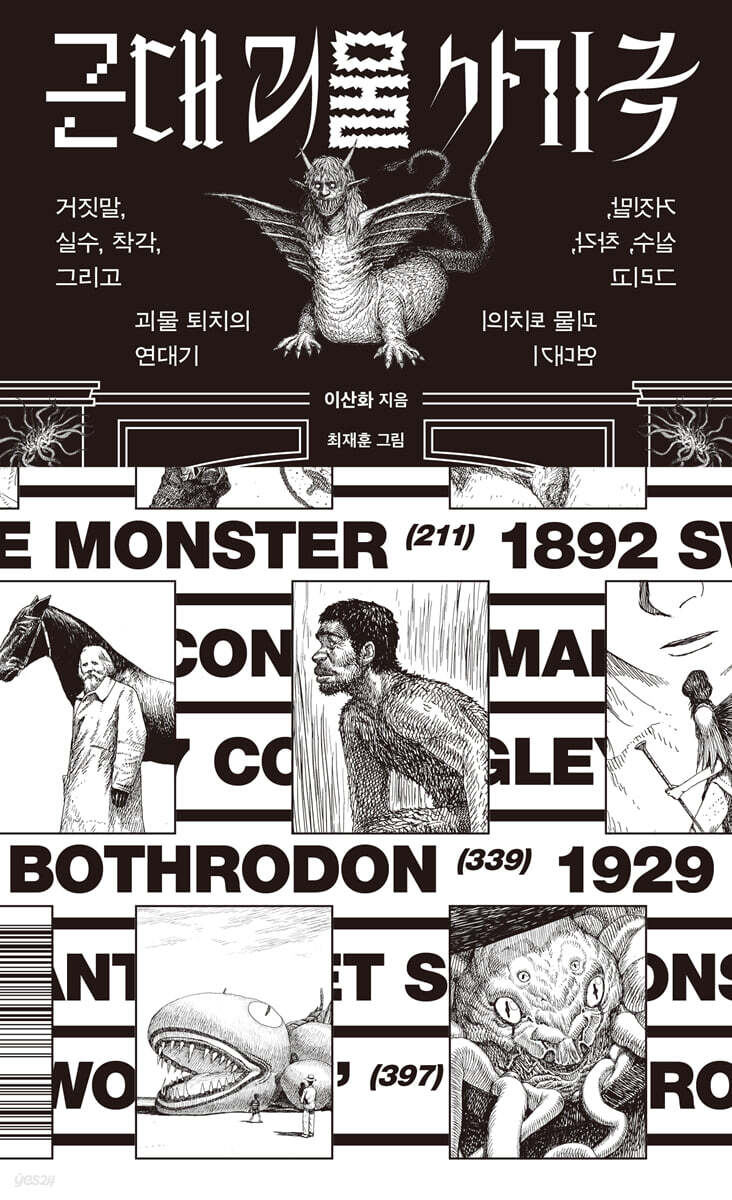
Includes vivid monster illustrations
Author Lee San-hwa, who was praised for “excellent in unfolding genre narratives of different characters based on scientific rigor” in “Missing Space Vanilla,” published in 2024, now presents “Modern Monster Fraud,” which he conceived after devouring Eastern and Western literature for several years.
This is a masterpiece that vividly brings back to life monsters that were forgotten or erased from people's memories through meticulous research.
This monumental non-fiction work, completed with the author's characteristic passion for delving into a subject with unstinting intensity, is consistently engaging, so much so that, despite being a massive 500-page historical book, it feels like reading a mystery novel.
In this author's epic journey, writer Choi Jae-hoon, widely known as the art director of the 2024 Korean film "The Grave," participated from the planning stage.
He used his creative imagination to realize the subtle boundary between surrealism and reality contained in 『Modern Monster Fraud』 through 29 plates.
Artist Choi Jae-hoon says that he tried to portray the vivid images of monsters that seem to be alive and breathing somewhere even now, while also expressing the fantasy of monsters whose traces can be found nowhere.
The black-and-white illustrations in the book breathe life into the text, transporting us back to that era like a time machine.
The writer of Dioxide summons scientists Carl Linnaeus (Carl von Linnaeus) and Bernard Oebelman to write a chronicle of modern monsters.
Linnaeus was a botanist who created the binomial nomenclature system, which uses the genus and species names of organisms to systematically classify organisms and establish the order of nature.
He believed that if the monsters of myth and legend really existed, they should be able to be classified scientifically, and that those that could not be classified should be banished from the realm of zoology.
“The sword of judgment called modern science has finally begun to reach the monsters who had been living peacefully in the long-held perception of Europeans.
And as history records, the Hydra of Hamburg was one of the first monsters to face that blade.”
Thus, monsters who had to avoid scientific judgment throughout modern history finally have the opportunity to have their existence 'scientifically' acknowledged by Oebelman, the 'father of modern monster research.'
He defends the possibility of monsters in “In Search of Unknown Animals,” which begins with the ambitious declaration that “there are lost worlds all over the world.”
While Linnaeus's extermination of the Hydra was a prelude to the modern era of extermination of 'impossible monsters' in the name of science, Oebelman's extermination of Loew, which occurred 220 years later, was part of an attempt to select 'possible monsters' from among those branded as impossible and recognize them in the name of science.
These two incidents are the beginning and end of the monster chronicle introduced by the author of this article.
Although their appearances and backgrounds may be different, all modern monsters have survived, if only for a moment, in the two-century-long war of nerves between those who deny and those who believe, those who fabricate and those who expose, to deceive the world and leave their names in history.
The Hamburg Hydra and the New Guinea Rho were both monsters combining the characteristics of several taxonomically distinct animals, and Linnaeus and Oebelman immediately pointed out this fact and denied their existence.
Just as Linnaeus' methodology for defeating the Hydra was inherited in his book, Systema Naturae, which laid the foundation for modern zoology, Oebelman's methodology for defeating Lowe based on that very zoology established In Search of Unknown Animals as the starting point for academic monster research.
- In the text
Why has humanity imagined, invented, and believed in monsters?
Original genre writer Lee San-ga
A grand narrative that took four years of data collection and writing.
×
Choi Jae-hoon, the concept artist of “Pamyeo”
Includes vivid monster illustrations
Author Lee San-hwa, who was praised for “excellent in unfolding genre narratives of different characters based on scientific rigor” in “Missing Space Vanilla,” published in 2024, now presents “Modern Monster Fraud,” which he conceived after devouring Eastern and Western literature for several years.
This is a masterpiece that vividly brings back to life monsters that were forgotten or erased from people's memories through meticulous research.
This monumental non-fiction work, completed with the author's characteristic passion for delving into a subject with unstinting intensity, is consistently engaging, so much so that, despite being a massive 500-page historical book, it feels like reading a mystery novel.
In this author's epic journey, writer Choi Jae-hoon, widely known as the art director of the 2024 Korean film "The Grave," participated from the planning stage.
He used his creative imagination to realize the subtle boundary between surrealism and reality contained in 『Modern Monster Fraud』 through 29 plates.
Artist Choi Jae-hoon says that he tried to portray the vivid images of monsters that seem to be alive and breathing somewhere even now, while also expressing the fantasy of monsters whose traces can be found nowhere.
The black-and-white illustrations in the book breathe life into the text, transporting us back to that era like a time machine.
The writer of Dioxide summons scientists Carl Linnaeus (Carl von Linnaeus) and Bernard Oebelman to write a chronicle of modern monsters.
Linnaeus was a botanist who created the binomial nomenclature system, which uses the genus and species names of organisms to systematically classify organisms and establish the order of nature.
He believed that if the monsters of myth and legend really existed, they should be able to be classified scientifically, and that those that could not be classified should be banished from the realm of zoology.
“The sword of judgment called modern science has finally begun to reach the monsters who had been living peacefully in the long-held perception of Europeans.
And as history records, the Hydra of Hamburg was one of the first monsters to face that blade.”
Thus, monsters who had to avoid scientific judgment throughout modern history finally have the opportunity to have their existence 'scientifically' acknowledged by Oebelman, the 'father of modern monster research.'
He defends the possibility of monsters in “In Search of Unknown Animals,” which begins with the ambitious declaration that “there are lost worlds all over the world.”
While Linnaeus's extermination of the Hydra was a prelude to the modern era of extermination of 'impossible monsters' in the name of science, Oebelman's extermination of Loew, which occurred 220 years later, was part of an attempt to select 'possible monsters' from among those branded as impossible and recognize them in the name of science.
These two incidents are the beginning and end of the monster chronicle introduced by the author of this article.
Although their appearances and backgrounds may be different, all modern monsters have survived, if only for a moment, in the two-century-long war of nerves between those who deny and those who believe, those who fabricate and those who expose, to deceive the world and leave their names in history.
The Hamburg Hydra and the New Guinea Rho were both monsters combining the characteristics of several taxonomically distinct animals, and Linnaeus and Oebelman immediately pointed out this fact and denied their existence.
Just as Linnaeus' methodology for defeating the Hydra was inherited in his book, Systema Naturae, which laid the foundation for modern zoology, Oebelman's methodology for defeating Lowe based on that very zoology established In Search of Unknown Animals as the starting point for academic monster research.
- In the text
- You can preview some of the book's contents.
Preview
index
letter
[1735] Linnaeus defeats the Hydra in Hamburg
Part 1 1700s
[1758] Know Thyself - Cave Man
[1758] Unidentified Pain - Hell Wrath Worm
[1763] The Legacy Left Behind - Charlton's Yellow Butterfly
[1770] Blueprint for the Future - Turks
[1784] What is reflected in the face of the monster - The monster of Lake Breakwater
Part 2 1800s
[1808] The Time Traveler Washed Ashore - The Stronsa Beast
[1822] The Greatest Show on Earth Opens - The Fiji Mermaid
[1835] The World's Most Fascinating Lie - The Bat-Man on the Moon
[1840] Champions and Challengers - Missouri
[1845] The Resurrection of the Biblical Monster - Hydrachos
[1854] Everyone makes mistakes at first - Iguanodon in the Crystal Palace
[1857] Small Illusions and Giant Leaps - The Emperor Flea
[1864] Who Planted the Seed? - The Orgoeyu Meteorite
[1869] The Show Must Go On - Cardiff Giant
[1874] Sweet Bait in the Forest - The Man-Eating Tree of Madagascar
[1891] Persistent as a Wandering Ghost - The Crawfordsville Monster
[1892] The Mystery Left Behind by the Great Detective - The Swamp Viper
[1896] The Dead Kraken Waits Dreaming - The Monster of St. Augustine
[1899] In Search of Ancient Survivors - Conradi Mammoth
Part 3 1900s
[1904] If only people were as clever as animals - Clever Hans
[1912] The culprit is in this - Piltdown Man
[1917] Fairy Tales for Adults - The Coatingley Fairies
[1919] The Dragon in the Darkness of the Mind - Brontosaurus of the Congo
[1926] Knowledge is poison - Bosrodon
[1929] The real monster not captured in the photograph - De Roy's ape
[1933] The Illusion Will Last Forever - The Loch Ness Monster
[1937] How to Inflate a Monster - The Nantucket Sea Monster
[1938] The World Turns Upside Down - Martians in "War of the Worlds"
[1939] Possible Monsters, Impossible Monsters - Lowe
The final chapter
[1948] Sanderson encounters footprints on the banks of the Suwannee River.
Acknowledgements
main
Search
[1735] Linnaeus defeats the Hydra in Hamburg
Part 1 1700s
[1758] Know Thyself - Cave Man
[1758] Unidentified Pain - Hell Wrath Worm
[1763] The Legacy Left Behind - Charlton's Yellow Butterfly
[1770] Blueprint for the Future - Turks
[1784] What is reflected in the face of the monster - The monster of Lake Breakwater
Part 2 1800s
[1808] The Time Traveler Washed Ashore - The Stronsa Beast
[1822] The Greatest Show on Earth Opens - The Fiji Mermaid
[1835] The World's Most Fascinating Lie - The Bat-Man on the Moon
[1840] Champions and Challengers - Missouri
[1845] The Resurrection of the Biblical Monster - Hydrachos
[1854] Everyone makes mistakes at first - Iguanodon in the Crystal Palace
[1857] Small Illusions and Giant Leaps - The Emperor Flea
[1864] Who Planted the Seed? - The Orgoeyu Meteorite
[1869] The Show Must Go On - Cardiff Giant
[1874] Sweet Bait in the Forest - The Man-Eating Tree of Madagascar
[1891] Persistent as a Wandering Ghost - The Crawfordsville Monster
[1892] The Mystery Left Behind by the Great Detective - The Swamp Viper
[1896] The Dead Kraken Waits Dreaming - The Monster of St. Augustine
[1899] In Search of Ancient Survivors - Conradi Mammoth
Part 3 1900s
[1904] If only people were as clever as animals - Clever Hans
[1912] The culprit is in this - Piltdown Man
[1917] Fairy Tales for Adults - The Coatingley Fairies
[1919] The Dragon in the Darkness of the Mind - Brontosaurus of the Congo
[1926] Knowledge is poison - Bosrodon
[1929] The real monster not captured in the photograph - De Roy's ape
[1933] The Illusion Will Last Forever - The Loch Ness Monster
[1937] How to Inflate a Monster - The Nantucket Sea Monster
[1938] The World Turns Upside Down - Martians in "War of the Worlds"
[1939] Possible Monsters, Impossible Monsters - Lowe
The final chapter
[1948] Sanderson encounters footprints on the banks of the Suwannee River.
Acknowledgements
main
Search
Detailed image

Into the book
Even after the cavemen returned to their natural place in the natural world, people were still fascinated by stories about beings who looked very much like humans, but were not human at all.
Such stories have always reflected what we consider to be human standards and how we try to exclude those who are different from us through those standards.
From Piltdown Man, once believed to be the ancestor of humanity, to the apes of Druah, who harbored a chilling racism, the stories of these monstrous sisters, whose eyes glint in the darkness and illuminate our ugliest features, will continue for generations to come.
--- p.30
Perhaps the removal of Sloane's bust and the expulsion of the Charlton's yellow butterfly from the natural world are not so different.
Just as his disciple Fabricius did not pretend not to know that the butterfly Linnaeus had named had a black spot, even if it is a precious and glorious legacy, if it is tainted, it must be revealed and the facts must be set straight.
That would be the true first step in Linnaeus's lifelong quest to slay monsters.
--- p.48~49
The life story of the Fijian mermaid is particularly fascinating because it illustrates the complex relationship between 19th-century science and monsters.
A century after Linnaeus's slaying of the Hydra, science has established itself as the most powerful weapon for defeating monsters rooted in conventional wisdom, but at the same time, it has also become a means of creating monsters beyond common sense when necessary.
To a man like Barnum, the truth of monsters or science was of no importance, as even those who believed in science could be fooled by 'scientific' monsters.
The question was which truth would be more popular, that is, which would make money.
The Greatest Show on Earth, a spectacular stage featuring more believable monsters than ever before, has finally opened its curtains.
--- p.108
Of course, this explosive popularity was largely due to the article being written in a plausible manner.
By mentioning Herschel, who was actually preparing to observe Halley's Comet using a large telescope at the Cape of Good Hope, and an actual Scottish academic journal that had been shut down just two years earlier, Sun tried to make the absurd story as factual and professional as possible.
However, the reason why the lunar ecosystem and the everyday life of the bat-humans reported in the newspaper were so enthusiastically received cannot be attributed solely to the plausibility of the writing.
No matter how plausible a story is, if people don't want to believe it, they tend to deny it first.
On the other hand, if it is something that people want to believe, they tend to easily accept even the most absurd stories.
In other words, New Yorkers in 1835 were ready to accept the existence of extraterrestrial life at any time.
--- p.112
By linking new concepts like extinction, paleontology, dinosaurs, and lost worlds with older biblical passages, 19th-century Christians were able to maintain their faith in a Christian worldview without completely rejecting the achievements of modern science.
It was in this context that the New York Dissector and the New York Evangelist recognized Hydraarchus as the biblical monster Leviathan.
People of the time sought to reconcile science and faith, which had been in constant conflict, by seeking evidence in the Bible that a new monster had once existed in New York City, and by finding evidence in the monster that the Bible's contents were true.
--- p.143
However, it is not possible to simply say that the St. Augustine Monster was simply the product of a common misunderstanding.
The century-long uproar surrounding the bodies that appeared on the Florida coast has been a recurring pattern, not of foolish misconceptions and clear explanations, but of scientific "proofs" and their scientific rebuttals.
This means that even those who claim to have mastered the scientific methodology sometimes dream of the existence of the Kraken, like Denis Montfort in the past, and therefore sometimes hastily interpret the evidence before them in a way that tries to acknowledge its existence whenever possible.
So, 'proof' that the St. Augustine Monster or other globsters were actually the remains of giant octopuses may continue to emerge.
Like Lovecraft's Cthulhu, the Kraken, though dead, still dwells in the depths of the sea, dreaming of our curiosity, fear, and imagination, waiting for the day when it will rise again to the surface.
--- p.251
Today, the Piltdown incident is widely cited in scientific circles as an example of the dangers of preconceptions and the importance of objectivity.
Although creationists have always liked to point out that Piltdown Man is proof of how gullible and stupid evolutionists are, it's easy to dismiss the criticisms of those who are too religiously engrossed to accept the countless pieces of evidence for human evolution that have been unearthed since the 19th century.
We just have to remember the real culprit behind the Piltdown incident.
About the power of honor and patriotism that can turn even the jawbone of a mere orangutan into the remains of a great Englishman, and about the frail nature of humanity, the primate of all creation, who can so firmly believe even the most obvious lie for decades if they so choose.
--- p.297
If we were to list all the photos purportedly of unknown creatures in order of popularity, the first spot would undoubtedly be taken by the legendary "surgeon's photo," which shows the Loch Ness Monster, the epitome of modern monsters, poking its head out of the water.
Next in line, of course, should be frame 352 from the Patterson-Kimlin Films, which captures the famous scene of Bigfoot, the modern monster, looking back.
These two photographs are famous not because they capture the monster most clearly, nor because they are universally recognized evidence.
The numerous controversies surrounding the blurry figures in the photos have instead made them symbols of modern and contemporary monster stories, and even cultural icons.
--- p.349
This monumental slaying of a monster in 1955, undertaken by none other than a pioneer in monster research, is in many ways reminiscent of Linnaeus's slaying of the Hydra in 1735.
The Hamburg Hydra and the New Guinea Rho were both monsters combining the characteristics of several taxonomically distinct animals, and Linnaeus and Oebelman immediately pointed out this fact and denied their existence.
Just as Linnaeus' methodology for defeating the Hydra was inherited in his book, Systema Naturae, which laid the foundation for modern zoology, Oebelman's methodology for defeating Lowe based on that very zoology established In Search of Unknown Animals as the starting point for academic monster research.
Such stories have always reflected what we consider to be human standards and how we try to exclude those who are different from us through those standards.
From Piltdown Man, once believed to be the ancestor of humanity, to the apes of Druah, who harbored a chilling racism, the stories of these monstrous sisters, whose eyes glint in the darkness and illuminate our ugliest features, will continue for generations to come.
--- p.30
Perhaps the removal of Sloane's bust and the expulsion of the Charlton's yellow butterfly from the natural world are not so different.
Just as his disciple Fabricius did not pretend not to know that the butterfly Linnaeus had named had a black spot, even if it is a precious and glorious legacy, if it is tainted, it must be revealed and the facts must be set straight.
That would be the true first step in Linnaeus's lifelong quest to slay monsters.
--- p.48~49
The life story of the Fijian mermaid is particularly fascinating because it illustrates the complex relationship between 19th-century science and monsters.
A century after Linnaeus's slaying of the Hydra, science has established itself as the most powerful weapon for defeating monsters rooted in conventional wisdom, but at the same time, it has also become a means of creating monsters beyond common sense when necessary.
To a man like Barnum, the truth of monsters or science was of no importance, as even those who believed in science could be fooled by 'scientific' monsters.
The question was which truth would be more popular, that is, which would make money.
The Greatest Show on Earth, a spectacular stage featuring more believable monsters than ever before, has finally opened its curtains.
--- p.108
Of course, this explosive popularity was largely due to the article being written in a plausible manner.
By mentioning Herschel, who was actually preparing to observe Halley's Comet using a large telescope at the Cape of Good Hope, and an actual Scottish academic journal that had been shut down just two years earlier, Sun tried to make the absurd story as factual and professional as possible.
However, the reason why the lunar ecosystem and the everyday life of the bat-humans reported in the newspaper were so enthusiastically received cannot be attributed solely to the plausibility of the writing.
No matter how plausible a story is, if people don't want to believe it, they tend to deny it first.
On the other hand, if it is something that people want to believe, they tend to easily accept even the most absurd stories.
In other words, New Yorkers in 1835 were ready to accept the existence of extraterrestrial life at any time.
--- p.112
By linking new concepts like extinction, paleontology, dinosaurs, and lost worlds with older biblical passages, 19th-century Christians were able to maintain their faith in a Christian worldview without completely rejecting the achievements of modern science.
It was in this context that the New York Dissector and the New York Evangelist recognized Hydraarchus as the biblical monster Leviathan.
People of the time sought to reconcile science and faith, which had been in constant conflict, by seeking evidence in the Bible that a new monster had once existed in New York City, and by finding evidence in the monster that the Bible's contents were true.
--- p.143
However, it is not possible to simply say that the St. Augustine Monster was simply the product of a common misunderstanding.
The century-long uproar surrounding the bodies that appeared on the Florida coast has been a recurring pattern, not of foolish misconceptions and clear explanations, but of scientific "proofs" and their scientific rebuttals.
This means that even those who claim to have mastered the scientific methodology sometimes dream of the existence of the Kraken, like Denis Montfort in the past, and therefore sometimes hastily interpret the evidence before them in a way that tries to acknowledge its existence whenever possible.
So, 'proof' that the St. Augustine Monster or other globsters were actually the remains of giant octopuses may continue to emerge.
Like Lovecraft's Cthulhu, the Kraken, though dead, still dwells in the depths of the sea, dreaming of our curiosity, fear, and imagination, waiting for the day when it will rise again to the surface.
--- p.251
Today, the Piltdown incident is widely cited in scientific circles as an example of the dangers of preconceptions and the importance of objectivity.
Although creationists have always liked to point out that Piltdown Man is proof of how gullible and stupid evolutionists are, it's easy to dismiss the criticisms of those who are too religiously engrossed to accept the countless pieces of evidence for human evolution that have been unearthed since the 19th century.
We just have to remember the real culprit behind the Piltdown incident.
About the power of honor and patriotism that can turn even the jawbone of a mere orangutan into the remains of a great Englishman, and about the frail nature of humanity, the primate of all creation, who can so firmly believe even the most obvious lie for decades if they so choose.
--- p.297
If we were to list all the photos purportedly of unknown creatures in order of popularity, the first spot would undoubtedly be taken by the legendary "surgeon's photo," which shows the Loch Ness Monster, the epitome of modern monsters, poking its head out of the water.
Next in line, of course, should be frame 352 from the Patterson-Kimlin Films, which captures the famous scene of Bigfoot, the modern monster, looking back.
These two photographs are famous not because they capture the monster most clearly, nor because they are universally recognized evidence.
The numerous controversies surrounding the blurry figures in the photos have instead made them symbols of modern and contemporary monster stories, and even cultural icons.
--- p.349
This monumental slaying of a monster in 1955, undertaken by none other than a pioneer in monster research, is in many ways reminiscent of Linnaeus's slaying of the Hydra in 1735.
The Hamburg Hydra and the New Guinea Rho were both monsters combining the characteristics of several taxonomically distinct animals, and Linnaeus and Oebelman immediately pointed out this fact and denied their existence.
Just as Linnaeus' methodology for defeating the Hydra was inherited in his book, Systema Naturae, which laid the foundation for modern zoology, Oebelman's methodology for defeating Lowe based on that very zoology established In Search of Unknown Animals as the starting point for academic monster research.
--- p.427
Publisher's Review
It has become the motif of numerous novels, movies, animations, and dramas.
Reveal the monster's true identity!
Crucial clues hidden behind rumors and lies
The existence of 'monsters', then and now, is an interesting subject of conversation that crosses the line between imagination and reality.
Like everyone else, author Lee Sang-hwa was also fascinated by monster stories since childhood.
As the author followed in the footsteps of the monster, he realized that monsters were not simply products of the imagination, but were born from a complex intertwining of the fears and desires within us humans, along with the scientific hegemony and historical ideology of the time.
It feels a bit complicated to try to uncover the true identity of the object of my passion and compile it into a book.
Some might think that I'm ruining the fun of monster stories by dissecting them and labeling them as lies.
But I am convinced that even the most trivial and vain truth has a value that infinitely surpasses the sweetest lie.
Every time we realize just how firmly we can believe in absurd monster stories, how difficult it is to break free from ingrained beliefs, and what the truth is behind the various rumors and lies that decorate history, we will surely understand the world and ourselves more clearly.
- In the text
"Modern Monster Hoaxes" begins with a series of fake monsters that successfully deceived humanity, but it also tenaciously traces how the various monsters that graced the modern era stimulated human imagination, desire, and vanity, while simultaneously functioning as a medium for expressing the anxieties and fears of reality.
For example, the author reads the issue of racism through the scientific debate surrounding the 18th century 'cave man' and raises fundamental questions about the definition of humanity, while introducing 'Misurium' in the 19th century and discussing how the birth of the discipline of paleontology greatly influenced humanity's imagination of monsters, and while digging into the incident that became the starting point of the story of the 'Brontosaurus of the Congo' in the 20th century, he also looks into the darkness in our hearts caused by imperialism and religious blind faith.
Through this chronicle of fraud, fabrication, delusion, and error, all of which have been left behind in modern history under the name of "monster," we are naturally led to consider what kind of beings humanity has defined as "monsters," and what kind of zeitgeist and beliefs have been reflected in humanity's belief in monsters.
As we follow the author's gaze, which delves into the history of modern science and society through the window of monsters, we will realize that monsters can exist in any era, with only their appearances changing.
It shook up the modern history of science and reason.
The Strange Chronicles of Monsters
When we hear the word 'monster', we often think of bizarre and fearsome beings with strange shapes and supernatural powers that often appear in myths and legends.
However, in ancient and medieval Western societies, these monsters were not so strictly distinguished from real animals.
This is because, in a time when information was not easily conveyed and religion and common sense dominated public perception, the very idea of verifying truth from falsehood was not universal.
It was the power of modern science that changed this situation.
The 18th-century botanist Carl Linnaeus (Carl von Linnaeus) did not stop at observing each natural object individually, but established a methodology for systematically classifying them by examining their relationships with each other. His classification method was organized into the book Systema Naturae and has become the most common tool for studying plants and animals.
There was no room for monsters in a rationally reorganized classification system.
As science developed and the space for monsters became smaller and smaller, the monsters of the 18th century, unlike those of previous eras, chose to disguise themselves in a more convincing and 'scientific' way to survive.
The cavemen, hell wrath beetles, Charlton's yellow butterfly, Turks, and the monster of Lake Pagwa, who disguised themselves as 'trustworthy' beings, succeeded in surviving by blinding the eyes of the people of their time.
But how could seemingly incompatible science and monsters coexist? According to the author, "science has established itself as the most powerful weapon for eradicating monsters rooted in conventional wisdom, but it has also become a means for creating monsters beyond common sense when necessary."
Humanity's endless greed for the 'greatest show on earth'
In the midst of it all, fake monsters who have been splendidly deceiving the public
Ironically, scientific advancements give birth to other monsters.
Advances in astronomy have stimulated the public's imagination about the possibility of extraterrestrial life, and advances in paleontology have revealed the existence of extinct animals such as dinosaurs and mammoths that once ruled the Earth, suggesting new archetypes of monsters.
“A paradigm of monster stories that attempts to provide a more plausible scientific explanation by pointing to surviving ancient creatures as the identity of the monster, the so-called ‘primordial survivor paradigm,’ to borrow the expression of British paleontologist Darren Naish,” was created.
As astronomy increasingly pointed to the possibility of extraterrestrial life, theologians, rather than outright denying it, sought to reconcile it with religious beliefs.
The logic was that if God were omnipotent and benevolent, he would have arranged for other planets to be habitable.
Among the theologians who accepted this logic was Timothy Dwight, president of Yale University from 1795 to 1817, who went so far as to suggest in one sermon that there might be people on the moon who would live happier lives than Earthlings.
Meanwhile, the person who most passionately advocated the theory of multiple universes in the 1820s was undoubtedly the Scottish philosopher Thomas Dick.
In his book, The Christian Philosopher, which was published in 1823 and was also very popular in the United States, Dick argued eloquently that intelligent life exists not only on other planets in the solar system but also within the sun, and that the Bible contains ample evidence for the theory of multiple universes.
- In the text
New monster stories based on science are further fueling public interest in monsters.
Coincidentally, as humanity enjoyed unprecedented prosperity following the Industrial Revolution, major cities like London and New York, in particular, were transformed into new worlds filled with people seeking new stimulation and opportunities.
In this social climate, those seeking commercial gain begin to create various 'star' monsters to stimulate the public's curiosity.
The author introduces various monstrous frauds that emerged during this period and warns of human nature's tendency to be easily swayed by greed and deception.
For example, there is the 'Fiji Mermaid', which appeared to the world in 1822.
The person who created the fake mermaid was the infamous conman Barnum, also known as the star of the movie “The Greatest Showman.”
He planned a grand show to get science on his side: he created fake scientists and fooled the press.
“Under Barnum’s clever tactics, the language of science, once used to slay monsters, has been turned into an ally of monsters.”
Another monster that has captivated humanity with lies is the 'Cardiff Giant', created by American tobacco merchant George Hull.
Hull plans to make a fortune targeting Christians who believe the biblical story of David and Goliath is true.
He made a plaster statue of himself, buried it in a pit, and then told a brazen lie that he had found a giant from the Bible, deceiving people. But soon he was fooled by an even bolder and more elaborate lie.
However, this does not mean that all modern monsters were the products of fraud and lies.
The "Crawfordsville Monster," which appeared in the skies over Crawfordsville, Indiana, in the late 19th century, came to life thanks to the testimony of credible witnesses, and later came to be recognized as "one of the most fantastic reports of UFO sightings."
The media also played a significant role in making this monster a household name in history.
The 19th century ushered in the golden age of mass media in the United States with the appearance of mass-produced one-cent "penny newspapers."
Newspapers constantly published sensational, unverified monster stories to capture readers' attention, and these stories spread like wildfire, causing a stir every time.
A representative example is the 1835 New York daily newspaper The Sun, which confused the public by reporting fake news about a "bat-man on the moon" as if it were fact.
Later, in the 20th century, radio broadcasting, a new and powerful means of disseminating information, inherited the stigma of being a medium for spreading rumors about monsters.
The “wave of mass hysteria” reported in the next morning’s newspaper was nothing more than an optical illusion.
What actually happened was nothing more than a localized riot by a small number of people, but due to the influx of inquiries, the newspapers misjudged the scale of the incident and reported it based on a handful of sensational anecdotes that fit their misjudgement, generalizing the entire incident and adding unfounded speculation, which created the illusion that the world had turned upside down.
Meanwhile, Campbell speculates that the exaggerated reporting was intended to attack the credibility of the competing medium, radio, but Schwartz points out that at the time, the conflict between the two media was easing rather than intensifying, and that about 30% of American radio stations were owned by newspapers.
Of course, even if the reporters intentionally exaggerated the incident to some extent, it doesn't change the fact that they likely perceived the "War of the Worlds" incident as being bigger than it actually was.
By accepting as fact the fictional disaster of the public's delusions about radio, they have unknowingly created another grand lie, so to speak, 'fake news about fake news.'
- In the text
This phenomenon of monster stories of unknown authenticity spreading uncontrollably through the mass media is not something that is just a thing of the past.
Even today, fake news spreads faster and more widely through social media such as YouTube, Instagram, and X (formerly Twitter), although the media has changed.
Fake news, including monster stories, will inevitably be reproduced, as the more people click and share, the more advertising revenue there is.
In this way, the advancement of science and the growth of mass media since the Industrial Revolution have played a significant role in the formation and spread of monster rumors, and their aftereffects continue to influence modern society.
Imperialism, world wars, and the monsters of the 'science of discrimination'
The cruel darkness of a more monstrous era
The author does not overlook the prejudice and hatred hidden in many monster stories.
Because we cannot discuss monsters without examining what modern Western civilization has perceived as a "monster"—that is, as something unfamiliar, fearful, and alien.
For example, Carl Linnaeus suspected that the "white Negro" who appeared in London in 1758 might be the legendary caveman, and Georges Montandon, a French anthropologist steeped in racist ideology, tried to support his claims with photographs of an unknown ape taken in South America.
The two world wars, in which the darkness accumulated throughout modern history burst forth in its most tragic form, also had a profound influence on monster stories.
While imperialist ambitions and perverse patriotism each created new monsters, the horrors of war gave even the most outrageous monster stories an irresistible persuasiveness.
The author comments on how people in the 20th century were fooled by nonsensical stories like the 'Cottingley Fairy':
“In the aftermath of World War I, which was called ‘the war to end all wars,’ wounded and weary adults may have had to desperately believe that a fairytale-like world as beautiful as a child’s imagination existed not only in reality but also in reality.”
In this way, when science was reduced from a gilded pedestal of civilization to a tool of destruction, ethics and morality were trampled under the ideology that justified massacre, and war and the Great Depression devastated citizens' lives, and economic and psychological anxiety reached a peak, monsters went beyond mere imaginary beings and became metaphors symbolizing the dark side of the times.
At the end of these monster stories, which the author has pulled out of the darkness of modern history through extensive literature research, we naturally turn our attention to the darkness facing modern society.
What will the new monsters of the 21st century, born from threats like technological supremacy, climate disaster, ecological destruction, and the resurgence of fascism, look like? The twenty-nine ancient monster tales contained in "Modern Monster Hoaxes" serve as both a warning and a prophecy for the future.
No matter how much science and technology advance, monsters will never disappear unless we, as humans, fundamentally change.
The War of the Worlds was clearly the end of an era, though the world wasn't turned upside down overnight.
It was never going to happen that bizarre Martians would appear and threaten humanity in killing machines.
But changes and threats that were too difficult to even imagine were about to arrive at any moment, and news of them would pour into society at an unprecedented rate and with unprecedented mercilessness.
The broadcast on October 30, 1938, was merely a preview.
At the end of the long modern era, when all sorts of monsters swarmed in the shadow of scientific and technological advancement, a new world, the modern era, was finally approaching.
- In the text
? The author's autograph is included on the cover.
Reveal the monster's true identity!
Crucial clues hidden behind rumors and lies
The existence of 'monsters', then and now, is an interesting subject of conversation that crosses the line between imagination and reality.
Like everyone else, author Lee Sang-hwa was also fascinated by monster stories since childhood.
As the author followed in the footsteps of the monster, he realized that monsters were not simply products of the imagination, but were born from a complex intertwining of the fears and desires within us humans, along with the scientific hegemony and historical ideology of the time.
It feels a bit complicated to try to uncover the true identity of the object of my passion and compile it into a book.
Some might think that I'm ruining the fun of monster stories by dissecting them and labeling them as lies.
But I am convinced that even the most trivial and vain truth has a value that infinitely surpasses the sweetest lie.
Every time we realize just how firmly we can believe in absurd monster stories, how difficult it is to break free from ingrained beliefs, and what the truth is behind the various rumors and lies that decorate history, we will surely understand the world and ourselves more clearly.
- In the text
"Modern Monster Hoaxes" begins with a series of fake monsters that successfully deceived humanity, but it also tenaciously traces how the various monsters that graced the modern era stimulated human imagination, desire, and vanity, while simultaneously functioning as a medium for expressing the anxieties and fears of reality.
For example, the author reads the issue of racism through the scientific debate surrounding the 18th century 'cave man' and raises fundamental questions about the definition of humanity, while introducing 'Misurium' in the 19th century and discussing how the birth of the discipline of paleontology greatly influenced humanity's imagination of monsters, and while digging into the incident that became the starting point of the story of the 'Brontosaurus of the Congo' in the 20th century, he also looks into the darkness in our hearts caused by imperialism and religious blind faith.
Through this chronicle of fraud, fabrication, delusion, and error, all of which have been left behind in modern history under the name of "monster," we are naturally led to consider what kind of beings humanity has defined as "monsters," and what kind of zeitgeist and beliefs have been reflected in humanity's belief in monsters.
As we follow the author's gaze, which delves into the history of modern science and society through the window of monsters, we will realize that monsters can exist in any era, with only their appearances changing.
It shook up the modern history of science and reason.
The Strange Chronicles of Monsters
When we hear the word 'monster', we often think of bizarre and fearsome beings with strange shapes and supernatural powers that often appear in myths and legends.
However, in ancient and medieval Western societies, these monsters were not so strictly distinguished from real animals.
This is because, in a time when information was not easily conveyed and religion and common sense dominated public perception, the very idea of verifying truth from falsehood was not universal.
It was the power of modern science that changed this situation.
The 18th-century botanist Carl Linnaeus (Carl von Linnaeus) did not stop at observing each natural object individually, but established a methodology for systematically classifying them by examining their relationships with each other. His classification method was organized into the book Systema Naturae and has become the most common tool for studying plants and animals.
There was no room for monsters in a rationally reorganized classification system.
As science developed and the space for monsters became smaller and smaller, the monsters of the 18th century, unlike those of previous eras, chose to disguise themselves in a more convincing and 'scientific' way to survive.
The cavemen, hell wrath beetles, Charlton's yellow butterfly, Turks, and the monster of Lake Pagwa, who disguised themselves as 'trustworthy' beings, succeeded in surviving by blinding the eyes of the people of their time.
But how could seemingly incompatible science and monsters coexist? According to the author, "science has established itself as the most powerful weapon for eradicating monsters rooted in conventional wisdom, but it has also become a means for creating monsters beyond common sense when necessary."
Humanity's endless greed for the 'greatest show on earth'
In the midst of it all, fake monsters who have been splendidly deceiving the public
Ironically, scientific advancements give birth to other monsters.
Advances in astronomy have stimulated the public's imagination about the possibility of extraterrestrial life, and advances in paleontology have revealed the existence of extinct animals such as dinosaurs and mammoths that once ruled the Earth, suggesting new archetypes of monsters.
“A paradigm of monster stories that attempts to provide a more plausible scientific explanation by pointing to surviving ancient creatures as the identity of the monster, the so-called ‘primordial survivor paradigm,’ to borrow the expression of British paleontologist Darren Naish,” was created.
As astronomy increasingly pointed to the possibility of extraterrestrial life, theologians, rather than outright denying it, sought to reconcile it with religious beliefs.
The logic was that if God were omnipotent and benevolent, he would have arranged for other planets to be habitable.
Among the theologians who accepted this logic was Timothy Dwight, president of Yale University from 1795 to 1817, who went so far as to suggest in one sermon that there might be people on the moon who would live happier lives than Earthlings.
Meanwhile, the person who most passionately advocated the theory of multiple universes in the 1820s was undoubtedly the Scottish philosopher Thomas Dick.
In his book, The Christian Philosopher, which was published in 1823 and was also very popular in the United States, Dick argued eloquently that intelligent life exists not only on other planets in the solar system but also within the sun, and that the Bible contains ample evidence for the theory of multiple universes.
- In the text
New monster stories based on science are further fueling public interest in monsters.
Coincidentally, as humanity enjoyed unprecedented prosperity following the Industrial Revolution, major cities like London and New York, in particular, were transformed into new worlds filled with people seeking new stimulation and opportunities.
In this social climate, those seeking commercial gain begin to create various 'star' monsters to stimulate the public's curiosity.
The author introduces various monstrous frauds that emerged during this period and warns of human nature's tendency to be easily swayed by greed and deception.
For example, there is the 'Fiji Mermaid', which appeared to the world in 1822.
The person who created the fake mermaid was the infamous conman Barnum, also known as the star of the movie “The Greatest Showman.”
He planned a grand show to get science on his side: he created fake scientists and fooled the press.
“Under Barnum’s clever tactics, the language of science, once used to slay monsters, has been turned into an ally of monsters.”
Another monster that has captivated humanity with lies is the 'Cardiff Giant', created by American tobacco merchant George Hull.
Hull plans to make a fortune targeting Christians who believe the biblical story of David and Goliath is true.
He made a plaster statue of himself, buried it in a pit, and then told a brazen lie that he had found a giant from the Bible, deceiving people. But soon he was fooled by an even bolder and more elaborate lie.
However, this does not mean that all modern monsters were the products of fraud and lies.
The "Crawfordsville Monster," which appeared in the skies over Crawfordsville, Indiana, in the late 19th century, came to life thanks to the testimony of credible witnesses, and later came to be recognized as "one of the most fantastic reports of UFO sightings."
The media also played a significant role in making this monster a household name in history.
The 19th century ushered in the golden age of mass media in the United States with the appearance of mass-produced one-cent "penny newspapers."
Newspapers constantly published sensational, unverified monster stories to capture readers' attention, and these stories spread like wildfire, causing a stir every time.
A representative example is the 1835 New York daily newspaper The Sun, which confused the public by reporting fake news about a "bat-man on the moon" as if it were fact.
Later, in the 20th century, radio broadcasting, a new and powerful means of disseminating information, inherited the stigma of being a medium for spreading rumors about monsters.
The “wave of mass hysteria” reported in the next morning’s newspaper was nothing more than an optical illusion.
What actually happened was nothing more than a localized riot by a small number of people, but due to the influx of inquiries, the newspapers misjudged the scale of the incident and reported it based on a handful of sensational anecdotes that fit their misjudgement, generalizing the entire incident and adding unfounded speculation, which created the illusion that the world had turned upside down.
Meanwhile, Campbell speculates that the exaggerated reporting was intended to attack the credibility of the competing medium, radio, but Schwartz points out that at the time, the conflict between the two media was easing rather than intensifying, and that about 30% of American radio stations were owned by newspapers.
Of course, even if the reporters intentionally exaggerated the incident to some extent, it doesn't change the fact that they likely perceived the "War of the Worlds" incident as being bigger than it actually was.
By accepting as fact the fictional disaster of the public's delusions about radio, they have unknowingly created another grand lie, so to speak, 'fake news about fake news.'
- In the text
This phenomenon of monster stories of unknown authenticity spreading uncontrollably through the mass media is not something that is just a thing of the past.
Even today, fake news spreads faster and more widely through social media such as YouTube, Instagram, and X (formerly Twitter), although the media has changed.
Fake news, including monster stories, will inevitably be reproduced, as the more people click and share, the more advertising revenue there is.
In this way, the advancement of science and the growth of mass media since the Industrial Revolution have played a significant role in the formation and spread of monster rumors, and their aftereffects continue to influence modern society.
Imperialism, world wars, and the monsters of the 'science of discrimination'
The cruel darkness of a more monstrous era
The author does not overlook the prejudice and hatred hidden in many monster stories.
Because we cannot discuss monsters without examining what modern Western civilization has perceived as a "monster"—that is, as something unfamiliar, fearful, and alien.
For example, Carl Linnaeus suspected that the "white Negro" who appeared in London in 1758 might be the legendary caveman, and Georges Montandon, a French anthropologist steeped in racist ideology, tried to support his claims with photographs of an unknown ape taken in South America.
The two world wars, in which the darkness accumulated throughout modern history burst forth in its most tragic form, also had a profound influence on monster stories.
While imperialist ambitions and perverse patriotism each created new monsters, the horrors of war gave even the most outrageous monster stories an irresistible persuasiveness.
The author comments on how people in the 20th century were fooled by nonsensical stories like the 'Cottingley Fairy':
“In the aftermath of World War I, which was called ‘the war to end all wars,’ wounded and weary adults may have had to desperately believe that a fairytale-like world as beautiful as a child’s imagination existed not only in reality but also in reality.”
In this way, when science was reduced from a gilded pedestal of civilization to a tool of destruction, ethics and morality were trampled under the ideology that justified massacre, and war and the Great Depression devastated citizens' lives, and economic and psychological anxiety reached a peak, monsters went beyond mere imaginary beings and became metaphors symbolizing the dark side of the times.
At the end of these monster stories, which the author has pulled out of the darkness of modern history through extensive literature research, we naturally turn our attention to the darkness facing modern society.
What will the new monsters of the 21st century, born from threats like technological supremacy, climate disaster, ecological destruction, and the resurgence of fascism, look like? The twenty-nine ancient monster tales contained in "Modern Monster Hoaxes" serve as both a warning and a prophecy for the future.
No matter how much science and technology advance, monsters will never disappear unless we, as humans, fundamentally change.
The War of the Worlds was clearly the end of an era, though the world wasn't turned upside down overnight.
It was never going to happen that bizarre Martians would appear and threaten humanity in killing machines.
But changes and threats that were too difficult to even imagine were about to arrive at any moment, and news of them would pour into society at an unprecedented rate and with unprecedented mercilessness.
The broadcast on October 30, 1938, was merely a preview.
At the end of the long modern era, when all sorts of monsters swarmed in the shadow of scientific and technological advancement, a new world, the modern era, was finally approaching.
- In the text
? The author's autograph is included on the cover.
GOODS SPECIFICS
- Date of issue: May 26, 2025
- Page count, weight, size: 512 pages | 560g | 130*213*30mm
- ISBN13: 9791191842876
- ISBN10: 1191842878
You may also like
카테고리
korean


korean

![GQ KOREA Mark (Monthly): December [2025]](http://librairie.coreenne.fr/cdn/shop/files/8ef265dbbfbf186523ed75ba7319009d.jpg?v=1765340328&width=3840)


