

3-Minute Urban Humanities Class
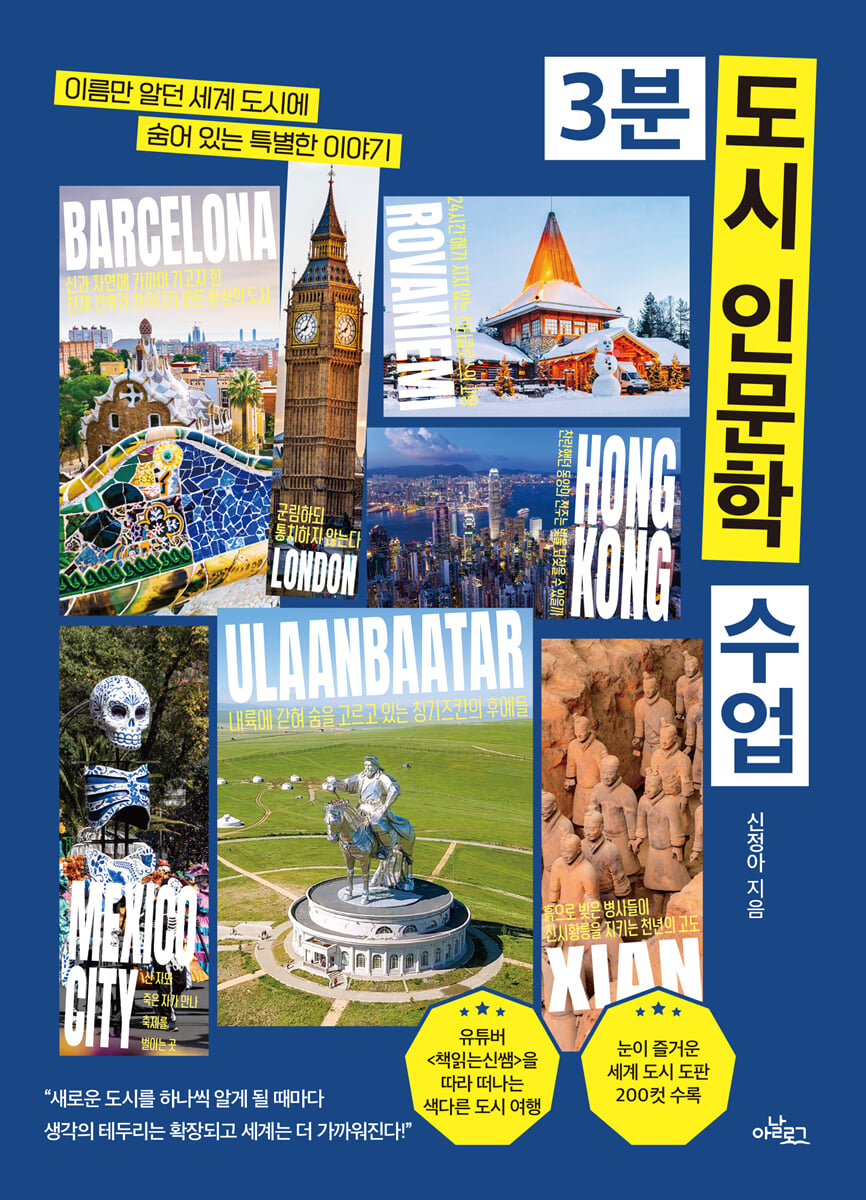 |
Description
Book Introduction
- A word from MD
- A book written by author Shin Jeong-ah, who runs the YouTube channel 'Book Reading Teacher', which introduces various books, and is a current middle school teacher.
It introduces 40 cities around the world and incorporates knowledge of history, philosophy, art, and architecture.
Although the introductions to each city are independent, reading the book from beginning to end reveals the flow of world history.
- Son Min-gyu, humanities PD
“Every time you get to know a city, your horizons expand and the world becomes closer!”
Through 40 cities around the world, each with its own interesting story.
The easiest and most fun way to learn humanities, encompassing history, philosophy, art, and architecture.
Why is it important to understand a city? People always flock to cities, and diverse people meet, interact, and develop through mutual influence.
In other words, cities are an excellent material for understanding the past, present, and future of humanity and the world.
Moreover, imagining a wider world beyond the boundaries of the world we live in now and hoping to visit it someday enriches our lives and broadens our scope of thought far more than we might think.
Author Shin Jeong-ah, a YouTuber who runs the YouTube channel 'Book Reading Teacher Shin' and introduces books from various fields, and a current middle school teacher, introduces 40 cities around the world through '3-Minute City Humanities Class'.
This book is written for those who are just beginning to broaden their horizons and seek to acquire more diverse knowledge and culture. It focuses on a single topic that has had a decisive influence on creating the unique characteristics of each city, and explains only the essential points in a concise manner that is easy for anyone to understand.
“Who built the round dome of the Santa Maria del Fiore Cathedral that comes to mind when you think of Florence?” “Why do only Quebecers speak French in Canada, where English is the main language?” “Why was a huge park built in the middle of Manhattan, New York?” Through hidden stories of cities that are familiar but not well known, even readers without much background knowledge can learn about world history, culture, art, and philosophy in a more accessible and interesting way.
Each city story is independent, so you can read them one by one, starting with the city story that interests you most, regardless of order.
Although this book does not cover in-depth topics, it will serve as a good starting point for further development of knowledge and culture.
Through 40 cities around the world, each with its own interesting story.
The easiest and most fun way to learn humanities, encompassing history, philosophy, art, and architecture.
Why is it important to understand a city? People always flock to cities, and diverse people meet, interact, and develop through mutual influence.
In other words, cities are an excellent material for understanding the past, present, and future of humanity and the world.
Moreover, imagining a wider world beyond the boundaries of the world we live in now and hoping to visit it someday enriches our lives and broadens our scope of thought far more than we might think.
Author Shin Jeong-ah, a YouTuber who runs the YouTube channel 'Book Reading Teacher Shin' and introduces books from various fields, and a current middle school teacher, introduces 40 cities around the world through '3-Minute City Humanities Class'.
This book is written for those who are just beginning to broaden their horizons and seek to acquire more diverse knowledge and culture. It focuses on a single topic that has had a decisive influence on creating the unique characteristics of each city, and explains only the essential points in a concise manner that is easy for anyone to understand.
“Who built the round dome of the Santa Maria del Fiore Cathedral that comes to mind when you think of Florence?” “Why do only Quebecers speak French in Canada, where English is the main language?” “Why was a huge park built in the middle of Manhattan, New York?” Through hidden stories of cities that are familiar but not well known, even readers without much background knowledge can learn about world history, culture, art, and philosophy in a more accessible and interesting way.
Each city story is independent, so you can read them one by one, starting with the city story that interests you most, regardless of order.
Although this book does not cover in-depth topics, it will serve as a good starting point for further development of knowledge and culture.
- You can preview some of the book's contents.
Preview
index
Prologue: Cities are an incredibly interesting and effective resource for understanding humanity and the world.
Chapter 1.
Cities Embracing Art
Florence: Who built that magnificent and beautiful cathedral dome?
The Vatican: The world's smallest country, where the entire city is a history book.
Prague: Why does my heart warm when I listen to the symphonic poem "Moldau"?
Bin: Where the whole city becomes beautiful music
Antwerp: What did Nello see in Rubens' painting in his last moments?
Kyoto: City of Swords or City of Zen?
Barcelona: Straight lines are human lines, curves are divine lines.
Chapter 2.
Cities remember history
Jerusalem: How did a land that should have been overflowing with love become the world's powder keg?
Athens: What was the decisive moment that led to the beginning of democracy in Athens?
Rome: The glory of the glorious Roman Empire, now a desolate ruin
Istanbul: The Beginning and End of the Continent Connecting Asia and Europe
Xi'an: The thousand-year-old capital where Tripitaka returned from India with Buddhist scriptures
Bangkok: What was the secret to resisting colonial rule among the great powers in the 19th century?
Taipei: Chinese or Taiwanese?
Hong Kong: Can the Pearl of the Orient regain its luster?
St. Petersburg: Peter the Great's grand plan to ignite stagnant Russian culture
London: The parliamentary system began because the king was not interested in politics?
Quebec: Why is Quebec the only French-speaking state in English-speaking Canada?
Chapter 3.
Cities Leading Innovation
Florence: Dante's immortal love for Beatrice, which opened the door to modernity.
Paris: You said you would leave Paris once the Eiffel Tower was completed?
Dubai: Oil isn't the reason Dubai is rich?
Cairo: The knowledge and technology of ancient Egypt developed thanks to the flooding of the Nile River.
Singapore: From a forest-covered wasteland to a global hub
New York: Why create a huge park amidst a forest of skyscrapers?
Menlo Park (Silicon Valley): A 21st-century legend began in a small garage.
Seattle: Fragrant, Delicious Coffee Revitalizes a Fading Manufacturing Town
Sydney: The world's most famous and artistic seashell
Chapter 4.
Cities coexist with nature
Ulaanbaatar: Why is economic growth so difficult for a resource-rich country?
Rovaniemi: The hometown of Santa Claus, where the sun never sets 24 hours a day.
Geneva: How did Switzerland become a neutral nation, taking no sides?
Cape Town: Can Europe's hope be Africa's?
Venice: The Glory and Decline of the World's Most Beautiful 'City of Water'
Amsterdam: Virus-infected tulips sold for the price of a house?
Mexico City: The living and the dead meet in a raucous celebration.
Chapter 5.
City, Dreaming of Hope
Dublin: How did a famine-stricken British colony become the wealthiest nation in the world?
Anchorage: A once-useless icehouse becomes a treasure trove.
Havana: Why are there so many colorful old cars in Havana?
Buenos Aires: Paris of South America, dance of passion once again!
Funafuti: Why did Tuvalu's foreign minister go into the sea to give a speech?
Freiburg: Creating an eco-friendly city is a dream come true?
COPENHAGEN: What do fairy tale writer Andersen and physicist Niels Bohr have in common?
Epilogue
Chapter 1.
Cities Embracing Art
Florence: Who built that magnificent and beautiful cathedral dome?
The Vatican: The world's smallest country, where the entire city is a history book.
Prague: Why does my heart warm when I listen to the symphonic poem "Moldau"?
Bin: Where the whole city becomes beautiful music
Antwerp: What did Nello see in Rubens' painting in his last moments?
Kyoto: City of Swords or City of Zen?
Barcelona: Straight lines are human lines, curves are divine lines.
Chapter 2.
Cities remember history
Jerusalem: How did a land that should have been overflowing with love become the world's powder keg?
Athens: What was the decisive moment that led to the beginning of democracy in Athens?
Rome: The glory of the glorious Roman Empire, now a desolate ruin
Istanbul: The Beginning and End of the Continent Connecting Asia and Europe
Xi'an: The thousand-year-old capital where Tripitaka returned from India with Buddhist scriptures
Bangkok: What was the secret to resisting colonial rule among the great powers in the 19th century?
Taipei: Chinese or Taiwanese?
Hong Kong: Can the Pearl of the Orient regain its luster?
St. Petersburg: Peter the Great's grand plan to ignite stagnant Russian culture
London: The parliamentary system began because the king was not interested in politics?
Quebec: Why is Quebec the only French-speaking state in English-speaking Canada?
Chapter 3.
Cities Leading Innovation
Florence: Dante's immortal love for Beatrice, which opened the door to modernity.
Paris: You said you would leave Paris once the Eiffel Tower was completed?
Dubai: Oil isn't the reason Dubai is rich?
Cairo: The knowledge and technology of ancient Egypt developed thanks to the flooding of the Nile River.
Singapore: From a forest-covered wasteland to a global hub
New York: Why create a huge park amidst a forest of skyscrapers?
Menlo Park (Silicon Valley): A 21st-century legend began in a small garage.
Seattle: Fragrant, Delicious Coffee Revitalizes a Fading Manufacturing Town
Sydney: The world's most famous and artistic seashell
Chapter 4.
Cities coexist with nature
Ulaanbaatar: Why is economic growth so difficult for a resource-rich country?
Rovaniemi: The hometown of Santa Claus, where the sun never sets 24 hours a day.
Geneva: How did Switzerland become a neutral nation, taking no sides?
Cape Town: Can Europe's hope be Africa's?
Venice: The Glory and Decline of the World's Most Beautiful 'City of Water'
Amsterdam: Virus-infected tulips sold for the price of a house?
Mexico City: The living and the dead meet in a raucous celebration.
Chapter 5.
City, Dreaming of Hope
Dublin: How did a famine-stricken British colony become the wealthiest nation in the world?
Anchorage: A once-useless icehouse becomes a treasure trove.
Havana: Why are there so many colorful old cars in Havana?
Buenos Aires: Paris of South America, dance of passion once again!
Funafuti: Why did Tuvalu's foreign minister go into the sea to give a speech?
Freiburg: Creating an eco-friendly city is a dream come true?
COPENHAGEN: What do fairy tale writer Andersen and physicist Niels Bohr have in common?
Epilogue
Detailed image
.jpg)
Into the book
Cities, where countless people gather and bustle, attract more people through their very presence, despite the negative consequences.
As social beings, humans desire to interact with many people, and in the process, they interact and cooperate, achieving amazing innovations.
The talented people who gathered in the city were able to shine brighter when they were together than when they were alone.
The diversity that comes from chaos creates intense chemistry and ignites the spark of innovation.
Thus, cities become an extremely interesting and effective material for understanding humanity and the world.
--- p.6
If Brunelleschi had won the competition for the Gates of Paradise, he would have been remembered as the sculptor who carved the doors of the Baptistery.
However, because of his defeat at this time, he became known as a hero who built the symbol of Florence and as a genius of the Renaissance.
What if he had been frustrated and stayed where he was? Remember! Brunelleschi, who created the miracle of Florence, was reborn as a genius after suffering defeat.
--- p.20
I sometimes wonder how Japan, a country of swords and warriors, and Japan, a country with such elegant gardens, can coexist.
Those who realized that humans could not completely control the world and the samurai who fought and cut each other to unify the Warring States period are all Japanese.
I feel once again that we cannot properly understand a society by looking at it through only one standard.
Is Kyoto a city of swords or a city of Zen?
You have to see both to truly understand Japan.
--- p.51
The phenomenon of starting to like something after repeatedly encountering it, even though you disliked it, is called the 'Eiffel Tower Effect'.
This is also called the mere exposure effect, and is often used in marketing.
It's a funny name from Parisians who used to hate the Eiffel Tower, but ended up loving it after seeing it over and over again.
But for the French, the Eiffel Tower is not just something they see often and are familiar with.
This 'Iron Lady' must be their pride, having shared a history of glory and shame.
--- p.138~139
When Manhattan was first designed, it was supposed to be a place filled with densely packed high-rise buildings.
Frederick Law Olmsted, the landscape architect who designed Central Park, is said to have said this:
“If we don’t build a park here now, we’ll need a mental hospital this size in 100 years.” Sitting in this beautiful park in New York, the busiest city in the world, I can’t help but admire his foresight.
--- p.162
The idea that carbon neutrality is a distant and distant goal, that global warming is now beyond our control.
Can't we, following the example of innovation in Copenhagen, also turn this mindset around? It's time for all of us to put our heads together, share ideas, and move forward together for the future of humanity.
Just as the scientists of Copenhagen, who bravely and joyfully debated freely and actively without being confined by existing knowledge, opened up a new world.
As social beings, humans desire to interact with many people, and in the process, they interact and cooperate, achieving amazing innovations.
The talented people who gathered in the city were able to shine brighter when they were together than when they were alone.
The diversity that comes from chaos creates intense chemistry and ignites the spark of innovation.
Thus, cities become an extremely interesting and effective material for understanding humanity and the world.
--- p.6
If Brunelleschi had won the competition for the Gates of Paradise, he would have been remembered as the sculptor who carved the doors of the Baptistery.
However, because of his defeat at this time, he became known as a hero who built the symbol of Florence and as a genius of the Renaissance.
What if he had been frustrated and stayed where he was? Remember! Brunelleschi, who created the miracle of Florence, was reborn as a genius after suffering defeat.
--- p.20
I sometimes wonder how Japan, a country of swords and warriors, and Japan, a country with such elegant gardens, can coexist.
Those who realized that humans could not completely control the world and the samurai who fought and cut each other to unify the Warring States period are all Japanese.
I feel once again that we cannot properly understand a society by looking at it through only one standard.
Is Kyoto a city of swords or a city of Zen?
You have to see both to truly understand Japan.
--- p.51
The phenomenon of starting to like something after repeatedly encountering it, even though you disliked it, is called the 'Eiffel Tower Effect'.
This is also called the mere exposure effect, and is often used in marketing.
It's a funny name from Parisians who used to hate the Eiffel Tower, but ended up loving it after seeing it over and over again.
But for the French, the Eiffel Tower is not just something they see often and are familiar with.
This 'Iron Lady' must be their pride, having shared a history of glory and shame.
--- p.138~139
When Manhattan was first designed, it was supposed to be a place filled with densely packed high-rise buildings.
Frederick Law Olmsted, the landscape architect who designed Central Park, is said to have said this:
“If we don’t build a park here now, we’ll need a mental hospital this size in 100 years.” Sitting in this beautiful park in New York, the busiest city in the world, I can’t help but admire his foresight.
--- p.162
The idea that carbon neutrality is a distant and distant goal, that global warming is now beyond our control.
Can't we, following the example of innovation in Copenhagen, also turn this mindset around? It's time for all of us to put our heads together, share ideas, and move forward together for the future of humanity.
Just as the scientists of Copenhagen, who bravely and joyfully debated freely and actively without being confined by existing knowledge, opened up a new world.
--- p.262
Publisher's Review
“People always flock to cities, and cities create amazing stories.”
Travel together to 40 cities with the most interesting stories in the world.
A book that broadens the depth and breadth of your thoughts across history, philosophy, art, religion, and architecture!
Have you ever, as a child, spun a globe crammed with unfamiliar countries and cities, pointed to a spot and vaguely imagined life there? Or perhaps, while playing "Bulumabul" with friends, rolled the dice and wondered what city your piece landed on, based on the number on the dice? Nowadays, a quick internet search provides a wealth of information about other countries and cities, and if you're so inclined, it's not difficult to travel there yourself.
However, most of the places we seek are either well-known tourist cities or nearby areas that can be visited within a few days.
It is very rare to discover unexpected hidden stories in an unexpected city, just like playing a game of dice where the destination is determined by chance.
Author Shin Jeong-ah, who runs the YouTube channel 'Book Reading Teacher Shin', introduces 40 cities around the world through '3-Minute City Humanities Class'.
Of course, the cities covered in this book each have so many stories that they could not be introduced in a single book.
But here, we'll focus on one topic that has had a decisive impact on shaping the city's character, and explain it concisely so that anyone can understand it.
Whether it's a well-known city like Florence, Paris, or New York, or a lesser-known one like Anchorage, Freiburg, or Antwerp, it's not easy to describe it in a single word.
After reading this book, readers will be able to confidently answer the question, "What kind of city is that?"
It only takes 3 minutes to understand a city!
A short but not light, fun introduction to the humanities in a global city.
Why is it important to understand a city? People always flock to cities, and cities develop as diverse people interact and influence one another.
That is why cities are an excellent material for understanding the past, present, and future of humanity and the world.
Moreover, imagining a wider world beyond the boundaries of the world we live in now and hoping to visit it someday enriches our lives much more than we might think.
This book is divided into five chapters: 'Art, History, Innovation, Nature, and Hope.'
The fascinating stories hidden in 40 cities around the world unfold across a variety of topics, including people, history, geography, religion, art, literature, culture, politics, economics, science, and the environment.
Chapter 1 - Cities Embracing Art deals with innovations in the arts, such as fine art, music, and architecture.
From the geniuses of Florence, who unleashed their creativity and led the Renaissance with an unprecedented number of brilliant artists, to the music of Prague and Vienna, and the architecture of Barcelona, you can discover the stories of geniuses who created the unique charm of today's cities.
Chapter 2 - Cities Remember History contains the most important moments in human history.
We take a look at the history of cities that are not so unfamiliar but not well known, such as how Jerusalem became a holy place for three religions, what story Istanbul, where Eastern and Western civilizations meet, holds, and what history China and Taiwan have gone through to reach their present state.
'Chapter 3 - Cities, Leading Innovation' is a story about a city created by new ideas.
Through stories such as the Eiffel Tower in Paris, once considered an eyesore; Dubai, a miraculous city built in the middle of the desert; and Menlo Park in Silicon Valley, where innovations that changed the world took place, you can get a vivid glimpse into the process of cultural creation and technological advancement that took place in cities.
Chapter 4 - Cities, Coexisting with Nature examines cities where geographical location holds particular significance.
We hear stories of Geneva, Cape Town, and Rovaniemi, famous for their beautiful nature, as well as cities like Venice, Amsterdam, and Mexico City, which were built by overcoming the constraints of nature.
Finally, in Chapter 5 - City, Dreaming of Hope, we travel to a city that has overcome difficulties and created hope, a city that strives to find hope for the future.
Dublin and Anchorage tell the story of how people overcame historical and geographical disadvantages to achieve wealth, while the submerged city of Funafuti and the eco-friendly city of Freiburg make us reflect on what we must do for the future of all humanity.
Even if you have no background knowledge, every time you read a page about a city that interests you,
The boundaries surrounding you expand and the world becomes closer!
This book is for those who are just beginning to broaden their horizons and seek to acquire more diverse knowledge and culture.
It would be great to read well-known classics or listen to good lectures on YouTube, but if we use world cities that we are familiar with but not well-known as guides for learning, chapter by chapter, we can learn about the world's history, culture, art, and philosophy more closely and interestingly.
Because it's a format that briefly examines the core of 40 cities, even readers without much background knowledge can broaden their interests and global perspectives by reading each page of the city story they like.
There are cities in the world that continue to live up to their past glory, cities that are in decline, and cities that are emerging.
The rise and fall of all these cities is related not only to the people who live there, but also to the whole world.
In particular, the stories of Funafuti in Tuvalu, a small island nation that is disappearing due to global warming, and Freiburg in Germany, the world's environmental capital, introduced in the last five chapters, are stories that are directly related to our lives today, and make us realize why we need to know about the world's cities.
Although this book does not cover in-depth topics, it can serve as a good starting point for further development of knowledge and culture.
Travel together to 40 cities with the most interesting stories in the world.
A book that broadens the depth and breadth of your thoughts across history, philosophy, art, religion, and architecture!
Have you ever, as a child, spun a globe crammed with unfamiliar countries and cities, pointed to a spot and vaguely imagined life there? Or perhaps, while playing "Bulumabul" with friends, rolled the dice and wondered what city your piece landed on, based on the number on the dice? Nowadays, a quick internet search provides a wealth of information about other countries and cities, and if you're so inclined, it's not difficult to travel there yourself.
However, most of the places we seek are either well-known tourist cities or nearby areas that can be visited within a few days.
It is very rare to discover unexpected hidden stories in an unexpected city, just like playing a game of dice where the destination is determined by chance.
Author Shin Jeong-ah, who runs the YouTube channel 'Book Reading Teacher Shin', introduces 40 cities around the world through '3-Minute City Humanities Class'.
Of course, the cities covered in this book each have so many stories that they could not be introduced in a single book.
But here, we'll focus on one topic that has had a decisive impact on shaping the city's character, and explain it concisely so that anyone can understand it.
Whether it's a well-known city like Florence, Paris, or New York, or a lesser-known one like Anchorage, Freiburg, or Antwerp, it's not easy to describe it in a single word.
After reading this book, readers will be able to confidently answer the question, "What kind of city is that?"
It only takes 3 minutes to understand a city!
A short but not light, fun introduction to the humanities in a global city.
Why is it important to understand a city? People always flock to cities, and cities develop as diverse people interact and influence one another.
That is why cities are an excellent material for understanding the past, present, and future of humanity and the world.
Moreover, imagining a wider world beyond the boundaries of the world we live in now and hoping to visit it someday enriches our lives much more than we might think.
This book is divided into five chapters: 'Art, History, Innovation, Nature, and Hope.'
The fascinating stories hidden in 40 cities around the world unfold across a variety of topics, including people, history, geography, religion, art, literature, culture, politics, economics, science, and the environment.
Chapter 1 - Cities Embracing Art deals with innovations in the arts, such as fine art, music, and architecture.
From the geniuses of Florence, who unleashed their creativity and led the Renaissance with an unprecedented number of brilliant artists, to the music of Prague and Vienna, and the architecture of Barcelona, you can discover the stories of geniuses who created the unique charm of today's cities.
Chapter 2 - Cities Remember History contains the most important moments in human history.
We take a look at the history of cities that are not so unfamiliar but not well known, such as how Jerusalem became a holy place for three religions, what story Istanbul, where Eastern and Western civilizations meet, holds, and what history China and Taiwan have gone through to reach their present state.
'Chapter 3 - Cities, Leading Innovation' is a story about a city created by new ideas.
Through stories such as the Eiffel Tower in Paris, once considered an eyesore; Dubai, a miraculous city built in the middle of the desert; and Menlo Park in Silicon Valley, where innovations that changed the world took place, you can get a vivid glimpse into the process of cultural creation and technological advancement that took place in cities.
Chapter 4 - Cities, Coexisting with Nature examines cities where geographical location holds particular significance.
We hear stories of Geneva, Cape Town, and Rovaniemi, famous for their beautiful nature, as well as cities like Venice, Amsterdam, and Mexico City, which were built by overcoming the constraints of nature.
Finally, in Chapter 5 - City, Dreaming of Hope, we travel to a city that has overcome difficulties and created hope, a city that strives to find hope for the future.
Dublin and Anchorage tell the story of how people overcame historical and geographical disadvantages to achieve wealth, while the submerged city of Funafuti and the eco-friendly city of Freiburg make us reflect on what we must do for the future of all humanity.
Even if you have no background knowledge, every time you read a page about a city that interests you,
The boundaries surrounding you expand and the world becomes closer!
This book is for those who are just beginning to broaden their horizons and seek to acquire more diverse knowledge and culture.
It would be great to read well-known classics or listen to good lectures on YouTube, but if we use world cities that we are familiar with but not well-known as guides for learning, chapter by chapter, we can learn about the world's history, culture, art, and philosophy more closely and interestingly.
Because it's a format that briefly examines the core of 40 cities, even readers without much background knowledge can broaden their interests and global perspectives by reading each page of the city story they like.
There are cities in the world that continue to live up to their past glory, cities that are in decline, and cities that are emerging.
The rise and fall of all these cities is related not only to the people who live there, but also to the whole world.
In particular, the stories of Funafuti in Tuvalu, a small island nation that is disappearing due to global warming, and Freiburg in Germany, the world's environmental capital, introduced in the last five chapters, are stories that are directly related to our lives today, and make us realize why we need to know about the world's cities.
Although this book does not cover in-depth topics, it can serve as a good starting point for further development of knowledge and culture.
GOODS SPECIFICS
- Date of issue: January 20, 2025
- Page count, weight, size: 264 pages | 440g | 152*210*18mm
- ISBN13: 9791192706368
- ISBN10: 1192706366
You may also like
카테고리
korean


korean

![GQ KOREA Mark (Monthly): December [2025]](http://librairie.coreenne.fr/cdn/shop/files/8ef265dbbfbf186523ed75ba7319009d.jpg?v=1765340328&width=3840)


