

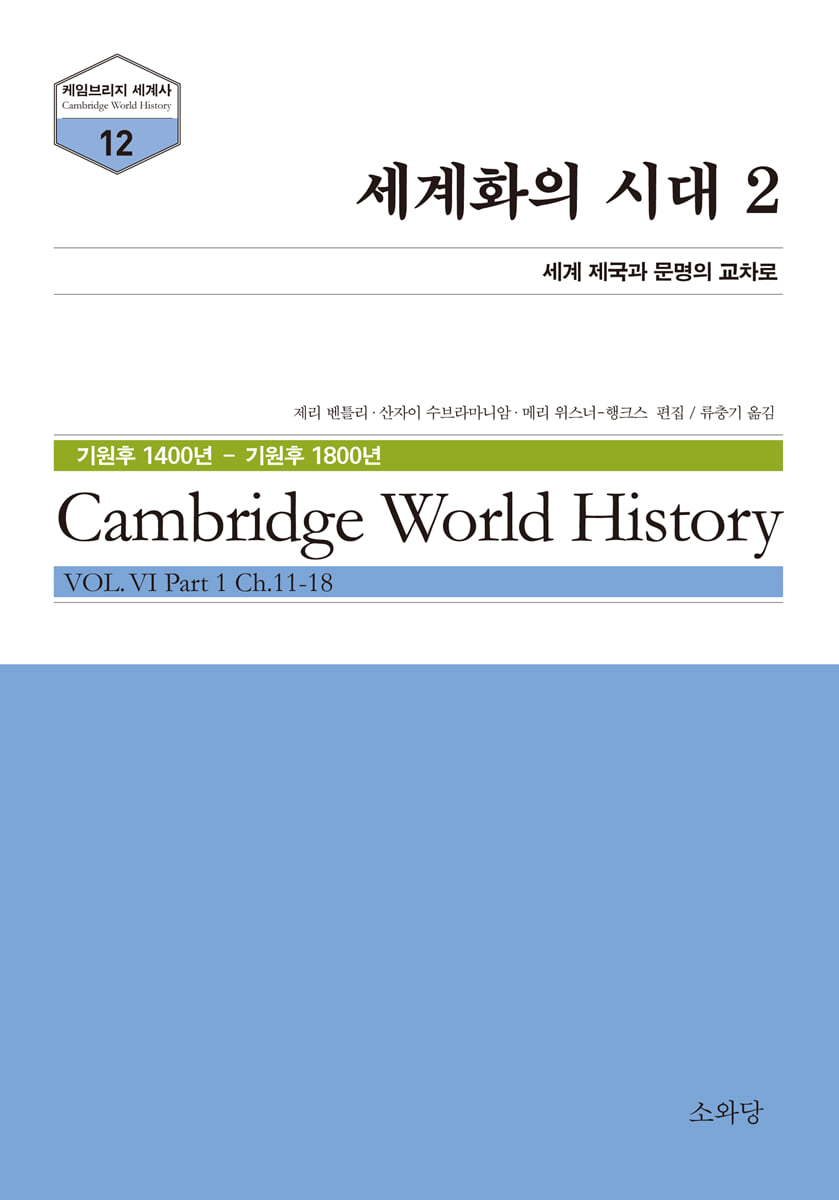
The Age of Globalization 2
 |
Description
Book Introduction
The period from 1400 to 1800 was a period of active biological, commercial, and cultural exchange.
As a result, the world at that time became more closely connected than ever before.
This book (Korean edition, volumes 11-14) examines the important changes of this period.
Volumes 11 and 12 of the Korean edition examine issues of the environment, disease, technology, and cities from a global perspective.
We also looked specifically at empires in the Eastern and Western Hemispheres, the crossroads of the Indian Ocean, Central Asia, and the Caribbean, and regions of competition and conflict such as Southeast Asia, Asia, Africa, and the Mediterranean.
Volumes 13 and 14 of the Korean edition focus on patterns of change.
It analyzes events that occurred on a global scale, including the expansion of Christianity and Islam, migration, and war.
It also examines in detail issues such as the Columbian Exchange, slavery, silver, trade, corporations, Asian religions, legal conflicts, plantation economies, early industrialization, and historiography.
As a result, the world at that time became more closely connected than ever before.
This book (Korean edition, volumes 11-14) examines the important changes of this period.
Volumes 11 and 12 of the Korean edition examine issues of the environment, disease, technology, and cities from a global perspective.
We also looked specifically at empires in the Eastern and Western Hemispheres, the crossroads of the Indian Ocean, Central Asia, and the Caribbean, and regions of competition and conflict such as Southeast Asia, Asia, Africa, and the Mediterranean.
Volumes 13 and 14 of the Korean edition focus on patterns of change.
It analyzes events that occurred on a global scale, including the expansion of Christianity and Islam, migration, and war.
It also examines in detail issues such as the Columbian Exchange, slavery, silver, trade, corporations, Asian religions, legal conflicts, plantation economies, early industrialization, and historiography.
- You can preview some of the book's contents.
Preview
index
(Continued from Volume 11)
PART 3 Formation of large-scale political units
CHAPTER 11 Empires of the Iberian Peninsula, 1400–1800
CHAPTER 12 Eurasian Imperial Rivalry: Russia vs. China
CHAPTER 13 Islamic Empires of the Early Modern World
PART 4 Intersection Area
CHAPTER 14 Central Asia, the Crossroads of the World
CHAPTER 15 Southeast Asia, the Crossroads of the World
CHAPTER 16 The Caribbean, the Crucible of Modern World History
CHAPTER 17 The Mediterranean, the Crossroads of the World
PART 5 OVERVIEW
CHAPTER 18: Numerous Political Journeys: A Comparative Study
PART 3 Formation of large-scale political units
CHAPTER 11 Empires of the Iberian Peninsula, 1400–1800
CHAPTER 12 Eurasian Imperial Rivalry: Russia vs. China
CHAPTER 13 Islamic Empires of the Early Modern World
PART 4 Intersection Area
CHAPTER 14 Central Asia, the Crossroads of the World
CHAPTER 15 Southeast Asia, the Crossroads of the World
CHAPTER 16 The Caribbean, the Crucible of Modern World History
CHAPTER 17 The Mediterranean, the Crossroads of the World
PART 5 OVERVIEW
CHAPTER 18: Numerous Political Journeys: A Comparative Study
Publisher's Review
The 12th book in the Cambridge World History series (18 volumes)
The Cambridge World History Series is a vast world history series in which over 200 scholars from around the world have participated.
The Korean version is scheduled to be published in 18 volumes.
This book, the twelfth in a series, examines how regional, mega-political units functioned as crossroads for global exchange.
Part 3: Formation of large-scale political units
We examine the rivalry between regional giant empires, such as the empires of the Iberian Peninsula and the Sino-Russian rivalry.
The section concludes with a broader discussion of the Islamic empires of the time, with the intention of moving beyond the traditional triangular framework (Ottoman, Safavid, and Mughal).
The articles in this section have several common goals:
For example, the spatial scope of the empire was taken as the subject of analysis, and unlike the existing method of explaining each empire separately (e.g., the Dutch and English Empires, or the Portuguese and Spanish Empires), attention was paid to the mutual interactions involved in the formation of each empire.
Section 4 Intersection Area
This discussion introduced the concept of “crossroads,” a concept that has been influential in recent decades, particularly since the French historian Denys Lombard’s Le Carrefour Javanais.
The articles in this section cover regions that are common in traditional world history, such as the Mediterranean, but also explore interesting regions such as Southeast Asia, Central Asia, and the Caribbean.
Part 5 Overview
This is the concluding volume of the Korean edition, Volumes 11 and 12, and is an ambitious project that broadly compares various political journeys.
Here, we aim to examine both the gradual transformation of the global state structure and the process by which Western Europe gained dominance.
However, we must not overlook the fact that as of 1800, Western European hegemony had not yet been established and fierce competition was taking place.
The Cambridge World History Series is a vast world history series in which over 200 scholars from around the world have participated.
The Korean version is scheduled to be published in 18 volumes.
This book, the twelfth in a series, examines how regional, mega-political units functioned as crossroads for global exchange.
Part 3: Formation of large-scale political units
We examine the rivalry between regional giant empires, such as the empires of the Iberian Peninsula and the Sino-Russian rivalry.
The section concludes with a broader discussion of the Islamic empires of the time, with the intention of moving beyond the traditional triangular framework (Ottoman, Safavid, and Mughal).
The articles in this section have several common goals:
For example, the spatial scope of the empire was taken as the subject of analysis, and unlike the existing method of explaining each empire separately (e.g., the Dutch and English Empires, or the Portuguese and Spanish Empires), attention was paid to the mutual interactions involved in the formation of each empire.
Section 4 Intersection Area
This discussion introduced the concept of “crossroads,” a concept that has been influential in recent decades, particularly since the French historian Denys Lombard’s Le Carrefour Javanais.
The articles in this section cover regions that are common in traditional world history, such as the Mediterranean, but also explore interesting regions such as Southeast Asia, Central Asia, and the Caribbean.
Part 5 Overview
This is the concluding volume of the Korean edition, Volumes 11 and 12, and is an ambitious project that broadly compares various political journeys.
Here, we aim to examine both the gradual transformation of the global state structure and the process by which Western Europe gained dominance.
However, we must not overlook the fact that as of 1800, Western European hegemony had not yet been established and fierce competition was taking place.
GOODS SPECIFICS
- Date of issue: November 25, 2024
- Page count, weight, size: 392 pages | 150*215*30mm
- ISBN13: 9788967220402
- ISBN10: 8967220405
You may also like
카테고리
korean


korean

![GQ KOREA Mark (Monthly): December [2025]](http://librairie.coreenne.fr/cdn/shop/files/8ef265dbbfbf186523ed75ba7319009d.jpg?v=1765340328&width=3840)


