

Chinese History Digest 100
 |
Description
Book Introduction
How did China become a modern hegemonic power?
The history from the appearance of ancient Peking Man to the present day
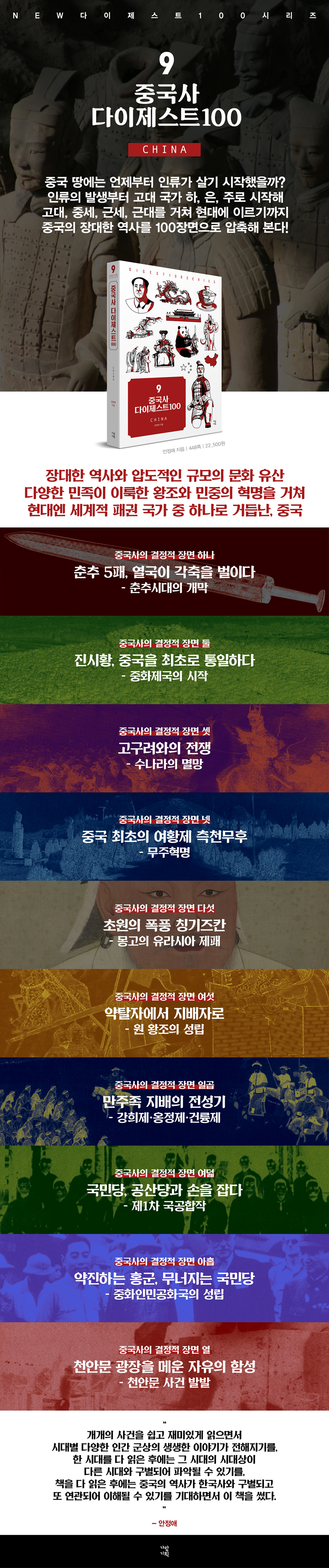
『Chinese History Digest 100』 traced through 100 scenes
China, the world's second most populous country with a vast territory.
The culture of this vast nation dates back to an ancient civilization that arose around 5000 BC.
Since history is so grand, there are many history books that focus on each era or dynasty, but this book summarizes Chinese history into exactly 100 scenes, making it easy to understand the overall flow of history.
Garam Planning's history book, "Chinese History Digest 100," condenses the overall history of China into a single volume while not leaving out any major events. Each chapter includes various image materials to encourage deeper interest in individual events.
This book is divided into prehistoric, ancient, medieval, early modern, late modern, modern, and contemporary periods, and is organized by selecting major events in each period to help readers understand the overall flow of Chinese history.
Each incident was written with the hope that it would convey vivid stories of diverse human figures from each era, and that the era's characteristics could be understood as distinct from those of other eras. Furthermore, the story was organized with consideration for the connection between Korean history and Chinese history as a neighboring country.
The connection with various East Asian countries, including not only Korea but also Japan and Vietnam, is also covered, broadening the scope of understanding of Asian history.
Through "Chinese History Digest 100," I hope to understand the main stream of Chinese history and, furthermore, to view future world history, which flows amidst the interests of various nations, from a broader perspective.
The history from the appearance of ancient Peking Man to the present day
『Chinese History Digest 100』 traced through 100 scenes
China, the world's second most populous country with a vast territory.
The culture of this vast nation dates back to an ancient civilization that arose around 5000 BC.
Since history is so grand, there are many history books that focus on each era or dynasty, but this book summarizes Chinese history into exactly 100 scenes, making it easy to understand the overall flow of history.
Garam Planning's history book, "Chinese History Digest 100," condenses the overall history of China into a single volume while not leaving out any major events. Each chapter includes various image materials to encourage deeper interest in individual events.
This book is divided into prehistoric, ancient, medieval, early modern, late modern, modern, and contemporary periods, and is organized by selecting major events in each period to help readers understand the overall flow of Chinese history.
Each incident was written with the hope that it would convey vivid stories of diverse human figures from each era, and that the era's characteristics could be understood as distinct from those of other eras. Furthermore, the story was organized with consideration for the connection between Korean history and Chinese history as a neighboring country.
The connection with various East Asian countries, including not only Korea but also Japan and Vietnam, is also covered, broadening the scope of understanding of Asian history.
Through "Chinese History Digest 100," I hope to understand the main stream of Chinese history and, furthermore, to view future world history, which flows amidst the interests of various nations, from a broader perspective.
index
preface
Chapter 1.
offering
1.
When did humans first inhabit China?: Peking Man
2.
What are the origins of Chinese civilization?: The lower-level civilization and the Hongshan culture.
3.
The Breakdown of Equality and the Emergence of a Class Society: Yongsan Culture and Yangjeo Culture
Chapter 2.
youth of the world
4.
The Power of Legend Confirmed: The Founding of the Han Dynasty
5.
The World of Yin Ruins Guided by Oracle Bone Inscriptions: The Founding of the Shang Dynasty
6.
The unique ruling system of the Zhou Dynasty, the feudal system: the founding of the Zhou Dynasty
7.
The Five Hegemons of the Spring and Autumn Annals: The Great War: The Beginning of the Spring and Autumn Period
8.
The Spread of Iron and the Transformation of Military Technology: The Second Agricultural Revolution
9.
The Golden Age of Chinese Thought: The Emergence of the Hundred Schools of Thought
10.
How the Underdeveloped Qin Dynasty Became a Power: Shang Yang's Reforms
11.
Qin Shi Huang, the First to Unify China: The Beginning of the Chinese Empire
12.
Song of the Terracotta Army and Scarecrows of the Yeosan Mausoleum: The Rebellion of Jin Sheng and Wu Guang
13.
The Battle of Xiang Yu and Liu Bang: The Founding of the Han Empire
14.
Was the Xiongnu Mute a cruel and ruthless man?: Mute Chanyu
15.
The life of the family of the prime minister of Jangsa State in the Han Dynasty: Han Miao of Ma Wangdui
16.
When the rabbit dies, the hunting dog is boiled: The Rebellion of the Seven Kingdoms of Ocho
17.
The Silk Road: A Narrow Gateway to East-West Trade: Zhang Qian's Western Expedition
18.
Confucianism as an Imperial Ideology: Emperor Wu of Han's Incorporation of Confucianism into the State Religion
19.
Sima Qian, the father of Chinese history: Completed the first comprehensive history, Records of the Grand Historian.
20.
Wang Mang, Dreaming of a Confucian Utopia: The Light and Shadow of the Xin Dynasty
21.
The Emergence of a Coalition of Aristocrats: The Establishment of the Later Han Dynasty
22.
Science and Technology of the Later Han Dynasty: Cai Yun's Invention of Paper
23.
The Emperor's Side, the Royal Family and the Eunuchs: The Yellow Turban Rebellion
Chapter 3.
Middle Ages
24.
The Battle of Red Cliffs, Dividing the World into Three: The Three Kingdoms Period
25.
The Great Migration and the Development of Gangnam: The Invasion of the Five Great Powers and the Establishment of the Eastern Jin Dynasty
26.
The Development of Taoism and Buddhism: The Founding of Taoism
27.
Art for Art's Sake, the Birth of Aristocratic Culture: Wang Xizhi's Book of the Chaotic Period
28.
Construction of the Grand Canal, the Continent's Artery: The Reunification of the Sui Dynasty
29.
War with Goguryeo: The Fall of the Sui Dynasty
30.
The East Asian World is Completed: Emperor Taizong of Tang, Zhenguan's Rule
31.
Empress Wu Zetian, China's First Empress: The Wuzhou Revolution
32.
Dunhuang, the Gateway to the West: Tang Sancai and the Silla Envoy
33.
Singing Poetry, Li Bai and Du Fu: The Pinnacle of Aristocratic Culture
34.
The Age of Thieves and Warriors: The Ansa Rebellion
35.
Collapse of the Equal Tax System: Implementation of the Two Tax Act
36.
Life in 9th-century China, Sillabang, Gyeontangsa: The Diary of the Japanese Monk Ennin
37.
We Are Different from the Tang Dynasty: The Rebellion of the Salt Merchant Huang Shao
Chapter 4.
Early modern times
38.
The Establishment of Civilism and Monarchic Autocracy: The Five Dynasties and Ten Kingdoms and the Founding of the Song Dynasty
39.
The Founding of the Northern Nomadic Peoples and Their Southern Expansion: The Founding of the Khitan and the Alliance of Former Yan
40.
The establishment of the civil service examination system and the establishment of a society of scholars: the expansion of the landowner system
41.
The Emergence of Neo-Confucianism and the Culture of the Aristocrats: The World of Literati Painting
42.
Industrial Leap Forward and Population Growth: A Rapid Developement of Agricultural Productivity
43.
The Development of Commercial Cities and the Emergence of Common People's Culture: The Official Publication of Banknotes
44.
The New and Old Party Factions Continue to Strife: Wang Anshi's Reforms
45.
Gunpowder, the Compass, and Printing: Sim Gwal's Dream-Writing Dialogue
46.
Jurchen rule in northern China: the fall of the Northern Song Dynasty
47.
Storm of the Steppes: Genghis Khan: Mongol Conquest of Eurasia
48.
From Marauder to Ruler: The Rise of the Yuan Dynasty
49.
The Yuan Invasion and Goryeo, Japan, and Vietnam: The Second Japanese Expedition
50.
One Empire, Expanding East-West Exchange: Marco Polo and the Travels of Marco Polo
51.
The Flowering of Plays and Novels: The Development of Common Culture in the Yuan Dynasty
52.
People who wish for the descent of Maitreya Buddha: The Red Turban Rebellion
Chapter 5.
Late modern times
53.
The Han Chinese, Once Again Masters of Mainland China: Zhu Yuanzhang's Founding of the Ming Dynasty
54.
The Forbidden City, the Emperor's Residence: The Yongle Emperor's Ascension to the Throne
55.
Ocean Voyage, Reaching Africa: Jeonghwa's South Sea Expedition
56.
Vietnam's Choice, a History of Tribute: China's Conquest of Vietnam
57.
Eunuch on the Emperor's Side: Civil Engineering's Incident
58.
The Emergence of the Target Group and the Equality of the People: The Establishment of Yangmingism
59.
Don't Let a Piece of Plank Float in the Sea: The Hae-Gyeong Policy and the Transformation of the Northern Route and Southern Route
60.
The Activities of Jesuit Missionaries: Matteo Ricci, Producing the Gonyo Mangukjeondo
61.
The Imjin War and the Changing Situation in East Asia: The Manchus and the Founding of the Later Jin Dynasty
62.
Zhang Juzheng's Reforms and Li Zicheng's Rebellion: The Fall of the Ming Dynasty
63.
Taiwan becomes part of China: Zheng Chenggong's conquest of Taiwan
64.
The Qing Dynasty consolidates its rule over China: The Rebellion of the Three Feudatories
65.
The heyday of Manchu rule: Kangxi, Yongzheng, and Qianlong emperors
66.
The Gentlemen, Seeking Truth Based on Facts: The Development of Textual Criticism
67.
Western Powers Overlook China: The Beginning of the Cantonese Trade System
Chapter 6.
Modern times
68.
The Most Immoral War in History: The Opium Wars
69.
The fall of Beijing to Western powers: The Second Opium War
70.
A Peasant Heavenly Kingdom on Earth: The Taiping Rebellion
71.
Western Technology in China's Institutions: The Promotion of the Self-Strengthening Movement
72.
China's Decay into a Paper Tiger: The Sino-French and First Sino-Japanese Wars
73.
The reformist dream ended in a hundred days: the reform movement for self-reliance
74.
Drive Out Western Ghosts and Protect the Qing Dynasty: The Boxer Rebellion
75.
Sun Yat-sen, the father of the Chinese revolution: Formation of the Chinese Alliance
76.
The Flames of Revolution Rising from Wuchang: The Xinhai Revolution
77.
The Unfulfilled Dream of a Republic Emperor: Yuan Shikai's Rule of China
78.
The Warlords' Proliferation of Territories: The Age of the Warlords
79.
Down with Imperialism: The May Fourth Movement Begins
80.
A Spark Ignites the Wilderness: The Founding of the Communist Party
81.
The Kuomintang and the Communist Party Join Hands: The First Kuomintang-Communist Cooperation
82.
Jinggangshan, the base of the revolution: The formation of the Red Army
83.
Japan Embarks on Continental Invasion: The Manchurian Incident
84.
Crossing 18 Mountains and 17 Rivers: The Long March of the Red Army
85.
The Establishment of the Anti-Japanese United Front: The Second Kuomintang-Communist Cooperation
86.
Bloodthirsty Soldiers of Hell: The Second Sino-Japanese War and the Nanjing Massacre
87.
The Diverging Paths of Two Sisters: Song Jingling and Song Meiling
Chapter 7.
hyundai
88.
The Red Army advances, the Kuomintang crumbles: The founding of the People's Republic of China
89.
Republic of China in Taiwan: Chiang Kai-shek's rule begins in Taiwan
90.
Towards a New Society: Land Reform and Women's Laws
91.
Powerful China, Suffering Minorities: China's Invasion of Tibet
92.
When your lips are dry, your teeth become sensitive: Participation in the Korean War
93.
The End of Social Consensus: A Hundred Flowers Bloom, A Hundred Schools of Thought Contend
94.
Revisionism vs. Dogmatism: The Sino-Soviet Conflict
95.
Surpassing Britain through Self-Reliance: The Great Leap Forward and the Establishment of People's Communes
96.
The Madness That Swept Mainland China: The Cultural Revolution
97.
Reconciliation with the 'Enemy of the World': US-China Diplomatic Relations
98.
China's Openness and the Era of Pragmatism: Deng Xiaoping's Rise to Power
99.
The Tiananmen Square Cry for Freedom: The Tiananmen Incident
100.
For a Peaceful Future for East Asia: Cross-Strait Economic Cooperation Framework Agreement Signed
Chapter 1.
offering
1.
When did humans first inhabit China?: Peking Man
2.
What are the origins of Chinese civilization?: The lower-level civilization and the Hongshan culture.
3.
The Breakdown of Equality and the Emergence of a Class Society: Yongsan Culture and Yangjeo Culture
Chapter 2.
youth of the world
4.
The Power of Legend Confirmed: The Founding of the Han Dynasty
5.
The World of Yin Ruins Guided by Oracle Bone Inscriptions: The Founding of the Shang Dynasty
6.
The unique ruling system of the Zhou Dynasty, the feudal system: the founding of the Zhou Dynasty
7.
The Five Hegemons of the Spring and Autumn Annals: The Great War: The Beginning of the Spring and Autumn Period
8.
The Spread of Iron and the Transformation of Military Technology: The Second Agricultural Revolution
9.
The Golden Age of Chinese Thought: The Emergence of the Hundred Schools of Thought
10.
How the Underdeveloped Qin Dynasty Became a Power: Shang Yang's Reforms
11.
Qin Shi Huang, the First to Unify China: The Beginning of the Chinese Empire
12.
Song of the Terracotta Army and Scarecrows of the Yeosan Mausoleum: The Rebellion of Jin Sheng and Wu Guang
13.
The Battle of Xiang Yu and Liu Bang: The Founding of the Han Empire
14.
Was the Xiongnu Mute a cruel and ruthless man?: Mute Chanyu
15.
The life of the family of the prime minister of Jangsa State in the Han Dynasty: Han Miao of Ma Wangdui
16.
When the rabbit dies, the hunting dog is boiled: The Rebellion of the Seven Kingdoms of Ocho
17.
The Silk Road: A Narrow Gateway to East-West Trade: Zhang Qian's Western Expedition
18.
Confucianism as an Imperial Ideology: Emperor Wu of Han's Incorporation of Confucianism into the State Religion
19.
Sima Qian, the father of Chinese history: Completed the first comprehensive history, Records of the Grand Historian.
20.
Wang Mang, Dreaming of a Confucian Utopia: The Light and Shadow of the Xin Dynasty
21.
The Emergence of a Coalition of Aristocrats: The Establishment of the Later Han Dynasty
22.
Science and Technology of the Later Han Dynasty: Cai Yun's Invention of Paper
23.
The Emperor's Side, the Royal Family and the Eunuchs: The Yellow Turban Rebellion
Chapter 3.
Middle Ages
24.
The Battle of Red Cliffs, Dividing the World into Three: The Three Kingdoms Period
25.
The Great Migration and the Development of Gangnam: The Invasion of the Five Great Powers and the Establishment of the Eastern Jin Dynasty
26.
The Development of Taoism and Buddhism: The Founding of Taoism
27.
Art for Art's Sake, the Birth of Aristocratic Culture: Wang Xizhi's Book of the Chaotic Period
28.
Construction of the Grand Canal, the Continent's Artery: The Reunification of the Sui Dynasty
29.
War with Goguryeo: The Fall of the Sui Dynasty
30.
The East Asian World is Completed: Emperor Taizong of Tang, Zhenguan's Rule
31.
Empress Wu Zetian, China's First Empress: The Wuzhou Revolution
32.
Dunhuang, the Gateway to the West: Tang Sancai and the Silla Envoy
33.
Singing Poetry, Li Bai and Du Fu: The Pinnacle of Aristocratic Culture
34.
The Age of Thieves and Warriors: The Ansa Rebellion
35.
Collapse of the Equal Tax System: Implementation of the Two Tax Act
36.
Life in 9th-century China, Sillabang, Gyeontangsa: The Diary of the Japanese Monk Ennin
37.
We Are Different from the Tang Dynasty: The Rebellion of the Salt Merchant Huang Shao
Chapter 4.
Early modern times
38.
The Establishment of Civilism and Monarchic Autocracy: The Five Dynasties and Ten Kingdoms and the Founding of the Song Dynasty
39.
The Founding of the Northern Nomadic Peoples and Their Southern Expansion: The Founding of the Khitan and the Alliance of Former Yan
40.
The establishment of the civil service examination system and the establishment of a society of scholars: the expansion of the landowner system
41.
The Emergence of Neo-Confucianism and the Culture of the Aristocrats: The World of Literati Painting
42.
Industrial Leap Forward and Population Growth: A Rapid Developement of Agricultural Productivity
43.
The Development of Commercial Cities and the Emergence of Common People's Culture: The Official Publication of Banknotes
44.
The New and Old Party Factions Continue to Strife: Wang Anshi's Reforms
45.
Gunpowder, the Compass, and Printing: Sim Gwal's Dream-Writing Dialogue
46.
Jurchen rule in northern China: the fall of the Northern Song Dynasty
47.
Storm of the Steppes: Genghis Khan: Mongol Conquest of Eurasia
48.
From Marauder to Ruler: The Rise of the Yuan Dynasty
49.
The Yuan Invasion and Goryeo, Japan, and Vietnam: The Second Japanese Expedition
50.
One Empire, Expanding East-West Exchange: Marco Polo and the Travels of Marco Polo
51.
The Flowering of Plays and Novels: The Development of Common Culture in the Yuan Dynasty
52.
People who wish for the descent of Maitreya Buddha: The Red Turban Rebellion
Chapter 5.
Late modern times
53.
The Han Chinese, Once Again Masters of Mainland China: Zhu Yuanzhang's Founding of the Ming Dynasty
54.
The Forbidden City, the Emperor's Residence: The Yongle Emperor's Ascension to the Throne
55.
Ocean Voyage, Reaching Africa: Jeonghwa's South Sea Expedition
56.
Vietnam's Choice, a History of Tribute: China's Conquest of Vietnam
57.
Eunuch on the Emperor's Side: Civil Engineering's Incident
58.
The Emergence of the Target Group and the Equality of the People: The Establishment of Yangmingism
59.
Don't Let a Piece of Plank Float in the Sea: The Hae-Gyeong Policy and the Transformation of the Northern Route and Southern Route
60.
The Activities of Jesuit Missionaries: Matteo Ricci, Producing the Gonyo Mangukjeondo
61.
The Imjin War and the Changing Situation in East Asia: The Manchus and the Founding of the Later Jin Dynasty
62.
Zhang Juzheng's Reforms and Li Zicheng's Rebellion: The Fall of the Ming Dynasty
63.
Taiwan becomes part of China: Zheng Chenggong's conquest of Taiwan
64.
The Qing Dynasty consolidates its rule over China: The Rebellion of the Three Feudatories
65.
The heyday of Manchu rule: Kangxi, Yongzheng, and Qianlong emperors
66.
The Gentlemen, Seeking Truth Based on Facts: The Development of Textual Criticism
67.
Western Powers Overlook China: The Beginning of the Cantonese Trade System
Chapter 6.
Modern times
68.
The Most Immoral War in History: The Opium Wars
69.
The fall of Beijing to Western powers: The Second Opium War
70.
A Peasant Heavenly Kingdom on Earth: The Taiping Rebellion
71.
Western Technology in China's Institutions: The Promotion of the Self-Strengthening Movement
72.
China's Decay into a Paper Tiger: The Sino-French and First Sino-Japanese Wars
73.
The reformist dream ended in a hundred days: the reform movement for self-reliance
74.
Drive Out Western Ghosts and Protect the Qing Dynasty: The Boxer Rebellion
75.
Sun Yat-sen, the father of the Chinese revolution: Formation of the Chinese Alliance
76.
The Flames of Revolution Rising from Wuchang: The Xinhai Revolution
77.
The Unfulfilled Dream of a Republic Emperor: Yuan Shikai's Rule of China
78.
The Warlords' Proliferation of Territories: The Age of the Warlords
79.
Down with Imperialism: The May Fourth Movement Begins
80.
A Spark Ignites the Wilderness: The Founding of the Communist Party
81.
The Kuomintang and the Communist Party Join Hands: The First Kuomintang-Communist Cooperation
82.
Jinggangshan, the base of the revolution: The formation of the Red Army
83.
Japan Embarks on Continental Invasion: The Manchurian Incident
84.
Crossing 18 Mountains and 17 Rivers: The Long March of the Red Army
85.
The Establishment of the Anti-Japanese United Front: The Second Kuomintang-Communist Cooperation
86.
Bloodthirsty Soldiers of Hell: The Second Sino-Japanese War and the Nanjing Massacre
87.
The Diverging Paths of Two Sisters: Song Jingling and Song Meiling
Chapter 7.
hyundai
88.
The Red Army advances, the Kuomintang crumbles: The founding of the People's Republic of China
89.
Republic of China in Taiwan: Chiang Kai-shek's rule begins in Taiwan
90.
Towards a New Society: Land Reform and Women's Laws
91.
Powerful China, Suffering Minorities: China's Invasion of Tibet
92.
When your lips are dry, your teeth become sensitive: Participation in the Korean War
93.
The End of Social Consensus: A Hundred Flowers Bloom, A Hundred Schools of Thought Contend
94.
Revisionism vs. Dogmatism: The Sino-Soviet Conflict
95.
Surpassing Britain through Self-Reliance: The Great Leap Forward and the Establishment of People's Communes
96.
The Madness That Swept Mainland China: The Cultural Revolution
97.
Reconciliation with the 'Enemy of the World': US-China Diplomatic Relations
98.
China's Openness and the Era of Pragmatism: Deng Xiaoping's Rise to Power
99.
The Tiananmen Square Cry for Freedom: The Tiananmen Incident
100.
For a Peaceful Future for East Asia: Cross-Strait Economic Cooperation Framework Agreement Signed
Detailed image
Into the book
There is a well-known idiom called 'Wasin Sangdam'.
The scene of people 'lying down on the rough firewood, sleeping, and tasting bitter bear bile', reminiscing about the humiliation of defeat, shows a cross-section of the fierce competition for survival between countries during the Spring and Autumn Period.
It was difficult to survive without consulting a doctor.
In the early Spring and Autumn Period, there were about 140 vassal states granted by the King of Zhou, but by the end of the Spring and Autumn Period, they were organized into seven states: Qin, Chu, Qi, Han, Wei, Zhao, and Yan.
The number of recorded wars alone exceeds 1,200.
---「Chapter 2.
Ancient _7.
From "The Five Hegemons of the Spring and Autumn Annals, the Great Nations Struggle: The Opening of the Spring and Autumn Period"
Having become the sole king of the world at the age of 39, he felt that his title should be different from that of the previous six monarchs.
Now he is the first person to be called 'emperor' rather than 'king', that is, Shi Huangdi.
'Hwang' is an adjective meaning shining and shining, and 'Je' refers to the highest god who rules over the natural world and the human world.
Now the monarch was not just called the 'Son of Heaven' or the 'Mandate of Heaven', but the 'Absolute God' himself.
It could be said that this is a title befitting the emergence of an absolute monarch.
---「Chapter 2.
Ancient _11.
From "Qin Shi Huang, the First to Unify China: The Beginning of the Chinese Empire"
Woo Jung-moon ordered a hasty retreat, but his realization came too late.
The Sui soldiers, who had traveled far from their homeland, were already exhausted, and Goguryeo's ambushes attacked the retreating Sui soldiers from all sides.
Goguryeo almost annihilated the Sui army by suddenly releasing the waters of the river that had been blocked when the retreating Sui army was halfway across the Salsu (Cheongcheon River).
Of the 300,000 special forces, only 2,700 returned alive.
This is the Battle of Salsu, a battle that shines in the history of world warfare.
---Chapter 3.
Middle Ages _29.
From "War with Goguryeo: The Fall of the Sui Dynasty"
Never before have the world's two greatest civilizations, East Asia and West Asia, developed independently for thousands of years since the dawn of civilization, interacted with each other so profoundly.
It was a vast exchange that could not be compared to the 'Steppe Road' pioneered by the Scythians in the past or the 'Silk Road' operated by the oasis traders of Central Asia.
---Chapter 4.
Early Modern Period _50.
From "War with Goguryeo: The Fall of the Sui Dynasty"
The Sinocentrism that China had long maintained was shattered without a trace, and Chinese society was plunged into great shock.
The activities of foreign merchants, which had been limited to Gwangju, expanded, and there was no mention of opium, which had been a problem.
Britain's position to continue the opium trade was enforced.
---「Chapter 6 Modern Times _68.
From "The Most Immoral War in History: The Opium Wars"
The Cultural Revolution left deep-seated hatred and vengeance, leaving deep, indelible scars between various groups.
The area where we can share opinions has become narrower.
Each faction lost the open and fluid character of the Hundred Flowers and Great Leap Forward periods.
The scene of people 'lying down on the rough firewood, sleeping, and tasting bitter bear bile', reminiscing about the humiliation of defeat, shows a cross-section of the fierce competition for survival between countries during the Spring and Autumn Period.
It was difficult to survive without consulting a doctor.
In the early Spring and Autumn Period, there were about 140 vassal states granted by the King of Zhou, but by the end of the Spring and Autumn Period, they were organized into seven states: Qin, Chu, Qi, Han, Wei, Zhao, and Yan.
The number of recorded wars alone exceeds 1,200.
---「Chapter 2.
Ancient _7.
From "The Five Hegemons of the Spring and Autumn Annals, the Great Nations Struggle: The Opening of the Spring and Autumn Period"
Having become the sole king of the world at the age of 39, he felt that his title should be different from that of the previous six monarchs.
Now he is the first person to be called 'emperor' rather than 'king', that is, Shi Huangdi.
'Hwang' is an adjective meaning shining and shining, and 'Je' refers to the highest god who rules over the natural world and the human world.
Now the monarch was not just called the 'Son of Heaven' or the 'Mandate of Heaven', but the 'Absolute God' himself.
It could be said that this is a title befitting the emergence of an absolute monarch.
---「Chapter 2.
Ancient _11.
From "Qin Shi Huang, the First to Unify China: The Beginning of the Chinese Empire"
Woo Jung-moon ordered a hasty retreat, but his realization came too late.
The Sui soldiers, who had traveled far from their homeland, were already exhausted, and Goguryeo's ambushes attacked the retreating Sui soldiers from all sides.
Goguryeo almost annihilated the Sui army by suddenly releasing the waters of the river that had been blocked when the retreating Sui army was halfway across the Salsu (Cheongcheon River).
Of the 300,000 special forces, only 2,700 returned alive.
This is the Battle of Salsu, a battle that shines in the history of world warfare.
---Chapter 3.
Middle Ages _29.
From "War with Goguryeo: The Fall of the Sui Dynasty"
Never before have the world's two greatest civilizations, East Asia and West Asia, developed independently for thousands of years since the dawn of civilization, interacted with each other so profoundly.
It was a vast exchange that could not be compared to the 'Steppe Road' pioneered by the Scythians in the past or the 'Silk Road' operated by the oasis traders of Central Asia.
---Chapter 4.
Early Modern Period _50.
From "War with Goguryeo: The Fall of the Sui Dynasty"
The Sinocentrism that China had long maintained was shattered without a trace, and Chinese society was plunged into great shock.
The activities of foreign merchants, which had been limited to Gwangju, expanded, and there was no mention of opium, which had been a problem.
Britain's position to continue the opium trade was enforced.
---「Chapter 6 Modern Times _68.
From "The Most Immoral War in History: The Opium Wars"
The Cultural Revolution left deep-seated hatred and vengeance, leaving deep, indelible scars between various groups.
The area where we can share opinions has become narrower.
Each faction lost the open and fluid character of the Hundred Flowers and Great Leap Forward periods.
---「Chapter 7 Modern Times _96.
From "The Madness That Swept Mainland China: The Cultural Revolution"
From "The Madness That Swept Mainland China: The Cultural Revolution"
Publisher's Review
When did humans first begin living in China?
From the beginning of mankind, the ancient states of Ha and Eun mainly started
From ancient times, the Middle Ages, early modern times, and modern times to the present day
China's grand history compressed into 100 scenes!
China, one of the world's four great civilizations.
When did humans first inhabit China? Because China is rich in limestone strata, over 200 fossilized human bones and Paleolithic cultural layers have been excavated.
Although fossils of the 'Australopithecus' stage have not yet been discovered, human remains from the 'Homo erectus', 'Homo sapiens', and 'Homo sapiens sapiens' stages of the early Paleolithic stage have been excavated.
Thanks to these archaeological developments, a large number of relics from the ancient states of Xia, Yin, and Zhou, which were once considered legends, have been unearthed, proving that they were historically real states.
As China is a large landmass with a large population, it is undoubtedly the birthplace of diverse ideas.
The various schools of thought, commonly referred to as the Hundred Schools of Thought, originated from the 6th to 3rd centuries BC and have formed the foundation of many states in China up to the present day, and are firmly embedded in the cultural foundations of East Asian countries today.
Over the years, Chinese culture has developed a rich heritage and history that stands out globally.
The Great Wall of China and the Mausoleum of the First Qin Emperor are world-famous tourist destinations, and the novel Romance of the Three Kingdoms, based on their historical records, has been developed into various contents enjoyed by people around the world. In addition, various attractive characters from history are being reinterpreted and introduced in movies and dramas as China's video technology advances.
And now China has become one of the world's leading powers, exerting global influence not only culturally but also economically.
Although exchanges between the Korean Peninsula and the continent have lasted over 2,000 years, it is true that not many people have a clear understanding of the flow of Chinese history.
"Chinese History Digest 100" introduces the history of conflicts and revolutions that began with the emergence of ancient humans in China and continued from the Spring and Autumn Period to the present day, chronologically. It also examines the relationship between China's neighboring countries, such as Korea, Japan, and Vietnam, and its ethnic minorities, providing a broader perspective.
From the beginning of mankind, the ancient states of Ha and Eun mainly started
From ancient times, the Middle Ages, early modern times, and modern times to the present day
China's grand history compressed into 100 scenes!
China, one of the world's four great civilizations.
When did humans first inhabit China? Because China is rich in limestone strata, over 200 fossilized human bones and Paleolithic cultural layers have been excavated.
Although fossils of the 'Australopithecus' stage have not yet been discovered, human remains from the 'Homo erectus', 'Homo sapiens', and 'Homo sapiens sapiens' stages of the early Paleolithic stage have been excavated.
Thanks to these archaeological developments, a large number of relics from the ancient states of Xia, Yin, and Zhou, which were once considered legends, have been unearthed, proving that they were historically real states.
As China is a large landmass with a large population, it is undoubtedly the birthplace of diverse ideas.
The various schools of thought, commonly referred to as the Hundred Schools of Thought, originated from the 6th to 3rd centuries BC and have formed the foundation of many states in China up to the present day, and are firmly embedded in the cultural foundations of East Asian countries today.
Over the years, Chinese culture has developed a rich heritage and history that stands out globally.
The Great Wall of China and the Mausoleum of the First Qin Emperor are world-famous tourist destinations, and the novel Romance of the Three Kingdoms, based on their historical records, has been developed into various contents enjoyed by people around the world. In addition, various attractive characters from history are being reinterpreted and introduced in movies and dramas as China's video technology advances.
And now China has become one of the world's leading powers, exerting global influence not only culturally but also economically.
Although exchanges between the Korean Peninsula and the continent have lasted over 2,000 years, it is true that not many people have a clear understanding of the flow of Chinese history.
"Chinese History Digest 100" introduces the history of conflicts and revolutions that began with the emergence of ancient humans in China and continued from the Spring and Autumn Period to the present day, chronologically. It also examines the relationship between China's neighboring countries, such as Korea, Japan, and Vietnam, and its ethnic minorities, providing a broader perspective.
GOODS SPECIFICS
- Date of issue: May 24, 2024
- Page count, weight, size: 448 pages | 660g | 153*225*30mm
- ISBN13: 9788984355989
- ISBN10: 8984355984
You may also like
카테고리
korean


korean

![GQ KOREA Mark (Monthly): December [2025]](http://librairie.coreenne.fr/cdn/shop/files/8ef265dbbfbf186523ed75ba7319009d.jpg?v=1765340328&width=3840)


