

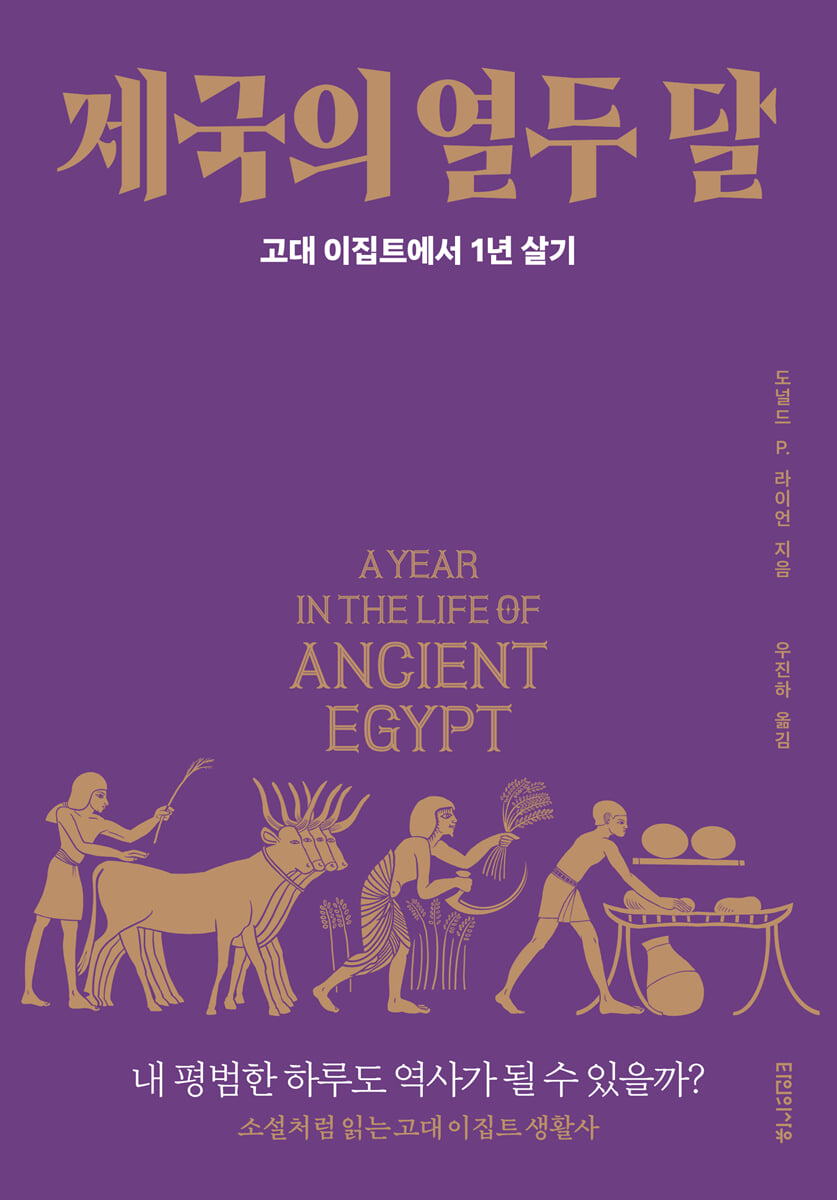
Twelve Months of the Empire
 |
Description
Book Introduction
What was life like for ordinary people, not those in power, 3,400 years ago?
A Vivid Look into Ancient Egyptian Life Through Stories
Egypt, circa 1400 BC.
Amenhotep II, who had ruled Egypt for 26 years, suddenly passes away, and his son Thutmose IV becomes the new ruler of Upper and Lower Egypt.
While the Egyptian army swept across the border, architects worked tirelessly to complete the tomb of the late Amenhotep II, and all the extravagant ornaments that would adorn the tomb were also completed on schedule and without a hitch.
Meanwhile, countless Egyptians continue to live their daily lives unchanged for thousands of years.
This book is a historical fiction that depicts the lives of ordinary people in the Egyptian Empire by following a year in ancient Egypt divided into three periods based on the flooding of the Nile River.
From village farmers who wanted to avoid hard labor, to fishermen on the Nile who never had a dull moment, to potters who loved making pottery more than love, to mummification artisans who took on the weighty responsibility, we meet the diverse people who supported ancient Egypt.
Through the daily lives of those in Memphis and Thebes, the political and religious centers of the ancient Egyptian Empire, let us take a closer look at the life of ancient Egypt, which enjoyed splendid prosperity.
A Vivid Look into Ancient Egyptian Life Through Stories
Egypt, circa 1400 BC.
Amenhotep II, who had ruled Egypt for 26 years, suddenly passes away, and his son Thutmose IV becomes the new ruler of Upper and Lower Egypt.
While the Egyptian army swept across the border, architects worked tirelessly to complete the tomb of the late Amenhotep II, and all the extravagant ornaments that would adorn the tomb were also completed on schedule and without a hitch.
Meanwhile, countless Egyptians continue to live their daily lives unchanged for thousands of years.
This book is a historical fiction that depicts the lives of ordinary people in the Egyptian Empire by following a year in ancient Egypt divided into three periods based on the flooding of the Nile River.
From village farmers who wanted to avoid hard labor, to fishermen on the Nile who never had a dull moment, to potters who loved making pottery more than love, to mummification artisans who took on the weighty responsibility, we meet the diverse people who supported ancient Egypt.
Through the daily lives of those in Memphis and Thebes, the political and religious centers of the ancient Egyptian Empire, let us take a closer look at the life of ancient Egypt, which enjoyed splendid prosperity.
- You can preview some of the book's contents.
Preview
index
Entering
Chapter 1 When the Nile overflows, the first month
Chapter 2 When the Nile overflows, the second month
Chapter 3 When the Nile overflows, the third month
Chapter 4 When the Nile Overflows, the Fourth Month
Chapter 5: Sowing and Cultivating, the First Month
Chapter 6: Sowing and Cultivating, the Second Month
Chapter 7: Sowing and Cultivating, the Third Month
Chapter 8: Sowing and Cultivating, the Fourth Month
Chapter 9: The First Month, Full of Abundance
Chapter 10: The Second Month Will Be Full of Abundance
Chapter 11: The Third Month Will Be Full of Abundance
Chapter 12: The Fourth Month, Full of Abundance
Epilogue
Acknowledgements
Photo source
References
Chapter 1 When the Nile overflows, the first month
Chapter 2 When the Nile overflows, the second month
Chapter 3 When the Nile overflows, the third month
Chapter 4 When the Nile Overflows, the Fourth Month
Chapter 5: Sowing and Cultivating, the First Month
Chapter 6: Sowing and Cultivating, the Second Month
Chapter 7: Sowing and Cultivating, the Third Month
Chapter 8: Sowing and Cultivating, the Fourth Month
Chapter 9: The First Month, Full of Abundance
Chapter 10: The Second Month Will Be Full of Abundance
Chapter 11: The Third Month Will Be Full of Abundance
Chapter 12: The Fourth Month, Full of Abundance
Epilogue
Acknowledgements
Photo source
References
Detailed image

Into the book
The weather continued to be pleasantly warm with a fresh breeze.
The fields were still under water thanks to the Nile River flooding.
After completing some relatively light housework, Baki strolled through the town streets in a satisfied mood.
When I get back home, I'll have lunch and take a long, deep nap.
But as the farmer approached the house, he stopped and turned in the other direction, trying to figure out how to get into the house.
Two strange men were standing at his neighbor's door, arguing with the landlord about something.
One was dressed neatly like a high-ranking official, while the other was dressed simply, carrying a formidable-looking spear and a short dagger at his side.
Baki changed direction and ran across the edge of the flooded field.
As soon as I got home, I quickly ran into the house, keeping my body low.
As I gently pulled back the cloth that served as the entrance to the house, I saw the strange men I had seen earlier approaching me.
“When those people come here, tell them that my husband is not at home,” Baki told Mutui.
“Tell them that you have a leg injury and are recuperating at a relative’s house far away!”
--- p.74
Roy rarely spoke while working.
His master also knew very well that it was better to leave a skilled worker alone and not disturb him.
Roy, who is twenty-five years old and still lives with his parents, has no interest in women.
People used to joke that if there was a match for him, it would be a clay pot.
Last week I fired hundreds of these round, flat jars with handles on both sides, a task that, while not particularly difficult, required a certain amount of skill and concentration.
--- p.78
“The papyrus paper we use is made through the following process.
“First, peel off the outer green skin of the papyrus stem with a knife, and cut the inner white stem into thin strips.”
Dagi was greatly impressed by the surprisingly uniform thickness and length of the cut white stems.
The two moved to a place where flat stones were laid out.
The explanation continued.
“Here, the stems that were cut into string shapes earlier are placed in a tight line and placed side by side.
And lay the other stems across it at right angles.
Then, we cut and trim it so that there are no protruding parts at the edges, and make it into the size of paper commonly used by our scribes.
“If you pound the stems that are laid out like that so that they stick together well and then dry them, the papyrus paper is complete!”
--- p.96~97
Because Thebes was close to the Nile River and other important construction sites, there were always many people who were injured or sick.
He has had countless people come to him over the years, including those with cuts, broken bones, stomach aches, those bitten by crocodiles or hippos, those with blindness, heart problems, pregnant women, and even regular patients who keep coming back despite having no other problems, as well as those seeking treatment for hopeless baldness.
Neferhotep, a man of great experience, was never surprised by anything and would find a cure, no matter what, from surgery to poultices to medication.
The papyrus scrolls, a kind of medical book, contained advice and treatments for various conditions, but equally they also contained prayers to the gods who presided over the healing.
In ancient Egypt, magic and sorcery were also part of healing, and amulets to elicit the help of the gods were always kept in the doctor's box.
--- p.136~137
Drawing on his long experience, Mahu began to put his hand between the cracks in the flesh and pull out the glistening mass, placing the intestines he had removed into a prepared bowl.
After cutting out the other parts of the intestines with a knife, the bowl was immediately transferred to a jar full of natural baking soda.
Next it was time to take out the other organs except the heart.
The liver, stomach, and lungs were removed with special care and placed in separate containers to dry separately.
Mahu, with his rich experience and skilled intuition, knew exactly where each organ was located, and he removed them all with amazing skill, leaving not a single scratch on the heart.
After receiving the bundle of linen cloths, Mahu wiped the sticky insides of the corpse with palm oil, then placed the soiled cloths separately in a large white jar.
--- p.167
Baki, a farmer, found the death of the Pharaoh insignificant.
What on earth did the ruler of Egypt ever do for himself? Didn't he just squeeze taxes from his own people, eat well, live a life of luxury beyond their wildest dreams?
The pharaoh lived in magnificent palaces in Memphis and Thebes, traveled around Egypt in magnificent ships and chariots, and had a large staff of servants and officials who carried out his every whim and command.
But soon Baki, as an Egyptian citizen, recognized that Pharaoh Amenhotep was a god-like being, both in life and in death, and he erased the blasphemous thoughts from his mind.
The fields were still under water thanks to the Nile River flooding.
After completing some relatively light housework, Baki strolled through the town streets in a satisfied mood.
When I get back home, I'll have lunch and take a long, deep nap.
But as the farmer approached the house, he stopped and turned in the other direction, trying to figure out how to get into the house.
Two strange men were standing at his neighbor's door, arguing with the landlord about something.
One was dressed neatly like a high-ranking official, while the other was dressed simply, carrying a formidable-looking spear and a short dagger at his side.
Baki changed direction and ran across the edge of the flooded field.
As soon as I got home, I quickly ran into the house, keeping my body low.
As I gently pulled back the cloth that served as the entrance to the house, I saw the strange men I had seen earlier approaching me.
“When those people come here, tell them that my husband is not at home,” Baki told Mutui.
“Tell them that you have a leg injury and are recuperating at a relative’s house far away!”
--- p.74
Roy rarely spoke while working.
His master also knew very well that it was better to leave a skilled worker alone and not disturb him.
Roy, who is twenty-five years old and still lives with his parents, has no interest in women.
People used to joke that if there was a match for him, it would be a clay pot.
Last week I fired hundreds of these round, flat jars with handles on both sides, a task that, while not particularly difficult, required a certain amount of skill and concentration.
--- p.78
“The papyrus paper we use is made through the following process.
“First, peel off the outer green skin of the papyrus stem with a knife, and cut the inner white stem into thin strips.”
Dagi was greatly impressed by the surprisingly uniform thickness and length of the cut white stems.
The two moved to a place where flat stones were laid out.
The explanation continued.
“Here, the stems that were cut into string shapes earlier are placed in a tight line and placed side by side.
And lay the other stems across it at right angles.
Then, we cut and trim it so that there are no protruding parts at the edges, and make it into the size of paper commonly used by our scribes.
“If you pound the stems that are laid out like that so that they stick together well and then dry them, the papyrus paper is complete!”
--- p.96~97
Because Thebes was close to the Nile River and other important construction sites, there were always many people who were injured or sick.
He has had countless people come to him over the years, including those with cuts, broken bones, stomach aches, those bitten by crocodiles or hippos, those with blindness, heart problems, pregnant women, and even regular patients who keep coming back despite having no other problems, as well as those seeking treatment for hopeless baldness.
Neferhotep, a man of great experience, was never surprised by anything and would find a cure, no matter what, from surgery to poultices to medication.
The papyrus scrolls, a kind of medical book, contained advice and treatments for various conditions, but equally they also contained prayers to the gods who presided over the healing.
In ancient Egypt, magic and sorcery were also part of healing, and amulets to elicit the help of the gods were always kept in the doctor's box.
--- p.136~137
Drawing on his long experience, Mahu began to put his hand between the cracks in the flesh and pull out the glistening mass, placing the intestines he had removed into a prepared bowl.
After cutting out the other parts of the intestines with a knife, the bowl was immediately transferred to a jar full of natural baking soda.
Next it was time to take out the other organs except the heart.
The liver, stomach, and lungs were removed with special care and placed in separate containers to dry separately.
Mahu, with his rich experience and skilled intuition, knew exactly where each organ was located, and he removed them all with amazing skill, leaving not a single scratch on the heart.
After receiving the bundle of linen cloths, Mahu wiped the sticky insides of the corpse with palm oil, then placed the soiled cloths separately in a large white jar.
--- p.167
Baki, a farmer, found the death of the Pharaoh insignificant.
What on earth did the ruler of Egypt ever do for himself? Didn't he just squeeze taxes from his own people, eat well, live a life of luxury beyond their wildest dreams?
The pharaoh lived in magnificent palaces in Memphis and Thebes, traveled around Egypt in magnificent ships and chariots, and had a large staff of servants and officials who carried out his every whim and command.
But soon Baki, as an Egyptian citizen, recognized that Pharaoh Amenhotep was a god-like being, both in life and in death, and he erased the blasphemous thoughts from his mind.
--- p.177~178
Publisher's Review
Ancient Egypt, full of gold, pyramids, and fascinating stories
Was the true protagonist of this land really the Pharaoh?
When it comes to history and culture, no story captures people's interest and imagination as much as ancient Egypt.
When we gaze upon the immense and magnificent monuments such as the pyramids, the Sphinx, the Temple of Karnak, and the countless obelisks, we feel overwhelmed by the charisma of the empire from thousands of years ago.
And what about the delicate and dazzling artifacts discovered in the Pharaoh's tomb!
Ancient Egypt consisted of Upper Egypt, the southern region including the Nile River Valley, and Lower Egypt, the northern region surrounding the Nile River Delta.
And the ruler of Upper Egypt and Lower Egypt was Pharaoh.
But apart from the rulers, the foundation that supported the empire was the common people.
Because of them, the tombs and temples that served as the Pharaoh's resting place were built, the granaries that provided food for the people were abundant, the armies could be mobilized to go on military expeditions, and the empire's continued prosperity was possible.
In the history of ancient Egyptian civilization spanning over 3,000 years, the period set in this book is the First Dynasty of the New Kingdom.
The New Kingdom period, from 1550 to 1069 BC, was a time when Egypt gained influence over its neighbors and rose to the ranks of an empire.
The story begins around 1400 BC, when Amenhotep II, renowned as the warrior pharaoh, was facing his sudden death.
│ Against the backdrop of the death of Amenhotep II and the ascension of Thutmose IV
A glimpse into the everyday lives of the most ordinary people who lived in wondrous times.
Amenhotep II, who seemed destined for eternal power, ascends to heaven as a falcon (a dramatic expression used in ancient Egypt to signal the death of a pharaoh), and his son Thutmose IV mysteriously ascends to the throne.
In this process, the author wittily unfolds the life of ancient Egyptians over the course of one year.
Baki, a farmer living in a village near Thebes, struggles to avoid toil while his fields are submerged in the Nile, while Nefer, a fisherman, casts his nets into the Nile every day, praying to the god Hapi for a good catch.
The palace physician Neferhotep does his best to help the ailing Pharaoh recover, and the mummification artisan Mahu works hard to create the perfect mummy.
The fascinating daily lives of various ancient Egyptian people unfold, from soldiers, potters, and weavers to scribes, priests, and high-ranking officials.
But why was the time period set to one year? Hidden within this lies a special chronological division of time for the ancient Egyptians.
The ancient Egyptian calendar was not much different from today's calendar, but it had three periods of four months each, based on the flooding of the Nile River.
The three periods were the Nile flood season from mid-July to mid-November, the sowing and cultivation season from mid-November to mid-March, and the harvest season from mid-March to mid-July of the following year.
The story of the book unfolds exactly along this flow.
│ Besides Tutankhamun, Ramses, and Cleopatra,
A historical faction focusing on the "ordinary life" of ancient Egypt.
Even your ordinary day can become history!
Regardless of East or West, most of the protagonists of history we are familiar with were people in power.
When we think of Egypt, the pyramids, Sphinx, mummies, Ramses, Cleopatra, etc. come to mind, and they are also the monuments of the powerful or those in power.
But the author, a renowned professor and archaeologist, paid more attention to ordinary ancient Egyptians.
By combining real-life figures such as Pharaoh Amenhotep II, Thutmose IV, and Prime Minister Amenemope with fictional characters such as the farmer Baki, the fisherman Nefer, and the potter Roy, a vivid story was created that makes you feel as if you were in ancient Egypt.
Although the characters are fictional, their lives, based on excavations and research, are somewhat close to reality.
You can get a glimpse into the overall appearance of ancient Egyptian society, including the lives of farmers and fishermen around the time of the Nile River's flood, scenes of ancient Egyptian weddings and funerals, festivals and trade of ancient Egyptians, and how to make paper and boats using papyrus.
This book, which covers the life history of ancient Egyptians, is also meaningful to us living in the present.
The fact that the ordinary, repetitive daily routines that occur without any particular special events accumulate to form the history of an individual, and further, the history of an era.
It is a little comforting to know that my daily life today, which seems insignificant in the grand scheme of history, is not meaningless.
Was the true protagonist of this land really the Pharaoh?
When it comes to history and culture, no story captures people's interest and imagination as much as ancient Egypt.
When we gaze upon the immense and magnificent monuments such as the pyramids, the Sphinx, the Temple of Karnak, and the countless obelisks, we feel overwhelmed by the charisma of the empire from thousands of years ago.
And what about the delicate and dazzling artifacts discovered in the Pharaoh's tomb!
Ancient Egypt consisted of Upper Egypt, the southern region including the Nile River Valley, and Lower Egypt, the northern region surrounding the Nile River Delta.
And the ruler of Upper Egypt and Lower Egypt was Pharaoh.
But apart from the rulers, the foundation that supported the empire was the common people.
Because of them, the tombs and temples that served as the Pharaoh's resting place were built, the granaries that provided food for the people were abundant, the armies could be mobilized to go on military expeditions, and the empire's continued prosperity was possible.
In the history of ancient Egyptian civilization spanning over 3,000 years, the period set in this book is the First Dynasty of the New Kingdom.
The New Kingdom period, from 1550 to 1069 BC, was a time when Egypt gained influence over its neighbors and rose to the ranks of an empire.
The story begins around 1400 BC, when Amenhotep II, renowned as the warrior pharaoh, was facing his sudden death.
│ Against the backdrop of the death of Amenhotep II and the ascension of Thutmose IV
A glimpse into the everyday lives of the most ordinary people who lived in wondrous times.
Amenhotep II, who seemed destined for eternal power, ascends to heaven as a falcon (a dramatic expression used in ancient Egypt to signal the death of a pharaoh), and his son Thutmose IV mysteriously ascends to the throne.
In this process, the author wittily unfolds the life of ancient Egyptians over the course of one year.
Baki, a farmer living in a village near Thebes, struggles to avoid toil while his fields are submerged in the Nile, while Nefer, a fisherman, casts his nets into the Nile every day, praying to the god Hapi for a good catch.
The palace physician Neferhotep does his best to help the ailing Pharaoh recover, and the mummification artisan Mahu works hard to create the perfect mummy.
The fascinating daily lives of various ancient Egyptian people unfold, from soldiers, potters, and weavers to scribes, priests, and high-ranking officials.
But why was the time period set to one year? Hidden within this lies a special chronological division of time for the ancient Egyptians.
The ancient Egyptian calendar was not much different from today's calendar, but it had three periods of four months each, based on the flooding of the Nile River.
The three periods were the Nile flood season from mid-July to mid-November, the sowing and cultivation season from mid-November to mid-March, and the harvest season from mid-March to mid-July of the following year.
The story of the book unfolds exactly along this flow.
│ Besides Tutankhamun, Ramses, and Cleopatra,
A historical faction focusing on the "ordinary life" of ancient Egypt.
Even your ordinary day can become history!
Regardless of East or West, most of the protagonists of history we are familiar with were people in power.
When we think of Egypt, the pyramids, Sphinx, mummies, Ramses, Cleopatra, etc. come to mind, and they are also the monuments of the powerful or those in power.
But the author, a renowned professor and archaeologist, paid more attention to ordinary ancient Egyptians.
By combining real-life figures such as Pharaoh Amenhotep II, Thutmose IV, and Prime Minister Amenemope with fictional characters such as the farmer Baki, the fisherman Nefer, and the potter Roy, a vivid story was created that makes you feel as if you were in ancient Egypt.
Although the characters are fictional, their lives, based on excavations and research, are somewhat close to reality.
You can get a glimpse into the overall appearance of ancient Egyptian society, including the lives of farmers and fishermen around the time of the Nile River's flood, scenes of ancient Egyptian weddings and funerals, festivals and trade of ancient Egyptians, and how to make paper and boats using papyrus.
This book, which covers the life history of ancient Egyptians, is also meaningful to us living in the present.
The fact that the ordinary, repetitive daily routines that occur without any particular special events accumulate to form the history of an individual, and further, the history of an era.
It is a little comforting to know that my daily life today, which seems insignificant in the grand scheme of history, is not meaningless.
GOODS SPECIFICS
- Date of issue: April 29, 2024
- Page count, weight, size: 308 pages | 526g | 150*215*18mm
- ISBN13: 9791172036607
- ISBN10: 1172036608
You may also like
카테고리
korean


korean

![GQ KOREA Mark (Monthly): December [2025]](http://librairie.coreenne.fr/cdn/shop/files/8ef265dbbfbf186523ed75ba7319009d.jpg?v=1765340328&width=3840)


