

4 Japanese Cultures That Look Different When You Know Them
 |
Description
Book Introduction
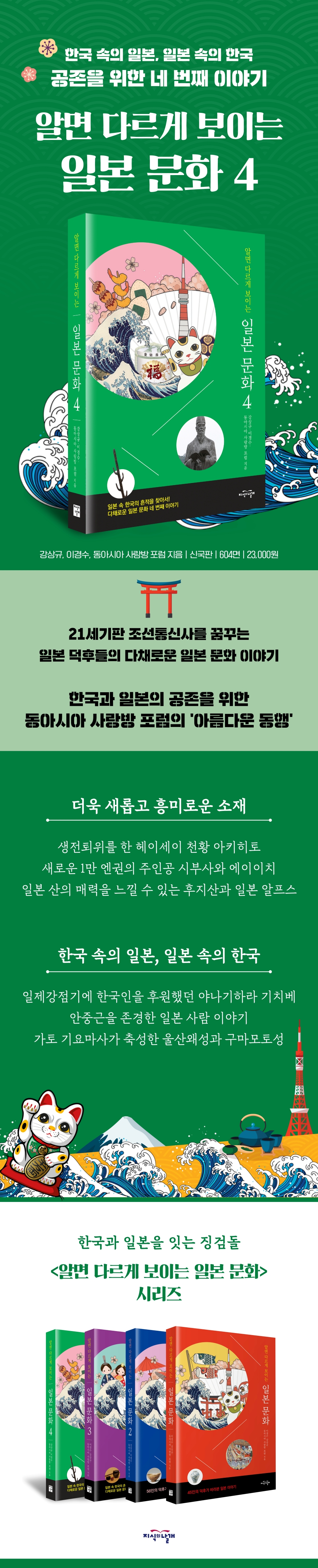
For the coexistence of Korea and Japan
"Beautiful Companionship" at the East Asia Love Room Forum
The Japan enthusiasts of the 'East Asia Love Room Forum', who dream of a 21st century version of the Joseon Tongsinsa, are back with their fourth talk about Japanese culture.
It presents the Japanese people and Japanese culture through new and interesting subjects, including Emperor Akihito of Heisei, who abdicated the throne for the first time in 200 years in the history of emperors; Japanese society living with people with cognitive disabilities; Eiichi Shibusawa, who will be featured on the new 10,000 yen note starting in July 2024; Mt. Fuji and the Japanese Alps, where you can feel the charm of Japanese mountains; and the Gokaido, the "Road to Edo" that created today's Tokyo.
In particular, we focus on stories of “Japan in Korea, Korea in Japan,” such as Yanagihara Kichibe, who supported Korean students who went to Japan during the Japanese colonial period in both material and spiritual ways, the stories of Japanese people who respected Ahn Jung-geun, the Ulsan Japanese Castle and Kumamoto Castle built by Japanese general Kato Kiyomasa, and the footsteps of Wangin discovered in Japanese historical materials and place names.
The authors' wish for coexistence between Korea and Japan is conveyed.
"Beautiful Companionship" at the East Asia Love Room Forum
The Japan enthusiasts of the 'East Asia Love Room Forum', who dream of a 21st century version of the Joseon Tongsinsa, are back with their fourth talk about Japanese culture.
It presents the Japanese people and Japanese culture through new and interesting subjects, including Emperor Akihito of Heisei, who abdicated the throne for the first time in 200 years in the history of emperors; Japanese society living with people with cognitive disabilities; Eiichi Shibusawa, who will be featured on the new 10,000 yen note starting in July 2024; Mt. Fuji and the Japanese Alps, where you can feel the charm of Japanese mountains; and the Gokaido, the "Road to Edo" that created today's Tokyo.
In particular, we focus on stories of “Japan in Korea, Korea in Japan,” such as Yanagihara Kichibe, who supported Korean students who went to Japan during the Japanese colonial period in both material and spiritual ways, the stories of Japanese people who respected Ahn Jung-geun, the Ulsan Japanese Castle and Kumamoto Castle built by Japanese general Kato Kiyomasa, and the footsteps of Wangin discovered in Japanese historical materials and place names.
The authors' wish for coexistence between Korea and Japan is conveyed.
- You can preview some of the book's contents.
Preview
index
· Enter_4
· Major Japanese place names from the series "Japanese Culture: A Different Perspective When You Know It"_17
1.
Small Perspectives on Japan's Politics, Economy, and History_19
A Thought on Masao Maruyama's "Japanese Thought" (Kang Sang-gyu, Professor of Japanese Studies, Korea National Open University)_20
Looking Back on Emperor Akihito (Kim Sung-bae, Assistant Professor, Department of Japanese Language and Literature, Pukyong National University)_28
War Crimes by Doctors: The Kyushu Imperial University Vivisection Incident and the Yokohama Trial (Park Gyu-hoon, Attorney at Law, Gwanghwamun Law Firm)_37
Indirect experience is crucial at every critical juncture in life - A connection with Japan that paved the way for a lifetime of active service (Kang Chang-hee, Director of the Happy 100-Year Asset Management Research Group)_47
The Korean and Japanese Economies: Similar but Different (Kim Kyung-rok, Advisor, Mirae Asset Global Investments) … 55
In the era of electric vehicles, which should you buy? Electric or internal combustion engine? (Park Oh-young, CEO of Asung Trading)_66
What's the Power of a General Trading Company Even Warren Buffett Invested in? (Yang Seung-yoon, Eugene Investment & Securities Analyst)_78
A Businessman's Challenge: A Study of Japanese Companies (Ji Gye-moon, CEO of a Japanese Business Consulting Firm)_84
2.
A unique sense of beauty and taste_93
Learning History and Culture at a Japanese Cafe (Lee Kyung-soo, Professor of Japanese Studies, Korea National Open University)_94
Animation Pilgrimage and Content Tourism (Kim Ji-seon, Professor of Japanese Language and Culture, Ewha Womans University)_103
Sake Story (Kim Ji-yeon, Director of Heepa Cultural Foundation)_111
Japanese Culture Encountered through Traditional Nursery Rhymes and Fairy Tales (Jeon In-ok, Professor Emeritus of Early Childhood Education, Korea National Open University, Multicultural Arts Educator)_122
Japanese Culture Explained Through Proverbs (Shin Jae-gwan, Former CEO of a Trading Company, Tutor at the Korea National Open University Graduate School)_134
The Extraordinary and Everyday in Neon Genesis Evangelion (Yuko Yoshida, Lecturer, Department of Japanese Language and Literature, Chonnam National University)_145
Goshuin: Collecting My Own Fate (Doi Miho, Professor, Department of Liberal Arts, Hansung University)_154
3.
Take a trip to the place in my heart_165
The "Secret Secret" of Japan's Train System (Ko Seong-uk, children's literature author, former school principal)_166
Echigo Chōfu - "Yukizarashi," the Inherited Blessing of the Snow (Akiko Yamagishi, Professor, Pohang University)_180
Falling in Love with the Charm of Japan's Northeast Region (Moon Kyung-chul, Professor, Tohoku Culture University)_191
The Charm of Japan's Mountains: Mount Fuji and the Japanese Alps (Seok Chi-sun, Advisor, International Workers' Exchange Center)_205
A Shikoku Field Trip with a Japanese Expert Professor (Kang Sook, World Culture Explorer / Kang Yeon-i, President of the Korean National Open University Department of Cultural Studies Alumni Association)_218
Studying in Japan at 70: A Remarkable Transformation (Cho Bumi, former elementary and middle school teacher, and middle and high school principal) 231
A Revisited Experience with Sakamoto Ryoma, Resurrected Through Storytelling (Kim Kyung-ran, Japanese Travel and Hot Springs Expert / Lee Ki-seong, Oriental Medicine Doctor)_244
The Charm of Traveling in Japan: Michi-no-Eki (Kim Mi-jin, Local Artist)_253
Escape the hustle and bustle of Tokyo and enjoy Nikko's nature (Park Hyun-soo, Waseda University, Faculty of Creative Science and Engineering)_265
A Journey to Tokyo and Paris with the Star of the New 10,000 Yen Note (Lee Ju-young, Translator, Japonism Researcher)_270
4.
Traces that cannot be erased even if ignored: Japan on the Korean Peninsula_283
Yanagihara Kichibe and Joseon (Kim Kyung-ok, HK Research Professor, Institute of Japanese Studies, Hallym University)_284
Ulsan Castle and Kumamoto Castle, Built by Kato Kiyomasa (Kim Young-sik, Ph.D. in Engineering, Author of "Understanding Modern Japanese Castles and Japanese Castles")_295
In the Footsteps of the King (Haruko Suzuki, Part-Time Lecturer at Taisho University)_306
A Story of a Japanese Man Who Admires Ahn Jung-geun (Lee Hye-gyun, Secretary General of the Ahn Jung-geun Memorial Society)_313
5.
A sense of community embedded in detailed rules and etiquette_323
A Japanese Award: A True Honor (Eo Gi-ryong, Principal of Gwacheon Girls' High School / Lee Woo-jin, Teacher at Gwacheon Foreign Language High School)_324
The Relationship Between the Japanese and Religion: Buddhism from a Historical Perspective (Takahiro Teshima, Professor of Japanese Language, Kyung Hee University)_335
Living with People with Cognitive Impairment in Japanese Society (Min Eun-sook, Sunyu International Medical Business College)_343
My Japanese Neighbors (Kim Jeong-ok, Matsumoto City)_354
Korea: Just Do It, Japan: More Preparation (Noh Young-gil, Nagoya Restaurant Entrepreneur, Hanmiya CEO)_365
Masashi Sada, National Singer Masan - Japanese Traditional Culture in Lyrics (Park Kyung-ae, Visiting Professor, Konkuk University)_376
Japan's Reservation Culture and Online Services (Jeong Hee-bong, translator of Hotel Brand Stories)_386
Japanese Dining Etiquette (Jihye Choi, English Literature Student, Rikkyo University)_395
Mother's Support, the Brothers' Struggle to Study Abroad in Japan (Kim Su-jin, a housewife who works and studies / Hyung Seong-moon, a student at Obirin University / Hyung Woo-jeong, a student at Kyoto University of Foreign Studies)_402
6.
Japanese_411: Similar to Korean, yet very different
A Comparison of Korean and Japanese Languages from a Cultural Perspective (Lee Taek-woong, Professor, Nagoya University) 412
Why You Should Learn Japanese Right Now (Kim Soo-jin, Korean Language Instructor in Switzerland, YouTuber of "Sassoon, Who Speaks Four Languages")_419
A Touching Story of a Japanese Book - Adding the Joy of Comparing the Original Japanese and the Translation (Seong Ji-hyeon, Lecturer, Korea National Open University)_427
The Joy of Reading and Translating Japanese Novels (Hwang Nam-deok, Essayist)_437
7.
Japan in Korea, Korea in Japan, Beyond the River_447
Books: A Stepping Stone Between Korea and Japan - "Korea" in Japanese Literature and "Japan" in Korean Literature (Kim Na-jeong, Playwright, Novelist)_448
Studying Japanese, Studying Abroad, and Living in Japan (In Seong-hee, Professor of Korean Language, Faculty of Literature, Waseda University)_460
Fukuoka in Kyushu: A Stepping Stone for Japan-Korea Relations (Kim Sang-il, Professor, Chungwon University)_471
The Allure of Korea and Japan as Seen Through Mass Media (Doe Mikako, Professor, Yeungjin College)_479
Nami Island - Kagoshima - Miyazaki - Busan Story (Jinhyung Lee, Artist, Woodworking Studio)_485
Exploring Japanese History and Culture in Korea (Imjin Line, Tomoni Planning, Daehwa Craft Cooperative)_497
8.
Japanese History and Culture: A Look at Reconciliation_511
Famous Scenes from Japanese History Through Food Culture (Kim Se-geol, Ph.D. in Political Science)_512
Shukuba, A Journey to the Edo Period (Lee Hye-young, Lecturer at Korea National Open University, Researcher of Japanese Language and Culture)_518
This is Our Sekigahara, a Crossroads of History (Choi Gap-su, Korea Financial Investment Association)_530
The Road to Edo, the Road That Created Modern Tokyo: Gokaido (Hong Yu-seon, Translator, World Toys CEO)_544
Joseon Tongsinsa, a diplomatic mission in the late Joseon Dynasty (Yu Chun-mi, Korean language instructor at the Sejong Institute of the Korean Cultural Center at the Korean Embassy in Japan)_556
Korea, China, and Japan in East Asia (Seo Hyeon-seop, Professor Emeritus, Nagasaki Prefectural University)_569
The World of Shinto in the Film "Suzume's Lockdown" - Focusing on Norito (Han Jeong-mi, Visiting Professor, University of Tokyo)_586
Reference Material_596
· Major Japanese place names from the series "Japanese Culture: A Different Perspective When You Know It"_17
1.
Small Perspectives on Japan's Politics, Economy, and History_19
A Thought on Masao Maruyama's "Japanese Thought" (Kang Sang-gyu, Professor of Japanese Studies, Korea National Open University)_20
Looking Back on Emperor Akihito (Kim Sung-bae, Assistant Professor, Department of Japanese Language and Literature, Pukyong National University)_28
War Crimes by Doctors: The Kyushu Imperial University Vivisection Incident and the Yokohama Trial (Park Gyu-hoon, Attorney at Law, Gwanghwamun Law Firm)_37
Indirect experience is crucial at every critical juncture in life - A connection with Japan that paved the way for a lifetime of active service (Kang Chang-hee, Director of the Happy 100-Year Asset Management Research Group)_47
The Korean and Japanese Economies: Similar but Different (Kim Kyung-rok, Advisor, Mirae Asset Global Investments) … 55
In the era of electric vehicles, which should you buy? Electric or internal combustion engine? (Park Oh-young, CEO of Asung Trading)_66
What's the Power of a General Trading Company Even Warren Buffett Invested in? (Yang Seung-yoon, Eugene Investment & Securities Analyst)_78
A Businessman's Challenge: A Study of Japanese Companies (Ji Gye-moon, CEO of a Japanese Business Consulting Firm)_84
2.
A unique sense of beauty and taste_93
Learning History and Culture at a Japanese Cafe (Lee Kyung-soo, Professor of Japanese Studies, Korea National Open University)_94
Animation Pilgrimage and Content Tourism (Kim Ji-seon, Professor of Japanese Language and Culture, Ewha Womans University)_103
Sake Story (Kim Ji-yeon, Director of Heepa Cultural Foundation)_111
Japanese Culture Encountered through Traditional Nursery Rhymes and Fairy Tales (Jeon In-ok, Professor Emeritus of Early Childhood Education, Korea National Open University, Multicultural Arts Educator)_122
Japanese Culture Explained Through Proverbs (Shin Jae-gwan, Former CEO of a Trading Company, Tutor at the Korea National Open University Graduate School)_134
The Extraordinary and Everyday in Neon Genesis Evangelion (Yuko Yoshida, Lecturer, Department of Japanese Language and Literature, Chonnam National University)_145
Goshuin: Collecting My Own Fate (Doi Miho, Professor, Department of Liberal Arts, Hansung University)_154
3.
Take a trip to the place in my heart_165
The "Secret Secret" of Japan's Train System (Ko Seong-uk, children's literature author, former school principal)_166
Echigo Chōfu - "Yukizarashi," the Inherited Blessing of the Snow (Akiko Yamagishi, Professor, Pohang University)_180
Falling in Love with the Charm of Japan's Northeast Region (Moon Kyung-chul, Professor, Tohoku Culture University)_191
The Charm of Japan's Mountains: Mount Fuji and the Japanese Alps (Seok Chi-sun, Advisor, International Workers' Exchange Center)_205
A Shikoku Field Trip with a Japanese Expert Professor (Kang Sook, World Culture Explorer / Kang Yeon-i, President of the Korean National Open University Department of Cultural Studies Alumni Association)_218
Studying in Japan at 70: A Remarkable Transformation (Cho Bumi, former elementary and middle school teacher, and middle and high school principal) 231
A Revisited Experience with Sakamoto Ryoma, Resurrected Through Storytelling (Kim Kyung-ran, Japanese Travel and Hot Springs Expert / Lee Ki-seong, Oriental Medicine Doctor)_244
The Charm of Traveling in Japan: Michi-no-Eki (Kim Mi-jin, Local Artist)_253
Escape the hustle and bustle of Tokyo and enjoy Nikko's nature (Park Hyun-soo, Waseda University, Faculty of Creative Science and Engineering)_265
A Journey to Tokyo and Paris with the Star of the New 10,000 Yen Note (Lee Ju-young, Translator, Japonism Researcher)_270
4.
Traces that cannot be erased even if ignored: Japan on the Korean Peninsula_283
Yanagihara Kichibe and Joseon (Kim Kyung-ok, HK Research Professor, Institute of Japanese Studies, Hallym University)_284
Ulsan Castle and Kumamoto Castle, Built by Kato Kiyomasa (Kim Young-sik, Ph.D. in Engineering, Author of "Understanding Modern Japanese Castles and Japanese Castles")_295
In the Footsteps of the King (Haruko Suzuki, Part-Time Lecturer at Taisho University)_306
A Story of a Japanese Man Who Admires Ahn Jung-geun (Lee Hye-gyun, Secretary General of the Ahn Jung-geun Memorial Society)_313
5.
A sense of community embedded in detailed rules and etiquette_323
A Japanese Award: A True Honor (Eo Gi-ryong, Principal of Gwacheon Girls' High School / Lee Woo-jin, Teacher at Gwacheon Foreign Language High School)_324
The Relationship Between the Japanese and Religion: Buddhism from a Historical Perspective (Takahiro Teshima, Professor of Japanese Language, Kyung Hee University)_335
Living with People with Cognitive Impairment in Japanese Society (Min Eun-sook, Sunyu International Medical Business College)_343
My Japanese Neighbors (Kim Jeong-ok, Matsumoto City)_354
Korea: Just Do It, Japan: More Preparation (Noh Young-gil, Nagoya Restaurant Entrepreneur, Hanmiya CEO)_365
Masashi Sada, National Singer Masan - Japanese Traditional Culture in Lyrics (Park Kyung-ae, Visiting Professor, Konkuk University)_376
Japan's Reservation Culture and Online Services (Jeong Hee-bong, translator of Hotel Brand Stories)_386
Japanese Dining Etiquette (Jihye Choi, English Literature Student, Rikkyo University)_395
Mother's Support, the Brothers' Struggle to Study Abroad in Japan (Kim Su-jin, a housewife who works and studies / Hyung Seong-moon, a student at Obirin University / Hyung Woo-jeong, a student at Kyoto University of Foreign Studies)_402
6.
Japanese_411: Similar to Korean, yet very different
A Comparison of Korean and Japanese Languages from a Cultural Perspective (Lee Taek-woong, Professor, Nagoya University) 412
Why You Should Learn Japanese Right Now (Kim Soo-jin, Korean Language Instructor in Switzerland, YouTuber of "Sassoon, Who Speaks Four Languages")_419
A Touching Story of a Japanese Book - Adding the Joy of Comparing the Original Japanese and the Translation (Seong Ji-hyeon, Lecturer, Korea National Open University)_427
The Joy of Reading and Translating Japanese Novels (Hwang Nam-deok, Essayist)_437
7.
Japan in Korea, Korea in Japan, Beyond the River_447
Books: A Stepping Stone Between Korea and Japan - "Korea" in Japanese Literature and "Japan" in Korean Literature (Kim Na-jeong, Playwright, Novelist)_448
Studying Japanese, Studying Abroad, and Living in Japan (In Seong-hee, Professor of Korean Language, Faculty of Literature, Waseda University)_460
Fukuoka in Kyushu: A Stepping Stone for Japan-Korea Relations (Kim Sang-il, Professor, Chungwon University)_471
The Allure of Korea and Japan as Seen Through Mass Media (Doe Mikako, Professor, Yeungjin College)_479
Nami Island - Kagoshima - Miyazaki - Busan Story (Jinhyung Lee, Artist, Woodworking Studio)_485
Exploring Japanese History and Culture in Korea (Imjin Line, Tomoni Planning, Daehwa Craft Cooperative)_497
8.
Japanese History and Culture: A Look at Reconciliation_511
Famous Scenes from Japanese History Through Food Culture (Kim Se-geol, Ph.D. in Political Science)_512
Shukuba, A Journey to the Edo Period (Lee Hye-young, Lecturer at Korea National Open University, Researcher of Japanese Language and Culture)_518
This is Our Sekigahara, a Crossroads of History (Choi Gap-su, Korea Financial Investment Association)_530
The Road to Edo, the Road That Created Modern Tokyo: Gokaido (Hong Yu-seon, Translator, World Toys CEO)_544
Joseon Tongsinsa, a diplomatic mission in the late Joseon Dynasty (Yu Chun-mi, Korean language instructor at the Sejong Institute of the Korean Cultural Center at the Korean Embassy in Japan)_556
Korea, China, and Japan in East Asia (Seo Hyeon-seop, Professor Emeritus, Nagasaki Prefectural University)_569
The World of Shinto in the Film "Suzume's Lockdown" - Focusing on Norito (Han Jeong-mi, Visiting Professor, University of Tokyo)_586
Reference Material_596
Detailed image
Into the book
In an era marked by post-war democracy, economic power, an aging society, globalization, and the rise of civic consciousness, Akihito is said to have demonstrated a humane, emotional, and integrated image within society.
If the era of Hirohito after 1945 was a 'democratic system under a monarchy,' then the Heisei era is said to have ushered in an era of 'an emperor under a democratic system.'
--- p.31, from “Looking Back at Emperor Akihito of Heisei”
On the other hand, the population structure problems of low birth rate and aging population are common to both Korea and Japan.
We are more serious than Japan.
If there is Japanification brought about by the strong exchange rate and the collapse of the bubble, we will be portraying a low-growth drama brought about by the collapse of the demographic structure.
There is a way out.
Neither is easy, whether the global economy is booming for a long time or we are making huge innovations.
We are likely to fall into the trap of demographic structure and create a path called 'Koreafication'.
Because we cannot afford zero interest rates and massive government debt like Japan, the weak link could emerge in the foreign exchange market.
This is a path where the population structure collapses, leading to a low-growth, high-debt society, which in turn causes instability in the foreign exchange market.
We can see this by looking at Greece during the European financial crisis.
Rather than looking back at Japan's situation in the 1990s, we urgently need a response based on our own demographic issues and the competitiveness of our currency.
--- p.64~65, from “The Korean and Japanese Economy, Similar but Different”
Have you ever heard of 'goshuin'? Written in kanji, it is 御朱印.
This refers to a seal that can be received as proof of visiting a shrine or temple.
'Goshuin collecting', which involves collecting pilgrimage certificates, has been attracting attention for several years.
If we look for the factors that have created the craze for collecting goshuin, we find hidden within it not only Japan's unique religious views, but also the Japanese values that cherish the bonds of encounter, or "goen," and the Japanese sensibilities that have a special attachment to handwriting and limited editions.
--- p.154, from “Goshuin, Collecting My Own Fate”
Fukuzawa, who has been the model for the 10,000 yen note since 1984, is now approaching retirement.
With the new Emperor Naruhito's ascension to the throne on May 1, 2019, Japan entered a new era with the era name changed to "Reiwa," and new 1,000-yen, 5,000-yen, and 10,000-yen notes were also issued.
Among these, the person selected as the new face of the 10,000 yen note is Eiichi Shibusawa (?? ?一, 1840-1931), known as the 'father of the modern Japanese economy.'
Deputy Prime Minister Taro Aso explained that Shibusawa was chosen as the new face of the 10,000 yen note because "he has made a significant contribution to the development of Japanese capitalism."
Shibusawa is a person who is strangely intertwined with Korea.
Shibusawa, who founded Japan's first bank, the First National Bank (now Mizuho Bank), in 1876, established the Busan branch of the First Bank in 1878, and was the portrait figure on the First Bank note, the currency used in the early days of the Korean Empire.
Shibusawa also served as the chairman of Keijo Electric, the predecessor of Korea Electric Power Corporation.
--- p.271~272, from "A trip to Tokyo and Paris with the protagonist of the new 10,000 yen bill"
During the Japanese colonial period, Koreans went to Japan in search of modern, advanced knowledge and jobs.
Kichibe Yanagihara was a person who treated Koreans with Christian humanity as a mission, as Koreans had to endure ethnic discrimination simply because they came from colonial Korea.
Born in 1858 and died in March 1945, Yanagihara was also successful as a businessman, running a dyeing factory for army uniforms and a cotton yarn factory.
As can be seen from his year of birth, during the period when Japan, which had successfully modernized through the Meiji Restoration, was expanding into an empire through the Sino-Japanese War, the Russo-Japanese War, the Manchurian Incident, and the Second Sino-Japanese War, he was a businessman and a social worker who did not spare support for the poor and workers, especially Korean workers.
In particular, his support for Korean female students studying abroad is noteworthy in terms of the transfer of modern knowledge.
Above all, considering that Na Hye-seok, the first female painter in Joseon, and Lee Ae-nae, the first female pianist, were also representative modern intellectuals who received support from Yanagihara, we cannot help but trace the footsteps he left behind during his lifetime as a Japanese guarantor for Korean female students studying abroad, along with his criticism of the ideological limitations of the imperial system.
--- p.284, from “Yanagihara Kichibe and Joseon”
The world, people, countries, and each other's circumstances and relationships are truly complex.
Literature resists dichotomies.
We uncover the complexities hidden beneath the surface and deconstruct the workings of humans and systems that we otherwise would not understand.
It reveals the inner self, circumstances, and complex relationships of a character in layers.
Good literature, by embracing complexity, opens up the possibility of relationships beyond binary oppositions.
This article examines Japanese literature that contains 'Korea' and Korean literature that embraces 'Japan'.
Empathy and understanding begin with seeing things from the other person's perspective and feeling their way.
These works open new horizons in Korea-Japan relations by meticulously examining the inner workings of the other side and examining aspects of their lives.
I would like to introduce a few books that are stepping stones connecting the seas.
If the era of Hirohito after 1945 was a 'democratic system under a monarchy,' then the Heisei era is said to have ushered in an era of 'an emperor under a democratic system.'
--- p.31, from “Looking Back at Emperor Akihito of Heisei”
On the other hand, the population structure problems of low birth rate and aging population are common to both Korea and Japan.
We are more serious than Japan.
If there is Japanification brought about by the strong exchange rate and the collapse of the bubble, we will be portraying a low-growth drama brought about by the collapse of the demographic structure.
There is a way out.
Neither is easy, whether the global economy is booming for a long time or we are making huge innovations.
We are likely to fall into the trap of demographic structure and create a path called 'Koreafication'.
Because we cannot afford zero interest rates and massive government debt like Japan, the weak link could emerge in the foreign exchange market.
This is a path where the population structure collapses, leading to a low-growth, high-debt society, which in turn causes instability in the foreign exchange market.
We can see this by looking at Greece during the European financial crisis.
Rather than looking back at Japan's situation in the 1990s, we urgently need a response based on our own demographic issues and the competitiveness of our currency.
--- p.64~65, from “The Korean and Japanese Economy, Similar but Different”
Have you ever heard of 'goshuin'? Written in kanji, it is 御朱印.
This refers to a seal that can be received as proof of visiting a shrine or temple.
'Goshuin collecting', which involves collecting pilgrimage certificates, has been attracting attention for several years.
If we look for the factors that have created the craze for collecting goshuin, we find hidden within it not only Japan's unique religious views, but also the Japanese values that cherish the bonds of encounter, or "goen," and the Japanese sensibilities that have a special attachment to handwriting and limited editions.
--- p.154, from “Goshuin, Collecting My Own Fate”
Fukuzawa, who has been the model for the 10,000 yen note since 1984, is now approaching retirement.
With the new Emperor Naruhito's ascension to the throne on May 1, 2019, Japan entered a new era with the era name changed to "Reiwa," and new 1,000-yen, 5,000-yen, and 10,000-yen notes were also issued.
Among these, the person selected as the new face of the 10,000 yen note is Eiichi Shibusawa (?? ?一, 1840-1931), known as the 'father of the modern Japanese economy.'
Deputy Prime Minister Taro Aso explained that Shibusawa was chosen as the new face of the 10,000 yen note because "he has made a significant contribution to the development of Japanese capitalism."
Shibusawa is a person who is strangely intertwined with Korea.
Shibusawa, who founded Japan's first bank, the First National Bank (now Mizuho Bank), in 1876, established the Busan branch of the First Bank in 1878, and was the portrait figure on the First Bank note, the currency used in the early days of the Korean Empire.
Shibusawa also served as the chairman of Keijo Electric, the predecessor of Korea Electric Power Corporation.
--- p.271~272, from "A trip to Tokyo and Paris with the protagonist of the new 10,000 yen bill"
During the Japanese colonial period, Koreans went to Japan in search of modern, advanced knowledge and jobs.
Kichibe Yanagihara was a person who treated Koreans with Christian humanity as a mission, as Koreans had to endure ethnic discrimination simply because they came from colonial Korea.
Born in 1858 and died in March 1945, Yanagihara was also successful as a businessman, running a dyeing factory for army uniforms and a cotton yarn factory.
As can be seen from his year of birth, during the period when Japan, which had successfully modernized through the Meiji Restoration, was expanding into an empire through the Sino-Japanese War, the Russo-Japanese War, the Manchurian Incident, and the Second Sino-Japanese War, he was a businessman and a social worker who did not spare support for the poor and workers, especially Korean workers.
In particular, his support for Korean female students studying abroad is noteworthy in terms of the transfer of modern knowledge.
Above all, considering that Na Hye-seok, the first female painter in Joseon, and Lee Ae-nae, the first female pianist, were also representative modern intellectuals who received support from Yanagihara, we cannot help but trace the footsteps he left behind during his lifetime as a Japanese guarantor for Korean female students studying abroad, along with his criticism of the ideological limitations of the imperial system.
--- p.284, from “Yanagihara Kichibe and Joseon”
The world, people, countries, and each other's circumstances and relationships are truly complex.
Literature resists dichotomies.
We uncover the complexities hidden beneath the surface and deconstruct the workings of humans and systems that we otherwise would not understand.
It reveals the inner self, circumstances, and complex relationships of a character in layers.
Good literature, by embracing complexity, opens up the possibility of relationships beyond binary oppositions.
This article examines Japanese literature that contains 'Korea' and Korean literature that embraces 'Japan'.
Empathy and understanding begin with seeing things from the other person's perspective and feeling their way.
These works open new horizons in Korea-Japan relations by meticulously examining the inner workings of the other side and examining aspects of their lives.
I would like to introduce a few books that are stepping stones connecting the seas.
--- p.449, from “Books, the Stepping Stones Connecting Korea and Japan - ‘Korea’ in Japanese Literature and ‘Japan’ in Korean Literature”
GOODS SPECIFICS
- Date of issue: March 6, 2024
- Page count, weight, size: 604 pages | 866g | 152*225*25mm
- ISBN13: 9788920049712
- ISBN10: 8920049718
You may also like
카테고리
korean


korean

![GQ KOREA Mark (Monthly): December [2025]](http://librairie.coreenne.fr/cdn/shop/files/8ef265dbbfbf186523ed75ba7319009d.jpg?v=1765340328&width=3840)


