

The 12.12 Coup and Me
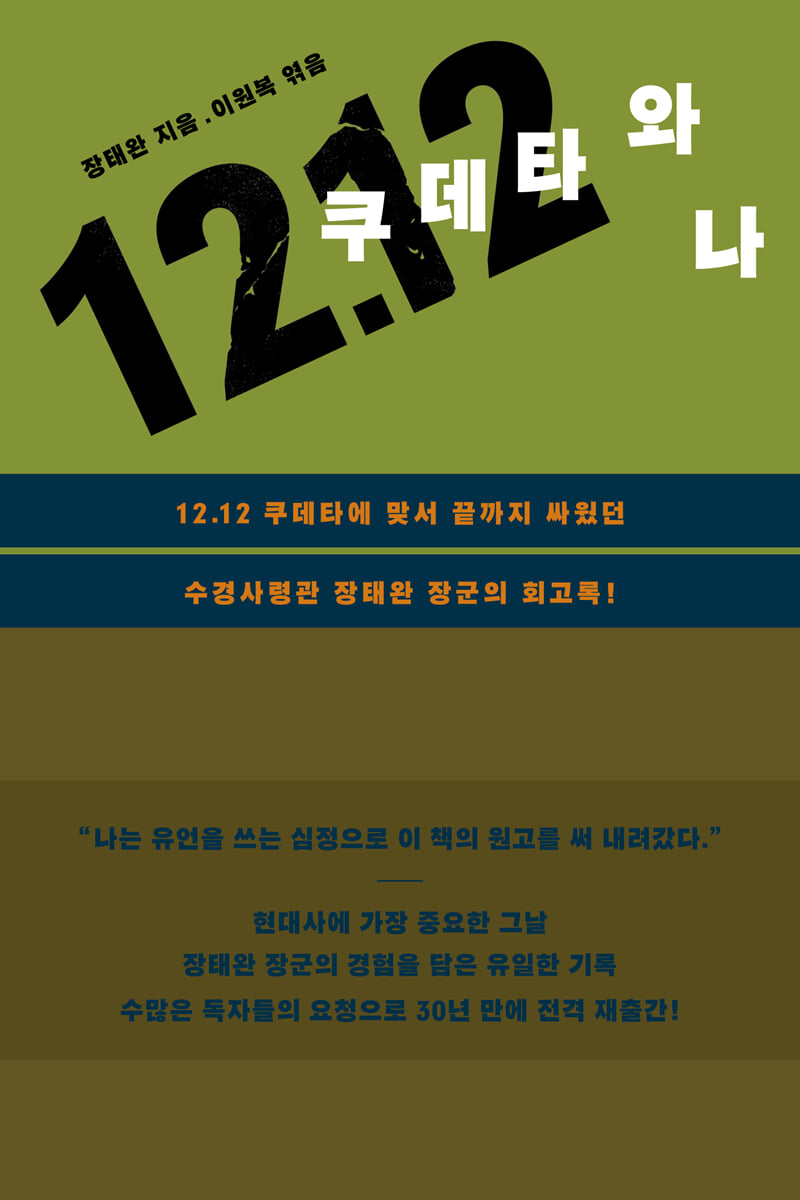 |
Description
Book Introduction
He tried to stop the December 12 military rebellion until the end.
General Jang Tae-wan's memoirs republished!
On December 12, 1979, the Hanahoe, which had been strengthening its power amidst the chaos caused by the assassination of President Park Chung-hee on October 26, staged a coup.
Although there were many attempts to restrain the Hanahoe, the coup eventually occurred, and numerous soldiers, including Chun Doo-hwan, advanced on the capital city of Seoul.
Even in the face of overwhelmingly unfavorable circumstances, General Jang Tae-wan, who was the commander of the Capital Defense Command, attempted to suppress the rebellion by mobilizing every means at his disposal, but in the end, Seoul and the Republic of Korea fell into their hands.
“With a heart of atonement, I have maintained silence throughout the years.” General Jang Tae-wan’s memoir, “The December 12 Coup and I,” begins with this sentence.
General Jang Tae-wan risked his life to prevent the coup, but he felt guilty for a long time about the failure of the suppression operation.
Although General Jang Tae-wan's story has been covered in various media, not much has been said about his actual life and spirit.
This book is a reissue of 'The 12,12 Coup and Me', which was published in 1993 and then went out of print. It has undergone spelling corrections and proofreading to improve readability.
However, sentences that were intended to convey the author's intention as is were used as is in the original text.
General Jang Tae-wan's memoirs republished!
On December 12, 1979, the Hanahoe, which had been strengthening its power amidst the chaos caused by the assassination of President Park Chung-hee on October 26, staged a coup.
Although there were many attempts to restrain the Hanahoe, the coup eventually occurred, and numerous soldiers, including Chun Doo-hwan, advanced on the capital city of Seoul.
Even in the face of overwhelmingly unfavorable circumstances, General Jang Tae-wan, who was the commander of the Capital Defense Command, attempted to suppress the rebellion by mobilizing every means at his disposal, but in the end, Seoul and the Republic of Korea fell into their hands.
“With a heart of atonement, I have maintained silence throughout the years.” General Jang Tae-wan’s memoir, “The December 12 Coup and I,” begins with this sentence.
General Jang Tae-wan risked his life to prevent the coup, but he felt guilty for a long time about the failure of the suppression operation.
Although General Jang Tae-wan's story has been covered in various media, not much has been said about his actual life and spirit.
This book is a reissue of 'The 12,12 Coup and Me', which was published in 1993 and then went out of print. It has undergone spelling corrections and proofreading to improve readability.
However, sentences that were intended to convey the author's intention as is were used as is in the original text.
- You can preview some of the book's contents.
Preview
index
Chapter 1.
The seed of tragedy called a coup
A soldier's life, beginning with the Korean War
The emergence of a private organization within the military, Hanahoe
The Yun Pil-yong Incident Reveals Military Illnesses
Hanahoe, which grew under the protection of President Park
The rise of omnipotent power: Cha Ji-chul and Chun Doo-hwan
Lee Byeong-hyeong, Kim Bok-dong, and me
Chapter 2.
The claws of ambition revealed after October 26th
The assassination of President Park on October 26th
Chief of Staff Jeong Seung-hwa issues a Level 2 emergency order.
Chief Jeong, who was wary of soldiers' political participation
The position of commander of the water police force that I was given by chance
Kimchi money sent by Security Command Commander Chun Doo-hwan
Colonel Park, Chief of Staff, was denied promotion to general.
Chapter 3.
The unfortunate December 12 military rebellion
Lead role in Yeonhui-dong Secret Fairy
President Choi's arrest warrant is postponed
The illegal arrest of President Jeong without authorization
The meticulously planned kidnapping of President Jeong
A dire situation inside the Army B-2 bunker
Comrades who turned into enemies
The reappearance of the Minister of Defense, whose whereabouts had been unknown.
Chapter 4.
The commander of the water police in isolation
Army Headquarters Command relocated to Suyeongsa
Prepare to deploy to Gyeongbokgung Palace and the Security Command
The rebels' 1st Airborne Brigade troops deployed
The suppression force's artillery unit failed to enter Seoul.
The arrest of Special Forces Commander Jeong Byeong-ju from the rebel side
Army headquarters staff meeting held late at night
Chapter 5.
After the December 12 Military Coup
The rebels' 1st Airborne Brigade enters Seoul.
The rebels completely took control of the Army Headquarters and the Ministry of National Defense.
Defense Minister Roh issues a mysterious "standstill" order.
Transferred to the serving area by the hands of a trusted subordinate
The military's seizure of power and the reshuffle of the leadership
Operational Evaluation of the December 12 Military Coup
The necessity of uncovering the truth about and condemning the December 12 military rebellion
Lessons from the December 12 Military Coup
Legal Review of the December 12 Military Coup
Chapter 6.
Two months of ordeal in prison
Security Command's Seobinggo Special Investigation Unit
interrogation with the intention of death
The investigator's persistent behind-the-scenes investigation
The first news I heard from my family
Meeting with Chun Doo-hwan and his release
Chapter 7.
Holding my son close to my chest
House arrest and father's death
A pilgrimage to the East Coast battlegrounds out of the blue
Our family was poor but happy
The running away and death of an only son
Holding my son close to my chest
The marriage of the only daughter, Hyeon-ri
Myocardial infarction that is bothering me
Testimony left at the crossroads of life and death
supplement
General Jang Tae-wan's magnetic field chart
The 12/12 military rebellion and its timing
The seed of tragedy called a coup
A soldier's life, beginning with the Korean War
The emergence of a private organization within the military, Hanahoe
The Yun Pil-yong Incident Reveals Military Illnesses
Hanahoe, which grew under the protection of President Park
The rise of omnipotent power: Cha Ji-chul and Chun Doo-hwan
Lee Byeong-hyeong, Kim Bok-dong, and me
Chapter 2.
The claws of ambition revealed after October 26th
The assassination of President Park on October 26th
Chief of Staff Jeong Seung-hwa issues a Level 2 emergency order.
Chief Jeong, who was wary of soldiers' political participation
The position of commander of the water police force that I was given by chance
Kimchi money sent by Security Command Commander Chun Doo-hwan
Colonel Park, Chief of Staff, was denied promotion to general.
Chapter 3.
The unfortunate December 12 military rebellion
Lead role in Yeonhui-dong Secret Fairy
President Choi's arrest warrant is postponed
The illegal arrest of President Jeong without authorization
The meticulously planned kidnapping of President Jeong
A dire situation inside the Army B-2 bunker
Comrades who turned into enemies
The reappearance of the Minister of Defense, whose whereabouts had been unknown.
Chapter 4.
The commander of the water police in isolation
Army Headquarters Command relocated to Suyeongsa
Prepare to deploy to Gyeongbokgung Palace and the Security Command
The rebels' 1st Airborne Brigade troops deployed
The suppression force's artillery unit failed to enter Seoul.
The arrest of Special Forces Commander Jeong Byeong-ju from the rebel side
Army headquarters staff meeting held late at night
Chapter 5.
After the December 12 Military Coup
The rebels' 1st Airborne Brigade enters Seoul.
The rebels completely took control of the Army Headquarters and the Ministry of National Defense.
Defense Minister Roh issues a mysterious "standstill" order.
Transferred to the serving area by the hands of a trusted subordinate
The military's seizure of power and the reshuffle of the leadership
Operational Evaluation of the December 12 Military Coup
The necessity of uncovering the truth about and condemning the December 12 military rebellion
Lessons from the December 12 Military Coup
Legal Review of the December 12 Military Coup
Chapter 6.
Two months of ordeal in prison
Security Command's Seobinggo Special Investigation Unit
interrogation with the intention of death
The investigator's persistent behind-the-scenes investigation
The first news I heard from my family
Meeting with Chun Doo-hwan and his release
Chapter 7.
Holding my son close to my chest
House arrest and father's death
A pilgrimage to the East Coast battlegrounds out of the blue
Our family was poor but happy
The running away and death of an only son
Holding my son close to my chest
The marriage of the only daughter, Hyeon-ri
Myocardial infarction that is bothering me
Testimony left at the crossroads of life and death
supplement
General Jang Tae-wan's magnetic field chart
The 12/12 military rebellion and its timing
Detailed image
.jpg)
Into the book
More than anyone else, I have longed for a fair investigation into the December 12 military rebellion, which tarnished the honor of the military, which is more precious than life itself, completely trampled upon its legitimacy, command system, and discipline, and even caused a disruption of the national constitution, and for the perpetrators to be punished.
On February 18, 1963, after the declaration of the return of Chairman Park Chung-hee to power and the transfer of power to the civilian government, the 11th class of graduates, led by Chun Doo-hwan, who had begun to receive special treatment and protection from Chairman Park, formed the Hanahoe with the ambition that graduates of the regular military academy would become the pillars of the military in the future.
--- p.25
The Yun Pil-yong case was a case where he was convicted of operating a private organization within the military and abusing his power to commit various corruption and injustices. I simply cannot understand how the key figures in that private organization were able to escape the eye of the storm and remain unharmed.
--- p.37
I woke up around 3:00 a.m. on October 27, 1979, to the loud ringing of the phone.
I picked up the receiver and saw that it was the chief of staff of the Army Headquarters Training Staff Office.
“Sir! A level 2 emergency alert has been issued.
“You must come in quickly.”
--- p.55
I came home late at night and went to bed, but I couldn't fall asleep.
The position of Commander of the Capital Defense Command is coveted by many generals, so I couldn't help but be taken aback when it came to me, a position I had never dreamed of.
--- p.69
There is an issue that needs to be addressed here.
It was on December 5th that Secretary Heo Hwa-pyeong of the Security Command came to me with money for kimchi and said that General Chun Doo-hwan would prepare a meal to celebrate my appointment as Commander of the Capital Defense Command. It was on December 8th that Colonel Cho Hong came to me and told me that he would invite me to a unity dinner at 6:30 PM on December 12th.
--- p.80
It was 8 p.m. when I arrived at the Capital Defense Command.
As soon as I got out of the car, I headed straight to the underground situation room.
The instructions I gave in the car were already in progress.
However, the only subordinate unit commander waiting in the situation room was Hwang Dong-hwan, the commander of the air defense artillery unit.
--- p.103
The next morning, Lieutenant Colonel Shin received a secret order from Chun Doo-hwan and took the lead in arresting the Army Headquarters leaders who had gathered at the Suyeongsa.
--- p.110
“General Jang! Don’t be so excited and come here.
“Come here and talk to us.” The moment I heard that, I was so angry that I couldn’t stand it.
The curse words I had been holding back came out of my mouth.
--- p.126
Since it was only a matter of time before they would enter Seoul, regardless of which bridge they would use, I asked Park Dong-won (14th class of the Korea Military Academy), Chief of Operations, to review which bridge they would use.
--- p.144
I've been making calls here and there asking for troop support.
The commanders who initially agreed to provide troop support changed their attitude as time passed, making excuses that there were no orders from their superiors and saying it was difficult.
--- p.161
“First, observation fire must be conducted, but then not only will the Gwanghwamun area be reduced to rubble, but the civilian casualties will be unspeakably large.
So, shelling is impossible, and instead, we will prepare flares.” In this situation, the artillery unit’s entry into Seoul also ended in failure.
--- p.171
Just after I gave up on the final assault on the Joint Chiefs of Staff and returned to my office, I received a call from the Minister of National Defense, Roh Jae-hyun, whom I had been desperately searching for.
It was around 3:00 AM on December 13th.
It was around the time when Seoul was already completely under the control of rebel forces.
--- p.204
The December 12 military rebellion was not an accidental event.
As I have said repeatedly, it was a meticulously planned coup led by some political military figures centered around the Hanahoe, with the aim of usurping power long ago.
Those who rose to power in this military coup first began to replace the military leadership in order to seize military power.
--- p.214
I took a few puffs of a cigarette in my mouth and my head started spinning and I felt dizzy.
It was a natural thing.
I quit smoking four years ago, and I had a nightmare last night, using all my strength, so it wasn't surprising that I was feeling dizzy.
--- p.243
Since I was detained in the Seobingo Lost and Foundry, the Security Command has had two private soldiers stationed at my house on a weekly basis, monitoring the daily movements of people entering and leaving the house and their families day and night and reporting to the Security Command.
--- p.264
In the meantime, darkness began to fall.
The company commander, who was riding in a jeep, tried to take me to the company headquarters, so I had no choice but to show him my ID.
--- p.291
Although I am still searching for the whereabouts of the unidentified remains, I hold individual memorial services once a year to atone for the spirits of the confirmed dead. On Memorial Day, I visit the national cemetery without fail, visit the graves of the 37 dead, and offer a chrysanthemum to the spirits.
--- p.318
Sometimes, when I had post-operative complications, it was very helpful to go there.
However, in November 1991, four years after the surgery, another vascular disease called an aortic aneurysm occurred.
Again with the help of my sister, I returned to St. Vincent's Hospital in Los Angeles to have surgery with Dr. Yokoyama, who had previously performed my heart surgery.
On February 18, 1963, after the declaration of the return of Chairman Park Chung-hee to power and the transfer of power to the civilian government, the 11th class of graduates, led by Chun Doo-hwan, who had begun to receive special treatment and protection from Chairman Park, formed the Hanahoe with the ambition that graduates of the regular military academy would become the pillars of the military in the future.
--- p.25
The Yun Pil-yong case was a case where he was convicted of operating a private organization within the military and abusing his power to commit various corruption and injustices. I simply cannot understand how the key figures in that private organization were able to escape the eye of the storm and remain unharmed.
--- p.37
I woke up around 3:00 a.m. on October 27, 1979, to the loud ringing of the phone.
I picked up the receiver and saw that it was the chief of staff of the Army Headquarters Training Staff Office.
“Sir! A level 2 emergency alert has been issued.
“You must come in quickly.”
--- p.55
I came home late at night and went to bed, but I couldn't fall asleep.
The position of Commander of the Capital Defense Command is coveted by many generals, so I couldn't help but be taken aback when it came to me, a position I had never dreamed of.
--- p.69
There is an issue that needs to be addressed here.
It was on December 5th that Secretary Heo Hwa-pyeong of the Security Command came to me with money for kimchi and said that General Chun Doo-hwan would prepare a meal to celebrate my appointment as Commander of the Capital Defense Command. It was on December 8th that Colonel Cho Hong came to me and told me that he would invite me to a unity dinner at 6:30 PM on December 12th.
--- p.80
It was 8 p.m. when I arrived at the Capital Defense Command.
As soon as I got out of the car, I headed straight to the underground situation room.
The instructions I gave in the car were already in progress.
However, the only subordinate unit commander waiting in the situation room was Hwang Dong-hwan, the commander of the air defense artillery unit.
--- p.103
The next morning, Lieutenant Colonel Shin received a secret order from Chun Doo-hwan and took the lead in arresting the Army Headquarters leaders who had gathered at the Suyeongsa.
--- p.110
“General Jang! Don’t be so excited and come here.
“Come here and talk to us.” The moment I heard that, I was so angry that I couldn’t stand it.
The curse words I had been holding back came out of my mouth.
--- p.126
Since it was only a matter of time before they would enter Seoul, regardless of which bridge they would use, I asked Park Dong-won (14th class of the Korea Military Academy), Chief of Operations, to review which bridge they would use.
--- p.144
I've been making calls here and there asking for troop support.
The commanders who initially agreed to provide troop support changed their attitude as time passed, making excuses that there were no orders from their superiors and saying it was difficult.
--- p.161
“First, observation fire must be conducted, but then not only will the Gwanghwamun area be reduced to rubble, but the civilian casualties will be unspeakably large.
So, shelling is impossible, and instead, we will prepare flares.” In this situation, the artillery unit’s entry into Seoul also ended in failure.
--- p.171
Just after I gave up on the final assault on the Joint Chiefs of Staff and returned to my office, I received a call from the Minister of National Defense, Roh Jae-hyun, whom I had been desperately searching for.
It was around 3:00 AM on December 13th.
It was around the time when Seoul was already completely under the control of rebel forces.
--- p.204
The December 12 military rebellion was not an accidental event.
As I have said repeatedly, it was a meticulously planned coup led by some political military figures centered around the Hanahoe, with the aim of usurping power long ago.
Those who rose to power in this military coup first began to replace the military leadership in order to seize military power.
--- p.214
I took a few puffs of a cigarette in my mouth and my head started spinning and I felt dizzy.
It was a natural thing.
I quit smoking four years ago, and I had a nightmare last night, using all my strength, so it wasn't surprising that I was feeling dizzy.
--- p.243
Since I was detained in the Seobingo Lost and Foundry, the Security Command has had two private soldiers stationed at my house on a weekly basis, monitoring the daily movements of people entering and leaving the house and their families day and night and reporting to the Security Command.
--- p.264
In the meantime, darkness began to fall.
The company commander, who was riding in a jeep, tried to take me to the company headquarters, so I had no choice but to show him my ID.
--- p.291
Although I am still searching for the whereabouts of the unidentified remains, I hold individual memorial services once a year to atone for the spirits of the confirmed dead. On Memorial Day, I visit the national cemetery without fail, visit the graves of the 37 dead, and offer a chrysanthemum to the spirits.
--- p.318
Sometimes, when I had post-operative complications, it was very helpful to go there.
However, in November 1991, four years after the surgery, another vascular disease called an aortic aneurysm occurred.
Again with the help of my sister, I returned to St. Vincent's Hospital in Los Angeles to have surgery with Dr. Yokoyama, who had previously performed my heart surgery.
--- p.337
Publisher's Review
A soldier's life, beginning with the Korean War
But the tragedy that could not be prevented
General Jang Tae-wan was one of the many young men who sacrificed their lives for their country during the Korean War.
Jang Tae-wan, who was attending Daegu Commercial School, entered the 11th class of the Army Comprehensive School and, after receiving short-term officer training, demonstrated his worth as a patriotic warrior who protected the liberal democracy of the Republic of Korea by constantly moving back and forth to the front lines.
In addition, Jang Tae-wan served as a tactical instructor at the Army Infantry School and the inspector general of the respected General Han Shin's unit, and was promoted to general, which was the first among the 30,000 officers commissioned during the three years of the Korean War.
In this way, General Jang Tae-wan was a soldier who devoted himself to his country and a citizen who loved the Republic of Korea.
But on the other hand, there were also those who were called 'political soldiers' and only looked after their own interests behind the scenes.
In particular, Chun Doo-hwan, who created the military's internal secret organization 'Hanahoe', which could become his base, right after the May 16, 1961 coup, is a typical example of such a person.
Chun Doo-hwan and the Hanahoe secretly and meticulously secured key positions among themselves to increase their power, and General Jang Tae-wan vividly conveys this process in his memoir.
“With the heart of atonement for the unfaithful and silent
“I have remained silent for the past 13 years.”
After the assassination of President Park Chung-hee on October 26, 1979, Hanahoe began preparing for a coup in earnest.
Chun Doo-hwan, who rose through the ranks of Assistant Chief of Administrative Affairs at the Blue House Security Service and then Assistant Chief of Operations, further expanded his power together with Cha Ji-cheol, and meticulously planned for December 12th.
And General Jang Tae-wan, who had just been appointed as the commander of the Capital Defense Command, also ended up falling for that conspiracy.
On December 12, General Jang Tae-wan was invited to a secret dinner, but it turned out to be a trap to tie up General Jang Tae-wan, who was the commander of the Capital Defense Command, and when he rushed out to take action, Chun Doo-hwan and the Hanahoe forces were already advancing on the capital city of Seoul.
Although he had not even been in office for a month, General Jang Tae-wan did his best as the commander of the Capital Defense Command to suppress the December 12th Military Rebellion.
We made every possible contact and even tried to persuade rebel soldiers.
But despite all the methods he could muster, the rebels eventually took complete control of the Army Headquarters and the Ministry of National Defense, and General Jang Tae-wan could only watch the tragedy of the nation collapsing.
Afterwards, General Jang Tae-wan was sent to Seobinggo and spent time in prison.
And he reveals in his memoir that even after his release, he lived for a long time feeling guilty about not being able to prevent the coup.
However, he never gave up his will to live and his country, and in 1993, he once again dedicated himself to his country by appearing as a public witness before the '12?12 Coup d'état Truth Investigation Committee'.
General Jang Tae-wan hoped that, through “The 12?12 Coup and Me,” an unfortunate history like the 12?12 military rebellion would never be repeated.
A nation that forgets its history has no future.
The truth of that day, recreated through the voice of someone who witnessed the tragedy firsthand and felt the deepest despair, will serve as a crucial historical guide for the Republic of Korea.
Who Should Read This Book
1.
People interested in the 'December 12 Military Coup'
2.
People interested in Korean history
3.
People interested in politics
4.
People who want to know about General Jang Tae-wan
5.
People who want to know about Hanahoe
But the tragedy that could not be prevented
General Jang Tae-wan was one of the many young men who sacrificed their lives for their country during the Korean War.
Jang Tae-wan, who was attending Daegu Commercial School, entered the 11th class of the Army Comprehensive School and, after receiving short-term officer training, demonstrated his worth as a patriotic warrior who protected the liberal democracy of the Republic of Korea by constantly moving back and forth to the front lines.
In addition, Jang Tae-wan served as a tactical instructor at the Army Infantry School and the inspector general of the respected General Han Shin's unit, and was promoted to general, which was the first among the 30,000 officers commissioned during the three years of the Korean War.
In this way, General Jang Tae-wan was a soldier who devoted himself to his country and a citizen who loved the Republic of Korea.
But on the other hand, there were also those who were called 'political soldiers' and only looked after their own interests behind the scenes.
In particular, Chun Doo-hwan, who created the military's internal secret organization 'Hanahoe', which could become his base, right after the May 16, 1961 coup, is a typical example of such a person.
Chun Doo-hwan and the Hanahoe secretly and meticulously secured key positions among themselves to increase their power, and General Jang Tae-wan vividly conveys this process in his memoir.
“With the heart of atonement for the unfaithful and silent
“I have remained silent for the past 13 years.”
After the assassination of President Park Chung-hee on October 26, 1979, Hanahoe began preparing for a coup in earnest.
Chun Doo-hwan, who rose through the ranks of Assistant Chief of Administrative Affairs at the Blue House Security Service and then Assistant Chief of Operations, further expanded his power together with Cha Ji-cheol, and meticulously planned for December 12th.
And General Jang Tae-wan, who had just been appointed as the commander of the Capital Defense Command, also ended up falling for that conspiracy.
On December 12, General Jang Tae-wan was invited to a secret dinner, but it turned out to be a trap to tie up General Jang Tae-wan, who was the commander of the Capital Defense Command, and when he rushed out to take action, Chun Doo-hwan and the Hanahoe forces were already advancing on the capital city of Seoul.
Although he had not even been in office for a month, General Jang Tae-wan did his best as the commander of the Capital Defense Command to suppress the December 12th Military Rebellion.
We made every possible contact and even tried to persuade rebel soldiers.
But despite all the methods he could muster, the rebels eventually took complete control of the Army Headquarters and the Ministry of National Defense, and General Jang Tae-wan could only watch the tragedy of the nation collapsing.
Afterwards, General Jang Tae-wan was sent to Seobinggo and spent time in prison.
And he reveals in his memoir that even after his release, he lived for a long time feeling guilty about not being able to prevent the coup.
However, he never gave up his will to live and his country, and in 1993, he once again dedicated himself to his country by appearing as a public witness before the '12?12 Coup d'état Truth Investigation Committee'.
General Jang Tae-wan hoped that, through “The 12?12 Coup and Me,” an unfortunate history like the 12?12 military rebellion would never be repeated.
A nation that forgets its history has no future.
The truth of that day, recreated through the voice of someone who witnessed the tragedy firsthand and felt the deepest despair, will serve as a crucial historical guide for the Republic of Korea.
Who Should Read This Book
1.
People interested in the 'December 12 Military Coup'
2.
People interested in Korean history
3.
People interested in politics
4.
People who want to know about General Jang Tae-wan
5.
People who want to know about Hanahoe
GOODS SPECIFICS
- Date of issue: January 31, 2024
- Page count, weight, size: 360 pages | 468g | 140*210*21mm
- ISBN13: 9791189318529
- ISBN10: 1189318520
You may also like
카테고리
korean


korean

![GQ KOREA Mark (Monthly): December [2025]](http://librairie.coreenne.fr/cdn/shop/files/8ef265dbbfbf186523ed75ba7319009d.jpg?v=1765340328&width=3840)


