

The Age of Creativity
 |
Description
Book Introduction
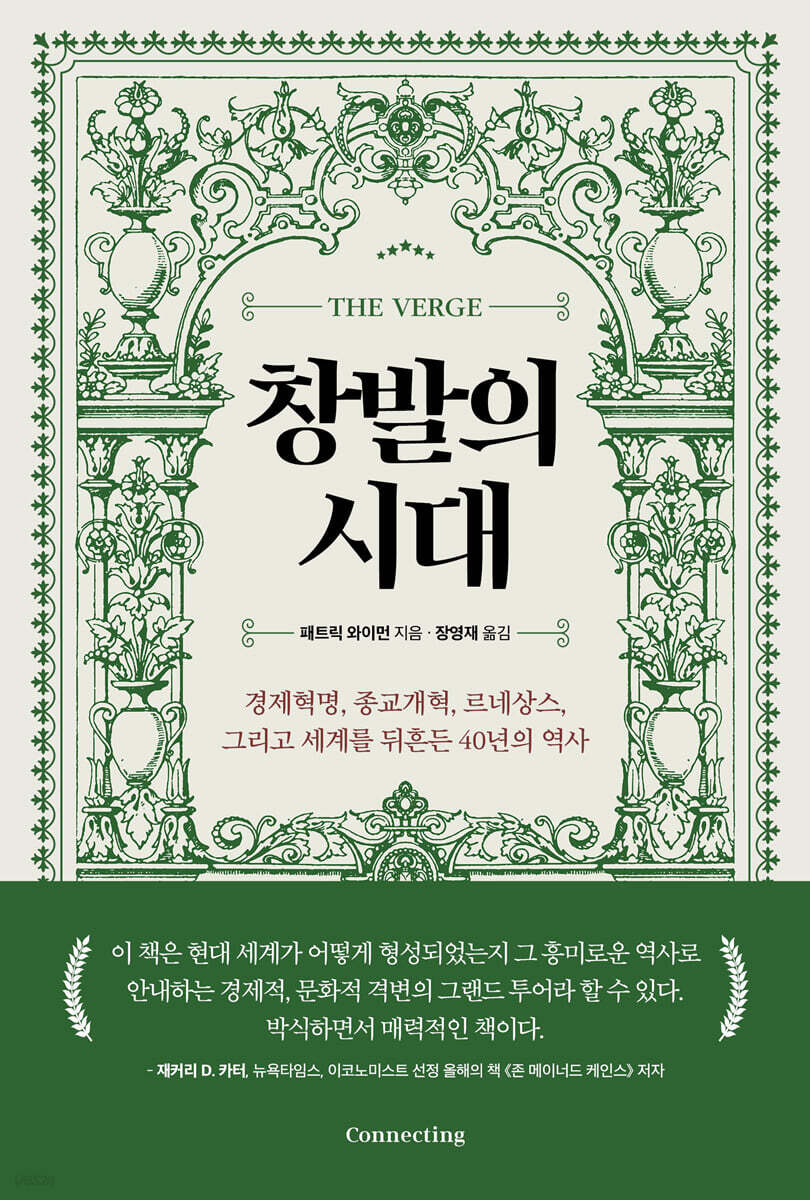
This book takes you through the fascinating history of how the modern world was formed.
It could be called a grand tour of economic and cultural upheaval.
It's a knowledgeable and engaging book.
Zachary D.
Carter, author of John Maynard Keynes
How did the West, which was more backward than the East until the 16th century, become prosperous?
Because connections and innovations have occurred in a wide range of areas, including economy, society, culture, politics, and technology!
A must-read for anyone who wants to understand how the modern world and our daily lives were shaped!
To understand the present we live in, we must know the past.
So we study history and learn lessons from it that can help us today.
In this book, Patrick Wyman, a doctorate in history and producer of the popular history podcast series "Tides of History," tells the story of a period that marked a decisive turning point in both Western and world history.
For the past 500 years, countless scholars—historians, economists, sociologists, political scientists, philosophers, and others—have debated which theory best explains how the West became richer than the East and became the center of the world.
But Patrick Wyman says that no single lens alone can interpret this complex and massive explosion.
Because the theories of each field alone cannot provide an accurate explanation of the historical background and context at that time.
During that turbulent forty-year period, from 1490 to 1530, the seeds of what would become known as the Great Divergence, a period that widened the gap between the West and the rest of the world, were planted.
Over a period of forty years, Europe saw the complex and unpredictable interactions of long voyages for money and fame, the resulting expansion of trade and finance, the expansion and rise of nations, new wars using gunpowder, the spread of printing, fueled by mass media, and their cumulative consequences: a epochal economic revolution, profound religious upheaval, widespread conflict, and the push toward globalization.
When individually very important developments occurred simultaneously and connected at a certain time, they led to explosive development.
Complex and massive changes have rippled across the globe, altering the course of world history and laying the foundation for a future that surprisingly resembles our present reality.
From famous historical figures such as Christopher Columbus, who sailed across the Atlantic; Jakob Fugger, the 16th-century Western billionaire who shook history with his money and economy; and Martin Luther, who sparked the Reformation with his Ninety-Five Theses, to lesser-known figures such as a ruthless English merchant and a one-armed German mercenary captain, this book vividly portrays one of the most important periods in world history and provides deep insights.
Offering fascinating and insightful insights, this book will offer readers many lessons and insights, ranging from the heated debate on "How did the West surpass the East?" to the deeply personal and crucial question of "When and how did the modern world and our lives come to be?"
It could be called a grand tour of economic and cultural upheaval.
It's a knowledgeable and engaging book.
Zachary D.
Carter, author of John Maynard Keynes
How did the West, which was more backward than the East until the 16th century, become prosperous?
Because connections and innovations have occurred in a wide range of areas, including economy, society, culture, politics, and technology!
A must-read for anyone who wants to understand how the modern world and our daily lives were shaped!
To understand the present we live in, we must know the past.
So we study history and learn lessons from it that can help us today.
In this book, Patrick Wyman, a doctorate in history and producer of the popular history podcast series "Tides of History," tells the story of a period that marked a decisive turning point in both Western and world history.
For the past 500 years, countless scholars—historians, economists, sociologists, political scientists, philosophers, and others—have debated which theory best explains how the West became richer than the East and became the center of the world.
But Patrick Wyman says that no single lens alone can interpret this complex and massive explosion.
Because the theories of each field alone cannot provide an accurate explanation of the historical background and context at that time.
During that turbulent forty-year period, from 1490 to 1530, the seeds of what would become known as the Great Divergence, a period that widened the gap between the West and the rest of the world, were planted.
Over a period of forty years, Europe saw the complex and unpredictable interactions of long voyages for money and fame, the resulting expansion of trade and finance, the expansion and rise of nations, new wars using gunpowder, the spread of printing, fueled by mass media, and their cumulative consequences: a epochal economic revolution, profound religious upheaval, widespread conflict, and the push toward globalization.
When individually very important developments occurred simultaneously and connected at a certain time, they led to explosive development.
Complex and massive changes have rippled across the globe, altering the course of world history and laying the foundation for a future that surprisingly resembles our present reality.
From famous historical figures such as Christopher Columbus, who sailed across the Atlantic; Jakob Fugger, the 16th-century Western billionaire who shook history with his money and economy; and Martin Luther, who sparked the Reformation with his Ninety-Five Theses, to lesser-known figures such as a ruthless English merchant and a one-armed German mercenary captain, this book vividly portrays one of the most important periods in world history and provides deep insights.
Offering fascinating and insightful insights, this book will offer readers many lessons and insights, ranging from the heated debate on "How did the West surpass the East?" to the deeply personal and crucial question of "When and how did the modern world and our lives come to be?"
- You can preview some of the book's contents.
Preview
index
Notes on Money and Currency
Introduction May 6, 1527
Great Divergence·Economic Practices·Why Then?·Special Times
Chapter 1: Christopher Columbus and the Exploration March 4, 1493
The Roots of Atlantic Expansion · Fernão Gómez and Atlantic Navigation · Early Merchant Investors · The Rise of Christopher Columbus · Columbus's Plan · Portugal's Atlantic · The Search for Sponsors · Columbus's Voyages · Portugal's Expansion into India · The End of Columbus
Chapter 2: Isabella of Castile and the Rise of the Nation, April 1466
The rise of the nation, Isabella and the unification of the dynasty, Ferdinand of Aragon, the rise and fall of monarchies, the Reconquista and Granada, the Queen's wars, national finances, the end of Granada and a look into its inner world, the entanglements of dynasties
Chapter 3: Jakob Fugger and Banking, February 1508
Medieval banking and usury; the rise of southern Germany; the Fugger family; Venice and the commercial geography of the late Middle Ages; state finances; mining; diversified interests; the future of the Habsburgs; the end of Jakob Fugger
Chapter 4: Götz von Berlichingen and the Military Revolution, Landshut, Bavaria, June 1504
Military Revolution, Swimming Against the Current, The Life of a Nobleman, The Contract War, Landsknechts and Switzerland, Gunpowder, The Great War, The Little War; The Old War, The New War, The Last Battle: Saint-Dizier, 1544
Chapter 5: Aldus Manutius and the Printing Press, Venice, September 1508
Gutenberg and the Book, Venice and the Spread of Printing, Aldus Manutius and Learning, The New Knowledge, The Dirty Business of Printing, Aldine's Printing House, Doing Business in the Book Market, The Information Revolution
Chapter 6 John Heritage and Everyday Capitalism, Moreton-in-Marsh, England, April 17, 1512
The Late Medieval Countryside and the End of Feudalism, John Heritage and the Family, Enclosures and Capitalism, Accounting Books, The Wool Trade, Merchants and the Operation of Commercial Society, Credit and Money, The End of John Heritage
Chapter 7: Martin Luther, Printing, and the Schism of the Church, Wittenberg, October 31, 1517
The Ninety-Five Theses, The Miner's Son, Brother Martin and the Church, The Reformation, Indulgences, Leo, Albert, and Jacob, Printing, Luther, and the Reformation, The Counterattack, Luther's Bestsellers, The Diet of Worms, The Last Days of Martin Luther
Chapter 8 Suleiman the Magnificent and the Ottoman Empire Mohács, Kingdom of Hungary, August 31, 1526
Rough Changes, The Rising Ottoman Wave, Facing Two Worlds, Belgrade and Rhodes, Mohács, Vienna, The Ottoman Way
Chapter 9: Charles V and Universal Reign, September 20, 1517
A fairly ordinary young man, coming to Spain, buying the throne, excessive greed, war and peace, unity and disintegration, a global empire, Tunis, the end of Charles
conclusion
Acknowledgements
References
main
Introduction May 6, 1527
Great Divergence·Economic Practices·Why Then?·Special Times
Chapter 1: Christopher Columbus and the Exploration March 4, 1493
The Roots of Atlantic Expansion · Fernão Gómez and Atlantic Navigation · Early Merchant Investors · The Rise of Christopher Columbus · Columbus's Plan · Portugal's Atlantic · The Search for Sponsors · Columbus's Voyages · Portugal's Expansion into India · The End of Columbus
Chapter 2: Isabella of Castile and the Rise of the Nation, April 1466
The rise of the nation, Isabella and the unification of the dynasty, Ferdinand of Aragon, the rise and fall of monarchies, the Reconquista and Granada, the Queen's wars, national finances, the end of Granada and a look into its inner world, the entanglements of dynasties
Chapter 3: Jakob Fugger and Banking, February 1508
Medieval banking and usury; the rise of southern Germany; the Fugger family; Venice and the commercial geography of the late Middle Ages; state finances; mining; diversified interests; the future of the Habsburgs; the end of Jakob Fugger
Chapter 4: Götz von Berlichingen and the Military Revolution, Landshut, Bavaria, June 1504
Military Revolution, Swimming Against the Current, The Life of a Nobleman, The Contract War, Landsknechts and Switzerland, Gunpowder, The Great War, The Little War; The Old War, The New War, The Last Battle: Saint-Dizier, 1544
Chapter 5: Aldus Manutius and the Printing Press, Venice, September 1508
Gutenberg and the Book, Venice and the Spread of Printing, Aldus Manutius and Learning, The New Knowledge, The Dirty Business of Printing, Aldine's Printing House, Doing Business in the Book Market, The Information Revolution
Chapter 6 John Heritage and Everyday Capitalism, Moreton-in-Marsh, England, April 17, 1512
The Late Medieval Countryside and the End of Feudalism, John Heritage and the Family, Enclosures and Capitalism, Accounting Books, The Wool Trade, Merchants and the Operation of Commercial Society, Credit and Money, The End of John Heritage
Chapter 7: Martin Luther, Printing, and the Schism of the Church, Wittenberg, October 31, 1517
The Ninety-Five Theses, The Miner's Son, Brother Martin and the Church, The Reformation, Indulgences, Leo, Albert, and Jacob, Printing, Luther, and the Reformation, The Counterattack, Luther's Bestsellers, The Diet of Worms, The Last Days of Martin Luther
Chapter 8 Suleiman the Magnificent and the Ottoman Empire Mohács, Kingdom of Hungary, August 31, 1526
Rough Changes, The Rising Ottoman Wave, Facing Two Worlds, Belgrade and Rhodes, Mohács, Vienna, The Ottoman Way
Chapter 9: Charles V and Universal Reign, September 20, 1517
A fairly ordinary young man, coming to Spain, buying the throne, excessive greed, war and peace, unity and disintegration, a global empire, Tunis, the end of Charles
conclusion
Acknowledgements
References
main
Publisher's Review
The essential element for exponential development in human history was 'emergence'!
Look back on the 40 turbulent years from 1490 to 1530 that shaped modern society!
When you look at the news or read books, you sometimes come across the word 'creation'.
Creativity means to suddenly discover or achieve something new that others do not know or have not done.
The starting point of the great turning point covered in this book, “The Age of Creation,” can be said to be creation itself.
Before the emergence of the West, the West was a remote frontier region lacking geographical and resource factors compared to the East.
Until then, most modern artifacts were produced in the East.
The compass, which guides us through the vast seas, and gunpowder, which has a variety of uses from war to play, were both first invented in the East.
Until then, there was such a gap that inventions important enough to shape the world we live in were mainly invented in the East.
But as the Great Divergence occurred, the West moved from the periphery of the world to its center.
What happened that enabled the West to achieve this explosive development?
Patrick Wyman, a doctorate in history and producer of a popular history podcast, explains why in this book.
No single lens alone can explain this absurd development.
We were able to develop because we were connected and developed across fields!
Simply making progress in one area is unlikely to bring about eye-popping changes.
For over 500 years, scholars from numerous fields have studied the Great Divergence, but because they approached it from their own perspectives, their theories have often been unconvincing and inadequate.
Patrick Wyman says it's difficult to explain explosive developments from such a narrow perspective.
Wyman argues that this was possible because developments occurred in various fields, including economics, society, culture, politics, institutions, and war, and these developments combined.
The modern world we know was formed through the development and connection of each field, leading to creation.
The Age of Exploration, the development of commerce, the development of finance, the development of printing, the advancement of culture and knowledge, the upheaval of politics and bloody wars, all combined to completely change the existing paradigm.
Patrick Wyman shows how intense the changes of the time were through the lives of real people who achieved historic feats in numerous fields, including economics, society, culture, politics, institutions, and war.
Although there was a backlash to that drastic change, the winds of change ultimately blew successfully, allowing us to embrace the modern world.
The Age of Creativity should not be thought of simply as a piece of past history.
The Age of Creation, from 1490 to 1530, still offers lessons and insights today!
The Age of Creation, from 1490 to 1530, was a time of upheaval.
Like a racehorse running without hesitation, time has passed and people have lived.
The world at that time was developing rapidly, just like the world today, and opportunities were created for that development to connect.
Today, we have an optimal environment for greater connectivity, development, and change than ever before.
From cutting-edge transportation to an online world where you can connect without having to physically visit, the network for innovation is ample and growing, and tremendous progress is being made in various fields, including the economy, society, culture, and politics.
If we read this book and look at the era of creation and the modern world we live in together, we will realize that a new era of creation has arrived.
Offering remarkable insights into the world of emergence, this book is a must-read for anyone seeking to understand the modern world we live in. It will also offer profound lessons and insights for anyone seeking fresh inspiration and insight to navigate a complex yet increasingly emergent era, informed by the experiences of our forebears.
Look back on the 40 turbulent years from 1490 to 1530 that shaped modern society!
When you look at the news or read books, you sometimes come across the word 'creation'.
Creativity means to suddenly discover or achieve something new that others do not know or have not done.
The starting point of the great turning point covered in this book, “The Age of Creation,” can be said to be creation itself.
Before the emergence of the West, the West was a remote frontier region lacking geographical and resource factors compared to the East.
Until then, most modern artifacts were produced in the East.
The compass, which guides us through the vast seas, and gunpowder, which has a variety of uses from war to play, were both first invented in the East.
Until then, there was such a gap that inventions important enough to shape the world we live in were mainly invented in the East.
But as the Great Divergence occurred, the West moved from the periphery of the world to its center.
What happened that enabled the West to achieve this explosive development?
Patrick Wyman, a doctorate in history and producer of a popular history podcast, explains why in this book.
No single lens alone can explain this absurd development.
We were able to develop because we were connected and developed across fields!
Simply making progress in one area is unlikely to bring about eye-popping changes.
For over 500 years, scholars from numerous fields have studied the Great Divergence, but because they approached it from their own perspectives, their theories have often been unconvincing and inadequate.
Patrick Wyman says it's difficult to explain explosive developments from such a narrow perspective.
Wyman argues that this was possible because developments occurred in various fields, including economics, society, culture, politics, institutions, and war, and these developments combined.
The modern world we know was formed through the development and connection of each field, leading to creation.
The Age of Exploration, the development of commerce, the development of finance, the development of printing, the advancement of culture and knowledge, the upheaval of politics and bloody wars, all combined to completely change the existing paradigm.
Patrick Wyman shows how intense the changes of the time were through the lives of real people who achieved historic feats in numerous fields, including economics, society, culture, politics, institutions, and war.
Although there was a backlash to that drastic change, the winds of change ultimately blew successfully, allowing us to embrace the modern world.
The Age of Creativity should not be thought of simply as a piece of past history.
The Age of Creation, from 1490 to 1530, still offers lessons and insights today!
The Age of Creation, from 1490 to 1530, was a time of upheaval.
Like a racehorse running without hesitation, time has passed and people have lived.
The world at that time was developing rapidly, just like the world today, and opportunities were created for that development to connect.
Today, we have an optimal environment for greater connectivity, development, and change than ever before.
From cutting-edge transportation to an online world where you can connect without having to physically visit, the network for innovation is ample and growing, and tremendous progress is being made in various fields, including the economy, society, culture, and politics.
If we read this book and look at the era of creation and the modern world we live in together, we will realize that a new era of creation has arrived.
Offering remarkable insights into the world of emergence, this book is a must-read for anyone seeking to understand the modern world we live in. It will also offer profound lessons and insights for anyone seeking fresh inspiration and insight to navigate a complex yet increasingly emergent era, informed by the experiences of our forebears.
GOODS SPECIFICS
- Publication date: November 2, 2022
- Page count, weight, size: 484 pages | 686g | 152*225*24mm
- ISBN13: 9791140802586
- ISBN10: 1140802585
You may also like
카테고리
korean


korean

![GQ KOREA Mark (Monthly): December [2025]](http://librairie.coreenne.fr/cdn/shop/files/8ef265dbbfbf186523ed75ba7319009d.jpg?v=1765340328&width=3840)


