

Brunelleschi's dome
 |
Description
Book Introduction
Brunelleschi's love and passion for the classics
It became the rock and foundation for establishing a new way of life in a new era.
Brunelleschi, who built the world's largest dome without installing wooden frame suspended beams, was a great master who broke away from past methods and concepts and showed the beauty of Renaissance architecture, and was praised as a genius.
The Florence Cathedral, the first dome of the Renaissance, was emotionally and emotionally in perfect harmony with the vast, empty Gothic interior of the Duomo, and later influenced such buildings as St. Peter's Basilica in the Vatican and San Giorgio Maggiore in Venice.
Brunelleschi, a watchmaker and goldsmith, and his love and passion for the classics became the bedrock and foundation for a new era and a source of pride for the Florentines who willingly persevered for the perfect beauty of the dome of Florence.
The life of the great architect Bruelleschi, who ushered in the golden age of the 15th-century Renaissance with his spirit of challenge, provides us with many lessons.
It became the rock and foundation for establishing a new way of life in a new era.
Brunelleschi, who built the world's largest dome without installing wooden frame suspended beams, was a great master who broke away from past methods and concepts and showed the beauty of Renaissance architecture, and was praised as a genius.
The Florence Cathedral, the first dome of the Renaissance, was emotionally and emotionally in perfect harmony with the vast, empty Gothic interior of the Duomo, and later influenced such buildings as St. Peter's Basilica in the Vatican and San Giorgio Maggiore in Venice.
Brunelleschi, a watchmaker and goldsmith, and his love and passion for the classics became the bedrock and foundation for a new era and a source of pride for the Florentines who willingly persevered for the perfect beauty of the dome of Florence.
The life of the great architect Bruelleschi, who ushered in the golden age of the 15th-century Renaissance with his spirit of challenge, provides us with many lessons.
- You can preview some of the book's contents.
Preview
index
Brunelleschi's dome
index
01 A More Beautiful and Glorious Temple·13
02 The Goldsmith of San Giovanni·34
03 Treasure Hunters·52
04 The Stubborn Man·74
05 Two Rivals ·96
06 People without families or names·109
07 A Machine You've Never Heard of Before · 121
08 Sandstone Chain·145
09 The Story of a Fat Carpenter·155
10th quintal peak·165
11 Bricks and Mortar·181
12 Wrapping a circle around a circle·200
13 The Monster of the Arno River·214
14 The Disaster at Lucca·233
15. Adding insult to injury·252
16 Cathedral Dedication Ceremony·268
17 Laterna·274
18 Great Genius, Filippo Brunelleschi·292
19 The Secret Room of Joy·302
index
01 A More Beautiful and Glorious Temple·13
02 The Goldsmith of San Giovanni·34
03 Treasure Hunters·52
04 The Stubborn Man·74
05 Two Rivals ·96
06 People without families or names·109
07 A Machine You've Never Heard of Before · 121
08 Sandstone Chain·145
09 The Story of a Fat Carpenter·155
10th quintal peak·165
11 Bricks and Mortar·181
12 Wrapping a circle around a circle·200
13 The Monster of the Arno River·214
14 The Disaster at Lucca·233
15. Adding insult to injury·252
16 Cathedral Dedication Ceremony·268
17 Laterna·274
18 Great Genius, Filippo Brunelleschi·292
19 The Secret Room of Joy·302
Into the book
The tendency to ignore architects was also influenced by the prejudice of ancient and medieval philosophers who viewed architecture as an insignificant human achievement, unworthy of intellectuals.
Cicero viewed architecture as physical labor, like farming, sewing, or metalworking, and in his Moral Letters, he placed architecture as the lowest of the four arts he classified.
The architecture he saw was 'common and lowly'.
It was merely a show of dexterity, not a pursuit of beauty or honor.
That is why architecture was treated worse than the work of creating stage sets, which was called the 'art of entertainment'.
However, by completing the Basilica of Santa Maria, Filippo achieved an achievement that changed the public perception of the architect's intellect and social status.
Thanks to his fame, during the Renaissance, architecture was transformed from a simple skill to a liberal art for intellectuals, and it came to be regarded as a leading force in cultural creation rather than a 'common and lowly' skill.
Unlike many medieval architects who remained anonymous, Filippo's name is widely known.
His ingenious design of erecting a dome without a central frame was on the lips of many.
A Latin poem was composed in his honor, books were dedicated to him, and numerous writers wrote biographies of Philip.
His bust was sculpted and his portrait was painted.
Philip has become a mythical figure.
Above all, Filippo was a phenomenal 'genius'.
Originally, the word 'genius' referred to Italian humanist philosophers who had original ideas.
Before Filippo, no architect, sculptor, or painter had ever been called a 'genius'.
However, the inscription written by Marsupini calls Filippo a 'genius given by God'.
Vasari even said that Filippo was a man called from heaven to save architecture from a state of ruin.
Of course, Philip was only a human, neither a god nor an angel.
However, Philip gave the Renaissance writers the confidence that modern man was as great as, or perhaps even greater than, the ancient Romans and Greeks who had inspired them.
The dome of Santa Maria del Fiore stands tall in the heart of Florence, unchanged since five hundred years ago.
Even as we walk down the narrow alleys of Florence, or turn a corner into a square, the dome suddenly appears before us.
Also on the steps of the Basilica of San Miniato al Monte, E.
In M. Forster's novel A Room with a View, Lucy Honeychurch stands there, always by his side, on her hotel balcony or on her cafe terrace.
On a clear day, the dome can be seen from Pistoia, 25 kilometers west of Florence.
In the 15th century, the citizens of Pistoia named the street facing the dome 'Via della Farranza', meaning 'street of the appearance'.
The cathedral, visible from afar, was more than just an architectural feat, a triumph of innovative structural engineering, wrought from brick, stone, and marble.
Just as the Florentines believed that the frescoes in the monastery of Santissima Annunziata were painted by gods or angels, they regarded them as miracles created by gods or angels in the Arno Valley.
Wherever you look, the dome holds a great mystery.
This enormous dome is all the more wondrous because it was built by human power, overcoming countless wars and struggles without a complete understanding of the laws of nature.
Cicero viewed architecture as physical labor, like farming, sewing, or metalworking, and in his Moral Letters, he placed architecture as the lowest of the four arts he classified.
The architecture he saw was 'common and lowly'.
It was merely a show of dexterity, not a pursuit of beauty or honor.
That is why architecture was treated worse than the work of creating stage sets, which was called the 'art of entertainment'.
However, by completing the Basilica of Santa Maria, Filippo achieved an achievement that changed the public perception of the architect's intellect and social status.
Thanks to his fame, during the Renaissance, architecture was transformed from a simple skill to a liberal art for intellectuals, and it came to be regarded as a leading force in cultural creation rather than a 'common and lowly' skill.
Unlike many medieval architects who remained anonymous, Filippo's name is widely known.
His ingenious design of erecting a dome without a central frame was on the lips of many.
A Latin poem was composed in his honor, books were dedicated to him, and numerous writers wrote biographies of Philip.
His bust was sculpted and his portrait was painted.
Philip has become a mythical figure.
Above all, Filippo was a phenomenal 'genius'.
Originally, the word 'genius' referred to Italian humanist philosophers who had original ideas.
Before Filippo, no architect, sculptor, or painter had ever been called a 'genius'.
However, the inscription written by Marsupini calls Filippo a 'genius given by God'.
Vasari even said that Filippo was a man called from heaven to save architecture from a state of ruin.
Of course, Philip was only a human, neither a god nor an angel.
However, Philip gave the Renaissance writers the confidence that modern man was as great as, or perhaps even greater than, the ancient Romans and Greeks who had inspired them.
The dome of Santa Maria del Fiore stands tall in the heart of Florence, unchanged since five hundred years ago.
Even as we walk down the narrow alleys of Florence, or turn a corner into a square, the dome suddenly appears before us.
Also on the steps of the Basilica of San Miniato al Monte, E.
In M. Forster's novel A Room with a View, Lucy Honeychurch stands there, always by his side, on her hotel balcony or on her cafe terrace.
On a clear day, the dome can be seen from Pistoia, 25 kilometers west of Florence.
In the 15th century, the citizens of Pistoia named the street facing the dome 'Via della Farranza', meaning 'street of the appearance'.
The cathedral, visible from afar, was more than just an architectural feat, a triumph of innovative structural engineering, wrought from brick, stone, and marble.
Just as the Florentines believed that the frescoes in the monastery of Santissima Annunziata were painted by gods or angels, they regarded them as miracles created by gods or angels in the Arno Valley.
Wherever you look, the dome holds a great mystery.
This enormous dome is all the more wondrous because it was built by human power, overcoming countless wars and struggles without a complete understanding of the laws of nature.
--- From the text
Publisher's Review
The red tiled dome, a symbol of Florence, covered in red flowers!
The story behind the dome of Santa Maria del Fiore, the most beautiful cathedral in the world
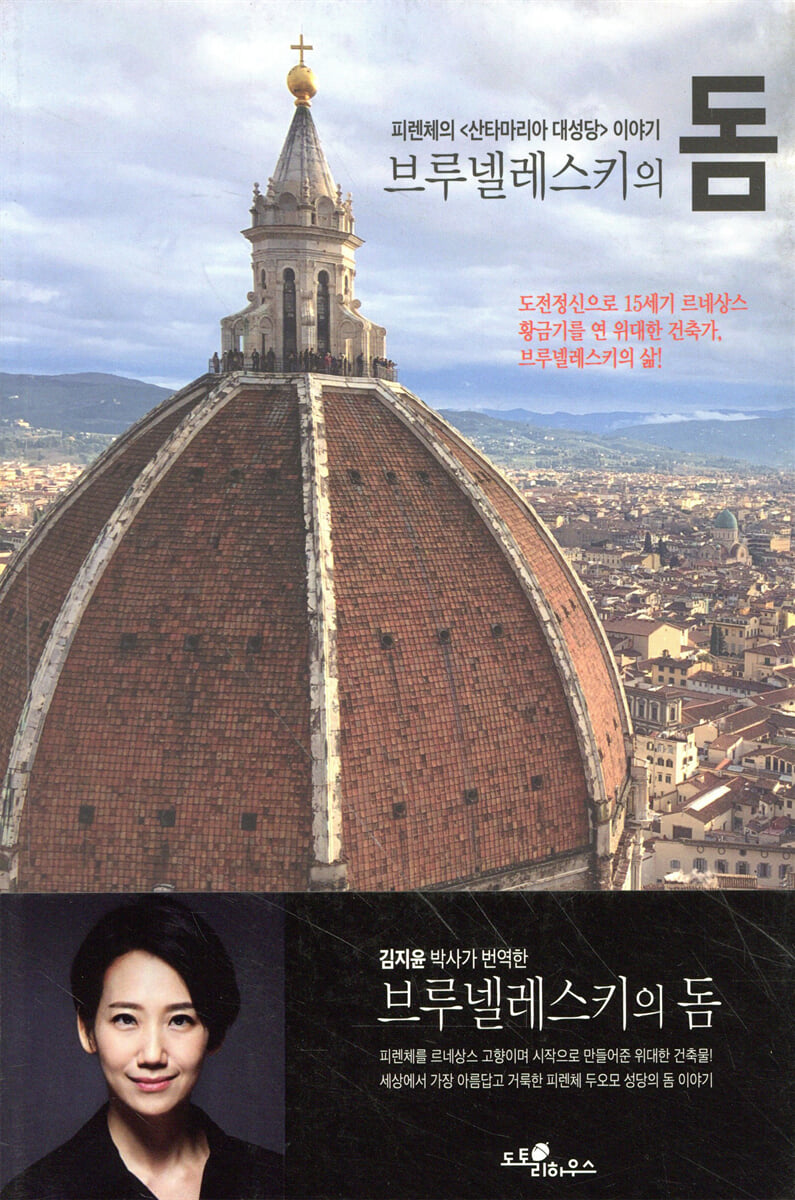
The dome of the Cathedral of Santa Maria del Fiore, which still pierces the sky over Florence today and boasts the tallest and most magnificent structure, was started in 1420 and was not completed until 1435.
It was an architectural enigma at the time, and to this day remains one of the wonders of the world. It boasts the world's largest and most technologically advanced stone dome. The sheer scale of the dome is breathtaking, taking viewers by surprise.
The dome may look like a fountain, but it is a perfect blend of incredible engineering and artistic design, and it is a magnificent piece of architecture that made Florence the birthplace and birthplace of the Renaissance.
The artist who completed the dome of this Cathedral of Santa Maria del Fiore was a middle-aged Filippo Brunelleschi.
Strictly speaking, the Renaissance began earlier, but it can be said to have reached its peak in the 15th century, during the Quattrocento period, with the construction of the Duomo Cathedral at its center.
Of course, Florence is a city founded by the Roman Caesars, and traces of ancient and medieval times are preserved intact.
Even though the cathedral and Palazzo Vecchio had been built since the Middle Ages, and the Baptistery of St. John was built in the Byzantine style, the Florentines, who had gained enormous wealth through finance and commerce, were not satisfied with the Gothic architecture attempted in the late Middle Ages, and so they began building domes, which had been abandoned as impossible technology in the past, in the new Renaissance style.
Construction of the new cathedral began in 1296, to designs by the Pisan architect Arnolfo di Cambio.
Cambio planned to replace the spire with a small dome on the Gothic structure, but Cambio passed away in 1302 while construction was still underway, and construction of the cathedral was halted.
From then until 1349, construction on the cathedral was repeatedly interrupted and the design changed due to various problems. Finally, in 1349, construction resumed, and after 73 years, all the architectural structures except the dome were completed.
During the long construction period, Florence was reborn as a city where Renaissance humanities and science developed and where the human body, nature, and the universe were rediscovered.
The wish to build the tallest and largest dome was not realized due to technical limitations, but the Florentines did not give up and waited in the belief that one day God would solve the mystery of this dome.
With the belief that one day God will solve the mystery of this dome
The construction of the dome, which remained a mystery to the Florentines, was unraveled at the beginning of the 15th century.
Brunelleschi, a goldsmith who had applied for a competition to create the bronze doors of the Baptistery of St. John, gave up the position to his rival Ghiberti and went to Rome to study ancient architecture.
He studied the architecture of ancient Rome closely, especially the Pantheon, and studied the construction methods of domes, acquiring engineering skills and returning.
In 1418, the Duomo Guild Council launched a competition to design a dome.
The criteria for the competition, which included Brunelleschi and a large number of architects from various countries, were to build the largest dome at the time based on the last revised design, but with a reduced use of expensive wood.
But building a massive dome, one that had never been built before, remained a difficult challenge.
Brunelleschi was confident that he could build a dome without the wooden buttresses of the previous Gothic style, but he never made his idea public.
Instead, the person who could stand an egg upright on a marble slab would be given the right to build the dome, and Brunelleschi was ultimately chosen.
During the construction period (1296-1369)
Florence is where Renaissance humanities and sciences developed.
It will be reborn as a city that rediscovers humanity, nature, and the universe.
He started construction on the dome again at the point where construction had stopped.
It was a dome-shaped structure that started from an octagonal drum and rose to a conical shape.
The most difficult task in building the dome was to stack the bricks while supporting the double weight load without external supporting walls.
To address this problem, Brunelleschi devised an engineering method to distribute the Duomo's center of gravity across its double shell, inspired by the six-meter-thick double-shell structure of the Pantheon in Rome.
In order to support the center of gravity of the compressive force going down the dome and the tensile force spreading down the slopes in all directions, the shape of the dome was designed not as a perfect hemisphere but as an upward-facing umbrella-shaped shape and an octagonal dome close to a circle, thereby dispersing the force.
The double-shell structure, with one dome on the inside and the other on the outside, is lined with stairs and the interior is seamlessly connected with vertical and horizontal chains and rings to ensure the safety of the domes.
In addition, the secret to the successful construction of the dome was its herringbone brick construction.
The inner floor of the dome rises upwards in a flower-like shape, and the bricks are stacked in an alternating pattern to create a series of arches, providing balance.
This method was not originally in his design, but by a stroke of genius, the shape that gave the Duomo its name, Saint Mary of the Flowers, appeared.
A perfect harmony of engineering and artistic design,
The world's largest dome! Florence's Duomo!
Brunelleschi faced many difficulties during the long 16-year construction period.
Although the Medici family took care of the financial difficulties, he had to deal with the criticism and gossip from other architects that arose surrounding the construction.
The long-awaited year 1436 has finally arrived.
140 years after construction began, Brunelleschi completed the dome of the Duomo, a Renaissance masterpiece of exquisite design and engineering.
Ten years after the dome was completed and just over a month after construction began on the roof lanterns to provide natural lighting and ventilation inside the dome, Brunelleschi passed away and the first funeral was held under the dome he had built.
“Here lies the great Florentine genius Filippo Brunelleschi.” The suspended lantern project was later completed by Brunelleschi’s friend Michelozzo.
Brunelleschi's love and passion for the classics
It became the rock and foundation for establishing a new way of life in a new era.
Brunelleschi, who built the world's largest dome without installing wooden frame suspended beams, was a great master who broke away from past methods and concepts and showed the beauty of Renaissance architecture, and was praised as a genius.
The Florence Cathedral, the first dome of the Renaissance, was emotionally and emotionally in perfect harmony with the vast, empty Gothic interior of the Duomo, and later influenced such buildings as St. Peter's Basilica in the Vatican and San Giorgio Maggiore in Venice.
Brunelleschi, a watchmaker and goldsmith, and his love and passion for the classics became the bedrock and foundation for a new era and a source of pride for the Florentines who willingly persevered for the perfect beauty of the dome of Florence.
Author Ross King concludes, "The more I think about it, the more astonishing it is that humans were able to build this massive dome amidst war and strife, before the laws of nature and scientific architecture had even been established."
The story behind the dome of Santa Maria del Fiore, the most beautiful cathedral in the world
The dome of the Cathedral of Santa Maria del Fiore, which still pierces the sky over Florence today and boasts the tallest and most magnificent structure, was started in 1420 and was not completed until 1435.
It was an architectural enigma at the time, and to this day remains one of the wonders of the world. It boasts the world's largest and most technologically advanced stone dome. The sheer scale of the dome is breathtaking, taking viewers by surprise.
The dome may look like a fountain, but it is a perfect blend of incredible engineering and artistic design, and it is a magnificent piece of architecture that made Florence the birthplace and birthplace of the Renaissance.
The artist who completed the dome of this Cathedral of Santa Maria del Fiore was a middle-aged Filippo Brunelleschi.
Strictly speaking, the Renaissance began earlier, but it can be said to have reached its peak in the 15th century, during the Quattrocento period, with the construction of the Duomo Cathedral at its center.
Of course, Florence is a city founded by the Roman Caesars, and traces of ancient and medieval times are preserved intact.
Even though the cathedral and Palazzo Vecchio had been built since the Middle Ages, and the Baptistery of St. John was built in the Byzantine style, the Florentines, who had gained enormous wealth through finance and commerce, were not satisfied with the Gothic architecture attempted in the late Middle Ages, and so they began building domes, which had been abandoned as impossible technology in the past, in the new Renaissance style.
Construction of the new cathedral began in 1296, to designs by the Pisan architect Arnolfo di Cambio.
Cambio planned to replace the spire with a small dome on the Gothic structure, but Cambio passed away in 1302 while construction was still underway, and construction of the cathedral was halted.
From then until 1349, construction on the cathedral was repeatedly interrupted and the design changed due to various problems. Finally, in 1349, construction resumed, and after 73 years, all the architectural structures except the dome were completed.
During the long construction period, Florence was reborn as a city where Renaissance humanities and science developed and where the human body, nature, and the universe were rediscovered.
The wish to build the tallest and largest dome was not realized due to technical limitations, but the Florentines did not give up and waited in the belief that one day God would solve the mystery of this dome.
With the belief that one day God will solve the mystery of this dome
The construction of the dome, which remained a mystery to the Florentines, was unraveled at the beginning of the 15th century.
Brunelleschi, a goldsmith who had applied for a competition to create the bronze doors of the Baptistery of St. John, gave up the position to his rival Ghiberti and went to Rome to study ancient architecture.
He studied the architecture of ancient Rome closely, especially the Pantheon, and studied the construction methods of domes, acquiring engineering skills and returning.
In 1418, the Duomo Guild Council launched a competition to design a dome.
The criteria for the competition, which included Brunelleschi and a large number of architects from various countries, were to build the largest dome at the time based on the last revised design, but with a reduced use of expensive wood.
But building a massive dome, one that had never been built before, remained a difficult challenge.
Brunelleschi was confident that he could build a dome without the wooden buttresses of the previous Gothic style, but he never made his idea public.
Instead, the person who could stand an egg upright on a marble slab would be given the right to build the dome, and Brunelleschi was ultimately chosen.
During the construction period (1296-1369)
Florence is where Renaissance humanities and sciences developed.
It will be reborn as a city that rediscovers humanity, nature, and the universe.
He started construction on the dome again at the point where construction had stopped.
It was a dome-shaped structure that started from an octagonal drum and rose to a conical shape.
The most difficult task in building the dome was to stack the bricks while supporting the double weight load without external supporting walls.
To address this problem, Brunelleschi devised an engineering method to distribute the Duomo's center of gravity across its double shell, inspired by the six-meter-thick double-shell structure of the Pantheon in Rome.
In order to support the center of gravity of the compressive force going down the dome and the tensile force spreading down the slopes in all directions, the shape of the dome was designed not as a perfect hemisphere but as an upward-facing umbrella-shaped shape and an octagonal dome close to a circle, thereby dispersing the force.
The double-shell structure, with one dome on the inside and the other on the outside, is lined with stairs and the interior is seamlessly connected with vertical and horizontal chains and rings to ensure the safety of the domes.
In addition, the secret to the successful construction of the dome was its herringbone brick construction.
The inner floor of the dome rises upwards in a flower-like shape, and the bricks are stacked in an alternating pattern to create a series of arches, providing balance.
This method was not originally in his design, but by a stroke of genius, the shape that gave the Duomo its name, Saint Mary of the Flowers, appeared.
A perfect harmony of engineering and artistic design,
The world's largest dome! Florence's Duomo!
Brunelleschi faced many difficulties during the long 16-year construction period.
Although the Medici family took care of the financial difficulties, he had to deal with the criticism and gossip from other architects that arose surrounding the construction.
The long-awaited year 1436 has finally arrived.
140 years after construction began, Brunelleschi completed the dome of the Duomo, a Renaissance masterpiece of exquisite design and engineering.
Ten years after the dome was completed and just over a month after construction began on the roof lanterns to provide natural lighting and ventilation inside the dome, Brunelleschi passed away and the first funeral was held under the dome he had built.
“Here lies the great Florentine genius Filippo Brunelleschi.” The suspended lantern project was later completed by Brunelleschi’s friend Michelozzo.
Brunelleschi's love and passion for the classics
It became the rock and foundation for establishing a new way of life in a new era.
Brunelleschi, who built the world's largest dome without installing wooden frame suspended beams, was a great master who broke away from past methods and concepts and showed the beauty of Renaissance architecture, and was praised as a genius.
The Florence Cathedral, the first dome of the Renaissance, was emotionally and emotionally in perfect harmony with the vast, empty Gothic interior of the Duomo, and later influenced such buildings as St. Peter's Basilica in the Vatican and San Giorgio Maggiore in Venice.
Brunelleschi, a watchmaker and goldsmith, and his love and passion for the classics became the bedrock and foundation for a new era and a source of pride for the Florentines who willingly persevered for the perfect beauty of the dome of Florence.
Author Ross King concludes, "The more I think about it, the more astonishing it is that humans were able to build this massive dome amidst war and strife, before the laws of nature and scientific architecture had even been established."
GOODS SPECIFICS
- Publication date: November 16, 2020
- Page count, weight, size: 320 pages | 140*210*30mm
- ISBN13: 9791196324131
- ISBN10: 1196324131
You may also like
카테고리
korean


korean

![GQ KOREA Mark (Monthly): December [2025]](http://librairie.coreenne.fr/cdn/shop/files/8ef265dbbfbf186523ed75ba7319009d.jpg?v=1765340328&width=3840)


