

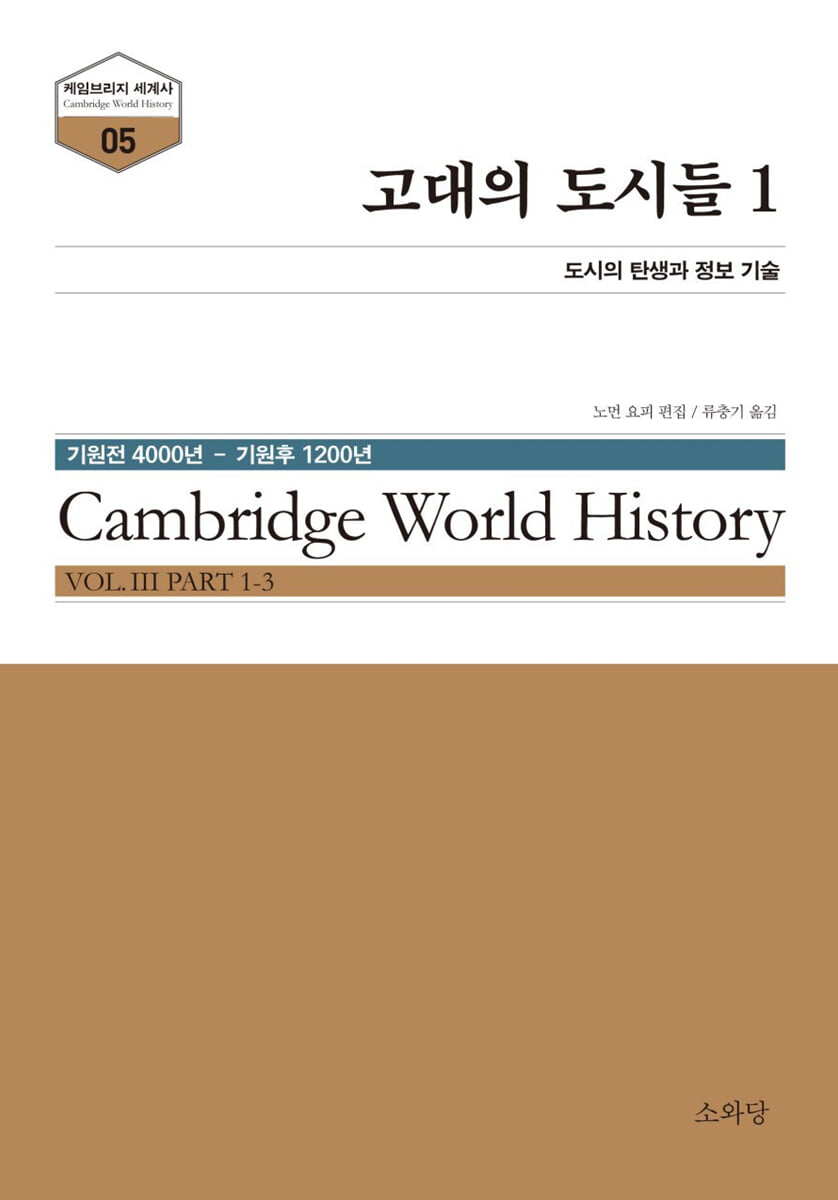
Ancient Cities 1
 |
Description
Book Introduction
Humans have become unable to live outside the city.
Today's humanity cannot live outside the city.
Even people who live in the most remote rural areas are connected to the city in some way.
When did this system emerge? Why on earth did the urban system emerge? This book examines the history of cities as a turning point in world history.
Many of the problems we face today—disease, violence, inequality, subjugation, war, and religion—began with the birth of cities.
If this is a historically formed condition of human existence, we can solve this problem historically.
Today's humanity cannot live outside the city.
Even people who live in the most remote rural areas are connected to the city in some way.
When did this system emerge? Why on earth did the urban system emerge? This book examines the history of cities as a turning point in world history.
Many of the problems we face today—disease, violence, inequality, subjugation, war, and religion—began with the birth of cities.
If this is a historically formed condition of human existence, we can solve this problem historically.
- You can preview some of the book's contents.
Preview
index
CHAPTER 1 Introduction: A History of Early Urban Studies 33
PART 1: Early Cities, Arenas of Ritual
CHAPTER 2 The Cities of Ancient Egypt: Monumental Architecture and Ritual Events.
CHAPTER 3 Cities Offered to the Gods: The Form and Meaning of Classic Maya Cities
CHAPTER 4 Urban Formation in Southeast Asia: From Early Cities to Ancient States
CHAPTER 5: The City, the Stage for Events
PART 2 Early Cities and Information Technology
CHAPTER 6 Urbanization and Communication Technologies: The Mesopotamian City of Uruk, 4th Millennium BCE
CHAPTER 7 Scripts and Cities in Ancient China
CHAPTER 8 Reading Early Maya Cities: The Role of Writing in Urbanization
CHAPTER 9 The Administrative System of Tawantinsuyu (Inca Empire) as Seen Through Quipu
CHAPTER 10 Scripts and Recordkeeping in Early Cities
PART 3: EARLY URBAN LANDSCAPES
CHAPTER 11 The Origins of the City of Tiwanaku: A Distributed Center and a Spiritual Landscape
CHAPTER 12 Cities and Urbanization in Mesopotamia, 3500–1600 BCE
CHAPTER 13 Teotihuacan: Early Urbanization in a Regional Context
CHAPTER 14 Urban Landscapes: Transforming Space and Rebuilding Community
PART 1: Early Cities, Arenas of Ritual
CHAPTER 2 The Cities of Ancient Egypt: Monumental Architecture and Ritual Events.
CHAPTER 3 Cities Offered to the Gods: The Form and Meaning of Classic Maya Cities
CHAPTER 4 Urban Formation in Southeast Asia: From Early Cities to Ancient States
CHAPTER 5: The City, the Stage for Events
PART 2 Early Cities and Information Technology
CHAPTER 6 Urbanization and Communication Technologies: The Mesopotamian City of Uruk, 4th Millennium BCE
CHAPTER 7 Scripts and Cities in Ancient China
CHAPTER 8 Reading Early Maya Cities: The Role of Writing in Urbanization
CHAPTER 9 The Administrative System of Tawantinsuyu (Inca Empire) as Seen Through Quipu
CHAPTER 10 Scripts and Recordkeeping in Early Cities
PART 3: EARLY URBAN LANDSCAPES
CHAPTER 11 The Origins of the City of Tiwanaku: A Distributed Center and a Spiritual Landscape
CHAPTER 12 Cities and Urbanization in Mesopotamia, 3500–1600 BCE
CHAPTER 13 Teotihuacan: Early Urbanization in a Regional Context
CHAPTER 14 Urban Landscapes: Transforming Space and Rebuilding Community
Publisher's Review
The fifth book in the Cambridge World History series (18 volumes)
The Cambridge World History Series is a vast world history series in which over 200 scholars from around the world have participated.
The Korean version is scheduled to be published in 18 volumes.
This book is the fifth in a series of comparative analyses of the causes of the birth of ancient cities and their aftermath from a world historical perspective.
For God alone
Ironically, cities were created for gods, not humans.
The monumental architecture and rituals of ancient Egypt, the pyramids and urban architecture of the Classical Maya, and the ruins of Southeast Asian cities all point to the fact that entire cities were designed for sacrifice.
The city was a place for sacrifices to the gods, with blood shed, and for the procession of people marching towards the gods.
So, we cannot understand the birth of cities without religion. (Part I)
The key is communication skills
A key tool in building cities was communication technology.
Mobilizing and organizing large-scale human resources was impossible without communication technology.
Cuneiform script was created in the Mesopotamian city of Uruk, oracle bone script was created in the ancient Chinese city of Anyang, and pictographic and knot-based script played a key role in the formation of the early Mayan cities.
Why were writing systems created in specific times and places? The answer lies in cities. (Part II)
Differences in urban models
Just because the city originated in Mesopotamia, not all cities in the world followed the Mesopotamian model.
The cities of Mesopotamia, the city of Tiwanaku in the Andes, and the great Mayan city of Teotihuacan differed in their time of birth, their process of urbanization, the layout of their residential areas, and the relationship between ceremonial and residential areas.
This book attempts to move beyond classical urban theory and create a new world history of cities by comparing these. (Part III)
Volume 5 Author List
Norman Yoffee, University of Michigan; Institute for the Study of the Ancient World, New York University
Nicola Terrenato, University of Michigan
John Baines, University of Oxford
Stephen Houston, Brown University
Thomas G. Garrison
Garrison), University of Southern California
Miriam T. Stark
Stark), University of Hawaii, Ma?noa
Hans J. Nissen
Nissen), Free University of Berlin
Wang Haicheng (王海城), University of Washington
Danny Law, University of Texas
Gary Urton, Harvard University
John W. Janusek
Janusek), Vanderbilt University
Geoff Emberling, University of Michigan
Sarah C. Clayton
Clayton), University of Wisconsin, Madison
The Cambridge World History Series is a vast world history series in which over 200 scholars from around the world have participated.
The Korean version is scheduled to be published in 18 volumes.
This book is the fifth in a series of comparative analyses of the causes of the birth of ancient cities and their aftermath from a world historical perspective.
For God alone
Ironically, cities were created for gods, not humans.
The monumental architecture and rituals of ancient Egypt, the pyramids and urban architecture of the Classical Maya, and the ruins of Southeast Asian cities all point to the fact that entire cities were designed for sacrifice.
The city was a place for sacrifices to the gods, with blood shed, and for the procession of people marching towards the gods.
So, we cannot understand the birth of cities without religion. (Part I)
The key is communication skills
A key tool in building cities was communication technology.
Mobilizing and organizing large-scale human resources was impossible without communication technology.
Cuneiform script was created in the Mesopotamian city of Uruk, oracle bone script was created in the ancient Chinese city of Anyang, and pictographic and knot-based script played a key role in the formation of the early Mayan cities.
Why were writing systems created in specific times and places? The answer lies in cities. (Part II)
Differences in urban models
Just because the city originated in Mesopotamia, not all cities in the world followed the Mesopotamian model.
The cities of Mesopotamia, the city of Tiwanaku in the Andes, and the great Mayan city of Teotihuacan differed in their time of birth, their process of urbanization, the layout of their residential areas, and the relationship between ceremonial and residential areas.
This book attempts to move beyond classical urban theory and create a new world history of cities by comparing these. (Part III)
Volume 5 Author List
Norman Yoffee, University of Michigan; Institute for the Study of the Ancient World, New York University
Nicola Terrenato, University of Michigan
John Baines, University of Oxford
Stephen Houston, Brown University
Thomas G. Garrison
Garrison), University of Southern California
Miriam T. Stark
Stark), University of Hawaii, Ma?noa
Hans J. Nissen
Nissen), Free University of Berlin
Wang Haicheng (王海城), University of Washington
Danny Law, University of Texas
Gary Urton, Harvard University
John W. Janusek
Janusek), Vanderbilt University
Geoff Emberling, University of Michigan
Sarah C. Clayton
Clayton), University of Wisconsin, Madison
GOODS SPECIFICS
- Publication date: October 15, 2021
- Page count, weight, size: 572 pages | 150*215*35mm
- ISBN13: 9788967220334
- ISBN10: 8967220332
You may also like
카테고리
korean


korean

![GQ KOREA Mark (Monthly): December [2025]](http://librairie.coreenne.fr/cdn/shop/files/8ef265dbbfbf186523ed75ba7319009d.jpg?v=1765340328&width=3840)


