

Learning Western Ancient History from the Beginning
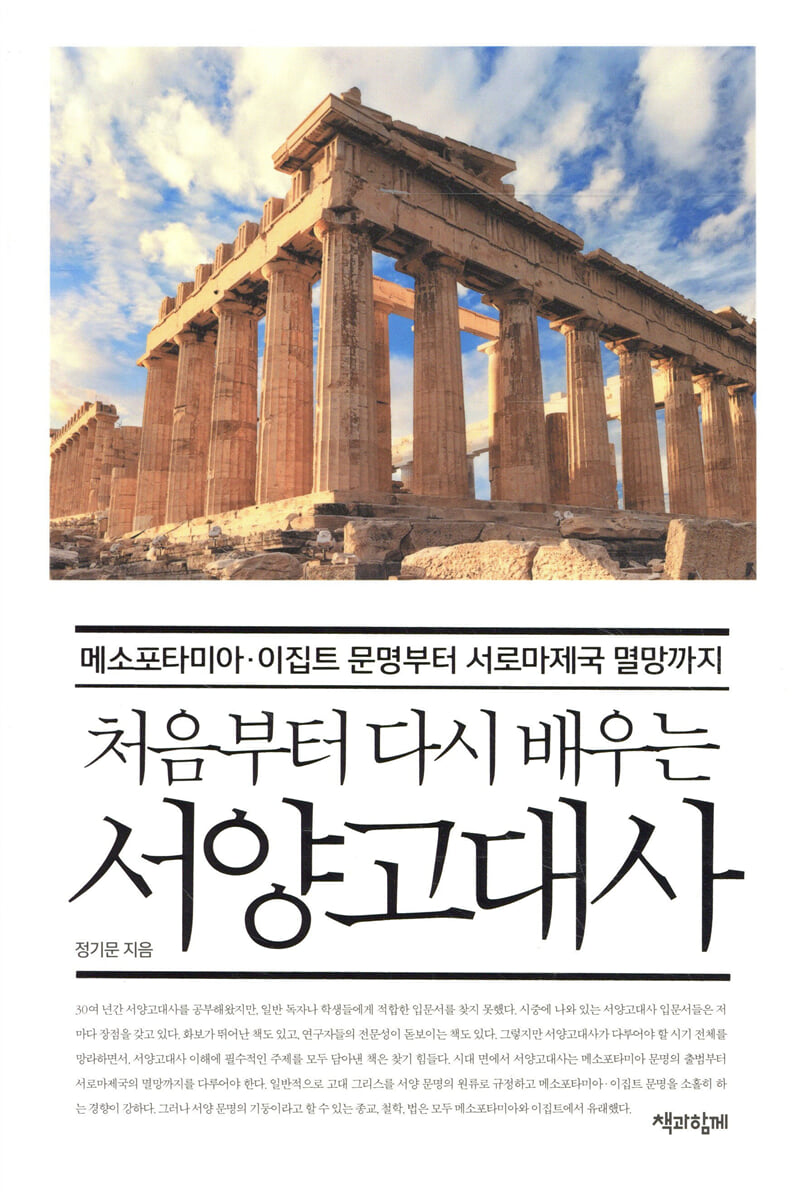 |
Description
Book Introduction
- A word from MD
- The roots of Europe, which led modern civilization, lie in ancient Greece, Rome, and Christianity.
Modern people are also under its influence.
This is why we need to know Western ancient history.
This book summarizes ancient Western history in an easy-to-understand manner.
It also features many interesting episodes, such as the Roman emperor's love of chicken.
- Son Min-gyu, MD of History
The long course of ancient Western history, told by storyteller Professor Jeong Gi-mun.
Greek mythology and philosophy, Christianity, and the rule of law are deeply ingrained in the West and in our lives.
This is why not only specialists but also general readers and students need to know about ancient Western history.
This book is a comprehensive and introductory book on Western antiquity written by Professor Jeong Gi-mun, who has devoted over 30 years to exploring Western ancient history and the history of Christianity.
This book focuses on three main points.
First, by primarily covering the origins of Mesopotamian and Egyptian civilizations before ancient Greece, we delve into the true origins of Western civilization.
The 'human' god represented by Greece was already seen in Sumer, and philosophy and law also began in Mesopotamia.
The influence of Egypt on Greece cannot be ignored.
Next, we increased the weight of cultural history, which had not been covered in depth before, and included all the core topics for understanding Western civilization, such as Greek literature and Christianity, and law and architecture, the essence of Roman practical culture.
Lastly, as an author who has written many popular history books with the belief that 'history is an interesting story', he has included an abundance of interesting stories.
It allows readers to enjoy ancient Western history through historical truths behind previously known facts and interesting, unknown anecdotes.
Greek mythology and philosophy, Christianity, and the rule of law are deeply ingrained in the West and in our lives.
This is why not only specialists but also general readers and students need to know about ancient Western history.
This book is a comprehensive and introductory book on Western antiquity written by Professor Jeong Gi-mun, who has devoted over 30 years to exploring Western ancient history and the history of Christianity.
This book focuses on three main points.
First, by primarily covering the origins of Mesopotamian and Egyptian civilizations before ancient Greece, we delve into the true origins of Western civilization.
The 'human' god represented by Greece was already seen in Sumer, and philosophy and law also began in Mesopotamia.
The influence of Egypt on Greece cannot be ignored.
Next, we increased the weight of cultural history, which had not been covered in depth before, and included all the core topics for understanding Western civilization, such as Greek literature and Christianity, and law and architecture, the essence of Roman practical culture.
Lastly, as an author who has written many popular history books with the belief that 'history is an interesting story', he has included an abundance of interesting stories.
It allows readers to enjoy ancient Western history through historical truths behind previously known facts and interesting, unknown anecdotes.
- You can preview some of the book's contents.
Preview
index
introduction
Part 1: Mesopotamian and Egyptian Civilization
Chapter 1 Mesopotamian Civilization
Chapter 2: The Tribes That Ruled Mesopotamia
Chapter 3: Egypt, the Land of the Sun and Pyramids
Chapter 4: History and Heroes of Egypt
Part 2 Ancient Greece
Chapter 5 Aegean Civilization
Chapter 6: Greek Mythology, Thought, and Culture
Chapter 7: Greek Philosophy and Socrates
Chapter 8: Comedy and Tragedy, Historical Narration
Chapter 9: History and Democracy in Athens
Chapter 10: The Division of Greece and the Birth of Hellenism
Part 3 Ancient Rome
Chapter 11: The Birth and Development of Rome
Chapter 12: The Development of the Roman Republic
Chapter 13: The Reforms of the Gracchi Brothers
Chapter 14: The Fall of the Roman Republic
Chapter 15: The Establishment of the Roman Empire
Chapter 16: The Birth and Development of Christianity
Chapter 17: Persecution of Christians in the Roman Empire
Chapter 18: The Fall of the Western Roman Empire
Americas
Part 1: Mesopotamian and Egyptian Civilization
Chapter 1 Mesopotamian Civilization
Chapter 2: The Tribes That Ruled Mesopotamia
Chapter 3: Egypt, the Land of the Sun and Pyramids
Chapter 4: History and Heroes of Egypt
Part 2 Ancient Greece
Chapter 5 Aegean Civilization
Chapter 6: Greek Mythology, Thought, and Culture
Chapter 7: Greek Philosophy and Socrates
Chapter 8: Comedy and Tragedy, Historical Narration
Chapter 9: History and Democracy in Athens
Chapter 10: The Division of Greece and the Birth of Hellenism
Part 3 Ancient Rome
Chapter 11: The Birth and Development of Rome
Chapter 12: The Development of the Roman Republic
Chapter 13: The Reforms of the Gracchi Brothers
Chapter 14: The Fall of the Roman Republic
Chapter 15: The Establishment of the Roman Empire
Chapter 16: The Birth and Development of Christianity
Chapter 17: Persecution of Christians in the Roman Empire
Chapter 18: The Fall of the Western Roman Empire
Americas
Into the book
First of all, in terms of time, Western ancient history should cover the period from the rise of Mesopotamian civilization to the fall of the Western Roman Empire.
There is a strong tendency to define ancient Greece as the origin of Western civilization and to neglect the civilizations of Mesopotamia and Egypt.
However, religion, philosophy, and law, which can be said to be the pillars of Western civilization, all originated in Mesopotamia and Egypt.
---From the "Preface"
The ziggurat symbolizes the Mesopotamian desire to get closer to the gods and worship them.
The most famous of these ziggurats is the Tower of Babel.
The word Babel is originally Babilim (B?b-ilim) in Akkadian, meaning 'gate of god'.
Later, the Greeks called Babel Babylon, and the region Babylonia.
For the Babylonians, the Tower of Babel was a temple and the center of religious life.
---From "Chapter 1: Mesopotamian Civilization"
After building the library, Ashurbanipal said, “I wrote on clay tablets the wisdom of Ea, the skill of the learned priests, the knowledge of the saints, and the consolations of the great gods, after the books of the Assyrians and Babylonians, and I examined and supervised the contents myself.”
These words of Ashurbanipal show that Assyria also had a great interest in the development of learning and culture.
Assyria may be known only as a cruel conqueror because the Assyrian kings left behind many inscriptions advertising their exploits, and historians have relied too heavily on such records.
---From "Chapter 2: The Tribes That Ruled Mesopotamia"
At the beginning of his reign, Tutankhamun attempted to continue the religious reforms of his predecessor.
This is revealed by the fact that his original name was Tutankhaten, which means living image of Aten.
The year after Tutankhaten ascended the throne, his subjects changed his name to Tutankhamun, meaning "living image of Amun," and reversed all of the religious policies pursued by his predecessor.
As Tutankhamun grew older, conflicts arose with his subjects, and it seems that the subjects ended up killing Tutankhamun.
---From Chapter 3, Egypt, the Land of the Sun and Pyramids
Although Ramses II was defeated in battle, he retreated to Egypt and had inscriptions written about his victory posted throughout the country.
At that time, the press was not developed, so few people outside the country knew whether the king had won or lost, so no one questioned Ramses II's fraudulent activities.
Despite the defeat at the Battle of Kadesh, all Egyptians believed Ramses II's propaganda, as peace and prosperity continued during the 66 years of his reign.
Even later historians have long believed this inscription and believed that Egypt won the Battle of Kadesh.
---From "Chapter 4: History and Heroes of Egypt"
They created a new civilization combining Greek and Minoan elements between about 1600 and 1200 BC.
This civilization is called the Mycenaean civilization.
After the fall of Crete around 1400 BC, they conquered the islands off the coast of the Aegean Sea and took control of the eastern Mediterranean.
Mycenaean civilization is important because it is the first Western civilization.
The Mycenaeans are clearly the ancestors of Westerners, both linguistically and ethnically.
It was at this time that the ancestors of Westerners came to Western lands and created the first civilization.
---From "Chapter 5: Aegean Civilization"
To translate a polis into a city-state simply because trade and governance take place in urban areas could diminish the national aspect of the polis.
Fundamentally, cities were sustained by the produce of the countryside, and most Greeks, including Athenians, were members of village communities that lived in rural areas.
Therefore, it is more appropriate to call it a polis, as the ancient Greeks called it, rather than a city-state, as it differs from medieval cities where citizenship was exclusively granted to city residents.
---From "Chapter 6: Greek Mythology, Thought, and Culture"
It is often said that the two roots of Western civilization are God-centered Hebraism and human-centered Hellenism.
Many historians are fond of this expression, but it was a possibility that several Western thinkers argued for in the mid-19th century.
This phrase does not appear often in major Western introductory textbooks, but it appears frequently in Japanese world history textbooks, Korean world history textbooks, and introductory Western history textbooks.
---From "Chapter 7: Greek Philosophy and Socrates"
The tragedy of Athens originated from a song sung while sacrificing a goat to the god Dionysus.
A chorus of men dressed as satyrs (half-man, half-beast servants of the god Dionysus) danced and sang around the altar.
Because the satyr was half-human and half-goat, the song he sang while disguised like this was called the 'Goat Song'.
In Greek, the word for goat is tragos and the word for song is aoidia, so the word 'tragedy' was created by combining the two words.
Therefore, ‘tragedy’ is not necessarily a ‘sad play’.
Euripides' tragedies, such as Helen and Ion, end with happy endings.
---From "Chapter 8 Comedy and Tragedy, Historical Narrative"
If commoners had written history, Peisistratus would probably have been portrayed as a saint.
All the records that remain today were written by nobles.
The nobles hated Peisistratus for disregarding their authority and traditions, and they exaggerated any wrongdoing he did.
Therefore, the tyrant was never a cruel ruler, but rather a ruler who ruled for the common people against the interests of the nobles.
---From "Chapter 9: History and Democracy of Athens"
The pre-Alexandrian Greeks lived in small-scale polis units, and as Plato said in the Laws, 'every polis was in a state of chronic war against every other polis.'
Now, with Alexander uniting the East and all of Greece, a new world opened up.
---From "Chapter 10: The Division of Greece and the Birth of Hellenism"
Virgil, a representative poet of the Roman Peace Period, systematized the legend of Aeneas while praising the achievements of Augustus.
The Romans' combination of the legends of Romulus and Aeneas was a strategy to assert that their ancestors were people of culture no less than the Greeks.
---From "Chapter 11: The Birth and Development of Rome"
Above all, the unification of Italy was not achieved by Rome alone.
The human and material support provided by various Italian allies was a decisive force in Rome's victory over its enemies.
Rome conquered countries that were originally its enemies, then turned them into allies and established cooperative relationships with them.
The allies were impressed by Rome's generosity and loyalty, and gradually began to identify themselves with Rome.
This ability to turn enemies into allies was the most important virtue that enabled Rome to grow into a world-class empire.
---From "Chapter 12: The Development of the Roman Republic"
The fact that the senatorial aristocrats killed the Gracchi brothers who had embarked on reform meant that reform was no longer possible within the bounds of the law.
Although the Gracchi brothers did engage in some unconventional actions, they fundamentally attempted to reform the Roman political system.
If these reforms were frustrated, the only path left was civil war.
---From "Chapter 13: The Reform of the Gracchi Brothers"
Cicero, the de facto leader of the Republicans and Rome's greatest writer, was captured by Antony's troops and executed.
Antony, who killed Cicero, cut off Cicero's head and hung it in the Roman forum.
Then Antony's wife Fulvia pulled out Cicero's tongue from his neck and stabbed it with an awl, saying, "With this three-inch tongue you have disturbed the country."
Historians say that the Roman Republic ended the moment the awl was stuck in Cicero's tongue.
---From "Chapter 14: The Fall of the Roman Republic"
The opening of a new era always involves conflict, confrontation, and suffering.
This was the historical background behind the fact that emperors (princeps) such as Tiberius (14-37), Caligula (37-41), and Nero (54-68) were driven out due to mental illness or tyranny.
That is, although the princeps tried to further strengthen their power, the nobles who could not give up their nostalgia for the traditions of the republic continued to resist, and the conflicts that arose here sometimes escalated into civil war.
---From "Chapter 15: The Establishment of the Roman Empire"
As Christianity overcame the concept of tribal gods and began to worship a universal god, a new change appeared in the topography of ancient society.
Ancient people considered only 'citizens' belonging to their own tribe or nation to be full human beings, and treated people belonging to other tribes or those who did not have citizenship of their own nation as second-class human beings.
Therefore, ancient people believed that it was okay to kill other races when conquering them through war, and they discriminated against foreigners who immigrated and worked in their country in various ways.
Christianity opposed this and broke down the racial barriers that existed in the ancient world by teaching that all people are equal regardless of nationality or race.
---From "Chapter 16: The Birth and Development of Christianity"
The Christians in Rome were already anxious, and they predicted that the great fire would be a sign of the end times and that the end would come soon.
This led to clashes between Christians and polytheists, and Nero ordered an investigation into the Christians.
Nero considered Christianity an evil superstition and believed that persecuting it would help stabilize his regime.
So, it was not Nero who first arrested Christians to get rid of the stigma he had been wearing.
---From "Chapter 17: Persecution of Christians in the Roman Empire"
Diocletian's idea of a temporary emperor was revolutionary, but the concept was simple.
After reigning for 20 years, even the youngest emperors are bound to grow old.
Old people do not have the memory or strength of young people.
It is a waste and a sin for an old man to continue to occupy the throne.
It's really simple logic.
It's just that people who have tasted the sweetness of power are unable to put it into practice.
There is a strong tendency to define ancient Greece as the origin of Western civilization and to neglect the civilizations of Mesopotamia and Egypt.
However, religion, philosophy, and law, which can be said to be the pillars of Western civilization, all originated in Mesopotamia and Egypt.
---From the "Preface"
The ziggurat symbolizes the Mesopotamian desire to get closer to the gods and worship them.
The most famous of these ziggurats is the Tower of Babel.
The word Babel is originally Babilim (B?b-ilim) in Akkadian, meaning 'gate of god'.
Later, the Greeks called Babel Babylon, and the region Babylonia.
For the Babylonians, the Tower of Babel was a temple and the center of religious life.
---From "Chapter 1: Mesopotamian Civilization"
After building the library, Ashurbanipal said, “I wrote on clay tablets the wisdom of Ea, the skill of the learned priests, the knowledge of the saints, and the consolations of the great gods, after the books of the Assyrians and Babylonians, and I examined and supervised the contents myself.”
These words of Ashurbanipal show that Assyria also had a great interest in the development of learning and culture.
Assyria may be known only as a cruel conqueror because the Assyrian kings left behind many inscriptions advertising their exploits, and historians have relied too heavily on such records.
---From "Chapter 2: The Tribes That Ruled Mesopotamia"
At the beginning of his reign, Tutankhamun attempted to continue the religious reforms of his predecessor.
This is revealed by the fact that his original name was Tutankhaten, which means living image of Aten.
The year after Tutankhaten ascended the throne, his subjects changed his name to Tutankhamun, meaning "living image of Amun," and reversed all of the religious policies pursued by his predecessor.
As Tutankhamun grew older, conflicts arose with his subjects, and it seems that the subjects ended up killing Tutankhamun.
---From Chapter 3, Egypt, the Land of the Sun and Pyramids
Although Ramses II was defeated in battle, he retreated to Egypt and had inscriptions written about his victory posted throughout the country.
At that time, the press was not developed, so few people outside the country knew whether the king had won or lost, so no one questioned Ramses II's fraudulent activities.
Despite the defeat at the Battle of Kadesh, all Egyptians believed Ramses II's propaganda, as peace and prosperity continued during the 66 years of his reign.
Even later historians have long believed this inscription and believed that Egypt won the Battle of Kadesh.
---From "Chapter 4: History and Heroes of Egypt"
They created a new civilization combining Greek and Minoan elements between about 1600 and 1200 BC.
This civilization is called the Mycenaean civilization.
After the fall of Crete around 1400 BC, they conquered the islands off the coast of the Aegean Sea and took control of the eastern Mediterranean.
Mycenaean civilization is important because it is the first Western civilization.
The Mycenaeans are clearly the ancestors of Westerners, both linguistically and ethnically.
It was at this time that the ancestors of Westerners came to Western lands and created the first civilization.
---From "Chapter 5: Aegean Civilization"
To translate a polis into a city-state simply because trade and governance take place in urban areas could diminish the national aspect of the polis.
Fundamentally, cities were sustained by the produce of the countryside, and most Greeks, including Athenians, were members of village communities that lived in rural areas.
Therefore, it is more appropriate to call it a polis, as the ancient Greeks called it, rather than a city-state, as it differs from medieval cities where citizenship was exclusively granted to city residents.
---From "Chapter 6: Greek Mythology, Thought, and Culture"
It is often said that the two roots of Western civilization are God-centered Hebraism and human-centered Hellenism.
Many historians are fond of this expression, but it was a possibility that several Western thinkers argued for in the mid-19th century.
This phrase does not appear often in major Western introductory textbooks, but it appears frequently in Japanese world history textbooks, Korean world history textbooks, and introductory Western history textbooks.
---From "Chapter 7: Greek Philosophy and Socrates"
The tragedy of Athens originated from a song sung while sacrificing a goat to the god Dionysus.
A chorus of men dressed as satyrs (half-man, half-beast servants of the god Dionysus) danced and sang around the altar.
Because the satyr was half-human and half-goat, the song he sang while disguised like this was called the 'Goat Song'.
In Greek, the word for goat is tragos and the word for song is aoidia, so the word 'tragedy' was created by combining the two words.
Therefore, ‘tragedy’ is not necessarily a ‘sad play’.
Euripides' tragedies, such as Helen and Ion, end with happy endings.
---From "Chapter 8 Comedy and Tragedy, Historical Narrative"
If commoners had written history, Peisistratus would probably have been portrayed as a saint.
All the records that remain today were written by nobles.
The nobles hated Peisistratus for disregarding their authority and traditions, and they exaggerated any wrongdoing he did.
Therefore, the tyrant was never a cruel ruler, but rather a ruler who ruled for the common people against the interests of the nobles.
---From "Chapter 9: History and Democracy of Athens"
The pre-Alexandrian Greeks lived in small-scale polis units, and as Plato said in the Laws, 'every polis was in a state of chronic war against every other polis.'
Now, with Alexander uniting the East and all of Greece, a new world opened up.
---From "Chapter 10: The Division of Greece and the Birth of Hellenism"
Virgil, a representative poet of the Roman Peace Period, systematized the legend of Aeneas while praising the achievements of Augustus.
The Romans' combination of the legends of Romulus and Aeneas was a strategy to assert that their ancestors were people of culture no less than the Greeks.
---From "Chapter 11: The Birth and Development of Rome"
Above all, the unification of Italy was not achieved by Rome alone.
The human and material support provided by various Italian allies was a decisive force in Rome's victory over its enemies.
Rome conquered countries that were originally its enemies, then turned them into allies and established cooperative relationships with them.
The allies were impressed by Rome's generosity and loyalty, and gradually began to identify themselves with Rome.
This ability to turn enemies into allies was the most important virtue that enabled Rome to grow into a world-class empire.
---From "Chapter 12: The Development of the Roman Republic"
The fact that the senatorial aristocrats killed the Gracchi brothers who had embarked on reform meant that reform was no longer possible within the bounds of the law.
Although the Gracchi brothers did engage in some unconventional actions, they fundamentally attempted to reform the Roman political system.
If these reforms were frustrated, the only path left was civil war.
---From "Chapter 13: The Reform of the Gracchi Brothers"
Cicero, the de facto leader of the Republicans and Rome's greatest writer, was captured by Antony's troops and executed.
Antony, who killed Cicero, cut off Cicero's head and hung it in the Roman forum.
Then Antony's wife Fulvia pulled out Cicero's tongue from his neck and stabbed it with an awl, saying, "With this three-inch tongue you have disturbed the country."
Historians say that the Roman Republic ended the moment the awl was stuck in Cicero's tongue.
---From "Chapter 14: The Fall of the Roman Republic"
The opening of a new era always involves conflict, confrontation, and suffering.
This was the historical background behind the fact that emperors (princeps) such as Tiberius (14-37), Caligula (37-41), and Nero (54-68) were driven out due to mental illness or tyranny.
That is, although the princeps tried to further strengthen their power, the nobles who could not give up their nostalgia for the traditions of the republic continued to resist, and the conflicts that arose here sometimes escalated into civil war.
---From "Chapter 15: The Establishment of the Roman Empire"
As Christianity overcame the concept of tribal gods and began to worship a universal god, a new change appeared in the topography of ancient society.
Ancient people considered only 'citizens' belonging to their own tribe or nation to be full human beings, and treated people belonging to other tribes or those who did not have citizenship of their own nation as second-class human beings.
Therefore, ancient people believed that it was okay to kill other races when conquering them through war, and they discriminated against foreigners who immigrated and worked in their country in various ways.
Christianity opposed this and broke down the racial barriers that existed in the ancient world by teaching that all people are equal regardless of nationality or race.
---From "Chapter 16: The Birth and Development of Christianity"
The Christians in Rome were already anxious, and they predicted that the great fire would be a sign of the end times and that the end would come soon.
This led to clashes between Christians and polytheists, and Nero ordered an investigation into the Christians.
Nero considered Christianity an evil superstition and believed that persecuting it would help stabilize his regime.
So, it was not Nero who first arrested Christians to get rid of the stigma he had been wearing.
---From "Chapter 17: Persecution of Christians in the Roman Empire"
Diocletian's idea of a temporary emperor was revolutionary, but the concept was simple.
After reigning for 20 years, even the youngest emperors are bound to grow old.
Old people do not have the memory or strength of young people.
It is a waste and a sin for an old man to continue to occupy the throne.
It's really simple logic.
It's just that people who have tasted the sweetness of power are unable to put it into practice.
---From "Chapter 18: The Fall of the Western Roman Empire"
Publisher's Review
Greek mythology and philosophy, Christianity, and the rule of law, the pillars of Western civilization
The essence of Western ancient history that penetrates the flow of its construction and development
The Twelve Olympians, the Trojan War, Greek philosophy, Athenian democracy and the Roman Republic, Pax Romana, and Christianity seem familiar, but not many people know them well.
Many people want to learn about Western ancient history, whether to enrich themselves or satisfy their intellectual curiosity, and there are many books on the subject. However, there are not many comprehensive introductory books that cover Western ancient history.
Professor Jeong Gi-moon of Kunsan National University's Department of History, who has devoted over 30 years to exploring Western ancient history and the history of Christianity, has long been aware of this problem and has spent several years reorganizing Western ancient history.
『Western Ancient History: Relearning from Scratch』, which was born in this way, focuses on three main points.
First, the starting point of Western ancient history was set as the emergence of the Mesopotamian and Egyptian civilizations.
'Human' gods are already clearly observed in Sumer, and the first philosophy arose in the Ionian region, which adopted the advanced learning of Mesopotamia and Egypt.
The concept of rule of law was also firmly established in Mesopotamia and then passed on to Greece and Rome.
The influence of Egypt on Greek mythology and language cannot be ignored.
Second, we increased the weight of cultural history, a field that had not been covered in depth before, and covered law and architecture, the essence of Roman practical culture, as well as Christianity, the religion of Western civilization.
An introduction to Western ancient history must cover all the topics that are central to understanding Western civilization.
Third, it contains many interesting stories.
You can enjoy learning about Western ancient history through topics such as the excavations of British archaeologist Leonard Woolley, Noah's flood, the truth about the ziggurats and the Tower of Babel, the story behind the discovery of the Valley of the Kings, the homosexual incident that led to the downfall of the Athenian tyranny, Aspasia, the woman who actually wrote Pericles' speeches, and Emperor Honorius' love of chickens in the late Roman Empire.
The origin of Western civilization is not ancient Greece,
Mesopotamian and Egyptian civilizations
The author strongly argues that the true starting point of Western ancient history must be the Mesopotamian and Egyptian civilizations.
The 'human' god represented by Greece was already seen in Sumer, and the first philosophy was born in the Ionian region of Asia Minor, which had active exchanges with Mesopotamia and Egypt.
The rule of law also originated in Mesopotamia, and the influence of Egypt on Greece cannot be ignored.
With this problem awareness, the author unfolds the vast historical flow of Mesopotamian and Egyptian civilization.
It explores the connection between the story of Noah's Ark and the Epic of Gilgamesh, the truth about the Tower of Babel, which judged human arrogance, and provides an easy-to-understand explanation of the tribes that ruled Mesopotamia from Sumer to Persia, the flow of Egyptian mythology and history, and its heroes.
Assyria, notorious for its brutal conquests, was actually very interested in learning and cultural development.
Tutankhamun, famous for his golden mask, had a father named Akhenaten, who founded monotheism, and his death was an assassination by nobles.
Ramses II, despite his defeat at the Battle of Kadesh, falsely claimed victory.
The historical truth behind these superficially known facts piques readers' interest.
From Greek tragedy and comedy to literature, philosophy, Christianity, and Roman practical culture.
Western ancient history, which greatly enriches cultural history
Homer's works and Greek tragedies are frequently cited in Western conversations.
Structures and motifs from Greek literature are also widely used in Hollywood films.
For example, the flashback technique, which goes back in time, was already used to a high degree by Homer.
However, existing introductory books do not address in detail why Greek literature inspired people for so long, how outstanding Roman law and architecture were, or why Christianity was persecuted.
As a scholar specializing in Roman history and deeply researching Christianity, the author significantly expands the cultural history to reveal the true face of ancient Western culture.
The reason Socrates asked Asclepius, the god of medicine, to repay his debt of a chicken before he died was because he thought of death as a 'treatment' that would lead to a perfect spiritual world.
The word tragedy comes from the Greek word tragos, meaning goat.
As we can see here, Athenian tragedy originated from songs sung while sacrificing goats to the god Dionysus, and did not necessarily end with a sad ending.
Nero, known as a tyrant, actually persecuted Christianity to stabilize his regime before he declared it an illegal religion.
In this way, the profound knowledge that only a specialist in Western ancient history can provide satisfies intellectual curiosity.
Professor Jeong Gi-moon, a storyteller, has extended it
A twist on a well-known fact, an interesting subject
Professor Jeong Gi-moon, the author, has been working to share the results of historical research with the public for over 20 years.
Such efforts led to the writing of popular history books, including "History Books for People Who Believe History is an Interesting Story."
This is a major difference from many specialists who are stuck in the language of scholars.
Such problem awareness and effort shine through in this book as well.
In addition to our efforts to include accurate knowledge, including the latest academic theories, we have also included a wealth of material that will be of interest to general readers.
Readers will be able to enjoy learning about ancient Western history through stories such as the fact that the tyrant Peisistratus was not actually a tyrant, that the tyranny that continued through his sons was unexpectedly brought down by a homosexual incident, and that Emperor Honorius in the late Roman Empire cherished his chickens more than the city of Rome itself.
The essence of Western ancient history that penetrates the flow of its construction and development
The Twelve Olympians, the Trojan War, Greek philosophy, Athenian democracy and the Roman Republic, Pax Romana, and Christianity seem familiar, but not many people know them well.
Many people want to learn about Western ancient history, whether to enrich themselves or satisfy their intellectual curiosity, and there are many books on the subject. However, there are not many comprehensive introductory books that cover Western ancient history.
Professor Jeong Gi-moon of Kunsan National University's Department of History, who has devoted over 30 years to exploring Western ancient history and the history of Christianity, has long been aware of this problem and has spent several years reorganizing Western ancient history.
『Western Ancient History: Relearning from Scratch』, which was born in this way, focuses on three main points.
First, the starting point of Western ancient history was set as the emergence of the Mesopotamian and Egyptian civilizations.
'Human' gods are already clearly observed in Sumer, and the first philosophy arose in the Ionian region, which adopted the advanced learning of Mesopotamia and Egypt.
The concept of rule of law was also firmly established in Mesopotamia and then passed on to Greece and Rome.
The influence of Egypt on Greek mythology and language cannot be ignored.
Second, we increased the weight of cultural history, a field that had not been covered in depth before, and covered law and architecture, the essence of Roman practical culture, as well as Christianity, the religion of Western civilization.
An introduction to Western ancient history must cover all the topics that are central to understanding Western civilization.
Third, it contains many interesting stories.
You can enjoy learning about Western ancient history through topics such as the excavations of British archaeologist Leonard Woolley, Noah's flood, the truth about the ziggurats and the Tower of Babel, the story behind the discovery of the Valley of the Kings, the homosexual incident that led to the downfall of the Athenian tyranny, Aspasia, the woman who actually wrote Pericles' speeches, and Emperor Honorius' love of chickens in the late Roman Empire.
The origin of Western civilization is not ancient Greece,
Mesopotamian and Egyptian civilizations
The author strongly argues that the true starting point of Western ancient history must be the Mesopotamian and Egyptian civilizations.
The 'human' god represented by Greece was already seen in Sumer, and the first philosophy was born in the Ionian region of Asia Minor, which had active exchanges with Mesopotamia and Egypt.
The rule of law also originated in Mesopotamia, and the influence of Egypt on Greece cannot be ignored.
With this problem awareness, the author unfolds the vast historical flow of Mesopotamian and Egyptian civilization.
It explores the connection between the story of Noah's Ark and the Epic of Gilgamesh, the truth about the Tower of Babel, which judged human arrogance, and provides an easy-to-understand explanation of the tribes that ruled Mesopotamia from Sumer to Persia, the flow of Egyptian mythology and history, and its heroes.
Assyria, notorious for its brutal conquests, was actually very interested in learning and cultural development.
Tutankhamun, famous for his golden mask, had a father named Akhenaten, who founded monotheism, and his death was an assassination by nobles.
Ramses II, despite his defeat at the Battle of Kadesh, falsely claimed victory.
The historical truth behind these superficially known facts piques readers' interest.
From Greek tragedy and comedy to literature, philosophy, Christianity, and Roman practical culture.
Western ancient history, which greatly enriches cultural history
Homer's works and Greek tragedies are frequently cited in Western conversations.
Structures and motifs from Greek literature are also widely used in Hollywood films.
For example, the flashback technique, which goes back in time, was already used to a high degree by Homer.
However, existing introductory books do not address in detail why Greek literature inspired people for so long, how outstanding Roman law and architecture were, or why Christianity was persecuted.
As a scholar specializing in Roman history and deeply researching Christianity, the author significantly expands the cultural history to reveal the true face of ancient Western culture.
The reason Socrates asked Asclepius, the god of medicine, to repay his debt of a chicken before he died was because he thought of death as a 'treatment' that would lead to a perfect spiritual world.
The word tragedy comes from the Greek word tragos, meaning goat.
As we can see here, Athenian tragedy originated from songs sung while sacrificing goats to the god Dionysus, and did not necessarily end with a sad ending.
Nero, known as a tyrant, actually persecuted Christianity to stabilize his regime before he declared it an illegal religion.
In this way, the profound knowledge that only a specialist in Western ancient history can provide satisfies intellectual curiosity.
Professor Jeong Gi-moon, a storyteller, has extended it
A twist on a well-known fact, an interesting subject
Professor Jeong Gi-moon, the author, has been working to share the results of historical research with the public for over 20 years.
Such efforts led to the writing of popular history books, including "History Books for People Who Believe History is an Interesting Story."
This is a major difference from many specialists who are stuck in the language of scholars.
Such problem awareness and effort shine through in this book as well.
In addition to our efforts to include accurate knowledge, including the latest academic theories, we have also included a wealth of material that will be of interest to general readers.
Readers will be able to enjoy learning about ancient Western history through stories such as the fact that the tyrant Peisistratus was not actually a tyrant, that the tyranny that continued through his sons was unexpectedly brought down by a homosexual incident, and that Emperor Honorius in the late Roman Empire cherished his chickens more than the city of Rome itself.
GOODS SPECIFICS
- Date of issue: March 2, 2021
- Page count, weight, size: 424 pages | 614g | 152*225*30mm
- ISBN13: 9791191432015
You may also like
카테고리
korean


korean

![GQ KOREA Mark (Monthly): December [2025]](http://librairie.coreenne.fr/cdn/shop/files/8ef265dbbfbf186523ed75ba7319009d.jpg?v=1765340328&width=3840)


