

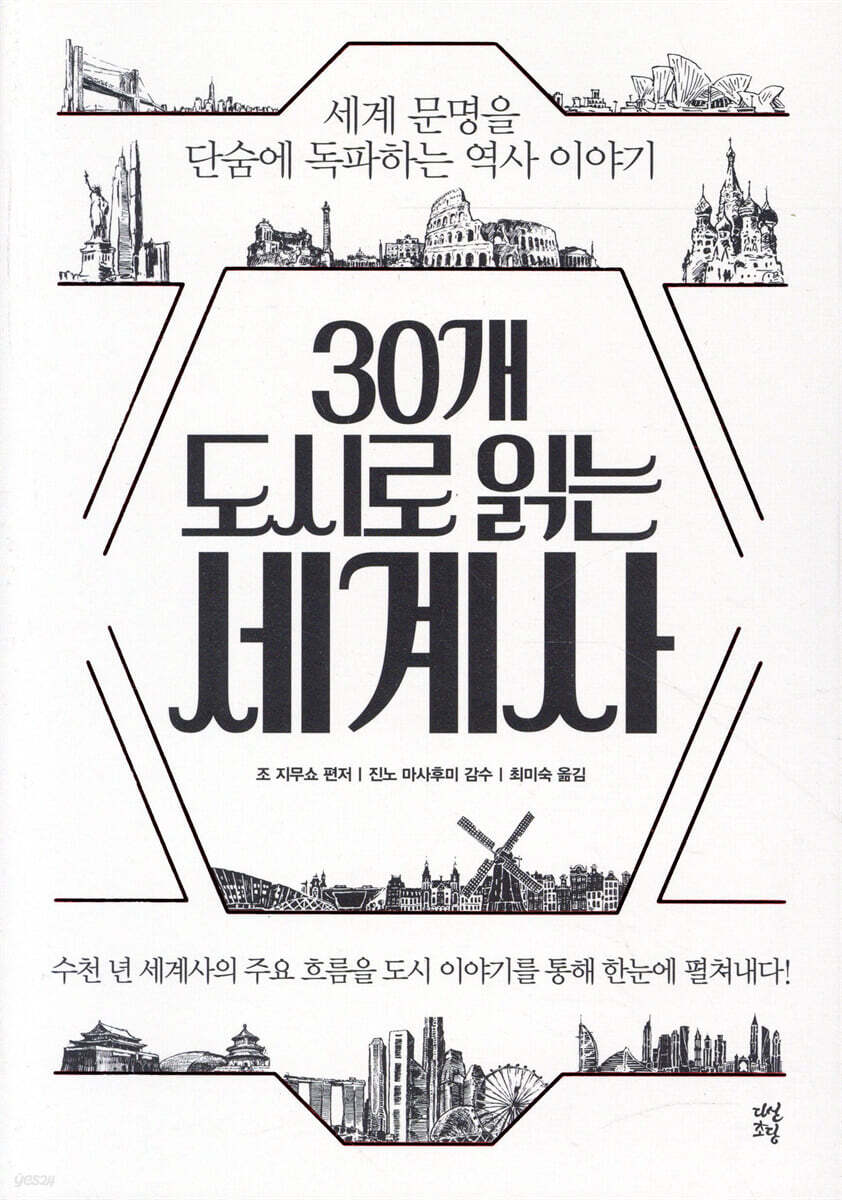
World History in 30 Cities
 |
Description
Book Introduction
The main flow of world history over thousands of years
Unfolding the city story at a glance!
It simply and clearly explains the vast world history from BC to the 20th century through the histories of 30 cities.
As the saying goes, 'Cities are works of history,' world history has been formed around urban civilization.
Therefore, examining the history of the world's major cities to reach their current state is an effective way to understand the overall context of world history.
This book covers a wide range of cities that are essential to understanding world history, including Rome, Athens, and Paris, which influenced world civilization, as well as Chang'an, Angkor, and Kyoto. Experts from each city have carefully selected and reviewed the essential knowledge that must be known.
This will be an appropriate guide for anyone who is beginning to study world history, re-studying it, or wanting to build their knowledge from the ground up, or preparing for exams.
Additionally, you will be able to experience the new fun of seeing a city you thought you knew well in a completely different way than before.
Unfolding the city story at a glance!
It simply and clearly explains the vast world history from BC to the 20th century through the histories of 30 cities.
As the saying goes, 'Cities are works of history,' world history has been formed around urban civilization.
Therefore, examining the history of the world's major cities to reach their current state is an effective way to understand the overall context of world history.
This book covers a wide range of cities that are essential to understanding world history, including Rome, Athens, and Paris, which influenced world civilization, as well as Chang'an, Angkor, and Kyoto. Experts from each city have carefully selected and reviewed the essential knowledge that must be known.
This will be an appropriate guide for anyone who is beginning to study world history, re-studying it, or wanting to build their knowledge from the ground up, or preparing for exams.
Additionally, you will be able to experience the new fun of seeing a city you thought you knew well in a completely different way than before.
- You can preview some of the book's contents.
Preview
index
Introduction
30-city world map
01 Babylon: An ancient strategic site whose name was mentioned in the Bible
―Uruk
02 Jerusalem: A Holy Land with a History of Suffering
03 Athens: A city of culture and learning that fostered democracy
04 Alexandria: The Academic City Where Hellenistic Culture Was Born
05 Teotihuacan: The 'City of the Gods', an Eternal Mystery
06 Rome: The Eternal City, Reborn Again and Again
―Vatican
07 Constantinople: A strategic point where Europe and Asia meet
08 Chang'an: A synonym for the capital where numerous dynasties rose and fell.
09 Baghdad: The "City of Peace" that Established the Golden Age of the Islamic Empire
10 Kyoto: The 'Millennium Capital' at the Heart of Japan
11 Samarkand: A key point on the Silk Road connecting the East and the West
12 Angkor: A jungle city with magnificent and beautiful temples
13 Tunis: A Mediterranean crossroads with 3,000 years of history
14 Beijing: The Capital of China Transformed from a Provincial City into the Center of China
15 Malacca: An old port city where world heritage and everyday life coexist
16 Moscow: The 'Third Rome' Built in the Great Forest
17 Isfahan: The altitude of the plateau called 'half the world'
18 Venice: The 'City of Water' that dominated the Mediterranean through trade
19 Delhi: A city with a thousand faces, a multicultural melting pot
―Mumbai
20 St. Petersburg: Peter the Great's "Window to Europe"
21 Paris: The Origin of French Culture that Spread to the World
22 Amsterdam: A trading city founded by Protestant merchants
23 London: The city that became the 'center of the world' in the 19th century
24 New York: A megacity symbolizing the superpower of the United States
―Washington, DC
25 Vienna: The 'City of Music' Built by the Habsburgs
-Prague
26 Rio de Janeiro: A new town built on a tropical harbor
―São Paulo
27 Sydney: A port city built on a rias coast
28 Singapore: A city-state that has established itself as Asia's wealthiest nation
29 Shanghai: A rapidly growing port city, raising the banner of economic development.
-Hong Kong
30 Dubai: A near-future city in the desert
Sources and map references
30-city world map
01 Babylon: An ancient strategic site whose name was mentioned in the Bible
―Uruk
02 Jerusalem: A Holy Land with a History of Suffering
03 Athens: A city of culture and learning that fostered democracy
04 Alexandria: The Academic City Where Hellenistic Culture Was Born
05 Teotihuacan: The 'City of the Gods', an Eternal Mystery
06 Rome: The Eternal City, Reborn Again and Again
―Vatican
07 Constantinople: A strategic point where Europe and Asia meet
08 Chang'an: A synonym for the capital where numerous dynasties rose and fell.
09 Baghdad: The "City of Peace" that Established the Golden Age of the Islamic Empire
10 Kyoto: The 'Millennium Capital' at the Heart of Japan
11 Samarkand: A key point on the Silk Road connecting the East and the West
12 Angkor: A jungle city with magnificent and beautiful temples
13 Tunis: A Mediterranean crossroads with 3,000 years of history
14 Beijing: The Capital of China Transformed from a Provincial City into the Center of China
15 Malacca: An old port city where world heritage and everyday life coexist
16 Moscow: The 'Third Rome' Built in the Great Forest
17 Isfahan: The altitude of the plateau called 'half the world'
18 Venice: The 'City of Water' that dominated the Mediterranean through trade
19 Delhi: A city with a thousand faces, a multicultural melting pot
―Mumbai
20 St. Petersburg: Peter the Great's "Window to Europe"
21 Paris: The Origin of French Culture that Spread to the World
22 Amsterdam: A trading city founded by Protestant merchants
23 London: The city that became the 'center of the world' in the 19th century
24 New York: A megacity symbolizing the superpower of the United States
―Washington, DC
25 Vienna: The 'City of Music' Built by the Habsburgs
-Prague
26 Rio de Janeiro: A new town built on a tropical harbor
―São Paulo
27 Sydney: A port city built on a rias coast
28 Singapore: A city-state that has established itself as Asia's wealthiest nation
29 Shanghai: A rapidly growing port city, raising the banner of economic development.
-Hong Kong
30 Dubai: A near-future city in the desert
Sources and map references
Detailed image
Into the book
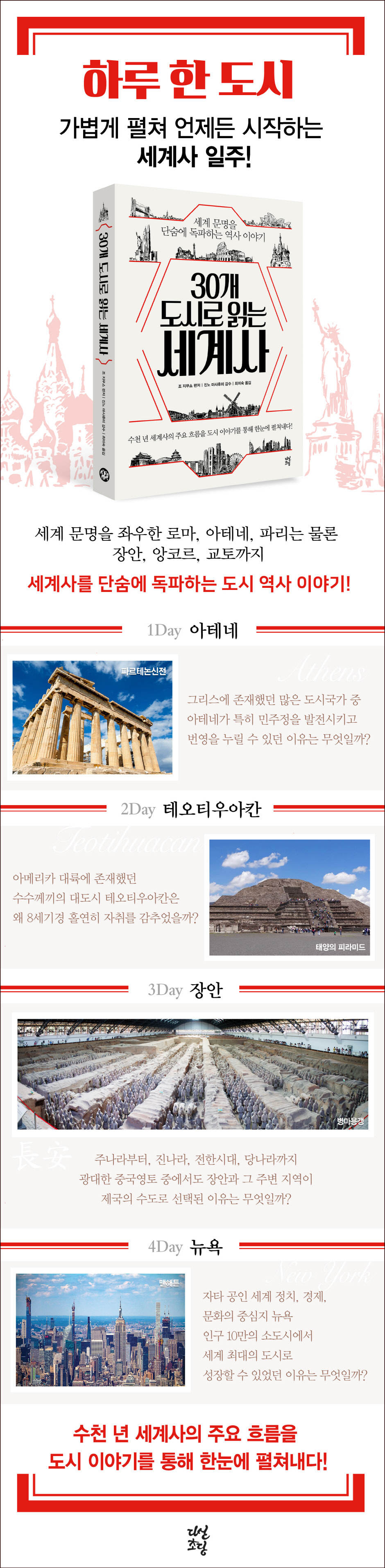
Many people have probably heard of the legend of the Tower of Babel in the Old Testament.
According to the legend, the king of the ancient city of Babel (Babylon), which was very prosperous at the time, tried to build a huge tower that would reach the sky.
In fact, the stone tower of the Babylonian temple, built in the 6th century BC, is estimated to have been an enormous 90 meters tall.
What existed thousands of years ago on the Mesopotamian plains, now a barren desert?
--- p.13, from “Babylon: An Ancient Fortress Named in the Bible”
Athens, which perfected ancient democracy during the ancient Greek era.
Here, great figures who left their mark on world history, such as Socrates and Aristotle, interacted with each other, developing academic disciplines such as philosophy, literature, and architecture, and fostering diverse cultures.
Among the many city-states that existed in Greece, why was Athens able to develop democracy and enjoy great prosperity?
--- p.37, from “Athens: A city of culture and learning that brought democracy to fruition”
Chang'an, now Xi'an in Shaanxi Province, has long served as the capital of numerous Chinese dynasties since the Western Han Dynasty.
Chang'an, organized under a meticulous urban plan, was the greatest metropolis of its time and the object of envy among East Asian countries.
The Chang'an area, where the capitals of the Zhou and Jin dynasties were located, contains the entire history of China up to the fall of the Tang Dynasty.
Why were Chang'an and its surrounding areas repeatedly chosen as the capital among the vast territory of China?
--- p.95, from “Chang’an: A synonym for the capital where numerous dynasties rose and fell”
In the center of the Eurasian continent, many cities developed around large and small oases, and these cities prospered as transit points on the Silk Road trade network.
One of them, Samarkand, had deep relationships with several great powers, including the Tang Dynasty of mainland China and the Abbasid Dynasty of Islam.
During the Timurid dynasty of the 15th century, it ruled over a vast territory stretching from northern India to Türkiye, and Samarkand was the center of Islamic culture at the time.
--- p.129, from “Samarkand: A Key Point on the Silk Road Connecting the East and the West”
Many cities have changed hands several times, but Tunisia, a strategic location in the Mediterranean, has seen a particularly large number of powers intertwined and at odds with each other.
Carthage, a city-state near eastern Tunis, was ruled by various ethnic groups and in modern times was incorporated into the French sphere of influence.
Tunis, where you can see various relics and buildings from each era, boasts its presence as a representative international city on the African continent.
--- p.147, from “Tunis: The Mediterranean Crossroads with 3,000 Years of History”
Russia is sometimes considered a continent rather than a single country.
Moscow, the capital of Russia, has been the center of Eastern Orthodox culture since the 16th century.
In the 18th century, it gave up its position as the capital, but after the revolution in the 20th century, it gained a new position as the 'center of world socialism' along with its status as the capital.
Although often considered the frontier of Europe, the city is actually a cosmopolitan city with a very colorful history.
--- p.179, from “Moscow: The ‘Third Rome’ Built in the Great Forest”
Venice is a representative tourist city of Italy.
In the past, Venice developed through trade and became a city-state that dominated the area by controlling the then metropolis of Constantinople.
How did Venice overcome its limited land area and achieve hegemony in the Mediterranean?
--- p.179, from “Venice: The ‘City of Water’ that Conquered the Mediterranean through Trade”
Although the Kingdom of France was established in the 9th century, Paris did not remain its capital forever.
French kings of the 16th and 17th centuries moved around their territory, and the Bourbon dynasty, which lasted until the late 18th century, reached its peak when Versailles became the center of politics.
Although a liberal culture developed among the citizens during this time, the beautiful image of Paris did not take hold until the 19th century, a century rife with revolution and war.
--- p.237, from “Paris: The Origin of French Culture Spread to the World”
Rio de Janeiro's Carnival, which brings to mind people dancing passionately to the rhythm of samba, is a popular festival that symbolizes Brazil.
Rio de Janeiro, a city of diverse races and classes, has given birth to several unique cultures, including samba.
Established in the 16th century, the city developed as an export port for gold, silver, and coffee produced in South America.
However, in the early 19th century, it also had a dramatic fate of becoming the capital of Portugal, its suzerain state.
--- p.305, from “Rio de Janeiro: A New Town Built in a Tropical Harbor”
Dubai has established special economic zones to attract foreign investment and is attracting tourists from all over the world with its luxurious resorts.
In just a few decades, the city has rapidly transformed into a cutting-edge design metropolis filled with skyscrapers.
Most Middle Eastern countries, which have a lot of desert, depend on the oil industry.
But why did Dubai pursue reforms that would remove its reliance on oil resources?
According to the legend, the king of the ancient city of Babel (Babylon), which was very prosperous at the time, tried to build a huge tower that would reach the sky.
In fact, the stone tower of the Babylonian temple, built in the 6th century BC, is estimated to have been an enormous 90 meters tall.
What existed thousands of years ago on the Mesopotamian plains, now a barren desert?
--- p.13, from “Babylon: An Ancient Fortress Named in the Bible”
Athens, which perfected ancient democracy during the ancient Greek era.
Here, great figures who left their mark on world history, such as Socrates and Aristotle, interacted with each other, developing academic disciplines such as philosophy, literature, and architecture, and fostering diverse cultures.
Among the many city-states that existed in Greece, why was Athens able to develop democracy and enjoy great prosperity?
--- p.37, from “Athens: A city of culture and learning that brought democracy to fruition”
Chang'an, now Xi'an in Shaanxi Province, has long served as the capital of numerous Chinese dynasties since the Western Han Dynasty.
Chang'an, organized under a meticulous urban plan, was the greatest metropolis of its time and the object of envy among East Asian countries.
The Chang'an area, where the capitals of the Zhou and Jin dynasties were located, contains the entire history of China up to the fall of the Tang Dynasty.
Why were Chang'an and its surrounding areas repeatedly chosen as the capital among the vast territory of China?
--- p.95, from “Chang’an: A synonym for the capital where numerous dynasties rose and fell”
In the center of the Eurasian continent, many cities developed around large and small oases, and these cities prospered as transit points on the Silk Road trade network.
One of them, Samarkand, had deep relationships with several great powers, including the Tang Dynasty of mainland China and the Abbasid Dynasty of Islam.
During the Timurid dynasty of the 15th century, it ruled over a vast territory stretching from northern India to Türkiye, and Samarkand was the center of Islamic culture at the time.
--- p.129, from “Samarkand: A Key Point on the Silk Road Connecting the East and the West”
Many cities have changed hands several times, but Tunisia, a strategic location in the Mediterranean, has seen a particularly large number of powers intertwined and at odds with each other.
Carthage, a city-state near eastern Tunis, was ruled by various ethnic groups and in modern times was incorporated into the French sphere of influence.
Tunis, where you can see various relics and buildings from each era, boasts its presence as a representative international city on the African continent.
--- p.147, from “Tunis: The Mediterranean Crossroads with 3,000 Years of History”
Russia is sometimes considered a continent rather than a single country.
Moscow, the capital of Russia, has been the center of Eastern Orthodox culture since the 16th century.
In the 18th century, it gave up its position as the capital, but after the revolution in the 20th century, it gained a new position as the 'center of world socialism' along with its status as the capital.
Although often considered the frontier of Europe, the city is actually a cosmopolitan city with a very colorful history.
--- p.179, from “Moscow: The ‘Third Rome’ Built in the Great Forest”
Venice is a representative tourist city of Italy.
In the past, Venice developed through trade and became a city-state that dominated the area by controlling the then metropolis of Constantinople.
How did Venice overcome its limited land area and achieve hegemony in the Mediterranean?
--- p.179, from “Venice: The ‘City of Water’ that Conquered the Mediterranean through Trade”
Although the Kingdom of France was established in the 9th century, Paris did not remain its capital forever.
French kings of the 16th and 17th centuries moved around their territory, and the Bourbon dynasty, which lasted until the late 18th century, reached its peak when Versailles became the center of politics.
Although a liberal culture developed among the citizens during this time, the beautiful image of Paris did not take hold until the 19th century, a century rife with revolution and war.
--- p.237, from “Paris: The Origin of French Culture Spread to the World”
Rio de Janeiro's Carnival, which brings to mind people dancing passionately to the rhythm of samba, is a popular festival that symbolizes Brazil.
Rio de Janeiro, a city of diverse races and classes, has given birth to several unique cultures, including samba.
Established in the 16th century, the city developed as an export port for gold, silver, and coffee produced in South America.
However, in the early 19th century, it also had a dramatic fate of becoming the capital of Portugal, its suzerain state.
--- p.305, from “Rio de Janeiro: A New Town Built in a Tropical Harbor”
Dubai has established special economic zones to attract foreign investment and is attracting tourists from all over the world with its luxurious resorts.
In just a few decades, the city has rapidly transformed into a cutting-edge design metropolis filled with skyscrapers.
Most Middle Eastern countries, which have a lot of desert, depend on the oil industry.
But why did Dubai pursue reforms that would remove its reliance on oil resources?
--- p.341, from “Dubai: A Near-Future City in the Desert”
Publisher's Review
Let's start studying world history from the starting point of 'The History of World Cities'!
"World History in 30 Cities" begins the study of world history from the familiar and interesting starting point of "the history of the world's major cities."
Breaking away from the stereotype that history studies must be uniformly memorized from prehistoric times to the present, the study simply and clearly explains the major trends of world history, focusing on the history of the 'city', the space in which we live now.
The 30 articles covering 30 cities were carefully selected and reviewed by experts from each city, providing essential historical knowledge to understand the overall context of world history, in an optimal length that can be easily read, memorized, and studied at any time.
As you complete your historical journey, without the burden of a city a day, you will soon see at a glance the entire flow of world history, which once seemed difficult and complex.
A city history story that sweeps across the vast world of civilization in one breath.
This book begins with the part that interests each person and guides you to experience the fun of history through 'experiential' rather than 'memorization.'
'What kind of history did that city, whose name is so familiar, go through to reach its current state?'
'What kind of history will be engraved in the city I've already visited and the city I'll visit next?'
'Why and how was that famous cultural heritage built?'
First, open the book and start reading about the city you are interested in.
You can read all of the interesting cities in continents like Europe and Asia in one go.
From the rise and fall of various powers in a single city, to the actions of key figures, the background of the establishment of famous cultural heritage sites, and even key archaeological knowledge.
You will experience the intellectual pleasure of traversing thousands of years of urban civilization in one breath as historical knowledge unfolds before your eyes, briskly organized with abundant illustrations.
Study world history at any time by lightly unfolding one city a day!
"World History in 30 Cities" covers a wide range of cities essential to understanding world history, including Rome, Athens, Paris, Beijing, Teotihuacan, Isfahan, and Samarkand.
World civilization has developed primarily around cities since ancient times.
Cities have always been the central stage of history.
Cities, centers of politics, economics, art, and academia, are essential spaces for understanding world history.
This book presents the most efficient way to study history for busy modern people by organizing the vast world history in the easiest, simplest, and clearest way, focusing on the effective topic of 'cities.'
If you want a history textbook that is easy and fun to read, rather than a thick, difficult, one-sided book that requires memorization, I recommend starting with this book.
By the time you complete your daily city history tour, you'll have gained a sense of accomplishment from having explored the city's historical background, and you'll have become a person who is well-versed in the basics of world history.
Additionally, you will be able to experience a new kind of fun as the city you thought you were familiar with appears completely different from before.
"World History in 30 Cities" begins the study of world history from the familiar and interesting starting point of "the history of the world's major cities."
Breaking away from the stereotype that history studies must be uniformly memorized from prehistoric times to the present, the study simply and clearly explains the major trends of world history, focusing on the history of the 'city', the space in which we live now.
The 30 articles covering 30 cities were carefully selected and reviewed by experts from each city, providing essential historical knowledge to understand the overall context of world history, in an optimal length that can be easily read, memorized, and studied at any time.
As you complete your historical journey, without the burden of a city a day, you will soon see at a glance the entire flow of world history, which once seemed difficult and complex.
A city history story that sweeps across the vast world of civilization in one breath.
This book begins with the part that interests each person and guides you to experience the fun of history through 'experiential' rather than 'memorization.'
'What kind of history did that city, whose name is so familiar, go through to reach its current state?'
'What kind of history will be engraved in the city I've already visited and the city I'll visit next?'
'Why and how was that famous cultural heritage built?'
First, open the book and start reading about the city you are interested in.
You can read all of the interesting cities in continents like Europe and Asia in one go.
From the rise and fall of various powers in a single city, to the actions of key figures, the background of the establishment of famous cultural heritage sites, and even key archaeological knowledge.
You will experience the intellectual pleasure of traversing thousands of years of urban civilization in one breath as historical knowledge unfolds before your eyes, briskly organized with abundant illustrations.
Study world history at any time by lightly unfolding one city a day!
"World History in 30 Cities" covers a wide range of cities essential to understanding world history, including Rome, Athens, Paris, Beijing, Teotihuacan, Isfahan, and Samarkand.
World civilization has developed primarily around cities since ancient times.
Cities have always been the central stage of history.
Cities, centers of politics, economics, art, and academia, are essential spaces for understanding world history.
This book presents the most efficient way to study history for busy modern people by organizing the vast world history in the easiest, simplest, and clearest way, focusing on the effective topic of 'cities.'
If you want a history textbook that is easy and fun to read, rather than a thick, difficult, one-sided book that requires memorization, I recommend starting with this book.
By the time you complete your daily city history tour, you'll have gained a sense of accomplishment from having explored the city's historical background, and you'll have become a person who is well-versed in the basics of world history.
Additionally, you will be able to experience a new kind of fun as the city you thought you were familiar with appears completely different from before.
GOODS SPECIFICS
- Date of issue: July 6, 2020
- Page count, weight, size: 360 pages | 600g | 148*210*30mm
- ISBN13: 9791130630366
- ISBN10: 1130630366
You may also like
카테고리
korean


korean

![GQ KOREA Mark (Monthly): December [2025]](http://librairie.coreenne.fr/cdn/shop/files/8ef265dbbfbf186523ed75ba7319009d.jpg?v=1765340328&width=3840)


