

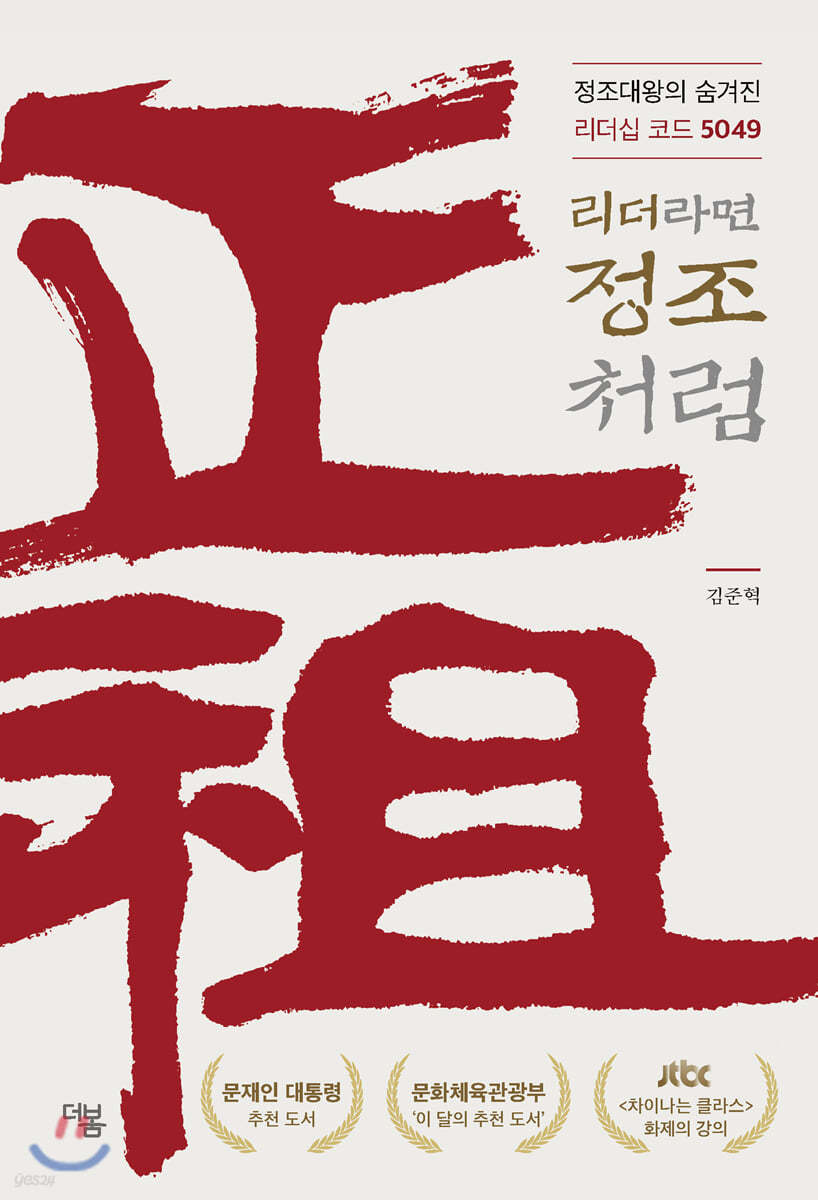
If you are a leader, be like Jeongjo
 |
Description
Book Introduction
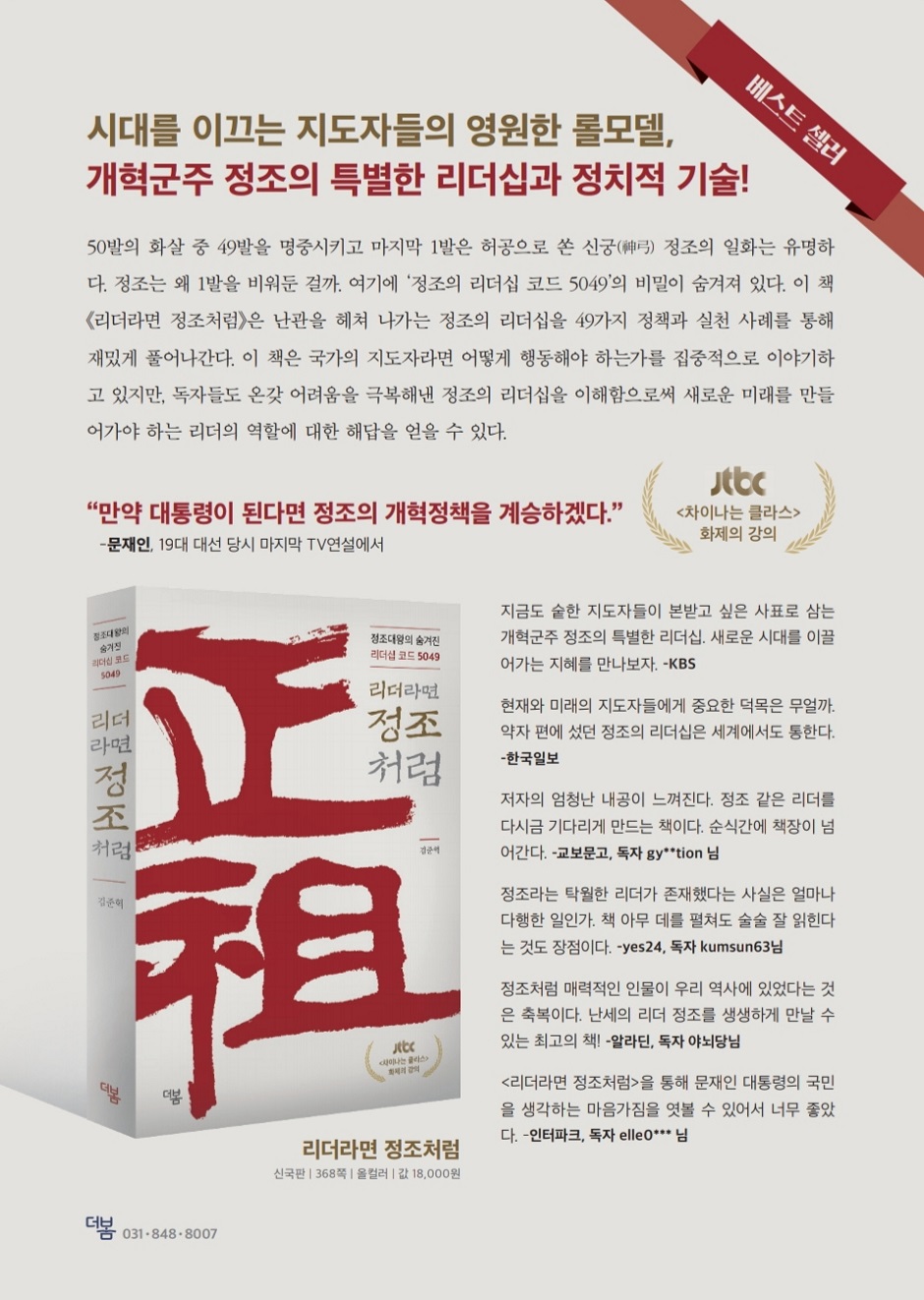
Books recommended by President Moon Jae-in! Ministry of Culture, Sports and Tourism's 'Recommended Book of the Month' The eternal role model of leaders who lead the times, The special leadership and political skills of the reformist monarch Jeongjo! King Jeongjo, who is considered the greatest reformist monarch in our history, was a divine archer. When he shot his bow, he hit the target 49 times out of 50 times. However, the last shot would not hit the target but would fly into the air. He could have hit all 50 shots, but to be humble, he didn't fire the last one. Herein lies the deep meaning of King Jeongjo, who was well-versed in the Book of Changes. When fortune telling, 50 mountain branches called Sicho (蓍草) are usually used, but one of them symbolizes the Supreme Ultimate, so it is not used and only 49 mountain branches are used to draw the fortune telling. And through that fortune telling, we discover the hidden meaning of the world's principles and changes. King Jeongjo took inspiration from this and considered a single arrow to be the king's mountain branch, so he did not use it at all. The secret of 'Jeongjo's Leadership Code 5049' is hidden right here. "If You're a Leader, Be Like Jeongjo" tells the story of Jeongjo's leadership through 49 examples of policies and practices. How could his leadership and deeds for his people be limited to only 49? Of course, he was human, so he sometimes made mistakes and used harsh language. On the one hand, he was called a seasoned politician, and on the other hand, he was called a conservative monarch. Nevertheless, it is not easy to find a person as worthy as Jeongjo in our history. So, I urge leaders dedicated to reforming this land to read this book. “If I become president, I will continue King Jeongjo’s reform policies.” - Moon Jae-in, in his last TV speech during the 19th presidential election |
- You can preview some of the book's contents.
Preview
index
Prologue 05
Chapter 1 | The Studying Monarch
01 Expand your knowledge through extensive reading 15
02 Study continuously to attain the status of a military master 22
03 Train your body through martial arts training 28
04 Practicing Frugality 35
Chapter 2 | Reading the Changing Times
05 Clarifying the Ideology of National Reform 45
06 Opening an Era of Harmony, Setting Aside from Personal Feelings 52
Strengthening Social Welfare through the 07 Enactment 58
08 Reforming the Economy by Abolishing the Gold Pledge 63
09 Thoroughly distinguish between public and private matters 71
10 Laying the Foundation for a Democratic System 78
11. Promoting a tree-planting policy with a long-term perspective 82
12 Creating a New Code for the People 89
Chapter 3 | Ushering in a New Era through Talent Acquisition
13. Recruiting Talent Beyond Social Status 97
14 Selecting a Key Figure for Political Coordination 104
15. Appointing key personnel to take charge of reforms 111
16 Nurturing young talent to lead the future 118
17. Laying the foundation for nurturing talent through the establishment of Gyujanggak and the appointment of Chogye Munsin. 124
18 Listen carefully to the opinions of rural scholars 131
19 Eliminating regional discrimination and fostering talent 137
Chapter 4 | The Strong Monarch
20 Controlling Anger Through Constant Cultivation and Reflection 147
21. Disregard relatives and promote wise talents. 153
22 Clearly State Your Intentions with Nine Mottos 160
23 Showing generosity and humor 164
24 Prepare thoroughly to secure authenticity 171
25 Boldly eradicate the forces resisting reform 177
26 Leading Military Training 182
27 The King's Procession with the People 190
28 Actively Responding to Natural Disasters 198
29. Strongly opposing the entrenched powers of vested interests. 203
Chapter 5 | Showing the Human Side
30 Practicing True Filial Piety 213
31 Protecting Those Who Follow Him to the End 222
32 Do Your Best for the Woman You Love 230
33. Dealing firmly with the mistakes of close associates 237
34 Establishing a position as the successor to the previous kings 245
35. Exchanging Secret Letters for True Communication 252
Chapter 6 | Pursuing a Politics of Inclusion
36. The King and His Subjects' Accompaniment Ceremony at Changdeokgung Palace 263
37 Laying the Foundation for Economic Development by Building Innovation Cities 270
38 Raising Awareness of Independence through the Northern Expedition 275
39 Respect and Care for the People 282
40 Revealing the Legitimacy of Scholarship by Emphasizing Confucius 290
41 Respect for Professionals 296
42 When something important comes up, I don't even touch half a glass of alcohol. 300
Chapter 7 | Opening the Joseon Dynasty's Jinkyung Culture Era
43 Revitalizing Literature by Activating Type Casting 309
44 Creative Thinking and Using Advanced Machinery 316
45 Opening a Feast for Hyegyeonggung Palace with Joseon Music 322
46 Activating Hunminjeongeum 329
47 Strengthening National Defense by Developing Martial Arts 334
48 Recognizing Cultural Diversity 341
49 Opening a New Cultural Era with Jinkyung Culture 350
Epilogue 357
References 360
Chapter 1 | The Studying Monarch
01 Expand your knowledge through extensive reading 15
02 Study continuously to attain the status of a military master 22
03 Train your body through martial arts training 28
04 Practicing Frugality 35
Chapter 2 | Reading the Changing Times
05 Clarifying the Ideology of National Reform 45
06 Opening an Era of Harmony, Setting Aside from Personal Feelings 52
Strengthening Social Welfare through the 07 Enactment 58
08 Reforming the Economy by Abolishing the Gold Pledge 63
09 Thoroughly distinguish between public and private matters 71
10 Laying the Foundation for a Democratic System 78
11. Promoting a tree-planting policy with a long-term perspective 82
12 Creating a New Code for the People 89
Chapter 3 | Ushering in a New Era through Talent Acquisition
13. Recruiting Talent Beyond Social Status 97
14 Selecting a Key Figure for Political Coordination 104
15. Appointing key personnel to take charge of reforms 111
16 Nurturing young talent to lead the future 118
17. Laying the foundation for nurturing talent through the establishment of Gyujanggak and the appointment of Chogye Munsin. 124
18 Listen carefully to the opinions of rural scholars 131
19 Eliminating regional discrimination and fostering talent 137
Chapter 4 | The Strong Monarch
20 Controlling Anger Through Constant Cultivation and Reflection 147
21. Disregard relatives and promote wise talents. 153
22 Clearly State Your Intentions with Nine Mottos 160
23 Showing generosity and humor 164
24 Prepare thoroughly to secure authenticity 171
25 Boldly eradicate the forces resisting reform 177
26 Leading Military Training 182
27 The King's Procession with the People 190
28 Actively Responding to Natural Disasters 198
29. Strongly opposing the entrenched powers of vested interests. 203
Chapter 5 | Showing the Human Side
30 Practicing True Filial Piety 213
31 Protecting Those Who Follow Him to the End 222
32 Do Your Best for the Woman You Love 230
33. Dealing firmly with the mistakes of close associates 237
34 Establishing a position as the successor to the previous kings 245
35. Exchanging Secret Letters for True Communication 252
Chapter 6 | Pursuing a Politics of Inclusion
36. The King and His Subjects' Accompaniment Ceremony at Changdeokgung Palace 263
37 Laying the Foundation for Economic Development by Building Innovation Cities 270
38 Raising Awareness of Independence through the Northern Expedition 275
39 Respect and Care for the People 282
40 Revealing the Legitimacy of Scholarship by Emphasizing Confucius 290
41 Respect for Professionals 296
42 When something important comes up, I don't even touch half a glass of alcohol. 300
Chapter 7 | Opening the Joseon Dynasty's Jinkyung Culture Era
43 Revitalizing Literature by Activating Type Casting 309
44 Creative Thinking and Using Advanced Machinery 316
45 Opening a Feast for Hyegyeonggung Palace with Joseon Music 322
46 Activating Hunminjeongeum 329
47 Strengthening National Defense by Developing Martial Arts 334
48 Recognizing Cultural Diversity 341
49 Opening a New Cultural Era with Jinkyung Culture 350
Epilogue 357
References 360
Detailed image
Into the book
"Don't demand perfection in your work, and don't expect everything you say." Often, those who work with leaders aren't able to perform perfectly, as expected.
However, that does not mean that we should criticize them and say things like, "They did not do a good job."
Because a leader must not reveal his emotions.
--- p.152
In conclusion, the meaning of Jeongjo's secret message is communication.
The idea was for the king to show his sincerity through communication with his subjects and to use this to carry out politics for the people.
Moreover, Jeongjo was far superior to his subjects in both academics and martial arts, and possessed leadership as a strong leader.
As seen in Jeong Yak-yong's records, when King Jeongjo raised his voice and scolded his subjects in front of the king, everyone trembled in fear.
Although King Jeongjo possessed great power, he believed that communication between the king, his subjects, officials, and the people was more important.
This is why King Jeongjo's appearance feels new and more magnificent through his secret royal edict.
--- p.258
“When the people are hungry, I am hungry too, and when the people are full, I am full too.
Moreover, what can be said about providing relief and care in the event of a famine, a task that must be done with such urgency that it seems as if it cannot be accomplished?
“This is a matter of life and death for the people, and there can be no interruption, not even for a moment.”
--- p.283
Jeongjo always viewed the people as water and the king as a boat.
Even in conversations with the members of Gyujanggak, his own think tank, the king himself was wary, always talking about the relationship between the king and the people.
Jeongjo, in conjunction with the military and civil administration, presented his own unique philosophy and adopted it as his pen name in 1798, 22 years after he became king.
That is the ‘Master of the Ten Thousand Bright Moon’.
--- p.357
Regardless of time and place, it is common for the privileged class to keep only themselves literate and the common people ignorant.
But Jeongjo didn't do that.
He was convinced that a country could develop only when its people became smarter.
At that time, actively promoting Hunminjeongeum to increase the knowledge of the people was no different from providing the people with up-to-date information today to enable them to make the right choices.
As the people's knowledge and information increased, civilization developed naturally.
However, that does not mean that we should criticize them and say things like, "They did not do a good job."
Because a leader must not reveal his emotions.
--- p.152
In conclusion, the meaning of Jeongjo's secret message is communication.
The idea was for the king to show his sincerity through communication with his subjects and to use this to carry out politics for the people.
Moreover, Jeongjo was far superior to his subjects in both academics and martial arts, and possessed leadership as a strong leader.
As seen in Jeong Yak-yong's records, when King Jeongjo raised his voice and scolded his subjects in front of the king, everyone trembled in fear.
Although King Jeongjo possessed great power, he believed that communication between the king, his subjects, officials, and the people was more important.
This is why King Jeongjo's appearance feels new and more magnificent through his secret royal edict.
--- p.258
“When the people are hungry, I am hungry too, and when the people are full, I am full too.
Moreover, what can be said about providing relief and care in the event of a famine, a task that must be done with such urgency that it seems as if it cannot be accomplished?
“This is a matter of life and death for the people, and there can be no interruption, not even for a moment.”
--- p.283
Jeongjo always viewed the people as water and the king as a boat.
Even in conversations with the members of Gyujanggak, his own think tank, the king himself was wary, always talking about the relationship between the king and the people.
Jeongjo, in conjunction with the military and civil administration, presented his own unique philosophy and adopted it as his pen name in 1798, 22 years after he became king.
That is the ‘Master of the Ten Thousand Bright Moon’.
--- p.357
Regardless of time and place, it is common for the privileged class to keep only themselves literate and the common people ignorant.
But Jeongjo didn't do that.
He was convinced that a country could develop only when its people became smarter.
At that time, actively promoting Hunminjeongeum to increase the knowledge of the people was no different from providing the people with up-to-date information today to enable them to make the right choices.
As the people's knowledge and information increased, civilization developed naturally.
--- p.333
Publisher's Review
The dramatic life and extraordinary leadership of King Jeongjo, the reformist monarch of the late Joseon Dynasty.
Today we live in an age of convergence.
We have entered an era where diverse cultures and ideas communicate and science and humanities meet to create a new culture.
From that perspective, the era of convergence that is about to arrive will truly be a wonderful world.
But on the other hand, our era is also an era where communication does not exist.
We live in a reality where communication is not possible due to discord between classes, regions, politics, and even between the North and South.
On one hand, it is called the era of convergence, while on the other hand, it is called the era of disconnection.
King Jeongjo, a reformist monarch of the late Joseon Dynasty, lived a life as a great monarch who transcended his tragic personal life and left his mark on history.
After the death of his father, Crown Prince Sado, he suffered from all kinds of plots by opposing forces and the risk of being deposed. Furthermore, even after becoming king, he faced numerous death crises, such as the 'Jeonhyeon-gak assassination attempt' (Jeongyu Incident) in 1777 (the first year of King Jeongjo's reign).
Nevertheless, the reason that Jeongjo led an era as a reformist monarch of his time and is still recognized as the greatest leader in our history is because of the special leadership and political skills that he possessed.
President Moon Jae-in, the current leader of South Korea, was also greatly influenced by Jeongjo.
In fact, in his final TV speech during the 19th presidential election, candidate Moon Jae-in declared that if he were to become president, he would inherit King Jeongjo's reform policies. It is no exaggeration to say that most of the policies being pursued by the Moon Jae-in administration are also inheritors of King Jeongjo's reform policies.
In particular, what he said at the ceremony to attach a flag made of string to the Samjeonggeom of 16 newly promoted lieutenant generals at the Blue House in early June is very similar to the reason why King Jeongjo did not hit the target with his last arrow.
“The Samjeonggeom is more powerful when it is sheathed than when it is drawn and wielded.”
Continuously train and discipline yourself to establish yourself as a military leader.
A monarch's private actions, no matter how trivial, can be considered public actions.
That is why Jeongjo was always cautious in his words and actions, and never lost his dignity.
King Jeongjo always emphasized to his officials, “Private matters to the public, and loss to the superior is of benefit to the inferior.”
He emphasized that although it starts from a private matter, it must necessarily lead to a public matter, and that even if the superiors receive less, more benefits should go to the subordinates.
There should not be people who take private advantage of public work, and there should not be people who try to monopolize the profits without distributing them equally to those who worked with them.
Jeongjo valued communication and ran the government together with his subjects, advocating for a system of ruler-subject co-governance.
As a king, he completely rejected personal interests and pursued only public interests, and while he was warmer than anyone else, he also displayed the dignity of treating the mistakes of his relatives and close associates with contempt.
In particular, as a monarch, he did not neglect his studies while handling a huge amount of state affairs, and he also diligently trained his body.
Moreover, in an era when Buddhism, Taoism, and Western learning were considered heretical and were unconditionally rejected, King Jeongjo firmly stated that Neo-Confucianism was not the only ideology that moved the world.
In a time when anyone who did not speak of Neo-Confucianism, especially Zhu Xi's Neo-Confucianism, was ostracized and killed as a traitor, the greatest Confucian scholar in Joseon history, who called himself a military teacher, acknowledged another ideology and religion.
Such a spirit of Jeongjo developed into a higher level of Silhak, and during the Jeongjo era, Joseon's culture developed to a world-class level.
He set out on the road to listen to the grievances of the people, use the medical knowledge he had studied to help the poor, and learn military strategy and martial arts to prevent foreign invasion and build a strong military force.
This leadership of example and communication inspired officials, the aristocracy, and the common people, creating the greatest era of Jin Gyeong culture in our history.
So, Jeongjo has always been an object of respect for us and a model for those who want to create a new era.
The secret of Jeongjo's leadership lies in the idea of valuing all the people!
The king is the boat, the people are the water! The king is the boat, and the people are the water.
In other words, the people support the king, but if the king does something wrong, the people can overthrow the king.
There are many kings in Eastern history who have accurately understood the profound meaning of this 'king-popularity', but the most representative figure among them is probably King Jeongjo, the 22nd king of Joseon.
Jeongjo always viewed the people as water and the king as a boat.
So, Jeongjo says this.
“The bright moon in the sky should not shine a little on some small rivers, nor should it shine more on some large rivers.” This means that the king should not bestow many favors on the powerful and wealthy, and less on the powerless and poor commoners, but should bestow them equally on everyone.
In 1798, 22 years after becoming king, Jeongjo began using the self-titled title ‘Mancheonmyeongwoljuinong (萬川明月主人翁)’.
He also knew exactly what ‘Mancheonmyeongwol’ meant.
“As the river flows, the moon also flows.
When the sky stops, the moon stops too.
When the sky is calm, the moon is calm.
However, when the sky swirls, the moon becomes distorted.” In other words, the bright moon in the sky flows with the water, and when the water is calm, it is also calm and peaceful, but when the sky encounters a valley or irregular terrain and swirls, the moon loses its original round shape and becomes angular or distorted, losing its true form.
This means that the boat will soon capsize due to strong waves.
In the end, the king's boat and the bright moon, the people's water and the ten thousand rivers are the same.
This is Jeongjo's thinking, and he lived his entire life with this thinking.
The joy of reading the popular lectures from Jtbc's 'China Class' in book form!
This book aims to present to readers the meaning of King Jeongjo's leadership code, '5049', by organizing his life and leadership as a national leader into 49 categories.
How could his leadership and deeds for his people be limited to only 49? Of course, he was human, so he sometimes made mistakes and used harsh language.
On the one hand, he was called a seasoned politician, and on the other hand, he was called a conservative monarch.
Nevertheless, it is not easy to find a figure comparable to Jeongjo in our history.
King Jeongjo's leadership is not just the leadership of a monarch that was common in the feudal dynasty era, but it is a leadership that can be applied to all areas of the Republic of Korea as it prepares for a unified Korea in the 21st century.
The author, Professor Kim Jun-hyeok, is widely known as a ‘chastity expert.’
In particular, last winter, the program 'China Class' on JTBC introduced the dramatic life of King Jeongjo, the great monarch of Joseon, in lectures titled 'Leadership from the Wiminjeong Monarch Jeongjo' and 'Charming Monarch Jeongjo, I Want to Know More About Him', which became a hot topic.
Meanwhile, this book is also the final installment of Professor Kim Jun-hyeok's trilogy of 'Jeongjo Series'.
Part 1 is titled “Hwaseong, a City of Great Harmony Where the Dreams of King Jeongjo and Dasan Come Together,” which contains the historical significance of the construction of Hwaseong Fortress, a symbol of King Jeongjo’s reforms. Part 2 is titled “Jangyongyeong: Joseon’s Strongest Army Created by King Jeongjo,” which reveals the creation and significance of Jangyongyeong, the core of King Jeongjo’s military reforms.
Now, through his last work, “If You Are a Leader, Be Like Jeongjo,” he is focusing on how a national leader should behave.
I hope that this book will help readers understand the leadership of King Jeongjo, who overcame all difficulties, and help them grow into leaders who can create a new future.
Today we live in an age of convergence.
We have entered an era where diverse cultures and ideas communicate and science and humanities meet to create a new culture.
From that perspective, the era of convergence that is about to arrive will truly be a wonderful world.
But on the other hand, our era is also an era where communication does not exist.
We live in a reality where communication is not possible due to discord between classes, regions, politics, and even between the North and South.
On one hand, it is called the era of convergence, while on the other hand, it is called the era of disconnection.
King Jeongjo, a reformist monarch of the late Joseon Dynasty, lived a life as a great monarch who transcended his tragic personal life and left his mark on history.
After the death of his father, Crown Prince Sado, he suffered from all kinds of plots by opposing forces and the risk of being deposed. Furthermore, even after becoming king, he faced numerous death crises, such as the 'Jeonhyeon-gak assassination attempt' (Jeongyu Incident) in 1777 (the first year of King Jeongjo's reign).
Nevertheless, the reason that Jeongjo led an era as a reformist monarch of his time and is still recognized as the greatest leader in our history is because of the special leadership and political skills that he possessed.
President Moon Jae-in, the current leader of South Korea, was also greatly influenced by Jeongjo.
In fact, in his final TV speech during the 19th presidential election, candidate Moon Jae-in declared that if he were to become president, he would inherit King Jeongjo's reform policies. It is no exaggeration to say that most of the policies being pursued by the Moon Jae-in administration are also inheritors of King Jeongjo's reform policies.
In particular, what he said at the ceremony to attach a flag made of string to the Samjeonggeom of 16 newly promoted lieutenant generals at the Blue House in early June is very similar to the reason why King Jeongjo did not hit the target with his last arrow.
“The Samjeonggeom is more powerful when it is sheathed than when it is drawn and wielded.”
Continuously train and discipline yourself to establish yourself as a military leader.
A monarch's private actions, no matter how trivial, can be considered public actions.
That is why Jeongjo was always cautious in his words and actions, and never lost his dignity.
King Jeongjo always emphasized to his officials, “Private matters to the public, and loss to the superior is of benefit to the inferior.”
He emphasized that although it starts from a private matter, it must necessarily lead to a public matter, and that even if the superiors receive less, more benefits should go to the subordinates.
There should not be people who take private advantage of public work, and there should not be people who try to monopolize the profits without distributing them equally to those who worked with them.
Jeongjo valued communication and ran the government together with his subjects, advocating for a system of ruler-subject co-governance.
As a king, he completely rejected personal interests and pursued only public interests, and while he was warmer than anyone else, he also displayed the dignity of treating the mistakes of his relatives and close associates with contempt.
In particular, as a monarch, he did not neglect his studies while handling a huge amount of state affairs, and he also diligently trained his body.
Moreover, in an era when Buddhism, Taoism, and Western learning were considered heretical and were unconditionally rejected, King Jeongjo firmly stated that Neo-Confucianism was not the only ideology that moved the world.
In a time when anyone who did not speak of Neo-Confucianism, especially Zhu Xi's Neo-Confucianism, was ostracized and killed as a traitor, the greatest Confucian scholar in Joseon history, who called himself a military teacher, acknowledged another ideology and religion.
Such a spirit of Jeongjo developed into a higher level of Silhak, and during the Jeongjo era, Joseon's culture developed to a world-class level.
He set out on the road to listen to the grievances of the people, use the medical knowledge he had studied to help the poor, and learn military strategy and martial arts to prevent foreign invasion and build a strong military force.
This leadership of example and communication inspired officials, the aristocracy, and the common people, creating the greatest era of Jin Gyeong culture in our history.
So, Jeongjo has always been an object of respect for us and a model for those who want to create a new era.
The secret of Jeongjo's leadership lies in the idea of valuing all the people!
The king is the boat, the people are the water! The king is the boat, and the people are the water.
In other words, the people support the king, but if the king does something wrong, the people can overthrow the king.
There are many kings in Eastern history who have accurately understood the profound meaning of this 'king-popularity', but the most representative figure among them is probably King Jeongjo, the 22nd king of Joseon.
Jeongjo always viewed the people as water and the king as a boat.
So, Jeongjo says this.
“The bright moon in the sky should not shine a little on some small rivers, nor should it shine more on some large rivers.” This means that the king should not bestow many favors on the powerful and wealthy, and less on the powerless and poor commoners, but should bestow them equally on everyone.
In 1798, 22 years after becoming king, Jeongjo began using the self-titled title ‘Mancheonmyeongwoljuinong (萬川明月主人翁)’.
He also knew exactly what ‘Mancheonmyeongwol’ meant.
“As the river flows, the moon also flows.
When the sky stops, the moon stops too.
When the sky is calm, the moon is calm.
However, when the sky swirls, the moon becomes distorted.” In other words, the bright moon in the sky flows with the water, and when the water is calm, it is also calm and peaceful, but when the sky encounters a valley or irregular terrain and swirls, the moon loses its original round shape and becomes angular or distorted, losing its true form.
This means that the boat will soon capsize due to strong waves.
In the end, the king's boat and the bright moon, the people's water and the ten thousand rivers are the same.
This is Jeongjo's thinking, and he lived his entire life with this thinking.
The joy of reading the popular lectures from Jtbc's 'China Class' in book form!
This book aims to present to readers the meaning of King Jeongjo's leadership code, '5049', by organizing his life and leadership as a national leader into 49 categories.
How could his leadership and deeds for his people be limited to only 49? Of course, he was human, so he sometimes made mistakes and used harsh language.
On the one hand, he was called a seasoned politician, and on the other hand, he was called a conservative monarch.
Nevertheless, it is not easy to find a figure comparable to Jeongjo in our history.
King Jeongjo's leadership is not just the leadership of a monarch that was common in the feudal dynasty era, but it is a leadership that can be applied to all areas of the Republic of Korea as it prepares for a unified Korea in the 21st century.
The author, Professor Kim Jun-hyeok, is widely known as a ‘chastity expert.’
In particular, last winter, the program 'China Class' on JTBC introduced the dramatic life of King Jeongjo, the great monarch of Joseon, in lectures titled 'Leadership from the Wiminjeong Monarch Jeongjo' and 'Charming Monarch Jeongjo, I Want to Know More About Him', which became a hot topic.
Meanwhile, this book is also the final installment of Professor Kim Jun-hyeok's trilogy of 'Jeongjo Series'.
Part 1 is titled “Hwaseong, a City of Great Harmony Where the Dreams of King Jeongjo and Dasan Come Together,” which contains the historical significance of the construction of Hwaseong Fortress, a symbol of King Jeongjo’s reforms. Part 2 is titled “Jangyongyeong: Joseon’s Strongest Army Created by King Jeongjo,” which reveals the creation and significance of Jangyongyeong, the core of King Jeongjo’s military reforms.
Now, through his last work, “If You Are a Leader, Be Like Jeongjo,” he is focusing on how a national leader should behave.
I hope that this book will help readers understand the leadership of King Jeongjo, who overcame all difficulties, and help them grow into leaders who can create a new future.
GOODS SPECIFICS
- Date of issue: June 20, 2020
- Page count, weight, size: 368 pages | 648g | 152*223*30mm
- ISBN13: 9791188522743
- ISBN10: 1188522744
You may also like
카테고리
korean


korean

![GQ KOREA Mark (Monthly): December [2025]](http://librairie.coreenne.fr/cdn/shop/files/8ef265dbbfbf186523ed75ba7319009d.jpg?v=1765340328&width=3840)


