

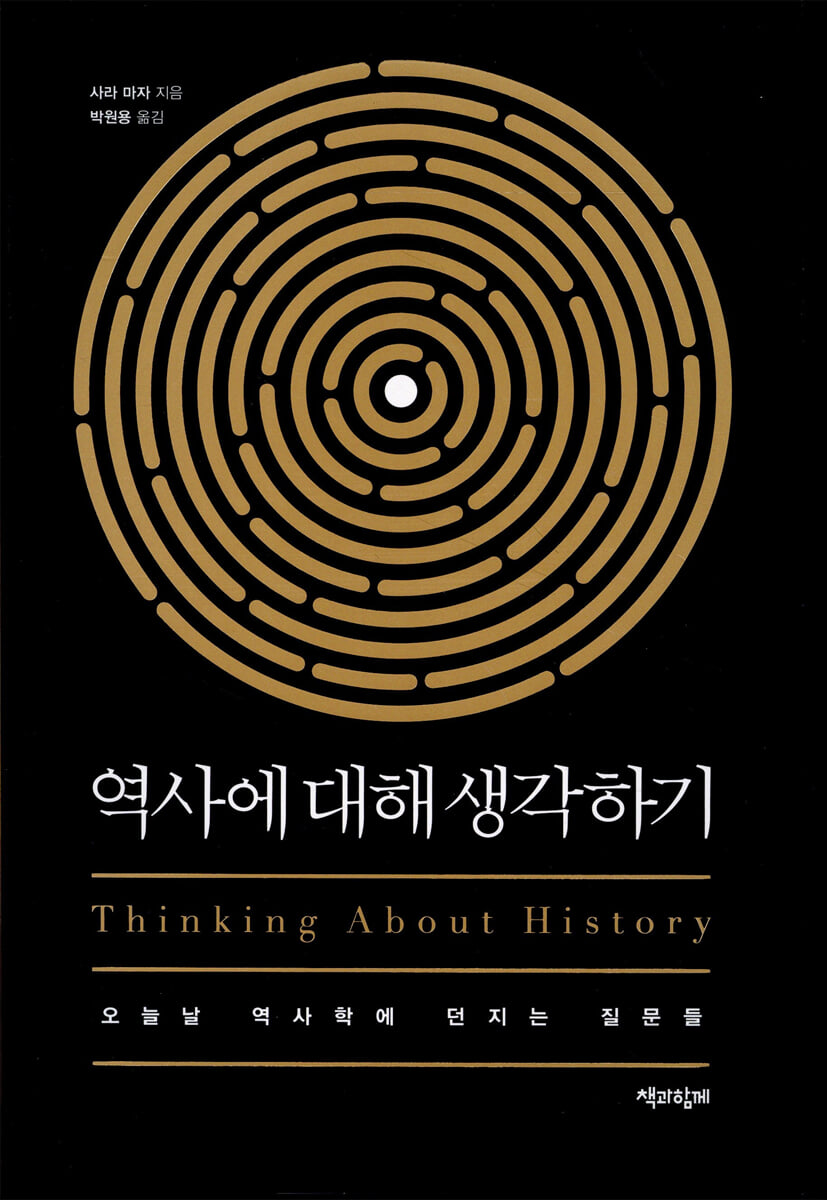
Thinking about history
 |
Description
Book Introduction
Today, the concept of history is constantly changing as perspectives on the past diversify.
Historians are constantly exploring new people, groups, places, and objects, reinterpreting the past, and there is active debate surrounding the essence of history.
The idea of a past that can be grasped completely and objectively is no longer valid, and the ethical value of 'history' now lies not in learning lessons from an immutable 'past' interpreted from a particular perspective, but in preventing the past from becoming a dead fossil by constantly questioning and debating it.
Based on this historical consciousness, "Thinking About History" shows how the concept of the past has dynamically changed in response to the questions and debates raised in historical studies over the past several decades.
To effectively demonstrate this, the book is structured around six questions that can help identify the major turning points in historiography, allowing readers to examine the major currents and contexts of historiography. It covers a wide range of topics, from traditional topics like military history and biography to more recent fields like global history and environmental history, faithfully reflecting the changing trends in modern historiography based on the latest research findings and data.
This book, which demonstrates that history has always brought forth new topics by awakening and renewing itself through the most acute questions and debates about the concept of the past, goes beyond simply thinking about 'why' we should study history and provides clues as to 'how' we should think about history today.
Historians are constantly exploring new people, groups, places, and objects, reinterpreting the past, and there is active debate surrounding the essence of history.
The idea of a past that can be grasped completely and objectively is no longer valid, and the ethical value of 'history' now lies not in learning lessons from an immutable 'past' interpreted from a particular perspective, but in preventing the past from becoming a dead fossil by constantly questioning and debating it.
Based on this historical consciousness, "Thinking About History" shows how the concept of the past has dynamically changed in response to the questions and debates raised in historical studies over the past several decades.
To effectively demonstrate this, the book is structured around six questions that can help identify the major turning points in historiography, allowing readers to examine the major currents and contexts of historiography. It covers a wide range of topics, from traditional topics like military history and biography to more recent fields like global history and environmental history, faithfully reflecting the changing trends in modern historiography based on the latest research findings and data.
This book, which demonstrates that history has always brought forth new topics by awakening and renewing itself through the most acute questions and debates about the concept of the past, goes beyond simply thinking about 'why' we should study history and provides clues as to 'how' we should think about history today.
- You can preview some of the book's contents.
Preview
index
Opening remarks
Chapter 1: Whose History Is It?
History from Above: 'Great Men' and a Few Women
Social history and quantification
E.
P. Thompson's Historical Revolution
Resistance and Agency
Power and the Private Sphere
Chapter 2: Where is the history?
How did national history become unnatural?
Maritime, triangular trade, borders
The growth of Earth history
Euro-American substitution
Chapter 3 What is the history?
From ideas to things
Changing history of ideas
Thomas Kuhn's Scientific Revolutions
Science in Historical Context
A new history of things
Nature and non-human entities
Chapter 4 How is history produced?
From chronicler to university professor
Popular history and public history
Orthodoxy and Revisionism: How Controversy Shapes History
Do archives and documents make history?
Chapter 5: Is the cause important or the meaning?
Causality and History
In Search of Laws and Types: Social Science History and Comparison
Marxism and the Annales School
The history of multi-layered causality and the return of events
In Search of Meaning: Microhistory
Clifford Geertz, Michel Foucault, and the New Cultural History
Chapter 6: Is History Fact or Fiction?
The Rise and Fall of Objectivity
Postmodernism and History: Radical Skepticism and New Methods
Everything is made up
Strangers at the entrance
Distortion and Imagination: Where to Draw the Line?
Closing remarks
Acknowledgements
main
Translator's Note
Search
Chapter 1: Whose History Is It?
History from Above: 'Great Men' and a Few Women
Social history and quantification
E.
P. Thompson's Historical Revolution
Resistance and Agency
Power and the Private Sphere
Chapter 2: Where is the history?
How did national history become unnatural?
Maritime, triangular trade, borders
The growth of Earth history
Euro-American substitution
Chapter 3 What is the history?
From ideas to things
Changing history of ideas
Thomas Kuhn's Scientific Revolutions
Science in Historical Context
A new history of things
Nature and non-human entities
Chapter 4 How is history produced?
From chronicler to university professor
Popular history and public history
Orthodoxy and Revisionism: How Controversy Shapes History
Do archives and documents make history?
Chapter 5: Is the cause important or the meaning?
Causality and History
In Search of Laws and Types: Social Science History and Comparison
Marxism and the Annales School
The history of multi-layered causality and the return of events
In Search of Meaning: Microhistory
Clifford Geertz, Michel Foucault, and the New Cultural History
Chapter 6: Is History Fact or Fiction?
The Rise and Fall of Objectivity
Postmodernism and History: Radical Skepticism and New Methods
Everything is made up
Strangers at the entrance
Distortion and Imagination: Where to Draw the Line?
Closing remarks
Acknowledgements
main
Translator's Note
Search
Into the book
In Faces of War, Keegan challenges the prevailing assumption among military historians that victory or defeat in war depends on leadership, command, and discipline.
Combat, like other human activities, is complex and varied.
And the stakes of that moment are more important than anything else,” he points out.
Even the ideally brave soldier does not necessarily want the same results as his superiors.
Training, command, and unity among soldiers are most commonly cited as reasons why soldiers advance even in extremely dangerous situations, but these often crumble in the face of real danger.
Keegan argues that the outcome of a battle is determined by the soldiers, not the commander.
Therefore, the most important task of the military historian is to understand how battles felt 'at the bottom', what circumstances led soldiers to stand their ground or to ignore orders and run.
---From "Chapter 1: 'Whose History Is It?' Social History and Quantification"
It is this narrative approach that sociologist Paul Gilroy challenged in his celebrated book, The Black Atlantic (1993), a history of the intellectual and cultural legacy of Atlantic slavery.
In classical narratives, Atlantic history has largely, but not entirely, focused on what happened to Africans and their descendants.
Gilroy's research, on the contrary, focuses on what the descendants of slaves did—what they wrote and produced—and shows how these offered an alternative to the victorious narrative of the European Atlantic that had persisted for decades.
Gilroy asserts that, whether the modern West refers to Europe or America, black people there have created intellectual and cultural traditions that transcend and challenge national frameworks.
That is, the writings of intellectuals like DuBois or Richard Wright, and black culture such as punk music and rap, are rooted in the experience of transnational slavery.
He argues that African Americans and European blacks are unable to escape what Dubois calls a "double self-consciousness."
That is, they are alienated from the places where they live, and such a situation makes it difficult for them to feel ultimate identification with any national entity.
What Gilroy called the "Black Atlantic" was a cultural space for the descendants of black slaves, whose "modernity" was filled with whips, shackles, and slave ships.
In contrast to conventional descriptions of "Atlantic modernity," where ideologies of liberation vigorously shuttle between the Old and New Worlds, Gilroy's "The Black Atlantic" posits a "counterculture of modernity," a space of resistance absent from the state, and brilliantly demonstrates how intellectual and cultural history can be written outside, or even against, the framework of the state.
---From Chapter 2, "Where is the History?": Maritime, Triangular Trade, and Borders
The complex history of chocolate illustrates not only the contact between two worlds, but also the way cultures move through food, almost independently of human will, subverting established hierarchies.
Norton's analysis of the autonomous power of taste is a particular example of the more general claim that things can be active agents in history.
Ceremonial objects, such as the crown on a monarch's head or rings exchanged at a wedding, change an individual's status.
Since the invention of printing, books and newspapers have not been limited to entertainment and information transmission.
As Benedict Anderson has pointed out, they created a horizontal camaraderie with other readers that was previously unimaginable.
Some historians argue that split windows sharpened people's awareness of the separation between the public and private worlds.
People are constantly inventing things that influence the way they perceive the world around them.
For example, starting in the 15th and 16th centuries, Europeans made clocks increasingly accurate and beautiful, which became an important item in the lives of the elite.
The clock has made people, especially philosophers and scientists, think differently about nature, to the point that the human and animal bodies, and even the universe itself, are commonly described as moving like clockwork.
As Jessica Riskin has pointed out, studying the interconnectedness of clocks and ideas implies a methodology for connecting intellectual history to material culture.
That is, some things “cannot be separated from ideas.
Because people constantly use them as standards and examples for thinking, and as a result, they design and build machines based on (implicit or explicit) philosophical principles."
---From "Chapter 3, 'What is History?' A New History of Things"
History alternates between description and explanation, and explanation is often shaped by discussion.
Although bestselling biographies and histories of war inevitably contain perspectives or value judgments, and frequently present clear arguments, history 'as story' persists in some forms of popular historical narrative.
The production of books and documentaries, and the exhibitions in museums, inevitably involve a certain degree of visible selection, and museums and historical sites, as the most 'public' forms of history, are sometimes the subject of sharp debate.
Historians in academia readily embrace controversy as a driving force behind their research and interpretation.
In other words, the ambition of all researchers, from undergraduate students to emeritus professors, is to open the door to conversation by saying something new.
In most cases, the questions raised by historians lead to the exploration of historical sources (not sources for a research project).
The study of history requires persistence, patience, and creative imagination, along with sometimes a great deal of luck.
In most cases, it takes years to 'accidentally' discover really good feed, and the feed is discovered from the questions you ask.
In exceptional cases, such as oral history, researchers can take this argument to its logical extreme by actually producing the necessary sources.
Yet, there will remain many questions for which no historical records exist, and the stories of those whose lives were deemed unworthy of recording will remain buried forever.
---From Chapter 4, “How is History Produced?” Do Data and Archives Make History?
Gaddis's common-sense position that everything is important, but recent events are more important in explaining causality, reflects the current intellectual climate.
In the early 21st century, rigorous philosophical and methodological practice among historians began to weaken.
It is rare these days to find a Marxist who insists that everything is a question of the mode of production, an idealist who believes in the pure power of ideas, a determinist who claims that various historical events were inevitably destined to occur, or a believer in chance theory who talks about Cleopatra's nose.
If forced to choose, many people might stick to chaos theory as interpreted by historians.
That is, there are laws out there somewhere, but those laws involve complex variables, so no outcome can be a neat consequence of a set of preconditions.
Clayton Roberts proposed the term 'deduction' to describe the historian's explanatory process.
In other words, it is a methodology that combines description and analysis by tracing multiple factors and events that led to a single result.
The discomfort felt by recent historians with the framework of grand causality is in line with the evolution of science over the past several decades, which has rejected linear thinking and moved toward disciplines such as fractal geometry and chaos theory.
Although the study of history has been continually enriched by Marx's insights into power and historical change and by Braudel's creative interdisciplinary work, historical writing is, simply put, moving away from the causal framework that once held it so crucial.
---From "Chapter 5, 'Is the Cause Important or the Meaning?' The History of Multilayered Causality and the Return of Events"
Why were these and many other scholars so deeply concerned about postmodern perspectives on history? A thoroughly postmodern perspective, in that it suggests we can never be certain about what the past actually was, represents a truly profound philosophical challenge to the prevailing way of thinking about history.
Postmodernists argue that all historians have words and 'texts' (including oral testimony, images, concrete artifacts, etc.) whose connection to the 'real past' can never be known.
In the words of the historical theorist Keith Jenkins, textuality is “the only thing that can be used.”
Since history is thus constituted by the interpretation of such texts, the process of historical formation is inevitably subjective.
As I have already pointed out, for theorists like Hayden White, describing the past is akin to narrating past events, as in a novel.
That is, even if we respect the evidence, historians are always using literary techniques in a broad sense.
For Elton, acknowledging the subjectivity of historians and their problem-solving from their current concerns amounts to an absurdly narcissistic act, a selfish attempt by historians to elevate themselves above the “authority of their sources.”
Combat, like other human activities, is complex and varied.
And the stakes of that moment are more important than anything else,” he points out.
Even the ideally brave soldier does not necessarily want the same results as his superiors.
Training, command, and unity among soldiers are most commonly cited as reasons why soldiers advance even in extremely dangerous situations, but these often crumble in the face of real danger.
Keegan argues that the outcome of a battle is determined by the soldiers, not the commander.
Therefore, the most important task of the military historian is to understand how battles felt 'at the bottom', what circumstances led soldiers to stand their ground or to ignore orders and run.
---From "Chapter 1: 'Whose History Is It?' Social History and Quantification"
It is this narrative approach that sociologist Paul Gilroy challenged in his celebrated book, The Black Atlantic (1993), a history of the intellectual and cultural legacy of Atlantic slavery.
In classical narratives, Atlantic history has largely, but not entirely, focused on what happened to Africans and their descendants.
Gilroy's research, on the contrary, focuses on what the descendants of slaves did—what they wrote and produced—and shows how these offered an alternative to the victorious narrative of the European Atlantic that had persisted for decades.
Gilroy asserts that, whether the modern West refers to Europe or America, black people there have created intellectual and cultural traditions that transcend and challenge national frameworks.
That is, the writings of intellectuals like DuBois or Richard Wright, and black culture such as punk music and rap, are rooted in the experience of transnational slavery.
He argues that African Americans and European blacks are unable to escape what Dubois calls a "double self-consciousness."
That is, they are alienated from the places where they live, and such a situation makes it difficult for them to feel ultimate identification with any national entity.
What Gilroy called the "Black Atlantic" was a cultural space for the descendants of black slaves, whose "modernity" was filled with whips, shackles, and slave ships.
In contrast to conventional descriptions of "Atlantic modernity," where ideologies of liberation vigorously shuttle between the Old and New Worlds, Gilroy's "The Black Atlantic" posits a "counterculture of modernity," a space of resistance absent from the state, and brilliantly demonstrates how intellectual and cultural history can be written outside, or even against, the framework of the state.
---From Chapter 2, "Where is the History?": Maritime, Triangular Trade, and Borders
The complex history of chocolate illustrates not only the contact between two worlds, but also the way cultures move through food, almost independently of human will, subverting established hierarchies.
Norton's analysis of the autonomous power of taste is a particular example of the more general claim that things can be active agents in history.
Ceremonial objects, such as the crown on a monarch's head or rings exchanged at a wedding, change an individual's status.
Since the invention of printing, books and newspapers have not been limited to entertainment and information transmission.
As Benedict Anderson has pointed out, they created a horizontal camaraderie with other readers that was previously unimaginable.
Some historians argue that split windows sharpened people's awareness of the separation between the public and private worlds.
People are constantly inventing things that influence the way they perceive the world around them.
For example, starting in the 15th and 16th centuries, Europeans made clocks increasingly accurate and beautiful, which became an important item in the lives of the elite.
The clock has made people, especially philosophers and scientists, think differently about nature, to the point that the human and animal bodies, and even the universe itself, are commonly described as moving like clockwork.
As Jessica Riskin has pointed out, studying the interconnectedness of clocks and ideas implies a methodology for connecting intellectual history to material culture.
That is, some things “cannot be separated from ideas.
Because people constantly use them as standards and examples for thinking, and as a result, they design and build machines based on (implicit or explicit) philosophical principles."
---From "Chapter 3, 'What is History?' A New History of Things"
History alternates between description and explanation, and explanation is often shaped by discussion.
Although bestselling biographies and histories of war inevitably contain perspectives or value judgments, and frequently present clear arguments, history 'as story' persists in some forms of popular historical narrative.
The production of books and documentaries, and the exhibitions in museums, inevitably involve a certain degree of visible selection, and museums and historical sites, as the most 'public' forms of history, are sometimes the subject of sharp debate.
Historians in academia readily embrace controversy as a driving force behind their research and interpretation.
In other words, the ambition of all researchers, from undergraduate students to emeritus professors, is to open the door to conversation by saying something new.
In most cases, the questions raised by historians lead to the exploration of historical sources (not sources for a research project).
The study of history requires persistence, patience, and creative imagination, along with sometimes a great deal of luck.
In most cases, it takes years to 'accidentally' discover really good feed, and the feed is discovered from the questions you ask.
In exceptional cases, such as oral history, researchers can take this argument to its logical extreme by actually producing the necessary sources.
Yet, there will remain many questions for which no historical records exist, and the stories of those whose lives were deemed unworthy of recording will remain buried forever.
---From Chapter 4, “How is History Produced?” Do Data and Archives Make History?
Gaddis's common-sense position that everything is important, but recent events are more important in explaining causality, reflects the current intellectual climate.
In the early 21st century, rigorous philosophical and methodological practice among historians began to weaken.
It is rare these days to find a Marxist who insists that everything is a question of the mode of production, an idealist who believes in the pure power of ideas, a determinist who claims that various historical events were inevitably destined to occur, or a believer in chance theory who talks about Cleopatra's nose.
If forced to choose, many people might stick to chaos theory as interpreted by historians.
That is, there are laws out there somewhere, but those laws involve complex variables, so no outcome can be a neat consequence of a set of preconditions.
Clayton Roberts proposed the term 'deduction' to describe the historian's explanatory process.
In other words, it is a methodology that combines description and analysis by tracing multiple factors and events that led to a single result.
The discomfort felt by recent historians with the framework of grand causality is in line with the evolution of science over the past several decades, which has rejected linear thinking and moved toward disciplines such as fractal geometry and chaos theory.
Although the study of history has been continually enriched by Marx's insights into power and historical change and by Braudel's creative interdisciplinary work, historical writing is, simply put, moving away from the causal framework that once held it so crucial.
---From "Chapter 5, 'Is the Cause Important or the Meaning?' The History of Multilayered Causality and the Return of Events"
Why were these and many other scholars so deeply concerned about postmodern perspectives on history? A thoroughly postmodern perspective, in that it suggests we can never be certain about what the past actually was, represents a truly profound philosophical challenge to the prevailing way of thinking about history.
Postmodernists argue that all historians have words and 'texts' (including oral testimony, images, concrete artifacts, etc.) whose connection to the 'real past' can never be known.
In the words of the historical theorist Keith Jenkins, textuality is “the only thing that can be used.”
Since history is thus constituted by the interpretation of such texts, the process of historical formation is inevitably subjective.
As I have already pointed out, for theorists like Hayden White, describing the past is akin to narrating past events, as in a novel.
That is, even if we respect the evidence, historians are always using literary techniques in a broad sense.
For Elton, acknowledging the subjectivity of historians and their problem-solving from their current concerns amounts to an absurdly narcissistic act, a selfish attempt by historians to elevate themselves above the “authority of their sources.”
---From "Strangers at the Entrance" in Chapter 6, "Is History Fact or Fiction?"
Publisher's Review
What is history today?
The idea of a past that can be fully and objectively understood is no longer accepted today.
Historians are constantly reinterpreting the past by focusing their attention on new people, groups, places, and objects.
Moreover, debates surrounding the study of history, such as what the social role of historians is and whether objectivity is truly possible in history, are actively taking place not only within the field of history but also in public culture.
In this era, the historical view that “a nation that fails to learn from history has no future” is losing ground in today’s historical academia.
In today's world, where the concept of history is constantly changing depending on perspectives and methodologies, the ethical value of 'history' lies not in learning lessons from the unchanging 'past' interpreted from a specific perspective, but in not turning the past into a dead fossil by constantly questioning and debating it.
Northwestern history professor Sarah Maza wrote Thinking About History with this problem in mind, hoping that readers would think for themselves about what history really is.
In this book, the author clearly organizes the major currents and contexts of historical studies, focusing on six crucial questions that brought about significant changes in the field of historical studies. This demonstrates that history has always developed through change and self-renewal.
What questions does history need to ask today?
The author develops his writing by using six questions as the titles of each chapter, which clearly show how the history of the past has changed through the problems and methodologies raised by historians.
History has changed as historians have turned their attention to new people, new places, and new things.
As the center of history gradually shifted from the ruling class, especially the minority of men, to majority groups such as the working class and women who had been excluded in the past, and as groups that had been excluded in the past became central to history, the way historians conduct research and the questions they raise changed (Chapter 1, 'Whose History?'), and as connections with various regions and cultures deepened and became more important, historians are telling new stories that previous history could not tell by focusing their attention on 'the time before the nation, or the space between nations' (Chapter 2, 'Whose History?').
Furthermore, as the traditional hierarchy of historical research topics—that is, the hierarchy with knowledge at the top and nature and objects below—is shaken by new approaches, upheaval is occurring in various subfields of history (Chapter 3, “What is History?”).
In this way, the first half examines how the change in the object of historical research has led to a new perspective on history.
The second half unfolds around three ways in which the project of history has generated internal and external debates, namely tensions related to the production of historiography.
In an era where the subjects producing history are becoming increasingly diverse, we examine the differences and overlaps between academic history, public history, and popular history, and the nature of historical materials, which is difficult to define and sometimes causes controversy (Chapter 4, "How is History Produced?"). Amidst the prevailing belief that historical research is a study of causes, we examine how historians have attempted to move beyond the exploration of linear causality that emphasizes causality and to discover the meaning of events themselves (Chapter 5, "Is Cause Important or Meaning Important?"). When postmodern historiography challenged the ideal of "objectivity" in historical research and shook the very existence of historical studies, we examine what impact it had on the work and thinking of historians (Chapter 6, "Is History Fact or Fiction?"). We also examine how the important debates that arose by raising doubts about the nature of history are leading to changes in the field of historical studies.
Despite the rapid changes in historical studies, there are not many books in Korea that introduce these latest trends.
Although individual books reflecting the trends of modern history are being translated and published, there is a lack of books that encompass them under the discipline of history.
This book covers a wide range of topics, from traditional military history and biographies to more recent fields like Earth history and environmental history. Drawing on the latest research findings and data, it faithfully reflects the changing trends in modern historiography.
How should we think about history today?
We seek to know the past to know who we were and are.
But if we stop at simply memorizing and accepting the past interpreted according to a set framework, the past will lose its vitality.
By addressing the major questions and debates in historical scholarship over the past several decades, this book demonstrates that the true utility of history lies not in obtaining "lessons" from a well-organized past, but in constantly revisiting the past, questioning it, and expanding our minds by raising questions.
History has always brought forth new themes by awakening and renewing itself through the most acute questions and debates.
Rather than providing an answer to the question of 'why' we should study history, this book aims to suggest methods by asking questions about 'how' we can think about and discuss history. I hope that this book will provide readers with an opportunity to think more actively about their own history.
The idea of a past that can be fully and objectively understood is no longer accepted today.
Historians are constantly reinterpreting the past by focusing their attention on new people, groups, places, and objects.
Moreover, debates surrounding the study of history, such as what the social role of historians is and whether objectivity is truly possible in history, are actively taking place not only within the field of history but also in public culture.
In this era, the historical view that “a nation that fails to learn from history has no future” is losing ground in today’s historical academia.
In today's world, where the concept of history is constantly changing depending on perspectives and methodologies, the ethical value of 'history' lies not in learning lessons from the unchanging 'past' interpreted from a specific perspective, but in not turning the past into a dead fossil by constantly questioning and debating it.
Northwestern history professor Sarah Maza wrote Thinking About History with this problem in mind, hoping that readers would think for themselves about what history really is.
In this book, the author clearly organizes the major currents and contexts of historical studies, focusing on six crucial questions that brought about significant changes in the field of historical studies. This demonstrates that history has always developed through change and self-renewal.
What questions does history need to ask today?
The author develops his writing by using six questions as the titles of each chapter, which clearly show how the history of the past has changed through the problems and methodologies raised by historians.
History has changed as historians have turned their attention to new people, new places, and new things.
As the center of history gradually shifted from the ruling class, especially the minority of men, to majority groups such as the working class and women who had been excluded in the past, and as groups that had been excluded in the past became central to history, the way historians conduct research and the questions they raise changed (Chapter 1, 'Whose History?'), and as connections with various regions and cultures deepened and became more important, historians are telling new stories that previous history could not tell by focusing their attention on 'the time before the nation, or the space between nations' (Chapter 2, 'Whose History?').
Furthermore, as the traditional hierarchy of historical research topics—that is, the hierarchy with knowledge at the top and nature and objects below—is shaken by new approaches, upheaval is occurring in various subfields of history (Chapter 3, “What is History?”).
In this way, the first half examines how the change in the object of historical research has led to a new perspective on history.
The second half unfolds around three ways in which the project of history has generated internal and external debates, namely tensions related to the production of historiography.
In an era where the subjects producing history are becoming increasingly diverse, we examine the differences and overlaps between academic history, public history, and popular history, and the nature of historical materials, which is difficult to define and sometimes causes controversy (Chapter 4, "How is History Produced?"). Amidst the prevailing belief that historical research is a study of causes, we examine how historians have attempted to move beyond the exploration of linear causality that emphasizes causality and to discover the meaning of events themselves (Chapter 5, "Is Cause Important or Meaning Important?"). When postmodern historiography challenged the ideal of "objectivity" in historical research and shook the very existence of historical studies, we examine what impact it had on the work and thinking of historians (Chapter 6, "Is History Fact or Fiction?"). We also examine how the important debates that arose by raising doubts about the nature of history are leading to changes in the field of historical studies.
Despite the rapid changes in historical studies, there are not many books in Korea that introduce these latest trends.
Although individual books reflecting the trends of modern history are being translated and published, there is a lack of books that encompass them under the discipline of history.
This book covers a wide range of topics, from traditional military history and biographies to more recent fields like Earth history and environmental history. Drawing on the latest research findings and data, it faithfully reflects the changing trends in modern historiography.
How should we think about history today?
We seek to know the past to know who we were and are.
But if we stop at simply memorizing and accepting the past interpreted according to a set framework, the past will lose its vitality.
By addressing the major questions and debates in historical scholarship over the past several decades, this book demonstrates that the true utility of history lies not in obtaining "lessons" from a well-organized past, but in constantly revisiting the past, questioning it, and expanding our minds by raising questions.
History has always brought forth new themes by awakening and renewing itself through the most acute questions and debates.
Rather than providing an answer to the question of 'why' we should study history, this book aims to suggest methods by asking questions about 'how' we can think about and discuss history. I hope that this book will provide readers with an opportunity to think more actively about their own history.
GOODS SPECIFICS
- Date of issue: May 30, 2019
- Page count, weight, size: 408 pages | 602g | 155*225*20mm
- ISBN13: 9791188990368
- ISBN10: 1188990365
You may also like
카테고리
korean


korean

![GQ KOREA Mark (Monthly): December [2025]](http://librairie.coreenne.fr/cdn/shop/files/8ef265dbbfbf186523ed75ba7319009d.jpg?v=1765340328&width=3840)


