

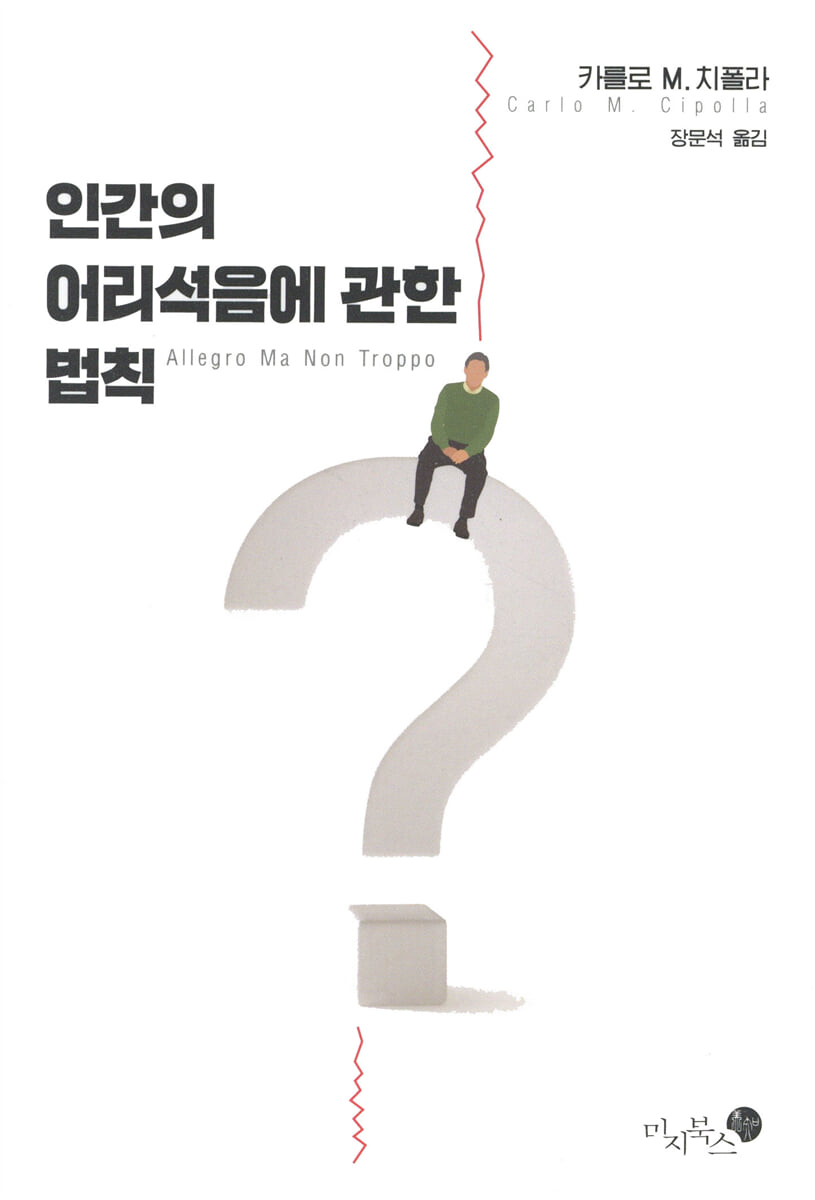
The Law of Human Folly
 |
Description
Book Introduction
We always underestimate the destructive power of foolish people.
Insightful with quirky imagination and sharp humor
Chipola-style anthropology
Carlo M., a world-renowned Italian historian,
A book by Chipola that ideally blends scholarship and humor to provide insight into the human world full of foolishness.
Consisting of two short essays, one on "Medieval History Through Pepper" and the other on "Human Folly," "The Laws of Human Folly" offers an intellectual feast that blends history, economics, anthropology, and humor.
In the first half of this book, Cipolla unfolds the history of medieval Europe, where desire and economy intersect, using objects such as pepper, wine, and chastity belts as protagonists. In the second half, he introduces a ridiculous theory about a group of foolish people.
Foolish people who have caused incalculable losses to humanity exist everywhere and at all times.
Why do we underestimate the destructive power of foolish people? How do fools lead vibrant civilizations to ruin? The essence of "Cipolla-style anthropology," insightful and insightful, with ingenious imagination and sharp humor.
Insightful with quirky imagination and sharp humor
Chipola-style anthropology
Carlo M., a world-renowned Italian historian,
A book by Chipola that ideally blends scholarship and humor to provide insight into the human world full of foolishness.
Consisting of two short essays, one on "Medieval History Through Pepper" and the other on "Human Folly," "The Laws of Human Folly" offers an intellectual feast that blends history, economics, anthropology, and humor.
In the first half of this book, Cipolla unfolds the history of medieval Europe, where desire and economy intersect, using objects such as pepper, wine, and chastity belts as protagonists. In the second half, he introduces a ridiculous theory about a group of foolish people.
Foolish people who have caused incalculable losses to humanity exist everywhere and at all times.
Why do we underestimate the destructive power of foolish people? How do fools lead vibrant civilizations to ruin? The essence of "Cipolla-style anthropology," insightful and insightful, with ingenious imagination and sharp humor.
- You can preview some of the book's contents.
Preview
index
From the starting point
The role of spices (especially pepper) in the development of the medieval economy
The Law of Human Folly
supplement
After moving: It's a joke, but it's not a joke
The role of spices (especially pepper) in the development of the medieval economy
The Law of Human Folly
supplement
After moving: It's a joke, but it's not a joke
Into the book
Humor, when used appropriately and in the right way at the right time, is a powerful lubricant that relieves tension, resolves difficult situations, and makes relationships more flexible.
Therefore, I am deeply convinced that using humor when necessary is a social duty.
From the above trite considerations, the two articles that make up this book were born.
--- p.10
“The first group of people had the responsibility of praying to the Lord, while the second group was engaged in commerce and agriculture.
And finally, to protect these two classes from injustice and invasion, the nobles appeared.” But the account given by Philip of Vitry is biased and inaccurate.
Because the nobles had no intention of “protecting the other two social classes from injustice and aggression.”
On the contrary, it only added injustice to injustice and aggression to aggression.
--- p.20
“In 1337, King Edward of England declared war on the French king for that excellent French wine, and, as those who declare war always do, he thought it would be a blitzkrieg.
But as always happens to those who plan blitzkriegs, that prediction is completely wrong.
“King Edward’s blitzkrieg, as we have seen, lasted 116 years, and he did not live long enough to know it.”--- p.57
A wise person knows that he is wise.
Even the clever know that they are clever.
Even the innocent are keenly aware of their own naivety.
Conversely, only fools do not know that they are fools.
--- p.92~93
A fool will show up out of nowhere with a smile on his face, as if he were doing the most natural thing in the world, only to ruin your plans, destroy your peace, mess up your work and life, and steal your money, time, good mood, appetite, and efficiency.
And all this is done without malice, without remorse, without rationality.
In a word, it is foolish.
Therefore, I am deeply convinced that using humor when necessary is a social duty.
From the above trite considerations, the two articles that make up this book were born.
--- p.10
“The first group of people had the responsibility of praying to the Lord, while the second group was engaged in commerce and agriculture.
And finally, to protect these two classes from injustice and invasion, the nobles appeared.” But the account given by Philip of Vitry is biased and inaccurate.
Because the nobles had no intention of “protecting the other two social classes from injustice and aggression.”
On the contrary, it only added injustice to injustice and aggression to aggression.
--- p.20
“In 1337, King Edward of England declared war on the French king for that excellent French wine, and, as those who declare war always do, he thought it would be a blitzkrieg.
But as always happens to those who plan blitzkriegs, that prediction is completely wrong.
“King Edward’s blitzkrieg, as we have seen, lasted 116 years, and he did not live long enough to know it.”--- p.57
A wise person knows that he is wise.
Even the clever know that they are clever.
Even the innocent are keenly aware of their own naivety.
Conversely, only fools do not know that they are fools.
--- p.92~93
A fool will show up out of nowhere with a smile on his face, as if he were doing the most natural thing in the world, only to ruin your plans, destroy your peace, mess up your work and life, and steal your money, time, good mood, appetite, and efficiency.
And all this is done without malice, without remorse, without rationality.
In a word, it is foolish.
--- p.93
Publisher's Review
Allegro ma non troppo!
A positive spell to endure a reality plagued by absurdity and injustice.
Allegro Ma Non Troppo.
This strange Italian term is a musical term meaning 'fast but not too fast' or 'fun but not too fast'.
However, the prominent Italian economic historian Carlo M.
For Chipola, it is also a theme that runs through the foundation of Chipola-style anthropology, full of humor and wit, 'like a joke but not a joke.'
The Laws of Human Stupidity is a collection of two short essays written in English by Cipolla, which he published in a limited edition for his friends, but which gained unexpected popularity and was subsequently published officially in Italy.
This work was introduced in Korea several years ago, and is now being translated into a new version based on the Italian version.
Just as in his previous work, 『A World History of Spanish Silver』, Cipolla dealt with the modern European world triggered by the Spanish invaders' plunder of silver from the American continent, in the first article of this book, "The Role of Spices (Particularly Pepper) in the Development of the Medieval Economy," he summarizes the vast European history of the Middle Ages, which began with the fall of the Roman Empire, in one breath using the subject of 'pepper'.
But the way Cipolla unravels this momentous history is incredibly mischievous.
With Chipola-style jokes and wit interspersed here and there, readers are bound to be confused about what is historical fact and what is Chipola's joke.
But as we speed through the historical scenes, brimming with laughter and humor like a medieval sitcom, we soon encounter Cipolla's delightful critique of a key hypothesis in the field of historical scholarship.
Pierre, the Hermit, addicted to pepper, launches a crusade
Cipolla lightly criticizes the Nordic-centric narrative of the birth of capitalism, and moves its origins back to the Middle Ages.
The stage he sets for his story is the beginning of the second millennium, when medieval Europe, devastated by the fall of the Roman Empire and the invasion of the Vikings, is regaining its energy and expanding anew.
During the Dark Ages, when violence was rampant and trade with the East was in decline, Pierre the Hermit lived in France.
He loved pepper so much, but he couldn't bear the frustration of not being able to eat it to his heart's content, so he started the Crusades to liberate the Holy Land from Muslim oppression and reopen trade routes with the East, thereby supplying pepper to Europe again.
Fortunately(?), at the end of the arduous expedition of the Crusades, the defeat of the Muslims awaited them, and a new world opened up before Westerners.
Thanks to the Italians' exceptional commercial talent, the pepper trade expanded rapidly.
Men whose sexual vitality had increased due to increased pepper consumption were able to socialize with beautiful women, but the chastity belts worn by their husbands when they went on crusades were a problem.
As they developed a keen interest in the manufacture of iron, the key to unlocking the chastity belt, 'European metallurgy' developed.
In Western Europe, the number of surnames meaning blacksmith (Smith, Schmidt, Ferrari, Ferrero, Fabre, Lefebvre, etc.) suddenly increased, and a period of sustainable expansion began in the metallurgical industry.
This extraordinary history led by Pepper does not stop here.
A historical story that goes on and on
Pepper itself was traded as currency and contributed to the development of finance.
Although the merchants made a lot of money through usury, they felt guilty and gave huge donations to churches and monasteries.
This money had an immediate economic impact.
Bishops and abbots created a 'multiplier effect' on the European economy by spending huge amounts of money to build cathedrals and monasteries.
The population grew and per capita income grew faster.
The chain reaction of pepper, wine, and chastity belts had a cascading effect on the English wool industry, William the Conqueror's invasion of England, the Black Death, and the Hundred Years' War.
However, an era driven by the power of 'pepper' suddenly comes to an end.
Edward III, who had borrowed money from Florentine merchants to wage the Hundred Years' War, declared bankruptcy.
“For the Florentines this loss was a great disaster.
"If you can't trust an English gentleman in business, who the hell can you trust?" Cipolla's witty quip that the bankruptcy of the English crown caused the Florentines to abandon commerce and banking and turn to painting and poetry, thus beginning the Renaissance and ending the Middle Ages will likely leave serious readers stunned.
But hidden between the lines is a Cipolla-style critique of the Nordic-centric historical interpretation of the “Protestant origins of modern capitalism” formalized by Max Weber.
Capitalism was born in medieval Italy even before Protestantism appeared.
Chipola's anthropology, which provides insight into the human world full of foolishness.
Chipola's original and witty ideas burst forth as if on cue in his second book, "The Laws of Human Folly."
Chipola opens with a statement about the timeless truth that has endured through the ages: the harm that foolish humans inflict on the world.
“Foolish people” are people who harm others while also harming themselves.
Chipola argues that foolish people always exist in a certain proportion in any society (even in elite and academic societies!), and that those who are not foolish always underestimate the potential destructive power of foolish people.
Chipola divides people who are not foolish into three major categories.
First, a wise person is one who benefits both himself and others.
Second, a naive person is someone who suffers losses himself but benefits others.
Third, a clever person is one who harms others but benefits himself.
Leaving aside ethical value judgments, naive and cunning people do not influence the increase or decrease of the benefits or losses of society as a whole.
They only transfer benefits from themselves to others and from others to themselves.
But fools are the ones who destroy the interests of society as a whole, and are, in Chipola's words, "the most dangerous type of individual on earth."
Foolish humans are difficult to deal with because of their inherent irrationality, making them unpredictable and difficult to deal with. Doing business with them or engaging with them is bound to be very costly.
They appear out of nowhere and launch surprise attacks, and as Friedrich Schiller said, “even the gods are forced to give up in the face of foolishness.”
A "not-quite-joke" about a country being ruined by foolish people.
Such fools appear in a certain proportion in any group, regardless of education or social environment, and are not limited to ancient, medieval, modern, or contemporary times.
Here, Chipola's drive as a historian reaches its conclusion.
In both prosperous and declining societies, the proportion of fools is the same.
A prosperous nation is usually one where the wise keep the foolish in check while creating enough benefits for themselves and others to ensure progress.
However, if, due to some trigger, the naive and the clever are influenced by the foolish and begin to engage in foolish activities (especially if the elites become corrupted in this way), then that society will decline.
The destructive power of foolish people is irresistibly strengthened, and the country is headed toward ruin.
It is a poignant statement that seems like a joke but is not a joke (= allegro ma non troppo), which Cipolla conveys to us in the form of humor.
A positive spell to endure a reality plagued by absurdity and injustice.
Allegro Ma Non Troppo.
This strange Italian term is a musical term meaning 'fast but not too fast' or 'fun but not too fast'.
However, the prominent Italian economic historian Carlo M.
For Chipola, it is also a theme that runs through the foundation of Chipola-style anthropology, full of humor and wit, 'like a joke but not a joke.'
The Laws of Human Stupidity is a collection of two short essays written in English by Cipolla, which he published in a limited edition for his friends, but which gained unexpected popularity and was subsequently published officially in Italy.
This work was introduced in Korea several years ago, and is now being translated into a new version based on the Italian version.
Just as in his previous work, 『A World History of Spanish Silver』, Cipolla dealt with the modern European world triggered by the Spanish invaders' plunder of silver from the American continent, in the first article of this book, "The Role of Spices (Particularly Pepper) in the Development of the Medieval Economy," he summarizes the vast European history of the Middle Ages, which began with the fall of the Roman Empire, in one breath using the subject of 'pepper'.
But the way Cipolla unravels this momentous history is incredibly mischievous.
With Chipola-style jokes and wit interspersed here and there, readers are bound to be confused about what is historical fact and what is Chipola's joke.
But as we speed through the historical scenes, brimming with laughter and humor like a medieval sitcom, we soon encounter Cipolla's delightful critique of a key hypothesis in the field of historical scholarship.
Pierre, the Hermit, addicted to pepper, launches a crusade
Cipolla lightly criticizes the Nordic-centric narrative of the birth of capitalism, and moves its origins back to the Middle Ages.
The stage he sets for his story is the beginning of the second millennium, when medieval Europe, devastated by the fall of the Roman Empire and the invasion of the Vikings, is regaining its energy and expanding anew.
During the Dark Ages, when violence was rampant and trade with the East was in decline, Pierre the Hermit lived in France.
He loved pepper so much, but he couldn't bear the frustration of not being able to eat it to his heart's content, so he started the Crusades to liberate the Holy Land from Muslim oppression and reopen trade routes with the East, thereby supplying pepper to Europe again.
Fortunately(?), at the end of the arduous expedition of the Crusades, the defeat of the Muslims awaited them, and a new world opened up before Westerners.
Thanks to the Italians' exceptional commercial talent, the pepper trade expanded rapidly.
Men whose sexual vitality had increased due to increased pepper consumption were able to socialize with beautiful women, but the chastity belts worn by their husbands when they went on crusades were a problem.
As they developed a keen interest in the manufacture of iron, the key to unlocking the chastity belt, 'European metallurgy' developed.
In Western Europe, the number of surnames meaning blacksmith (Smith, Schmidt, Ferrari, Ferrero, Fabre, Lefebvre, etc.) suddenly increased, and a period of sustainable expansion began in the metallurgical industry.
This extraordinary history led by Pepper does not stop here.
A historical story that goes on and on
Pepper itself was traded as currency and contributed to the development of finance.
Although the merchants made a lot of money through usury, they felt guilty and gave huge donations to churches and monasteries.
This money had an immediate economic impact.
Bishops and abbots created a 'multiplier effect' on the European economy by spending huge amounts of money to build cathedrals and monasteries.
The population grew and per capita income grew faster.
The chain reaction of pepper, wine, and chastity belts had a cascading effect on the English wool industry, William the Conqueror's invasion of England, the Black Death, and the Hundred Years' War.
However, an era driven by the power of 'pepper' suddenly comes to an end.
Edward III, who had borrowed money from Florentine merchants to wage the Hundred Years' War, declared bankruptcy.
“For the Florentines this loss was a great disaster.
"If you can't trust an English gentleman in business, who the hell can you trust?" Cipolla's witty quip that the bankruptcy of the English crown caused the Florentines to abandon commerce and banking and turn to painting and poetry, thus beginning the Renaissance and ending the Middle Ages will likely leave serious readers stunned.
But hidden between the lines is a Cipolla-style critique of the Nordic-centric historical interpretation of the “Protestant origins of modern capitalism” formalized by Max Weber.
Capitalism was born in medieval Italy even before Protestantism appeared.
Chipola's anthropology, which provides insight into the human world full of foolishness.
Chipola's original and witty ideas burst forth as if on cue in his second book, "The Laws of Human Folly."
Chipola opens with a statement about the timeless truth that has endured through the ages: the harm that foolish humans inflict on the world.
“Foolish people” are people who harm others while also harming themselves.
Chipola argues that foolish people always exist in a certain proportion in any society (even in elite and academic societies!), and that those who are not foolish always underestimate the potential destructive power of foolish people.
Chipola divides people who are not foolish into three major categories.
First, a wise person is one who benefits both himself and others.
Second, a naive person is someone who suffers losses himself but benefits others.
Third, a clever person is one who harms others but benefits himself.
Leaving aside ethical value judgments, naive and cunning people do not influence the increase or decrease of the benefits or losses of society as a whole.
They only transfer benefits from themselves to others and from others to themselves.
But fools are the ones who destroy the interests of society as a whole, and are, in Chipola's words, "the most dangerous type of individual on earth."
Foolish humans are difficult to deal with because of their inherent irrationality, making them unpredictable and difficult to deal with. Doing business with them or engaging with them is bound to be very costly.
They appear out of nowhere and launch surprise attacks, and as Friedrich Schiller said, “even the gods are forced to give up in the face of foolishness.”
A "not-quite-joke" about a country being ruined by foolish people.
Such fools appear in a certain proportion in any group, regardless of education or social environment, and are not limited to ancient, medieval, modern, or contemporary times.
Here, Chipola's drive as a historian reaches its conclusion.
In both prosperous and declining societies, the proportion of fools is the same.
A prosperous nation is usually one where the wise keep the foolish in check while creating enough benefits for themselves and others to ensure progress.
However, if, due to some trigger, the naive and the clever are influenced by the foolish and begin to engage in foolish activities (especially if the elites become corrupted in this way), then that society will decline.
The destructive power of foolish people is irresistibly strengthened, and the country is headed toward ruin.
It is a poignant statement that seems like a joke but is not a joke (= allegro ma non troppo), which Cipolla conveys to us in the form of humor.
GOODS SPECIFICS
- Date of issue: February 15, 2019
- Page count, weight, size: 128 pages | 148g | 124*182*20mm
- ISBN13: 9788994142913
- ISBN10: 8994142916
You may also like
카테고리
korean


korean

![GQ KOREA Mark (Monthly): December [2025]](http://librairie.coreenne.fr/cdn/shop/files/8ef265dbbfbf186523ed75ba7319009d.jpg?v=1765340328&width=3840)


