

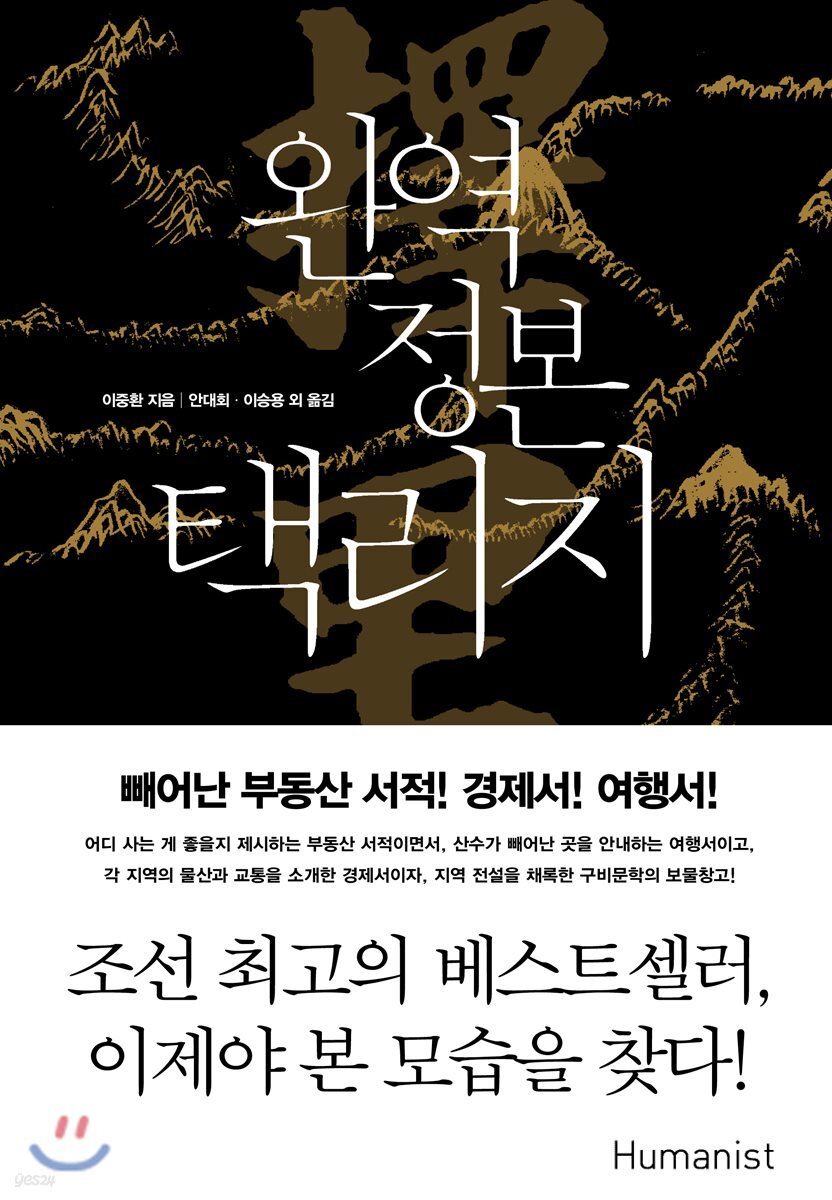
Complete translation of the original text of Taekriji
 |
Description
Book Introduction
The masterpiece of human geography, "Taekriji," is finally published in its original form!
『Taekriji』 is an original human geography book that fully captures the specific realities and changes in industry, transportation, and culture of Joseon society, which changed significantly since the 18th century.
Lee Jung-hwan analyzed the politics, history, economy, society, culture, legends, landscapes, and scenic spots of the eight provinces of Joseon from various perspectives and then divided them into places worth living in and places not worth living in.
Thanks to his unique perspective on geography, 『Taekriji』 remains a unique book to this day as a reference for choosing a place to live and touring mountains and rivers.
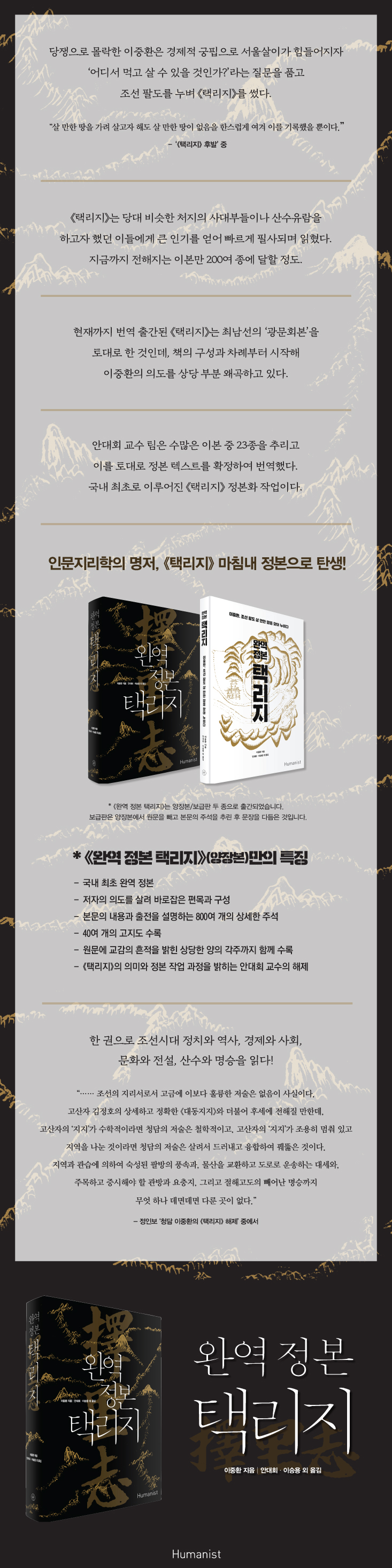
『Complete Translation of the Original Text of Taekriji』 is a book translated by Professor Ahn Dae-hoe's team after confirming the original text based on the content of the exchange of 23 selected versions of the 『Taekriji』 among the 200 or so different versions.
The composition and organization that had been incorrectly used were corrected to match the original, and many of the errors in the content were corrected, making it the first standardized version. It was published in two editions: a hardcover and a popular edition.
『Taekriji』 is an original human geography book that fully captures the specific realities and changes in industry, transportation, and culture of Joseon society, which changed significantly since the 18th century.
Lee Jung-hwan analyzed the politics, history, economy, society, culture, legends, landscapes, and scenic spots of the eight provinces of Joseon from various perspectives and then divided them into places worth living in and places not worth living in.
Thanks to his unique perspective on geography, 『Taekriji』 remains a unique book to this day as a reference for choosing a place to live and touring mountains and rivers.
『Complete Translation of the Original Text of Taekriji』 is a book translated by Professor Ahn Dae-hoe's team after confirming the original text based on the content of the exchange of 23 selected versions of the 『Taekriji』 among the 200 or so different versions.
The composition and organization that had been incorrectly used were corrected to match the original, and many of the errors in the content were corrected, making it the first standardized version. It was published in two editions: a hardcover and a popular edition.
- You can preview some of the book's contents.
Preview
index
Unlocking the competition
Seo Ik-ik from "Taekriji"
Seo Jeong-eon-yu of "Taekriji"
introduction
Paldoron
Introduction to the Eight Provinces Theory
Pyeongan Province
Hamgyeong Province
Hwanghae-do
Gangwon-do
Gyeongsang Province
Jeolla-do
Chungcheong Province
gyeonggi-do
Restoration theory
Introduction to the theory of restoration
geography
menstruation
Trade and Transportation
humanity
arithmetic
The great trunk of mountains and rivers
Famous mountains and temples
Capital and hermitage
Mountain on the sea
Yeongdong's mountains and rivers
The mountains and rivers of your town
Riverside residence
A dwelling by the stream
conclusion
epilogue
《Taekriji》 follow-up - Lee Jung-hwan
《Taekriji》 - Jupiter Hall
《Taekriji》 - Mokhyeong
《Palyeokgageocheo》 - Lee Bong-hwan
《Taekriji》 by Hong Joong-in
After seeing "Taekriji," I wrote a book to show to my children - Hong Gwi-beom
Foot 《Taekriji》 - Jeong Yak-yong
An introduction to Cheongdam Lee Jung-hwan's "Taekriji" - Jeong In-bo
Appendix: Epitaph of Lee Jung-hwan, Left Officer of the Ministry of War - Lee Ik
Original text (omitted in the popular edition)
Search
Seo Ik-ik from "Taekriji"
Seo Jeong-eon-yu of "Taekriji"
introduction
Paldoron
Introduction to the Eight Provinces Theory
Pyeongan Province
Hamgyeong Province
Hwanghae-do
Gangwon-do
Gyeongsang Province
Jeolla-do
Chungcheong Province
gyeonggi-do
Restoration theory
Introduction to the theory of restoration
geography
menstruation
Trade and Transportation
humanity
arithmetic
The great trunk of mountains and rivers
Famous mountains and temples
Capital and hermitage
Mountain on the sea
Yeongdong's mountains and rivers
The mountains and rivers of your town
Riverside residence
A dwelling by the stream
conclusion
epilogue
《Taekriji》 follow-up - Lee Jung-hwan
《Taekriji》 - Jupiter Hall
《Taekriji》 - Mokhyeong
《Palyeokgageocheo》 - Lee Bong-hwan
《Taekriji》 by Hong Joong-in
After seeing "Taekriji," I wrote a book to show to my children - Hong Gwi-beom
Foot 《Taekriji》 - Jeong Yak-yong
An introduction to Cheongdam Lee Jung-hwan's "Taekriji" - Jeong In-bo
Appendix: Epitaph of Lee Jung-hwan, Left Officer of the Ministry of War - Lee Ik
Original text (omitted in the popular edition)
Search
Detailed image
Publisher's Review
1.
Lee Jung-hwan, a fallen aristocrat, discusses the human geography of Joseon's eight provinces.
- The value of Taekriji, the most original human geography book of the Joseon Dynasty
《Taekriji》 is a truly groundbreaking work in that it was written by an individual to discuss geography in an era when the state monopolized knowledge of national geography.
All previous geography books were government-sponsored and published, and thus failed to reflect the reality of Joseon, which had changed significantly since the 18th century.
On the other hand, 《Taekriji》 not only contains the specific realities and changing realities of the industry, transportation, and culture of the time, but also reveals Lee Jung-hwan's unique perspective in critiquing the politics, history, economy, society, culture, legends, landscapes, and scenic spots of the eight provinces of Joseon from a humanities, social, and economic perspective, and is thus considered a masterpiece of human geography.
《Taekriji》 was copied and read faster than any other book immediately after its publication, and its popularity is proven by the fact that there are over 200 different versions that have been passed down to the present day.
Through this book, Lee Jung-hwan not only satisfied the curiosity about the geography of the time, but also gave birth to a new desire for geography.
Lee Jung-hwan suffered financial hardship after falling into political strife at the young age of 30.
At that time, for a nobleman to lose his official position meant that not only would his life in Seoul become difficult due to financial hardship, but he would also be reduced to a position where he would have to worry about his livelihood for the rest of his life.
This is the background to his persistent questioning and answering of "Where can I make a living?", such as selecting areas with economic conditions as the best residential areas despite being a member of the nobility and placing greater emphasis on economic centers rather than administrative centers.
He divided the entire country into regions and themes and looked at it from various angles, including administration, transportation, local products, customs, human nature, history, people, and landscapes. He placed great emphasis on practical requirements such as the fertility of farmland, distribution of goods, convenience of transportation, production of special crops, and market activity when determining whether a place was worth living in or not.
In this way, in Taekriji, he pointed out that the hardships he experienced were not a personal problem but a structural problem facing late Joseon society, and even suggested an alternative.
For scholars in such situations, this book was both a practical guide and a self-help book.
All landscapes are meant to please the mind and body and to release emotions.
If there is no such mountain where one lives, people become rough.
However, there are many places with good mountains and rivers where the physiology is not very good.
As humans, we cannot live by carrying our shells like a giraffe or by eating dirt like an earthworm, so we cannot live by simply taking mountains and rivers.
So, it would be better to choose a place with good geography, with fertile land and wide fields, build a house and live there, and have a beautiful mountain and water ten li away or half a day's drive away, so that you can go there whenever you feel like it to relieve your worries or stay there for a day or two and come back.
This is a good method that can be continued for a long time.
-[Theory of Restoration] From 'Sansu' (345 pages in hardcover/268 pages in popular edition)
But the nobles should not do such things.
But if we find a good place where fish and salt are distributed, set sail, and use the profits to cover the expenses for the four ceremonial rites of passage, what harm can there be? - [Theory of Restoration] From 'Physiology' (Hardcover, p. 243/Public Edition, p. 184)
2.
The birth of Korea's first complete translation of "Taekriji"!
- The importance of producing a standard version of Korea's representative classics
Professor Ahn Dae-hoe cited canonization and standardization as pressing issues facing Korean classics.
The idea is to select the classics that represent our country, compile a list of works that are worth reading across time, and at the same time, go through the process of standardizing them into a standard version.
The work of standardizing texts is the foundation for accurately understanding classics and the foundation for proper academic research and translation work.
Facing the enormous task of canonizing and standardizing Korean classics, Professor Ahn Dae-hoe's team has completed one task.
This is the work of the original text of the Taekriji, the canon of human geography and of which there are over 200 different versions.
《Taekriji》 has been handed down in numerous versions to this day, proving its popularity and value.
It is rare for a book published in the late Joseon Dynasty to have so many different versions.
Although it has served as a source for many other materials because it has been widely read and copied, no definitive version of the Taekriji has ever been produced.
All of the currently widely read versions of Taekriji are based on the Gwangmunhoe version translated by Choi Nam-seon in 1912. However, the Gwangmunhoe version is only one of many different versions, so it is not representative.
In addition, Choi Nam-seon distorted some of the contents of the Taekriji by deleting or adding some content.
In other words, the Taekriji we have read so far is a text that has not undergone rigorous academic review.
Since Professor Ahn Dae-hoe began his first seminar with nine researchers in 2012, he has spent a long time selecting and discussing 23 versions from numerous variants, and finally finalizing and translating the original text.
Among the 23 selected manuscripts, there are many new manuscripts that have not been previously reviewed in academia.
Important points of communication were carefully organized and included in the original text in the hardcover edition of “Complete Translation of the Jeongbon Taekriji” with approximately 700 annotations.
The biggest difference between the Complete Translation of the Jeongbon Taekriji and the existing Taekriji is that the table of contents and structure have been updated.
Currently, almost all translations and papers follow the following categories and structure: General Theory of the People, General Theory of the Eight Provinces, General Theory of Bokgeo, General Theory, and Author's Preface.
However, during the process of working on the original text, it was confirmed that this section only appeared in a very small number of copies, so in the “Complete Translation of the Original Text,” a new section and structure of introduction, discussion of the eight provinces, discussion of restoration, conclusion, and postscript were introduced in accordance with the original text’s intent.
The ‘Preface’ also includes a selection of historical materials that were discovered over a long period of time while working on the original text.
It contains prefaces written by Hong Jung-in, Jeong Yak-yong, and Jeong In-bo. The preface written in a mixed Korean and Chinese character style by Jeong In-bo, a scholar from the Japanese colonial period, is a valuable resource that proves the value of Taekriji that remains unchanged even after the passage of time.
In addition, the article about the famous 'Hamheung Tea Ceremony' in the 'Taekriji' was not included because it was judged not to be included in the original.
Since even the large and small errors in translation have been significantly corrected, the “Complete Translation of the Original Taekriji” can be said to be the first proper “Taekriji.”
Even if we do not compare its merits with those of Sima Qian or Yi Daoyuan, it is true that there is no better book on geography in Joseon, past or present.
It is worthy of being passed down to future generations along with the detailed and accurate 《Daedongjiji》 by Gosanja Kim Jeong-ho. If Gosanja's 'jiji' is mathematical, Cheongdam's writing is philosophical, and if Gosanja's 'jiji' is quiet and divided into regions, Cheongdam's writing revives, reveals, integrates, and penetrates.
There is no place that deals with the customs and practices of the eight directions that have matured through local customs, the trend of exchanging goods and transporting them by road, the official defenses and strategic points that should be noted and valued, and even the outstanding scenic spots of isolated islands.
-[Preface] From 'Annotation of Cheongdam Lee Jung-hwan's "Taekriji"' (page 382 of the hardcover edition/page 302 of the popular edition)
3.
A single volume containing the mountains, rivers, scenic spots, and legends of each province, along with ancient maps.
- A guide to domestic mountain and water tours that is still valid at this point in time
《Taekriji》 is not only a guidebook for choosing a place to live, but is also a classic that is considered a first-class guidebook for exploring famous places of interest.
Even now, there is no book that can replace this one, which organizes the Korean mountains and rivers well and makes them a useful travel reference.
Based on his 30 years of experience personally exploring the regions excluding Pyeongan and Jeolla provinces, Lee Jung-hwan provides guidance on which mountains, rivers, pavilions, famous sites, and cultural heritage sites to visit in which regions.
In addition to introducing major mountains and rivers and scenic spots in the eight provinces of Joseon, the scenic spots around Yeongdong, Gwanbuk, and Danyang in Chungcheongbuk-do, which are particularly rich in scenic spots, were separately organized and explained.
In addition, the 《Jeongbon Wanyeok Taekriji》 generously included old maps so that people could directly check the areas that Lee Jung-hwan selected as geomantic sites or gave significant explanations about.
Readers will be able to see the appearance of the country in the 18th century Joseon Dynasty through carefully selected old maps, and will also have the pleasure of comparing them with modern maps.
In addition, Lee Jung-hwan believed that oral legends were a factor in understanding the lives and consciousness of local people and revealing regional characteristics, and so he actively collected and recorded oral legends distributed throughout the country.
There are over 40 great oral legends to choose from.
Since the study of legends in earnest began only after the 20th century, Taekriji can be said to be the oldest and most reliable report of oral literature before the 20th century.
《Complete Translation of the Jeongbon Taekriji》(hardcover) meticulously explains the contents and sources with detailed annotations.
Although the four counties of Yeongchun, Danyang, Cheongpung, and Jecheon are in the Chungcheong region, they are actually located in the upper reaches of the Han River.
Stone walls and boulders are scattered along the river flowing through the valley, and among them, Danyang is by far the best.
Danyang-gun is surrounded by mountains, so there are no fields extending for more than 10 ri, but the scenery is magnificent, with rivers, streams, rocks, and valleys.
There are famous places in the world called Idam and Samam.
Among these ponds, Dodam Island Pond is located within Yeongchun, and is deep and wide because the river water meanders around and collects there.
Three rock peaks rise up from the water, each separate from the others, and stand in a straight line like a string, strangely and ingeniously carved and engraved, like a stone mountain built on a pile of houses.
However, the only regret is that the rocks are small and low in height, so there is no view of a towering, steep cliff.
-[Restoration of Restoration] From 'The Landscape of Your Town' (320 pages in hardcover/248 pages in popular edition)
As the story goes, there was once a rich man's house where the lake was.
One day, a beggar asked for rice, but the rich man gave him not rice but excrement.
Then, the house he was living in suddenly sank, forming a lake, and all the grain that had been piled up turned into small clams.
Every year, when there is a bad harvest, there are many clams, and when there is a good harvest, there are few. They are sweet and fragrant, making them suitable for cooking, so the locals called them “jeokgokhap (rice clams formed by accumulating grains).”
In spring and summer, men from far and wide come to the lake carrying loads on their backs and women on their heads, and line up on the road to collect shells. It is said that there are still pieces of roof tiles and bowls at the bottom of the lake, and that divers sometimes pick them up.1)
1) The story of Jeokgokhap explains the origin of a pond in a specific area, and is one of the Jangji Pond legends that is widely circulated throughout the country.
… … was first recorded in 《Taekriji》.
(omitted)
-[Restoration of Restoration] From 'Yeongdong's Landscape' (315 pages in hardcover/244 pages in popular edition)
4.
Published in both hardcover and popular editions to increase accessibility.
- 《Complete Translation of the Original Taekriji》, read differently depending on the purpose
Professor Ahn Dae-hoe's translations of classics are renowned for their fluency.
In the "Complete Translation of the Original Text of Taekriji," we focused on preserving the style of writing by Lee Jung-hwan, who was also renowned as a writer, while also using Chinese characters as clearly as possible and providing supplementary explanations to make them easier to understand, so that more readers could access the original text of Taekriji.
In addition, we have included a detailed commentary that summarizes the background and characteristics of Taekriji's writing, as well as Lee Jung-hwan's life, so that this book alone is sufficient for a proper understanding of Taekriji.
Based on this, the complete translation of the Jeongbon Taekriji was published in two editions: a hardcover and a popular edition.
The two versions have the same content, but the biggest difference is that the hardcover version includes the original text of the original text, which was confirmed through a process of cross-referencing, along with annotations that explain in as much detail as possible the source of sentences, the origins of the content, and the origin of the text.
In particular, the original text contains approximately 700 annotations containing traces of communication, which will be of great help to researchers.
In addition, the hardcover edition contains a considerable amount of annotations in the text, and it also includes generous illustrations to enhance understanding, so it is worth owning a hardcover edition for readers who wish to properly understand the classic “Taekriji.”
On the other hand, the popular edition of the complete translation of Taekriji excludes the original text and minimizes the annotations in the text to ensure that the original flavor of Taekriji can be fully experienced.
The text is written in a simpler format than the hardcover version, and only important illustrations are included, so it is recommended for readers who want to read 《Taekriji》 lightly.
Lee Jung-hwan, a fallen aristocrat, discusses the human geography of Joseon's eight provinces.
- The value of Taekriji, the most original human geography book of the Joseon Dynasty
《Taekriji》 is a truly groundbreaking work in that it was written by an individual to discuss geography in an era when the state monopolized knowledge of national geography.
All previous geography books were government-sponsored and published, and thus failed to reflect the reality of Joseon, which had changed significantly since the 18th century.
On the other hand, 《Taekriji》 not only contains the specific realities and changing realities of the industry, transportation, and culture of the time, but also reveals Lee Jung-hwan's unique perspective in critiquing the politics, history, economy, society, culture, legends, landscapes, and scenic spots of the eight provinces of Joseon from a humanities, social, and economic perspective, and is thus considered a masterpiece of human geography.
《Taekriji》 was copied and read faster than any other book immediately after its publication, and its popularity is proven by the fact that there are over 200 different versions that have been passed down to the present day.
Through this book, Lee Jung-hwan not only satisfied the curiosity about the geography of the time, but also gave birth to a new desire for geography.
Lee Jung-hwan suffered financial hardship after falling into political strife at the young age of 30.
At that time, for a nobleman to lose his official position meant that not only would his life in Seoul become difficult due to financial hardship, but he would also be reduced to a position where he would have to worry about his livelihood for the rest of his life.
This is the background to his persistent questioning and answering of "Where can I make a living?", such as selecting areas with economic conditions as the best residential areas despite being a member of the nobility and placing greater emphasis on economic centers rather than administrative centers.
He divided the entire country into regions and themes and looked at it from various angles, including administration, transportation, local products, customs, human nature, history, people, and landscapes. He placed great emphasis on practical requirements such as the fertility of farmland, distribution of goods, convenience of transportation, production of special crops, and market activity when determining whether a place was worth living in or not.
In this way, in Taekriji, he pointed out that the hardships he experienced were not a personal problem but a structural problem facing late Joseon society, and even suggested an alternative.
For scholars in such situations, this book was both a practical guide and a self-help book.
All landscapes are meant to please the mind and body and to release emotions.
If there is no such mountain where one lives, people become rough.
However, there are many places with good mountains and rivers where the physiology is not very good.
As humans, we cannot live by carrying our shells like a giraffe or by eating dirt like an earthworm, so we cannot live by simply taking mountains and rivers.
So, it would be better to choose a place with good geography, with fertile land and wide fields, build a house and live there, and have a beautiful mountain and water ten li away or half a day's drive away, so that you can go there whenever you feel like it to relieve your worries or stay there for a day or two and come back.
This is a good method that can be continued for a long time.
-[Theory of Restoration] From 'Sansu' (345 pages in hardcover/268 pages in popular edition)
But the nobles should not do such things.
But if we find a good place where fish and salt are distributed, set sail, and use the profits to cover the expenses for the four ceremonial rites of passage, what harm can there be? - [Theory of Restoration] From 'Physiology' (Hardcover, p. 243/Public Edition, p. 184)
2.
The birth of Korea's first complete translation of "Taekriji"!
- The importance of producing a standard version of Korea's representative classics
Professor Ahn Dae-hoe cited canonization and standardization as pressing issues facing Korean classics.
The idea is to select the classics that represent our country, compile a list of works that are worth reading across time, and at the same time, go through the process of standardizing them into a standard version.
The work of standardizing texts is the foundation for accurately understanding classics and the foundation for proper academic research and translation work.
Facing the enormous task of canonizing and standardizing Korean classics, Professor Ahn Dae-hoe's team has completed one task.
This is the work of the original text of the Taekriji, the canon of human geography and of which there are over 200 different versions.
《Taekriji》 has been handed down in numerous versions to this day, proving its popularity and value.
It is rare for a book published in the late Joseon Dynasty to have so many different versions.
Although it has served as a source for many other materials because it has been widely read and copied, no definitive version of the Taekriji has ever been produced.
All of the currently widely read versions of Taekriji are based on the Gwangmunhoe version translated by Choi Nam-seon in 1912. However, the Gwangmunhoe version is only one of many different versions, so it is not representative.
In addition, Choi Nam-seon distorted some of the contents of the Taekriji by deleting or adding some content.
In other words, the Taekriji we have read so far is a text that has not undergone rigorous academic review.
Since Professor Ahn Dae-hoe began his first seminar with nine researchers in 2012, he has spent a long time selecting and discussing 23 versions from numerous variants, and finally finalizing and translating the original text.
Among the 23 selected manuscripts, there are many new manuscripts that have not been previously reviewed in academia.
Important points of communication were carefully organized and included in the original text in the hardcover edition of “Complete Translation of the Jeongbon Taekriji” with approximately 700 annotations.
The biggest difference between the Complete Translation of the Jeongbon Taekriji and the existing Taekriji is that the table of contents and structure have been updated.
Currently, almost all translations and papers follow the following categories and structure: General Theory of the People, General Theory of the Eight Provinces, General Theory of Bokgeo, General Theory, and Author's Preface.
However, during the process of working on the original text, it was confirmed that this section only appeared in a very small number of copies, so in the “Complete Translation of the Original Text,” a new section and structure of introduction, discussion of the eight provinces, discussion of restoration, conclusion, and postscript were introduced in accordance with the original text’s intent.
The ‘Preface’ also includes a selection of historical materials that were discovered over a long period of time while working on the original text.
It contains prefaces written by Hong Jung-in, Jeong Yak-yong, and Jeong In-bo. The preface written in a mixed Korean and Chinese character style by Jeong In-bo, a scholar from the Japanese colonial period, is a valuable resource that proves the value of Taekriji that remains unchanged even after the passage of time.
In addition, the article about the famous 'Hamheung Tea Ceremony' in the 'Taekriji' was not included because it was judged not to be included in the original.
Since even the large and small errors in translation have been significantly corrected, the “Complete Translation of the Original Taekriji” can be said to be the first proper “Taekriji.”
Even if we do not compare its merits with those of Sima Qian or Yi Daoyuan, it is true that there is no better book on geography in Joseon, past or present.
It is worthy of being passed down to future generations along with the detailed and accurate 《Daedongjiji》 by Gosanja Kim Jeong-ho. If Gosanja's 'jiji' is mathematical, Cheongdam's writing is philosophical, and if Gosanja's 'jiji' is quiet and divided into regions, Cheongdam's writing revives, reveals, integrates, and penetrates.
There is no place that deals with the customs and practices of the eight directions that have matured through local customs, the trend of exchanging goods and transporting them by road, the official defenses and strategic points that should be noted and valued, and even the outstanding scenic spots of isolated islands.
-[Preface] From 'Annotation of Cheongdam Lee Jung-hwan's "Taekriji"' (page 382 of the hardcover edition/page 302 of the popular edition)
3.
A single volume containing the mountains, rivers, scenic spots, and legends of each province, along with ancient maps.
- A guide to domestic mountain and water tours that is still valid at this point in time
《Taekriji》 is not only a guidebook for choosing a place to live, but is also a classic that is considered a first-class guidebook for exploring famous places of interest.
Even now, there is no book that can replace this one, which organizes the Korean mountains and rivers well and makes them a useful travel reference.
Based on his 30 years of experience personally exploring the regions excluding Pyeongan and Jeolla provinces, Lee Jung-hwan provides guidance on which mountains, rivers, pavilions, famous sites, and cultural heritage sites to visit in which regions.
In addition to introducing major mountains and rivers and scenic spots in the eight provinces of Joseon, the scenic spots around Yeongdong, Gwanbuk, and Danyang in Chungcheongbuk-do, which are particularly rich in scenic spots, were separately organized and explained.
In addition, the 《Jeongbon Wanyeok Taekriji》 generously included old maps so that people could directly check the areas that Lee Jung-hwan selected as geomantic sites or gave significant explanations about.
Readers will be able to see the appearance of the country in the 18th century Joseon Dynasty through carefully selected old maps, and will also have the pleasure of comparing them with modern maps.
In addition, Lee Jung-hwan believed that oral legends were a factor in understanding the lives and consciousness of local people and revealing regional characteristics, and so he actively collected and recorded oral legends distributed throughout the country.
There are over 40 great oral legends to choose from.
Since the study of legends in earnest began only after the 20th century, Taekriji can be said to be the oldest and most reliable report of oral literature before the 20th century.
《Complete Translation of the Jeongbon Taekriji》(hardcover) meticulously explains the contents and sources with detailed annotations.
Although the four counties of Yeongchun, Danyang, Cheongpung, and Jecheon are in the Chungcheong region, they are actually located in the upper reaches of the Han River.
Stone walls and boulders are scattered along the river flowing through the valley, and among them, Danyang is by far the best.
Danyang-gun is surrounded by mountains, so there are no fields extending for more than 10 ri, but the scenery is magnificent, with rivers, streams, rocks, and valleys.
There are famous places in the world called Idam and Samam.
Among these ponds, Dodam Island Pond is located within Yeongchun, and is deep and wide because the river water meanders around and collects there.
Three rock peaks rise up from the water, each separate from the others, and stand in a straight line like a string, strangely and ingeniously carved and engraved, like a stone mountain built on a pile of houses.
However, the only regret is that the rocks are small and low in height, so there is no view of a towering, steep cliff.
-[Restoration of Restoration] From 'The Landscape of Your Town' (320 pages in hardcover/248 pages in popular edition)
As the story goes, there was once a rich man's house where the lake was.
One day, a beggar asked for rice, but the rich man gave him not rice but excrement.
Then, the house he was living in suddenly sank, forming a lake, and all the grain that had been piled up turned into small clams.
Every year, when there is a bad harvest, there are many clams, and when there is a good harvest, there are few. They are sweet and fragrant, making them suitable for cooking, so the locals called them “jeokgokhap (rice clams formed by accumulating grains).”
In spring and summer, men from far and wide come to the lake carrying loads on their backs and women on their heads, and line up on the road to collect shells. It is said that there are still pieces of roof tiles and bowls at the bottom of the lake, and that divers sometimes pick them up.1)
1) The story of Jeokgokhap explains the origin of a pond in a specific area, and is one of the Jangji Pond legends that is widely circulated throughout the country.
… … was first recorded in 《Taekriji》.
(omitted)
-[Restoration of Restoration] From 'Yeongdong's Landscape' (315 pages in hardcover/244 pages in popular edition)
4.
Published in both hardcover and popular editions to increase accessibility.
- 《Complete Translation of the Original Taekriji》, read differently depending on the purpose
Professor Ahn Dae-hoe's translations of classics are renowned for their fluency.
In the "Complete Translation of the Original Text of Taekriji," we focused on preserving the style of writing by Lee Jung-hwan, who was also renowned as a writer, while also using Chinese characters as clearly as possible and providing supplementary explanations to make them easier to understand, so that more readers could access the original text of Taekriji.
In addition, we have included a detailed commentary that summarizes the background and characteristics of Taekriji's writing, as well as Lee Jung-hwan's life, so that this book alone is sufficient for a proper understanding of Taekriji.
Based on this, the complete translation of the Jeongbon Taekriji was published in two editions: a hardcover and a popular edition.
The two versions have the same content, but the biggest difference is that the hardcover version includes the original text of the original text, which was confirmed through a process of cross-referencing, along with annotations that explain in as much detail as possible the source of sentences, the origins of the content, and the origin of the text.
In particular, the original text contains approximately 700 annotations containing traces of communication, which will be of great help to researchers.
In addition, the hardcover edition contains a considerable amount of annotations in the text, and it also includes generous illustrations to enhance understanding, so it is worth owning a hardcover edition for readers who wish to properly understand the classic “Taekriji.”
On the other hand, the popular edition of the complete translation of Taekriji excludes the original text and minimizes the annotations in the text to ensure that the original flavor of Taekriji can be fully experienced.
The text is written in a simpler format than the hardcover version, and only important illustrations are included, so it is recommended for readers who want to read 《Taekriji》 lightly.
GOODS SPECIFICS
- Date of publication: October 29, 2018
- Format: Hardcover book binding method guide
- Page count, weight, size: 560 pages | 1,202g | 165*235*35mm
- ISBN13: 9791160801668
You may also like
카테고리
korean


korean

![GQ KOREA Mark (Monthly): December [2025]](http://librairie.coreenne.fr/cdn/shop/files/8ef265dbbfbf186523ed75ba7319009d.jpg?v=1765340328&width=3840)


