

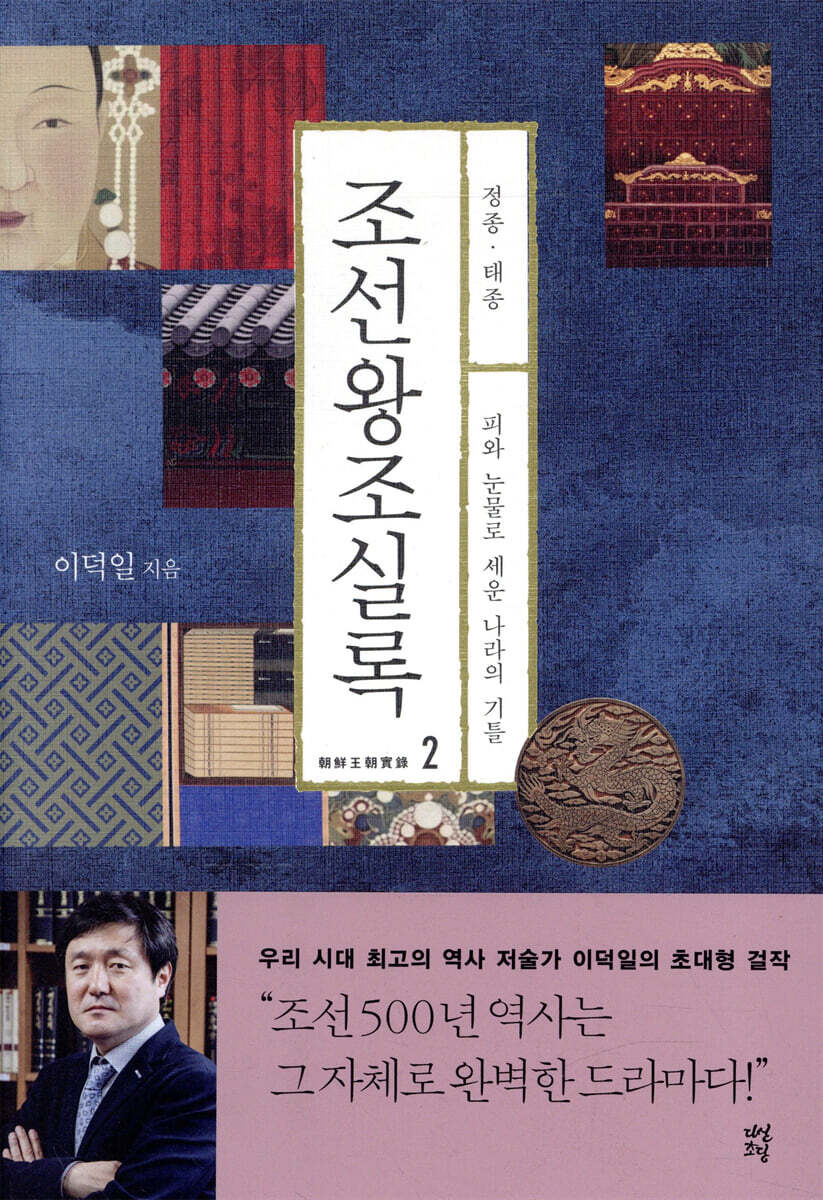
Annals of the Joseon Dynasty 2 King Jeongjong and King Taejong
 |
Description
Book Introduction
10 years of planning and research, 5 years of writing!
The first authentic Joseon Dynasty Annals by Lee Deok-il, the greatest historian of our time
“The 500 years of Joseon history are a perfect drama in themselves!”
There are 78 historical dramas set in Joseon! Joseon's history itself is a perfect drama.
All of this is because there was an annals that recorded everything about the Joseon Dynasty, but unfortunately, there are not many readers who have properly read the annals of the Joseon Dynasty.
Because of its vastness, only digest history books focused on imparting knowledge have been published.
Here, Lee Deok-il, the greatest historian of our time, publishes the authentic 10-volume Annals of the Joseon Dynasty, with fascinating storytelling and insight that penetrates the essence of human life.
This history book was born after 10 years of planning and research, and 5 years of writing.
In a publishing market where there were only introductory books, the 'Authentic Annals of the Joseon Dynasty' was finally born.
Lee Deok-il, who has been creating a new style for historical textbooks, uses his characteristically sharp and solid writing style to question existing interpretations and find modern meaning in this book.
In particular, the original assessment of the key figures who led Joseon provides readers with an opportunity to deeply reflect on their own lives.
Because it fully embodies the national aspiration and zeitgeist to create a "country worthy of being called a country," the message it conveys to our society today is also incredibly powerful.
Our history, which is several times more interesting and moving than the Romance of the Three Kingdoms or the history of Rome, will now make your heart race.
The first authentic Joseon Dynasty Annals by Lee Deok-il, the greatest historian of our time
“The 500 years of Joseon history are a perfect drama in themselves!”
There are 78 historical dramas set in Joseon! Joseon's history itself is a perfect drama.
All of this is because there was an annals that recorded everything about the Joseon Dynasty, but unfortunately, there are not many readers who have properly read the annals of the Joseon Dynasty.
Because of its vastness, only digest history books focused on imparting knowledge have been published.
Here, Lee Deok-il, the greatest historian of our time, publishes the authentic 10-volume Annals of the Joseon Dynasty, with fascinating storytelling and insight that penetrates the essence of human life.
This history book was born after 10 years of planning and research, and 5 years of writing.
In a publishing market where there were only introductory books, the 'Authentic Annals of the Joseon Dynasty' was finally born.
Lee Deok-il, who has been creating a new style for historical textbooks, uses his characteristically sharp and solid writing style to question existing interpretations and find modern meaning in this book.
In particular, the original assessment of the key figures who led Joseon provides readers with an opportunity to deeply reflect on their own lives.
Because it fully embodies the national aspiration and zeitgeist to create a "country worthy of being called a country," the message it conveys to our society today is also incredibly powerful.
Our history, which is several times more interesting and moving than the Romance of the Three Kingdoms or the history of Rome, will now make your heart race.
- You can preview some of the book's contents.
Preview
index
Introduction: Reading the Annals of the Joseon Dynasty
Part 1: King Jeongjong, the virtuous king who never indulged in greed
The Han of the Millennium
The Ming Dynasty is engulfed in chaos.
- Missing a once-in-a-lifetime opportunity
The Oath of the Covenant
-The fate of the room
-Taejo Lee Seong-gye decides to abdicate
-The Birth of Jeongsa Gongsin
-The unknown intentions of Jeongjong
The never-ending power struggle
-The purpose of moving the capital to Hanyang
-The Prince's Rebellion reenacted in Gaegyeong
-An unexpectedly close match
-Prince Bangwon sets out to abolish private soldiers
In the king's seat
-Demand for a settlement of Lee Seong-gye's past history
-The King who follows
-The incident of enthronement of the former king
-A king who has not been recognized for a long time
Part 2: The Path of King Taejong
The rich man who became an enemy
-Welcoming the Ming Dynasty envoy
- King Yi Seong-gye's last counterattack
-Hamheung Chasa and Jo Sa-ui's Rebellion
-The karma of the painter's country
I will come and govern the country
-How did you come to forget me?
-Anxiety about the replacement of the queen
-Royal in-laws on the brink of death
- A purge of relatives without blood or tears
Completion of the founding of Joseon, the Slave and Jongbu Law
-Slaves excluded from reform
-Park Ja-cheong and Jang Yeong-sil, an era when even the most talented people rose to fame.
-Never-ending slave lawsuits
-Taejong's declaration of liberation of slaves, Jongbu Law
Between the four great powers and the independent
-The Ming Civil War and Mansangun
-Ming Dynasty eunuchs and concubines from Joseon
-The tragedy of Joseon concubines, the Eoyeo incident
Part 3: Preparing for an Era of Peace
Carry out a change of crown prince
- Promoting a national marriage with a Ming Dynasty princess
-Other rising princes
The Crown Prince's endless misdeeds
-The Crown Prince challenges his father.
Chungnyeong, the son who will fulfill his destiny
-Chungnyeong's greatest weapon, reading
-Get off the tiger's back
-The will of the king who holds military power
Building a country worthy of its name
-The northern region of Joseon, the location of Gongheumjin
-Conquest of Tsushima Island
-I'll take on the villain role.
Between a tyrant and a saint
-A life full of twists and turns
-A tyrant to the weary, a saint to the people
King Taejong, a strong leader who put the people first
Chronology
Search
Part 1: King Jeongjong, the virtuous king who never indulged in greed
The Han of the Millennium
The Ming Dynasty is engulfed in chaos.
- Missing a once-in-a-lifetime opportunity
The Oath of the Covenant
-The fate of the room
-Taejo Lee Seong-gye decides to abdicate
-The Birth of Jeongsa Gongsin
-The unknown intentions of Jeongjong
The never-ending power struggle
-The purpose of moving the capital to Hanyang
-The Prince's Rebellion reenacted in Gaegyeong
-An unexpectedly close match
-Prince Bangwon sets out to abolish private soldiers
In the king's seat
-Demand for a settlement of Lee Seong-gye's past history
-The King who follows
-The incident of enthronement of the former king
-A king who has not been recognized for a long time
Part 2: The Path of King Taejong
The rich man who became an enemy
-Welcoming the Ming Dynasty envoy
- King Yi Seong-gye's last counterattack
-Hamheung Chasa and Jo Sa-ui's Rebellion
-The karma of the painter's country
I will come and govern the country
-How did you come to forget me?
-Anxiety about the replacement of the queen
-Royal in-laws on the brink of death
- A purge of relatives without blood or tears
Completion of the founding of Joseon, the Slave and Jongbu Law
-Slaves excluded from reform
-Park Ja-cheong and Jang Yeong-sil, an era when even the most talented people rose to fame.
-Never-ending slave lawsuits
-Taejong's declaration of liberation of slaves, Jongbu Law
Between the four great powers and the independent
-The Ming Civil War and Mansangun
-Ming Dynasty eunuchs and concubines from Joseon
-The tragedy of Joseon concubines, the Eoyeo incident
Part 3: Preparing for an Era of Peace
Carry out a change of crown prince
- Promoting a national marriage with a Ming Dynasty princess
-Other rising princes
The Crown Prince's endless misdeeds
-The Crown Prince challenges his father.
Chungnyeong, the son who will fulfill his destiny
-Chungnyeong's greatest weapon, reading
-Get off the tiger's back
-The will of the king who holds military power
Building a country worthy of its name
-The northern region of Joseon, the location of Gongheumjin
-Conquest of Tsushima Island
-I'll take on the villain role.
Between a tyrant and a saint
-A life full of twists and turns
-A tyrant to the weary, a saint to the people
King Taejong, a strong leader who put the people first
Chronology
Search
Detailed image

Into the book
In the Annals of King Jeongjong, the expression “His Majesty is generous and kind to the people” appears frequently.
If King Yi Seong-gye had given the position of crown prince to Bang-gwa instead of Bang-seok, the tragedy of the Rebellion of King Mu-in might not have occurred.
He was not stingy in establishing good customs either.
King Jeongjong was also the king who institutionalized the admission of officers to the royal court.
…it is quite a burden to know that every word and action of yours will be recorded and remain forever.
However, King Jeongjong, who thought that the petition of the Ministry of Personnel was reasonable, had a historian attend all the meetings attended by the king, and this became an irrevocable custom for later kings.
_From 〈Oath of the Covenant〉 (pp. 51-52)
If the selfless conduct shown by King Jeongjong had been greatly praised, the bloody struggle surrounding the throne might not have occurred.
Because King Jeongjong was treated as a non-existent king, Sejong's sons did not learn respect for a life of humility.
After Sejong's death, a bloody power struggle recurred among his sons, and even Sejong's older brothers Yangnyeong and Hyoryeong repeatedly requested that Sejo kill Danjong. This may be the karma that Taejong and Sejong had for not establishing the selfless conduct practiced by Jeongjong as an important value of the Joseon royal family.
From {In the King's Seat} (page 121)
The group of meritorious retainers was disintegrated as Lee Mu and his four brothers-in-law were executed, and even Lee Suk-beon, who could be considered one of King Taejong's closest associates, was sentenced to lifelong exile.
…Taejong definitely severed the private possession of power based on close ties to the king.
The officials were dissatisfied with Taejong's bloody purge, but they could not express it outwardly.
Even the king's relatives and in-laws could not dare to lay hands on the people's property in a situation where they were dying.
With Taejong's cruel purge of his loyal subjects without any blood or tears, Joseon gradually became a normal dynasty.
From {My Country and the Country} (page 210)
Even though their fathers were commoners, because of their mothers' social status, they were reduced to slaves and were bought and sold like objects. To these slaves, Taejong's royal edict was like the voice of heaven.
Not only did countless slaves who had to shed tears because of their mothers' status rise to the status of commoners, but the number of commoners increased significantly, strengthening the national treasury.
Taejong's remark that "when heaven produced the people, there were originally no heavenly beings" clearly shows that Taejong was a monarch who tried to govern according to the mandate of heaven.
_{Completion of the founding of Joseon, the Slave and Jongbu Law} (page 251)
“I have ridden a tiger for 18 years, and that is enough.” Taejong likened the throne to riding a tiger’s back.
The reason why those in power, past or present, often meet tragic ends the moment they give up power or are at the peak of their power is because they forget this fact.
Taejong decided not to waste time and to hand over the throne on that day.
From {Chungnyeong, the son who will complete his destiny} (page 328)
King Taejong of Joseon established the border between Cheoryeong and Gongheumjin with the Ming Dynasty, and confirmed the Manchurian plains as Joseon territory. He also conquered Tsushima Island and stabilized the lives of the coastal people.
He clearly showed that a country must have clear boundaries and that the country must protect people living in remote areas.
It has truly become a country worthy of its name.
From {Making a country worthy of being called a country} (page 354)
The role that heaven gave him was that of a villain.
Taejong silently walked that path and passed on the good role to his successor, Sejong.
It was the powerless people who recognized such a king.
That is why the people honored him as ‘Taejong-u’ for hundreds of years after his death.
Taejong's path, which prepared for a later era of peace by taking on the role of a villain and won the hearts of the people, was a path stained with blood and sweat, but it was also the path of a true emperor.
Until now, no monarch has walked this path except Taejong.
_{Between the Tyrant and the Sage}(pp. 370-371)
If King Yi Seong-gye had given the position of crown prince to Bang-gwa instead of Bang-seok, the tragedy of the Rebellion of King Mu-in might not have occurred.
He was not stingy in establishing good customs either.
King Jeongjong was also the king who institutionalized the admission of officers to the royal court.
…it is quite a burden to know that every word and action of yours will be recorded and remain forever.
However, King Jeongjong, who thought that the petition of the Ministry of Personnel was reasonable, had a historian attend all the meetings attended by the king, and this became an irrevocable custom for later kings.
_From 〈Oath of the Covenant〉 (pp. 51-52)
If the selfless conduct shown by King Jeongjong had been greatly praised, the bloody struggle surrounding the throne might not have occurred.
Because King Jeongjong was treated as a non-existent king, Sejong's sons did not learn respect for a life of humility.
After Sejong's death, a bloody power struggle recurred among his sons, and even Sejong's older brothers Yangnyeong and Hyoryeong repeatedly requested that Sejo kill Danjong. This may be the karma that Taejong and Sejong had for not establishing the selfless conduct practiced by Jeongjong as an important value of the Joseon royal family.
From {In the King's Seat} (page 121)
The group of meritorious retainers was disintegrated as Lee Mu and his four brothers-in-law were executed, and even Lee Suk-beon, who could be considered one of King Taejong's closest associates, was sentenced to lifelong exile.
…Taejong definitely severed the private possession of power based on close ties to the king.
The officials were dissatisfied with Taejong's bloody purge, but they could not express it outwardly.
Even the king's relatives and in-laws could not dare to lay hands on the people's property in a situation where they were dying.
With Taejong's cruel purge of his loyal subjects without any blood or tears, Joseon gradually became a normal dynasty.
From {My Country and the Country} (page 210)
Even though their fathers were commoners, because of their mothers' social status, they were reduced to slaves and were bought and sold like objects. To these slaves, Taejong's royal edict was like the voice of heaven.
Not only did countless slaves who had to shed tears because of their mothers' status rise to the status of commoners, but the number of commoners increased significantly, strengthening the national treasury.
Taejong's remark that "when heaven produced the people, there were originally no heavenly beings" clearly shows that Taejong was a monarch who tried to govern according to the mandate of heaven.
_{Completion of the founding of Joseon, the Slave and Jongbu Law} (page 251)
“I have ridden a tiger for 18 years, and that is enough.” Taejong likened the throne to riding a tiger’s back.
The reason why those in power, past or present, often meet tragic ends the moment they give up power or are at the peak of their power is because they forget this fact.
Taejong decided not to waste time and to hand over the throne on that day.
From {Chungnyeong, the son who will complete his destiny} (page 328)
King Taejong of Joseon established the border between Cheoryeong and Gongheumjin with the Ming Dynasty, and confirmed the Manchurian plains as Joseon territory. He also conquered Tsushima Island and stabilized the lives of the coastal people.
He clearly showed that a country must have clear boundaries and that the country must protect people living in remote areas.
It has truly become a country worthy of its name.
From {Making a country worthy of being called a country} (page 354)
The role that heaven gave him was that of a villain.
Taejong silently walked that path and passed on the good role to his successor, Sejong.
It was the powerless people who recognized such a king.
That is why the people honored him as ‘Taejong-u’ for hundreds of years after his death.
Taejong's path, which prepared for a later era of peace by taking on the role of a villain and won the hearts of the people, was a path stained with blood and sweat, but it was also the path of a true emperor.
Until now, no monarch has walked this path except Taejong.
_{Between the Tyrant and the Sage}(pp. 370-371)
--- From the text
Publisher's Review
We also finally have a 'Roman story'
I have a history book that surpasses all others!
1.
Korea's first 10-volume authentic Joseon Dynasty Annals
The Annals of the Joseon Dynasty are a UNESCO World Heritage Site and are the world's best written heritage, recording the rise and fall of 500 years of history without omission.
This was possible because there were historians who recorded reality harshly without being swayed by interference from those in power.
Lee Deok-il's "Annals of the Joseon Dynasty" focused on fully conveying the original value of the Annals of the Joseon Dynasty to today's readers by inheriting the spirit of the historian.
Thanks to this, we can look at each character and event from a balanced perspective and read the real story hidden behind what appears on the surface.
Additionally, this book helps readers understand Joseon history in a more three-dimensional way by arranging the text in terms of causal relationships that influence events rather than in simple chronological order.
Starting with the recently published 'Volume 1: Taejo' and 'Volume 2: Jeongjong and Taejong', writing will continue with the goal of completing all 10 volumes.
2.
A storytelling history filled with fascinating details
History is not knowledge, it is stories.
It is also a living story that exerts powerful force in the present and future.
That is why works such as the historical book “The Story of the Romans” that strengthens storytelling and the historical novel “Romance of the Three Kingdoms” capture the hearts of the public and are read continuously for a long time.
In this context, Lee Deok-il's "Annals of the Joseon Dynasty" is a masterpiece that succeeded in writing a history book centered on stories that are directly related to our history.
The Annals of the Joseon Dynasty, a world-renowned historical record that meticulously records everything, has finally seen the light of day thanks to the skillful work of a master.
As a result, we can approach history, which used to seem difficult and boring, in a more interesting way than any drama.
3.
Brilliant insights that guide life
Readers can gain three important pieces of wisdom that will help them in life through Lee Deok-il's "Annals of the Joseon Dynasty."
First, we can predict and prepare for the future of our society or an organization.
Through the big and small decisions of key figures, we come to understand the path we should take going forward, and this is the most important reason why we should study history.
Second, you can find out who is needed in the society or organization you belong to.
By observing the activities of the famous advisors who create successful leadership and the tolerance of the leaders who handle them, you will learn the secrets of recruiting talented people.
Third, readers can reflect on their personal lives.
If we encounter the scholarly spirit of our ancestors, who protected what they had to protect even at the risk of a knife to their throat, we, who are easily swayed by the world, will be able to establish a firm sense of self-centeredness.
4.
Vivid Korean history through photos and drawings
In Lee Deok-il's "Annals of the Joseon Dynasty," fragmentary knowledge becomes vivid and real through various relics and materials.
For example, we can directly appreciate the horse 'Hongungol' that Yi Seong-gye rode in the battle with Nahachu through An Gyeon's [Paljundo], and we can vividly experience the scene of Yi Seong-gye playing gyeokgu in Gaegyeong through Yi Yeo-seong's [Gyeokgudo].
In addition, portraits of key figures and various cultural assets appear throughout the book to aid readers' understanding and add life to the interesting story.
By allowing readers to embark on a museum tour in the palm of their hand, they will be able to immerse themselves more deeply in the grand drama that is the Annals of the Joseon Dynasty.
5.
A sharp eye to correct distorted history
A backward and stagnant country, a country that is weak and dependent on others, a country that is immersed in the metaphysics of Neo-Confucianism, a country where the ruling class only engages in factional strife and is the first to flee when disaster strikes, a cowardly country.
When we think of Joseon, a critical impression comes to mind.
However, a dynasty that lasted for a long time of 518 years cannot be simply defined in such a few words.
We need to be able to look at the institutions, systems, and spirit of the country called Joseon with a more balanced perspective.
In this context, Lee Deok-il's Annals of the Joseon Dynasty made every effort to correct distorted history.
By distinguishing between the 'practical vassalage' of the early Joseon Dynasty and the 'ideological vassalage' of the late Joseon Dynasty, we clearly assessed their merits and demerits, and we also corrected misconceptions about the territorial consciousness of our ancestors from the Goryeo Dynasty to the Joseon Dynasty.
If you remember the saying, "A nation that forgets its history has no future," let us now open this book, face the truth of our history, and prepare to move forward into a new future.
6.
The protagonists of Joseon history, met through new interpretations and historical imagination.
Ultimately, it is people who make history and change the course of history.
Lee Deok-il's "Annals of the Joseon Dynasty" breaks away from the fragmentary character critiques of the past and provides a three-dimensional evaluation of the key figures who shaped Joseon's history, seeking out their modern significance.
In particular, it attempts to approach each character's desires and will, as well as the situations and dilemmas they face. Through this process, we come to understand each character more deeply, and learn what we can learn from them and what we can use as a stepping stone.
Through the delicate observations and historical imagination of Lee Deok-il, the greatest historian of our time, the protagonists of Joseon history were given new life.
A cruel and ruthless tyrant or a saintly king who will be remembered in history?
King Taejong, who willingly took on the role of villain for the sake of a truly worthy nation
If it was Taejo Yi Seong-gye and Jeong Do-jeon who laid the foundation for the new nation of Joseon, it was undoubtedly Taejong Yi Bang-won who solidified its framework.
In Volume 2 of Lee Deok-il's "The Annals of the Joseon Dynasty," the story begins with King Taejong seizing power through two princes' rebellions and mercilessly purging his relatives and loyal subjects, and continues with his journey of establishing the rule of law at home and conquering Tsushima Island abroad, ultimately winning the praise of the people and finally passing away.
The book defines his life as that of a 'king willing to play the villain for the sake of a worthy nation.'
Taejong mercilessly eradicates the outdated practices of the public officials who were turning into powerful officials who had oppressed the people for their own gain in the late Goryeo Dynasty, establishes the rule of law, and protects the lives of countless people through the slave and servant system, laying the foundation for the new nation of Joseon.
He was truly “a tyrant to the weary, a saint to the people.”
His clear judgment and quick decision-making skills, which always allowed him to turn crises into opportunities, and his strong personality, which allowed him to coolly distinguish between work and pleasure and boldly take responsibility for and execute what needed to be done, remind us today of the responsibilities and roles of a true leader.
This book also offers a new evaluation of King Jeongjong, the second king of Joseon.
In reality, King Jeongjong's abdication of the throne is an act of selflessness that is difficult to find a parallel in our society.
Jeongjong himself broke the vicious cycle of power struggle and fratricide, and this decision was by no means motivated by fear.
He also legislated that officers be present at all meetings attended by the king, and although his reign was short, he worked to solve the people's problems throughout his reign.
A reevaluation of Jeongjong forces us, who are easily obsessed with power and greed today, to reflect on ourselves.
I have a history book that surpasses all others!
1.
Korea's first 10-volume authentic Joseon Dynasty Annals
The Annals of the Joseon Dynasty are a UNESCO World Heritage Site and are the world's best written heritage, recording the rise and fall of 500 years of history without omission.
This was possible because there were historians who recorded reality harshly without being swayed by interference from those in power.
Lee Deok-il's "Annals of the Joseon Dynasty" focused on fully conveying the original value of the Annals of the Joseon Dynasty to today's readers by inheriting the spirit of the historian.
Thanks to this, we can look at each character and event from a balanced perspective and read the real story hidden behind what appears on the surface.
Additionally, this book helps readers understand Joseon history in a more three-dimensional way by arranging the text in terms of causal relationships that influence events rather than in simple chronological order.
Starting with the recently published 'Volume 1: Taejo' and 'Volume 2: Jeongjong and Taejong', writing will continue with the goal of completing all 10 volumes.
2.
A storytelling history filled with fascinating details
History is not knowledge, it is stories.
It is also a living story that exerts powerful force in the present and future.
That is why works such as the historical book “The Story of the Romans” that strengthens storytelling and the historical novel “Romance of the Three Kingdoms” capture the hearts of the public and are read continuously for a long time.
In this context, Lee Deok-il's "Annals of the Joseon Dynasty" is a masterpiece that succeeded in writing a history book centered on stories that are directly related to our history.
The Annals of the Joseon Dynasty, a world-renowned historical record that meticulously records everything, has finally seen the light of day thanks to the skillful work of a master.
As a result, we can approach history, which used to seem difficult and boring, in a more interesting way than any drama.
3.
Brilliant insights that guide life
Readers can gain three important pieces of wisdom that will help them in life through Lee Deok-il's "Annals of the Joseon Dynasty."
First, we can predict and prepare for the future of our society or an organization.
Through the big and small decisions of key figures, we come to understand the path we should take going forward, and this is the most important reason why we should study history.
Second, you can find out who is needed in the society or organization you belong to.
By observing the activities of the famous advisors who create successful leadership and the tolerance of the leaders who handle them, you will learn the secrets of recruiting talented people.
Third, readers can reflect on their personal lives.
If we encounter the scholarly spirit of our ancestors, who protected what they had to protect even at the risk of a knife to their throat, we, who are easily swayed by the world, will be able to establish a firm sense of self-centeredness.
4.
Vivid Korean history through photos and drawings
In Lee Deok-il's "Annals of the Joseon Dynasty," fragmentary knowledge becomes vivid and real through various relics and materials.
For example, we can directly appreciate the horse 'Hongungol' that Yi Seong-gye rode in the battle with Nahachu through An Gyeon's [Paljundo], and we can vividly experience the scene of Yi Seong-gye playing gyeokgu in Gaegyeong through Yi Yeo-seong's [Gyeokgudo].
In addition, portraits of key figures and various cultural assets appear throughout the book to aid readers' understanding and add life to the interesting story.
By allowing readers to embark on a museum tour in the palm of their hand, they will be able to immerse themselves more deeply in the grand drama that is the Annals of the Joseon Dynasty.
5.
A sharp eye to correct distorted history
A backward and stagnant country, a country that is weak and dependent on others, a country that is immersed in the metaphysics of Neo-Confucianism, a country where the ruling class only engages in factional strife and is the first to flee when disaster strikes, a cowardly country.
When we think of Joseon, a critical impression comes to mind.
However, a dynasty that lasted for a long time of 518 years cannot be simply defined in such a few words.
We need to be able to look at the institutions, systems, and spirit of the country called Joseon with a more balanced perspective.
In this context, Lee Deok-il's Annals of the Joseon Dynasty made every effort to correct distorted history.
By distinguishing between the 'practical vassalage' of the early Joseon Dynasty and the 'ideological vassalage' of the late Joseon Dynasty, we clearly assessed their merits and demerits, and we also corrected misconceptions about the territorial consciousness of our ancestors from the Goryeo Dynasty to the Joseon Dynasty.
If you remember the saying, "A nation that forgets its history has no future," let us now open this book, face the truth of our history, and prepare to move forward into a new future.
6.
The protagonists of Joseon history, met through new interpretations and historical imagination.
Ultimately, it is people who make history and change the course of history.
Lee Deok-il's "Annals of the Joseon Dynasty" breaks away from the fragmentary character critiques of the past and provides a three-dimensional evaluation of the key figures who shaped Joseon's history, seeking out their modern significance.
In particular, it attempts to approach each character's desires and will, as well as the situations and dilemmas they face. Through this process, we come to understand each character more deeply, and learn what we can learn from them and what we can use as a stepping stone.
Through the delicate observations and historical imagination of Lee Deok-il, the greatest historian of our time, the protagonists of Joseon history were given new life.
A cruel and ruthless tyrant or a saintly king who will be remembered in history?
King Taejong, who willingly took on the role of villain for the sake of a truly worthy nation
If it was Taejo Yi Seong-gye and Jeong Do-jeon who laid the foundation for the new nation of Joseon, it was undoubtedly Taejong Yi Bang-won who solidified its framework.
In Volume 2 of Lee Deok-il's "The Annals of the Joseon Dynasty," the story begins with King Taejong seizing power through two princes' rebellions and mercilessly purging his relatives and loyal subjects, and continues with his journey of establishing the rule of law at home and conquering Tsushima Island abroad, ultimately winning the praise of the people and finally passing away.
The book defines his life as that of a 'king willing to play the villain for the sake of a worthy nation.'
Taejong mercilessly eradicates the outdated practices of the public officials who were turning into powerful officials who had oppressed the people for their own gain in the late Goryeo Dynasty, establishes the rule of law, and protects the lives of countless people through the slave and servant system, laying the foundation for the new nation of Joseon.
He was truly “a tyrant to the weary, a saint to the people.”
His clear judgment and quick decision-making skills, which always allowed him to turn crises into opportunities, and his strong personality, which allowed him to coolly distinguish between work and pleasure and boldly take responsibility for and execute what needed to be done, remind us today of the responsibilities and roles of a true leader.
This book also offers a new evaluation of King Jeongjong, the second king of Joseon.
In reality, King Jeongjong's abdication of the throne is an act of selflessness that is difficult to find a parallel in our society.
Jeongjong himself broke the vicious cycle of power struggle and fratricide, and this decision was by no means motivated by fear.
He also legislated that officers be present at all meetings attended by the king, and although his reign was short, he worked to solve the people's problems throughout his reign.
A reevaluation of Jeongjong forces us, who are easily obsessed with power and greed today, to reflect on ourselves.
GOODS SPECIFICS
- Date of issue: July 3, 2018
- Page count, weight, size: 388 pages | 690g | 153*215*30mm
- ISBN13: 9791130617602
- ISBN10: 1130617602
You may also like
카테고리
korean


korean

![GQ KOREA Mark (Monthly): December [2025]](http://librairie.coreenne.fr/cdn/shop/files/8ef265dbbfbf186523ed75ba7319009d.jpg?v=1765340328&width=3840)


